
The interaction between commutative algebra and graph theory has generated a large family of graph constructions that encode algebraic information through adjacency. One of the earliest milestones in this direction is Beck’s coloring viewpoint for commutative rings [ 8 ] , which was followed by the zero-divisor graph introduced by Anderson and Livingston [ 5 ] . Since then, zero-divisor graphs have developed into a substantial area linking algebraic structure, graph invariants, and combinatorial decompositions. Foundational aspects such as connectivity and diameter were clarified by Lucas [ 17 ] , while Badawi’s annihilator graph [ 7 ] and the compressed zero-divisor graph program of Anderson and LaGrange [ 2 , 3 , 4 ] showed that quotient-type constructions often reveal structural information that is hidden in the full graph. Further work on compressed and related zero-divisor graphs, including diameter questions and structural refinements, may be found in [ 12 ] .
In a parallel direction, edge ideals provide one of the most effective interfaces between combinatorics and commutative algebra. Throughout this paper, \(G\) is a finite simple graph with \(E(G)\neq\emptyset\) , and \(K\) is a field. We write \(I(G)\) for the edge ideal of \(G\) and \[R(G)=K[x_1,\dots,x_n]/I(G).\]
To avoid ambiguity with the standard use of the term “edge ring” for the subalgebra generated by edge monomials, we shall call \(R(G)\) the edge-ideal quotient ring of \(G\) . The quotient ring \(R(G)\) reflects the covering structure of \(G\) , and the minimal primes of \(I(G)\) are determined exactly by the minimal vertex covers of \(G\) ; this principle is classical and goes back to the work of Simis, Vasconcelos, and Villarreal [ 21 ] , Villarreal [ 22 ] , and later expositions such as [ 18 ] . Because square-free monomial ideals admit a particularly transparent minimal-prime description, edge-ideal quotient rings form a natural testing ground for zero-divisor graph constructions in which algebraic annihilation can be translated into combinatorial language.
Recently, Dupont-García, Portilla-Cruz, and Sánchez-Nungaray [ 9 ] studied the zero-divisor graph \(\Gamma(R(G))\) of the edge-ideal quotient ring of a simple graph and obtained a detailed description of several classical invariants. In particular, they proved that the number of minimal vertex covers determines both the clique number and the chromatic number of \(\Gamma(R(G))\) , and they identify the special role played by graphs with exactly two minimal vertex covers in the characterization of girth and diameter. That paper makes clear that the decisive combinatorial objects behind \(\Gamma(R(G))\) are not arbitrary monomials or arbitrary zero-divisors, but the minimal vertex covers of the original graph. This observation provides a strong motivation for seeking a finite quotient model in which the minimal-prime geometry of \(R(G)\) is converted directly into a support-theoretic graph.
At the same time, several recent contributions have shown that ring-based graphs continue to support active developments in spectral theory, distance theory, topological indices, metric dimension, genus, embedding behavior, and total-graph analogues. Topological and genus-type questions were explored in [ 19 , 20 ] , while embedding, metric, and traversal viewpoints appear in [ 1 , 14 ] . Additional recent studies on special classes and related graph constructions over commutative or hyperring settings may be found in [ 13 , 11 ] . These works show that the current literature increasingly values refined graph models capable of isolating structural patterns rather than merely computing classical invariants on the full graph. Some other recent works on algebraic garph theory with different ideas and different structures can be seen in [ 6 , 10 , 14 , 15 , 16 ] . The present paper follows this philosophy in the setting of edge-ideal quotient rings. The main idea is to encode an element \(z\in R(G)\) by the collection of minimal primes that do not contain \(z\) . This produces a support signature \(\sigma(z)\) , and the family of realizable support signatures of nonzero zero-divisors gives rise to a finite graph \(\Sigma(G)\) in which adjacency is defined by disjointness. The resulting graph is not intended to be a complete invariant of \(G\) or of \(R(G)\) . Rather, it is a finite support quotient associated with the minimal-prime system of \(R(G)\) , and it records the twin-class quotient and external support symmetry of the zero-divisor graph. In this way, the graph \(\Gamma(R(G))\) is reorganized into a finite support graph together with its support classes. Conceptually, this places the theory near the compressed zero-divisor graph viewpoint of [ 2 , 3 , 4 ] , but the present quotient is defined by minimal-prime avoidance rather than by annihilator equivalence classes.
It is useful to separate the general ring-theoretic part of the construction from the graph-specific part. For any reduced ring with finitely many minimal primes, minimal-prime avoidance gives a support signature and yields a disjointness criterion for zero-divisor adjacency. The edge-ideal quotient setting adds a concrete combinatorial interpretation, because the minimal primes are indexed by the minimal vertex covers of \(G\) . Thus, the general support mechanism is specialized here to edge ideals in order to relate the zero-divisor graph directly to the covering structure of the original graph.
The novelty of the present article lies in developing this support-signature viewpoint systematically for edge-ideal quotient rings and then using it to study symmetry and annihilation patterns. More precisely, the paper shows that adjacency in \(\Gamma(R(G))\) is determined by disjointness of support signatures, which yields a blow-up description of \(\Gamma(R(G))\) over the finite support graph \(\Sigma(G)\) . This identifies the twin classes of \(\Gamma(R(G))\) , shows that the quotient by twin classes is canonically isomorphic to \(\Sigma(G)\) , and allows several structural features to be read from the finite quotient. In particular, the support model gives a finite-quotient proof of the girth statement under the stated hypotheses and provides a precise diameter description. The symmetry aspect becomes especially clear in the automorphism theory: over an infinite field, the automorphism group of \(\Gamma(R(G))\) is noncanonically isomorphic to a semidirect product of internal permutations of support classes with the automorphism group of the support graph. Moreover, when \(m\geq 2\) , every nonempty proper subset of the minimal-prime index set is realized as a support signature, so the support graph is the full disjointness graph on these subsets and its automorphism group is naturally isomorphic to \(S_m\) . Thus, the paper advances the subject in one consistent direction: minimal vertex covers do not merely count cliques and colors, but also determine a useful finite quotient of the symmetry structure of the zero-divisor graph.
We emphasize that \(\Sigma(G)\) is a quotient object, not a complete invariant. Nonisomorphic graphs may have the same support graph; for instance, certain stars and the cycle \(C_4\) both lead to a two-vertex support quotient. This limitation is not a defect of the construction, but part of its purpose: the support graph compresses \(\Gamma(R(G))\) by retaining the minimal-prime support pattern while discarding internal information inside each support class.
The organization of the paper is as follows. Section 2 collects the background material on edge ideals, edge-ideal quotient rings, minimal primes, and zero-divisor graphs, and introduces the support-signature framework used throughout the manuscript. Section 3 develops the support graph \(\Sigma(G)\) , proves the support-adjacency criterion and the blow-up theorem, and derives consequences for girth and diameter together with illustrative examples. Section 3.2 is devoted to the symmetry theory of \(\Gamma(R(G))\) ; in particular, it identifies the twin classes, determines the quotient by twin classes, and establishes the automorphism-group decomposition in the infinite-field case. Section 4 contains the concluding discussion and future directions.
Throughout the paper, \(G\) denotes a finite simple graph with vertex set \[V(G)=\{x_1,\dots,x_n\},\] and edge set \(E(G)\) . We assume throughout that \(E(G)\neq\emptyset\) . Equivalently, the edge ideal \(I(G)\) is nonzero, and the quotient considered below is not a polynomial domain arising from an edgeless graph. Let \(K\) be a field and let \[A=K[x_1,\dots,x_n],\] be the polynomial ring in \(n\) commuting indeterminates over \(K\) . The edge ideal of \(G\) is the square-free monomial ideal \[I(G)=\langle x_ix_j:\{x_i,x_j\}\in E(G)\rangle.\]
The quotient ring \[R(G)=A/I(G),\] will be called the edge-ideal quotient ring of \(G\) . This terminology is used to avoid confusion with the standard phrase “edge ring”, which often denotes the subalgebra generated by the edge monomials. Since the generators of \(I(G)\) are square-free quadratic monomials, the ring \(R(G)\) lies naturally at the interface of graph theory and combinatorial commutative algebra; standard background on this interaction may be found in [ 21 , 22 , 18 ] .
A subset \(C\subseteq V(G)\) is called a vertex cover of \(G\) if every edge of \(G\) has at least one endpoint in \(C\) . A vertex cover is minimal if no proper subset of it is again a vertex cover. For a minimal vertex cover \[C=\{x_{i_1},\dots,x_{i_t}\},\] we write \[\langle C\rangle=\langle x_{i_1},\dots,x_{i_t}\rangle\subseteq A,\] for the corresponding monomial prime ideal in \(A\) , and we denote its image in \(R(G)\) by \[P_C=\langle x_{i_1},\dots,x_{i_t}\rangle/I(G)\subseteq R(G).\]
When the minimal vertex covers of \(G\) are listed as \(C_1,\dots,C_m\) , we shall write \[P_i=P_{C_i}\qquad (1\leq i\leq m).\]
Since \(E(G)\neq\emptyset\) , the quotient \(R(G)\) is not a domain in the trivial edgeless sense. In the results below, whenever support classes, girth, diameter, or automorphism groups of \(\Gamma(R(G))\) are discussed, the hypotheses will explicitly ensure that the relevant zero-divisor graph is nonempty. In particular, the support-class results requiring singleton supports will be stated under \(m\geq 2\) .
The first fact records the classical correspondence between minimal vertex covers and minimal primes of the edge ideal.
Proposition 2.1. Let \(C_1,\dots,C_m\) be the minimal vertex covers of \(G\) , and let \(P_i=\langle C_i\rangle/I(G)\) for \(1\leq i\leq m\) . Then \[I(G)=\bigcap_{i=1}^m \langle C_i\rangle,\] is the irredundant minimal-prime decomposition of \(I(G)\) . Consequently, the minimal primes of \(R(G)\) are precisely \(P_1,\dots,P_m\) .
Proof. This is a standard property of square-free monomial edge ideals. The minimal primes of \(I(G)\) correspond exactly to the minimal vertex covers of \(G\) , and the above decomposition is irredundant; see [ 18 , 21 , 22 ] . \(\square\)
Corollary 2.2. The ring \(R(G)\) is reduced. In particular, \[(0)=\bigcap_{i=1}^m P_i,\] inside \(R(G)\) .
Proof. Since \(I(G)\) is a square-free monomial ideal, it is radical. Hence the quotient \(R(G)=A/I(G)\) is reduced. The identity \[(0)=\bigcap_{i=1}^m P_i,\] is just the image in \(R(G)\) of the decomposition in Proposition 2.1 . \(\square\)
The reducedness of \(R(G)\) gives a convenient description of its zero-divisors.
Proposition 2.3. The set of zero-divisors of \(R(G)\) is \[Z(R(G))=\bigcup_{i=1}^m P_i.\]
Moreover, a nonzero element of \(R(G)\) is regular if and only if it belongs to no minimal prime \(P_i\) .
Proof. For every reduced Noetherian ring, the set of zero-divisors is the union of its minimal primes. Since \(R(G)\) is reduced by Corollary 2.2 and its minimal primes are exactly \(P_1,\dots,P_m\) by Proposition 2.1 , the claim follows. \(\square\)
For a commutative ring \(R\) , the Anderson–Livingston zero-divisor graph \(\Gamma(R)\) is the simple graph whose vertex set is \[Z(R)^\ast=Z(R)\setminus \{0\},\] and where two distinct vertices \(a\) and \(b\) are adjacent if and only if \(ab=0;\) see [ 5 ] . This graph has become one of the central objects in the subject and has led to several variants and quotient constructions, including annihilator graphs and compressed zero-divisor graphs; see [ 2 , 3 , 4 , 7 , 12 ] . In the present work, we remain with the Anderson–Livingston graph, but we develop a quotient mechanism based on minimal-prime support data.
Before specializing completely to edge-ideal quotient rings, we record the general support construction for reduced rings with finitely many minimal primes. This clarifies that the disjointness criterion is a general reduced-ring phenomenon, while the edge-ideal quotient setting gives a concrete combinatorial interpretation through minimal vertex covers.
Definition 2.4. Let \(R\) be a reduced ring with finitely many minimal primes \(P_1,\dots,P_m\) . For every element \(z\in R\) , define \[\sigma_R(z)=\{\,i\in [m]:z\notin P_i\,\},\qquad [m]=\{1,\dots,m\}.\]
When the ring is clear from the context, we write simply \(\sigma(z)\) .
Proposition 2.5. Let \(R\) be a reduced ring with finitely many minimal primes \(P_1,\dots,P_m\) . Then, for every \(z\in R\) , \[z=0\quad \Longleftrightarrow\quad \sigma_R(z)=\emptyset.\]
Moreover, if \(z\neq 0\) , then \[z\ \text{is regular}\quad \Longleftrightarrow\quad \sigma_R(z)=[m],\] and \[z\in Z(R)^\ast\quad \Longleftrightarrow\quad \emptyset\neq \sigma_R(z)\subsetneq [m].\]
Proof. Since \(R\) is reduced and \(P_1,\dots,P_m\) are its minimal primes, one has \((0)=\bigcap_{i=1}^m P_i.\) Thus \(\sigma_R(z)=\emptyset\) if and only if \(z\in P_i\) for every \(i\) , which is equivalent to \(z=0\) . For \(z\neq 0\) , the condition \(\sigma_R(z)=[m]\) means that \(z\) belongs to no minimal prime. Since the zero-divisors of a reduced ring are precisely the union of its minimal primes, this is equivalent to \(z\) being regular. Finally, a nonzero element is a zero-divisor exactly when it belongs to at least one minimal prime and, being nonzero, cannot belong to all minimal primes. This is precisely the condition \(\emptyset\neq \sigma_R(z)\subsetneq [m]\) . \(\square\)
Proposition 2.6. Let \(R\) be a reduced ring with finitely many minimal primes \(P_1,\dots,P_m\) . If \(x,y\in Z(R)^\ast\) , then \[xy=0\quad \Longleftrightarrow\quad \sigma_R(x)\cap \sigma_R(y)=\emptyset.\]
Proof. Assume first that \(\sigma_R(x)\cap\sigma_R(y)=\emptyset\) . Fix \(i\in[m]\) . If \(x\notin P_i\) , then \(i\in\sigma_R(x)\) , and the disjointness assumption gives \(i\notin\sigma_R(y)\) ; hence \(y\in P_i\) . If \(x\in P_i\) , then of course one factor already belongs to \(P_i\) . Thus \(xy\in P_i\) for every \(i\) , and therefore \[xy\in\bigcap_{i=1}^m P_i=(0).\]
Conversely, assume \(xy=0\) . If there were an index \(i\in\sigma_R(x)\cap\sigma_R(y)\) , then \(x\notin P_i\) and \(y\notin P_i\) . Since \(P_i\) is prime, this would imply \(xy\notin P_i\) , contradicting \(xy=0\in P_i\) . Hence \(\sigma_R(x)\cap\sigma_R(y)=\emptyset\) . \(\square\)
We now specialize this construction to the edge-ideal quotient ring \(R(G)\) .
Definition 2.7. Let \(G\) have minimal vertex covers \(C_1,\dots,C_m\) , and let \[P_i=\langle C_i\rangle/I(G)\qquad (1\leq i\leq m).\]
For every element \(z\in R(G)\) , the support signature of \(z\) is defined by \[\sigma(z)=\{\,i\in [m]: z\notin P_i\,\}, \qquad [m]=\{1,\dots,m\}.\]
For a nonempty proper subset \(S\subsetneq [m]\) , define the support class \[\mathcal{Z}_S=\{\,z\in Z(R(G))^\ast:\sigma(z)=S\,\}.\]
The support family of \(G\) is \[\mathcal{F}_G=\{\,S\subsetneq [m]: \emptyset\neq S,\ \mathcal{Z}_S\neq\emptyset\,\}.\]
The support graph of \(G\) is the graph \(\Sigma(G)\) with vertex set \(\mathcal{F}_G\) and adjacency relation \[S\sim T \quad \Longleftrightarrow \quad S\cap T=\emptyset.\]
The above construction is motivated by the minimal-prime structure of \(R(G)\) and by the general philosophy behind quotient-type zero-divisor graphs. At this stage, it is worth emphasizing two points. First, the support graph is finite even when the field \(K\) is infinite and the full graph \(\Gamma(R(G))\) has infinitely many vertices. Second, the graph \(\Sigma(G)\) is defined only from realizable support signatures, so it reflects actual annihilation patterns in \(R(G)\) rather than arbitrary subsets of \([m]\) . In contrast with compressed zero-divisor graphs based on annihilator equivalence, the present quotient is determined by minimal-prime avoidance. For edge-ideal quotient rings, these minimal primes are indexed by minimal vertex covers, which is the source of the graph-theoretic interpretation used below.
Before proceeding, we record two elementary but important consequences of the definition.
Lemma 2.8. For every \(z\in R(G)\) , the following statements hold: \[z=0 \quad \Longleftrightarrow \quad \sigma(z)=\emptyset.\]
Moreover, if \(z\neq 0\) , then \[z\in Z(R(G))^\ast \quad \Longleftrightarrow \quad \emptyset\neq \sigma(z)\subsetneq [m],\] and \[z\ \text{is regular} \quad \Longleftrightarrow \quad \sigma(z)=[m].\]
Proof. Since \(R(G)\) is reduced and \[(0)=\bigcap_{i=1}^m P_i,\] by Corollary 2.2 , we have \[\sigma(z)=\emptyset \quad \Longleftrightarrow \quad z\in P_i\ \text{for every}\ i \quad \Longleftrightarrow \quad z\in \bigcap_{i=1}^m P_i=(0).\]
Thus \(z=0\) if and only if \(\sigma(z)=\emptyset\) .
Now assume \(z\neq 0\) . If \(z\in Z(R(G))^\ast\) , then Proposition 2.3 shows that \(z\) belongs to at least one minimal prime \(P_j\) , and hence \(\sigma(z)\neq [m]\) . Also, since \(z\neq 0\) , the equality \((0)=\bigcap_{i=1}^m P_i\) implies that \(z\) cannot belong to all minimal primes, so \(\sigma(z)\neq\emptyset\) . Hence \(\emptyset\neq \sigma(z)\subsetneq [m]\) .
Conversely, if \(\emptyset\neq \sigma(z)\subsetneq [m]\) , then \(\sigma(z)\neq [m]\) , so \(z\in P_j\) for some \(j\) . By Proposition 2.3 , \(z\) is a zero-divisor. Since \(\sigma(z)\neq\emptyset\) , the first part gives \(z\neq 0\) . Thus \(z\in Z(R(G))^\ast\) .
Finally, for \(z\neq 0\) , the condition \(\sigma(z)=[m]\) means that \(z\) belongs to no minimal prime. By Proposition 2.3 , this is equivalent to \(z\) being regular. \(\square\)
The next lemma shows that singleton support signatures are present in the non-domain support situation. This simple fact will later be responsible for several rigidity statements involving girth, diameter, and automorphism structure.
Lemma 2.9. Assume that \(m\geq 2\) . Then, for every index \(i\in [m]\) , the support class \(\mathcal{Z}_{\{i\}}\) is nonempty.
Proof. Since the decomposition \[(0)=\bigcap_{i=1}^m P_i,\] is irredundant, one has \[\bigcap_{j\neq i}P_j \nsubseteq P_i.\]
Choose \[u_i\in \bigcap_{j\neq i}P_j\setminus P_i.\]
Because \(u_i\notin P_i\) , the element \(u_i\) is nonzero. Since \(m\geq 2\) , there exists at least one index \(j\neq i\) . By construction, \(u_i\in P_j\) for every \(j\neq i\) , so \(u_i\) belongs to at least one minimal prime. Therefore \(u_i\) is a zero-divisor by Proposition 2.3 . Hence \[u_i\in Z(R(G))^\ast.\]
Finally, by construction, \(u_i\notin P_i\) and \(u_i\in P_j\) for all \(j\neq i\) , so \[\sigma(u_i)=\{i\}.\]
Thus \(\mathcal{Z}_{\{i\}}\neq \emptyset\) . \(\square\)
The preceding singleton-support lemma has a stronger consequence: in the present reduced finite-minimal-prime setting, every nonempty proper subset of \([m]\) is realized as a support signature. Thus the support family is not merely computable; it is completely determined by \(m\) .
Proposition 2.10. Assume that \(m\geq 2\) . Then \[\mathcal{F}_G=\{\,S\subset [m]:\emptyset\neq S\neq [m]\,\}.\]
In particular, every nonempty proper subset of the minimal-prime index set is realized as the support signature of some nonzero zero-divisor of \(R(G)\) .
Proof. By Lemma 2.9 , for each \(i\in[m]\) there exists an element \[u_i\in \mathcal{Z}_{\{i\}}.\]
Let \(S\subset [m]\) be nonempty and proper, and define \[u_S=\sum_{i\in S}u_i.\]
We claim that \(\sigma(u_S)=S\) . Let \(k\notin S\) . Since \(\sigma(u_i)=\{i\}\) and \(i\neq k\) for every \(i\in S\) , we have \(u_i\in P_k\) for all \(i\in S\) . Hence \[u_S\in P_k,\] so \(k\notin\sigma(u_S)\) .
Now let \(k\in S\) . For every \(i\in S\) with \(i\neq k\) , we have \(u_i\in P_k\) , while \(u_k\notin P_k\) . If \(u_S\in P_k\) , then \[u_k=u_S-\sum_{\substack{i\in S\\ i\neq k}}u_i\in P_k,\] which contradicts \(u_k\notin P_k\) . Therefore \(u_S\notin P_k\) , and hence \(k\in\sigma(u_S)\) .
Thus \(\sigma(u_S)=S\) . Since \(S\) is nonempty and proper, Lemma 2.8 implies that \(u_S\in Z(R(G))^\ast\) . Hence \(S\in\mathcal{F}_G\) . The reverse inclusion follows directly from the definition of \(\mathcal{F}_G\) , so the equality follows. \(\square\)
The following example illustrates Proposition 2.10 explicitly for a path with three minimal vertex covers.
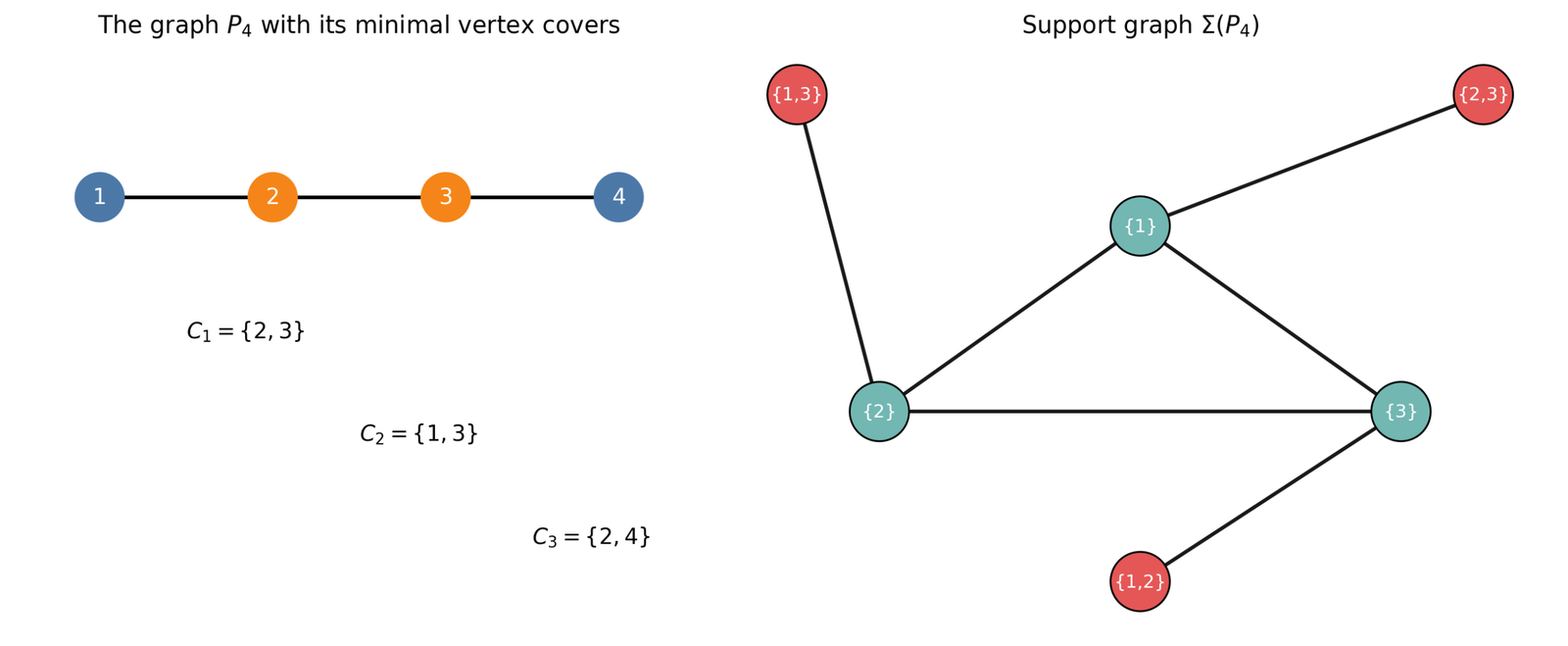
Example 2.11. Let \(G=P_4\) be the path on four vertices with edges \[E(G)=\{\{x_1,x_2\},\{x_2,x_3\},\{x_3,x_4\}\}.\]
Its minimal vertex covers are \[C_1=\{x_2,x_3\},\qquad C_2=\{x_1,x_3\},\qquad C_3=\{x_2,x_4\}.\]
Hence the minimal primes of \(R(P_4)\) are \[P_1=\langle x_2,x_3\rangle/I(G),\qquad P_2=\langle x_1,x_3\rangle/I(G),\qquad P_3=\langle x_2,x_4\rangle/I(G).\]
We now justify the support signatures explicitly. Since \(x_1x_4\notin P_1\) but \(x_1x_4\in P_2\) and \(x_1x_4\in P_3\) , one has \[\sigma(x_1x_4)=\{1\}.\]
Similarly, \(x_2\in P_1\) , \(x_2\notin P_2\) , and \(x_2\in P_3\) , so \[\sigma(x_2)=\{2\}.\]
Also, \(x_3\in P_1\) , \(x_3\in P_2\) , and \(x_3\notin P_3\) , so \[\sigma(x_3)=\{3\}.\]
For the two-element supports, \(x_4\notin P_1\) , \(x_4\notin P_2\) , and \(x_4\in P_3\) , whence \[\sigma(x_4)=\{1,2\}.\]
Likewise, \(x_1\notin P_1\) , \(x_1\in P_2\) , and \(x_1\notin P_3\) , whence \[\sigma(x_1)=\{1,3\}.\]
Finally, \(x_2+x_3\in P_1\) , while \(x_2+x_3\notin P_2\) and \(x_2+x_3\notin P_3\) , so \[\sigma(x_2+x_3)=\{2,3\}.\]
Therefore, \[\mathcal{F}_{P_4} = \big\{ \{1\},\{2\},\{3\},\{1,2\},\{1,3\},\{2,3\} \big\},\] which is exactly the family of all nonempty proper subsets of \([3]\) . Thus the support graph \(\Sigma(P_4)\) is the disjointness graph on all nonempty proper subsets of \([3]\) .
Example 2.12. Let \(G=K_{1,r}\) be the star graph with center \(x_1\) and leaves \(x_2,\dots,x_{r+1}\) . Then the minimal vertex covers are \[C_1=\{x_1\},\qquad C_2=\{x_2,\dots,x_{r+1}\}.\]
Hence \(m=2\) , and the only possible nonempty proper subsets of \([2]\) are \(\{1\}\) and \(\{2\}\) . By Lemma 2.9 , both occur, so \[\mathcal{F}_G=\big\{\{1\},\{2\}\big\}.\]
Consequently, the support graph \(\Sigma(G)\) has exactly two vertices joined by one edge. This example already suggests that graphs having exactly two minimal vertex covers display a particularly rigid support structure.
The next sections will show that this support framework determines adjacency in the zero-divisor graph, produces a blow-up model for \(\Gamma(R(G))\) , identifies the twin classes of the graph, and isolates the finite symmetry quotient that controls the automorphism structure.
The main idea of this subsection is that the zero-divisor graph of the edge-ideal quotient ring admits finite combinatorial control through support signatures. The first result is the basic algebraic mechanism behind the construction. It shows that, in the reduced ring \(R(G)\) , adjacency in \(\Gamma(R(G))\) is governed entirely by disjointness of supports with respect to the minimal-prime system.
Theorem 3.1. Let \(x,y\in Z(R(G))^\ast\) . Then \(x\sim y\) in \(\Gamma(R(G))\) if and only if \[\sigma(x)\cap \sigma(y)=\emptyset.\]
Moreover, for every \(z\in R(G)\) , one has \[z=0\Longleftrightarrow \sigma(z)=\emptyset,\] and, for \(z\neq 0\) , \[z\in Z(R(G))^\ast \Longleftrightarrow \emptyset\neq \sigma(z)\subsetneq [m].\]
Proof. This is the specialization of Proposition 2.6 and Proposition 2.5 to the reduced ring \(R(G)\) , whose minimal primes are \(P_1,\dots,P_m\) by Proposition 2.1 . For completeness, we recall the argument.
Assume first that \(\sigma(x)\cap \sigma(y)=\emptyset\) . Fix an index \(i\in [m]\) . If \(i\in \sigma(x)\) , then \(x\notin P_i\) , and since the supports are disjoint, one has \(i\notin \sigma(y)\) . Hence \(y\in P_i\) . If \(i\notin \sigma(x)\) , then \(x\in P_i\) . Thus, for every \(i\in [m]\) , at least one of \(x\) and \(y\) belongs to \(P_i\) . Since \(P_i\) is an ideal, it follows that \(xy\in P_i\) for every \(i\in [m]\) . Therefore \[xy\in \bigcap_{i=1}^m P_i=(0),\] by Corollary 2.2 . Hence \(xy=0\) , and so \(x\) and \(y\) are adjacent in \(\Gamma(R(G))\) .
Conversely, assume that \(x\sim y\) in \(\Gamma(R(G))\) , so that \(xy=0\) . Suppose, for contradiction, that \(\sigma(x)\cap \sigma(y)\neq \emptyset\) . Choose \(i\in \sigma(x)\cap \sigma(y)\) . Then \(x\notin P_i\) and \(y\notin P_i\) . Since \(P_i\) is prime, this implies \(xy\notin P_i\) , which contradicts \(xy=0\in P_i\) . Therefore \(\sigma(x)\cap \sigma(y)=\emptyset\) .
The remaining assertions follow from Lemma 2.8 . \(\square\)
Theorem 3.1 shows that the graph \(\Gamma(R(G))\) can be partitioned into support classes whose interaction is completely uniform. In particular, vertices with the same support signature behave identically with respect to adjacency.
Corollary 3.2. Let \(S,T\in \mathcal{F}_G\) . If \(x,y\in \mathcal{Z}_S\) with \(x\neq y\) , then \(x\) and \(y\) are nonadjacent in \(\Gamma(R(G))\) . If \(x\in \mathcal{Z}_S\) and \(y\in \mathcal{Z}_T\) , then \(x\sim y\) if and only if \(S\cap T=\emptyset\) . Consequently, each support class \(\mathcal{Z}_S\) is an independent set, and for distinct support classes \(\mathcal{Z}_S\) and \(\mathcal{Z}_T\) the induced bipartite subgraph between them is complete if and only if \(S\cap T=\emptyset\) .
Proof. Let \(x,y\in \mathcal{Z}_S\) with \(x\neq y\) . Then \(\sigma(x)=\sigma(y)=S\) . Since \(S\neq \emptyset\) , one has \[\sigma(x)\cap \sigma(y)=S\neq \emptyset.\]
Hence Theorem 3.1 implies that \(x\) and \(y\) are nonadjacent. This proves that \(\mathcal{Z}_S\) is an independent set.
Now let \(x\in \mathcal{Z}_S\) and \(y\in \mathcal{Z}_T\) . Then \(\sigma(x)=S\) and \(\sigma(y)=T\) . Therefore Theorem 3.1 gives \[x\sim y \Longleftrightarrow \sigma(x)\cap \sigma(y)=\emptyset \Longleftrightarrow S\cap T=\emptyset.\]
Since this condition depends only on \(S\) and \(T\) , the bipartite graph between \(\mathcal{Z}_S\) and \(\mathcal{Z}_T\) is either complete or empty, according as \(S\cap T=\emptyset\) or not. \(\square\)
The preceding corollary shows that \(\Gamma(R(G))\) is assembled from independent support classes whose mutual adjacency pattern is encoded by the finite graph \(\Sigma(G)\) . This yields the first global structural description of the zero-divisor graph.
Theorem 3.3. Let \(G\) be a finite simple graph with support family \(\mathcal{F}_G\) . Then \[\Gamma(R(G))\cong \Sigma(G)\big[\mathcal{Z}_S:S\in \mathcal{F}_G\big],\] that is, the zero-divisor graph of the edge-ideal quotient ring is the blow-up of the support graph obtained by replacing each vertex \(S\) of \(\Sigma(G)\) by the independent set \(\mathcal{Z}_S\) .
Proof. By Theorem 3.1 , every nonzero zero-divisor \(z\in R(G)\) has a well-defined support signature \(\sigma(z)\) , and this support signature is a nonempty proper subset of \([m]\) . Hence \[Z(R(G))^\ast=\bigsqcup_{S\in \mathcal{F}_G}\mathcal{Z}_S,\] where the union is disjoint because each vertex has exactly one support signature.
Next, Corollary 3.2 shows that each class \(\mathcal{Z}_S\) is independent, and that for distinct support sets \(S,T\in \mathcal{F}_G\) the adjacency relation between \(\mathcal{Z}_S\) and \(\mathcal{Z}_T\) is complete if and only if \(S\cap T=\emptyset\) . But this is exactly the edge condition in the support graph \(\Sigma(G)\) .
Therefore the entire graph \(\Gamma(R(G))\) is obtained from \(\Sigma(G)\) by replacing every support vertex \(S\) with the independent fiber \(\mathcal{Z}_S\) and joining two fibers completely whenever the corresponding support vertices are adjacent in \(\Sigma(G)\) . This is precisely the definition of the blow-up \(\Sigma(G)\big[\mathcal{Z}_S:S\in \mathcal{F}_G\big]\) . Hence the stated isomorphism follows. \(\square\)
The blow-up model converts many questions about \(\Gamma(R(G))\) into questions about the finite graph \(\Sigma(G)\) . The next proposition gives the precise distance comparison. The statement is written in a form that also covers the possibility that every support class has exactly one vertex.
Proposition 3.4. Assume that \(m\geq 2\) and that \(\Gamma(R(G))\) is nonempty. Then \[\operatorname{diam}(\Gamma(R(G))) = \max\Big( \operatorname{diam}(\Sigma(G)), \{\,2:\ |\mathcal{Z}_S|\geq 2\ \text{for some}\ S\in\mathcal{F}_G\,\} \Big),\] where the second entry is omitted if no support class has cardinality at least \(2\) . Moreover, \[\operatorname{diam}(\Sigma(G))\leq 3.\]
In particular, if at least one support class has at least two vertices, then \[\operatorname{diam}(\Gamma(R(G)))=\max\{2,\operatorname{diam}(\Sigma(G))\}.\]
Proof. Let \(x,y\in Z(R(G))^\ast\) , and write \(\sigma(x)=S\) and \(\sigma(y)=T\) with \(S,T\in \mathcal{F}_G\) .
We first treat the case \(S\neq T\) . Any path in \(\Gamma(R(G))\) joining \(x\) and \(y\) projects, by recording support signatures of its vertices, to a walk in \(\Sigma(G)\) joining \(S\) and \(T\) . After deleting repeated consecutive vertices, one obtains a path in \(\Sigma(G)\) , and therefore \[d_{\Sigma(G)}(S,T)\leq d_{\Gamma(R(G))}(x,y).\]
Conversely, let \[S=S_0\sim S_1\sim \cdots \sim S_r=T,\] be a shortest path in \(\Sigma(G)\) . Since each \(S_j\) belongs to \(\mathcal{F}_G\) , one may choose \(z_j\in \mathcal{Z}_{S_j}\) . Choose \(z_0=x\) and \(z_r=y\) . Because consecutive supports are adjacent in \(\Sigma(G)\) , they are disjoint, and thus Theorem 3.1 shows that \[z_0\sim z_1\sim \cdots \sim z_r,\] is a path in \(\Gamma(R(G))\) . Hence \[d_{\Gamma(R(G))}(x,y)\leq r=d_{\Sigma(G)}(S,T).\]
Combining the two inequalities yields \[d_{\Gamma(R(G))}(x,y)=d_{\Sigma(G)}(S,T),\] whenever \(S\neq T\) .
Now consider the case \(S=T\) . This case occurs only when \(x\) and \(y\) are distinct vertices in the same support class, so it is relevant exactly for support classes of cardinality at least \(2\) . Since \(S\) is a proper subset of \([m]\) , there exists \(i\in [m]\setminus S\) . By Lemma 2.9 , \(\mathcal{Z}_{\{i\}}\) is nonempty. Choose \(u_i\in \mathcal{Z}_{\{i\}}\) . Then \[\{i\}\cap S=\emptyset,\] so Theorem 3.1 gives \[x\sim u_i \quad \text{and} \quad u_i\sim y.\]
On the other hand, Corollary 3.2 shows that two distinct vertices in the same support class are nonadjacent. Therefore, for distinct \(x,y\in \mathcal{Z}_S\) , one has \[d_{\Gamma(R(G))}(x,y)=2.\]
Thus the distances in \(\Gamma(R(G))\) are exactly the distances in \(\Sigma(G)\) for vertices lying in different support classes, together with the additional distance \(2\) contributed by pairs of distinct vertices lying inside a common support class. This proves the stated formula for \(\operatorname{diam}(\Gamma(R(G)))\) .
It remains to prove the bound for \(\Sigma(G)\) . Let \(S,T\in \mathcal{F}_G\) be arbitrary.
If \(S\cap T=\emptyset\) , then \(S\) and \(T\) are adjacent in \(\Sigma(G)\) , so \[d_{\Sigma(G)}(S,T)=1.\]
Assume next that \(S\cap T\neq\emptyset\) and \(S\cup T\neq [m]\) . Choose \[i\in [m]\setminus (S\cup T).\]
Then \(\{i\}\in \mathcal{F}_G\) by Lemma 2.9 , and \[\{i\}\cap S=\emptyset=\{i\}\cap T.\]
Hence \[S\sim \{i\}\sim T,\] so \(d_{\Sigma(G)}(S,T)\leq 2\) .
Finally, assume that \(S\cap T\neq\emptyset\) and \(S\cup T=[m]\) . If \(S=T\) , then the distance is \(0\) . Suppose \(S\neq T\) . Since both sets are proper and distinct, there exist indices \[i\in S\setminus T \qquad\text{and}\qquad j\in T\setminus S.\]
Then \(j\notin S\) , \(i\notin T\) , and \[\{i\}\cap \{j\}=\emptyset.\]
Lemma 2.9 ensures that both singleton supports belong to \(\mathcal{F}_G\) . Therefore \[S\sim \{j\}\sim \{i\}\sim T,\] which shows that \(d_{\Sigma(G)}(S,T)\leq 3\) .
Since these are all possible cases, one concludes that \[\operatorname{diam}(\Sigma(G))\leq 3.\] \(\square\)
Proposition 3.4 shows that the support quotient retains the long-range distance information of the zero-divisor graph, with the only additional contribution coming from pairs of distinct vertices inside a common support class. In particular, extremal diameter behavior of \(\Gamma(R(G))\) is already visible at the level of the finite support graph, up to this internal-class distance \(2\) .
The support quotient also yields a proof of the girth behavior for edge-ideal quotient rings, but the precise statement must keep track of the cardinalities of the two support classes in the case \(m=2\) .
Theorem 3.5. Let \(m\) be the number of minimal vertex covers of \(G\) , and assume that \(m\geq 2\) . Then the following statements hold.
(a) If \(m\geq 3\) , then \[\operatorname{girth}(\Gamma(R(G)))=3.\]
(b) If \(m=2\) , then \[\Gamma(R(G))\cong K_{|\mathcal{Z}_{\{1\}}|,\ |\mathcal{Z}_{\{2\}}|}.\]
Consequently, \[\operatorname{girth}(\Gamma(R(G)))=4,\] if and only if \[|\mathcal{Z}_{\{1\}}|\geq 2 \quad\text{and}\quad |\mathcal{Z}_{\{2\}}|\geq 2.\]
In particular, if \(K\) is infinite and \(m=2\) , then \[\operatorname{girth}(\Gamma(R(G)))=4.\]
Proof. Assume first that \(m\geq 3\) . By Lemma 2.9 , the support family \(\mathcal{F}_G\) contains the singleton sets \(\{1\}\) , \(\{2\}\) , and \(\{3\}\) . These three sets are pairwise disjoint, so they form a triangle in \(\Sigma(G)\) . Choose vertices \[u_1\in \mathcal{Z}_{\{1\}},\qquad u_2\in \mathcal{Z}_{\{2\}},\qquad u_3\in \mathcal{Z}_{\{3\}}.\]
By Theorem 3.1 , the disjointness of the three singleton supports gives \[u_1\sim u_2,\qquad u_2\sim u_3,\qquad u_3\sim u_1.\]
Hence \(\Gamma(R(G))\) contains a triangle, and therefore \[\operatorname{girth}(\Gamma(R(G)))=3.\]
Now assume that \(m=2\) . The only nonempty proper subsets of \([2]\) are \(\{1\}\) and \(\{2\}\) . By Lemma 2.9 , \[\mathcal{F}_G=\big\{\{1\},\{2\}\big\}.\]
Moreover, \[\{1\}\cap \{2\}=\emptyset.\]
Thus Corollary 3.2 shows that each of \(\mathcal{Z}_{\{1\}}\) and \(\mathcal{Z}_{\{2\}}\) is an independent set, and every vertex of \(\mathcal{Z}_{\{1\}}\) is adjacent to every vertex of \(\mathcal{Z}_{\{2\}}\) . Hence \[\Gamma(R(G))\cong K_{|\mathcal{Z}_{\{1\}}|,\ |\mathcal{Z}_{\{2\}}|}.\]
A complete bipartite graph \(K_{a,b}\) contains a cycle if and only if \(a\geq 2\) and \(b\geq 2\) , and in that case its shortest cycle has length \(4\) . Therefore, when \(m=2\) , \[\operatorname{girth}(\Gamma(R(G)))=4,\] if and only if \[|\mathcal{Z}_{\{1\}}|\geq 2 \quad\text{and}\quad |\mathcal{Z}_{\{2\}}|\geq 2.\]
Finally, suppose that \(K\) is infinite. If \(a\in \mathcal{Z}_{\{1\}}\) is nonzero, then for every \(\lambda\in K^\times\) , \[\sigma(\lambda a)=\sigma(a)=\{1\}.\]
Distinct nonzero scalars give distinct elements because \(R(G)\) is a \(K\) -vector space and \(a\neq 0\) . Hence \[|\mathcal{Z}_{\{1\}}|\geq |K^\times|\geq 2.\]
The same argument gives \[|\mathcal{Z}_{\{2\}}|\geq 2.\]
Thus, over an infinite field, the case \(m=2\) gives \[\operatorname{girth}(\Gamma(R(G)))=4.\] \(\square\)
Corollary 3.6. Assume that \(K\) is infinite and \(m\geq 2\) . Then \[\operatorname{girth}(\Gamma(R(G)))= \begin{cases} 4, & m=2,\\ 3, & m\geq 3. \end{cases}\]
In particular, over an infinite field, \[\operatorname{girth}(\Gamma(R(G)))=4,\] if and only if \(G\) has exactly two minimal vertex covers.
Example 3.7. Let \(G=K_{1,r}\) with center \(x_1\) and leaves \(x_2,\dots,x_{r+1}\) . Then the minimal vertex covers are \[C_1=\{x_1\},\qquad C_2=\{x_2,\dots,x_{r+1}\}.\]
Hence \(m=2\) and \[\Sigma(G)\cong K_2.\]
If \(K\) is infinite, Corollary 3.6 gives \[\operatorname{girth}(\Gamma(R(G)))=4.\]
Thus every star graph has the same support quotient, and the difference between stars of different sizes is encoded in the internal cardinalities and algebraic structure of the two support classes.
Example 3.8. Let \(G=C_4\) . Its minimal vertex covers are \[C_1=\{x_1,x_3\},\qquad C_2=\{x_2,x_4\}.\]
Again \(m=2\) , so \[\Sigma(G)\cong K_2.\]
If \(K\) is infinite, Corollary 3.6 yields \[\operatorname{girth}(\Gamma(R(G)))=4.\]
In particular, the star graphs and the \(4\) -cycle are indistinguishable at the level of the support quotient: both produce the same two-vertex support graph, even though the underlying graphs are not isomorphic. This illustrates that \(\Sigma(G)\) is a useful quotient, but not a complete invariant of \(G\) .
Example 3.9. For \(G=P_4\) , Example 2.11 shows that \(\mathcal{F}_{P_4}\) is the full family of all nonempty proper subsets of \([3]\) . The vertices \(\{1,2\}\) and \(\{2,3\}\) are not adjacent, and they have no common neighbor in \(\Sigma(P_4)\) . However, they are joined by the path \[\{1,2\}\sim \{3\}\sim \{1\}\sim \{2,3\}.\]
Hence \[\operatorname{diam}(\Sigma(P_4))=3.\]
If \(K\) is infinite, then at least one support class has cardinality at least \(2\) , and Proposition 3.4 gives \[\operatorname{diam}(\Gamma(R(P_4)))=3.\]
Thus the support quotient detects the extremal diameter behavior of the zero-divisor graph in this example.
The support classes are not merely convenient blocks in the blow-up description of \(\Gamma(R(G))\) . They coincide exactly with the twin classes of the zero-divisor graph, and therefore they determine the finite quotient that controls the external support symmetry of the whole graph.
Theorem 3.10. Assume that \(m\geq 2\) . Let \(x,y\in Z(R(G))^\ast\) . Then \(x\) and \(y\) have the same open neighborhood in \(\Gamma(R(G))\) if and only if \[\sigma(x)=\sigma(y).\] Consequently, the support classes \(\mathcal{Z}_S\) are precisely the twin classes of \(\Gamma(R(G))\) .
Proof. Assume first that \(\sigma(x)=\sigma(y)=S\) . Let \(z\in Z(R(G))^\ast\) and write \(\sigma(z)=T\) . By Theorem 3.1 , one has \(x\sim z\) if and only if \(S\cap T=\emptyset.\) The same condition characterizes when \(y\sim z\) , because \(\sigma(y)=S\) as well. Hence \(x\sim z\) if and only if \(y\sim z\) for every vertex \(z\) of \(\Gamma(R(G))\) , and therefore \(N(x)=N(y).\)
Conversely, assume that \(\sigma(x)\neq \sigma(y)\) . Without loss of generality, choose \[i\in \sigma(x)\setminus \sigma(y).\]
By Lemma 2.9 , the class \(\mathcal{Z}_{\{i\}}\) is nonempty, so choose a vertex \[u_i\in \mathcal{Z}_{\{i\}}.\]
Since \(i\notin \sigma(y)\) , the sets \(\sigma(y)\) and \(\{i\}\) are disjoint, and thus Theorem 3.1 yields \(y\sim u_i.\)
On the other hand, since \(i\in \sigma(x)\) , one has \[\sigma(x)\cap \{i\}\neq \emptyset,\] and therefore \(x\nsim u_i.\) Hence \[N(x)\neq N(y).\]
This proves the equivalence and shows that two vertices are twins if and only if they belong to the same support class. \(\square\)
Theorem 3.10 identifies the finite quotient naturally associated with \(\Gamma(R(G))\) .
Corollary 3.11. Assume that \(m\geq 2\) . The quotient of \(\Gamma(R(G))\) by its twin classes is canonically isomorphic to the support graph \(\Sigma(G)\) .
Proof. By Theorem 3.10 , the twin classes of \(\Gamma(R(G))\) are exactly the support classes \(\mathcal{Z}_S\) with \(S\in \mathcal{F}_G\) . These classes therefore form the vertex set of the twin quotient. Two such classes are adjacent in the quotient precisely when every vertex of one class is adjacent to every vertex of the other. By Corollary 3.2 , this occurs exactly when \(S\cap T=\emptyset,\) which is precisely the adjacency relation in \(\Sigma(G)\) . Hence the twin quotient is canonically isomorphic to \(\Sigma(G)\) . \(\square\)
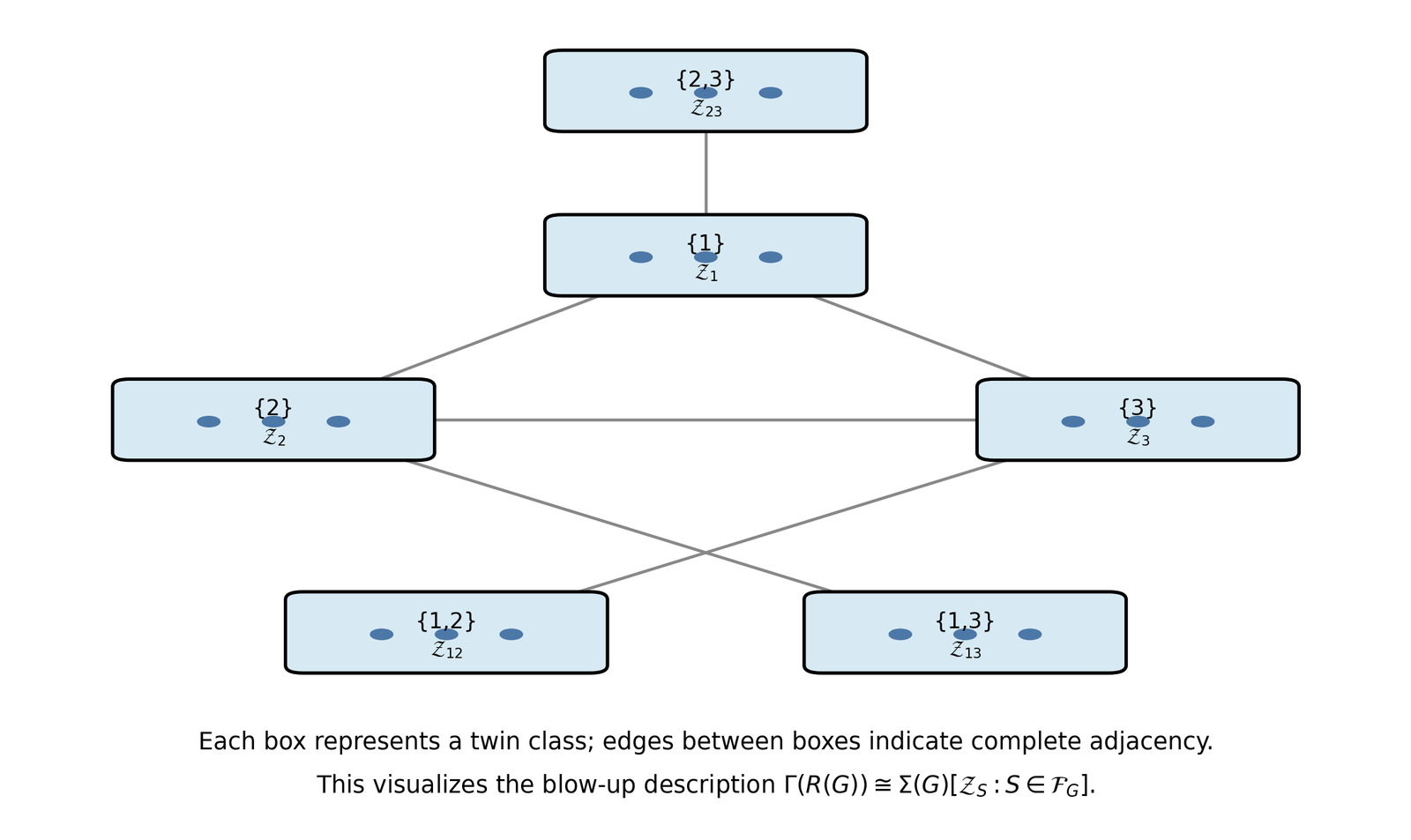
The quotient description is especially useful for automorphisms. Since every graph automorphism preserves open neighborhoods, it must preserve twin classes and hence induce a permutation of the support graph.
Proposition 3.12. Assume that \(m\geq 2\) . There is a natural group homomorphism \[\rho:\operatorname{Aut}(\Gamma(R(G)))\longrightarrow \operatorname{Aut}(\Sigma(G)),\] defined by the rule that \[\rho(\varphi)(S)=T \quad\text{whenever}\quad \varphi(\mathcal{Z}_S)=\mathcal{Z}_T.\]
Proof. Let \(\varphi\in \operatorname{Aut}(\Gamma(R(G)))\) . Since automorphisms preserve open neighborhoods, Theorem 3.10 implies that \(\varphi\) must permute the twin classes, that is, the support classes. Hence for every \(S\in \mathcal{F}_G\) there exists a unique \(T\in \mathcal{F}_G\) such that \[\varphi(\mathcal{Z}_S)=\mathcal{Z}_T.\]
This defines a permutation of \(\mathcal{F}_G\) .
It remains to show that this permutation preserves adjacency in \(\Sigma(G)\) . Let \(S,T\in \mathcal{F}_G\) . Then \(S\) and \(T\) are adjacent in \(\Sigma(G)\) if and only if every vertex of \(\mathcal{Z}_S\) is adjacent to every vertex of \(\mathcal{Z}_T\) , by Corollary 3.2 . Since \(\varphi\) preserves adjacency, the same is true for the image classes \[\mathcal{Z}_{\rho(\varphi)(S)} \quad\text{and}\quad \mathcal{Z}_{\rho(\varphi)(T)}.\]
Therefore \(\rho(\varphi)(S)\) and \(\rho(\varphi)(T)\) are adjacent in \(\Sigma(G)\) . Thus \[\rho(\varphi)\in \operatorname{Aut}(\Sigma(G)).\]
Compatibility with composition is immediate from the definition, so \(\rho\) is a group homomorphism. \(\square\)
Over finite fields, not every automorphism of the support graph need lift to an automorphism of the full zero-divisor graph, because support classes may have different cardinalities. The following formulation records the precise obstruction.
Definition 3.13. Define \[\operatorname{Aut}_{|\mathcal{Z}|}(\Sigma(G)) = \left\{ \beta\in \operatorname{Aut}(\Sigma(G)): |\mathcal{Z}_S|=|\mathcal{Z}_{\beta(S)}|\ \text{for every}\ S\in\mathcal{F}_G \right\}.\]
Proposition 3.14. Assume that \(m\geq 2\) . Then the image of \[\rho:\operatorname{Aut}(\Gamma(R(G)))\longrightarrow \operatorname{Aut}(\Sigma(G)),\] is contained in \(\operatorname{Aut}_{|\mathcal{Z}|}(\Sigma(G))\) . Conversely, every element of \(\operatorname{Aut}_{|\mathcal{Z}|}(\Sigma(G))\) lifts to an automorphism of \(\Gamma(R(G))\) . Hence \[\operatorname{Im}(\rho)=\operatorname{Aut}_{|\mathcal{Z}|}(\Sigma(G)).\]
Proof. If \(\varphi\in\operatorname{Aut}(\Gamma(R(G)))\) and \(\rho(\varphi)(S)=T\) , then \(\varphi\) gives a bijection \[\mathcal{Z}_S\longrightarrow \mathcal{Z}_T.\]
Thus \(|\mathcal{Z}_S|=|\mathcal{Z}_T|\) , and so \(\rho(\varphi)\in\operatorname{Aut}_{|\mathcal{Z}|}(\Sigma(G))\) .
Conversely, let \(\beta\in\operatorname{Aut}_{|\mathcal{Z}|}(\Sigma(G))\) . For each \(S\in\mathcal{F}_G\) , choose a bijection \[\psi_S:\mathcal{Z}_S\longrightarrow \mathcal{Z}_{\beta(S)}.\]
Define \(\widetilde{\beta}:Z(R(G))^\ast\to Z(R(G))^\ast\) by \(\widetilde{\beta}(x)=\psi_S(x)\) whenever \(x\in\mathcal{Z}_S\) . This is a well-defined bijection because the support classes partition \(Z(R(G))^\ast\) . If \(x\in\mathcal{Z}_S\) and \(y\in\mathcal{Z}_T\) , then Corollary 3.2 gives \[x\sim y \Longleftrightarrow S\cap T=\emptyset \Longleftrightarrow \beta(S)\cap \beta(T)=\emptyset \Longleftrightarrow \widetilde{\beta}(x)\sim \widetilde{\beta}(y).\]
Thus \(\widetilde{\beta}\) is a graph automorphism of \(\Gamma(R(G))\) , and \(\rho(\widetilde{\beta})=\beta\) . \(\square\)
The next theorem shows that, over an infinite field, all automorphisms of the support graph lift to automorphisms of the full zero-divisor graph, and the remaining automorphisms are exactly the independent permutations inside each support class.
Theorem 3.15. Assume that \(m\geq 2\) and that \(K\) is infinite. Then \(\operatorname{Aut}(\Gamma(R(G)))\) is noncanonically isomorphic to \[\left(\prod_{S\in \mathcal{F}_G}\operatorname{Sym}(\mathcal{Z}_S)\right)\rtimes \operatorname{Aut}(\Sigma(G)).\]
Proof. We begin by determining the kernel of the homomorphism \(\rho\) from Proposition 3.12 . Let \(\varphi\in \ker \rho\) . Then \[\varphi(\mathcal{Z}_S)=\mathcal{Z}_S,\] for every \(S\in \mathcal{F}_G\) . Since each support class \(\mathcal{Z}_S\) is an independent set and every vertex of \(\mathcal{Z}_S\) has the same adjacency relation with vertices outside \(\mathcal{Z}_S\) , any permutation of \(\mathcal{Z}_S\) extends to a graph automorphism by fixing all other support classes pointwise. Therefore \[\ker \rho=\prod_{S\in \mathcal{F}_G}\operatorname{Sym}(\mathcal{Z}_S).\]
It remains to prove that \(\rho\) is surjective. It is enough to show that all support classes have the same cardinality. Let \(S\in\mathcal{F}_G\) and choose \(0\neq x\in\mathcal{Z}_S\) . If \(\lambda\in K^\times\) , then \[\sigma(\lambda x)=\sigma(x)=S,\] so \(\lambda x\in\mathcal{Z}_S\) . Distinct nonzero scalars give distinct elements because \(R(G)\) is a \(K\) -vector space and \(x\neq 0\) . Hence \[|\mathcal{Z}_S|\geq |K|.\]
Conversely, since \(R(G)\) is a quotient of the polynomial ring \(K[x_1,\dots,x_n]\) in finitely many variables and \(K\) is infinite, \[|R(G)|\leq |K[x_1,\dots,x_n]|=|K|.\]
Thus \[|\mathcal{Z}_S|\leq |R(G)|\leq |K|.\]
Therefore, \[|\mathcal{Z}_S|=|K|,\] for every \(S\in\mathcal{F}_G\) .
Now let \(\beta\in \operatorname{Aut}(\Sigma(G))\) . Since all support classes have cardinality \(|K|\) , for each \(S\in \mathcal{F}_G\) choose a bijection \[\psi_S:\mathcal{Z}_S\to \mathcal{Z}_{\beta(S)}.\]
Define a map \[\widetilde{\beta}:Z(R(G))^\ast\to Z(R(G))^\ast,\] by setting \(\widetilde{\beta}(x)=\psi_S(x)\) whenever \(x\in \mathcal{Z}_S\) . Since the support classes form a partition of \(Z(R(G))^\ast\) , this gives a well-defined bijection.
Now let \(x\in \mathcal{Z}_S\) and \(y\in \mathcal{Z}_T\) . By Corollary 3.2 , one has \[x\sim y \Longleftrightarrow S\cap T=\emptyset.\]
Since \(\beta\) is an automorphism of the disjointness graph \(\Sigma(G)\) , this holds if and only if \[\beta(S)\cap \beta(T)=\emptyset.\]
Applying Corollary 3.2 again, this is equivalent to \(\widetilde{\beta}(x)\sim \widetilde{\beta}(y).\) Thus \(\widetilde{\beta}\) is a graph automorphism of \(\Gamma(R(G))\) .
By construction, \(\widetilde{\beta}\) maps each class \(\mathcal{Z}_S\) onto \(\mathcal{Z}_{\beta(S)}\) , so \(\rho(\widetilde{\beta})=\beta.\) Hence \(\rho\) is surjective. Therefore the short exact sequence \[1\longrightarrow \prod_{S\in \mathcal{F}_G}\operatorname{Sym}(\mathcal{Z}_S) \longrightarrow \operatorname{Aut}(\Gamma(R(G))) \longrightarrow \operatorname{Aut}(\Sigma(G)) \longrightarrow 1,\] splits after choosing bijections between support classes lying over each support-graph automorphism. Since these choices are not canonical in general, the resulting semidirect product isomorphism is noncanonical. Hence \[\operatorname{Aut}(\Gamma(R(G))) \cong \left(\prod_{S\in \mathcal{F}_G}\operatorname{Sym}(\mathcal{Z}_S)\right)\rtimes \operatorname{Aut}(\Sigma(G)).\] \(\square\)
By Proposition 2.10 , the support graph contains all nonempty proper subsets of the minimal-prime index set whenever \(m\geq 2\) . Thus the full disjointness graph appears automatically in the present setting.
Definition 3.16. The graph \(G\) is called support-saturated if \[\mathcal{F}_G=\{\,S\subset [m]: \emptyset\neq S\neq [m]\,\}.\]
In this case, the support graph will be denoted by \(\mathbb{D}_m\) , the full disjointness graph on all nonempty proper subsets of \([m]\) .
Theorem 3.17. Assume that \(G\) is support-saturated and has \(m\geq 2\) minimal vertex covers. Then \[\operatorname{Aut}(\Sigma(G))\cong S_m.\]
Consequently, if \(K\) is infinite, then \[\operatorname{Aut}(\Gamma(R(G)))\cong \left(\prod_{\emptyset\neq S\subsetneq [m]}\operatorname{Sym}(\mathcal{Z}_S)\right)\rtimes S_m.\]
Proof. Assume that \(G\) is support-saturated. Then \[\mathcal{F}_G=\{\,S\subset [m]:\emptyset\neq S\neq [m]\,\},\] so the vertex set of \(\Sigma(G)\) consists of all nonempty proper subsets of \([m]\) .
We first consider the case \(m=2\) . Then the only vertices of \(\Sigma(G)\) are \(\{1\}\) and \(\{2\}\) , and they are adjacent because \[\{1\}\cap \{2\}=\emptyset.\]
Hence \[\Sigma(G)\cong K_2,\] and therefore \[\operatorname{Aut}(\Sigma(G))\cong S_2.\]
Now assume that \(m\geq 3\) . For a nonempty proper subset \(S\subset [m]\) , the neighbors of \(S\) in \(\Sigma(G)\) are precisely the nonempty subsets of \([m]\setminus S\) . Hence \[\deg(S)=2^{m-|S|}-1.\]
This degree is maximal exactly when \(|S|=1\) . Therefore the singleton subsets \(\{1\},\dots,\{m\}\) are exactly the vertices of maximum degree. It follows that every automorphism of \(\Sigma(G)\) preserves the set of singleton vertices and hence induces a permutation \(\pi\in S_m.\)
Let \(\beta\in \operatorname{Aut}(\Sigma(G))\) , and let \(\pi\) be the induced permutation on singleton vertices, so that \[\beta(\{i\})=\{\pi(i)\} \qquad (1\leq i\leq m).\]
We claim that \[\beta(S)=\pi(S),\] for every nonempty proper subset \(S\subset [m]\) . Indeed, the singleton neighbors of \(S\) are exactly the vertices \[\{j\}\quad \text{with}\quad j\notin S.\]
Since \(\beta\) preserves adjacency and sends \(\{j\}\) to \(\{\pi(j)\}\) , the singleton neighbors of \(\beta(S)\) are precisely \[\{\pi(j)\}\quad \text{with}\quad j\notin S.\]
Thus \[[m]\setminus \beta(S)=\pi([m]\setminus S),\] and hence \[\beta(S)=\pi(S).\]
Therefore every automorphism of \(\Sigma(G)\) is uniquely determined by its action on the singleton vertices. This gives an injective homomorphism \[\operatorname{Aut}(\Sigma(G))\hookrightarrow S_m.\]
Conversely, every permutation \(\pi\in S_m\) induces an automorphism of \(\Sigma(G)\) by \[S\longmapsto \pi(S),\] because disjointness of subsets is preserved under relabeling. Hence the above map is also surjective, and therefore \[\operatorname{Aut}(\Sigma(G))\cong S_m.\]
The final statement follows from Theorem 3.15 . Since \(G\) is support-saturated, \[\mathcal{F}_G=\{\,S\subset [m]:\emptyset\neq S\neq [m]\,\},\] and the external automorphism group is \(S_m\) . Hence, for infinite \(K\) , \[\operatorname{Aut}(\Gamma(R(G)))\cong \left(\prod_{\emptyset\neq S\subsetneq [m]}\operatorname{Sym}(\mathcal{Z}_S)\right)\rtimes S_m.\] \(\square\)
Remark 3.18. By Proposition 2.10 , the support-saturation condition holds automatically in the present edge-ideal quotient setting whenever \(m\geq 2\) . Thus Theorem 3.17 applies to every nontrivial case considered here. The formulation in terms of support saturation is retained only to emphasize the role of the full disjointness graph on the nonempty proper subsets of \([m]\) .
Example 3.19. For \(G=P_4\) , Example 2.11 shows that \(G\) is support-saturated with \(m=3\) . Hence \[\operatorname{Aut}(\Sigma(P_4))\cong S_3.\]
If \(K\) is infinite, Theorem 3.17 yields \[\operatorname{Aut}(\Gamma(R(P_4)))\cong \left(\prod_{\emptyset\neq S\subsetneq [3]}\operatorname{Sym}(\mathcal{Z}_S)\right)\rtimes S_3.\]
Thus all external support symmetry comes from permuting the three minimal vertex covers, while the internal symmetry is given by arbitrary permutations within each support class.
Example 3.20. For a star graph \(K_{1,r}\) , one has \(\Sigma(G)\cong K_2,\)
so \[\operatorname{Aut}(\Sigma(G))\cong S_2\cong C_2.\]
Therefore, over an infinite field, \[\operatorname{Aut}(\Gamma(R(G)))\cong \big(\operatorname{Sym}(\mathcal{Z}_{\{1\}}) \times \operatorname{Sym}(\mathcal{Z}_{\{2\}})\big)\rtimes C_2.\]
The support quotient has only one nontrivial external symmetry, namely the transposition of the two minimal-prime supports.
Example 3.21. By Proposition 2.10 , when \(m\geq 2\) the support graph \(\Sigma(G)\) is the full disjointness graph on all nonempty proper subsets of \([m]\) . Hence Theorem 3.17 gives \[\operatorname{Aut}(\Sigma(G))\cong S_m.\]
Therefore, in the present edge-ideal quotient setting, the external support symmetry is exactly the relabeling symmetry of the \(m\) minimal vertex covers. When \(K\) is infinite, Theorem 3.15 shows that every automorphism of \(\Gamma(R(G))\) is obtained by combining these external permutations with arbitrary internal permutations inside the support classes. Thus the study of the external symmetry of \(\Gamma(R(G))\) reduces to the finite quotient \(\Sigma(G)\) , while the internal symmetry is carried by the classes \(\mathcal{Z}_S\) .
The zero-divisor graph of an edge-ideal quotient ring admits a useful support-theoretic decomposition once the minimal-prime system is encoded through support signatures. This decomposition replaces the full graph \(\Gamma(R(G))\) by the finite disjointness graph \(\Sigma(G)\) together with its support classes, and it expresses the zero-divisor graph as a blow-up of this support quotient. As a consequence, the twin relation, the quotient graph, the diameter description, the girth behavior under the stated hypotheses, and the automorphism structure over infinite fields can be studied through the support graph. The main conceptual message is that minimal vertex covers do not merely control numerical invariants such as clique number and chromatic number; they also determine a natural finite quotient that records the minimal-prime support pattern of zero-divisors.
At the same time, \(\Sigma(G)\) should not be viewed as a complete invariant of \(G\) or of the edge-ideal quotient ring \(R(G)\) . The examples of star graphs and \(C_4\) show that nonisomorphic graphs may have the same support quotient. Thus the support graph is best understood as a compressed object that preserves the support-level adjacency and external twin-class symmetry, while omitting the internal algebraic information contained inside the support classes.
Several natural questions remain open. Since Proposition 2.10 shows that the support family is full whenever \(m\geq 2\) , the next problem is not to determine which support families occur, but rather to understand the internal algebraic structure and cardinalities of the support classes \(\mathcal{Z}_S\) . It would also be useful to develop effective criteria or algorithms for describing these support classes from the minimal vertex covers of \(G\) , and to understand more precisely how finite-field phenomena affect the automorphism group through the cardinalities of the support classes. These questions suggest that the support-signature approach may serve as a useful bridge between the combinatorics of edge ideals and the quotient-based symmetry theory of ring-based graphs.