
A \(t\)–\((v,k,\lambda)\) design \(\cal D\) is a finite incidence structure \((\mathcal{P}, \mathcal{B})\) consisting of a set \(\cal P\) of \(v\) points and a set \(\cal B\) of blocks. Every block is incident with \(k\) points, every point is incident with \(r\) blocks, and any \(t\) distinct points are incident with \(\lambda\) blocks. The number of blocks is conventionally denoted \(b\) and the parameters of such a design \(\cal D\) are \(v, b, r, k, \lambda\), but, since \(b\) and \(r\) may easily be determined from \(v, k\) and \(\lambda\), it is conventional to speak of a \(t\)–\((v,k,\lambda)\) design. We assume all parameters are positive integers. If \(\mathcal{B}\) contains all \(k\)-subsets of \(\mathcal{P}\), the design \(\cal D\) is called complete. \(\cal D\) is non-trivial if \(t < k < v\). In particular, when \(\lambda = 1\), \(\cal D\) is called a Steiner \(t\)-design. In this paper, we always assume that \(\cal D\) is a non-trivial \(t\)-design with \(t\ge2\).
The full automorphism group of \(\cal D\), denoted \(\text{Aut}(\cal D)\), consists of all permutations of \(\mathcal{P}\) that preserve \(\mathcal{B}\). If \(G \leq \text{Aut}(\cal D)\) acts transitively (or primitively) on \(\mathcal{P}\), \(G\) or \(\cal D\) is called point-transitive (or point-primitive). Similarly, \(G\) or \(\cal D\) is block-transitive (or flag-transitive) if it acts transitively on \(\mathcal{B}\) (or on the flag set). Here a flag is a point-block pair \((\alpha, B)\) with \(\alpha \in B\). If \(G\) induces a permutation on ordered (or unordered) \(s\)-tuples of \(\mathcal{P}\), it is called \(s\)-transitive (or \(s\)-homogeneous). A base block set \(X\) contains exactly one block from each orbit of \(G\) acting on \(\mathcal{B}\). If \(G\) is block-transitive (or flag-transitive), any block can serve as a base block.
The study of flag-transitive Steiner \(t\)-designs has seen substantial advances over the past several decades. A foundational result by Higman and McLaughlin [14] established that any flag-transitive automorphism group of a Steiner \(2\)-design must be point-primitive. Building on this, Delandtsheer et al. [8] achieved a complete classification of flag-transitive Steiner \(2\)-design by leveraging the O’Nan-Scott theorem and the classification of finite simple groups. Further progress was made by Cameron and Praeger [4], who demonstrated that for a group \(G \leq \text{Aut}(\cal D)\) acting flag-transitively on a \(t\)-design, the parameter \(t\le 6\). This line of research culminated in the work of Huber [16], who provided a full classification of flag-transitive Steiner \(t\)-designs by employing the classification of finite \(2\)-transitive and \(3\)-homogeneous permutation groups (see Proposition 1.2).
In contrast, when the symmetry condition is relaxed from flag-transitivity to block-transitivity, the classification problem becomes markedly more intricate. Early work by Block [1] revealed that any block-transitive automorphism group must necessarily be point-transitive (Lemma 2.3). Delandtsheer [9] further observed that most block-transitive automorphism groups of \(t\)-designs are point-primitive.
Focusing on the case \(t=2\), Camina [5] established that the socle of a block-transitive, point-primitive Steiner \(2\)-design is either an elementary abelian group or a non-abelian simple group, that is, \(G\) is of affine or almost simple type. Additionally, Camina and Spiezia [6] proved that the socle cannot belong to the class of sporadic simple groups. More recently, Zhang [25] completed the classification of block-transitive, point-primitive \(2\)-designs with \(\lambda\le10\) and sporadic socle, yielding the following result:
Proposition 1.1. Let \(\mathcal {D} = (\mathcal{P}, \mathcal{B})\) be a \(2\)–\((v, k, \lambda)\) design with \(\lambda \leq 10\), and let \(G \leq \mathrm{Aut}(\cal D)\) act block-transitively and point-primitively on \(\cal D\). If \(\mathrm{Soc}(G)\) is a sporadic simple group, then \((\mathcal {D}, G)\) is one of the following:
(i) The parameters of \(\mathcal {D}\) are \((11, 3, 9)\), \((12, 6, 5)\), \((12, 3, 10)\), \((55, 3, 4)\), \((55, 3, 8)\), \((55, 4, 8)\), \((55, 9, 8)\), or \((55, 6, 10)\), and \(G \cong M_{11}\);
(ii) The parameters of \(\mathcal {D}\) are \((12, 3, 10)\), and \(G \cong M_{12}\);
(iii) The parameters of \(\mathcal {D}\) are \((22, 6, 5)\), \((176, 5, 4)\), or \((176, 16, 9)\), and \(G \cong M_{22}\);
(iv) The parameters of \(\mathcal {D}\) are \((22, 6, 5)\), and \(G \cong M_{22} : 2\);
(v) The parameters of \(\mathcal {D}\) are \((176, 8, 2)\), and \(G\cong HS\).
For the case \(t > 2\), significant progress has been made in classifying block-transitive Steiner \(t\)-designs. Gan [13] first applied the O’Nan-Scott theorem to demonstrate that the automorphism groups of block-transitive, point-primitive Steiner \(3\)-designs must be either of affine type or almost simple type. This key reduction paved the way for Lan [20], who subsequently achieved a complete classification when the socle is an alternating group \(A_n\). Further advancements were made by Zhan [24], who systematically investigated block-transitive \(3\)-designs with small block sizes, establishing a complete classification for \(k = 6\) in the point-imprimitive case. Fundamental limitations on the parameter \(t\) were revealed by Huber [17], who proved that no block-transitive Steiner \(t\)-designs exist for \(t > 7\), and for \(t = 6\), the automorphism group must necessarily be \(\text{P}\Gamma\text{L}(2, p^e)\) with \(p = 2\) or \(3\). These results were complemented by Cameron and Praeger [4], who showed that no block-transitive \(t\)-design with a sporadic socle can exist when \(t > 5\).
Most recently, Pang and Zhan [21] completed this line of research by classifying all block-transitive Steiner \(t\)-designs \(\mathcal{D}\) with sporadic groups \(G\). Their work conclusively established that \(G\) must act flag-transitively, and \(\mathcal{D}\) must belong to one of the exceptional cases listed below:
Proposition 1.2. Let \(\cal D = (\mathcal{P}, \mathcal{B})\) be a non-trivial Steiner \(t\)-design \((t \geq 2)\). If \(G \leq \mathrm{Aut}(\cal D)\) acts block-transitively on \(\cal D\) and \(\mathrm{Soc}(G)\) is a sporadic simple group, then \(({\cal D},G)\) is one of the following:
(i) \(\cal D\) is the unique \(3\)–\((22,6,1)\) design, and \(G\cong M_{22}\) or \(M_{22}:2\);
(ii) \(\cal D\) is the unique \(4\)–\((11,5,1)\) design, and \(G\cong M_{11}\);
(iii) \(\cal D\) is the unique \(4\)–\((23,7,1)\) design, and \(G\cong M_{23}\);
(iv) \(\cal D\) is the unique \(5\)–\((12,6,1)\) design, and \(G\cong M_{12}\);
(v) \(\cal D\) is the unique \(5\)–\((24,8,1)\) design, and \(G\cong M_{24}\).
Building upon these foundational results, this paper further investigates the classification of block-transitive, point-primitive \(t\)–\((v, k, \lambda)\) designs, with the following new contributions.
Theorem 1.3. Let \(\cal D = (\mathcal{P}, \mathcal{B})\) be a non-trivial \(t\)–\((v,k,\lambda)\) design with \(\lambda \leq 5\), and let \(G \leq \mathrm{Aut}(\cal D)\) be a block-transitive point-primitive group. If \(\mathrm{Soc}(G)\) is a sporadic simple group, then one of the following holds:
(1) If \(t=2\), then \(({\cal D}, G)\) corresponds to one of the cases \((\lambda\leq5)\) in Proposition 1.1.
(2) If \(t=3\), then \(({\cal D}, G)\) is one of the following:
(2.1) \(\cal D\) has parameters \((11,5,4)\), \((12,6,2)\) or \((12,4,3)\), and \(G\cong M_{11}\);
(2.2) \(\cal D\) has parameters \((22,4,3)\), \((22,5,3)\) or \((22,6,1)\), and \(G\cong M_{22}\) or \(M_{22}:2\);
(2.3) \(\cal D\) has parameters \((22,7,4)\), and \(G\cong M_{22}\);
(2.4) \(\cal D\) has parameters \((23,7,5)\), and \(G\cong M_{23}\).
(3) If \(t=4\), then \(({\cal D}, G)\) is one of the following:
(3.1) \(\cal D\) has parameters \((11,5,1)\), \((11,6,3)\) or \((12,6,4)\), and \(G\cong M_{11}\);
(3.2) \(\cal D\) has parameters \((23,5,3)\), \((23,6,3)\), \((23,7,1)\) or \((23,8,4)\), and \(G\cong M_{23}\);
(3.3) \(\cal D\) has parameters \((24,8,5)\), and \(G\cong M_{24}\).
(4) If \(t=5\), then \(({\cal D}, G)\) is one of the following:
(4.1) \(\cal D\) has parameters \((12,6,1)\), and \(G\cong M_{12}\);
(4.2) \(\cal D\) has parameters \((24,7,3)\), \((24,6,3)\) or \((24,8,1)\), and \(G\cong M_{24}\).
Remark 1.4. (i) Up to isomorphism, all designs described in Theorem
1.3
are unique. The base blocks of these designs and their corresponding
automorphism groups \(G\) are
completely listed in Tables 1-3. In particular,
the group \(G\) can be constructed
using the Magma command PrimitiveGroup(v,n)
[2], where the values
\(n\) and \(v\) are obtained from the third and fourth
columns of Tables 1-3,
respectively.
(ii) All designs listed in Theorem 1.3 are flag-transitive, except for the following two block-transitive but not flag-transitive designs:
The \(2\)–\((55,3,4)\) design with \(G\cong M_{11}\);
The \(2\)–\((176,5,4)\) design with \(G\cong M_{22}\).
| Case | \(G\) | \(n\) | \((v, b, r, k, \lambda)\) | Base block | Ref. |
|---|---|---|---|---|---|
| 1 | \(M_{11}\) | \(3\) | \([12, 22, 11, 6, 2]\) | \(\{1, 3, 7, 8, 9, 12\}\) | Lemma 3.6 |
| 2 | \(3\) | \([12, 165, 55, 4, 3]\) | \(\{ 1, 4, 7, 11 \}\) | Lemma 3.6 | |
| 3 | \(6\) | \([11, 165, 60, 4, 4]\) | Lemma 3.4 | ||
| 4 | \(6\) | \([11, 66, 30, 5, 4]\) | \(\{ 1, 2, 4, 5, 8 \}\) | Lemma 3.6 | |
| 5 | \(6\) | \([11, 33, 18, 6, 4]\) | Lemma 3.5 | ||
| 6 | \(M_{22}\) | \(1\) | \([22, 1155, 210, 4, 3]\) | \(\{1, 5, 7, 13\}\) | Lemma 3.6 |
| 7 | \(1\) | \([22, 462, 105, 5, 3]\) | \(\{1, 5, 14, 16, 17\}\) | Lemma 3.6 | |
| 8 | \(1\) | \([22, 231, 63, 6, 3]\) | Lemma 3.4 | ||
| 9 | \(1\) | \([22, 132, 42, 7, 3]\) | Lemma 3.5 | ||
| 10 | \(1\) | \([22, 1540, 280, 4, 4]\) | Lemma 3.4 | ||
| 11 | \(1\) | \([22, 308, 84, 6, 4]\) | Lemma 3.5 | ||
| 12 | \(1\) | \([22, 176, 56, 7, 4]\) | \(\{2,4,13,14,15,17,18\}\) | Lemma 3.6 | |
| 13 | \(M_{22}:2\) | \(2\) | \([22, 1155, 210, 4, 3]\) | \(\{2, 8, 10, 18\}\) | Lemma 3.6 |
| 14 | \(2\) | \([22, 462, 105, 5, 3]\) | \(\{1, 12, 13, 17, 18\}\) | Lemma 3.6 | |
| 15 | \(2\) | \([22,231, 63, 6, 3]\) | Lemma 3.4 | ||
| 16 | \(2\) | \([22, 132, 42, 7, 3]\) | Lemma 3.5 | ||
| 17 | \(M_{23}\) | \(5\) | \([23, 253, 77, 7, 5]\) | \(\{1, 13, 15, 17, 18, 19, 23\}\) | Lemma 3.6 |
| Case | \(G\) | \(n\) | \((v, b, r, k, \lambda)\) | Base block | Ref. |
|---|---|---|---|---|---|
| 1 | \(M_{11}\) | \(6\) | \([11, 66, 36, 6, 3]\) | \(\{1, 2, 3, 4, 7, 8\}\) | Lemma 3.9 |
| 2 | \(6\) | \([11, 198, 90, 5, 3]\) | Lemma 3.8 | ||
| 3 | \(M_{12}\) | \(4\) | \([12, 396, 165, 5, 4]\) | Lemma 3.8 | |
| 4 | \(4\) | \([12, 132, 66, 6, 4]\) | \(\{1, 2, 4, 8, 10, 11\}\) | Lemma 3.9 | |
| 5 | \(M_{23}\) | \(5\) | \([23, 5313, 1155, 5, 3]\) | \(\{4, 5, 10, 18, 20\}\) | Lemma 3.9 |
| 6 | \(5\) | \([23, 1771, 462, 6, 3]\) | \(\{2, 3, 5, 13, 21, 22\}\) | Lemma 3.9 | |
| 7 | \(5\) | \([23, 759, 231, 7, 3]\) | Lemma 3.9 | ||
| 8 | \(5\) | \([23, 7084, 1540, 5, 4]\) | Lemma 3.9 | ||
| 9 | \(5\) | \([23, 1012, 308, 7, 4]\) | Lemma 3.8 | ||
| 10 | \(5\) | \([23, 506, 176, 8, 4]\) | \(\{2, 4, 9, 14, 15, 18, 20, 21\}\) | Lemma 3.9 | |
| 11 | \(M_{24}\) | \(3\) | \([24, 759, 253, 8, 5]\) | \(\{5, 12, 14, 15, 17, 18, 21, 24\}\) | Lemma 3.9 |
| Case | \(G\) | \(n\) | \((v, b, r, k, \lambda)\) | Base block | Ref. |
|---|---|---|---|---|---|
| 1 | \(M_{24}\) | \(3\) | \([24, 127512, 26565, 5, 3]\) | Lemma 3.11 | |
| 2 | \(3\) | \([24, 21252, 5313, 6, 3]\) | \(\{2, 6, 8, 17, 18, 22\}\) | Lemma 3.12 | |
| 3 | \(3\) | \([24, 6072, 1771, 7, 3]\) | \(\{6, 9, 11, 12, 13, 20, 24\}\) | Lemma 3.12 | |
| 4 | \(3\) | \([24, 2277, 759, 8, 3]\) | Lemma 3.11 |
In this section we collect some basic results that will be used throughout the proof of Theorem 1.3.
Lemma 2.1. [15] Let \(\cal D\) be a \(t\)–\((v,k,\lambda)\) design. Then the parameters satisfy:
(i) \(vr=bk\);
(ii) \(\lambda\dbinom{v}{t}=\dbinom{k}{t} b\);
(iii) \(\lambda_2(v – 1)= r(k – 1) , \text{where } \lambda_2 = \lambda \dbinom{v – 2}{t – 2}/\dbinom{k – 2}{t – 2}\);
(iv) \(b \geq v\) (Fisher’s inequality).
Let \(G_\alpha\) denote the point stabilizer of \(\alpha\) in \(G\) (i.e., the subgroup of \(G\) fixing \(\alpha\)), and let \(G_B\) denote the setwise stabilizer of the block \(B\) in \(G\). We write \(\lfloor t/2 \rfloor\) for the greatest integer less than or equal to \(t/2\) (the floor function).
Lemma 2.2. [12] Let \(G\) be a transitive group \(G\) on point set \(\cal P\) with \(|{\cal P}|>1\). Then \(G\) is primitive if and only if \(G_\alpha\) is a maximal subgroup of \(G\).
The following is well-known Block’s Lemma:
Lemma 2.3. [1] Let \(\cal D\) be a non-trivial \(t\)–\((v, k, \lambda)\) design with \(t\ge2\). If \(G \leq \mathrm{Aut}(D)\) acts block-transitively on \(\cal D\), then \(G\) acts point-transitively on \(\cal D\).
Furthermore, block-transitivity imposes stronger constraints on the action on the point set:
Lemma 2.4. [22] Let \(\cal D = (\mathcal{P}, \mathcal{B})\) be a \(t\)–\((v,k,\lambda)\) design. If \(G \leq \mathrm{Aut}(\cal D)\) acts block-transitively on \(\cal D\), then \(G\) also acts \(\lfloor t/2 \rfloor\)-homogeneously on \(\mathcal{P}\).
Lemma 2.5. [10] Let \(\cal D = (\mathcal{P}, \mathcal{B})\) be a non-trivial \(t\)–\((v, k, \lambda)\) design admitting \(G\) as a block-transitive automorphism group. If \(B \in \mathcal{B}\) then the block size \(k\) can be written as a sum of orbit lengths of \(G_B\) acting on \(\cal P\). In particular, if \(B\) is an orbit of \(G_B\), then \(G\) is flag-transitive.
In light of Proposition 1.2 which provides a complete classification of all block-transitive Steiner \(t\)-designs with sporadic socle, we shall consistently work under the following hypothesis in this paper:
Hypothesis \(\Gamma\): Let \(\mathcal{D}\) be a non-trivial \(t\)–\((v,k,\lambda)\) design with \(1<\lambda\leq5\), and let \(G\) be a block-transitive point-primitive automorphism group of \(\cal D\) with \(\mathrm{Soc}(G)\) (the socle of \(G\)) is a sporadic simple group.
As \(\operatorname{S} \trianglelefteq G \leq \operatorname{Aut}(\operatorname{S})=\operatorname{S}.\operatorname{Out}(S)\), where \(S=\operatorname{Soc}(G)\) is a sporadic simple group. Actually, either \(G = S\) or \(S : 2\) since \(|\operatorname{Out}(S)| = 1\) or \(Z_2\) by ATLAS [7]. Also, \(G\) is block-transitive, \(G\) contains a subgroup \(G_B\) with index \(b\). By Block’s Lemma (Lemma 2.3), \(G\) is point-transitive, and so \(G\) contains a subgroup \(G_\alpha\) with index \(v\). As \(G\) is point-primitive, \(G_\alpha\) must be maximal in \(G\). For all sporadic groups, except the Monster, the complete list of maximal subgroups is given in the ATLAS [7]. Therefore, for each such sporadic group, we can find the possible values for \(|G|\) and \(|G_\alpha|\), consequently, for \(v\). From the non-triviality of the design \(\cal D\), Lemma 2.1 and the block-transitivity of the automorphism group \(G\), we know that the parameters \((v, b, r, k)\) of the design satisfy:
\[ \binom{k-2}{t-2}\mid \lambda\binom{v – 2}{t-2}; \tag{1}\label{ga1}\] \[t < k < v – 2; \tag{2}\label{ga2}\] \[r=\lambda\frac{\binom{v – 1}{t-1}}{\binom{k – 1}{t-1}} \in \mathbb{N}; \tag{3}\label{ga3}\] \[b = \frac{vr}{k} \in \mathbb{N}; \tag{4}\label{ga4}\] \[v \leq b; \tag{5}\label{ga5}\] \[b\mid|G|; \tag{6}\label{ga6}\] \[b < \binom{v}{k}. \tag{7}\label{ga7}\]
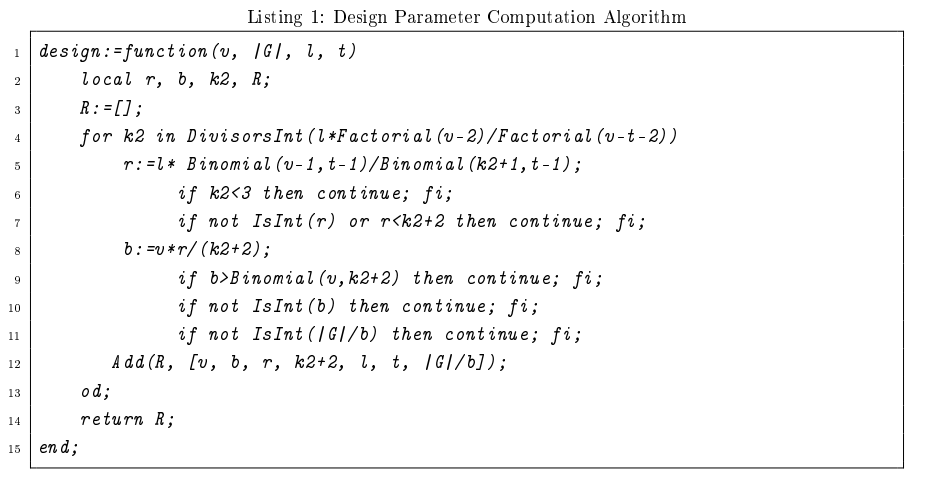
Apart from the Monster group \(M\), we can obtain all possible parameters \((v, b, r, k)\) with the aid of the following Algorithm 1 in computer algebra system GAP [23].
The case of the Monster group \(M\) will be dealt with separately in the following.
Lemma 3.1. Let \(G\) and \(\mathcal{D}\) satisfy Hypothesis \(\Gamma\) then \(\mathrm{Soc}(G)\neq M\).
Proof. Here we only need to consider the case \(t=3\), because if \(t=2\), \(\mathrm{Soc}(G)\neq M\) from [6, 25], and if \(t>3\), it follows from Lemma 2.4 that \(G\) is 2-homogeneous, and thus \(\mathrm{Soc}(G)\neq M\).
Suppose that \(t=3\). Then, from \(|\text{Out}(M)| = 1\), we can get \(G \cong M\). Let \(G_{\alpha}\) be a maximal subgroups of the Monster group \(M\). Although a complete classification of the maximal subgroups of the Monster group has recently been established [11], we proceed with an independent argument that does not rely on the full classification.
The ATLAS [7] lists 43 known maximal subgroups of \(M\). By Algorithm 1 one verifies that none of these subgroups yields parameters \((v,b,r,k,\lambda)\) satisfying Eqs. (1)-(7). Any potential new maximal subgroup of \(M\) must lie between a non-abelian simple group and its automorphism group, hence is almost simple. It is known that such a subgroup would be isomorphic to one of \(L_2(13),\; U_3(4),\; U_3(8),\; \text{or } Sz(8)\) (see [3]). A straightforward computation shows that Eqs. (1)-(7) admit no solution for these groups either.
Consequently, no maximal subgroup of \(M\) can appear as \(G_\alpha\) under Hypothesis \(\Gamma\). Therefore, \(\operatorname{Soc}(G) \neq M\). ◻
From [4, Proposition 2.4], it can be known that if \(\mathcal{D}\) and \(G\) satisfy Hypothesis \(\Gamma\), then \(t\leq 5\). To prove Theorem 1.3, from Propositions 1.1 and 1.2, we need to prove the cases when \(t = 3,4,5\) respectively.
Proposition 3.3. Let \(G\) and \(\cal D\) satisfy Hypothesis \(\Gamma\). If \(t = 3\), then \(({\cal D},G)\) is one of:
(i) \(\cal D\) is the unique \(3\)–\((11, 5, 4)\), the unique \(3\)–\((12, 6, 2)\), or the unique \(3\)–\((12, 4, 3)\) design, and \(G \cong M_{11}\) acts flag-transitively on \(\cal D\);
(ii) \(\cal D\) is the unique \(3\)–\((22, 4, 3)\) or the unique \(3\)–\((22, 5, 3)\) design, and \(G \cong M_{22}\) or \(M_{22} : 2\) acts flag-transitively on \(\cal D\);
(iii) \(\cal D\) is the unique \(3\)–\((22, 7, 4)\) design, and \(G \cong M_{22}\) acts flag-transitively on \(\cal D\);
(iv) \(\cal D\) is the unique \(3\)–\((23, 7, 5)\) design, and \(G \cong M_{23}\) acts flag-transitively on \(\cal D\).
Through Algorithm 1, we can find all the parameters \((v, b, r, k)\) satisfying equations (1)-(7), which are listed in Table 1. Next, by applying Lemmas 3.4-3.6, we analyze the parameters listed in Table 1 to complete the proof of Proposition 3.3. The commands mentioned in the proof below are performed by the computer algebra system Magma.
Lemma 3.4. There exist no designs corresponding to Cases \(5\), \(9\), \(11\), and \(16\) in Table 1.
Proof. We prove the nonexistence by showing that \(G\) has no subgroups of index \(b\) in these cases. For conciseness, we present the detailed argument only for Case 5 (where \(G \cong M_{11}\)), the remaining cases follow analogously.
Let \(G \cong M_{11}\) be the
primitive permutation group on the point set \(\mathcal{P} = \{1,2,\ldots,11\}\), then
\(G\) can be represented by
G:=PrimitiveGroup(11, 6). To verify the claim,
we check for subgroups of index \(b=33\). Through Magma command
Subgroups(G:OrderEqual:=n) where \(n=\frac{|G|}{b}\), we confirm that no
conjugacy class of subgroups with index 33 exists in \(G\). Thus, Case 5 is excluded. The other
Cases 9, 11 and 16 are ruled out by identical methodology. ◻
Lemma 3.5. There are no designs corresponding to Cases \(3\), \(8\), \(10\), and \(15\) in Table 1.
Proof. We claim that these cases do not satisfy Lemma 2.5. Only the proof for Case 8 is given, and the proofs for the remaining cases are similar and can be derived accordingly.
For Case 8, we get the unique permutation representation of \(G\cong M_{22}\) acting on point set \({\cal P}=\{1,2,\ldots,22\}\) by \({\tt G:=PrimitiveGroup(22,1)}\). It can be seen that there exists exactly one conjugacy class of subgroups in \(G\) with index \(b=231\), with representative \(H\). The orbit-lengths of \(H\) on \(\cal P\) are 2 and 20. This contradicts Lemma 2.5 as \(k=6\), so it is excluded. ◻
Lemma 3.6. There exist designs corresponding to Cases \(1\), \(2\), \(4\), \(6\), \(7\), \(12\), \(13\), \(14\) and \(17\) in Table 1.
Proof. We present the detailed argument for Case 1 (where
\(G\cong M_{11}\)), the remaining cases
follow similarly through analogous computations. It is easy to see that
the action of \(G\cong M_{11}\)
(PrimitiveGroup(12,3)) on the point set \(\mathcal{P} = \{1,2,\ldots,12\}\) has only
one conjugacy class of subgroups of index 22. Let \(H\) be a representative of this conjugacy
class. The action of \(H\) on \(\cal P\) has two orbits: \[B_1 = \{1, 3, 7, 8, 9, 12\}, \quad B_2 = \{ 2, 4,
6, 7, 8, 12\}.\]
Let \({\cal D}_1 = (\mathcal{P},
B_1^G)\) and \({\cal D}_2 =
(\mathcal{P}, B_2^G)\). Both \({\cal
D}_1\) and \({\cal D}_2\) are
\(3\)-designs with 22 blocks, due to
the 3-transitivity of \(G\). Thus,
\({\cal D}_1\) and \({\cal D}_2\) are \(3\)–\((12,6,2)\) designs by Lemma 2.1. By using the
Magma command
IsIsomorphic(D1,D2), we find that \({\cal D}_1\cong {\cal D}_2\). From Lemma 2.5,
\(G\cong M_{11}\) acts
flag-transitively on both \({\cal
D}_1\) and \({\cal D}_2\). ◻
The proof of Proposition 3.3 can be directly obtained from Lemmas 3.1-3.6.
Proposition 3.7. Let \(G\) and \(\cal D\) satisfy Hypothesis \(\Gamma\) and \(t = 4\), then \(({\cal D},G)\) is one of:
(i) \(\cal D\) is the unique \(4\)–\((11,6,3)\) design, and \(G\cong M_{11}\) acts flag-transitively on \(\cal D\);
(ii) \(\cal D\) is the unique \(4\)–\((12,6,4)\) design, and \(G\cong M_{12}\) acts flag-transitively on \(\cal D\);
(iii) \(\cal D\) is the unique \(4\)–\((23,5,3)\), the unique \(4\)–\((23,6,3)\), or the unique \(4\)–\((23,8,4)\) design, and \(G\cong M_{23}\) acts flag-transitively on \(\cal D\);
(iv) \(\cal D\) is the unique \(4\)–\((24,8,5)\) design, and \(G\cong M_{24}\) acts flag-transitively on \(\cal D\).
By Lemma 2.4, \(G\) acts 2-homogeneously on design \(\cal D\); furthermore, \(G\) is 2-transitive as \(G\) is a sporadic group [18]. Therefore, combining the classification of 2-transitive groups [19], \(\mathrm{Soc}(G)\) and the number of points \(v\) must be one of the following:
(1) \(M_v\) where \(v = 11, 12, 22, 23, 24\);
(2) \(M_{11}\) with \(v = 12\);
(3) \(HS\) with \(v = 176\);
(4) \(Co_3\) with \(v = 276\).
First, due to the non-triviality of the design, assume \(k > 4\). From Lemma 2.1, it is known that the parameters of the design need to satisfy equations (1)-(7). From Algorithm 1, the parameters \((v,b,r,k,\lambda)\) satisfying the above conditions can be calculated, as shown in Table 2.
Next, in Lemma 3.8 and Lemma 3.9, we process the 11 sets of parameters in Table 2, eliminate the impossible parameters, and construct corresponding designs for the possible parameters.
Lemma 3.8. There are no designs corresponding to Cases \(2\), \(3\), \(7\), \(8\), \(9\) in Table 2.
Proof. For Case 3, we get the unique permutation
representation of \(G \cong M_{12}\)
acting on the point set \({\cal
P}=\{1,2,\ldots,12\}\) via
G:=PrimitiveGroup(12, 4). It is not difficult
to find that \(G\) has only one
conjugacy class of subgroups with index 396. Let \(H\) be the representative of this conjugacy
class. The action of \(H\) on \(\cal P\) is transitive, which contradicts
Lemma 2.5 since \(k =
5\) .
For the other four cases, it is also straightforward to determine that the group \(G\) has no conjugacy class of subgroups with index \(b\). ◻
Theorem 3.9. There exist designs corresponding to Cases \(1\), \(4\), \(5\), \(6\), \(10\) and \(11\) in Table 2.
Proof. For Case 1, suppose that \(G \cong M_{11}\) acts on the point set
\(\mathcal{P} = \{1, 2, \ldots, 11\}\),
then \(G\) can be represented by
G:=PrimitiveGroup(11, 6). It is not difficult
to find that \(G\) has only one
conjugacy class of subgroups with index 66. Let \(H\) be a representative of this conjugacy
class. Then, the two orbits of \(H\)
acting on \(\mathcal{P}\) are:
\[B_1 = \{1, 6, 7, 10, 11\}, \quad B_2 = \{2, 3, 4, 5, 8, 9\},\] and \(|B_2^G| = 66\). Let \({\cal D}=({\cal P}, B_2^G)\), then \(\cal D\) is a \(4\)–\((11, 6, 3)\) design by 4-transitivity of \(G\) and Lemma 2.1 (ii). Obviously, \(G \cong M_{11}\) acts flag-transitively on \(\cal D\) by Lemma 2.5.
The remaining cases can be proved similarly.
Proposition 3.7 can be proved by Lemmas 3.8 and 3.9. ◻
Let \(\mathcal{D}\) be a \(5\)–\((v, k, \lambda)\) design, and let \(G\) act block-transitively on \(\cal D\). By Lemma 2.4, we know that \(G\) acts 2-transitively on the points of \(\mathcal{D}\), and the following conclusion is obtained:
Proposition 3.10. Let \(G\) and \(\cal D\) satisfy Hypothesis \(\Gamma\) and \(t = 5\), then \(({\cal D},G)\) is one of:
(1) \(\cal D\) is the unique \(5\)–\((24,6,3)\) design, and \(G\cong M_{24}\) acts flag-transitively on \(\cal D\);
(2) \(\cal D\) is the unique \(5\)–\((24,7,3)\) design, and \(G\cong M_{24}\) acts flag-transitively on \(\cal D\).
The proof of Proposition 3.10 is similar to that of Proposition 3.7. Here \(G\) must be one of the Mathieu groups (\(M_{11}\),\(M_{12}\),\(M_{22}\),\(M_{23}\),\(M_{24}\)), the Higman-Sims group (\(HS\)), or the third Conway group (\(Co_3\)). By running Algorithm 1 in GAP, we obtain all possible parameters listed in Table 3. We proceed to analyze these four sets of parameters via Lemmas 3.11 and 3.12.
Lemma 3.11. There are no designs corresponding to Cases \(1\) and \(4\) in Table \(\ref{Table3}\).
Proof. For Case 1, we obtain the permutation representation
of \(G \cong M_{24}\) acting on the
point set \(\mathcal{P} = \{1, 2, \ldots,
24\}\) via G:=PrimitiveGroup(24, 3). It
is known that there are five conjugacy classes of subgroups with index
127512, denoted as \(H_i (i = 1, 2, 3, 4,
5)\). And the orbit lengths of the action of \(H_i\) on \(\cal
P\) are enumerated in Table 4.
| \(H_1\) | \(H_2\) | \(H_3\) | \(H_4\) | \(H_5\) |
|---|---|---|---|---|
| \(\{2,2,20\}\) | \(\{1,1,2,20\}\) | \(\{4,20\}\) | \(\{2,6,16\}\) | \(\{1,2,5,16\}\) |
Note that \(k=5\), by Lemma 2.5, the cases in the first four columns of the Table 4 cannot occur. Let \(B\) denote the orbit of \(H_5\) on \(\cal P\) with \(|B|=5\). It is straightforward to verify by Magma that \(|B^G| = 42504 \neq 127512\). Therefore, the parameters in Case 1 cannot construct a \(5\)–\((24, 5, 3)\) design admitting \(G \cong M_{24}\) as its block-transitive automorphism group.
For Case 4, it is also straightforward to determine that the group \(M_{24}\) has no conjugacy class of subgroups with index 2277. ◻
Lemma 3.12. There exist designs corresponding to Cases \(2\) and \(3\) in Table 3.
Proof. For Case 2, a straightforward calculation shows that \(G\cong M_{24}\) has three conjugacy classes of subgroups with index 11520, denoted as \(H_i (i = 1, 2, 3)\). The set of \(H_1\)-orbit lengths on the point set \(\mathcal{P}\) is {4,20}, and \(H_2\) acts transitively on \(\cal P\). Thus, from Lemma 2.5, \(H_1\) and \(H_2\) cannot be the block stabilizer subgroup \(G_B\) since \(|B| = 6\). The three orbits of \(H_3\) acting on \(\mathcal{P}\) are: \[B_1 = \{ 11, 15\}, \quad B_2 = \{3, 6, 9, 17, 21, 24\},\]\[\quad B_3 = \{1, 2, 4, 5, 7, 8, 10, 12, 13, 14, 16, 18, 19, 20, 22, 23\},\] and \(|B_2^G| = 21252\). Let \({\cal D}_1 = (\mathcal{P}, B_2^G)\), then the incidence structure \({\cal D}_1\) is a \(5\)–\((24, 6, 3)\) design by 5-transitivity of \(G\) and Lemma 2.1 (ii). Also, by Lemma 2.5, we know that \(G\) acts flag-transitively on \({\cal D}_1\).
For Case 3, \(G\cong M_{24}\) has two conjugacy classes of subgroups with index 6072, denoted as \(K_i (i = 1, 2)\). The set of \(K_1\)-orbit lengths on the point set \(\mathcal{P}\) is {1,2,21}. Thus, from Lemma 2.5, \(K_1\) cannot be the block stabilizer subgroup \(G_B\) since \(k=7\). The three orbits of \(K_2\) acting on \(\mathcal{P}\) are: \[B'_1 = \{ 10\}, \quad B'_2 = \{1, 5, 7, 14, 17, 19, 21\},\]\[\quad B'_3 = \{2, 3, 4, 6, 8, 9, 11, 12, 13, 15, 16, 18, 20, 22, 23, 24\},\] and \(|{B'_2}^G| = 6072\). Let \({\cal D}_2=(\mathcal{P}, {B'_2}^G)\), then the incidence structure \({\cal D}_2\) is a \(5\)–\((24, 7, 3)\) design by 5-transitivity of \(G\) and Lemma 2.1 (ii). Also, \(G\) acts flag-transitively on \({\cal D}_2\).
Proposition 3.10 can be proved by Lemmas 3.11 and 3.12.
From Propositions 1.1-3.10, we know that Theorem 1.3 holds. ◻
This work is supported by the National Natural Science Foundation of China (No. 12361004) and the Natural Science Foundation of Jiangxi Province (Nos. 20224BAB211005 and 20242BAB25005).
The authors declare no conflict of interest.