
In \(1955\), Harary [6] obtained the number of non-isomorphic linear and connected graphs with \(p\) points and \(k\) lines. In \(1956\), Gilbert [4] enumerated connected labeled graphs. In \(1973\), Harary and Palmer [7] obtained the number of ways to label a graph, and also posed the problem of enumeration of labeled graphs on \(n\geq 1\) unisolated vertices and \(l\geq 0\) edges. In \(1997\), Bender et al. [1] obtained asymptotic number of labeled graphs on \(n\) unisolated vertices with \(q\) edges. Bender et al. [1] also obtained the recurrence relation representing the number \(d(n, q)\) of labeled graphs on \(n\) unisolated vertices, containing \(q\) edges as \(q d(n, q) = (N-q+1) d(n, q-1) + n(n-1) d(n-1, q-1) + N d(n-2, q-1)\) with boundary conditions \(d(0, 0) = 1\), and for non-zero values of \(n\) and \(q\), \(d(0, q) = d(n, 0) = 0\), where \(\frac{n}{2} \leq q \leq N = \binom{n}{2}\). In \(2008\), Tauraso [11] obtained the (triangular) sequence of edge coverings of the complete graph \(K_n\) for \(n \geq 1\), which is interestingly the sequence \(A054548\) (see Sloane [10]). In \(2020\), Bhavale and Waphare [2] introduced the concept of a fundamental basic block. Let \(\mathscr{F}_n(l)\) be the set of all non-isomorphic fundamental basic blocks of nullity \(l\), containing \(n\) comparable reducible elements. Bhavale and Waphare [2] obtained the recurrence relation representing the number of all non-isomorphic fundamental basic blocks on \(n \geq 1\) comparable reducible elements, having nullity \(l\), as \(|\mathscr{F}_{n+1}(l)| = \displaystyle \sum_{k=1}^{n} \sum_{j=0}^{k} \binom{n}{j} \binom{n-j}{k-j}|\mathscr{F}_{n-j}(l-k)|\) with \(|\mathscr{F}_{0}(0)|=1, |\mathscr{F}_{1}(l)|=0\), where \(\lfloor \frac{n+2}{2} \rfloor \leq l \leq \binom{n+1}{2}\). Bhavale and Waphare [2] also observed that for \(n \geq 2\), the sequence \((f(n,l))\) where \(f(n,l) = |\mathscr{F}_n(l)|\), is equivalent to the sequence \((d(n,l))\). But this equivalence is yet to establish. Moreover, both of these sequences are equivalent to \(A054548\). In this paper, we prove the equivalence of the sequence \((f(n,l))\) with the sequence \((d(n,l))\). We also provide an edge labeling which is uniquely determined for a given vertex labeling of a finite simple graph/directed graph.
A labeled graph \(G=(V(G),E(G))\) is a finite set of graph vertices \(V(G)\) with a set of graph edges \(E(G)\) of \(2\)-subsets of \(V(G)\). Two labeled graphs \(G\) and \(H\) are said to be isomorphic if and only if there is a one-one (or injective) map from \(V(G)\) onto (or surjective) \(V(H)\) which preserves not only adjacency but also the labeling. The nullity of a graph \(G\) is given by \(|E(G)|-|V(G)|+c\), where \(c\) is the number of connected components of \(G\).
Let \(\leq\) be a partial order relation on a non-empty set \(P\), and let \((P,\leq)\) be a poset. A subset \(S\) of a poset \((P,\leq)\) is subposet of \(P\) if \(S\) itself is a poset under the same relation \(\leq\) of \(P\). Elements \(x,y \in P\) are said to be \(comparable\), if either \(x \leq y\) or \(y \leq x\). Elements \(x, y \in P\) are said to be incomparable, denoted by \(x||y\), if \(x, y\) are not comparable. A chain (or a linear order) is a poset in which any two elements are comparable. An element \(c \in P\) is a lower bound (upper bound ) of \(a, b \in P\) if \(c \leq a, c \leq b ~ (a \leq c, b\leq c)\). A meet of \(a, b \in P\), denoted by \(a \wedge b\), is defined as the greatest lower bound of \(a\) and \(b\). A join of \(a, b \in P\), denoted by \(a \vee b\), is defined as the least upper bound of \(a\) and \(b\). An element \(b\) in \(P\) covers an element \(a\) in \(P\) if \(a<b\), and there is no element \(c\) in \(P\) such that \(a<c<b\). This fact is denoted by \(a \prec b\) and called as a covering or an edge. If \(a \prec b\) then \(a\) is called a lower cover of \(b\), and \(b\) is called an upper cover of \(a\). The graph on a poset \(P\) with edges as coverings is called cover graph and is denoted by \(C(P)\). The number of coverings in a chain is called length of the chain. If \(C\) is a chain on \(n\) elements, that is, if \(|C|=n\) then its length is \(n-1\). Bhavale and Waphare [2] defined nullity of a poset \(P\), denoted by \(\eta(P)\), to be the nullity of its cover graph \(C(P)\).
A poset \(L\) is a lattice if both \(a \wedge b\) and \(a \vee b\), exist in \(L\), \(\forall ~ a, b \in L\). A sublattice of a lattice \(L\) is a subset of \(L\) which is a lattice under the same operations \(\wedge\) and \(\vee\) of \(L\). For \(a \leq b\), the interval \([a, b] = \{ x \in L | a \leq x \leq b \}\) is a sublattice of \(L\). An element \(x\) in a lattice \(L\) is join-reducible(meet-reducible) in \(L\), if there exist \(y, z \in L\) both distinct from \(x\), such that \(y \vee z = x (y \wedge z = x)\). An element \(x\) in a lattice \(L\) is reducible, if it is either join-reducible or meet-reducible. The set of all reducible elements of \(L\) is denoted by \(\mathop{\mathrm{Red}}(L)\). An element \(x\) is join-irreducible(meet-irreducible), if it is not join-reducible(meet-reducible); An element \(x\) is doubly irreducible, if it is both join-irreducible and meet-irreducible. Lattices \(L_1\) and \(L_2\) are isomorphic (in symbol, \(L_1 \cong L_2\)), and the map \(\phi : L_1 \to L_2\) is an isomorphism if and only if \(\phi\) is one-one and onto (or bijective), and \(a \leq b\) in \(L_1\) if and only if \(\phi(a) \leq \phi(b)\) in \(L_2\).
For the other definitions, notation, and terminology see [5, 7, 13]. The following result is due to Rival [8].
Lemma 1.1. [8] If \(L\) is a lattice then \(L \setminus A\) is a sublattice of \(L\) for every subset \(A\) of all doubly irreducible elements of \(L\).
In \(1974\), Rival [8] introduced and studied the class of dismantlable lattices.
Definition 1.2. [8] A finite lattice of order \(n\) is called dismantlable if there exists a chain \(L_{1} \subset L_{2} \subset \cdots\subset L_{n}(=L)\) of sublattices of \(L\) such that \(|L_{i}| = i\), for all \(i\).
Brucker and Gély [3] characterized dismantlable lattices as follows.
Theorem 1.3. [3] ] A lattice \(L\) is dismantlable lattice if and only if there exists a chain of lattices \(L_1 \subset L_2 \subset \cdots \subset L_n = L\) such that \(L_1\) is a singleton and \(L_{i-1} = L_i \setminus \{x\}\), where \(x\) is a doubly irreducible element of \(L_i\).
Thakare et al. [12] introduced the concept of an adjunct operation of lattices. Suppose \(L_1\) and \(L_2\) are two disjoint lattices and \((a, b)\) is a pair of elements in \(L_1\) such that \(a<b\) and \(a \not\prec b\). Define the partial order \(\leq\) on \(L = L_1 \cup L_2\) with respect to the pair \((a,b)\) as follows: \(x \leq y\) in \(L\) if \(x, y \in L_1\) and \(x \leq y\) in \(L_1\), or \(x, y \in L_2\) and \(x \leq y\) in \(L_2\), or \(x \in L_1\), \(y \in L_2\) and \(x \leq a\) in \(L_1\), or \(x \in L_2\), \(y \in L_1\) and \(b \leq y\) in \(L_1\). The pair \((a, b)\) is called an adjunct pair of \(L\). If \(L\) is an adjunct of lattices \(L_1\) and \(L_2\) with an adjunct pair \((a, b)\) then it is denoted by \(L = L_1 ]_{a}^{b} L_2\).
The following structure theorem is due to Thakare et al. [12].
Theorem 1.4. [12] A finite lattice is dismantlable if and only if it is an adjunct of chains.
Suppose a dismantlable lattice \(L\)
is an adjunct of the chains \(C_0, C_1, C_2,
\ldots, C_r\), where \(C_0\) is
a maximal chain of \(L\). Then an
adjunct representation of \(L\) is
given by \(L = C_0 ]_{a_1}^{b_1} C_1
]_{a_2}^{b_2} C_2 \cdots\)
\(]_{a_r}^{b_r} C_r\), where \((a_i, b_i); 1 \leq i \leq r\) are adjunct
pairs. Moreover, an adjunct representation of lattice \(L\) is unique up to the order in which
adjunct pairs occur.
Proposition 1.5. If \(L = L_1 ]_{a}^{b} L_2\) then \(\eta(L) = \eta(L_1) + \eta(L_2) + 1\).
Proof. Note that \(|E(L)| = |E(L_1)|+|E(L_2)|+2\) and \(|V(L)| = |V(L_1)|+|V(L_2)|\). Further, \(\eta(L_1) + \eta(L_2) = (|E(L_1)|-|V(L_1)|+1) + (|E(L_2)|-|V(L_2)|+1) = (|E(L_1)|+|E(L_2)|+2) – (|V(L_1)|+|V(L_2)|) = |E(L)| – |V(L)| = \eta(L) – 1\). Thus \(\eta(L) = \eta(L_1) + \eta(L_2) + 1\). ◻
Using Theorem 1.4 and Proposition 1.5, we get the following result.
Corollary 1.6. A dismantlable lattice with \(n\) elements has nullity \(r\) if and only if it is an adjunct of \(r+1\) chains.
Now given a vertex labeling of a simple graph on \(n\) unisolated vertices, we obtain an edge labeling of that graph in the following section. Using this edge labeling, in Section 4, we obtain an equivalence between the sequences \((f(n,l))\) and \((d(n,l))\).
A labeling of a graph \(G\) is an assignment of labels to either the vertices or the edges or both subject to certain conditions. The origin of labelings can be attributed to Rosa [9]. In this section, given a vertex labeling of the complete graph \(K_n\), we obtain an edge labeling of \(K_n\) which is determined uniquely. In this regard, we begin with the fact that dictionary order is a linear order. That is, if \(S = \{(i, j) | 1 \leq i < j \leq n\}\), with a dictionary order as follows for \((i, j), (i', j') \in S, (i, j) \leq (i', j')\), if \(i \leq i'\), or if \(i = i'\) and \(j \leq j'\), then \((S, \leq)\) is a chain. For \(1 \leq r < n\), define \(S_r = \{(r, j) | r < j \leq n\}\).
Proposition 2.1. For \(1 \leq r < n\), \(S_r\) is a subchain of \(S\). Further, \(|S_r|=n-r\) and \(S_i \cap S_j = \phi, \forall i \neq j\).
Proof. As \(S_r \subseteq S\), \(S_r\) is a chain. Now, it follows that \(|S_r| = n-r\), since \(r < j \leq n\) implies that \(r+1 \leq j \leq r + (n-r)\). Also, by the definition of \(S_r\), \(S_i \cap S_j = \phi, \forall i \neq j\). ◻
Proposition 2.2. For \(n \geq 2\), \(S = S_1 \oplus S_2 \oplus \cdots \oplus S_{n-1}\).
Proof. By Proposition 2.1, suppose \(S_r\) is the chain \((r,r+1) \prec (r,r+2) \prec \cdots \prec (r,n)\), where \(1 \leq r \leq n-1\). It is sufficient to prove that \((r,n) \prec (r+1, r+2), \forall r\), where \(1 \leq r \leq n-2\). Suppose \((r,n) \leq (i,j) \leq (r+1,r+2)\). If \((i,j) = (r,n)\) then we are done. Otherwise, \(i \neq r\) or \(j \neq n\) which implies that \(r<i\), since \((r,n) \leq (i,j)\). Also, \((i,j) \leq (r+1,r+2)\) implies that \(i \leq r+1\), or \(i=r+1\) and \(j \leq r+2\). If \(i \leq r+1\) then \(i=r+1\) as \(r<i\). But then we must have \(j \leq r+2\). Now \(i = r+1 < j \leq r+2\). Therefore \(j=r+2\). Hence \((i,j) = (r+1,r+2)\). Thus, \(S = S_1 \oplus S_2 \oplus \cdots \oplus S_{n-1}\). ◻
Proposition 2.3. For fixed \(r\), where \(1 \leq r < n\), if the pair \((r,n)\) is \(l^{\rm th}\) element of \(S\) then \(l = rn – \binom{r+1}{2}\).
Proof. Observe that for \(1 \leq r < n\), \((r,n)\) is the largest element of the subchain \(S_r\) of \(S\). So consider a subchain \(C^{(r)} = S_1 \oplus S_2 \oplus \cdots \oplus S_{r}\) of \(S\). Note that, the pair \((r,n)\) is also the largest element of \(C^{(r)}\). Therefore \((r,n)\) is the \(l^{\rm th}\) element of \(S\), and \(l\) is one more than the length of the chain \(C^{(r)}\). Therefore \(l = (|C^{(r)}|-1) + 1 = |C^{(r)}| = |S_1 \oplus S_2 \oplus \cdots \oplus S_r| = \displaystyle \sum_{i=1}^{r}|S_i| = rn – \binom{r+1}{2}\), since by Proposition 2.1, \(|S_i| = n-i\) and \(S_i \cap S_j = \phi\), for all \(i \neq j\). ◻
Proposition 2.4. If \((i,j) \in S\) is \(k^{\rm th}\) element of \(S\) then \(1 \leq k = (i-1)n – \binom{i}{2} + j – i \leq N = \binom{n}{2}\).
Proof. Consider the chain \(S_i : (i,i+1) \prec (i,i+2) \prec \cdots \prec (i,n)\). Now \(j^{\rm th}\) pair in \(S_i\) is \((i,i+j)\). This implies that the pair \((i,j)\) in \(S_i\) is \((j-i)^{\rm th}\) pair in \(S_i\). Now by Proposition 2.3, if a pair \((i-1,n)\) is the \(l^{\rm th}\) element of \(S\), then \(l = (i-1)n – \binom{i}{2}\). Note that \((i-1,n)\) is the largest element of \(S_{i-1}\). Therefore if \((i,j)\) is \(k^{\rm th}\) element of \(S\) then \((i,j) \in S_i\) and \(k = l + (j-i) = (i-1)n – \binom{i}{2} + j – i\). ◻
Proposition 2.5. For \(1 \leq k \leq N = \binom{n}{2}\), there exists unique \((i,j) \in S\) such that \(k = (i-1)n-\binom{i}{2}+j-i\).
Proof. For if, suppose there exist \((i,j), (i',j') \in S\) such that \((i,j) \neq (i',j')\) but \[\label{eq1} k=(i-1)n-\binom{i}{2}+j-i=(i'-1)n-\binom{i'}{2}+j'-i'. \tag{1}\]
If \(i=i'\) then by Eq. (1), we have \(j=j'\), and hence \((i,j) = (i',j')\), which is a contradiction. Therefore \(i \neq i'\). Without loss of generality, suppose \(i<i'\). Now from Eq. (1), \(j-j' = (i'-i)(n-1) + (i'-i) (\frac{1-(i'+i)}{2}) = (i'-i)(n-\frac{1}{2}-\frac{i'}{2}-\frac{i}{2}) = (i'-i)(\frac{n-i'}{2} + \frac{n-i-1}{2}) \geq 0\), as \(1 \leq i < i' \leq n\). This implies that \(j \geq j'\), a contradiction, since there exists \(j \geq i+1\) such that \(j<j'\), as \(i<j\) and \(i < i+1 \leq i' < j'\). Thus \((i,j) \neq (i',j')\) implies that \((i-1)n-\binom{i}{2}+j-i \neq (i'-1)n-\binom{i'}{2}+j'-i'\), which is not possible by Eq. (1). Hence \((i,j) = (i',j')\). ◻
Let \(J_N = \{i | 1 \leq i \leq N = \binom{n}{2}\}\), where \(n \geq 2\). Then the following result follows immediately from Proposition 2.5.
Theorem 2.6. Let \(n \geq 2\). Define \(f : S \to J_N\) by \(f(i,j) = (i-1)n – \binom{i}{2} + j – i, \forall (i,j) \in S\). Then \(f\) is bijective, and hence \(|S| = N = \binom{n}{2}\).
Proof. Clearly \(f\) is a well defined function, since if \((i,j) = (i',j') \in S\) then \(i=i'\) and \(j=j'\). Therefore \(f(i,j) = f(i',j')\). Further by Proposition 2.5, \(f\) is clearly surjective. Note that, if \((i,j) \neq (i',j')\) in \(S\) then we get \((i-1)n-\binom{i}{2}+j-i \neq (i'-1)n-\binom{i'}{2}+j'-i'\). Hence \(f\) is injective. ◻
Let \(K_n\) be a complete graph on \(n \geq 2\) vertices, say \(\{1, 2, \ldots, n\}\). Let \(\overrightarrow{K_n}\) be the digraph associated with \(K_n\) such that \(1 \leq i < j \leq n\) whenever edge \((i,j) \in E(\overrightarrow{K_n})\). Then using Theorem 2.6, we get the following result.
Corollary 2.7. Consider a directed graph \(\overrightarrow{K_n}\) with vertex labeling \(1, 2, \ldots , n\). Then for \(i < j\), a directed edge \(\overrightarrow{(i,j)} \in E(\overrightarrow{K_n})\) can be labeled as \(k = (i-1)n – \binom{i}{2} + j – i \in J_N\). Moreover, for any \(k \in J_N\), there exists unique directed edge \(\overrightarrow{(i,j)} \in E(\overrightarrow{K_n})\).
In Corollary 2.7, we obtained unique edge labeling of \(\overrightarrow{K}_n\). Using this kind of edge labeling, we obtain in the following an edge labeling for a directed subgraph (on \(n\) unisolated vertices) of \(\overrightarrow{K}_n\).
Theorem 2.8. Suppose \(\overrightarrow{G}\) is a directed subgraph (on \(n\) unisolated vertices) of \(\overrightarrow{K}_n\) with vertex labeling \(\{v_1, v_2, \ldots, v_n\}\). Then for \(i<j\), if \(\overrightarrow{(v_i,v_j)} \in E(\overrightarrow{G})\) then \(\overrightarrow{(v_i,v_j)}\) can be labeled as \(k = (i-1)n-\binom{i}{2}+j-i \in J_N\). Moreover, if \(k \in J_N\) is a label of an edge \(\overrightarrow{e} \in E(\overrightarrow{G})\) then \(\overrightarrow{e} = \overrightarrow{(v_i,v_j)}\).
If we remove direction of each edge of a subgraph \(\overrightarrow{G}\) of \(\overrightarrow{K}_n\), then we get a simple subgraph \(G\) (on \(n\) unisolated vertices) of \(K_n\). Thus using Theorem 2.8, for a given finite simple graph \(G\) on \(n\) unisolated vertices, we get an edge labeling for the graph \(G\), which is uniquely determined.
In order to prove equivalence of the sequences \((f(n,l))\) and \((d(n,l))\), we need to study the class \(\mathscr{F}_n(l)\) firstly. For this sake in Section 3, we introduce the concept of a complete fundamental basic block, and obtain in general an adjunct representation of a fundamental basic block.
Bhavale and Waphare [2] defined the class of ‘‘RC-lattices’’as class of all lattices such that each member of the class has all the reducible elements comparable.
Theorem 3.1. [2] A lattice in which all the reducible elements are comparable is a dismantlable lattice.
Thus an RC-lattice is dismantlable. Bhavale and Waphare [2] also introduced the concepts of a doubly irreducible element, a basic block, and a fundamental basic block. An element of a poset \(P\) is doubly irreducible in \(P\), if it has at most one upper cover and at most one lower cover in \(P\). Let \(\mathop{\mathrm{Irr}}(P)\) denote the set of all doubly irreducible elements in the poset \(P\).
Definition 3.2. [2] A poset \(B\) is a basic block, if it is one element, or \(\mathop{\mathrm{Irr}}(B) = \phi\), or removal of a doubly irreducible element from \(B\) reduces nullity of \(B\) by one.
Definition 3.3. [2] An RC-lattice \(F\) is said to be a fundamental basic block, if it is a basic block, and all the adjunct pairs in an adjunct representation of \(F\) are distinct.
Definition 3.4. For \(n \geq 2\), complete fundamental basic block, denoted by \(\mathop{\mathrm{CF}}(n)\), is the fundamental basic block on \(n\) reducible elements, having nullity \(N = \binom{n}{2}\).
Using Definition 3.4, Theorem 1.4 and Proposition 2.5, we get an adjunct representation of a complete fundamental basic block in the following result.
Theorem 3.5. Let \(C : u_1\leq u_2\leq \cdots\leq u_n\) be the
chain of reducible elements of \(\mathop{\mathrm{CF}}(n)\). Then an adjunct
representation of \(\mathop{\mathrm{CF}}(n)\) is given by \(\mathop{\mathrm{CF}}(n) = C_0 ]^{u_2}_{u_1}\{c_1\}
]^{u_3}_{u_1}\{c_2\} \cdots ]^{u_n}_{u_1}\{c_{n-1}\}\)
\(]^{u_3}_{u_{2}}\{c_{n}\}
]^{u_4}_{u_{2}}\{c_{n+1}\} \cdots ]^{u_n}_{u_{2}}\{c_{2n-3}\}
]^{u_4}_{u_{3}}\{c_{2n-2}\} \cdots ]^{u_j}_{u_{i}}\{c_{k}\} \cdots
]^{u_n}_{u_{n-1}}\{c_{N}\}\), where \(N
= \binom{n}{2}\), \(k =
(i-1)n-\binom{i}{2}+j-i\), \(1\leq
i<j\leq n\), and \(C_0\) is
the chain \(u_1 \prec x_1 \prec u_2 \prec x_2
\prec \cdots \prec u_{n-1} \prec x_{n-1} \prec u_n\) with \(x_i || c_k\) for \(k = (i-1)n-\binom{i}{2}+1\).
Proof. By Theorem 3.1, \(\mathop{\mathrm{CF}}(n)\) is a dismantlable lattice. Therefore by Theorem 1.4 and Corollary 1.6, \(\mathop{\mathrm{CF}}(n) = C_0 ]^{b_1}_{a_1}C_1 ]^{b_2}_{a_2}C_2 \cdots ]^{b_N}_{a_N}C_{N}\), where \(C_0\) is a maximal chain containing the chain \(C : u_1 \leq u_2 \leq \cdots \leq u_n\), \(C_i\) is a chain and \((a_i, b_i)\) is an adjunct pair for each \(i, 1 \leq i \leq N = \binom{n}{2}\). Clearly \(|C_k|=1, \forall k, 1 \leq k \leq N\). For if, suppose \(|C_k| \geq 2\) for some \(k\), where \(1 \leq k \leq N\). Now removal of a doubly irreducible element from \(C_k\) results in removal of an (incident) edge from \(C_k\), as \(|C_k| \geq 2\). Therefore there exists \(y \in \mathop{\mathrm{Irr}}(C_k)\) such that \(\eta(\mathop{\mathrm{CF}}(n) \setminus \{y\}) = \eta(\mathop{\mathrm{CF}}(n))\). This is a contradiction to the fact that \(\mathop{\mathrm{CF}}(n)\) is a basic block. Therefore suppose \(C_k = \{c_k\}\), where \(1 \leq k \leq N\). Now \(a_k, b_k \in U = \{u_1, u_2, \ldots, u_n\}, \forall k, 1 \leq k \leq N\). Also by Proposition 2.5, for each \(1 \leq k \leq N\), there exists unique \((i,j) \in S\) such that \(k = (i-1)n-\binom{i}{2}+j-i\). Hence for each \(c_k\) or an adjunct pair \((a_k, b_k)\), there corresponds a unique pair \((u_i, u_j)\) such that \(k = (i-1)n-\binom{i}{2}+j-i\), where \(1 \leq i < j \leq n\). Moreover, \(a_k = u_i\) and \(b_k = u_j\). Now if \([u_i, u_{i+1}] \cap C_0\) consists of more than one doubly irreducible elements, then again we get a contradiction to the fact that \(\mathop{\mathrm{CF}}(n)\) is a basic block. Therefore for each \(i\), \(1 \leq i \leq n-1\), \([u_i, u_{i+1}] \cap C_0\) consists of exactly one doubly irreducible element, say \(x_i\). Thus \(C_0\) is the chain \(u_1 \prec x_1 \prec u_2 \prec x_2 \prec \cdots \prec u_{n-1} \prec x_{n-1} \prec u_n\). Moreover \(x_i || c_k\) for \(k = (i-1)n-\binom{i}{2}+1\), as \(u_i \prec c_k \prec u_{i+1}\). ◻
Let \(X = C_0 \setminus C\) and \(Y = \{c_k | k \in J_N \}\). Then from Theorem 3., \(X = \{x_1, x_2, \ldots , x_{n-1}\}\) and as a set \(\mathop{\mathrm{CF}}(n) = C_0 \cup Y\). Moreover, \(|\mathop{\mathrm{CF}}(n)|=|C_0|+|Y|=|C|+|X|+|Y|=n+(n-1)+N = 2n-1+\binom{n}{2}\). Also using Theorem 3.5, the total number of coverings or edges in \(\mathop{\mathrm{CF}}(n)\) is \((2n-2)+ 2 \binom{n}{2}\). Thus it can be verified that \(\eta(\mathop{\mathrm{CF}}(n)) = \binom{n}{2}\).
The following result immediately follows from Theorem 3.5.
Proposition 3.6. If \(F\) is a fundamental basic block obtained from \(\mathop{\mathrm{CF}}(n)\) by removal of a doubly irreducible element, then \(F\in \mathscr{F}_n(N-1)\), where \(n>2\) and \(N = \eta(\mathop{\mathrm{CF}}(n)) = \binom{n}{2}\).
Proof. Let \(z \in \mathop{\mathrm{Irr}}(\mathop{\mathrm{CF}}(n))\), where \(n>2\). Let \(L = \mathop{\mathrm{CF}}(n) \setminus \{z\}\). Then it is clear that \(\mathop{\mathrm{Red}}(L) = \mathop{\mathrm{Red}}(\mathop{\mathrm{CF}}(n))\). By Lemma 1.1, \(L\) is a sublattice of \(\mathop{\mathrm{CF}}(n)\). By Theorem 3.5, either \(z=c_k\) where \(1\leq k\leq N\) or \(z=x_i\) where \(1\leq i\leq n-1\). If \(z=x_i\) then \(L \cong \mathop{\mathrm{CF}}(n) \setminus \{c_{k}\}\) for \(k = (i-1)n-\binom{i}{2}+1\). Therefore without loss of generality, we assume that \(z=c_k\), where \(1 \leq k \leq N\). As \(k \in J_N\), by Proposition 2.5, there exists unique \((i,j) \in S\) such that \(k = (i-1)n-\binom{i}{2}+j-i\), where \(1 \leq i < j \leq n\). As \(c_k \notin L\), \((u_i, u_j)\) does not remain an adjunct pair in an adjunct representation of \(L\). Therefore by Theorem 3.5, \(L\) is an adjunct of \(N\) chains, and hence by Corollary 1.6, \(\eta(L) = N-1\). Note that the elements \(u_i\) and \(u_j\) remains reducible in \(L\), since \(\mathop{\mathrm{Red}}(L) = \mathop{\mathrm{Red}}(\mathop{\mathrm{CF}}(n))\). Now if \(j > i+1\) then by Definition 3.3 and using Theorem 3.5, \(L\) itself is the fundamental basic block on \(n\) reducible elements with \(\eta(L) = N-1\). Also, if \(j = i+1\) then by Definition 3.2, \(L\) does not remain a basic block, since \(\eta(L \setminus \{x_i\}) = \eta(L)\). But in this case, by Definition 3.3 and using Theorem 3.5, \(L \setminus \{x_i\}\) becomes the fundamental basic block on \(n\) reducible elements, having nullity same as that of \(L\). Note that by Lemma 1.1, \(L \setminus \{x_i\}\) is also a sublattice of \(L\), and hence of \(\mathop{\mathrm{CF}}(n)\). Thus removal of a doubly irreducible element from \(\mathop{\mathrm{CF}}(n)\) gives rise to the fundamental basic block on \(n\) reducible elements, having nullity exactly one less than that of \(\mathop{\mathrm{CF}}(n)\). ◻
Note that, removal of an arbitrary number of doubly irreducible elements from \(\mathop{\mathrm{CF}}(n)\) does not guarantee the preservation of all the \(n\) reducible elements. However, removal of at most \(n-2\) doubly reducible elements from \(\mathop{\mathrm{CF}}(n)\) preserves all the \(n\) reducible elements, since each reducible element is connected to the remaining all \(n-1\) reducible elements via \(n-1\) adjunct pairs.
Now by Lemma 1.1 and using the repeated application of the treatment which is used in the proof of Proposition 3.6, we get the following result.
Corollary 3.7. If \(F\) is a fundamental basic block obtained from \(\mathop{\mathrm{CF}}(n)\) by removal of \(N-l\) doubly irreducible elements such that \(\mathop{\mathrm{Red}}(F) = \mathop{\mathrm{Red}}(\mathop{\mathrm{CF}}(n))\) where \(n>2\), then \(F \in \mathscr{F}_n(l)\), where \(N = \eta(\mathop{\mathrm{CF}}(n)) = \binom{n}{2}\) and \(\lfloor \frac{n+1}{2}\rfloor \leq l \leq N\). Further, if \(l \geq N-n+2\) then \(f(n, l) = |\mathscr{F}_n(l)| = \binom{N}{l}\).
Proof. In Proposition 3.6, we have seen that removal of a doubly irreducible element from \(\mathop{\mathrm{CF}}(n)\) gives rise to the fundamental basic block on \(n\) reducible elements, having nullity exactly one less than that of \(\mathop{\mathrm{CF}}(n)\). Now by Theorem 1.3, removal of more than \(n-2\) doubly irreducible elements from \(\mathop{\mathrm{CF}}(n)\) gives rise to the fundamental basic block, but may contain \(\leq n\) reducible elements. But \(\mathop{\mathrm{Red}}(F) = \mathop{\mathrm{Red}}(\mathop{\mathrm{CF}}(n))\). Therefore removal of \(N-l\) doubly irreducible elements from \(\mathop{\mathrm{CF}}(n)\) (which are precisely the elements of the set \(Y\)) gives rise to the fundamental basic block, say \(F\) (on \(n\) reducible elements) having nullity \(N – (N-l) = l\). Thus \(F\in \mathscr{F}_n(l)\).
Now by Lemma 1.1, \(F\) is a sublattice of \(\mathop{\mathrm{CF}}(n)\). Hence \(\eta(F) = l \leq \eta(\mathop{\mathrm{CF}}(n)) = N = \binom{n}{2}\). Also, as far as the lower bound on \(l\) is concerned, there are the following two cases.
Case I. Suppose \(n\) is even, say \(n=2k, k \in \mathbb{N}\). By Definition 3.3, the multiplicity of each adjunct pair in an adjunct representation of \(F\) is one. Moreover, an adjunct pair corresponds to exactly two reducible elements of \(F\). Therefore, if we want to cover all the \(n\) reducible elements of \(F\), then at least \(k\) adjunct pairs are required. Therefore \(l \geq k = \frac{n}{2} = \lfloor \frac{n+1}{2} \rfloor\). Note that, if we consider \(l\) adjunct pairs, where \(l<k\) then care of all the \(2k\) reducible elements can not be taken.
Case II. Suppose \(n\) is odd, say \(n=2k+1, k \in \mathbb{N}\). Again in this case, at least \(k\) adjunct pairs are required to cover \(n-1\) reducible elements. Therefore one more adjunct pair is required to cover all the \(n\) reducible elements of \(F\), so that none of the reducible elements is left unassigned. Hence in this case, at least \(k+1 = \frac{n-1}{2} + 1 = \frac{n+1}{2} = \lfloor \frac{n+1}{2} \rfloor\) reducible elements are required. Thus \(l \geq \lfloor \frac{n+1}{2} \rfloor\).
Further, if \(l \geq N-n+2\) then \(N-l \leq n-2\). But then \(\mathop{\mathrm{Red}}(F) = \mathop{\mathrm{Red}}(\mathop{\mathrm{CF}}(n))\), and hence \(F \in \mathscr{F}_n(l)\). Therefore in this situation, \(f(n, l) = \binom{N}{N-l}\), which is the number of ways to choose \(N-l\) doubly irreducible elements for the removal, out of \(N\) doubly irreducible elements of \(\mathop{\mathrm{CF}}(n)\) (or the set \(Y\)). Thus \(f(n, l) = \binom{N}{l}\). ◻
In Theorem 3.5, we have obtained an adjunct representation of \(\mathop{\mathrm{CF}}(n)\) which is the fundamental basic block on \(n\) reducible elements, having maximum nullity \(N = \binom{n}{2}\). By Lemma 1.1 and by Corollary 3.7, each \(F\in \mathscr{F}_n(l)\) where \(\lfloor \frac{n+1}{2}\rfloor \leq l \leq N\), is a sublattice of \(\mathop{\mathrm{CF}}(n)\), since \(\mathop{\mathrm{Red}}(F) = \mathop{\mathrm{Red}}(\mathop{\mathrm{CF}}(n))\). Therefore using Theorem 3.5 and Corollary 3.7, we get an adjunct representation of \(F\) in general, by restricting an adjunct representation of \(\mathop{\mathrm{CF}}(n)\) to that of \(F\). In fact, we have the following result.
Corollary 3.8. An adjunct representation of \(F \in \mathscr{F}_n(l)\) is given by \(F = C'_0 ]^{b_1}_{a_1}\{c_{q_1}\}
]^{b_2}_{a_2}\{c_{q_2}\}\)
\(\cdots ]^{b_l}_{a_l}\{c_{q_l}\}\),
where for each \(s, 1 \leq s \leq l \leq N =
\binom{n}{2}\), \(a_s=u_i,
b_s=u_j\) with \(q_s =
(i-1)n-\binom{i}{2}+j-i, 1 \leq i < j \leq n\), (\(q_1 < q_2 < \cdots < q_l\)), and
\(C'_0\) is the chain containing
chain \(C : u_1 \leq u_2 \leq \cdots \leq
u_n\) of all the reducible elements of \(\mathop{\mathrm{CF}}(n)\) and all those
\(x_i \in X = C_0 \setminus C\) which
satisfy \(x_i || c_{q_s}\) in \(F\) for \(q_s =
(i-1)n-\binom{i}{2}+1\).
Remark 3.9. Let \(Y_F = Y \cap F\), where \(Y = \{c_k | k \in J_N \}\). Then by Corollary 3.8, \(Y_F = \{c_{q_s} | 1 \leq s \leq l\}\). Also by Corollary 3.7, if \(|Y \setminus Y_{F_1}| = |Y \setminus Y_{F_2}| = N-l\), then \(F_1, F_2 \in \mathscr{F}_n(l)\). Moreover, \(F_1 \cong F_2\) if and only if \(Y \setminus Y_{F_1} = Y \setminus Y_{F_2}\). That is, \(F_1 \cong F_2\) if and only if \(Y_{F_1} = Y_{F_2}\).
Let \(\mathscr{D}(n,q)\) be the set of all non-isomorphic labeled graphs on \(n\) unisolated vertices, containing \(q\) edges. Then \(\mathscr{D}(n,q)\) is precisely the set of all non-isomorphic labeled subgraphs (on \(n\) unisolated vertices, containing \(q\) edges) of \(K_{n}\). Clearly \(d(n, q) = |\mathscr{D}(n,q)|\). Let \(\overrightarrow{\mathscr{D}}(n,q)\) be the set of all non-isomorphic labeled digraphs on \(n\) unisolated vertices \(v_1, v_2, \ldots , v_n\) such that for \(\overrightarrow{G} \in \overrightarrow{\mathscr{D}}(n,q)\), \(\overrightarrow{(v_i, v_j)}\) is a directed edge of \(\overrightarrow{G}\) whenever \(i<j\). Note that, \(\overrightarrow{\mathscr{D}}(n,q)\) is precisely the set of all non-isomorphic labeled directed subgraphs (on \(n\) unisolated vertices, containing \(q\) directed edges) of \(\overrightarrow{K}_n\).
Lemma 4.1. For \(n \geq 2\) and for \(G \in \mathscr{D}(n,q)\), \(\lfloor \frac{n+1}{2}\rfloor \leq q \leq \binom{n}{2}\).
Proof. Let \(G \in \mathscr{D}(n,q)\) and \(n \geq 2\). Note that the complete graph \(K_n\) is the largest (simple) graph on \(n\) unisolated vertices which has \(N = \binom{n}{2}\) edges. As \(G\) is a subgraph of \(K_n\), \(q \leq N\). Now as far as lower bound on \(q\) is concerned, there are the following two cases.
Case I. Suppose \(n\) is even, say \(n=2k, k \in \mathbb{N}\). Since an edge consists of two vertices, at least \(k = \frac{n}{2} = \lfloor \frac{n+1}{2} \rfloor\) edges are required to cover all the vertices of \(G\), so that none of the vertex remains isolated.
Case II. Suppose \(n\) is odd, say \(n=2k+1, k \in \mathbb{N}\). Again, in this case at least \(k\) edges of \(G\) are required to cover \(n-1\) vertices out of \(n\). Therefore we require one more edge to cover all the \(n\) vertices of \(G\), so that none of the vertex remains isolated. Thus, in this case at least \(k+1 = \frac{n-1}{2} + 1 = \lfloor \frac{n+1}{2} \rfloor\) edges are required. ◻
The following result follows immediately from Lemma 4.1.
Corollary 4.2. For \(n \geq 2\) and for \(\overrightarrow{G} \in \overrightarrow{\mathscr{D}}(n,q)\), \(\lfloor \frac{n+1}{2}\rfloor \leq q \leq \binom{n}{2}\).
Consider the chain \(C: u_1 \leq u_2 \leq \cdots \leq u_n\) of all the reducible elements of \(\mathop{\mathrm{CF}}(n)\), where \(n \geq 2\). Then an interval \([u_i, u_j]\) is a sublattice of \(\mathop{\mathrm{CF}}(n)\) for \(1 \leq i < j \leq n\). Further, \([u_i, u_j] \cong \mathop{\mathrm{CF}}(m)\), where \(m = j-i+1 \leq n\). Let \(I = \{I_{ij}=[u_i, u_j] | 1 \leq i < j \leq n\}\). By Theorem 2.6, it clearly follows that \(|I| = |S| = \binom{n}{2}\).
By Proposition 2.4, each \(I_{ij} \in I\) can be associated with a unique directed edge \(\overrightarrow{e}_k \in E(\overrightarrow{K_n})\). Conversely, by Proposition 2.5, each directed edge \(\overrightarrow{e}_k \in E(\overrightarrow{K_n})\) can be associated with a unique interval \(I_{ij} \in I\).
In fact, using Proposition 2.5 and Theorem 3.5, we get the following result which provides unique association of \(\mathop{\mathrm{CF}}(n)\) with \(\overrightarrow{K_n}\).
Theorem 4.3. Let \(u_1 \leq u_2 \leq \cdots \leq u_n\) be the chain of all reducible elements of \(\mathop{\mathrm{CF}}(n)\), where \(n \geq 2\). Consider the class \(\mathscr{A} = \{u_i, I_{ij} = [u_i, u_j] | 1 \leq i \leq n, I_{ij} \in I\}\) associated with \(\mathop{\mathrm{CF}}(n)\). Let \(V(\overrightarrow{K_n}) = \{v_1, v_2, \ldots, v_n\}\) and \(E(\overrightarrow{K_n}) = \{\overrightarrow{e_k} | k \in J_N \}\). Define \(\psi : \mathscr{A} \to \overrightarrow{K_n}\) by \(\psi(u_i) = v_i\) where \(1 \leq i \leq n\), and \(\psi(I_{ij}) = \psi([u_i, u_j]) = \overrightarrow{(v_i, v_j)} = \overrightarrow{e_k}\) where \(k = (i-1)n-\binom{i}{2}+j-i\), \(1 \leq i < j \leq n\). Then \(\psi\) is a well-defined bijective map.
Proof. To show that \(\psi\) is well-defined, it is sufficient to prove \(\psi(I_{ij})=\psi(I_{pq})\) in \(E(\overrightarrow{K_n})\) whenever \(I_{ij}=I_{pq}\) in \(I\). So suppose \(I_{ij}=I_{pq}\) in \(I\). Therefore \(u_i=u_p\) and \(u_j=u_q\), since \([u_i, u_j] = [u_p, u_q]\). Also \(1 \leq i < j \leq n\), \(1 \leq p < q \leq n\). This implies that \(i=p\) and \(j=q\). Therefore \(v_i=v_p, v_j=v_q\), and \(k = (i-1)n-\binom{i}{2}+j-i = (p-1)n-\binom{p}{2}+q-p\). Therefore \(\overrightarrow{(v_i, v_j)} = \overrightarrow{(v_p, v_q)} = \overrightarrow{e_k}\). Thus \(\psi(I_{ij}) = \psi(I_{pq})\) in \(E(\overrightarrow{K_n})\).
To show that \(\psi\) is injective, it is sufficient to prove that \(I_{ij} = I_{pq}\) in \(I\) whenever \(\psi(I_{ij}) = \psi(I_{pq})\) in \(E(\overrightarrow{K_n})\). So suppose \(\psi(I_{ij}) = \psi(I_{pq})\) in \(E(\overrightarrow{K_n})\). But then \(\overrightarrow{e_k} = \overrightarrow{(v_i, v_j)} = \overrightarrow{(v_p, v_q)}\), with \(k = (i-1)n-\binom{i}{2}+j-i = (p-1)n-\binom{p}{2}+q-p\). Therefore \(v_i=v_p\) and \(v_j=v_q\). Now by Proposition 2.5, \((i,j) = (p,q)\). This implies that \(i=p\) and \(j=q\). Hence we have \(u_i=u_p\) and \(u_j=u_q\). Therefore \(I_{ij} = [u_i, u_j] = [u_p, u_q] = I_{pq}\) in \(I\).
To show that \(\psi\) is surjective, it is sufficient to prove that for each \(\overrightarrow{e_k} \in E(\overrightarrow{K_n})\), there exists \(I_{ij} \in I\) such that \(\psi(I_{ij}) = \overrightarrow{e_k}\). So suppose \(\overrightarrow{e_k} \in E(\overrightarrow{K_n})\), where \(1 \leq k \leq \binom{n}{2}\). By Proposition 2.5, there exists unique \((i,j)\) such that \(k = (i-1)n-\binom{i}{2}+j-i\), \(1 \leq i < j \leq n\). Thus there exists a unique pair \((u_i, u_j)\) of reducible elements of \(F\), and hence a unique interval \([u_i, u_j] = I_{ij} \in I\) such that \(\psi(I_{ij}) = \overrightarrow{e_k}\). ◻
Consider the chain \(u_1 \leq u_2 \leq \cdots \leq u_n\) of all reducible elements of \(F \in \mathscr{F}_n(l)\), where \(n \geq 2\). Let \(U = \{u_i | 1 \leq i \leq n\}\). Now if \(l<N\) then there exists \((i, j) \in S\) such that \((u_i, u_j)\) need not be an adjunct pair in an adjunct representation of \(F\). So let \(I_F = \{I_{ij} = [u_i, u_j] | 1 \leq i < j \leq n ~ \text{and} ~ (u_i, u_j) ~ \text{is an adjunct pair in} ~ F\}\), and let \(\mathscr{A}_F = U \cup I_F\). Then \(\mathscr{A}_F = \{u_i, I_{ij} | 1 \leq i \leq n, I_{ij} \in I_F\}\). By Corollary 1.6 and by Corollary 3.8, \(|I_F| = l\). Note that for every \(F \in \mathscr{F}_n(l)\), there is a unique class \(\mathscr{A}_F\) associated with \(F\). Clearly \(\mathscr{A}_F \subseteq \mathscr{A}\). Therefore, if we restrict the domain of the map \(\psi\) (see Theorem 4.3) to \(\mathscr{A}_F\), then we get the following result.
Corollary 4.4. For \(n \geq 2\) and for \(F\in \mathscr{F}_n(l)\), the (restricted) map \(\psi_F : {\mathscr{A}_F} \to \overrightarrow{K_n}\) given by \(\psi_F(u_i) = v_i\), \(1 \leq i \leq n\), and for \(I_{ij} \in I_F\), \(\psi_F(I_{ij}) = \psi_F([u_i, u_j]) = \overrightarrow{(v_i, v_j)} = \overrightarrow{e_k}\), where \(k = (i-1)n-\binom{i}{2}+j-i\), \(1 \leq i < j \leq n\). Then \(\psi_F\) is a well-defined injective map.
Using Corollary 3.8 and Corollary 4.4, we get the following result.
Proposition 4.5. For each \(F \in \mathscr{F}_n(l)\) there exists unique \(\overrightarrow{G_F} \in \overrightarrow{\mathscr{D}}(n,l)\) such that \(\psi_F(\mathscr{A}_F) = \overrightarrow{G_F}\).
Proof. By Corollary 4.4, for each \(F \in \mathscr{F}_n(l)\), \(\psi_F : {\mathscr{A}_F} \to \overrightarrow{K_n}\) is a well defined injective map, where \(\mathscr{A}_F = U \cup I_F\). Suppose \(\psi_F(\mathscr{A}_F) = \overrightarrow{G_F}\). Then \(\overrightarrow{G_F}\) is a (directed) subgraph of \(\overrightarrow{K_n}\) with \(V(\overrightarrow{G_F}) = \psi_F(U)\), \(E(\overrightarrow{G_F}) = \psi_F(I_F)\), and \(\psi_F : {\mathscr{A}_F} \to \overrightarrow{G_F}\) is a bijection. Clearly \(|V(\overrightarrow{G_F})| = n\). Also \(|E(\overrightarrow{G_F})| = l\), since by Corollary 3.8, \(|I_F| = l\). Thus \(\overrightarrow{G_F} \in \overrightarrow{\mathscr{D}}(n,l)\), since none of the vertex of \(\overrightarrow{G_F}\) is isolated. For if, suppose for some \(i\), there is an isolated vertex \(v_i\) in \(V(\overrightarrow{G_F})\). Therefore \(\overrightarrow{(v_i, v_j)} \notin E(\overrightarrow{G_F})\) for any vertex \(v_j \in V(\overrightarrow{G_F})\), where \(j>i\). This implies that \(\psi_F^{-1}(\overrightarrow{(v_i, v_j)}) = I_{ij} = [u_i, u_j] \notin I_F\) for any reducible element \(u_j\) of \(F\), where \(j>i\). In other words, \((u_i, u_j)\) is not an adjunct pair in an adjunct representation of \(F\) for any \(u_j\), where \(j>i\). Similarly, we can prove that \((u_j, u_i)\) is not an adjunct pair in an adjunct representation of \(F\) for any reducible element \(u_j\) of \(F\), where \(j<i\). Thus \(u_i\) does not remain as a reducible element of \(F\). This is a contradiction to the fact that \(F\) is a fundamental basic block on \(n\) reducible elements. Thus for any \(F \in \mathscr{F}_n(l)\), there is a unique class \(\mathscr{A}_F\), and hence there exists a unique directed graph \(\overrightarrow{G_F} \in \overrightarrow{\mathscr{D}}(n,l)\). ◻
In particular, if \(F \in \mathscr{F}_4(4)\) then \(\mathscr{A}_F = U \cup I_F\) with \(U = \{u_1, u_2, u_3, u_4\}\) and \(I_F = \{I_{12}, I_{14}, I_{23}, I_{24}\}\). Also \(\overrightarrow{G_F} \in \overrightarrow{\mathscr{D}}(4, 4)\) with \(V(\overrightarrow{G_F}) = \{v_1, v_2, v_3, v_4\}\) and \(E(\overrightarrow{G_F}) = \{\overrightarrow{e_1}, \overrightarrow{e_3}, \overrightarrow{e_4},\) \(\overrightarrow{e_5}\}\) (see Figure 1).
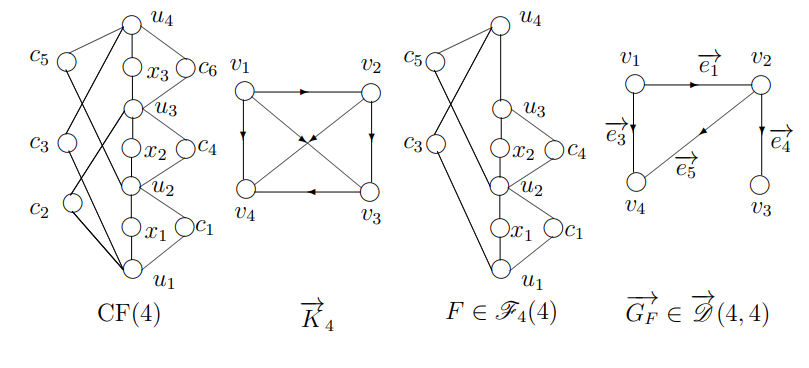
Now using Corollary 3.8 and Proposition 4.5, we get the following result.
Theorem 4.6. For \(n \geq 2\) and for fixed \(l\), \(\lfloor \frac{n+1}{2}\rfloor \leq l \leq \binom{n}{2}\), there is a one-to-one correspondence between \(\mathscr{F}_n(l)\) and \(\overrightarrow{\mathscr{D}}(n,l)\).
Proof. Define \(\phi : \mathscr{F}_n(l) \to \overrightarrow{\mathscr{D}}(n,l)\) by \(\phi(F) = \overrightarrow{G} ~ ( = \overrightarrow{G_F})\), for all \(F \in \mathscr{F}_n(l)\). By Proposition 4.5, \(\phi\) is a well defined map. Now using Theorem 4.3, Corollary 4.4 and Proposition 4.5, for each \(F \in \mathscr{F}_n(l)\), \(\psi_{F} : \mathscr{A}_F \to \overrightarrow{G}\) is a bijection, where \(\psi_F\) is a restriction of the bijective map \(\psi : \mathscr{A} \to \overrightarrow{K_n}\).
Let \(\overrightarrow{G} \in \overrightarrow{\mathscr{D}}(n,l)\). Then \(\overrightarrow{G}\) is a (directed) subgraph of \(\overrightarrow{K_n}\). Suppose \(V(\overrightarrow{G}) = V(\overrightarrow{K_n}) = \{v_1, v_2, \ldots , v_n\}\) and \(E(\overrightarrow{G}) = \{\overrightarrow{e_{q_1}}, \overrightarrow{e_{q_2}}, \ldots , \overrightarrow{e_{q_l}} \} \subseteq E(\overrightarrow{K_n}) = \{\overrightarrow{e_k} | k \in J_N\}\). By Theorem 2.8, \(\overrightarrow{e_k} = \overrightarrow{(v_i, v_j)}\) where \(k = (i-1)n – \binom{i}{2} + j – i\). Now suppose \(U = \psi^{-1} (V(\overrightarrow{G}))\) and \(J = \psi^{-1} (E(\overrightarrow{G}))\). Then there exists \(F \in \mathscr{F}_n(l)\) with \(\mathscr{A}_F = U \cup J\) such that \(\psi(\mathscr{A}_F) = \overrightarrow{G}\). Thus there exists \(F \in \mathscr{F}_n(l)\) with \(\mathscr{A}_F = U \cup J\) such that \(\phi(F) = \overrightarrow{G}\). Therefore \(\phi\) is a surjective map.
Let \(F_1, F_2 \in \mathscr{F}_n(l)\). Suppose \(\phi(F_1) = \overrightarrow{G_1}\), \(\phi(F_2) = \overrightarrow{G_2}\), and \(\overrightarrow{G_1} \cong \overrightarrow{G_2}\). By Corollary 3.8, suppose \(F_1 = C'_0 ]^{b_1}_{a_1}\{c_{q_1}\} ]^{b_2}_{a_2}\{c_{q_2}\} \cdots ]^{b_l}_{a_l}\{c_{q_l}\}\), where for each \(s, 1 \leq s \leq l \leq N = \binom{n}{2}\), \(a_s=u_i, b_s=u_j\) with \(q_s = (i-1)n-\binom{i}{2}+j-i\), \(1 \leq i < j \leq n\), (\(q_1 < q_2 < \cdots < q_l\)), and \(C'_0\) is the chain containing chain \(C : u_1 \leq u_2 \leq \cdots \leq u_n\) of all reducible elements of \(\mathop{\mathrm{CF}}(n)\), and all those \(x_i \in X = C_0 \setminus C\) which satisfy \(x_i || c_{q_s}\) in \(F_1\) for \(q_s = (i-1)n-\binom{i}{2}+1\). Note that \(C_0\) is a maximal chain \(u_1 \prec x_1 \prec u_2 \prec x_2 \prec \cdots \prec u_{n-1} \prec x_{n-1} \prec u_n\) of \(\mathop{\mathrm{CF}}(n)\). Similarly by Corollary 3.8, suppose \(F_2 = C''_0 ]^{b'_1}_{a'_1}\{c_{r_1}\} ]^{b'_2}_{a'_2}\{c_{r_2}\} \cdots ]^{b'_l}_{a'_l}\{c_{r_l}\}\), where for each \(s\), \(1 \leq s \leq l \leq N = \binom{n}{2}\), \(a'_s=u_{i'}, b'_s=u_{j'}\) with \(r_s = (i'-1)n-\binom{i'}{2}+j'-i'\), \(1 \leq i' <j' \leq n\), (\(r_1 < r_2 < \cdots < r_l\)), and \(C''_0\) is the chain containing chain \(C : u_1 \leq u_2 \leq \cdots \leq u_n\) of all reducible elements of \(\mathop{\mathrm{CF}}(n)\), and all those \(x_i \in X = C_0 \setminus C\) which satisfy \(x_i || c_{r_s}\) in \(F_2\) for \(r_s = (i-1)n-\binom{i}{2}+1\).
As \(\overrightarrow{G_1} \cong \overrightarrow{G_2}\), \(\psi_{F_1}(\mathscr{A}_{F_1}) \cong \psi_{F_2}(\mathscr{A}_{F_2})\). As \(\psi\) is bijective, \(\psi^{-1}(\psi_{F_1}(\mathscr{A}_{F_1})) = \psi^{-1}(\psi_{F_2}(\mathscr{A}_{F_2}))\). That is, \((\psi^{-1} \circ \psi_{F_1})(\mathscr{A}_{F_1}) = (\psi^{-1} \circ \psi_{F_2})(\mathscr{A}_{F_2})\). Hence \(\mathscr{A}_{F_1} = \mathscr{A}_{F_2}\), since \(\psi^{-1} \circ \psi_{F_1}\) and \(\psi^{-1} \circ \psi_{F_2}\) are identity maps on \(\mathscr{A}_{F_1}\) and \(\mathscr{A}_{F_2}\) respectively. As \(\mathscr{A}_{F_1} = \mathscr{A}_{F_2}\), we have \(U \cup I_{F_1} = U \cup I_{F_2}\). This implies that \(I_{F_1} = I_{F_2}\), that is, \(\{[a_s, b_s] | 1 \leq s \leq l\} = \{[a'_s, b'_s] | 1 \leq s \leq l\}\).
Now suppose for fixed \(s\) where \(1 \leq s \leq l\), \([a_s, b_s] \cong [a'_t, b'_t]\) for some \(t, 1 \leq t \leq l\). Then \(a_s = a'_t\) and \(b_s = b'_t\). But \(a_s \prec c_{q_s} \prec b_s\) and \(a'_t\prec c_{r_t} \prec b'_t\). Therefore \(c_{q_s} = c_{r_t}\), and hence \(q_s = r_t\). Thus for all \(s, 1 \leq s \leq l\), there exists \(t\), where \(1 \leq t \leq l\) such that \(c_{q_s} = c_{r_t}\). Therefore \(Y_{F_1} = Y \cap {F_1} \subseteq Y_{F_2} = Y \cap {F_2}\), where \(Y = \{c_k | k \in J_N\}\). Similarly, we can prove that \(Y_{F_2} \subseteq Y_{F_1}\). Therefore \(Y_{F_1} = Y_{F_2}\). Hence by Remark 3.9, \(F_1 \cong F_2\). Thus \(\phi\) is an injective map. ◻
Note that, for every \(\overrightarrow{G} \in \overrightarrow{\mathscr{D}}(n,l)\), there is a unique \(G \in {\mathscr{D}}(n,l)\) which is obtained from \(\overrightarrow{G}\) by removing direction of each edge \(\overrightarrow{e} \in \overrightarrow{G}\). Also for every \(G \in {\mathscr{D}}(n,l)\), there is a unique \(\overrightarrow{G} \in \overrightarrow{\mathscr{D}}(n,l)\) with \(V(\overrightarrow{G}) = V(G)\), and \((v_i, v_j) = \overrightarrow{e_k}\) is a directed edge in \(\overrightarrow{G}\) whenever \(k = (i-1)n-\binom{i}{2}+j-i\), \(1 \leq i < j \leq n\). Thus there is a one-to-one correspondence between \({\mathscr{D}}(n,l)\) and \(\overrightarrow{\mathscr{D}}(n,l)\). Thus by Theorem 4.6, we get the following main result.
Theorem 4.7. For \(n \geq 0\) and for fixed \(l\), \(\lfloor \frac{n+1}{2}\rfloor \leq l \leq \binom{n}{2}\), there is a one-to-one correspondence between \(\mathscr{F}_n(l)\) and \(\mathscr{D}(n,l)\), that is, \(f(n, l) = d(n, l)\).
Thus from Theorem 4.7, it clearly follows that the sequences \((f(n, l))\) and \((d(n, l))\) are equivalent.