
Sports industry is a collection of economic type activities that provide sports products and services for the society and the people, including sports product production, sports service activities and operation and many other contents [1,4, 20]. At present, there are some shortcomings in the business model of sports industry. The first is that the income of sports industry is not stable, the main income of traditional sports industry comes from advertising, but with the gradual increase of copyright fees, many famous portals have withdrawn, resulting in a serious decline in the economic income of the sports industry, which affects the commercial operation [7,9, 17,22]. Secondly, the promotion degree of the sports industry is not enough, limited by the traditional forms of promotion, its promotion is not large enough, the publicity is not wide enough, the publicity and dissemination time can not maintain the continuity, and thus the user stickiness is not strong, which is not conducive to the development of the business model [3, 10,14,16]. Furthermore, the slow expansion of the sports industry, the saturated industrial development situation has led to a lack of innovation power in the business model, affecting the further development of the sports industry [2,5, 11,18]. Finally, the structure of the sports industry is unclear, lack of detailed division, the organisational structure does not have a unified management standard, resulting in problems such as structural fragmentation and the inability to effectively control funds [13, 23,24].
Under the current background of the new technological revolution and industrial change, the digital economy is developing rapidly, and the sports industry, which benefits from multiple favourable policies, also shows rapid development [6,21]. However, on the road of high-quality development, the sports industry is facing many challenges and dilemmas while enjoying the dividends brought by the digital economy [8,15]. Therefore, the use of deep learning technology to establish a sports industry business model and analyse it aims to provide solid theoretical support and practical guidance for the lasting development of the sports industry business model.
This paper takes the innovation of sports industry business model as the research purpose, and breaks through to construct the type of business model that can have general guiding significance for the development of sports industry. For the first time, it systematically and comprehensively depicts the process of business model design in the sports industry, as well as the four stages of business model evolution in the sports industry, providing reference for enterprise decision makers. For the first time, it interprets the state of evolution of the sports industry business model itself from the perspective of knowledge dynamics, utilizes the enhanced learning mechanism to guide the innovation of the sports industry business model, and shapes the cognitive preferences and learning paths of industrial creativity. Taking Company H as the research object, the background and process of sports business model transformation are explained, and the association between business model transformation and enterprise performance is explored.
The existence of a business model cannot be separated from the influence of its business environment, and the construction of the business model of the sports industry focuses on the study of two issues, one is the elements of the business model, and the other is the logical relationship between these elements. To accurately answer this question, we need to first be clear about the evolution of the business model, and what is the connotation and core logic of the current business model []. Summarize about the business model research process, business has experienced the following stages of evolution. Summarize China’s reform and opening up more than 60 years of research on the business model of the sports industry, experienced from the “modular” to “logical” evolution, can be divided into four stages.
The first stage is the simple description stage, which is a simple listing of the sports industry business model from the perspective of the businessman, and its purpose is to make the public understand the concept of the sports industry business model and the specific essence of the connotation that it contains, and therefore to describe and list out the various aspects involved.
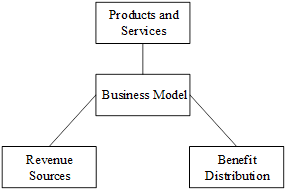
Adopting the form of simple listing, the complex sports industry business model system is constructed as shown in Figure 1. The sports industry business model shown to people belongs to the concept of conformity and contains three aspects:
The first is the system structure of products (sporting goods such as basketball, table tennis, etc.), services (providing sports services such as stadiums) and information flow (sports competitions, etc.), including the portrayal of the main players of various sports business activities and the roles they play.
The second is a description of the distribution of benefits among the participants in the conduct of these activities.
The third is a description of the specific points of profitability and sources of income from these activities.
The second stage is on the basis of the first stage, entering the stage of detailed description, but the stage still belongs to the modularization description stage, that is, the elements of the formed sports industry business model are united, and the second stage of the construction of the sports industry business model is also known as the bridge linkage model as shown in Figure 2. It takes customer interface, core strategy, strategic resources, and value network, which constitute the four elements of sports industry business model, while the four elements are composed of several sub-elements.
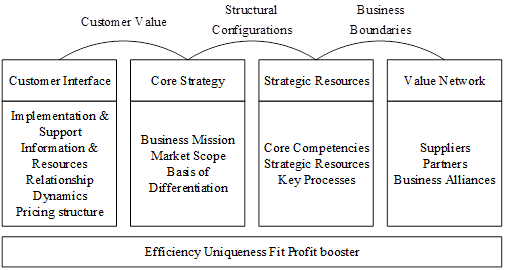
The four elements are connected by three “bridge-like” elements: customer value, structural configuration, and enterprise boundary, which is why the model is called the “bridging model”. Customer value is to solve what products (services) to provide to customers, through the structure of the allocation of the company’s core resources to maintain the key strategy, and finally through the corporate boundaries of the bridge to solve the external cooperation and upstream and downstream relationship between the enterprise resources. All of this is based on four elements: efficiency, uniqueness, matching, and profit-boosting tools.
The third stage that the business model of the sports industry enters is also called the network modeling stage. The model is refined and organized from 14 kinds of business model elements to form a system of 9 elements, and the business model of the sports industry at this stage is called BML model as shown in Figure 3. The model is relatively comprehensive to sort out the business model elements, and more practical to respond to all aspects of the business behavior of enterprises. Among them, it includes four segments, namely infrastructure, finance, product (service) provision and customers, as well as nine major elements to comprehensively show the whole process of business. The model is also the most widely used business model by major sports enterprises. However, the model has many elements, presenting a “fruit basket” structure, which only lists the elements and does not reflect the specific internal logical relationship and influence relationship.
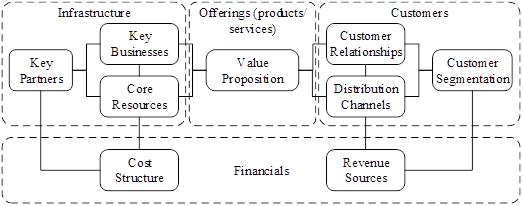
Compared with the previous two phases, the expression of business model in the third phase is logically shaped, and for the first time, technological innovation and business model innovation are summarized and defined. This business model innovation represents a new dimension of innovation, where the business model plays the role of a schematic construction of meaning, which is enough to prompt mature enterprises to filter information and recognize new business models that are fundamentally different from their own.
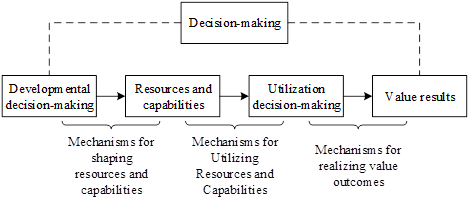
The fourth stage continues to dynamize the sports industry business model on the basis of the logistic analysis. By adopting rooted analysis, discovering theories from actual cases, visiting an actual enterprise to code and parse the data, and refining the propositions and concepts, the fourth stage of the business model of the sports industry is finally proposed as shown in Figure 4. Reviewing the stage evolution of the business model of the sports industry, it has shifted the focus from the merchant to the customer, and developed the arrangement of static business model elements to the construction of logical relationships among dynamic business model elements. The customer is placed at the core level, and all business behaviors revolve around the customer. Such a business model structure is in line with the current market characteristics and actuality, and it provides ideas and directions for the innovation of business model of sports industry in this paper.
From the perspective of knowledge dynamics, the development of the sports industry is actually a process of knowledge growth that encompasses the knowledge learning process of all sports enterprises. In the sports industry, the internal coordination mechanism is committed to constructing common perceptions and expectations to eliminate the uncertainty of individual interactions, and the prerequisite for the establishment of such common perceptions and expectations is the sharing of knowledge and consistent interpretation. This creates a learning environment among enterprises within the sports industry, which facilitates knowledge exchange and knowledge accumulation among enterprises.
In the process of the evolution of the sports industry business model itself, knowledge learning occupies its own important position and is the main driving force behind the development of the model from the first stage to the fourth stage. When we look at the micro-evolution of the sports industry, we can find the rise and fall of different enterprise states in the sports industry, and the key variable of this enterprise state is the state of knowledge, which mainly includes the stock of knowledge (such as the scale and richness of knowledge) and the structure of knowledge (such as the combination structure of explicit and tacit knowledge, and the combination structure of generalized and specialized knowledge, etc.). The learning process, on the other hand, is the main motive and driver of the change of knowledge state in the sports industry.
Sports industries are heterogeneous, their knowledge needs and knowledge accumulation methods are different, their learning methods and mechanisms are also different, and in different environments, the same creative enterprises will choose different learning methods and learning mechanisms. Regardless of whether the learning of creative enterprises is implicit learning or explicit learning, innovative learning or imitative learning, trial-and-error learning or searching learning, the learning of the sports industry will be originated from and attributed to cognition. From this point of view, the classification of learning, the learning mechanism of the sports industry can be divided into three categories, reinforcement learning (also known as unconscious learning), practice learning (also known as weak consciousness learning) learning and belief learning (also known as strong consciousness learning).
This paper focuses on the optimization mechanism of reinforcement learning on the business model of the sports industry. Reinforcement learning, which can also become unconscious learning, refers to the fact that the sports industry uses benefits as a criterion to determine future learning behaviors. When the current learning activities of the sports industry can bring higher benefit performance, such learning activities will continue. On the contrary, if the benefit performance is low, the sports industry will adjust the learning activity. In other words, the probability of implementing a particular learning activity in the sports industry is directly proportional to the benefits it brings. Creativity is a kind of complex knowledge activity, which has a strong pursuit of recognition itself, once recognized and obtaining high efficiency, this kind of reinforced learning tendency will be formed naturally in the sports industry, which in fact responds to a kind of self-sustainability of the sports industry’s usability adaptation in time. As an economic organization, the sports industry has the requirement of profit, and when the requirement is realized, it tends to maintain or expand this benefit, which is the internal power of reinforcement learning mechanism. Reinforcement learning is formed in the long-term evolution of the sports industry and persists due to its simplicity.
Reinforcement learning mechanisms reduce the degree of non-standardization and non-coding of knowledge and enhance the degree of sharing of knowledge and the consistency of its interpretation. The sports industry thus reduces cognitive distance and increases cognitive stickiness, enhancing the collectivist values and awareness of the creative enterprise. In the sports industry, when the entrepreneur identifies this enhanced learning among creative employees, especially in the creative core, he can consciously guide and shape the cognitive preferences and learning paths of creative employees. This process can be represented by the following mathematical model [12]:
Suppose \(a\) represents a certain behavior in the sports industry and \(p\left(a,t\right)\) represents the probability of \(a\) the behavior occurring at the \(t\) moment. At the \(t\) moment, if the behavior can bring positive benefits to the sports industry, then there is \(\Pi \left(t\right)>0\). Conversely, there is \(\Pi \left(t\right)<0\).
\(V\left[\Pi \left(t\right)\right]\) denotes the utility function of the perpetrator of the behavior, when the behavior can bring positive benefits \(\left(\Pi \left(t\right)>0\right)\) to the sports industry at the \(t\) moment, \(V\left[\Pi \left(t\right)\right]\) is a monotonically increasing function. Then when the behavior \(a\) brings positive benefits \(\left(\Pi \left(t\right)>0\right)\) and negative benefits \(\left(\Pi \left(t\right)<0\right)\) to the sports industry at the moment \(t\), the probability equations of the behavior occurring at the moment \(t+1\) are respectively: \[\label{GrindEQ__1_} p\left(a,t+1\right)=p\left(a,t\right)+\left\{\begin{array}{ll} {v\left[\Pi \left(t\right)\right]\left[1-p\left(a,t\right)\right]} & {\text{if }a=a\left(t\right)} \\ {-v\left[\Pi \left(t\right)\right]p\left(a,t\right)} & {\text{if }a\ne a\left(t\right)} \end{array}\right.\tag{1}\] \[\label{GrindEQ__2_} p\left(a,t+1\right)=p\left(a,t\right)+\left\{\begin{array}{ll} {-v\left[-\Pi \left(t\right)\right]p\left(a,t\right)} & {\text{if }a=a\left(t\right)} \\ {v\left[-\Pi \left(t\right)\right]\frac{p\left(a,t\right)p\left[a\left(t\right),t\right]}{1-p\left[a\left(t\right),t\right]} } & {\text{if }a\ne a\left(t\right)} \end{array}\right.\tag{2}\]
When behavior \(a\) brings positive benefits to the sports industry at moment \(t\), the probability of \(a\) occurring at moment \(t+1\) increases.
And when behavior \(a\) brings negative benefits to the sports industry at moment \(t\), the probability of \(a\) occurring at moment \(t+1\) decreases.
Combining these two cases, a reinforcement learning mechanism equation that covers both positive and negative benefits can be obtained: \[\label{GrindEQ__3_} p\left(a,t+1\right)=p\left(a,t\right)+\left\{\begin{array}{ll} {v\left[\Pi \left(t\right)\right]\left[1-p\left(a,t\right)\right]} & {\text{if }a=a\left(t\right)\wedge \Pi \left(t\right)\ge 0} \\ {-v\left[-\Pi \left(t\right)\right]p\left(a,t\right)} & {\text{if }a=a\left(t\right)\wedge \Pi \left(t\right)<0} \\ {-v\left[\Pi \left(t\right)\right]p\left(a,t\right)} & {\text{if }a\ne a\left(t\right)\wedge \Pi \left(t\right)\ge 0} \\ {v\left[-\Pi \left(t\right)\right]\frac{p\left(a,t\right)p[a\left(t\right),t]}{1-p\left[a\left(t\right),t\right]} } & {\text{if }a\ne a\left(t\right)\wedge \Pi \left(t\right)<0} \end{array}\right.\tag{3}\]
The above equation indicates that when the benefits that behavior \(a\) can bring to the sports industry are positive, the probability of its subsequent occurrence will increase. Conversely, the probability of its occurrence will gradually decrease. However, the same behavior may not always lead to the same benefit outcome, and here we consider two scenarios:
1) If the behavior occurs many times and each time brings positive benefits, the probability of its occurrence will tend to be 1, and then the behavior will become the behavioral tendency preference in the sports industry.
2) If the behavior occurs many times and each time brings negative benefits, the probability of its occurrence will tend to 0, and then the behavior will become the behavioral avoidance preference in the sports industry.
Founded in 2012 in Hainan, China, Company H is a company specializing in the field of sports and culture. The company’s vision is to bring sports back to its roots and provide people with active, healthy and enjoyable lifestyles through sports events and activities and the dissemination of sports culture. The subject of the study is currently the only soccer club in Hainan that has a high-level foreign head coach such as Euro A level, and the business model is also a more advanced model than other clubs of the same level. In 2017, Company H’s business transformation, the introduction of European soccer youth training system, the establishment of soccer clubs to carry out youth training business. With the gradual liberalization of the epidemic policy, the introduction of the European scientific training system and training, the hiring of the Portuguese European A-level soccer head coach, the opening of a professional soccer offline training courses, and the simultaneous development of interest cultivation for the purpose of online soccer live accompaniment business. Help students to improve sports skills, cultivate sports interest, and provide students with the opportunity to learn and communicate with advanced European soccer culture.
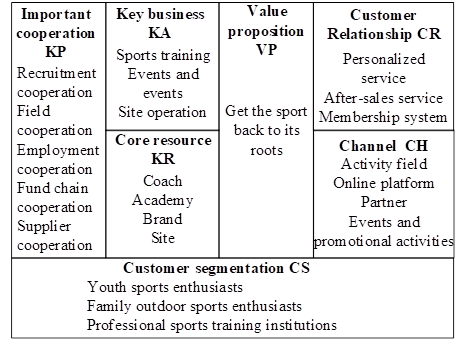
The business model canvas model consists of nine elements: value proposition, core resources, key business, key partners, customer segmentation, distribution channels, customer relationships, cost structure, and revenue sources, and these nine elements combined with the improved lean canvas model can be summarized into the value proposition, market logic, and product logic of the three dimensions of the business model.Company H’s existing business model canvas is shown in Figure 5, where the value proposition is in the middle of the canvas and plays the role of connecting the market logic and product logic. The value proposition is in the middle of the canvas and plays the role of connecting the market logic and product logic. the value proposition of Company H is “let sports return to the true nature”, focusing on providing sports scenes to meet the needs of family outdoor sports and healthy lifestyles, and the philosophy of its clubs is “sports come from love”, providing professional sports and sports activities. At the same time, its clubs, with the concept of “sports come from love”, provide professional sports training and guidance to meet the needs of customers for career development in sports.
In Enterprise H’s business model the market logic is the bridge for the effective operation of the whole business model, which is mainly composed of four elements: customer segmentation, channel access, customer relationship, and revenue source, and its logical relationship is shown in Figure 6.
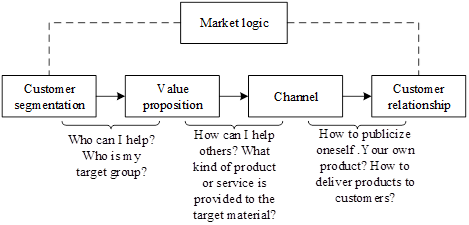
The following is the current status of each element of Company H’s market logic in its market operations:
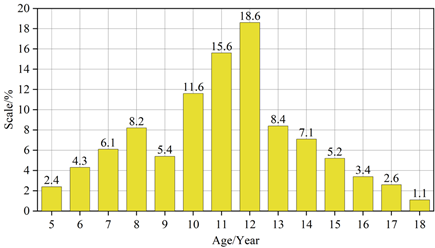
For the customer segmentation of Company H, the target market is grouped as follows according to different characteristics and needs. Youth Sports Enthusiasts Youths in the age range of 5 to 18 years old, this segment of customers is the main audience of the training segment. The specific distribution is shown in Figure 7, which shows that teenagers aged 10 to 12 years old are the important target customers in the training market, accounting for 45.8% of the total.
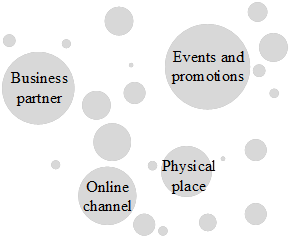
Company H’s channels are divided into online and offline, mainly relying on offline traditional channels to get traffic. Also the conversion rate is higher for event promotions and activities in offline channels, followed by conversions from partner channels. The online channel Xiaohongshu has the highest conversion, and the natural traffic from physical places is the lowest. Channel conversions are shown in Figure 8, where the larger the area the higher the conversion rate. It can be seen that the larger the area of events and promotions, that is, it means that the events and promotions are the highest.
Company H focuses on building a good relationship with its customers and meeting their individual needs by providing personalized exercise programs such as private lessons and instant leagues. Regular communication and feedback mechanisms, as well as ways to build trust and interaction.
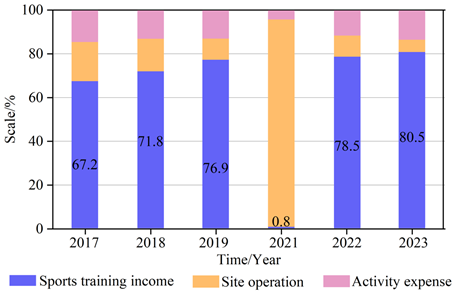
HB’s revenue sources are mainly composed of three parts: venue operation revenue, sports training revenue, and activity revenue. The revenue share of each part is shown in Figure 9, of which part of the data is not included in the study because the company as a whole is in a state of shutdown due to the epidemic during the period of 2020-2021.In 2021, as the training business is in a state of shutdown, the revenue from this business only accounts for about 1%. It can be seen that the proportion of sports training revenue in the total revenue gradually increases to 80.5%.
In the business model of an enterprise the product logic is the bulwark of the effective operation of the whole business model, which is mainly composed of three elements: core resources, key business, and cost structure. The following is the specific status quo of each element of product logic in Company H’s actual business activities:
The first part is the cooperation resources of institutions and clubs, including the European soccer youth training system, Portuguese youth training club cooperation resources, with direct access to European soccer training.
The second part is human resources, including European A-level head coach and coaching team, professional club operation team.
The third part is other resources, including brand reputation and training venues. These resources provide the Company with the necessary foundation to conduct sports training and activities that support the Company’s operations and service delivery.
The fees charged by the sports training business are shown in Table 1, with the age range of the business being 5-18 years old, divided into three groups: pre-school (U5- U7), elementary school (U8-U13) and secondary school (U13-18). There are year-round and half-yearly fees, and fees are charged according to age groups. The types of courses are divided into interest classes and elite classes, with two practices a week, a single session of 1 hour, and elite classes on weekends, with a relative 20% increase in fees.
| Course type | U5-U7 | U8-U13 | U13-U18 | Personal coach | ||
|---|---|---|---|---|---|---|
| Price | Simple section | Original price | 125\(\mathrm{\yen}\) | 150\(\mathrm{\yen}\) | 180\(\mathrm{\yen}\) | 300\(\mathrm{\yen}\) |
| Membership price | 115\(\mathrm{\yen}\) | 138\(\mathrm{\yen}\) | 165\(\mathrm{\yen}\) | 250\(\mathrm{\yen}\) | ||
| Single season | Class 30 | 3560\(\mathrm{\yen}\) | 4080\(\mathrm{\yen}\) | 4950\(\mathrm{\yen}\) | No | |
| Annual | Class 60 | 6200\(\mathrm{\yen}\) | 7150\(\mathrm{\yen}\) | 9200\(\mathrm{\yen}\) | No | |
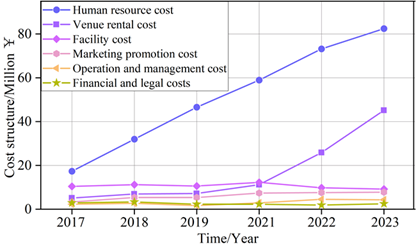
Company H’s costs include human resources, site rental, equipment and facilities, marketing and promotion, operations and management, training materials and activities, finance and legal affairs, etc., and the percentage of each cost is shown in Figure 10. The company’s main cost expenditure is in the part of human resources and site leasing, which accounts for more than 80% of the total.
In 2017, Company H carried out business model transformation and upgrading, and proposed the business model of “single focus, multi-brand, omni-channel” based on the enhanced learning mechanism. According to the 2017 annual report of Company H, the operating income of the enterprise reached 1.053 billion yuan, an increase of 19.52% compared with 2016. In the context of the slow growth of the industry as a whole, the continued growth of H Company’s operating income has brought light to the development of the industry. The creation of a complete business model of “single focus, multi-brand, omni-channel” has given Company H a stronger anti-risk ability.
Company H continues to invest more in R&D, and actively chooses this “single-focus” strategy, which is to focus on core competencies while improving the company’s risk resistance.
Consumer-oriented, each brand not only meets the needs of consumers with different positioning, but also provides consumers with a better experience, as shown in Table 2, Company H’s multi-brand product layout, which has cooperated with a number of brands such as Spandex, Dysant, Kolon Sports, Amber Sports, etc., in 2017, so as to realize that different products meet the needs of different consumers, and thus to consolidate the utility of the Group’s multi-brand strategy.
| Brand | Establish time for cooperation | Domain |
|---|---|---|
| ANTA | 2017-01-27 | Running, basketball and other functional sporting goods |
| ANTA KIDS | 2017-01-27 | Children’s sporting goods |
| FILA | 2017-02-24 | Sports fashion clothing |
| FILA KIDS | 2017-02-24 | Children’s sports fashion clothing |
| FILA FUSION | 2017-02-24 | Young fashion |
| DESCENT | 2017-05-30 | Comprehensive training and running high performance |
| SPRANDI | 2017-07-16 | Comfortable, high-tech fashion sneakers |
| KOLON SPORT | 2017-08-31 | Outdoor sporting goods |
| KING KOW | 2017-10-06 | Fashion items for children |
| NBA | 2017-12-19 | Functional and recreational basketball sporting goods |
Under the “multi-brand” model, Company H offers a variety of differentiated products to appeal to specific consumer segments. The multi-brand strategy has always aimed to satisfy the needs of all consumers through a combination of sponsorship resources, advertising and different product displays.
The rapid development of the Internet has made online sales one of the most important channels in corporate distribution, and Company H has successfully realized a multi-dimensional online and offline sales model under the “omni-channel” model. It has been adhering to the concept of omni-channel marketing, realizing the full coverage of offline stores, stores, department stores, etc., and at the same time, with the help of the Internet model, operating its brand official mall, but also through the small red book and other online and offline dual channels.
The comparative analysis of enterprise scale before and after the transformation of business model of Company H is shown in Table 3. In 2012, the market share of Company H was 5.2%, and in 2015, driven by the business model of “brand+retail” in 2013, its market share increased by 1.5%. Subsequently, the business model transformation and upgrading was carried out again in 2017, and its market share reached 16.9% in 2023. From 2016 to 2023, Company H’s market share increased by 80%, and the competitiveness of the enterprise in the industry was further strengthened, which also shows that the business model transformation and upgrading has played a positive role in the enterprise’s market capture.
| Year | Total assets (Millions \(\mathrm{\yen}\)) | Operating income (Millions \(\mathrm{\yen}\)) | Net profit (Millions \(\mathrm{\yen}\)) | Market share (%) | Number of stores (stores) | Number of employees (N) |
|---|---|---|---|---|---|---|
| 2012 | 113.5 | 90.5 | 15.4 | 5.2 | 32 | 1052 |
| 2013 | 125.6 | 112.4 | 26.3 | 6.7 | 41 | 1187 |
| 2014 | 143.1 | 131.6 | 31.2 | 7.5 | 48 | 1078 |
| 2015 | 151.2 | 138.8 | 33.5 | 8.3 | 51 | 1108 |
| 2016 | 158.6 | 145.2 | 35.2 | 9.4 | 53 | 1234 |
| 2017 | 192.7 | 173.4 | 42.5 | 12.6 | 68 | 1294 |
| 2018 | 243.5 | 241.4 | 56.9 | 15.3 | 72 | 1356 |
| 2019 | 305.8 | 332.6 | 55.4 | 16.7 | 83 | 1527 |
| 2021 | 193.4 | 106.5 | 23.2 | 18.2 | 81 | 1406 |
| 2022 | 325.9 | 334.2 | 85.5 | 17.4 | 89 | 1734 |
| 2023 | 431.0 | 495.6 | 79.4 | 16.9 | 103 | 1892 |
The total assets of the enterprise were 158.6 million yuan in 2016, 192.7 million yuan in the year of transformation and upgrading, and with the implementation and development of the “single-focus, multi-brand, omni-channel” business model, the total assets owned by the enterprise in 2023 will be 431.0 million yuan. Operating income also increased from 145.2 million yuan in 2016 to 495.6 million yuan in 2023, an increase of 2.4 times through transformation and upgrading. The increase in operating income led to an increase in the company’s net profit, which increased by 125.57 percentage points compared with 2016. Due to the transformation of the business model, the increase in the type of enterprise products, and the blessing of multi-brand products, the number of offline stores of the enterprise has increased, and the number of employees has also increased.
Under the transformation of business model based on reinforcement learning, the important guarantee for sustainable development is the innovation with the purpose of creating new technology, or the innovation based on scientific and technological knowledge and the resources it creates – technological innovation capability. Technological innovation is the soul of the sports industry, one of the necessary conditions for the development of this enterprise, and an important prerequisite for industrialization.
Under the transformation of business model based on reinforcement learning, the management innovation ability of the enterprise is improved through the activities of establishing a series of new management systems such as experience concept, organizational structure, decision-making mechanism and incentive and constraint mechanism adapted to the socialist market economy. The management innovation ability of sports industry is to integrate resources from the aspects of sports product production, sports marketing and sports event organization, so as to improve the operation ability of sports industry and make the enterprise become a brand new “agile (refers to the ability of the enterprise to adapt to the ever-changing and unpredictable business environment)” business entity.
Resource integration ability is one of the advantages of the enhanced learning mechanism. In terms of integrating resources, vertical integration, horizontal integration and platform integration can be adopted. In vertical integration, the main focus is on the value chain of the enterprise, analyzing whether there are any external resources that can be utilized in the process of research and development, production, sales and other links to help the enterprise develop sustainably. In horizontal integration, it is mainly the role of resources in the same industry to complement and promote each other, and it can be used to shape the competitive advantage with strategic partnerships in the industry. Furthermore, the way of platform integration is the direction and trend of the current development of Chinese enterprises.
Under the strengthened learning mechanism, sports enterprises can establish a learning organization, whether in personal learning, organizational learning and continuous progress and growth. The purpose of creating a learning organization is to integrate work, learning and knowledge into one, and managers inspire and encourage employees to learn more through incentives and learning mechanisms. Organizational learning ability is one of the sustainable competitive advantages of enterprises.
This paper examines and analyzes the development of the sports industry from the perspective of its own evolution. Based on the reinforcement learning mechanism, it explores the main motivation and driver of the knowledge state change in the sports industry. Taking Company H as a case study, the business model transformation and upgrading is carried out, and the business model of “single focus, multi-brand, omni-channel” is proposed. Through further analysis of the transformed business model, we summarize the correlation between Company H’s business model and corporate performance, and reveal the necessity of business model transformation of Company H. Company H’s transformation strategy successfully promotes its further development in the sports industry, and promotes the transformation of its business model in terms of products and sales channels respectively. The all-round layout of multi-brand development, the production of differentiated products to meet the needs of different consumers, to enhance the competitiveness of the enterprise market. Company H’s business model transformation strategy can be used as a reference for other sports enterprises in their business model transformation.