
Public key cryptography is built on algebraic structures that support hard computational problems, most notably the discrete logarithm problem in finite fields and elliptic curves. Diffie-Hellman key exchange is among the earliest and most widely used public key cryptographic techniques [4, 5, 9]. The classical Diffie Hellman key exchange protocol, derives its security from the presumed intractability of computing discrete logarithms in cyclic groups. Over the past two decades, there has been growing interest in exploring alternative algebraic and combinatorial settings for cryptography, including non-abelian groups (such as braid groups, matrix groups, and Heisenberg groups) as well as number-theoretic sequences (such as Fibonacci, Lehmer, Pell, and Mersenne sequences). These directions are motivated both by the search for new hardness assumptions and by the potential to develop post-quantum secure primitives.
The Fibonacci and Lehmer sequences have been extensively investigated in number theory and have found applications in pseudorandom number generation and cryptography. Similarly, generalized Fibonacci-type sequences, including \(t\)-step recurrences, have been studied in algebraic structures and finite groups. However, the systematic combination of these sequences into hybrid constructions and their application in non-abelian groups for cryptographic purposes remains largely unexplored.
In this paper, we introduce Hadamard-type \(t\)-Fibonacci-Lehmer (HTFL) sequences, a new class of hybrid recurrences that generalize both Lehmer and \(t\)-step Fibonacci sequences. We prove that these sequences are simply periodic in the special case \(M = \pm 1\), and extend the construction to finite groups. We then focus on the Heisenberg group, a well-known non-abelian nilpotent group with applications in mathematics and physics, and show how HTFL sequences can be realized in this setting.
Definition 1.1. [13] For integers \(L, M\), and \(LM\neq 0\), \(L-4M\neq 0\), the Lehmer sequence \(\lbrace U_n(L,M)\rbrace_{n=0}^\infty\) is \[U_n(L,M)=\left \{ \begin{array}{ll} 0&n=0,\\ 1&n=1,\\ LU_{n-1}(L,M)-MU_{n-2}(L,M)& n \mbox{ odd},\\ U_{n-1}(L,M)-MU_{n-2}(L,M)& n \mbox{ even}. \end{array}\right.\]
Many studies have been conducted on the Lehmer sequence [2, 14, 24]. In [6], Lehmer sequences on finite groups were introduced and their period was studied. Three RSA algorithms were given in [17] based on the Lehmer sequences and Lehmer orbits on groups.
The \(t-\)Fibonacci sequence \(\lbrace F_n(t)\rbrace_{n=0}^\infty\) is defined as \[F_n(t)=F_{n-1}(t)+F_{n-2}(t)+\cdots+F_{n-t}(t), n\geq t,\] with initial conditions \(F_0(t)=F_1(t)=\cdots=F_{n-t-2}(t)=0\) and \(F_{n-t-1}(t)=1\) [10]. In [3], the Fibonacci length of certain centro-polyhedral groups was determined. The Fibonacci length of the 2-generator \(p-\)groups of nilpotency class 2 was given in [12].
In [19], a new generalization of the Fibonacci sequence was presented that gives the copper ratio. The generalized bronze Fibonacci sequences and their hyperbolic quaternions were obtained in [20] and the relationships between the roots of the characteristic equation of these sequences were given.
From [18] we have the following. For \(m,s,v \in Z\), the elements of the Heisenberg group \(H_{(m,s,v)}\) can be expressed in matrix form as \[\begin{bmatrix} 1&m&v+ms\\ 0&1&s\\ 0&0&1 \end{bmatrix}.\]
Lemma 1.2. Every element of \(H_{(m,s,v)}\) can be written uniquely in the form \(a^ib^jc^k\), where \(1\leq i\leq m, 1\leq j\leq s\) and \(1\leq k\leq v\).
The Hadamard-type product of polynomials \(f\) and \(g\) is defined as follows.
Definition 1.3. [1] The Hadamard-type product of polynomials \(f\) and \(g\) is \(f\ast g=\sum\limits_{i=0}^\infty(a_i\ast b_i)x^i\) where \[a_i\ast b_i=\left \{ \begin{array}{ll} a_ib_i,& \mbox{if } a_ib_i\neq 0,\\ a_i+b_i,& \mbox{if } a_ib_i= 0, \end{array}\right.\] and \(f(x)=a_mx^m+\dots+a_1x+a_0\) and \(g(x)=b_nx^n+b_{n-1}x^{n-1}+\dots+b_1x+b_0\).
The classical Diffie-Hellman key exchange relies on exponentiation in cyclic groups and A universal algebraic generalization of the Diffie-Hellman scheme was presented in [23]. Although numerous generalizations to alternative algebraic settings have been explored [7, 23]. In particular, Partala introduced the Algebraically Generalized Diffie–Hellman (AGDH) framework [23], which abstracts key exchange to any algebraic structure admitting suitable endomorphisms, and formalized security through the Homomorphic Image Problemma (HIP) and its decision and computational variants. AGDH highlights that the essential ingredient of Diffie–Hellman protocols is the existence of commuting actions that enable both parties to derive a common secret from partially shared information.
In [16], two algorithms were given for Diffie-Hellman key exchange based on the generalized Pell \(p-\)numbers and Mersenne numbers. Here, the HTFL sequences are used for Diffie-Hellman key exchange on the Heisenberg group.
While our mathematical results are rigorous, we present the cryptographic application primarily as a conceptual framework. A preliminary security discussion is given, and we outline directions for strengthening the protocols under formal hardness assumptions. Our contributions can be summarized as follows:
\(\bullet\) Definition and analysis of HTFL sequences: A hybrid of Lehmer and \(t\)-Fibonacci sequences with proven periodicity properties.
\(\bullet\) Extension to finite groups: Formalization of HTFL sequences in group settings, with emphasis on the Heisenberg group.
\(\bullet\) Cryptographic application: Two prototype Diffie-Hellman protocols using HTFL sequences in matrix form, together with initial security considerations.
Our work may be viewed as a concrete instantiation of this general paradigm. Specifically, we introduce Hadamard-type \(t\)-Fibonacci–Lehmer (HTFL) sequences and embed them into upper-triangular unipotent matrix groups, focusing on the Heisenberg model. In this setting, the commuting structure arises from matrix exponentiation with HTFL-parameterized elements. From this perspective, our protocols realize an instance of AGDH in a non-abelian group context, with hardness assumptions naturally corresponding to HIP in the HTFL–Heisenberg framework. Thus, while our scheme is specialized and sequence-driven, it aligns with the broader direction of algebraic generalizations of Diffie-Hellman and contributes a novel family of candidate constructions for study within this landscape.
The remainder of this paper is organized as follows: In Section 2, the Hadamard-type \(t-\)Fibonacci-Lehmer sequences are introduced and it is shown that they are simply periodic. The Hadamard-type \(t-\)Fibonacci-Lehmer sequences on a finite group are defined in Section 3 and they are studied on the Heisenberg group. In Section 4, the Hadamard-type \(t-\)Fibonacci-Lehmer sequences are used for Diffie-Hellman key exchange. Finally, Section 5 gives some concluding remarks.
In this section, we define new sequences and then obtain results that will be used in the following sections. The characteristic polynomials of the Lehmer and \(t-\)Fibonacci sequences are \[\left \{ \begin{array}{ll} x^2-Lx+M& n \mbox{ odd},\\ x^2-x+M& n \mbox{ even}, \end{array}\right.\] and \(x^t-x^{t-1}-\cdots-x-1\), respectively. From Definition 1.3 we have the following sequences.
For integers \(L, M, t\), and \(LM\neq 0\), \(L-4M\neq 0\), the Hadamard-type \(t-\)Fibonacci-Lehmer sequence, \(\lbrace UF_n^t(L,M)\rbrace_{n=0}^\infty\)
is
\[\begin{aligned}
&UF_n^t(L,M)=\\
&\left \{ \begin{array}{ll}
UF_{n-1}^t(L,M)+UF_{n-2}^t(L,M)+\cdots+UF_{n-t+2}^t(L,M)-LUF_{n-t+1}^t(L,M)+MUF_{n-t}^t(L,M)
& n \mbox{ odd},\\
UF_{n-1}^t(L,M)+UF_{n-2}^t(L,M)+\cdots+UF_{n-t+2}^t(L,M)-UF_{n-t+1}^t(L,M)+MUF_{n-t}^t(L,M)
& n \mbox{ even},
\end{array}\right.
\end{aligned}\] where \(UF_{0}^t(L,M)=0, UF_{1}^t(L,M)=1\), \(UF_{2}^t(L,M)=0\), and \(UF_{3}^t(L,M)=\cdots=UF_{t-1}^t(L,M)=1\).
For example, if \(M=1\) and \(t=3\) we have \[UF_n^3(L,1)= \left \{ \begin{array}{ll} UF_{n-1}^3(L,1)-LUF_{n-2}^3(L,1)+MUF_{n-3}^3(L,1) & n \mbox{ odd},\\ UF_{n-1}^3(L,1)-UF_{n-2}^3(L,M)+UF_{n-3}^3(L,1) & n \mbox{ even}, \end{array}\right.\]
Table 1 gives \(UF_n^3(L,1)\) for \(-10 \leq L\leq -1\) and \(0\leq n\leq 10\).
| \(n\) | 0 | 1 | 2 | 3 | 4 | 5 | 6 | 7 | 8 | 9 | 10 |
|---|---|---|---|---|---|---|---|---|---|---|---|
| \(L=-1\) | 0 | 1 | 0 | 2 | 3 | 2 | 7 | 8 | 17 | 16 | 41 |
| \(L=-2\) | 0 | 1 | 0 | 2 | 3 | 7 | 6 | 23 | 24 | 76 | 75 |
| \(L=-3\) | 0 | 1 | 0 | 3 | 4 | 13 | 12 | 55 | 56 | 233 | 232 |
| \(L=-4\) | 0 | 1 | 0 | 4 | 5 | 21 | 20 | 109 | 110 | 565 | 2939 |
| \(L=-5\) | 0 | 1 | 0 | 5 | 6 | 31 | 30 | 191 | 197 | 1177 | 1176 |
| \(L=-6\) | 0 | 1 | 0 | 6 | 7 | 43 | 42 | 307 | 308 | 2192 | 2191 |
| \(L=-7\) | 0 | 1 | 0 | 7 | 8 | 57 | 56 | 463 | 464 | 3761 | 3760 |
| \(L=-8\) | 0 | 1 | 0 | 8 | 9 | 73 | 72 | 665 | 666 | 6058 | 6057 |
| \(L=-9\) | 0 | 1 | 0 | 9 | 10 | 91 | 90 | 919 | 920 | 9281 | 9280 |
| \(L=-10\) | 0 | 1 | 0 | 10 | 11 | 111 | 110 | 1231 | 1232 | 13652 | 13651 |
Theorem 2.2. For \(t\geq 3\) and \(M=\pm 1\), the sequence \(\lbrace UF_n^{t}(L,M) \rbrace\) is simply periodic.
Proof. Let \(X_{t}=\lbrace (x_1,x_2, \cdots, x_{t}) \mid x_i \in \mathbb{N}\) and \(1\leq x_{t}\leq \alpha \rbrace\) so then \(\mid X_{t} \mid = \alpha^{t}\). Since there are only a finite number of possible pairs of \(\alpha^{t}\), the sequence must repeat. We then have that \(\lbrace UF_n^{t}(L,M) \rbrace\) is periodic. Otherwise, assume that \(M=\pm 1\). Then for \(i\geq 0\), there exist \(i \geq j\) such that \[\begin{aligned} UF_{i+t}^{t,\alpha}(L,M)&\equiv UF_{j+t}^{t,\alpha}(L,M), UF_{i+t-1}^{t,\alpha}(L,M)\\ &\equiv UF_{j+t-1}^{t,\alpha}(L,M),\cdots,UF_{i}^{t,\alpha}(L,M)\equiv UF_{j}^{t,\alpha}(L,M). \end{aligned}\]
From the definition of the HTFL sequences we have \[\begin{aligned} UF_{i+t-j}^{t,\alpha}(L,M)&\equiv UF_{t}^{t,\alpha}(L,M), UF_{i+t-1-j}^{t,\alpha}(L,M)\\ &\equiv UF_{t-1}^{t,\alpha}(L,M),\cdots,UF_{i-j}^{t,\alpha}(L,M)\equiv UF_{0}^{t,\alpha}(L,M). \end{aligned}\]
Thus, the HTFL sequences are simply periodic. ◻
Let \(FK_\alpha^{t}(L,M)\) denote the minimal period of the HTFL sequences modulo \(\alpha\).
Theorem 2.3. (i) We have \(\lbrace UF_n^{3,5}(-3,1) \rbrace=\lbrace 0,1,0,3,4,3,2,\cdots,0,1,0,3, \cdots \rbrace\). Thus, \(UF_{0}^3(-3,1)\equiv UF_{40}^3(-3,1), UF_{1}^3(-3,1)\equiv UF_{41}^3(-3,1), UF_{2}^3(-3,1)\equiv UF_{42}^3(-3,1)\), and so \(FK_5^{3}(-3,1)=40\).
(ii) We have \(\lbrace UF_n^{3,7}(-4,1) \rbrace=\lbrace 0,1,0,4,5,0,6,4\cdots,0,1,0,4, \cdots \rbrace\) and \(UF_{0}^3(-4,1)\equiv UF_{12}^3(-4,1), UF_{1}^3(-4,1)\equiv UF_{13}^3(-4,1), UF_{2}^3(-4,1)\equiv UF_{14}^3(-4,1)\). Therefore, \(FK_7^{3}(-4,1)=12\).
Lemma 2.4. For \(t \geq 3, M=\pm 1, n\geq 2\), and \(i, j\), we have
(i) \(UF_{FK_n^{t}(L,M)+i}^t(L,M)=UF_i^t(L,M) \ (\mathrm{mod}\ n)\),
(ii) \(UF_{j\times FK_n^{t}(L,M)+i}^t(L,M)=UF_i^t(L,M) \ (\mathrm{mod}\ n).\)
Proof. (i) The result follows from the definition of the minimal period of the HTFL sequences modulo \(n\).
(ii) We have \[UF_{jFK_n^{t}(L,M)+i}^t(L,M)=UF_{FK_n^{t}(L,M)+(j-1)FK_n^{t}(L,M)+i}^t(L,M)=\cdots= UF_i^t(L,M).\] ◻
Corollary 2.5. For \(t\geq 3, M=\pm 1\), and \(v\) an integer, if \[\left \{ \begin{array}{ll} UF_v^t(L,M)\equiv 0& \ (\mathrm{mod}\ \alpha),\\ UF_{v+1}^t(L,M)\equiv 1& \ (\mathrm{mod}\ \alpha),\\ UF_{v+2}^t(L,M)\equiv 0& \ (\mathrm{mod}\ \alpha),\\ UF_{v+3}^t(L,M)\equiv 1& \ (\mathrm{mod}\ \alpha),\\ \vdots\\ UF_{v+t-1}^t(L,M)\equiv 1& \ (\mathrm{mod}\ \alpha),\\ \end{array}\right.\] then \(FK_\alpha^{t}(L,M)|v\).
Proof. Let \(v=s \times FK_\alpha^{t}(L,M)+i\) where \(0\leq i< FK_\alpha^{t}(L,M)\). Since \(FK_\alpha^{t}(L,M)\) is the smallest integer such that the assumption holds, the result follows from Lemma 2.4. ◻
In this section, we define the HTFL sequences in finite groups and prove that they are simply periodic. We also study these sequences on the group \(H_{(k,s,m)}\). The Hadamard-type \(t-\)Fibonacci-Lehmer sequences in a finite group are defined as follows.
Definition 3.1. For \(t\geq 3\) and integers \(L, M\), and \(LM\neq 0\), \(L-4M\neq 0\), a Hadamard-type \(t-\)Fibonacci-Lehmer sequence on a finite group is a sequence of group elements \(x_0, x_1, \cdots, x_n, \cdots\), given an initial (seed) set \(X=\lbrace a_1,a_2,\cdots,a_j\rbrace\) where \(j\geq 3\), is \[\label{eq3.1} x_{i+1}=\left \{ \begin{array}{ll} a_j, & i+1\leq j,\\ (x_{i-t+1})\cdots x_{i-2}(x_{i-1})^{-L}(x_{i})^M,& i \mbox{ even},\\ (x_{i-t+1})\cdots x_{i-2}(x_{i-1})^{-1}x_{i}^M,& i \mbox{ odd}.\\ \end{array}\right. \tag{1}\]
The elements of the Hadamard-type \(t-\)Fibonacci-Lehmer sequences in a finite group are denoted by \(UF_t^{L,M}(G)\) and the corresponding period is \(PF_t^{L,M}(G)\).
Theorem 3.2. The Hadamard-type \(t-\)Fibonacci-Lehmer sequences in a finite group are simply periodic if \(M=\pm 1\), and periodic otherwise.
Proof. Let \(G\) be a \(j-\)generator group and \((a_0,a_1,\cdots,a_{j-1})\) be a generating \(j-\)tuple for \(G\). If \(\mid G\mid=m\), then there are \(m^j\) distinct \(j-\)tuples of elements of \(G\) which implies that this subsequence repeats, i.e. the sequence is periodic. For simply periodic, there exist \(r\) and \(s\) in \(\mathbb{N}\) with \(s>r\) such that \(x_{s}=x_{r}, x_{s+1}=x_{r+1},\cdots, x_{s+t}=x_{r+t}\). From Definition 3.1, \(x_{s-r}=x_{0}, x_{s-r+1}=x_{1},\cdots, x_{s-r+t-1}=x_{t-1}\), so \(UF_t^{L,M}(G)\) is simply periodic. ◻
For \(M=1\), we study the Hadamard-type \(3-\)Fibonacci-Lehmer sequences on the finite group \(H_{(m,s,v)}\) with respect to \(X=\lbrace a,b,c\rbrace\) and obtain that \(FK_s^t(L,1)\) divides \(PF_3^{L,1}(H_{(m,s,v)})\) when \(L<0\). Let \(UF_n(L):= UF_n^3(L,1)\) and consider the following sequences \[T_0(L)=1, T_1(L)=0, T_2(L)=0,\] \[T_{n+1}(L)=\left \{ \begin{array}{ll} T_{n-2}(L)+LT_{n-1}(L)+T_{n}(L),& n \mbox{ even},\\ T_{n-2}(L)-T_{n-1}(L)+T_{n}(L),& n \mbox{ odd}, \end{array}\right.\] and \[w_0(L)=w_1(L)=0, w_2(L)=1,\] \[w_{n+1} (L)\left \{ \begin{array}{ll} w_{n-2}(L)-w_{n-1}(L)+w_{n}(L)-(T_{n}(L)-T_{n-1}(L))(UF_{n-2}(L)-UF_{n-1}(L) ),& n \mbox{ odd},\\ w_{n-2}(L)+Lw_{n-1}(L)+w_{n}(L)-(T_{n-1}(L)UF_{n-2}(L)+T_{n-1}(L)(UF_{n-2}(L)+UF_{n-1}(L))\\ +\cdots+T_{n-1}(L)(UF_{n-2}(L)+(L-1)UF_{n-1}(L))+T_{n}(L)(UF_{n-2}(L)+LUF_{n-1}(L))), & n \mbox{ even}. \end{array}\right.\]
Lemma 3.3. For \(L<0\) and \(M=1\), every element of the Hadamard-type \(3-\)Fibonacci-Lehmer sequences \(UF_3^{L,1}(H_{(m,s,v)})\) can be written in the form \(x_n=a^{T_n(L)}b^{UF_{n}(L)}c^{w_n(L)}, n\geq 3\).
Proof. For \(n = 3\) and \(n = 4\), we have \(x_3 =x_0x_1x_2=ab^Lc\) and \(x_4 =x_1x_2x_3=bc^{-1}(ab^Lc)=ab^{L+1}c^{-1}\). Then by induction on \(n\), if \(n\) is even we have \[\begin{aligned} x_{n+1}&=x_{n-2}x_{n-1}^Lx_{n}\\ &=a^{T_{n-2}(L)}b^{UF_{n-2}(L)}c^{w_{n-2}(L)}(a^{T_{n-1}(L)}b^{UF_{n-1}(L)}c^{w_{n-1}(L)})^La^{T_n(L)}b^{UF_{n}(L)}c^{w_n(L)}\\ &=a^{T_{n-2}(L)+T_{n-1}(L)}b^{UF_{n-2}(L)+UF_{n-1}(L)}c^{w_{n-2}(L)+w_{n-1}(L)-T_{n-1}(L)UF_{n-2}(L)}\\ &\qquad(a^{T_{n-1}(L)}b^{UF_{n-1}(L)}c^{w_{n-1}(L)})^{L-1}a^{T_n(L)}b^{UF_{n}(L)}c^{w_n(L)}\\ &=\vdots\\ &=a^{T_{n-2}(L)+LT_{n-1}(L)}b^{UF_{n-2}(L)+L UF_{n-1}(L)}\\ &\qquad c^{w_{n-2}(L)+Lw_{n-1}(L)-(T_{n-1}(L)UF_{n-2}(L)+T_{n-1}(L)(UF_{n-2}(L)+UF_{n-1}(L))+\cdots+T_{n-1}(L)}\\ &\qquad c^{(UF_{n-2}(L)+(L-1)UF_{n-1}(L)))}a^{T_n(L)}b^{UF_{n}(L)}c^{w_n(L)}\\ &=a^{T_{n-2}(L)+LT_{n-1}(L)+T_{n}(L)}b^{UF_{n-2}(L)+L UF_{n-1}(L)+UF_{n}(L)}\\ &\qquad c^{w_{n-2}(L)+Lw_{n-1}(L)+w_{n}(L)-(T_{n-1}(L)UF_{n-2}(L) +T_{n-1}(L)(UF_{n-2}(L)+UF_{n-1}(L))+\cdots+T_{n-1}(L)}\\ &\qquad c^{(UF_{n-2}(L)+(L-1)UF_{n-1}(L))+T_{n}(L)(UF_{n-2}(L)+L UF_{n-1}(L)))}\\ &=a^{T_n(L)}b^{UF_{n}(L)}c^{w_n(L)}, \end{aligned}\] and if \(n\) is odd \[\begin{aligned} x_{n+1}&=x_{n-2}x_{n-1}^{-1}x_{n}=\\ &=a^{T_{n-2}(L)}b^{UF_{n-2}(L)}c^{w_{n-2}(L)}(a^{T_{n-1}(L)}b^{UF_{n-1}(L)}c^{w_{n-1}(L)})^{-1}a^{T_n(L)}b^{UF_{n}(L)}c^{w_n(L)}\\ &=a^{T_{n-2}(L)-T_{n-1}(L)}b^{UF_{n-2}(L)-UF_{n-1}(L)}\\ &\qquad c^{w_{n-2}(L)-w_{n-1}(L)+(UF_{n-2}(L)-UF_{n-1}(L)) T_{n-1}(L)a^{T_n(L)}b^{UF_{n}(L)}c^{w_n(L)} }\\ &=a^{T_{n-2}(L)-T_{n-1}(L)+T_{n}(L)}b^{UF_{n-2}(L)-UF_{n-1}(L)+UF_{n}(L)}\\ &\qquad c^{w_{n-2}(L)-w_{n-1}(L)+w_{n}(L)-(T_{n}(L)-T_{n-1}(L))(UF_{n-2}(L)-UF_{n-1}(L) )}\\ &=a^{T_n(L)}b^{UF_{n}(L)}c^{w_n(L)}. \end{aligned}\] ◻
Lemma 3.4. If \(Pk_3^{L,1}(H_{(m,s,v)})=i\), then \(v\) is the least integer such that \[\left \{ \begin{array}{ll} T_{i-2}(L)\equiv 1& \ (\mathrm{mod}\ m),\\ T_{i-1}(L)\equiv 0& \ (\mathrm{mod}\ m),\\ T_{i}(L)\equiv 0& \ (\mathrm{mod}\ m),\\ UF_{i}(L)\equiv 0& \ (\mathrm{mod}\ s),\\ UF_{i+1}(L)\equiv 1& \ (\mathrm{mod}\ s),\\ UF_{i+2}(L)\equiv 0& \ (\mathrm{mod}\ s),\\ w_{i}(L)\equiv 0& \ (\mathrm{mod}\ v),\\ W_{i+1}(L)\equiv 0& \ (\mathrm{mod}\ v),\\ W_{i+2}(L)\equiv 1& \ (\mathrm{mod}\ v),\\ \end{array}\right.\] all hold. Moreover, \(FK_s^3(L,1)\) divides \(PK_3^{(L,1)}(H_{(m,s,v)})\).
Proof. By Lemma 3.3, we have \(x_n=a^{T_n(L)}b^{UF_{n}(L)}c^{w_n(L)}\). Since \(x_v=a\), \(x_{v+1}=b\), and \(x_{v+2}=c\), by Lemma 1.2 we have \[\left \{ \begin{array}{ll} T_{i-2}(L)\equiv 1& \ (\mathrm{mod}\ m),\\ T_{i-1}(L)\equiv 0& \ (\mathrm{mod}\ m),\\ T_{i}(L)\equiv 0& \ (\mathrm{mod}\ m),\\ UF_{i}(L)\equiv 0& \ (\mathrm{mod}\ s),\\ UF_{i+1}(L)\equiv 1& \ (\mathrm{mod}\ s),\\ UF_{i+2}(L)\equiv 0& \ (\mathrm{mod}\ s),\\ w_{i}(L)\equiv 0& \ (\mathrm{mod}\ v),\\ W_{i+1}(L)\equiv 0& \ (\mathrm{mod}\ v),\\ W_{i+2}(L)\equiv 1& \ (\mathrm{mod}\ v).\\ \end{array}\right.\]
Then from Corollary 2.5, \(FK_s^3(L,1) \mid v\). ◻
In this section, the Hadamard-type \(t-\)Fibonacci-Lehmer sequences on \(H_{(m,s,v)}\) are used for Diffie-Hellman key exchange. For \(n\geq 1\) and \(m, s, v \in \mathbb{Z}\), each element of the Heisenberg group, \(H_{(m,s,v)}\), can be written as \[x_n=a^mb^sc^v= \begin{bmatrix} 1&m&v+ms\\ 0&1&s\\ 0&0&1 \end{bmatrix}.\]
Then from Lemma 3.3 and setting \(M=1\), we have \[\begin{aligned} \label{eq4.1} x_n&=a^{T_n(L)}b^{UF_{n}(L)}c^{w_n(L)}\notag\\ &= \begin{bmatrix} 1&T_n(L)&w_n(L)+T_n(L)UF_{n}(L)\\ 0&1&UF_{n}(L)\\ 0&0&1 \end{bmatrix} :=H_n(L). \end{aligned} \tag{2}\]
Algorithm 1
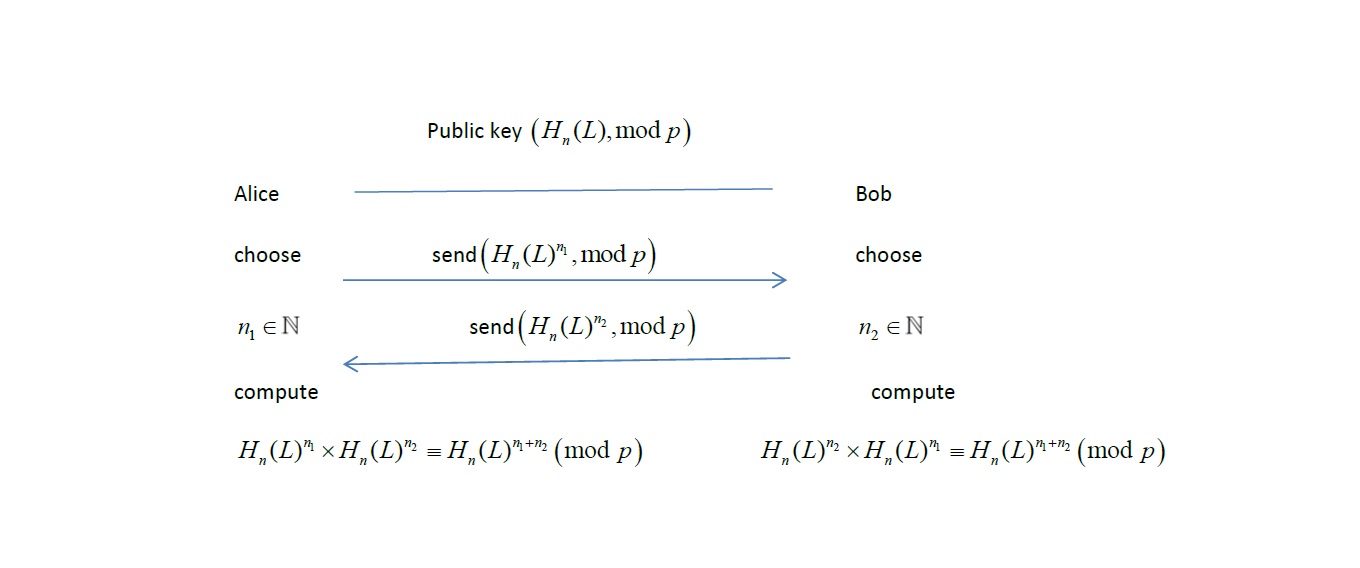
Alice and Bob want to establish a secret key. They select \(H_n(L)\) and \(p\) a prime number over an insecure
channel. Alice chooses a random number \(n_1\geq 4\) and sends \(H_n(L)^{n_1} \ (\mathrm{mod}\ p)\) to Bob.
Bob chooses a random number \(n_2\geq
4\) and sends \(H_n(L)^{n_2} \
(\mathrm{mod}\ p)\) to Alice. Alice and Bob both compute \(H_n(L)^{n_1n_2} \ (\mathrm{mod}\ p)\) and
use this as their private key. The algorithm steps are given below and
illustrated in Figure 1.
Step 1. The prime number \(p\) and generator \(H_n(L) \ (\mathrm{mod}\ p)\) are public (assume all users have agreed on the general linear group over a finite field \(F_p\) and \(H_n(L)\)).
Step 2. Alice chooses a random number \(n_1\geq 4\) and sends \(H_n(L)^{n_1} \ (\mathrm{mod}\ p)\) to Bob.
Step 3. Bob chooses a random number \(n_2\geq 4\) and sends \(H_n(L)^{n_2} \ (\mathrm{mod}\ p)\) to Alice.
Step 4. Alice and Bob both compute \(H_n(L)^{n_1n_2} \ (\mathrm{mod}\ p)\) and use this as the private key for future communications.
Example 4.1. Let \((H_{5}(-1), 5)\) be the public key. Alice chooses \(n_1=8\) and using (2) computes \(H_{5}(-1) \ (\mathrm{mod}\ 5)\) \[(H_{5}(-1))^8=\begin{bmatrix} 1&16&192\\ 0&1&24\\ 0&0&1 \end{bmatrix} \equiv \begin{bmatrix} 1&1&2\\ 0&1&4\\ 0&0&1 \end{bmatrix} \ (\mathrm{mod}\ 5),\] and sends this to Bob. Bob chooses \(n_2=4\) and obtains \(H_{-1}(5) \ (\mathrm{mod}\ 5)\) \[(H_{5}(-1))^4=\begin{bmatrix} 1&8&48\\ 0&1&12\\ 0&0&1 \end{bmatrix} \equiv\begin{bmatrix} 1&3&3\\ 0&1&2\\ 0&0&1\\ \end{bmatrix} \ (\mathrm{mod}\ 5),\] and sends this to Alice. Since \((H_{5}(-1))^4\times (H_{5}(-1))^8=(H_{5}(-1))^{12}=(H_{5}(-1))^8\times (H_{5}(-1))^4\), Alice and Bob both compute \[\begin{aligned} (H_{5}(-1))^4\times (H_{5}(-1))^8 &=\begin{bmatrix} 1&24&432\\ 0&1&36\\ 0&0&1 \end{bmatrix}\equiv\begin{bmatrix} 1&4&2\\ 0&1&1\\ 0&0&1 \end{bmatrix} \ (\mathrm{mod}\ 5). \end{aligned}\]
This is used as the private key for future communications.
Now using \(H_{n}(L)\), define the matrix \(\Gamma_i\) \(i=1,2,3,\cdots\), as \[\label{eq4.3} \Gamma_i(n,L)=\begin{bmatrix} H_{n}(L)&H_{n}(L)&H_{n}(L) &\cdots&H_{n}(L)&H_{n}(L)\\ 0&I&0&\cdots&0&0\\ 0&0&I&\cdots&0&0\\ \vdots&\vdots&\vdots&\vdots&\vdots&\vdots&\\ 0&0&0&\cdots&I&0\\ 0&0&0&\cdots&0&I\\ \end{bmatrix} \ (\mathrm{mod}\ p), \tag{3}\] where \(0\) is a \(3\times 3\) matrix with entries \(0\) and \(I\) is the \(3\times 3\) identity matrix.
Algorithm 2
Algorithm 2 is similar to Algorithm 1, except \(\Gamma_i(n,L)\) is used instead of the
secret key \(H_n(L)\). The algorithm
steps are given below and illustrated in Figure 2.

Example 4.2. Let \((\Gamma_2(3,2), 5)\) be the public key \[\Gamma_2(3,2)=\begin{bmatrix} 1&1&3&1&1&3\\ 0&1&2&0&1&2\\ 0&0&1&0&0&1\\ 0&0&0&1&0&0\\ 0&0&0&0&1&0\\ 0&0&0&0&0&1\\ \end{bmatrix} \ (\mathrm{mod}\ 5),\]
Alice chooses \(n_1=5\) and using (3) computes \(\Gamma_2(3,2)^5 \ (\mathrm{mod}\ 5)\) \[(\Gamma_2(3,2))^5=\begin{bmatrix} 1&5&35&5&15&85\\ 0&1&10&0&5&30\\ 0&0&1&0&0&5\\ 0&0&0&1&0&0\\ 0&0&0&0&1&0\\ 0&0&0&0&0&1\\ \end{bmatrix} \equiv \begin{bmatrix} 1&0&0&0&0&0\\ 0&1&0&0&0&0\\ 0&0&1&0&0&0\\ 0&0&0&1&0&0\\ 0&0&0&0&1&0\\ 0&0&0&0&0&1\\ \end{bmatrix} \ (\mathrm{mod}\ 5),\] and sends this to Bob. Bob chooses \(n_2=3\) and obtains \((\Gamma_2(3,2))^3 \ (\mathrm{mod}\ 5)\) \[(\Gamma_2(3,2))^3=\begin{bmatrix} 1&3&15&3&6&26\\ 0&1&6&0&3&12\\ 0&0&1&0&0&3\\ 0&0&0&1&0&0\\ 0&0&0&0&1&0\\ 0&0&0&0&0&1\\ \end{bmatrix} \equiv\begin{bmatrix} 1&3&0&3&1&1\\ 0&1&1&0&3&2\\ 0&0&1&0&0&3\\ 0&0&0&1&0&0\\ 0&0&0&0&1&0\\ 0&0&0&0&0&1\\ \end{bmatrix} \ (\mathrm{mod}\ 5),\] and sends this to Alice. Since \((\Gamma_2(3,2))^5\times (\Gamma_2(3,2) )^3=(\Gamma_2(3,2) )^{8}=( \Gamma_2(3,2) )^3\times (\Gamma_2(3,2) )^5\), Alice and Bob both compute \[\begin{aligned} (\Gamma_2(3,2) )^{8} &=\begin{bmatrix} 1&8&80&8&36&276\\ 0&1&16&0&8&72\\ 0&0&1&0&0&8\\ 0&0&0&1&0&0\\ 0&0&0&0&1&0\\ 0&0&0&0&0&1\\ \end{bmatrix}\equiv\begin{bmatrix} 1&3&0&3&1&1\\ 0&1&16&0&3&2\\ 0&0&1&0&0&3\\ 0&0&0&1&0&0\\ 0&0&0&0&1&0\\ 0&0&0&0&0&1\\ \end{bmatrix} \ (\mathrm{mod}\ 5). \end{aligned}\] This is used as the private key for future communications.
In this section, we formalize the hardness assumptions underlying the proposed key exchange protocols, place them in a standard security model, and discuss complexity considerations and potential attacks.
Let \(p\) be a relatively large prime and let \(H_n(L)\) denote the \(3 \times 3\) upper-triangular unipotent matrix defined earlier with entries parameterized by HTFL sequence terms.
\(\bullet\) HTFL Discrete
Logarithm Problem (HTFL-DLP).
Given \((H_n(L), H_n(L)^a \bmod p)\)
for a secret exponent \(a\), recover
\(a\).
\(\bullet\) HTFL Computational
Diffie-Hellman Problem (HTFL-CDH).
Given \((H_n(L)^a, H_n(L)^b)\), compute
\(H_n(L)^{ab}\).
\(\bullet\) HTFL Decisional
Diffie–Hellman Problem (HTFL-DDH).
Given \((H_n(L)^a, H_n(L)^b,
H_n(L)^c)\), decide whether \(c =
ab\).
The security of our protocols reduces to the hardness of HTFL-CDH in the Heisenberg group representation over \(\mathbb{F}_p\).
We analyze the scheme in the passive adversary model, where the adversary observes all protocol messages but cannot alter them.
\(\bullet\) Correctness. Both parties compute the same shared secret because matrix exponentiation is associative: \[(H_n(L)^a)^b = (H_n(L)^b)^a = H_n(L)^{ab}.\]
\(\bullet\) Security. An adversary observing only \(H_n(L)^a \bmod p\) and \(H_n(L)^b \bmod p\) cannot derive \(H_n(L)^{ab}\) unless it can solve HTFL-CDH. Therefore, protocol secrecy reduces to the intractability of this problem.
As with classical Diffie-Hellman, the scheme without authentication is vulnerable to man-in-the-middle attacks. Strengthening against active adversaries would require integrating authentication mechanisms, which we leave for future work.
\(\bullet\) Computation. The dominant cost is matrix multiplication in \(GL_3(\mathbb{F}_p)\). Exponentiation by square-and-multiply requires \(O(\log a)\) matrix multiplications. For Algorithm 2, the matrices are \(3i \times 3i\), yielding higher computational overhead but a larger key space.
\(\bullet\) Efficiency. Compared to classical finite-field Diffie-Hellman, matrix exponentiation introduces extra cost, but the algebraic structure may yield new hardness assumptions distinct from traditional discrete log settings.
\(\bullet\) Brute-force. One of the most important attacks is a brute force attack. Because matrices are used to create keys in these algorithms, these matrices must be invertible. It is possible to check only the order of the general linear group \(GL_m(F_p)\) which can be made very large by choosing \(p\) a relatively large prime number and \(m\) large. \(GL_m(F_p)\), \(q\) a prime number, consists of all invertible matrices of order \(m\times m\) over \(F_p\) [8]. This group has order \[\mid GL_m(F_p)\mid=(p^m-p^{m-1})(p^m-p^{m-2})\cdots(p^m-1).\]
For Algorithm 1, consider \(H_n(L)\). Since \(H_n(L)\) is a \(3\times 3\) matrix \[\mid GL_{3}(F_p) \mid=(p^{3}-p^{2})(p^{3}-p^{1})(p^{3}-1), \tag{4}\] matrices are possible. For Algorithm 2, we have \(\Gamma_i\) which is a \(3i\times 3i\) matrix, so \[\mid GL_{3i}(F_p) \mid=(p^{3i}-p^{3i-1})(p^{3i}-p^{3i-2})\cdots(p^{3i}-1), \tag{5}\] matrices are possible. Therefore for sufficiently large \(p\), the attack is intractable. Exponent space can be made exponentially large by choosing \(p\) and exponents of sufficient size.
\(\bullet\) Linear algebra attacks. Previous proposals of matrix-based Diffie–Hellman protocols have been shown vulnerable to linear algebraic attacks. Our construction differs by embedding HTFL sequences into the Heisenberg group, yielding a different algebraic structure. While this does not guarantee security, it motivates our hardness assumptions and highlights the importance of rigorous subgroup order analysis. While the matrices lie in \(GL_m(\mathbb{F}_p)\), the embedding in HTFL sequences complicates reduction to standard discrete log.
The current analysis establishes correctness and passive security under the HTFL-CDH assumption. We therefore view the presented protocols as conceptual prototypes linking HTFL sequences and cryptographic constructions, laying groundwork for future rigorous analysis.
New sequences called the HTFL sequences were obtained using the Fibonacci and Lehmer sequences. The period of these sequences was investigated and it was proven that they are simply periodic. The HTFL sequences on a finite group were given and studied on the Heisenberg group. Finally, Diffie-Hellman key exchange using the HTFL sequences on the Heisenberg group was presented and the security was examined. This is an interesting and useful application of group theory in cryptography. As future work, other sequences such as Mersenne, Pell, and Lucas sequences [11, 15, 21, 22]) can be considered to develop new Diffie-Hellman key exchange and other algorithms.
The authors declare that there are no conflicts of interest regarding the publication of this paper.
The authors would like to thank the referee for helpful comments and suggestions.