
Within mathematics, convex polytopes stand out as one of the most intriguing and intensively studied objects. A convex polytope is characterized by the property that every line segment joining two points on its boundary remains entirely contained within the polytope itself. This geometric property makes convex polytopes both theoretically rich and practically valuable, with connections that extend into numerous areas of mathematics and the applied sciences. Indeed, convex polytopes play a significant role in a variety of disciplines, ranging from the design of optimization algorithms in computer science to applications in economics through game theory.
In graph theory and related branches, the notions of resolving partition (RP) and partition dimension (PD) are equally versatile, as they provide powerful tools for addressing challenges in computer systems, communication networks, optimization techniques, mastermind games, and even the modeling of chemical compounds [15, 19, 20, 22]. The foundational work on metric dimension (MD) was first introduced independently by Slater [27] and by Harary and Melter [15]. Building on this framework, Chartrand et al. later proposed in 2000 the concept of PD of a graph as a natural variant of MD [11].
To recall some basic definitions, consider a connected graph \(\Omega\) of order \(\mu\) with vertex set \(V(\Omega)\) and edge set \(E(\Omega)\). For two vertices \(w, z \in V(\Omega)\) and for a subset \(J \subseteq V(\Omega)\), the distance \(d(w, z)\) is the length of the shortest path joining \(w\) and \(z\), while \(d(z, J) = \min\{d(z, x) \mid x \in J\}\) gives the distance from \(z\) to the set \(J\). For a vertex \(z \in V(\Omega)\), the open neighbourhood is defined as \(N(z) = \{u \in V(\Omega) : u \text{ is adjacent to } z\}\), and the closed neighbourhood is \(N[z] = N(z) \cup \{z\}\) [23]. For an ordered subset \(\mu = \{z_1, z_2, \ldots, z_k\} \subseteq V(\Omega)\), the representation of a vertex \(z\) relative to \(\mu\) is the \(k\)-tuple \((d(z, z_1), d(z, z_2), \ldots, d(z, z_k))\), denoted by \(r(z|\mu)\). If all such representations \(r(z|\mu)\) are distinct for every \(z \in V(\Omega)\), then \(\mu\) is called a resolving set of \(\Omega\). The metric dimension of \(\Omega\), denoted by \(\beta(\Omega)\), is then defined as \(\beta(\Omega) = \min\{|\mu| : \mu \text{ is a resolving set of } \Omega\}\).
The study of MD has generated a wide body of research across both pure and applied domains. For instance, in 2000, Chartrand et al. explored its applications in pharmaceutical chemistry [10, 12], demonstrating its relevance beyond abstract mathematics. Zehui et al. determined the MD for families of generalized Petersen graphs [25], while Rezaei et al. computed the MD for Cayley graphs [24]. More recently, in 2023, Bailey et al. examined the MD of dual polar graphs [9], further highlighting the continuing importance of this concept in contemporary graph theory.
Let \(\Theta = \{\Theta_1, \Theta_2, \ldots, \Theta_k\}\) denote an ordered \(k-\)partition of the vertex set of a connected graph \(\Omega\). For a given vertex \(z \in V(\Omega)\), its representation with respect to the partition \(\Theta\) is described by the \(k-\)dimensional vector \((d(z, \Theta_1), d(z, \Theta_2), \ldots, d(z, \Theta_k))\), which is written as \(r(z|\Theta)\). When this representation \(r(z|\Theta)\) is unique for every vertex \(z\) in \(V(\Omega)\), the partition \(\Theta\) is referred to as a resolving partition (RP) of \(\Omega\). The partition dimension (PD) of \(\Omega\), denoted by \(\operatorname{pd}(\Omega)\), is then formally defined as \(\operatorname{pd}(\Omega) = \min\{|\Theta| : \Theta \text{ is RP of } \Omega\}\).
The characterization of graphs with partition dimension equal to \(2\) or \(n\) was carried out by Chartrand et al. [11]. Over the years, PD has been investigated for a variety of graph families and structures. For example, Hasmawati et al. determined the PD of graphs obtained through the vertex amalgamation of cycles [16]. Azeem et al. derived sharp bounds on the PD of the hexagonal Möbius ladder [1]. Similarly, the PD of generalized Möbius ladders and certain wheel-related graphs was examined in [17] and [], respectively. In another line of research, Silalahi et al. studied both the MD and PD of multiple fan graphs [26], while Chu et al. analyzed sharp bounds for the PD of convex polytopes [13]. Recently, Azhar et al. explored the PD in the context of both its fault-tolerant and local variants [2, 8].
It is also noteworthy that the complexity of these problems has been established: Gary et al. and later Khuller et al. demonstrated that determining the metric dimension of general graphs is NP-hard [14, 21]. Since PD is a natural generalization of MD, the problem of computing the partition dimension is also NP-hard, which highlights the computational challenges associated with these concepts.
The study of PD has been extended to several important families of graphs. For example, Kamran et al. determined the PD of cyclic networks [5], tadpole and necklace graphs [6], mesh-related networks [3], cycle-related graphs [4], as well as chemical graphs [7]. Beyond simply identifying values, their work also highlighted a variety of real-world applications where PD plays a central role. These include the optimization of supply chains, efficient routing in communication networks, modeling of water flow within a locality, and the strategic deployment of sensors within residential environments [3, 4, 5, 6]. Motivated by these developments, we extend this line of research in the present paper by deriving sharp bounds on the PD for the convex polytopes \(T_\nu\), \(R_\nu\), and \(U_\nu\), thereby broadening the understanding of PD in geometric graph structures. The following proposition is instrumental in computing the PD of a graph.
Proposition 1.1. [11] Consider a graph \(\Omega\) of order \(\nu\). Then the following properties of the partition dimension hold:
(a) The partition dimension is always bounded above by the metric dimension plus one, that is, \(\operatorname{pd}(\Omega) \leq \beta(\Omega)+1\).
(b) For \(\nu \geq 2\), the condition \(\operatorname{pd}(\Omega) = 2\) is satisfied precisely when \(\Omega\) corresponds to the path graph \(P_{\nu}\).
(c) The equality \(\operatorname{pd}(\Omega) = \nu\) holds if and only if \(\Omega\) is the complete graph \(K_{\nu}\).
The rest of this article is arranged as follows. In Section 2, we focus on establishing the bounds for \(\operatorname{pd}(T_{\nu})\), providing detailed analysis of its structural properties. Section 3 is dedicated to deriving the corresponding bounds for \(\operatorname{pd}(R_{\nu})\), where the discussion extends to highlight key differences with the earlier case. Section 4 then presents the results concerning \(\operatorname{pd}(U_{\nu})\), emphasizing the unique characteristics of this family of convex polytopes. Finally, the paper concludes with a closing section, Section 5, in which we summarize the findings and put forward an open problem that may serve as a direction for future research.
A convex polytope denoted by \(T_{\nu}\) has \(3\)-sided, \(5\)-sided and \(\nu\)-sided faces. Vertices of \((T_{\nu})\) for \(\nu\geq 3\), are divided into three sets, \(A = \{a_\psi: 1\leq \psi\leq \nu\}\), \(B = \{b_\psi: 1\leq \psi\leq \nu\}\) and \(C = \{c_\psi: 1\leq \psi\leq \nu\}\). The cycle formed by \(\{a_\psi: 1\leq \psi\leq \nu\}\) is called inner cycle, the set of vertices \(\{b_\psi: 1\leq \psi\leq \nu\}\) called the central vertices and the cycle formed by \(\{c_\psi: 1\leq \psi\leq \nu\}\) called outer cycle. The set \(V (T_{\nu}) = A\cup B\cup C\) and \(E(T{\nu})= \{a_\psi a_{\psi+1}: 1 \leq \psi\leq \nu-1\}\cup\{a_1 a_{\nu}\}\cup\{a_1 b_{\nu}\}\cup\{a_\psi b_{\psi}:1 \leq \psi\leq \nu\}\cup \{b_\psi a_{\psi+1}: 1 \leq \psi\leq \nu-1\}\cup \{b_{\psi}c_{\psi}: 1 \leq \psi\leq \nu\}\cup\{c_\psi c_{\psi+1}: 1 \leq \psi\leq \nu-1\}\cup\{c_1 c_{\nu}\}\) are vertex set and edge set of convex polytope \(T_{\nu}\) respectively. The graph \(T_{6}\) is shown in Figure 1.
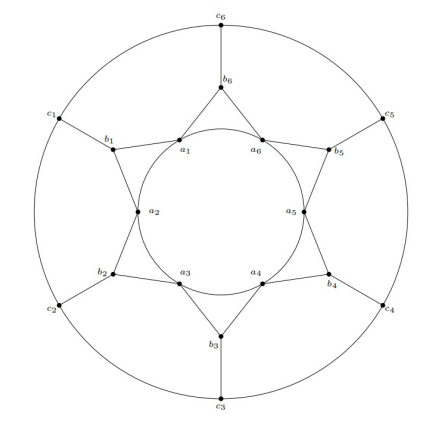
The metric dimension of the convex polytopes \(T_{\nu}\) has been computed in [18].
Lemma 2.1. [18] For every \(\nu\geq 6\), we have \(\beta (T_{\nu})= 3\).
The following theorem will allow us to compute the bounds of the partition dimension of \(T_\nu\).
Theorem 2.2. class=”math inline”>\(T_\nu\) be a convex polytope with \(\nu\geq3\). We have \(3 \leq \operatorname{pd}(T_{\nu})\leq 4\).
Proof. Let \(\Theta =\{ \Theta_1, \Theta_2, \Theta_3, \Theta_4 \}\) be a partition set of vertices of \(T_{\nu}\) for \(\nu\geq3\).
When \(\nu = 3\), take, \(\Theta_1 = \{a_\psi: 1\leq \psi\leq 3\}\cup\{b_\psi: 1\leq \psi\leq 3\}, \Theta_2 = \{c_1\}, \Theta_3 = \{c_2\}\) and \(\Theta_4 = \{c_3\}\).
When \(\nu = 4\) and \(7\), consider, \(\Theta_1 = \{a_\psi: 1\leq \psi\leq \nu\}\cup\{b_\psi: 1\leq \psi\leq \nu\}\cup\{c_\psi: 1\leq \psi\leq \alpha\}, \Theta_2 = \{c_{\psi}:\alpha+1\leq \psi\leq \nu-2\},\Theta_3 = \{c_{\nu-1}\}\) and \(\Theta_4 = \{c_{\nu}\}\).
When \(\nu = 5\) and \(8\), consider, \(\Theta_1 = \{a_\psi: 1\leq \psi\leq
\nu\}\cup\{b_\psi: 1\leq \psi\leq \nu\}\cup\{c_\psi: 1\leq \psi\leq
\alpha+1\},\Theta_2 = \{c_{\alpha+2}\}, \Theta_3 =
\{c_{\psi}:\alpha+3\leq \psi\leq \nu-1\}\) and \(\Theta_4 = \{c_{\nu}\}\).
When \(\nu = 6\), consider, \(\Theta_1 = \{a_\psi: 1\leq \psi\leq
6\}\cup\{b_\psi: 1\leq \psi\leq 6\}\cup\{c_1, c_2\}, \Theta_2 =
\{c_{3}\}, \Theta_3 = \{c_{4}\}\) and \(\Theta_4 = \{c_{5}, c_{6}\}\).
It can be verified easily by the inspection of representations that \(\Theta\) is a resolving set for \(\nu = 3,4,5,6,7\) and \(8\).
Case 1. When \(\nu = 3\alpha\) and \(\alpha\geq3\).
The representation of vertices of \(T_{\nu}\), \((R_p(V(T_{\nu}))\) w.r.t \(\Theta\) considering \(\Theta_1 = \{a_\psi: 1\leq \psi\leq \nu\}\cup\{b_\psi: 1\leq \psi\leq \nu\}\cup\{c_\psi: 1\leq \psi\leq \alpha\}\cup\{c_\psi: \alpha+2\leq \psi\leq \nu-\alpha\}, \Theta_2 = \{c_{\alpha+1}\}, \Theta_3 = \{c_{n-\alpha+1}\}\) and \(\Theta_4 = \{c_{\psi}:\nu-\alpha+2\leq \psi\leq \nu\}\) are shown in Table 1.
Case 2. When \(\nu = 3\alpha+1\) and \(\alpha\geq3\).
The \(R_p(V(T_{\nu})\) w.r.t \(\Theta\), considering \(\Theta_1 = \{a_\psi: 1\leq \psi\leq \nu\}\cup\{b_\psi: 1\leq \psi\leq \nu\}\cup\{c_\psi: 1\leq \psi\leq \lfloor\frac{3\alpha}{2}\rfloor\}\cup\{c_\psi: \lfloor\frac{3\alpha}{2}\rfloor+2\leq \psi\leq \nu-3\}, \Theta_2 = \{c_{\lfloor\frac{3\alpha}{2}\rfloor+1}\},\Theta_3 = \{c_{\nu-2},c_{\nu-1}\}\) and \(\Theta_4 = \{c_{\nu}\}\) are shown in Table 2.
Case 3. When \(\nu = 3\alpha+2\) and \(\alpha\geq3\).
The \(R_p(V(T_{\nu})\) w.r.t \(\Theta\) considering \(\Theta_1 = \{a_\psi: 1\leq \psi\leq \nu\}\cup\{b_\psi: 1\leq \psi\leq \nu\}\cup\{c_\psi: 1\leq \psi\leq \alpha+2\}\cup\{c_{\alpha+4},c_{\nu-1}\}, \Theta_2 = \{c_{\alpha+3}\},\Theta_3 = \{c_\psi: \alpha+5\leq \psi\leq \nu-2\}\) and \(\Theta_4 = \{c_{\nu}\}\) are shown in Table 3.
| Distance of vertex | from \(\Theta_1\) | from \(\Theta_2\) | from \(\Theta_3\) | from \(\Theta_4\) |
|---|---|---|---|---|
| \(a_{\wp} (1\leq \wp\leq\lceil \frac{\alpha}{2}\rceil +1)\) | \(0\) | \(\alpha+3-\wp\) | \(\alpha+\wp\) | \(\wp+1\) |
| \(a_{\lceil \frac{\alpha}{2}\rceil +1+\wp} (1\leq \wp\leq \lfloor \frac{\alpha}{2}\rfloor)\) | \(0\) | \(\lfloor \frac{\alpha}{2} \rfloor -\wp +2\) | \(\lfloor \frac{\nu}{2} \rfloor -\wp +2\) | \(\lceil \frac{\alpha}{2} \rceil +\wp +2\) |
| \(a_{\alpha+\wp+1} (1\leq \wp\leq \alpha)\) | \(0\) | \(\wp+1\) | \(\alpha+2-\wp\) | \(\alpha+3-\wp\) |
| \(a_{2\alpha+1+\wp} (1\leq \wp\leq \lceil \frac{\alpha}{2}\rceil)\) | \(0\) | \(\alpha+\wp+1\) | \(\wp+1\) | \(2\) |
| \(a_{\nu-\lceil \frac{\alpha}{2}\rceil +1+\wp} (1\leq \wp\leq \lfloor \frac{\alpha}{2}\rfloor-1)\) | \(0\) | \(\lfloor \frac{\nu}{2} \rfloor -\wp +2\) | \(\lceil \frac{\alpha}{2} \rceil +\wp +1\) | \(2\) |
| \(b_{\wp} (1\leq \wp\leq\lceil \frac{\alpha}{2}\rceil +1)\) | \(0\) | \(\alpha+2-\wp\) | \(\alpha+\wp\) | \(\wp+1\) |
| \(b_{\lfloor \frac{\alpha}{2}\rfloor +1+\wp} (1\leq \wp\leq \lceil \frac{\alpha}{2}\rceil)\) | \(0\) | \(\lceil \frac{\alpha}{2} \rceil -\wp +1\) | \(\lceil \frac{\nu}{2} \rceil -\wp +1\) | \(\lfloor \frac{\alpha}{2} \rfloor +\wp +2\) |
| \(b_{\alpha+\wp+1} (1\leq \wp\leq \alpha)\) | \(0\) | \(\wp+1\) | \(\alpha+1-\wp\) | \(\alpha+2-\wp\) |
| \(b_{2\alpha+1+\wp} (1\leq \wp\leq \lceil \frac{\alpha}{2}\rceil)\) | \(0\) | \(\alpha+\wp+1\) | \(\wp+1\) | \(1\) |
| \(b_{n-\lceil \frac{\alpha}{2}\rceil +1+\wp} (1\leq \wp\leq \lceil \frac{\alpha}{2}\rceil-1)\) | \(0\) | \(\lceil \frac{\nu}{2} \rceil -\wp +1\) | \(\lfloor \frac{\alpha}{2} \rfloor +\wp +1\) | \(1\) |
| \(c_{\wp} (1\leq \wp\leq\lceil \frac{\alpha}{2}\rceil +1)\) | \(0\) | \(\alpha+1-\wp\) | \(\alpha+\wp-1\) | \(\wp\) |
| \(c_{\lfloor \frac{\alpha}{2}\rfloor +\wp+1} (1\leq \wp\leq \lceil \frac{\alpha}{2}\rceil-1)\) | \(0\) | \(\lceil \frac{\alpha}{2} \rceil -\wp\) | \(\lceil \frac{\nu}{2} \rceil -\wp\) | \(\lfloor \frac{\alpha}{2} \rfloor +\wp +1\) |
| \(c_{\alpha+1}\) | \(1\) | \(0\) | \(\alpha\) | \(\alpha+1\) |
| \(c_{\alpha+\wp+1}(1\leq \wp\leq \alpha-1)\) | \(0\) | \(\wp\) | \(\alpha-\wp\) | \(\alpha-\wp+1\) |
| \(c_{2\alpha+1}\) | \(1\) | \(\alpha\) | \(0\) | \(1\) |
| \(c_{2\alpha+\wp+1} (1\leq \wp\leq \lfloor \frac{\alpha}{2}\rfloor)\) | \(1\) | \(\alpha+\wp\) | \(\wp\) | \(0\) |
| \(c_{\nu-\lceil \frac{\alpha}{2}\rceil +1+\wp} (1\leq \wp\leq \lceil \frac{\alpha}{2}\rceil-1)\) | \(1\) | \(\lceil \frac{\nu}{2} \rceil -\wp\) | \(\lfloor \frac{\alpha}{2} \rfloor +\wp\) | \(0\) |
| Distance of vertex | from \(\Theta_1\) | from \(\Theta_2\) | from \(\Theta_3\) | from \(\Theta_4\) |
|---|---|---|---|---|
| \(a_{\wp} (1\leq \wp\leq\lceil \frac{\nu}{2}\rceil -2)\) | \(0\) | \(\lceil \frac{\nu}{2}\rceil-\wp+2\) | \(\wp+2\) | \(\wp+1\) |
| \(a_{\lceil \frac{\nu}{2}\rceil+\wp-2} (1\leq \wp\leq 2)\) | \(0\) | \(4-\wp\) | \(\lfloor \frac{\nu}{2} \rfloor -\wp +2\) | \(\lceil \frac{\nu}{2} \rceil +\wp-1\) |
| \(a_{\lceil \frac{\nu}{2}\rceil+\wp} (1\leq \wp\leq \lfloor \frac{\nu}{2} \rfloor -2)\) | \(0\) | \(\wp+1\) | \(\lfloor \frac{\nu}{2} \rfloor -\wp\) | \(\lfloor \frac{\nu}{2} \rfloor -\wp+2\) |
| \(a_{\nu+\wp-2} (1\leq \wp\leq 2)\) | \(0\) | \(\lfloor \frac{\nu}{2} \rfloor +\wp-1\) | \(2\) | \(4-\wp\) |
| \(b_{\wp} (1\leq \wp\leq\lceil \frac{\nu}{2}\rceil -2)\) | \(0\) | \(\lceil \frac{\nu}{2}\rceil-\wp+1\) | \(\wp+2\) | \(\wp+1\) |
| \(b_{\lceil \frac{\nu}{2}\rceil-1}\) | \(0\) | \(2\) | \(\lfloor \frac{\nu}{2} \rfloor\) | \(\lceil \frac{\nu}{2} \rceil\) |
| \(b_{\lceil \frac{\nu}{2}\rceil-1+\wp} (1\leq \wp\leq \lfloor \frac{\nu}{2} \rfloor -1)\) | \(0\) | \(\wp\) | \(\lfloor \frac{\nu}{2} \rfloor -\wp\) | \(\lfloor \frac{\nu}{2} \rfloor -\wp+2\) |
| \(b_{\nu+\wp-2} (1\leq \wp\leq 2)\) | \(0\) | \(\lfloor \frac{\nu}{2} \rfloor +\wp-1\) | \(\wp\) | \(3-\wp\) |
| \(c_{\wp} (1\leq \wp\leq\lceil \frac{\nu}{2}\rceil -2)\) | \(0\) | \(\lceil \frac{\nu}{2}\rceil-\wp\) | \(\wp+1\) | \(\wp\) |
| \(c_{\lceil \frac{\nu}{2}\rceil -1}\) | \(0\) | \(1\) | \(\lfloor \frac{\nu}{2} \rfloor-1\) | \(\lceil \frac{\nu}{2}\rceil -1\) |
| \(c_{\lceil \frac{\nu}{2}\rceil}\) | \(1\) | \(0\) | \(\lfloor \frac{\nu}{2}\rfloor-2\) | \(\lfloor \frac{\nu}{2} \rfloor\) |
| \(c_{\lceil \frac{\nu}{2}\rceil+\wp} (1\leq \wp\leq \lfloor \frac{\nu}{2} \rfloor -3)\) | \(0\) | \(\wp\) | \(\lfloor \frac{\nu}{2} \rfloor -\wp-2\) | \(\lfloor \frac{\nu}{2} \rfloor -\wp\) |
| \(c_{\nu+\wp-3} (1\leq \wp\leq 2)\) | \(1\) | \(\lfloor \frac{\nu}{2} \rfloor +\wp-3\) | \(0\) | \(3-\wp\) |
| \(c_{\nu}\) | \(1\) | \(\lfloor \frac{\nu}{2} \rfloor\) | \(1\) | \(0\) |
| Distance of vertex | from Θ₁ | from Θ₂ | from Θ₃ | from Θ₄ |
|---|---|---|---|---|
| a𝜙 (1 ≤ 𝜙 ≤ ⌊α/2⌋ + 2) | 0 | α – 𝜙 + 5 | 𝜙 + 3 | 𝜙 + 1 |
| a⌊α/2⌋ + 𝜙 + 2 (1 ≤ 𝜙 ≤ ⌈α/2⌉ + 1) | 0 | ⌈α/2⌉ – 𝜙 + 3 | ⌈α/2⌉ – 𝜙 + 5 | ⌊α/2⌋ + 𝜙 + 3 |
| aα+4 (for 3 ≤ α ≤ 4) | 0 | 2 | 3 | 2α |
| aα+4 | 0 | 2 | 3 | α + 5 |
| a𝜙 (1 ≤ 𝜙 ≤ ⌈α/2⌉ – 3) | 0 | 𝜙 – α – 2 | 2 | 𝜙 + 1 |
| a⌈ν/2⌉ + 𝜙 + 1 (1 ≤ 𝜙 ≤ 2α – 3), α = 3 | 0 | ⌈α/2⌉ + 𝜙 | 2 | ⌊ν/2⌋ – 𝜙 + 1 |
| a⌈ν/2⌉ + 𝜙 + 1 (1 ≤ 𝜙 ≤ 2α – 3), 4 ≤ α ≤ 5 | 0 | ⌊α/2⌋ + 𝜙 | 2 | ⌊ν/2⌋ – 𝜙 + 1 |
| a⌈ν/2⌉ + 𝜙 (1 ≤ 𝜙 ≤ α + 3) | 0 | ⌈α/2⌉ + 𝜙 – 1 | 2 | ⌊ν/2⌋ – 𝜙 + 2 |
| a𝜙 (1 ≤ 𝜙 ≤ ⌊α/2⌋ – 3) | 0 | 4α – 𝜙 + 7 | 2 | 3α – 𝜙 + 4 |
| aν (for 3 ≤ α ≤ 5) | 0 | 2α | 3 | 2 |
| aν | 0 | α + 5 | 3 | 2 |
| b𝜙 (1 ≤ 𝜙 ≤ ⌈α/2⌉ + 1) | 0 | α + 4 – 𝜙 | 𝜙 + 3 | 𝜙 + 1 |
| b⌈α/2⌉ + 1 + 𝜙 (1 ≤ 𝜙 ≤ ⌊α/2⌋ + 2) | 0 | ⌊α/2⌋ – 𝜙 + 3 | ⌊α/2⌋ – 𝜙 + 5 | ⌈α/2⌉ + 𝜙 + 2 |
| bα+4 (for 3 ≤ α ≤ 5) | 0 | 2 | 2 | 2α – 1 |
| bα+4 | 0 | 2 | 2 | α + 5 |
| b𝜙 (1 ≤ 𝜙 ≤ ⌊α/2⌋ – 3) | 0 | 𝜙 – α – 2 | 1 | 𝜙 + 1 |
| b𝜙 (1 ≤ 𝜙 ≤ α – 1), α = 3 | 0 | 𝜙 – α – 2 | 1 | 3α – 𝜙 + 3 |
| b𝜙 (1 ≤ 𝜙 ≤ 2α – 4), 4 ≤ α ≤ 5 | 0 | 𝜙 – α – 2 | 1 | 3α – 𝜙 + 3 |
| bν/2 + 𝜙 (1 ≤ 𝜙 ≤ α + 2), α = 6 | 0 | ⌈α/2⌉ + 𝜙 – 1 | 1 | ν/2 – 𝜙 + 1 |
| b⌈ν/2⌉ + 𝜙 – 1 (1 ≤ 𝜙 ≤ α + 3), α ≥ 7 | 0 | ⌈α/2⌉ + 𝜙 – 1 | 1 | ⌈ν/2⌉ – 𝜙 + 1 |
| b𝜙 (1 ≤ 𝜙 ≤ ⌊α/2⌋ – 3) | 0 | 4α – 𝜙 + 6 | 1 | 3α – 𝜙 + 3 |
| bν-1 (for 3 ≤ α ≤ 6) | 0 | 2α – 1 | 2 | 2 |
| bν-1 | 0 | α + 5 | 2 | 2 |
| bν (for 3 ≤ α ≤ 4) | 0 | 2α | 3 | 1 |
| bν | 0 | α + 4 | 3 | 1 |
| c𝜙 (1 ≤ 𝜙 ≤ ⌈α/2⌉ + 1) | 0 | α – 𝜙 + 3 | 𝜙 + 2 | 𝜙 |
| c⌈α/2⌉ + 𝜙 + 1 (1 ≤ 𝜙 ≤ ⌊α/2⌋ + 1) | 0 | ⌊α/2⌋ – 𝜙 + 2 | ⌊α/2⌋ – 𝜙 + 4 | ⌈α/2⌉ + 𝜙 + 1 |
| cα+3 (for 3 ≤ α ≤ 4) | 1 | 0 | 2 | 2α – 1 |
| cα+3 | 1 | 0 | 2 | α + 3 |
| cα+4 (for 3 ≤ α ≤ 5) | 0 | 1 | 1 | 2α – 2 |
| cα+4 | 0 | 1 | 1 | α + 4 |
| c𝜙 (1 ≤ 𝜙 ≤ ⌊α/2⌋ – 3) | 0 | 𝜙 – α – 1 | 1 | 𝜙 |
| cν (for α = 3) | 1 | 5 | 2 | 0 |
| cν | 1 | α + 3 | 2 | 0 |
Tables 1 to 3 make it obvious that \(\Theta\) is a partition resolving set of \(T_{\nu}\), therefore, \(\operatorname{pd}(T_{\nu})\leq 4\). The Proposition 1.1 implies that \(\operatorname{pd}(T_{\nu})\geq 3\), since \(T_{\nu}\) is not a path graph. Hence, \(3 \leq \operatorname{pd}(T_{\nu})\leq 4\). ◻
A convex polytope denoted by \(R_{\nu}\) has \(4\nu\) \(3\)-sided faces. Vertices of \((T_{\nu})\) for \(\nu\geq 3\), are divided into three sets, \(A = \{a_\psi: 1\leq \psi\leq \nu\}\), \(B = \{b_\psi: 1\leq \psi\leq \nu\}\) and \(C = \{c_\psi: 1\leq \psi\leq \nu\}\). The cycle formed by \(\{a_\psi: 1\leq \psi\leq \nu\}\) is called inner cycle, the cycle formed by \(\{b_\psi: 1\leq \psi\leq \nu\}\) is the central cycle and the cycle formed by \(\{c_\psi: 1\leq \psi\leq \nu\}\) is called outer cycle. The set \(V (T_{\nu}) = A\cup B\cup C\) and \(E(T{\nu})= \{a_\psi a_{\psi+1}: 1 \leq \psi\leq \nu-1\}\cup\{a_1 a_{\nu}\}\cup\{a_1 b_{\nu}\}\cup\{a_\psi b_{\psi}1 \leq \psi\leq \nu\}\cup \{b_\psi a_{\psi+1}: 1 \leq \psi\leq \nu-1\}\cup \{b_{\psi}c_{\psi}: 1 \leq \psi\leq \nu\}\cup\{c_\psi c_{\psi+1}: 1 \leq \psi\leq \nu-1\}\cup\{c_1 c_{\nu}\}\) are vertex set and edge set of convex polytope \(R_{\nu}\) respectively. The graph \(R_{6}\) is shown in Figure 2.
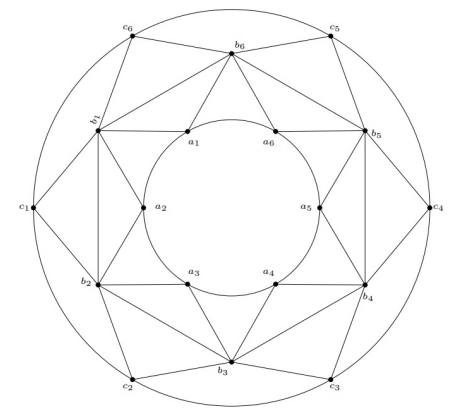
The following theorem will allow us to compute the bounds of the partition dimension of \(R_\nu\).
Theorem 3.1. Let \(R_\nu\) be a convex polytope with \(\nu\geq3\). We obtain \(3\leq \operatorname{pd}(R_{\nu})\leq 4\).
Proof. Let \(\Theta=\{ \Theta_1, \Theta_2, \Theta_3, \Theta_4 \}\) be a partition set of \(V(R_{\nu})\) for \(\nu\geq3\).
When \(\nu = 3\), consider,\(\Theta_1 = \{a_\psi: 1\leq \psi\leq 3\}\cup\{b_\psi: 1\leq \psi\leq 3\}, \Theta_2 = \{c_1\}, \Theta_3 = \{c_2\}\) and \(\Theta_4 = \{c_3\}\).
When \(\nu = 4\), consider, \(\Theta_1 = \{a_\psi: 1\leq \psi\leq 4\}\cup\{b_\psi: 1\leq \psi\leq 4\}\cup\{c_{1}\}, \Theta_2 = \{c_{2}\},\Theta_3 = \{c_{3}\}\) and \(\Theta_4 = \{c_{4}\}\).
When \(\nu = 5\), consider, \(\Theta_1 = \{a_\psi: 1\leq \psi\leq 5\}\cup\{b_\psi: 1\leq \psi\leq 5\}\cup\{c_{1},c_{2}\}, \Theta_2 = \{c_{3}\},\Theta_3 = \{c_{4}\}\) and \(\Theta_4 = \{c_{5}\}\).
When \(\nu = 6\), consider, \(\Theta_1 = \{a_\psi: 1\leq \psi\leq 6\}\cup\{b_\psi: 1\leq \psi\leq 6\}\cup\{c_1, c_2\}, \Theta_2 = \{c_{3}\}, \Theta_3 = \{c_{4}\}\) and \(\Theta_4 = \{c_{5}, c_{6}\}\).
| Distance of vertex | from \(\Theta_1\) | from \(\Theta_2\) | from \(\Theta_3\) | from \(\Theta_4\) |
|---|---|---|---|---|
| \(a_{\wp} (1\leq \wp\leq\lfloor \frac{\alpha}{2}\rfloor +2)\) | \(0\) | \(\alpha+5-\wp\) | \(\wp+3\) | \(\wp+2\) |
| \(a_{\lfloor \frac{\alpha}{2}\rfloor+2+\wp}(1\leq \wp\leq\lceil \frac{\alpha}{2}\rceil)\) | \(0\) | \(\lceil\frac{\alpha}{2}\rceil+3-\wp\) | \(\lceil\frac{\alpha}{2}\rceil+5-\wp\) | \(\lfloor \frac{\alpha}{2}\rfloor+4+\wp\) |
| \(a_{\alpha+3}\)(for \(\alpha=2,3)\) | \(0\) | \(3\) | \(4\) | \(2\alpha+1\) |
| \(a_{\alpha+3}\)(for \(\alpha\geq4)\) | \(0\) | \(3\) | \(4\) | \(\alpha+5\) |
| \(a_{\alpha+3+\wp}(1\leq \wp\leq \lfloor \frac{\alpha}{2}\rfloor-2)\) | \(0\) | \(\wp+3\) | \(3\) | \(\alpha+\wp+5\) |
| \(a_{\alpha+3+\wp}(1\leq \wp\leq \alpha)\)(for \(\alpha=2,3)\) | \(0\) | \(\wp+3\) | \(3\) | \(2\alpha-\wp+1\) |
| \(a_{\lceil \frac{\nu}{2} \rceil +\wp}(1\leq \wp\leq \alpha+2)\)(for \(\alpha\geq4)\) | \(0\) | \(\lceil \frac{\alpha}{2} \rceil +\wp\) | \(3\) | \(\lfloor \frac{\nu}{2}\rfloor+3-\wp\) |
| \(a_{\nu}\) (for \(\alpha=3)\) | \(0\) | \(7\) | \(3\) | \(3\) |
| \(a_{\nu-\lceil \frac{\alpha}{2} \rceil +\wp+2}(1\leq \wp\leq \lceil \frac{\alpha}{2}\rceil-2)\) | \(0\) | \(\lfloor \frac{\nu}{2}\rfloor+3-\wp\) | \(3\) | \(\lceil \frac{\alpha}{2} \rceil -\wp+1\) |
| \(b_{\wp} (1\leq \wp\leq\lfloor \frac{\alpha}{2}\rfloor +2)\) | \(0\) | \(\alpha+4-\wp\) | \(\wp+2\) | \(\wp+1\) |
| \(b_{\lfloor \frac{\alpha}{2}\rfloor+2+\wp}(1\leq \wp\leq\lceil \frac{\alpha}{2}\rceil)\) | \(0\) | \(\lceil\frac{\alpha}{2}\rceil+2-\wp\) | \(\lceil\frac{\alpha}{2}\rceil+4-\wp\) | \(\lfloor \frac{\alpha}{2}\rfloor+3+\wp\) |
| \(b_{\alpha+3}\)(for \(\alpha=2,3)\) | \(0\) | \(2\) | \(3\) | \(2\alpha+1\) |
| \(b_{\alpha+3}\)(for \(\alpha\geq4)\) | \(0\) | \(2\) | \(3\) | \(\alpha+4\) |
| \(b_{\alpha+3+\wp}(1\leq \wp\leq \lceil \frac{\alpha}{2}\rceil-3)\) | \(0\) | \(\wp+2\) | \(2\) | \(\alpha+\wp+4\) |
| \(b_{\alpha+3+\wp}(1\leq \wp\leq \alpha)\)(for \(\alpha=2,3)\) | \(0\) | \(\wp+2\) | \(2\) | \(2\alpha-\wp\) |
| \(b_{\lceil \frac{\nu}{2} \rceil +\wp}(1\leq \wp\leq \alpha+2)\)(for \(\alpha\geq4)\) | \(0\) | \(\lceil \frac{\alpha}{2} \rceil +\wp-1\) | \(2\) | \(\lceil \frac{\nu}{2}\rceil+2-\wp\) |
| \(b_{\nu}\) (for \(\alpha=3)\) | \(0\) | \(6\) | \(2\) | \(2\) |
| \(b_{\nu-\lfloor \frac{\alpha}{2} \rfloor +\wp+2}(1\leq \wp\leq \lfloor \frac{\alpha}{2}\rfloor-1)\) | \(0\) | \(\lceil \frac{\nu}{2}\rceil+2-\wp\) | \(2\) | \(\lfloor \frac{\alpha}{2} \rfloor -\wp+1\) |
| \(c_{\wp} (1\leq \wp\leq\lfloor \frac{\alpha}{2}\rfloor +2)\) | \(0\) | \(\alpha+3-\wp\) | \(\wp+1\) | \(\wp\) |
| \(c_{\lfloor \frac{\alpha}{2}\rfloor+2+\wp}(1\leq \wp\leq\lceil \frac{\alpha}{2}\rceil)\) | \(0\) | \(\lceil\frac{\alpha}{2}\rceil+1-\wp\) | \(\lceil\frac{\alpha}{2}\rceil+3-\wp\) | \(\lfloor \frac{\alpha}{2}\rfloor+2+\wp\) |
| \(c_{\alpha+3}\)(for \(\alpha=2,3)\) | \(0\) | \(1\) | \(2\) | \(2\alpha-1\) |
| \(c_{\alpha+3}\)(for \(\alpha\geq4)\) | \(0\) | \(1\) | \(2\) | \(\alpha+3\) |
| \(c_{\alpha+3+\wp}(1\leq \wp\leq \lfloor \frac{\alpha}{2}\rfloor-2)\) | \(0\) | \(\wp+1\) | \(1\) | \(\alpha+\wp+3\) |
| \(c_{\alpha+3+\wp}(1\leq \wp\leq \alpha)\)(for \(\alpha=2,3)\) | \(0\) | \(\wp+1\) | \(1\) | \(2\alpha-\wp-1\) |
| \(c_{\lceil \frac{\nu}{2} \rceil +\wp}(1\leq \wp\leq \alpha+2)\)(for \(\alpha\geq4)\) | \(0\) | \(\lfloor \frac{\alpha}{2} \rfloor +\wp-1\) | \(1\) | \(\lfloor \frac{\nu}{2}\rfloor+1-\wp\) |
| \(c_{\nu-\lfloor \frac{\alpha}{2} \rfloor +\wp+2}(1\leq \wp\leq \lceil \frac{\alpha}{2}\rceil-2)\) | \(0\) | \(\lfloor \frac{\nu}{2}\rfloor+1-\wp\) | \(1\) | \(\lceil \frac{\alpha}{2} \rceil -\wp-1\) |
| \(d_{\wp} (1\leq \wp\leq\lceil \frac{\alpha}{2}\rceil +1)\) | \(0\) | \(\alpha+2-\wp\) | \(\wp+1\) | \(\wp\) |
| \(d_{\lceil \frac{\alpha}{2}\rceil+1+\wp}(1\leq \wp\leq\lfloor \frac{\alpha}{2}\rfloor)\) | \(0\) | \(\lfloor\frac{\alpha}{2}\rfloor+1-\wp\) | \(\lfloor\frac{\alpha}{2}\rfloor+3-\wp\) | \(\lceil \frac{\alpha}{2}\rceil+1+\wp\) |
| \(d_{\alpha+2}\)(for \(\alpha=2)\) | \(1\) | \(0\) | \(2\) | \(3\) |
| \(d_{\alpha+2}\)(for \(\alpha\geq3)\) | \(1\) | \(0\) | \(2\) | \(\alpha+2\) |
| \(d_{\alpha+3}\)(for \(\alpha=2,3,4)\) | \(0\) | \(1\) | \(1\) | \(2\alpha-2\) |
| \(d_{\alpha+3}\)(for \(\alpha\geq5)\) | \(0\) | \(1\) | \(1\) | \(\alpha+3\) |
| \(d_{\alpha+3+\wp}(1\leq \wp\leq \lceil \frac{\alpha}{2}\rceil-3)\) | \(1\) | \(\wp+1\) | \(0\) | \(\alpha+\wp+3\) |
| \(d_{\alpha+3+\wp}(1\leq \wp\leq 2\alpha-3)\)(for \(\alpha=2,3)\) | \(1\) | \(\wp+1\) | \(0\) | \(\lfloor \frac{\nu}{2}\rfloor-\wp-1\) |
| \(d_{\alpha+3+\wp}(1\leq \wp\leq \alpha+1)\)(for \(\alpha=4)\) | \(1\) | \(\wp+1\) | \(0\) | \(\lfloor \frac{\nu}{2}\rfloor-\wp\) |
| \(d_{\lfloor \frac{\nu}{2} \rfloor +\wp}(1\leq \wp\leq \alpha+2)\)(for \(\alpha\geq5)\) | \(1\) | \(\lfloor \frac{\alpha}{2} \rfloor +\wp-2\) | \(0\) | \(\lceil \frac{\nu}{2}\rceil-\wp\) |
| \(d_{\nu}\) (for \(\alpha=2)\) | \(1\) | \(3\) | \(1\) | \(0\) |
| \(d_{\nu}\) (for \(\alpha\geq3)\) | \(1\) | \(\alpha+2\) | \(1\) | \(0\) |
| \(d_{\nu-\lceil \frac{\alpha}{2} \rceil +\wp+2}(1\leq \wp\leq \lfloor \frac{\alpha}{2}\rfloor-2)\) | \(1\) | \(\lceil \frac{\nu}{2}\rceil-\wp\) | \(0\) | \(\lfloor \frac{\alpha}{2} \rfloor -\wp-1\) |
| Distance of vertex | from \(\Theta_1\) | from \(\Theta_2\) | from \(\Theta_3\) | from \(\Theta_4\) |
|---|---|---|---|---|
| \(a_{\wp} (1\leq \wp\leq\lfloor \frac{\alpha}{2}\rfloor +2)\) | \(0\) | \(\alpha+5-\wp\) | \(\wp+3\) | \(\wp+2\) |
| \(a_{\lfloor \frac{\alpha}{2}\rfloor+2+\wp}(1\leq \wp\leq\lceil \frac{\alpha}{2}\rceil)\) | \(0\) | \(\lceil\frac{\alpha}{2}\rceil+3-\wp\) | \(\lceil\frac{\alpha}{2}\rceil+5-\wp\) | \(\lfloor \frac{\alpha}{2}\rfloor+4+\wp\) |
| \(a_{\alpha+3}\)(for \(\alpha=2)\) | \(0\) | \(3\) | \(4\) | \(6\) |
| \(a_{\alpha+3}\)(for \(\alpha\geq3)\) | \(0\) | \(3\) | \(4\) | \(\alpha+5\) |
| \(a_{\alpha+3+\wp}(1\leq \wp\leq \lceil \frac{\alpha}{2}\rceil-2)\) | \(0\) | \(\wp+3\) | \(3\) | \(\alpha+\wp+5\) |
| \(a_{\alpha+3+\wp}(1\leq \wp\leq 2\alpha-1)\)(for \(\alpha=2,3)\) | \(0\) | \(\wp+3\) | \(3\) | \(2\alpha-\wp+2\) |
| \(a_{\lceil \frac{\nu}{2} \rceil +\wp}(1\leq \wp\leq \alpha+2)\)(for \(\alpha\geq4)\) | \(0\) | \(\lceil \frac{\alpha}{2} \rceil +\wp+1\) | \(3\) | \(\lfloor \frac{\nu}{2}\rfloor+3-\wp\) |
| \(a_{\nu-\lceil \frac{\alpha}{2} \rceil +\wp+2}(1\leq \wp\leq \lfloor \frac{\alpha}{2}\rfloor-1)\) | \(0\) | \(\lfloor \frac{\nu}{2}\rfloor+3-\wp\) | \(3\) | \(\lfloor \frac{\alpha}{2} \rfloor -\wp+2\) |
| \(b_{\wp} (1\leq \wp\leq\lfloor \frac{\alpha}{2}\rfloor +2)\) | \(0\) | \(\alpha+4-\wp\) | \(\wp+2\) | \(\wp+1\) |
| \(b_{\lfloor \frac{\alpha}{2}\rfloor+2+\wp}(1\leq \wp\leq\lceil \frac{\alpha}{2}\rceil)\) | \(0\) | \(\lceil\frac{\alpha}{2}\rceil+2-\wp\) | \(\lceil\frac{\alpha}{2}\rceil+4-\wp\) | \(\lfloor \frac{\alpha}{2}\rfloor+3+\wp\) |
| \(b_{\alpha+3}\)(for \(\alpha=2)\) | \(0\) | \(2\) | \(3\) | \(5\) |
| \(b_{\alpha+3}\)(for \(\alpha\geq3)\) | \(0\) | \(2\) | \(3\) | \(\alpha+4\) |
| \(b_{\alpha+3+\wp}(1\leq \wp\leq \lceil \frac{\alpha}{2}\rceil-2)\) | \(0\) | \(\wp+2\) | \(2\) | \(\alpha+\wp+4\) |
| \(b_{\alpha+3+\wp}(1\leq \wp\leq 2\alpha-1)\)(for \(\alpha=2,3)\) | \(0\) | \(\wp+2\) | \(2\) | \(2\alpha-\wp-1\) |
| \(b_{\lceil \frac{\nu}{2} \rceil +\wp}(1\leq \wp\leq \alpha+2)\)(for \(\alpha\geq4)\) | \(0\) | \(\lceil \frac{\alpha}{2} \rceil +\wp\) | \(2\) | \(\lfloor \frac{\nu}{2}\rfloor+2-\wp\) |
| \(b_{\nu-\lfloor \frac{\alpha}{2} \rfloor +\wp+2}(1\leq \wp\leq \lfloor \frac{\alpha}{2}\rfloor-1)\) | \(0\) | \(\lceil \frac{\nu}{2}\rceil+2-\wp\) | \(2\) | \(\lfloor \frac{\alpha}{2} \rfloor -\wp+1\) |
| \(c_{\wp} (1\leq \wp\leq\lfloor \frac{\alpha}{2}\rfloor +2)\) | \(0\) | \(\alpha+3-\wp\) | \(\wp+1\) | \(\wp\) |
| \(c_{\lfloor \frac{\alpha}{2}\rfloor+2+\wp}(1\leq \wp\leq\lceil \frac{\alpha}{2}\rceil)\) | \(0\) | \(\lceil\frac{\alpha}{2}\rceil+1-\wp\) | \(\lceil\frac{\alpha}{2}\rceil+3-\wp\) | \(\lfloor \frac{\alpha}{2}\rfloor+2+\wp\) |
| \(c_{\alpha+3}\)(for \(\alpha=2)\) | \(0\) | \(1\) | \(2\) | \(4\) |
| \(c_{\alpha+3}\)(for \(\alpha\geq3)\) | \(0\) | \(1\) | \(2\) | \(\alpha+3\) |
| \(c_{\alpha+3+\wp}(1\leq \wp\leq \lfloor \frac{\alpha}{2}\rfloor-2)\) | \(0\) | \(\wp+1\) | \(1\) | \(\alpha+\wp+3\) |
| \(c_{\alpha+3+\wp}(1\leq \wp\leq 2\alpha-1)\)(for \(\alpha=2,3)\) | \(0\) | \(\wp+1\) | \(1\) | \(\lceil \frac{\nu}{2}\rceil-\wp\) |
| \(c_{\lceil \frac{\nu}{2} \rceil +\wp}(1\leq \wp\leq \alpha+2)\)(for \(\alpha\geq4)\) | \(0\) | \(\lfloor \frac{\alpha}{2} \rfloor +\wp-1\) | \(1\) | \(\lfloor \frac{\nu}{2}\rfloor+1-\wp\) |
| \(c_{\nu-\lfloor \frac{\alpha}{2} \rfloor +\wp+2}(1\leq \wp\leq \lfloor \frac{\alpha}{2}\rfloor-1)\) | \(0\) | \(\lfloor \frac{\nu}{2}\rfloor+1-\wp\) | \(1\) | \(\lfloor \frac{\alpha}{2} \rfloor -\wp\) |
| \(d_{\wp} (1\leq \wp\leq\lceil \frac{\alpha}{2}\rceil +1)\) | \(0\) | \(\alpha+2-\wp\) | \(\wp+1\) | \(\wp\) |
| \(d_{\lceil \frac{\alpha}{2}\rceil+1+\wp}(1\leq \wp\leq\lfloor \frac{\alpha}{2}\rfloor)\) | \(0\) | \(\lfloor\frac{\alpha}{2}\rfloor+1-\wp\) | \(\lfloor\frac{\alpha}{2}\rfloor+3-\wp\) | \(\lceil \frac{\alpha}{2}\rceil+1+\wp\) |
| \(d_{\alpha+2}\) | \(1\) | \(0\) | \(2\) | \(\alpha+2\) |
| \(d_{\alpha+3}\)(for \(\alpha=2,3)\) | \(0\) | \(1\) | \(1\) | \(2\alpha-1\) |
| \(d_{\alpha+3}\)(for \(\alpha\geq4)\) | \(0\) | \(1\) | \(1\) | \(\alpha+3\) |
| \(d_{\alpha+3+\wp}(1\leq \wp\leq \lceil \frac{\alpha}{2}\rceil-2)\) | \(1\) | \(\wp+1\) | \(0\) | \(\alpha+\wp+3\) |
| \(d_{\alpha+3+\wp}(1\leq \wp\leq 2\alpha-2)\)(for \(\alpha=2,3)\) | \(1\) | \(\wp+1\) | \(0\) | \(\lceil \frac{\nu}{2}\rceil-\wp-1\) |
| \(d_{\lfloor \frac{\nu}{2} \rfloor +\wp}(1\leq \wp\leq \alpha+2)\)(for \(\alpha\geq4)\) | \(1\) | \(\lfloor \frac{\alpha}{2} \rfloor +\wp-1\) | \(0\) | \(\lceil \frac{\nu}{2}\rceil-\wp\) |
| \(d_{\nu}\) | \(1\) | \(\alpha+2\) | \(1\) | \(0\) |
| \(d_{\nu-\lceil \frac{\alpha}{2} \rceil +\wp+2}(1\leq \wp\leq \lceil \frac{\alpha}{2}\rceil-2)\) | \(1\) | \(\lceil \frac{\nu}{2}\rceil-\wp\) | \(0\) | \(\lceil \frac{\alpha}{2} \rceil -\wp-1\) |
When \(\nu = 7\), consider, \(\Theta_1 = \{a_\psi: 1\leq \psi\leq 7\}\cup\{b_\psi: 1\leq \psi\leq 7\}\cup\{c_{1},c_{2},c_{3}\}, \Theta_2 = \{c_{4}\},\Theta_3 = \{c_{5},c_{6}\}\) and \(\Theta_4 = \{c_{7}\}\).
When \(\nu = 8\), consider, \(\Theta_1 = \{a_\psi: 1\leq \psi\leq 8\}\cup\{b_\psi: 1\leq \psi\leq 8\}\cup\{c_{1},c_{2},c_{3}\}\cup\{c_{5},c_{6}\}, \Theta_2 = \{c_{4}\},\Theta_3 = \{c_{7}\}\) and \(\Theta_4 = \{c_{8}\}\).
It can be verified easily by the inspection of representations that \(\Theta\) is a resolving set for \(\nu = 3,4,5,6,7\) and \(8\).
Case 1. When \(\nu = 3\alpha\) and \(\alpha\geq3\).
The \(R_p(V(R_{\nu})\) w.r.t \(\Theta\) considering \(\Theta_1 = \{a_\psi: 1\leq \psi\leq \nu\}\cup\{b_\psi: 1\leq \psi\leq \nu\}\cup\{c_\psi: 1\leq \psi\leq \alpha\}\cup\{c_\psi: \alpha+2\leq \psi\leq \nu-\alpha\}, \Theta_2 = \{c_{\alpha+1}\}, \Theta_3 = \{c_{\nu-\alpha+1}\}\) and \(\Theta_4 = \{c_\psi: \nu-\alpha+2\leq \psi\leq \nu\}\) are shown in Table 9.
Case 2. When \(\nu = 3\alpha+1\) and \(\alpha\geq3\).
The \(R_p(V(R_{\nu})\) w.r.t \(\Theta\) considering \(\Theta_1 = \{a_\psi: 1\leq \psi\leq \nu\}\cup\{b_\psi: 1\leq \psi\leq \nu\}\cup\{c_\psi: 1\leq \psi\leq \lfloor\frac{3\alpha}{2}\rfloor\}\cup\{c_\psi: \lfloor\frac{3\alpha}{2}\rfloor+2\leq \psi\leq \nu-3\}, \Theta_2 = \{c_{\lfloor\frac{3\alpha}{2}\rfloor+1}\},\Theta_3 = \{c_{\nu-2},c_{\nu-1}\}\) and \(\Theta_4 = \{c_{\nu}\}\) are shown in Table 4.
Case 3. When \(\nu = 3\alpha+2\) and \(\alpha\geq3\).
The \(R_p(V(R_{\nu})\) w.r.t considering \(\Theta\) \(\Theta_1 = \{a_\psi: 1\leq \psi\leq \nu\}\cup\{b_\psi: 1\leq \psi\leq \nu\}\cup\{c_\psi: 1\leq \psi\leq \alpha+2\}\cup\{c_{\alpha+4},c_{\nu-1}\}, \Theta_2 = \{c_{\alpha+3}\}, \Theta_3 = \{c_\psi: \alpha+5\leq \psi\leq \nu-2\}\) and \(\Theta_4 = \{c_{\nu}\}\) are shown in Table 5.
It is clear from Tables 6 to 8, that \(\Theta\) is a partition resolving set of \(R_\nu\). Therefore, \(\operatorname{pd}(R_\nu)\leq 4\). The Proposition 1.1 implies that \(\operatorname{pd}(R_{\nu})\geq 3\), since \(R_{\nu}\) is not a path graph. Hence, \(3 \leq \operatorname{pd}(R_{\nu})\leq 4\).
| Distance of vertex | from \(\Theta_1\) | from \(\Theta_2\) | from \(\Theta_3\) | from \(\Theta_4\) |
|---|---|---|---|---|
| \(a_{1}\) | \(0\) | \(\alpha+2\) | \(\alpha\) | \(2\) |
| \(a_{\wp} (2\leq \wp\leq\lfloor \frac{\alpha}{2}\rfloor +2)\) | \(0\) | \(\alpha+2-\wp\) | \(\alpha+\wp\) | \(\wp\) |
| \(a_{\lfloor \frac{\alpha}{2}\rfloor +2+\wp} (1\leq \wp\leq \lceil \frac{\alpha}{2}\rceil-1)\) | \(0\) | \(\lceil \frac{\alpha}{2} \rceil -\wp +1\) | \(\lceil \frac{\nu}{2} \rceil -\wp +1\) | \(\lfloor \frac{\alpha}{2} \rfloor +\wp +2\) |
| \(a_{\alpha+2}\) | \(0\) | \(2\) | \(\alpha+1\) | \(\alpha+2\) |
| \(a_{\alpha+2+\wp} (1\leq \wp\leq \alpha-1)\) | \(0\) | \(\wp+1\) | \(\alpha+1-\wp\) | \(\alpha+2-\wp\) |
| \(a_{2\alpha+2}\) | \(0\) | \(\alpha+1\) | \(2\) | \(2\) |
| \(a_{2\alpha+2+\wp} (1\leq \wp\leq \lfloor \frac{\alpha}{2}\rfloor)\) | \(0\) | \(\alpha+\wp+1\) | \(\wp +1\) | \(2\) |
| \(a_{\nu-\lceil \frac{\alpha}{2}\rceil +2+\wp} (1\leq \wp\leq \lfloor \frac{\alpha}{2}\rfloor-1)\) | \(0\) | \(\lceil \frac{\nu}{2} \rceil -\wp +1\) | \(\lfloor \frac{\alpha}{2} \rfloor +\wp +1\) | \(2\) |
| \(b_{\wp} (1\leq \wp\leq\lceil \frac{\alpha}{2}\rceil +1)\) | \(0\) | \(\alpha+2-\wp\) | \(\alpha+\wp-1\) | \(\wp\) |
| \(b_{\lceil \frac{\alpha}{2}\rceil +1+\wp} (1\leq \wp\leq \lfloor \frac{\alpha}{2}\rfloor)\) | \(0\) | \(\lfloor \frac{\alpha}{2} \rfloor -\wp +1\) | \(\lceil \frac{\nu}{2} \rceil -\wp +1\) | \(\lceil \frac{\alpha}{2} \rceil +\wp +1\) |
| \(b_{\alpha+\wp+1} (1\leq \wp\leq \alpha)\) | \(0\) | \(\wp\) | \(\alpha+1-\wp\) | \(\alpha+2-\wp\) |
| \(b_{2\alpha+2}\) | \(0\) | \(\alpha+1\) | \(1\) | \(1\) |
| \(b_{2\alpha+2+\wp}(1\leq \wp\leq \lceil \frac{\alpha}{2}\rceil-1)\) | \(0\) | \(\alpha+\wp+1\) | \(\wp+1\) | \(1\) |
| \(b_{\nu-\lfloor \frac{\alpha}{2}\rfloor +1+\wp} (1\leq \wp\leq \lfloor \frac{\alpha}{2}\rfloor-1)\) | \(0\) | \(\lceil \frac{\nu}{2} \rceil -\wp +1\) | \(\lceil \frac{\alpha}{2} \rceil +\wp\) | \(1\) |
| \(c_{\wp} (1\leq \wp\leq\lfloor\frac{\alpha}{2}\rfloor +1)\) | \(0\) | \(\alpha+1-\wp\) | \(\alpha+\wp-1\) | \(\wp\) |
| \(c_{\lfloor \frac{\alpha}{2}\rfloor +\wp+1} (1\leq \wp\leq \lceil \frac{\alpha}{2}\rceil-1)\) | \(0\) | \(\lceil \frac{\alpha}{2} \rceil -\wp\) | \(\lceil \frac{\nu}{2} \rceil -\wp\) | \(\lfloor \frac{\alpha}{2} \rfloor +\wp +1\) |
| \(c_{\alpha+1}\) | \(1\) | \(0\) | \(\alpha\) | \(\alpha+1\) |
| \(c_{\alpha+\wp+1}(1\leq \wp\leq \alpha-1)\) | \(0\) | \(\wp\) | \(\alpha-\wp\) | \(\alpha-\wp+1\) |
| \(c_{2\alpha+1}\) | \(1\) | \(\alpha\) | \(0\) | \(1\) |
| \(c_{2\alpha+\wp+1} (1\leq \wp\leq \lfloor \frac{\alpha}{2}\rfloor)\) | \(1\) | \(\alpha+\wp\) | \(\wp\) | \(0\) |
| \(c_{\nu-\lceil \frac{\alpha}{2}\rceil +1+\wp} (1\leq \wp\leq \lceil \frac{\alpha}{2}\rceil-1)\) | \(1\) | \(\lceil \frac{\nu}{2} \rceil -\wp\) | \(\lfloor \frac{\alpha}{2} \rfloor +\wp\) | \(0\) |
| Distance of vertex | from \(\Theta_1\) | from \(\Theta_2\) | from \(\Theta_3\) | from \(\Theta_4\) |
|---|---|---|---|---|
| \(a_{1}\) | \(0\) | \(\lfloor \frac{\nu}{2}\rfloor +1\) | \(2\) | \(2\) |
| \(a_{\wp} (2\leq \wp\leq\lceil \frac{\nu}{2}\rceil -1)\) | \(0\) | \(\lceil \frac{\nu}{2}\rceil+2-\wp\) | \(\wp+1\) | \(\wp\) |
| \(a_{\lceil \frac{\nu}{2}\rceil}\) | \(0\) | \(2\) | \(\lfloor \frac{\nu}{2} \rfloor\) | \(\lceil \frac{\nu}{2} \rceil\) |
| \(a_{\lceil \frac{\nu}{2}\rceil+1}\) | \(0\) | \(2\) | \(\lfloor \frac{\nu}{2} \rfloor-1\) | \(\lfloor \frac{\nu}{2} \rfloor +1\) |
| \(a_{\lceil \frac{\nu}{2}\rceil+\wp+1} (1\leq \wp\leq \lfloor \frac{\nu}{2}\rfloor-3)\) | \(0\) | \(\wp +1\) | \(\lfloor \frac{\nu}{2} \rfloor -\wp -1\) | \(\lfloor \frac{\nu}{2} \rfloor -\wp +1\) |
| \(a_{\nu-2+\wp}(1\leq \wp\leq 2)\) | \(0\) | \(\lfloor \frac{\nu}{2} \rfloor +\wp -2\) | \(2\) | \(4-\wp\) |
| \(b_{\wp} (1\leq \wp\leq\lceil \frac{\nu}{2}\rceil-2)\) | \(0\) | \(\lceil \frac{\nu}{2} \rceil+1-\wp\) | \(\wp+1\) | \(\wp\) |
| \(b_{\lceil \frac{\nu}{2}\rceil-1}\) | \(0\) | \(2\) | \(\lfloor \frac{\nu}{2} \rfloor\) | \(\lceil \frac{\nu}{2} \rceil-1\) |
| \(b_{\lceil \frac{\nu}{2}\rceil}\) | \(0\) | \(1\) | \(\lfloor \frac{\nu}{2} \rfloor-1\) | \(\lceil \frac{\nu}{2} \rceil\) |
| \(b_{\lceil \frac{\nu}{2}\rceil+\wp} (1\leq \wp\leq \lfloor \frac{\nu}{2}\rfloor-2)\) | \(0\) | \(\wp\) | \(\lfloor \frac{\nu}{2} \rfloor -\wp -1\) | \(\lfloor \frac{\nu}{2} \rfloor -\wp+1\) |
| \(b_{\nu-2+\wp}(1\leq \wp\leq 2)\) | \(0\) | \(\lfloor \frac{\nu}{2} \rfloor +\wp -2\) | \(1\) | \(3-\wp\) |
| \(c_{\wp} (1\leq \wp\leq\lceil \frac{\nu}{2}\rceil-2)\) | \(0\) | \(\lceil \frac{\nu}{2} \rceil-\wp\) | \(\wp+1\) | \(\wp\) |
| \(c_{\lceil \frac{\nu}{2}\rceil-1}\) | \(0\) | \(1\) | \(\lfloor \frac{\nu}{2} \rfloor-1\) | \(\lceil \frac{\nu}{2} \rceil-1\) |
| \(c_{\lceil \frac{\nu}{2}\rceil}\) | \(1\) | \(0\) | \(\lfloor \frac{\nu}{2} \rfloor-2\) | \(\lfloor \frac{\nu}{2} \rfloor\) |
| \(c_{\lceil \frac{\nu}{2}\rceil+\wp} (1\leq \wp\leq \lfloor \frac{\nu}{2}\rfloor-3)\) | \(0\) | \(\wp\) | \(\lfloor \frac{\nu}{2} \rfloor -\wp -2\) | \(\lfloor \frac{\nu}{2} \rfloor -\wp\) |
| \(c_{\nu+\wp-3}(1\leq \wp\leq 2)\) | \(1\) | \(\lfloor \frac{\nu}{2} \rfloor +\wp-3\) | \(0\) | \(3-\wp\) |
| \(c_{\nu}\) | \(1\) | \(\lfloor \frac{\nu}{2} \rfloor\) | \(1\) | \(0\) |
◻
A convex polytope denoted by \(U_{\nu}\) has \(3\)-sided, \(4\)-sided and \(5\)-sided faces. Vertices of \(U_{\nu}\) for \(\nu\geq 3\), are divided into four sets, \(A = \{a_\psi: 1\leq \psi\leq \nu\}\), \(B = \{b_\psi: 1\leq \psi\leq \nu\}\), \(C = \{c_\psi: 1\leq \psi\leq \nu\}\) and \(D = \{d_\psi: 1\leq \psi\leq \nu\}\). The cycles formed by \(\{a_\psi: 1\leq \psi\leq \nu\}\), \(\{b_\psi: 1\leq \psi\leq \nu\}\) and \(\{d_\psi: 1\leq \psi\leq \nu\}\) are called interior cycle, center cycle, and exterior cycle, respectively. The set of vertices \(\{c_\psi: 1\leq \psi\leq \nu\}\) is called the set of interior vertices. The set \(V (U_{\nu}) = A\cup B\cup C\cup D\) and \(E(U{\nu})= \{a_\psi a_{\psi+1}: 1 \leq \psi\leq \nu-1\}\cup\{a_1 a_{\nu}\}\cup\{a_\psi b_{\psi}:1 \leq \psi\leq \nu\}\cup\{b_\psi b_{\psi+1}: 1 \leq \psi\leq \nu-1\}\cup\{b_1 b_{\nu}\}\cup \{b_{\psi}c_{\psi}: 1 \leq \psi\leq \nu\}\cup \{c_\psi d_{\psi}: 1 \leq \psi\leq \nu\}\cup \{c_{\psi+1}d_\psi: 1 \leq \psi\leq \nu-1\}\cup \{c_1d_{\nu}\}\cup\{d_\psi d_{\psi+1}: 1 \leq \psi\leq \nu-1\}\cup\{d_1 d_{\nu}\}\) are vertex set and edge set of convex polytope \(U_{\nu}\) respectively. The graph \(U_{6}\) is shown in Figure 3.
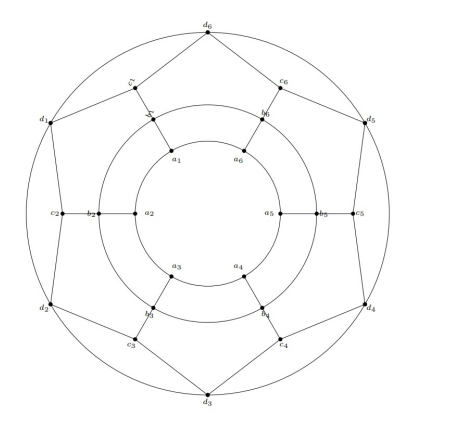
The following theorem will allow us to compute the bounds of the partition dimension of \(U_\nu\).
Theorem 4.1. Let \(U_\nu\) be a convex polytope with \(\nu\geq3\). We obtain \(3 \leq \operatorname{pd}(U_{\nu})\leq 4\).
Proof. Let \(\Theta=\{ \Theta_1, \Theta_2, \Theta_3, \Theta_4 \}\) be a partition set of \(V(U_{\nu})\) for \(\nu\geq3\).
When \(\nu = 3\), consider, \(\Theta_1 = \{a_\psi: 1\leq \psi\leq 3\}\cup\{b_\psi: 1\leq \psi\leq 3\}\cup\{c_1\}, \Theta_2 = \{c_2,c_3\}, \Theta_3 = \{d_1\}\) and \(\Theta_4 = \{d_2,d_3\}\).
When \(\nu = 4\), consider, \(\Theta_1 = \{a_\psi: 1\leq \psi\leq 4\}\cup\{b_\psi: 1\leq \psi\leq 4\}\cup\{c_\psi: 1\leq \psi\leq 4\}\cup\{d_1\}, \Theta_2 = \{d_2\}, \Theta_3 = \{d_3\}\) and \(\Theta_4 = \{d_4\}\).
When \(\nu = 5\), consider, \(\Theta_1 = \{a_\psi: 1\leq \psi\leq 5\}\cup\{b_\psi: 1\leq \psi\leq 5\}\cup\{c_\psi: 1\leq \psi\leq 5\}\cup\{d_1\}, \Theta_2 = \{d_2\}, \Theta_3 = \{d_3,d_4\}\) and \(\Theta_4 = \{d_5\}\).
When \(\nu = 6\), consider, \(\Theta_1 = \{a_\psi: 1\leq \psi\leq 6\}\cup\{b_\psi: 1\leq \psi\leq 6\}\cup\{c_\psi: 1\leq \psi\leq 6\}\cup\{d_1,d_2\}, \Theta_2 = \{d_3\}, \Theta_3 = \{d_4\}\) and \(\Theta_4 = \{d_5, d_6\}\).
It can be verified easily by the inspection of representations that \(\Theta\) is a resolving set for \(\nu = 3,4,5\) and \(6\).
Now, \(r(v|\Theta)\) for \(\nu\geq7\), considering \(\Theta_1 = \{a_\psi: 1\leq \psi\leq \nu\}\cup\{b_\psi: 1\leq \psi\leq \nu\}\cup\{c_\psi: 1\leq \psi\leq \nu\}\cup\{d_\psi: 1\leq \psi\leq \alpha+1\}\cup\{d_{\alpha+3}\}, \Theta_2 = \{d_{\alpha+2}\}, \Theta_3 = \{d_\psi: \alpha+4\leq \psi\leq \nu-1\}\) and \(\Theta_4 = \{d_\nu\}\) are shown in Tables 4,5 and 9.
It is obvious from Tables 4, 4.5 and 9. ., that \(\Theta\) is a partition resolving set of \(U_\nu\). Therefore, \(\operatorname{pd}(U_\nu)\leq 4\). The Proposition 1.1 implies that \(\operatorname{pd}(U_{\nu})\geq 3\), since \(U_{\nu}\) is not a path graph. Hence, \(3 \leq \operatorname{pd}(U_{\nu})\leq 4\). ◻
Among all metric-related parameters, the PD is recognized as particularly challenging to determine. Given the computational complexity involved in obtaining the exact PD for graphs, this paper has focused on establishing bounds for the PD of three specific classes of convex polytopes: \(T_\nu\), \(R_\nu\), and \(U_\nu\). Our analysis leads to the following conclusions:
(a) \(3 \leq \operatorname{pd}(T_\nu) \leq 4\).
(b) \(3 \leq \operatorname{pd}(R_\nu) \leq 4\).
(c) \(3 \leq \operatorname{pd}(U_\nu) \leq 4\).
Open Problem 5.1. A natural direction for future research is to compute the exact PD of the convex polytopes \(T_\nu\), \(R_\nu\), and \(U_\nu\), thereby refining the bounds established in this study.