
A graph of order \(p\) and of size \(q\) is called a \((p,q)\) -graph. For \(k\ge 2\) , we let \(\mathbb Z_k=\{0,1,\dots, k-1\}\) be the standard complete residue system modulo \(k\) . Suppose \(G=(V,E)\) is a \((p,q)\) -graph without isolated vertex. Let \(f:E\to \mathbb Z_k\) be an edge labeling of \(G\) . Let the vertex labeling \(f^*:V\to \mathbb Z_k\) be defined by \(f^*(v)\equiv \prod_{uv\in E} f(uv) \pmod k\) . An edge \(e\in E\) and a vertex \(v\in V\) are called an \(i\) -edge and \(j\) -vertex (under \(f\) ), if \(f(e)=i\) and \(f^*(v)=j\) , respectively, where \(i,j\in\mathbb Z_k\) . Let \(e_f(i)\) and \(v_f(j)\) denote the number of \(i\) -edges and \(j\) -vertices, respectively.
For \(k\ge 2\) , an edge labeling \(f: E\to \mathbb Z_k\) of \(G=(V,E)\) is said to be an edge \(k\) -product cordial labeling of \(G\) if \(|e_f(i_1)-e_f(i_2)|\le 1\) and \(|v_f(j_1)-v_f(j_2)|\le 1\) for \(i_1, i_2, j_1,j_2\in \mathbb Z_k\) . We say \(G\) is edge \(k\) -product cordial if \(G\) admits an edge \(k\) -product cordial labeling. In particular, if \(f\) is an edge \(k\) -product cordial labeling of \(G\) , then \[\left\lfloor\frac{|E|}{k}\right\rfloor\le e_f(i)\le \left\lceil\frac{|E|}{k}\right\rceil \quad \text{ and }\quad \left\lfloor\frac{|V|}{k}\right\rfloor\le v_f(j)\le \left\lceil\frac{|V|}{k}\right\rceil, \tag{1}\] for all \(i,j\in\mathbb Z_k\) .
In [3] , the authors repeatedly used the incorrect inequality “\(v_{f}(0)\ge e_f(0)+1\)” without proper justification. As a result, several statements in [3] are false. In this paper, we idenfity these incorrect statements and provide explicit counterexamples. Corrected statements and proofs are also given.
Statement 1.1. [3, Theorem 5] A graph \(G\) with \(k\le |V|\le |E|\) does not admit an edge \(k\) -product cordial labeling if \(|V|\equiv 0\pmod k\) .
We now present counterexamples to Statement 1.1 .
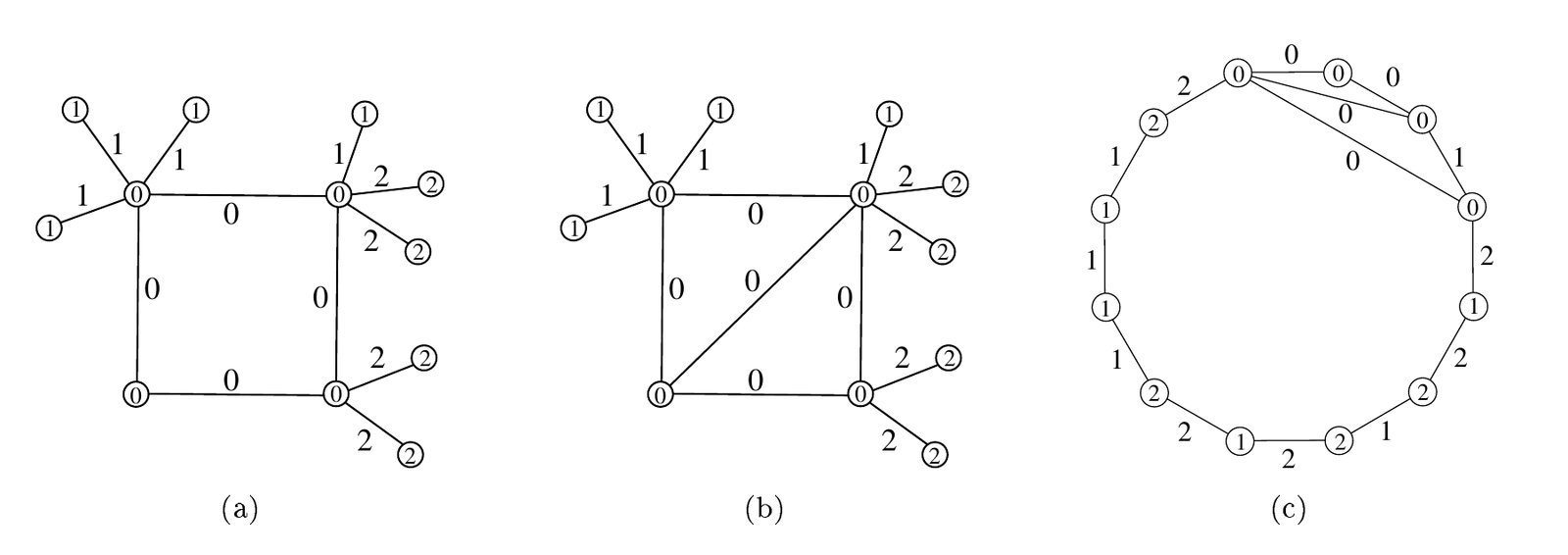
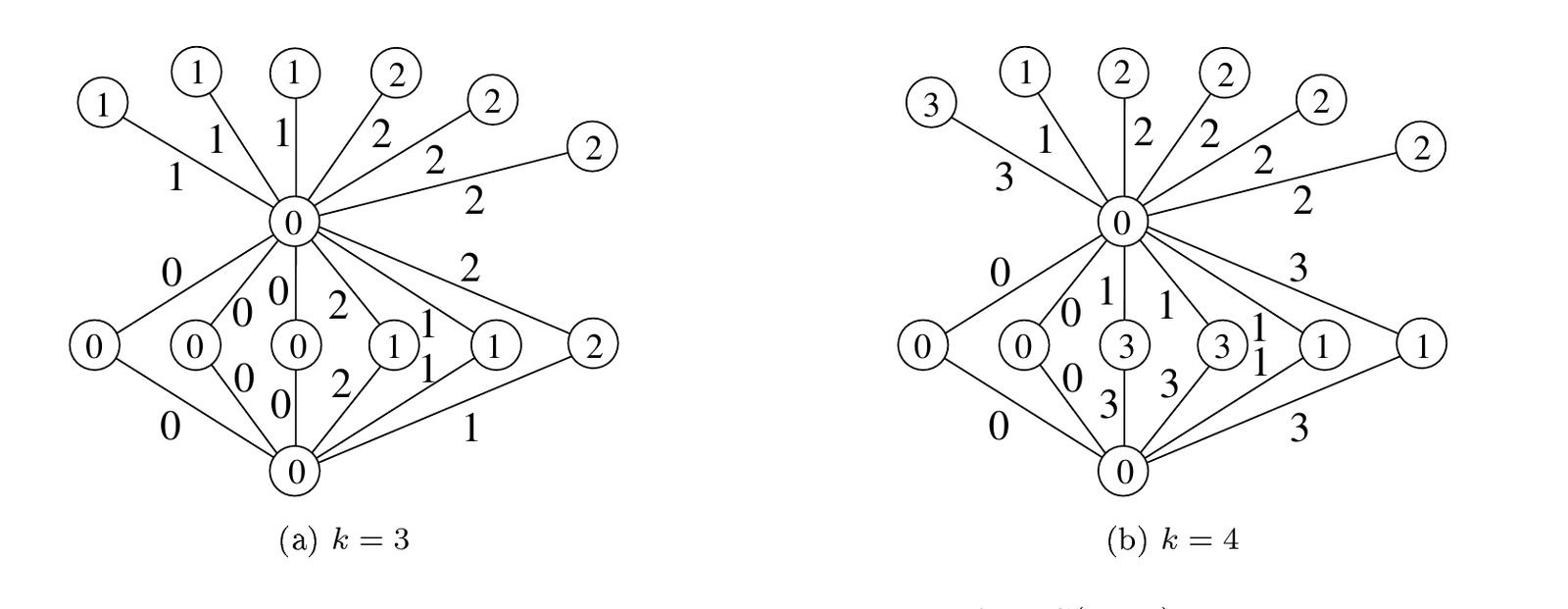
For convenience in verifying the cordiality conditions, we introduce the notation \[E_f=(e_f(0), e_f(1), \dots, e_f(k-1)),\quad V_f=(v_f(0), v_f(1), \dots, v_f(k-1)),\] which record the distributions of edge labels and vertex labels, respectively. For example, in Figure 1(a) , \(E_f=(4,4,4)\) and \(V_f=(4,4,4)\) ; in Figure 1(b) , \(E_f=(5,4,4)\) and \(V_f=(4,4,4)\) ; and in Figure 1(c) , \(E_f=(4,5,5)\) and \(V_f=(4,4,4)\) .
Moreover, there exist infinitely many counterexamples to Statement 1.1 . Let \(H_n\) be the graph obtained from \(C_n=u_1u_2\cdots u_nu_1\) by adding one chord. Let \(v_1, v_2, \dots, v_{(k-1)n}\) be additional vertices, where \(k\ge 2\) . For each \(v_j\) , add an edge connecting \(v_j\) to an arbitrary vertex of \(H_n\) . Denote the resulting graph by \(G_n\) . So \(G_n\) is a \((kn, kn+1)\) -graph.
Partition the \((k-1)n\) pendant edges into \(k-1\) groups of size \(n\) , denoted \(Y_1\dots, Y_{k-1}\) . Label all edges of \(H_n\) by 0 and label the edges in \(Y_i\) by \(i\) , for \(1\le i\le k-1\) . Let \(f\) be this labeling. Thus, \[e_f(0)=n+1, e_f(i)=n \mbox{ for } 1\le i\le k-1, \mbox{ and } v_{f}(j)=n \mbox{ for all } j.\] Hence, \(G_n\) is edge \(k\) -product cordial. Figure 1(b) shows an example for \(k=3\) and \(n=4\) .
If the chord is removed from \(G_n\) , we obtain a class of \((kn, kn)\) -graphs that are edge \(k\) -product cordial. Figure 1(a) shows an example for \(k=3\) and \(n=4\) .
Therefore, all statements in [3] that rely on Statement 1.1 are invalid. In the subsequent sections, we provide corrected proofs for several affected results.
We now introduce some notation. Suppose \(f:E\to\mathbb Z_k\) is an edge labeling of \(G=(V,E)\) . Let \(E_0\) be the set of all \(0\) -edges under \(f\) and let \(G_0=G[E_0]\) be the subgraph induced by \(E_0\) . Clearly \(e_f(0)=|E_0|\) and \(v_{f}(0)\ge |V(G_0)|\) . The equality holds if \(k\) is prime. Otherwise, there may be \(0\) -vertices not in \(G_0\) . For example, the induced label of a vertex incident to a \(2\) -edge and a \(3\) -edge is zero when \(k=6\) . These notations will be used throughout the paper. Notation and concepts not defined in this paper are referred to the book [1] .
Statement 1.2. [3, Theorem 19] Any graph \(G=(V,E)\) with \(\left\lfloor\frac{|V|}{k}\right\rfloor<\left\lfloor\frac{|E|}{k}\right\rfloor\) does not admit an edge \(k\) -product cordial labeling.
A counterexample to Statement 1.2 is shown below.
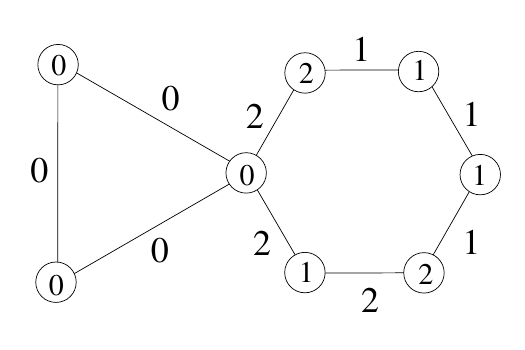
Here \(|V|=8\) , \(|E|=9\) and \(k=3\) . We have \(2=\left\lfloor\frac{|V|}{3}\right\rfloor<\left\lfloor\frac{|E|}{3}\right\rfloor=3\) with \(E_f=(3,3,3)\) and \(V_f=(3,3,2)\) where \(f\) denotes the above labeling.
Lemma 1.3. Suppose \(g\) is the girth of \(G\) and \(f\) is an edge labeling from \(E(G)\to \mathbb Z_k\) . If \(e_f(0)<g\) , then \(v_{f}(0)\ge e_f(0)+1\) .
Proof. Since \(e_f(0)<g\) , \(G_0\) is acyclic. Thus, \(|V(G_0)|\ge |E_0|+1\) . Hence \(v_{f}(0)\ge e_f(0)+1\) . ◻
We provide the following correction to Statement 1.2 .
Theorem 1.4. Let \(G=(V,E)\) be a graph whose girth is greater than \(\left \lceil \frac{|E|}{k}\right\rceil\) . If \(\left\lfloor\frac{|V|}{k}\right\rfloor<\left\lfloor\frac{|E|}{k}\right\rfloor\) , then \(G\) is not edge \(k\) -product cordial.
Proof. We prove the contrapositive of the theorem. Suppose \(G\) admits an edge \(k\) -product cordial labeling \(f\) . Since the girth of \(G\) is greater than \(\left \lceil \frac{|E|}{k}\right\rceil\) and \(e_f(0)=|E_0|\le \left \lceil \frac{|E|}{k}\right\rceil\) , \(G_0\) is acyclic. Thus \(v_f(0)\ge |V(G_0)|\ge |E_0|+1=e_f(0)+1\) .
Since \(e_f(0)\ge \left\lfloor \frac{|E|}{k}\right\rfloor\) and \(v_f(0)\le \left\lfloor \frac{|V|}{k}\right\rfloor+1\) , \(\left\lfloor \frac{|V|}{k}\right\rfloor+1\ge \left \lceil \frac{|V|}{k}\right\rceil\ge v_f(0)\ge e_f(0)+1 \ge \left\lfloor \frac{|E|}{k}\right\rfloor+1\) . Thus \(\left\lfloor \frac{|V|}{k}\right\rfloor\ge \left\lfloor \frac{|E|}{k}\right\rfloor\) . ◻
Lemma 1.5. For each \(n\ge 3\) and \(k\ge 2\) , there is a graph admitting an edge \(k\) -product cordial labeling \(f\) such that \(e_f(0)-v_{f}(0)=\left\lceil \frac{n^2-3n}{2k}\right\rceil\) .
Proof. Let \(G\) be the graph obtained from \(K_n\) by attaching \((k-1)n\) pendant edges arbitrary. So \(G\) is a \((kn, kn+\frac{1}{2}(n^2-3n))\) -graph. We label an \(n\) -cycle in \(K_n\) by 0, and label all pendant edges by \(1, 2, \dots, k-1\) evenly. At this moment, the number of \(i\) -edges is \(n\) , \(0\le i\le k-1\) . We still have \(\frac{1}{2}(n^2-n)-n=\frac{1}{2}(n^2-3n)\) unlabeled edges in \(K_n\) . Lastly, we label them by \(0,1,\dots, k-1\) in order and evenly. Let the resulting labeling be \(f\) . This construction guarantees that the difference between the number of \(i\) -edges and \(j\) -edges is at most 1 when \(i\ne j\) and \(e_f(0)= n + \left\lceil\frac{n^2-3n}{2k}\right\rceil\) . Clearly, \(v_f(j)=n\) for \(0\le j\le k-1\) . Thus \(f\) is an edge \(k\) -product cordial labeling of \(G\) . Hence, we have the lemma. ◻
Thus, for any fixed \(k\) , there is a graph admitting an edge \(k\) -product cordial labeling \(f\) such that \(e_f(0)-v_{f}(0)\) is arbitrarily large.
Example 1.6. Let \(n=4\) and \(k=4\) . According to the proof of Lemma 1.5 , we have the following labeling \(f\) .
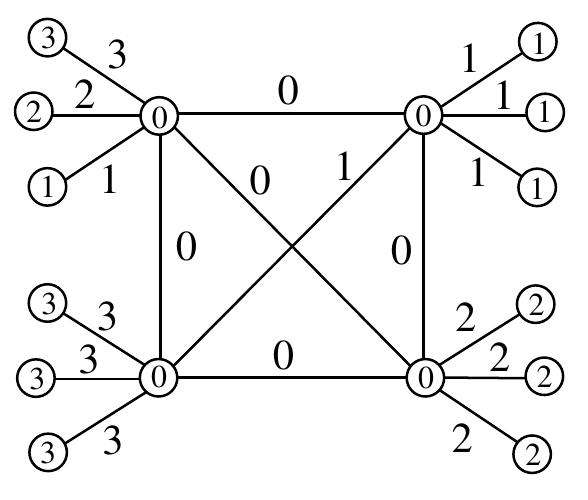
Clearly, \(E_f=(5,5,4,4)\) and \(V_f=(4,4,4,4)\) .
Let the vertex and the edge sets of the star \(K_{1,n}\) be \(\{u, u_1, \dots, u_n\}\) and \(\{uu_i\;|\; 1\le i\le n\}\) , respectively. The shadow graph of \(K_{1,n}\) , denoted \(D(K_{1,n})\) , has vertex set \(\{u, u’\}\cup\{u_i, u_i’\;|\; 1\le i\le n\}\) and edge set \(\{uu_i, uu_i’, u’u_i, u’u_i’\;|\; 1\le i\le n\}\) . Thus, \(D(K_{1,n})\) is a \((2n+2, 4n)\) -graph.
Theorem 2.1. Let \(n\ge 1\) and \(k\ge 2\) . Suppose \(D(K_{1,n})\) admits an edge \(k\) -product cordial labeling \(f\) , then \(k\ge 4n+1\) or \(k=2n+1\) .
Proof. Let \(G=D(K_{1,n})\) . Note that \(G\) is a \((2n+2, 4n)\) -graph. Thus, \(e_f(0)\ge \displaystyle\left\lfloor\frac{4n}{k}\right\rfloor\) and \(v_{f}(0)\le\displaystyle\left\lceil\frac{2n+2}{k}\right\rceil\) .
If \(n\ge 3\) , then \(v_{f}(0)=1, 2\) and \(e_f(0)=2,3\) . Since \(e_f(0)\ge 2\) , \(v_{f}(0)\ge 3\) . It is a contradiction.
If \(n=2\) , then \(k=3\) , \(e_{f}(0)=2, 3\) and \(v_f(j) = 2\) for \(j=0,1,2\) . It is also impossible.
So \(e_f(0)=2|X|+|Y|\) . On the other hand, \[\begin{aligned} 1+\frac{2n+2}{k} & > \left\lceil\frac{2n+2}{k}\right\rceil \ge v_{f}(0)\\ & \ge |V(G_0)|=|X|+|Y|+2= \frac{e_f(0)-|Y|}{2} +|Y|+2 \\&=\frac{e_f(0)}{2}+2+\frac{|Y|}{2}\ge \frac{e_f(0)}{2}+2\\ & \ge \frac{1}{2}\left\lfloor\frac{4n}{k}\right\rfloor+2> \frac{1}{2}\left(\frac{4n}{k}-1\right)+2=\frac{2n}{k}+\frac{3}{2}. \end{aligned}\]
We have \(\frac{2}{k}> \frac{1}{2}\) , i.e., \(k=2,3\) .
Suppose \(k=2\) so that \(e_f(i)=2n\) and \(v_{f}(j)=n+1\) for all \(i,j\) . Now, \(\displaystyle n+1=|X|+|Y|+2=\frac{e_f(0)}{2}+2+\frac{|Y|}{2}=n+2+\frac{|Y|}{2}\) , which is impossible.
Suppose \(k=3\) .
Consequently, either \(k\ge 4n+1\) or \(k=2n+1\) . ◻
Remark 2.2.
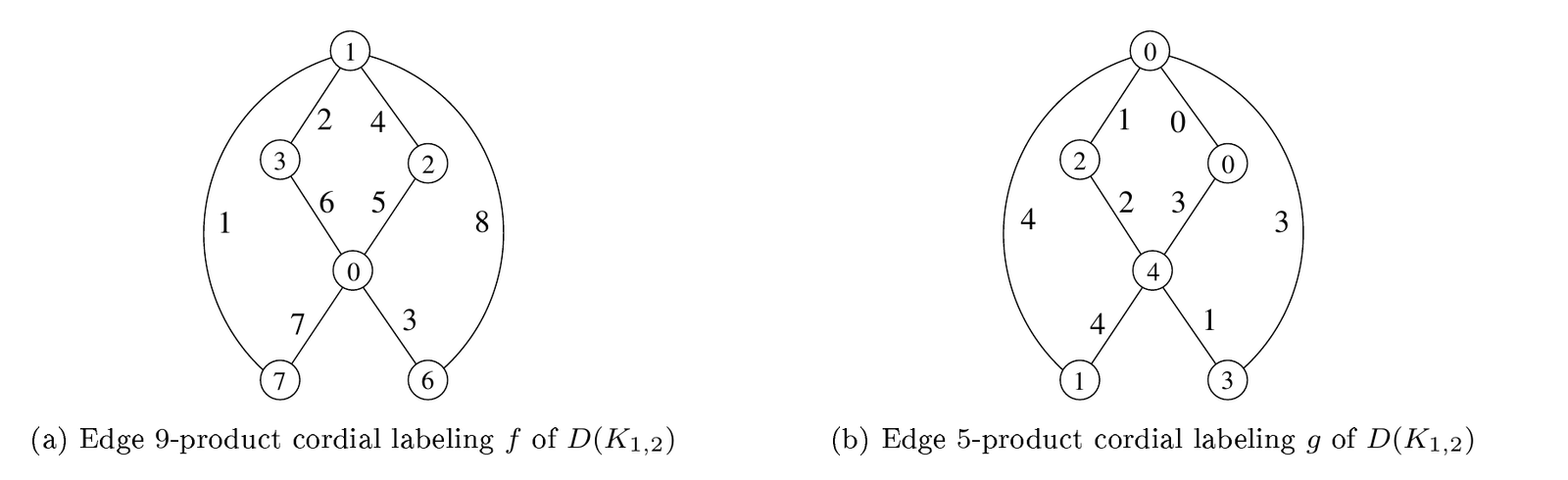
Hence, Figure 2(a) has \(E_f=(0,1,1,1,1,1,1,1,1)\) and \(V_f=(1,1,1,1,0,0,1,1,0)\) ; Figure 2(b) has \(E_g=(1,2,1,2,2)\) and \(V_g=(2,1,1,1,1)\) .
Combining Theorem 2.1 and the results in [3] , we have
Theorem 2.3. Suppose \(k=3,5\) . \(D(K_{1,n})\) is edge \(k\) -product cordial if and only if \(n=\frac{k-1}{2}\) .
Corollary 2.4. \(D(K_{1,1})\cong C_4\) is edge \(k\) -product cordial if and only if \(k=3\) or \(k\ge 6\) .
Proof. From the proof of Theorem 9 in [3] , the graph \(C_4\) is not edge \(5\) -product cordial. Combining this with Theorem 2.1 , we obtain the necessity.
An edge \(3\) -product cordial labeling of \(C_4\) is given in Remark 2.2 (3). For \(k\ge 6\) , label the edges of \(C_4\) by \(1,3,2,4\) in cyclic order. The induced vertex labels are \(3,6,8,4\) , which are pairwise distinct modulo \(k\) . Hence, this labeling is an edge \(k\) -product cordial, proving the sufficiency. ◻
Question 2.5. Is \(D(K_{1,n})\) edge \((2n+1)\) -product cordial for \(n\ge 3\) ?
Question 2.6. Is \(D(K_{1,n})\) edge \(k\) -product cordial for \(n\ge 2\) when \(k\ge 4n+1\) ?
In this section, \(S(K_{1,n})\) denotes the splitting graph of the star \(K_{1,n}\) . The vertex set of \(S(K_{1,n})\) is \(\{u, v\}\cup\{u_i, v_i\;|\; 1\le i\le n\}\) and its edge set is \(\{uu_i, vu_i, uv_i\;|\; 1\le i\le n\}\) . Thus \(S(K_{1,n})\) is a \((2n+2, 3n)\) -graph.
Statement 3.1. [3, Theorem 10] The graph \(S(K_{1,n})\) does not admit an edge \(k\) -product cordial labeling for \(k\le n\) .
This statement is false, as demonstrated by explicit counterexamples below.
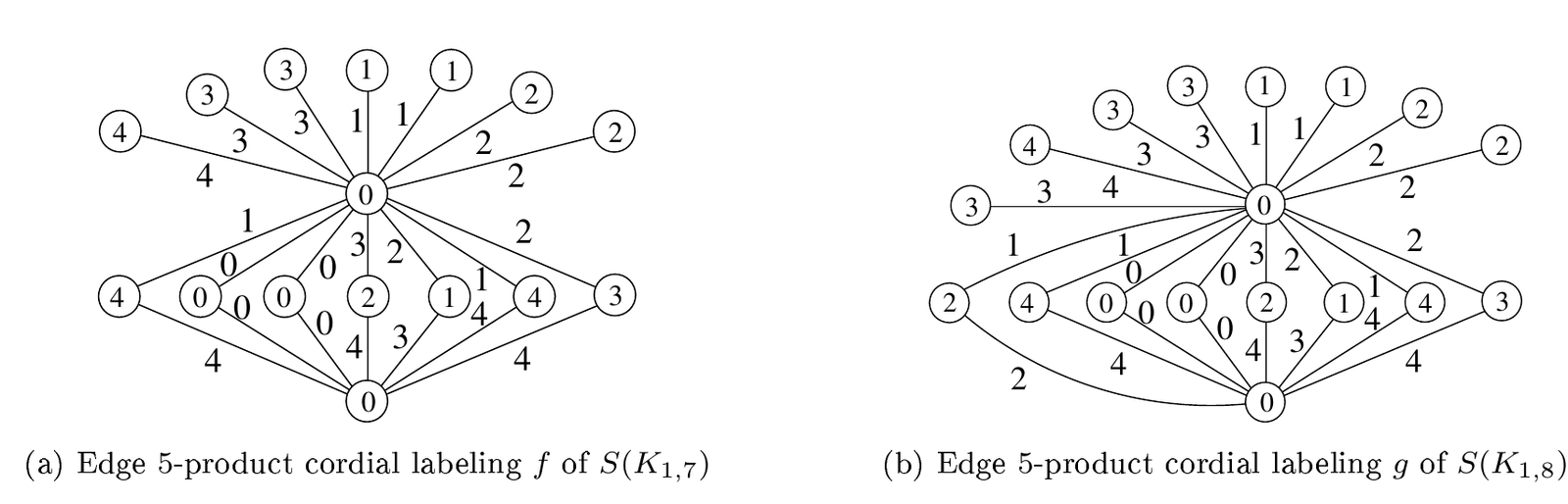
Here, \(E_f=(4,4,4,4,5)\) , \(V_f=(4, 3, 3, 3, 3)\) ; and \(E_g=(4,5,5,5,5)\) , \(V_g=(4, 3, 4, 4, 3)\) .
Theorem 3.2. Let \(n\ge 1\) and \(k\ge 2\) . Suppose \(G=S(K_{1,n})\) admits an edge \(k\) -product cordial labeling \(f\) .
Proof. Since \(G\) is a \((2n+2, 3n)\) -graph, we have \(e_f(0)\ge \displaystyle\left\lfloor\frac{3n}{k}\right\rfloor\) and \(\displaystyle\left\lfloor\frac{2n+2}{k}\right\rfloor\le v_{f}(0)\le \left\lceil\frac{2n+2}{k}\right\rceil\) .
Since \(v_f(0)\ge e_f(0)+1\) , it is impossible.
It is impossible.
Since \(v_f(0)\ge e_f(0)+1\) , \(e_f(0)\le 1\) .
Suppose \(e_f(0)=0\) . Then \(e_f(i)\le 1\) for \(1\le i\le k-1\) . Hence \(G\) has at most \(k-1\) edges, i.e., \(k\ge 3n+1\) .
Suppose \(e_f(0)=1\) , then \(v_f(0)\ge 2\) and hence \(v_f(j)\ge 1\) for \(1\le j\le k-1\) . So \(G\) has at least \(2+(k-1)=k+1\) vertices, i.e., \(k\le 2n+1\) .
Therefore, \(\frac{2n+2}{k}+1>\left\lceil\frac{2n+2}{k}\right\rceil\ge v_f(0)\ge 4\) . Thus, \(3k< 2n+2\) , i.e., \(3k\le 2n+1\) .
◻
Example 3.3. The examples in Figure 4 to Figure 6 verify conclusion (1) of Theorem 3.2 .
When \(e_f(0)=0\) , we have an edge \(8\) -product cordial labeling for \(S(K_{1,2})\) and an edge \(10\) -product cordial labeling for \(S(K_{1,3})\) . Clearly, there is an edge \(5\) -product cordial labeling for \(S(K_{1,1})\cong P_4\) .
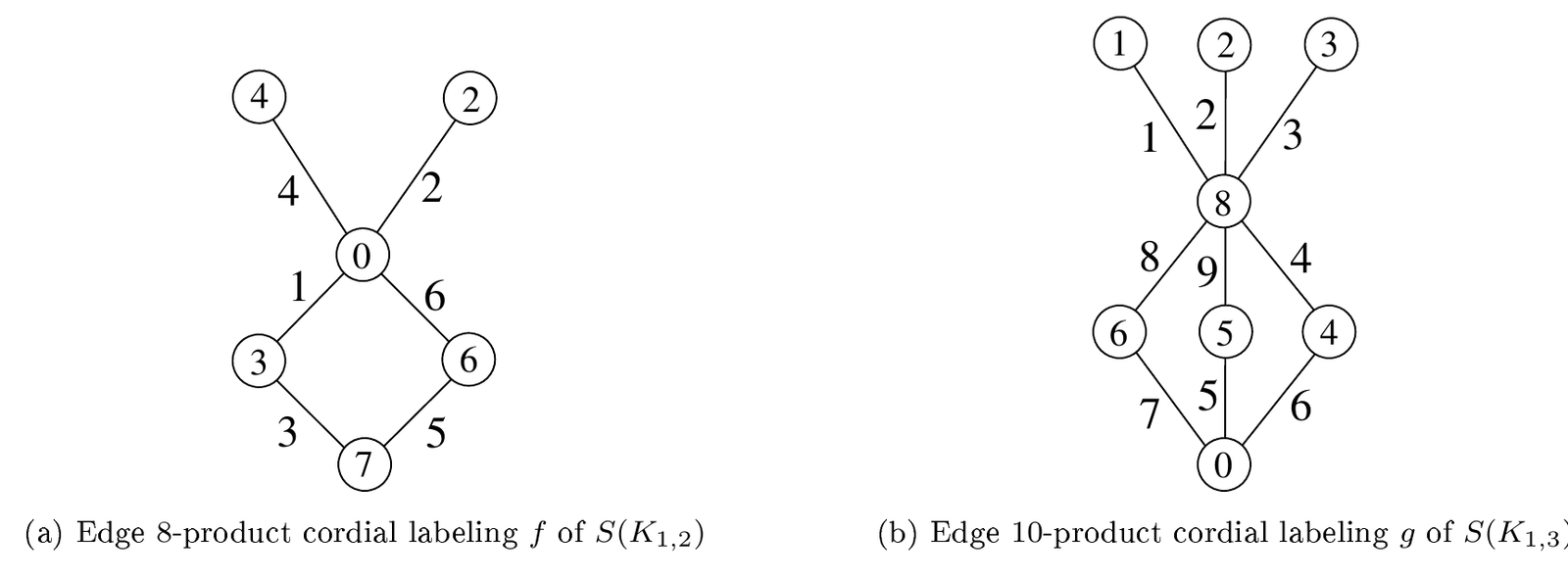
Here, Figure 4(a) has \(E_f=(0,1,1,1,1,1,1,0)\) , \(V_f=(1,0,1,1,1,0,1,1)\) ; and Figure 4(b) has \(E_g=(0,1,1,1,1,1,1,1,1,1)\) , \(V_g=(1,1,1,1,1,1,1,0,1,0)\) .
When \(e_f(0)=1\) , we have the following edge \(k\) -product cordial labelings for \(S(K_{1,n})\) with \(n=2,3\) . Actually, when \(n=2\) , \(4\le k\le 5\) and when \(n=3\) , \(5\le k\le 7\) .
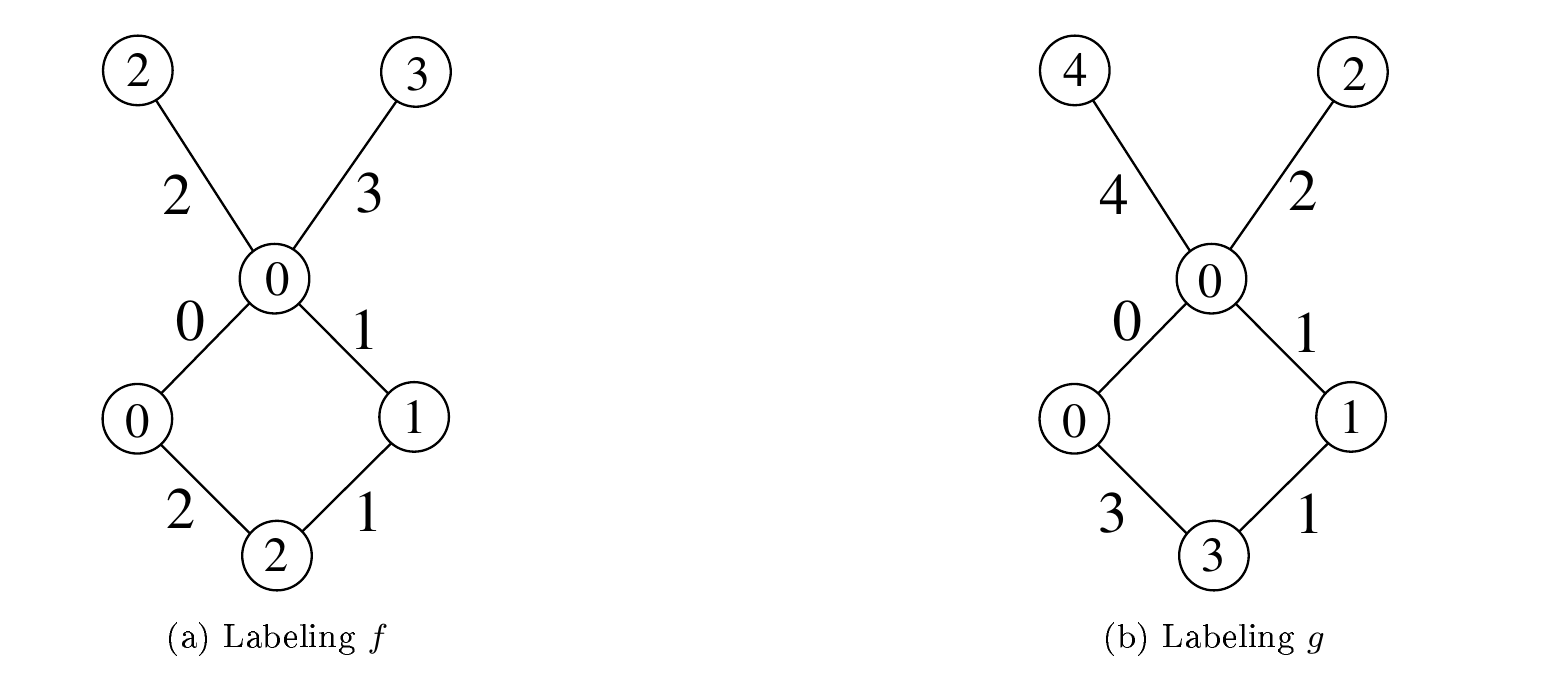
Here, Figure 5(a) has \(E_f=(1,2,2,1)\) , \(V_f=(2,1,2,1)\) ; and Figure 5(b) has \(E_g=(1,2,1,1,1)\) , \(V_g=(2,1,1,1,1)\) .
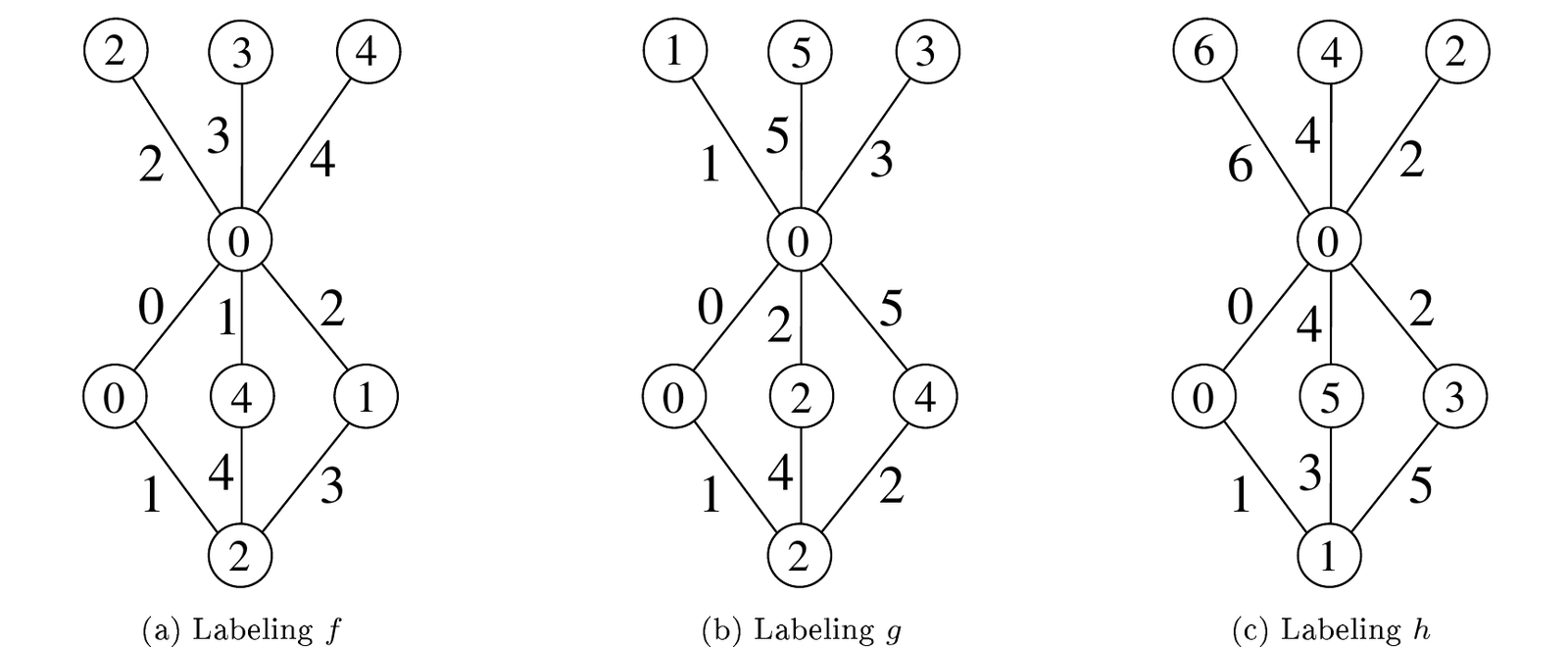
Here, Figure 6(a) has \(E_f=(1,2,2,2,2)\) , \(V_f=(2,1,2,1,2)\) ; Figure 6(b) has \(E_g=(1,2,2,1,1,2)\) , \(V_g=(2,1,2,1,1,1)\) ; and Figure 6(c) has \(E_h=(1,1,2,1,2,1,1)\) , \(V_h=(2,1,1,1,1,1,1)\) .
Note that Figure 3 gives two examples that verify conclusion (2) of Theorem 3.2 when \(k=5\) . Two more examples in Figure 7 verify conclusion (2) of Theorem 3.2 for \(k=3,4\) .
Here, Figure 7(a) has \(E_f=(6, 6, 6)\) , \(V_f=(5, 5, 4)\) ; and Figure 7(b) has \(E_f=(4, 5, 4, 5)\) , \(V_f=(4, 3, 4, 3)\) .
In this subsection, we point out some mistakes about edge \(3\) -product cordial behavior of \(S(K_{1,n})\) as shown in [3] and make some correction.
Statement 3.4. [3, Theorem 11] The graph \(S(K_{1,n})\) admits an edge \(3\) -product cordial labeling if and only if \(n=1\) .
Statement 3.4 is incorrect, since there is an edge \(3\) -product cordial labeling for the graph \(S(K_{1,6})\) as shown in Figure 7(a) .
Theorem 3.5. If \(G=S(K_{1,n})\) is edge \(3\) -product cordial, then \(n=1\) or \(n\ge 6\) .
Proof. By applying Theorem 3.2 , we have the following results.
Consider \(G=S(K_{1,4})\) which is a \((10, 12)\) -graph. Suppose \(f\) is an edge \(3\) -product cordial labeling. So \(e_f(i)=4\) , for \(i=0,1,2\) . Since \(G_0\) contains a cycle, \(G_0\) is a \(4\) -cycle. Since \(3\le v_f(0)\le 4\) , \(v_f(0)=4\) . Thus, \(v_f(1)=v_f(2)=3\) . Without loss of generality, we may assume that \(G_0\) is the \(4\) -cycle \(uu_1vu_2u\) .
Suppose there is only one non-pendant 2-edge, then this edge is incident to a degree 2 vertex, say \(u_3\) . Thus, another edge incident to \(u_3\) is a 1-edge. Therefore, \(v_f(2) = 4\) , a contradiction.
Suppose there are exactly two non-pendant 2-edges. If both are incident to \(u_3\) (or else \(u_4\) ), then \(v_f(1)=4\) , a contradiction. Otherwise, \(v_f(2) = 4\) , also a contradiction.
Suppose there are at least three non-pendant 2-edges, then \(v_f(1)\ge 4\) , a contradiction.
Thus, \(f\) does not exist.
Consider \(G=S(K_{1,5})\) which is a \((12, 15)\) -graph. Suppose \(f\) is an edge \(3\) -product cordial labeling. From (1) , we have \(e_f(0)=5\) and \(v_f(0)=4\) . Since every vertex incident to a 0-edge is also a 0-vertex, we must have \(|V(G_0)|=4\) so that \(G_0\cong K_{1,1,2}\) . However, \(S(K_{1,5})\) does not contain such a subgraph. Thus \(n\ge 6\) .
◻
Remark 3.6. Label the edges of \(S(K_{1,1})\cong P_4\) by 0,2,1 in order we get an edge \(3\) -product cordial labeling of it. Figure 7(a) shows an edge \(3\) -product cordial labeling of \(S(K_{1,6})\) .
Finding a necessary and sufficient condition for \(S(K_{1,n})\) being edge \(3\) -product cordial is not a purpose of this paper. So we leave this problem to interested readers.
Next, we study edge \(4\) -product cordiality of \(S(K_{1,n})\) .
Statement 3.7. [3, Theorem 12] The graph \(S(K_{1,n})\) admits an edge \(4\) -product cordial labeling if and only if \(n=2\) .
Statement 3.7 is incorrect, since there is an edge \(4\) -product cordial labeling for the graph \(S(K_{1,6})\) as shown in Figure 7(b) .
Theorem 3.8. If \(G=S(K_{1,n})\) is edge \(4\) -product cordial, then \(n=2\) or \(n\ge 6\) .
Proof. Suppose \(G=S(K_{1,n})\) admits an edge \(4\) -product cordial labeling \(f\) . From Theorem 3.2 , we have \(n=1\) with \(e_f(0)=0\) , or \(n=2\) , or \(n\ge 6\) . To complete the proof, we need only consider \(n=1\) with \(e_f(0)=0\) so that \(G\cong P_4\) with \(V_f=(1,1,1,1)\) . Since \(E_f=(0,1,1,1)\) , it is routine to check that \(v_f(0) = 0\) , a contradiction. ◻
Remark 3.9. To verify the above theorem, there is an edge \(4\) -product cordial labeling of \(S(K_{1,2})\) which was shown in the proof of Theorem 12 of [3] ; and Figure 7(b) .
Figure 3 (a) and Figure 3 (b) show that the following statement is incorrect.
Statement 3.10. [3, Theorem 13] The graph \(S(K_{1,n})\) admits an edge \(5\) -product cordial labeling if and only if \(n\le 3\) .
From Theorem 3.2 we have the following result immediately.
Theorem 3.11. If \(G=S(K_{1,n})\) is edge \(5\) -product cordial, then \(1\le n\le 3\) or \(n\ge 7\) .
Let \(G_1,\dots G_n\) , \(n\ge2\) , be \(n\) copies of a graph \(G\) . Let \(v\) be a vertex of \(G\) and \(v_i\in V(G_i)\) , \(i=1,\dots, n\) , be the vertex corresponding to \(v\) . The graph \(P(n.G^v)\) is the graph obtained from \(G_1+\cdots +G_n\) by adding the edge \(v_iv_{i+1}\) , \(1\le i\le n-1\) . \(P(n.G^v)\) is called the path union of \(n\) copies of the graph \(G\) [2] .
Suppose \(G=C_m\) , \(m\ge 3\) . By symmetry, all \(P(n.C_m^v)\) are isomorphic. We shall use \(P(n.C_m)\) instead of \(P(n.C_m^v)\) . Note that \(P(n.C_m)\) is an \((mn, mn+n-1)\) -graph. We let the \(i\) -th copy of \(C_m\) be \(v_{i,1}v_{i,2}\cdots v_{i, m}v_{i,1}\) . We also let \(v_{1,1}v_{2,1}\cdots v_{n,1}\) be a subpath of \(P(n.C_m)\) .
Statement 4.1. [3, Theorem 20] The graph \(P(n.C_m)\) does not admit an edge \(k\) -product cordial labeling if \(n\ge k\) .
In Figure 8 , we give two counterexamples to Statement 4.1 .

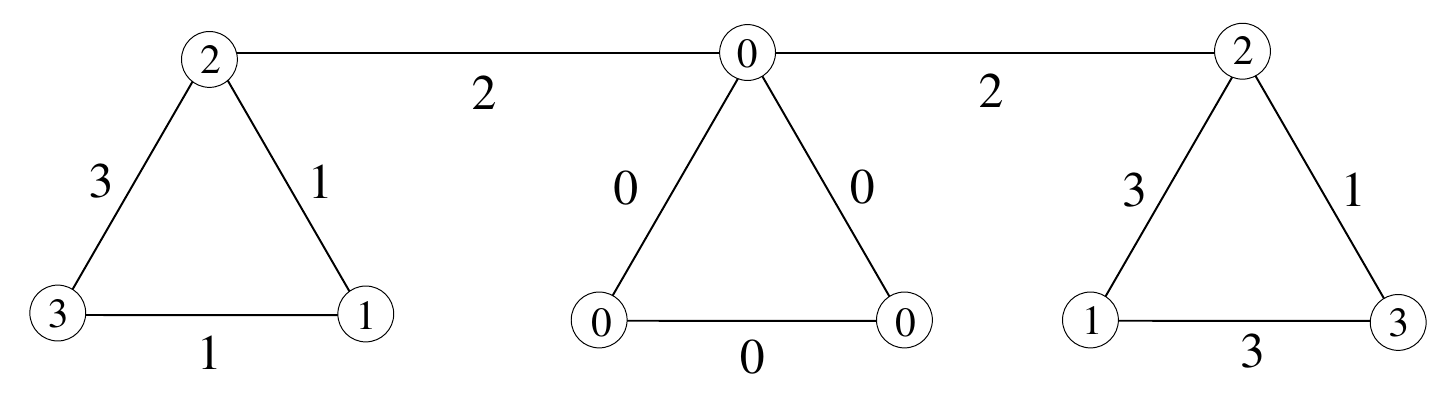
Here, Figure 8(a) has \(E_f=(4, 5, 4, 5, 5)\) , \(V_f=(4, 4, 4, 3, 3)\) ; and Figure 8(b) has \(E_f=(3, 4, 4)\) , \(V_f=(3, 3, 3)\) .
Since Statement 4.1 is false, the proofs of Theorems 21, 22, and 23 in [3] are also invalid. We note that Theorems 21, 22, and 23 are in fact incorrect. Counterexamples to Theorems 21 and 22 are given in Figure 8(b) , while a counterexample to Theorem 23 is given in Figure 9 .
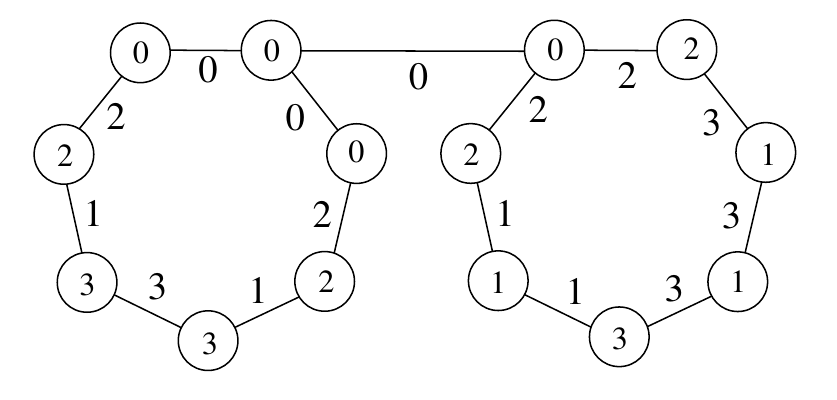
Here, \(E_f=(3, 4, 4, 4)\) , \(V_f=(4, 3, 4, 3)\) .
Theorem 4.2. Suppose graph \(P(n.C_m)\) admits an edge \(k\) -product cordial labeling. If \(G_0\) is acyclic, then \(k\ge n+1\) . If \(G_0\) contains a cycle, then \(k\le \lfloor\frac{mn-1}{m-1}\rfloor\) . Moreover, the bounds are attainable.
Proof. Suppose \(G_0\) is acyclic, then \(\frac{mn}{k}+1\ge \left\lceil \frac{mn}{k}\right\rceil\ge v_f(0)\ge e_f(0)+1\ge \left\lfloor \frac{mn+n-1}{k}\right\rfloor+1>\frac{mn+n-1}{k}\) . Thus, we have \(k>n-1\) , equivalently, \(k\ge n\) .
If \(k=n\) , then \(v_f(j)=m\) for all \(j\) . However, \(m=\left\lfloor\frac{mn+n-1}{n}\right\rfloor\le e_f(0)\) implies \(v_f(0)\ge m+1\) . It is a contradiction. Hence \(k\ge n+1\) . Figure 10 shows that \(P(4.C_4)\) admits an edge 5-product cordial labeling \(g\) .
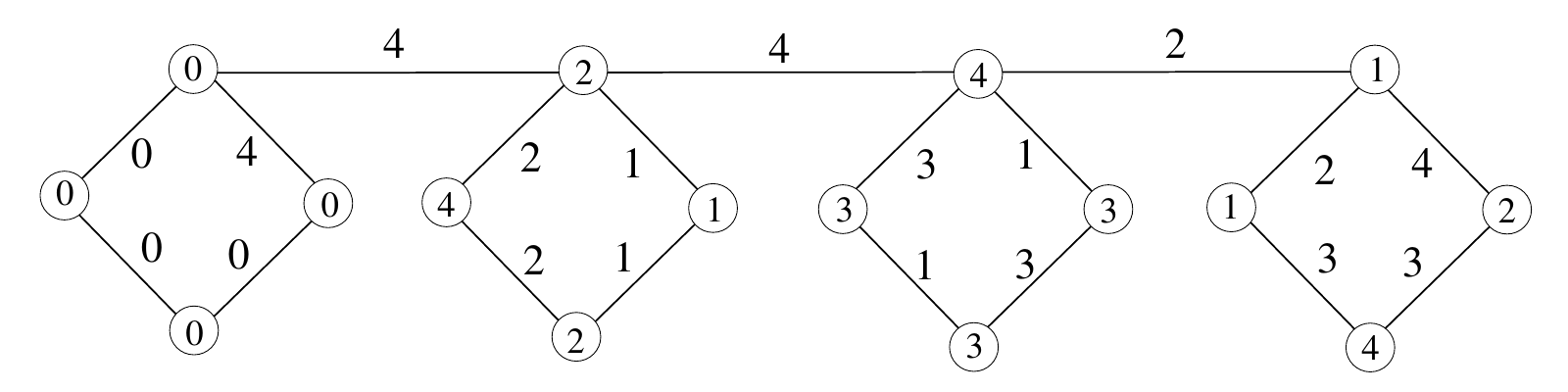
Here, \(E_g=(3,4,4,4,4)\) , \(V_g=(4, 3, 3, 3, 3)\) . Since \(n=4,k=5\) , the bound is attainable.
Suppose \(G_0\) contains a cycle, then \(v_f(0)\ge m\) . Now, \(\frac{mn}{k}+1 > \left\lceil \frac{mn}{k} \right\rceil\ge v_f(0)\ge m\) . So \(mn>(m-1)k\) , i.e., \(mn-1\ge (m-1)k\) . Hence \(k\le \frac{mn-1}{m-1}\) , i.e., \(k\le \lfloor\frac{mn-1}{m-1}\rfloor\) . The graph in Figure 11 shows the bound is attainable.
Here, \(E_f=(3,3,2,3)\) , \(V_f=(3, 2, 2, 2)\) . ◻
Remark 4.3. Suppose \(P(n.C_m)\) admits an edge \(n\) -product cordial labeling \(f\) , then \(v_f(j)=m\) . On the other hand, from the proof above \(G_0\) contains a cycle \(C_m\) . Thus \(G_0\cong C_m\) .
Let us consider some edge \(3\) -product cordial labelings of the graph \(P(n.C_3)\) . Note that \(P(n.C_3)\) is a \((3n, 4n-1)\) -graph. Suppose \(P(n.C_3)\) admits an edge \(3\) -product cordial labeling \(f\) , then \(v_f(j)=n\) , for all \(0\le j\le 2\) .
When \(n=2\) , \(G_0\) is acyclic. Now, \(e_f(0)=2,3\) for any edge \(3\) -product cordial labeling \(f\) . This implies that \(v_f(0)\ge 3\) . Thus \(P(2.C_3)\) is not edge \(3\) -product cordial.
When \(n=3\) , Figure 8(b) shows an edge \(3\) -product cordial labeling for \(P(3.C_3)\) .
Suppose \(n\ge 4\) and \(G=P(n.C_3)\) admits an edge \(3\) -product cordial labeling \(f\) . By Theorem 4.2 , \(G_0\) contains a cycle which is \(C_3\) .
Suppose \(n=4\) , then \(v_f(j)=4\) and \(e_f(i)=5\) for all \(i,j\) . If \(G_0\) is connected, then it is unicyclic. Hence \(|V(G_0)|=5\) which is impossible. If \(G_0\) is disconnected, then \(|V(G_0)|\ge 6\) which is also impossible. Thus there is no edge \(3\) -product cordial labeling for \(P(4.C_3)\) .
Suppose \(n=5\) , then \(v_f(j)=5\) and \(e_f(i)=6\) or 7, for all \(i,j\) . By a similar argument as above, there is no edge \(3\) -product cordial labeling for \(P(5.C_3)\) .
Suppose \(n=6\) , then \(v_f(j)=6\) and \(e_f(i)=7\) or 8, for all \(i,j\) . We have an edge \(3\) -product cordial labeling for \(P(6.C_3)\) as in Figure 12 .

Here, \(E_f=(7, 8, 8)\) , \(V_f=(6, 6, 6)\) .
The purpose of this paper is not to study the behavior of edge \(k\) -product cordiality of \(P(n.C_m)\) . We do not pursue in this direction further.
The proof of the following statement is invalid because the authors applied the inequality \(v_f(0)\ge e_f(0)\) without justification. Lemma 1.5 shows that this inequality may not hold in general.
Statement 5.1. [3, Theorem 4] A complete bipartite graph \(K_{m,n}\) with \(m\equiv r_1\pmod{k}\) and \(n\equiv r_2\pmod k\) does not admit an edge \(k\) -product cordial labeling if \(r_1+r_2<k\le r_1r_2\) .
We may restate the above statement as follows: For \(m\equiv r_1\pmod{k}\) and \(n\equiv r_2\pmod{k}\) , where \(0\le r_1, r_2<k\) , if \(K_{m,n}\) admits an edge \(k\) -product cordial labeling, then \(k\le r_1+r_2\) or \(k> r_1r_2\) .
Since \(D(K_{1,s}) \cong K_{2,2s}\) , Theorem 2.1 implies that if \(K_{2,2s}\) admits an edge \(k\) -product cordial labeling, then \(k=2s+1\) or \(k\ge 4s+1\) . Thus, taking \(m=r_1=2\) and \(n=r_2=2s\) , Statement 5.1 holds for \(K_{2,2s}\) . Since we believe that Statement 5.1 is true, we propose the following open problem.
Problem 5.2. Show that the above reformulation of Statement 5.1 holds.
Let us summarize the current status.