
Magic squares form a classical meeting point of arithmetic, combinatorics, and algebra. Among their many variants, pandiagonal (also called Nasik or diabolic) magic squares impose particularly rigid global constraints: not only rows, columns, and the two main diagonals, but also all broken diagonals (with wrap-around indexing on the torus) must have the same line sum. Early systematic discussions of the wrap-around diagonal constraints go back to Frost [6], and Rosser–Walker developed an algebraic framework for diabolic squares and their transformation groups in [13, 14]. For general background, see Andrews [1] and Omori [12].
A further refinement relevant to this paper is the compound condition. An order \(k^{2}\) magic square is called compound if the array can be partitioned into \(k\times k\) blocks and the resulting \(k\times k\) matrix of block sums is itself a magic square of order \(k\). Compound constructions have a long history (in particular for associative/regular families), and modern discussions of such compounding mechanisms appear, for example, in the context of Frierson-type parameterizations; see Loly–Cameron [10]. From the design-theoretic viewpoint, it is natural to approach highly structured magic squares via Latin squares and orthogonality, as summarized in the Handbook of Combinatorial Designs [4].
Related deterministic constructions and where we sit. There exist several deterministic approaches to pandiagonal magic squares, ranging from explicit families in selected congruence classes [8] to the particularly strong most-perfect class [11]. On the Latin-square side, pandiagonal (Nasik) Latin squares and their orthogonality properties are also studied in connection with modular \(n\)-queens constructions and panmagic squares; see, for example, Bell–Stevens [2] and the earlier algorithmic/structural treatments such as Xu–Lu [15]. These works make clear that “pandiagonality” and “orthogonality” are classical design constraints, and that linear (affine) Latin squares over \(\mathbb{Z}_k\) provide a standard source of explicit examples.
Positioning: what is not new, and what is new here. The \(k\times k\) kernel underlying our construction is a linear Latin square over \(\mathbb{Z}_k\). Thus, at the level of Latin-square theory, the kernel itself is not a new combinatorial object. The contribution of the present paper is instead at the construction level: we integrate a specific linear kernel with its transpose into a two-scale base-\(k\) encoding that yields, in closed form and without any search for orthogonal mates, a family of order \(k^{2}\) arrays satisfying simultaneously: (i) normality (the entries are exactly \(\{0,1,\dots,k^{4}-1\}\)), (ii) the full pandiagonal condition at order \(k^{2}\), and (iii) a compound block-sum pandiagonality property.
Why prime \(k\) and admissible parameters. We work with a prime \(k\ge 5\) so that \(\mathbb{Z}_k\) is a field and every nonzero residue has a unique inverse. This guarantees that the linear maps appearing in (a) diagonal-regularity of the kernel and (b) the orthogonality-with-transpose test are invertible. Equivalently, our admissible parameter range excludes the two degenerate cases where the relevant linear coefficients vanish, which in our setting reduces to a transparent condition of the form “\(m\not\equiv \pm 1 \pmod{k}\)”. We make explicit in the body of the paper exactly which steps use field structure and which merely use unit conditions, so the role of the primality assumption is fully auditable.
Method in one sentence. We build an order \(k^{2}\) square by superposing a linear Latin-square kernel and its transpose both at the block scale and at the within-block scale and then encoding the resulting four base-\(k\) digits as a single integer in \(\{0,1,\dots,k^{4}-1\}\).
Technical bottleneck: global broken diagonals and carry control. While bijectivity follows cleanly from orthogonality (hence from an explicit \(2\times 2\) invertibility condition), pandiagonality at order \(k^{2}\) requires a global analysis of broken diagonals on the \(k^{2}\times k^{2}\) torus. The key point is that lifting congruences along a global diagonal to integer equalities introduces a carry function. Our proof is fully explicit: each global broken diagonal sum is decomposed into four digit-level sums coming from broken diagonals of the kernel and its transpose, plus a carry contribution. We isolate the carry/no-carry counts into a short lemma showing that they depend only on the diagonal offset and not on block indices, thereby eliminating “by analogy” gaps and making the verification line-by-line.
Summary of contributions.
1. We define a concrete linear Latin-square kernel over \(\mathbb{Z}_k\) and record the exact conditions under which it is pandiagonal (diagonal-regular) as a Latin square.
2. We prove that this kernel is orthogonal to its transpose under a simple arithmetic nondegeneracy condition, hence no external orthogonal-mate search is needed.
3. Using a two-scale base-\(k\) superposition, we obtain a closed-form bijection from the \(k^{2}\times k^{2}\) grid onto \(\{0,1,\dots,k^{4}-1\}\).
4. We prove strict pandiagonality by an explicit diagonal parametrization together with a carry-sensitive decomposition, and we prove the compound property by evaluating block sums and showing the induced \(k\times k\) block-sum square is pandiagonal magic.
Computational validation (supplementary). Because the construction simultaneously enforces bijectivity, pandiagonality in both slopes, and the compound block-sum condition, we also include a concise verification protocol and representative test cases computed in Magma [3], which serve as reproducible consistency checks supporting (but not replacing) the proofs.
Section 2 fixes definitions (broken diagonals on the torus, orthogonality, and the compound condition) and indexing conventions. Sections 3–4 analyze the kernel and establish orthogonality and bijectivity. Section 5 contains the carry-based pandiagonality proof for global broken diagonals. Section 6 proves the compound block-sum property. Examples and computational validation tables are presented in Section 7, followed by concluding remarks in Section 8.
Throughout, let \(k\ge 7\) be a prime. We write \[\mathbb{Z}_k := \mathbb{Z}/k\mathbb{Z} \cong \{0,1,\dots,k-1\},\] for the residue ring, always identifying an element of \(\mathbb{Z}_k\) with its standard representative in \(\{0,1,\dots,k-1\}\) when we speak about integers. Since \(k\) is prime, \(\mathbb{Z}_k\) is a field, hence every nonzero element has a multiplicative inverse (cf. [9]).
Let \(m\ge 1\) be an integer. An \(m\times m\) array is a function \[A:\mathbb{Z}_m\times \mathbb{Z}_m \longrightarrow \mathbb{Z}.\]
We refer to \((i,j)\in \mathbb{Z}_m\times\mathbb{Z}_m\) as the cell in row \(i\) and column \(j\). All row/column/diagonal notions in this paper are toroidal (wrap-around) unless stated otherwise, as in the classical Nasik/diabolic framework [6, 14].
Definition 2.1(Rows, columns, and broken diagonals). Let \(A:\mathbb{Z}_m^2\to\mathbb{Z}\) be an \(m\times m\) array. For \(i\in\mathbb{Z}_m\) and \(j\in\mathbb{Z}_m\), define the \(i\)-th row and \(j\)-th column sums by \[R_i(A):=\sum\limits_{t\in\mathbb{Z}_m} A(i,t),\qquad C_j(A):=\sum\limits_{t\in\mathbb{Z}_m} A(t,j).\]
For \(a\in\mathbb{Z}_m\), define the broken diagonals of slopes \(+1\) and \(-1\) by \[D_a^{+}:=\{(t,\,t+a)\in\mathbb{Z}_m^2\mid\ t\in\mathbb{Z}_m\},\qquad D_a^{-}:=\{(t,\,-t+a)\in\mathbb{Z}_m^2\mid\ t\in\mathbb{Z}_m\},\] and their sums by \[\Delta_a^{+}(A):=\sum\limits_{(i,j)\in D_a^{+}} A(i,j),\qquad \Delta_a^{-}(A):=\sum\limits_{(i,j)\in D_a^{-}} A(i,j).\]
Definition 2.2(Pandiagonal (Nasik/diabolic) magic square).An \(m\times m\) array \(A:\mathbb{Z}_m^2\to\mathbb{Z}\) is a pandiagonal magic square if there exists an integer \(\mu\) such that \[R_i(A)=\mu\quad(\forall i\in\mathbb{Z}_m),\qquad C_j(A)=\mu\quad(\forall j\in\mathbb{Z}_m),\qquad \Delta_a^{\pm}(A)=\mu\quad(\forall a\in\mathbb{Z}_m).\] If, moreover, the multiset of entries is exactly \(\{0,1,\dots,m^2-1\}\), then \(A\) is said to be normal.
The terminology “Nasik” and “diabolic” for the wrap-around diagonal condition appears in early sources such as [6, 14]; we follow the now common term pandiagonal.
Proposition 2.3(Magic constant for normal squares). Let \(A\) be a normal \(m\times m\) pandiagonal magic square in the sense of Definition 2.2. Then its magic constant is \[\mu=\frac{m(m^2-1)}{2}.\]
Proof. Since \(A\) is normal, the total sum of all entries equals \[\sum\limits_{x=0}^{m^2-1} x=\frac{m^2(m^2-1)}{2}.\]
On the other hand, this total sum also equals \(\sum\limits_{i\in\mathbb{Z}_m} R_i(A)=m\mu\). Dividing by \(m\) gives \(\mu=\frac{m(m^2-1)}{2}\). ◻
We use Latin squares as the algebraic “digit” devices underlying the construction (cf. standard references [5, 4]).
Definition 2.4(Latin square).A Latin square of order \(k\) on the symbol set \(\mathbb{Z}_k\) is a map \[L:\mathbb{Z}_k\times \mathbb{Z}_k \longrightarrow \mathbb{Z}_k\] such that, for every fixed \(i\in\mathbb{Z}_k\), the map \(j\mapsto L(i,j)\) is a bijection of \(\mathbb{Z}_k\), and for every fixed \(j\in\mathbb{Z}_k\), the map \(i\mapsto L(i,j)\) is a bijection of \(\mathbb{Z}_k\).
Definition 2.5(Orthogonality).Two Latin squares \(L_1,L_2:\mathbb{Z}_k^2\to\mathbb{Z}_k\) are orthogonal if the map \[\mathbb{Z}_k^2 \longrightarrow \mathbb{Z}_k^2,\qquad (i,j)\longmapsto \left(L_1(i,j),\,L_2(i,j)\right),\] is a bijection. Equivalently, each ordered pair in \(\mathbb{Z}_k^2\) occurs exactly once among the superimposed entries. (See [5, 4].)
Definition 2.6(Toroidal diagonal-regularity for a Latin square).Let \(L:\mathbb{Z}_k^2\to\mathbb{Z}_k\) be a Latin square. We say that \(L\) is toroidally diagonal-regular if, for every \(a\in\mathbb{Z}_k\), the restrictions \(t\mapsto L(t,t+a)\) and \(t\mapsto L(t,-t+a)\) are bijections \(\mathbb{Z}_k\to\mathbb{Z}_k\).
Diagonal constraints for Latin squares (in various forms) are classical and appear in the Latin-square literature; Definition 2.6 is the toroidal form tailored to pandiagonality [5, 4].
Definition 2.7(Linear Latin square).For \(a,b\in\mathbb{Z}_k\), define \[L_{a,b}(i,j):=ai+bj \in \mathbb{Z}_k\qquad (i,j\in\mathbb{Z}_k).\]
We call \(L_{a,b}\) a linear Latin square (over \(\mathbb{Z}_k\)).
Linear Latin squares are a standard family [7, 5]. The next propositions record the exact nondegeneracy conditions we shall use.
Proposition 2.8(Latin property and diagonal-regularity).Let \(a,b\in\mathbb{Z}_k\). Then:
(i) \(L_{a,b}\) is a Latin square if and only if \(a\ne 0\) and \(b\ne 0\) in \(\mathbb{Z}_k\).
(ii) If \(a, b\ne 0\) and \(a \pm b\ne 0\), then \(L_{a,b}\) is toroidally diagonal-regular in the sense of Definition 2.6.
Proof. (i) Fix \(i\in\mathbb{Z}_k\). Then \(j\mapsto L_{a,b}(i,j)=ai+bj\) is a bijection if and only if \(b\ne 0\). Similarly, fixing \(j\) yields bijectivity in \(i\) if and only if \(a\ne 0\). Thus \(L_{a,b}\) is Latin exactly when \(a,b\ne 0\).
(ii) Assume \(a,b\ne 0\). For each \(c\in\mathbb{Z}_k\), consider the slope \(+1\) diagonal map \[t\longmapsto L_{a,b}(t,t+c)=(a+b)t+bc.\]
This is a bijection if and only if \(a+b\ne 0\). Likewise, the slope \(-1\) diagonal map is \[t\longmapsto L_{a,b}(t,-t+c)=(a-b)t+bc,\] which is a bijection if and only if \(a-b\ne 0\). In our application (MIS kernel), the parameters are chosen so that \(a\pm b\ne 0\) holds. Under this condition, both families of broken diagonals are permutations, hence \(L_{a,b}\) is diagonal-regular. ◻
Remark 2.9. In later sections the MIS kernel will be a specific \(L_{a,b}\) arising from a modular inverse. The parameter restriction used in the main theorem implies \(a\pm b\ne 0\) in \(\mathbb{Z}_k\), so Proposition 2.8(ii) applies.
Proposition 2.10(Orthogonality of linear Latin squares).Let \(a,b,c,d\in\mathbb{Z}_k\) with \(a,b,c,d\ne 0\). Then \(L_{a,b}\) and \(L_{c,d}\) are orthogonal (Definition 2.5) if and only if \[\det\begin{pmatrix} a & b \\ c & d \end{pmatrix} = ad-bc \ne 0 \quad\text{in }\mathbb{Z}_k.\]
Proof. Consider the map \(\Phi:\mathbb{Z}_k^2\to\mathbb{Z}_k^2\) given by \[\Phi(i,j) = (L_{a,b}(i,j),\,L_{c,d}(i,j)) = (ai+bj,\,ci+dj).\]
This is \(\mathbb{Z}_k\)-linear with matrix \(\begin{pmatrix} a & b \\ c & d\end{pmatrix}\). Over the field \(\mathbb{Z}_k\) the map \(\Phi\) is bijective if and only if its determinant is nonzero. By Definition 2.5, bijectivity of \(\Phi\) is exactly orthogonality. ◻
Corollary 2.11(Orthogonality with the transpose).Let \(a,b\in\mathbb{Z}_k\) with \(a,b\ne 0\), and write \(L:=L_{a,b}\). Then \(L\) is orthogonal to its transpose \(L^{\mathsf T}(i,j):=L(j,i)=aj+bi\) if and only if \[a^2-b^2 \ne 0 \quad\text{in }\mathbb{Z}_k, \qquad\text{(equivalently, }a\not\equiv \pm b \pmod{k}\text{)}.\]
Proof. Let \(a,b\in\mathbb{Z}_k^\times\) and consider the two linear Latin squares \(L_{a,b}(i,j)=ai+bj\) and its transpose \(L_{b,a}(i,j)=bi+aj\). Define a \(\mathbb{Z}_k\)-linear map \[\Phi:\mathbb{Z}_k^2\to\mathbb{Z}_k^2,\qquad \Phi(i,j)=(L_{a,b}(i,j),\,L_{b,a}(i,j))=(ai+bj,\,bi+aj).\]
By Definition 2.5, the pair \((L_{a,b},L_{b,a})\) is orthogonal if and only if \(\Phi\) is bijective.
The matrix of \(\Phi\) is \(\begin{pmatrix} a & b\\ b & a\end{pmatrix}\), whose determinant equals \[\det\begin{pmatrix} a & b\\ b & a\end{pmatrix}=a^2-b^2=(a-b)(a+b)\in\mathbb{Z}_k.\]
Since \(\mathbb{Z}_k\) is a field, \(\Phi\) is bijective if and only if this determinant is nonzero, i.e. if and only if \(a\not\equiv \pm b\pmod{k}\). ◻
A key feature of the construction is a closed-form digit superposition that turns a small number of \(\mathbb{Z}_k\)-valued “digits” into a single integer entry (cf. the general compound constructions surveyed in [1, 10]).
Definition 2.12(Base-\(k\) encoding). Define the map \[\operatorname{enc}_k:\mathbb{Z}_k^4 \longrightarrow \{0,1,\dots,k^4-1\}\subset\mathbb{Z},\] by \[\operatorname{enc}_k(d_0,d_1,d_2,d_3):= d_0 + k d_1 + k^2 d_2 + k^3 d_3,\] where each \(d_r\in\mathbb{Z}_k\) is identified with its representative in \(\{0,1,\dots,k-1\}\).
Proposition 2.13(Encoding bijection). The map \(\operatorname{enc}_k\) in Definition 2.12 is a bijection. Equivalently, each integer \(x\in\{0,1,\dots,k^4-1\}\) admits a unique base-\(k\) expansion \[x=d_0 + k d_1 + k^2 d_2 + k^3 d_3,\qquad d_r\in\{0,1,\dots,k-1\}.\]
Proof. This is the standard uniqueness of base-\(k\) expansions. Injectivity: if \(\sum\limits_{r=0}^3 k^r d_r = \sum\limits_{r=0}^3 k^r d'_r\) with \(0\le d_r,d'_r\le k-1\), reduce modulo \(k\) to get \(d_0=d'_0\), subtract and divide by \(k\), and iterate. Surjectivity: given \(x\), define \(d_0\equiv x\pmod{k}\) with \(0\le d_0\le k-1\), then set \(x_1=(x-d_0)/k\) and repeat. ◻
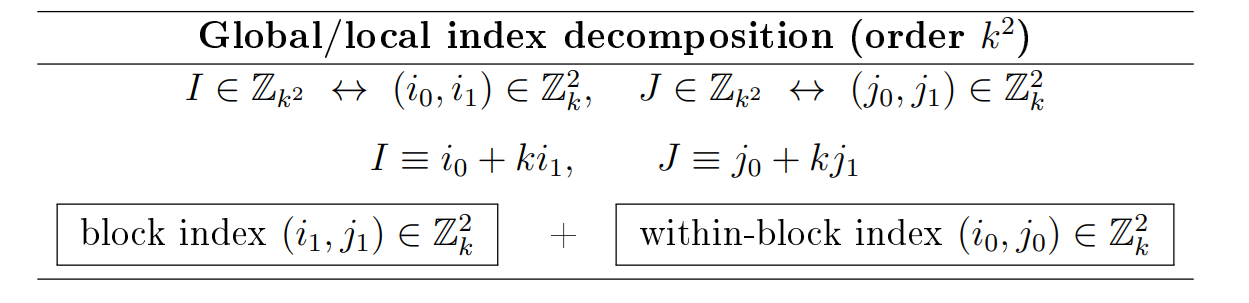
Definition 2.14(Block digits for indices in \(\mathbb{Z}_{k^2}\)).For \(I\in\mathbb{Z}_{k^2}\), define its digits \((i_0,i_1)\in\mathbb{Z}_k^2\) by the unique decomposition \[I \equiv i_0 + k i_1 \pmod{k^2} \qquad\text{with } i_0,i_1\in\{0,1,\dots,k-1\}.\]
We write \(I\leftrightarrow (i_0,i_1)\), and similarly \(J\leftrightarrow (j_0,j_1)\).
Remark 2.15. Under Definition 2.14, the pair \((i_1,j_1)\in\mathbb{Z}_k^2\) records the block of size \(k\times k\) containing the cell \((I,J)\in\mathbb{Z}_{k^2}^2\), while \((i_0,j_0)\) records the position within that block. This is the formal basis of the compound property.
Definition 2.16(Base- \(k\) superposition of digit arrays).Let \(D_0,D_1,D_2,D_3:\mathbb{Z}_{k^2}^2\to\mathbb{Z}_k\) be \(\mathbb{Z}_k\)-valued digit arrays. Their base-\(k\) superposition is the integer array \[S:\mathbb{Z}_{k^2}^2\to\mathbb{Z},\qquad S(I,J):=\operatorname{enc}_k\left(D_0(I,J),D_1(I,J),D_2(I,J),D_3(I,J)\right).\]
Proposition 2.17(Bijection criterion via digit tuples). With notation as in Definition 2.16, the following are equivalent:
(i) The superposition \(S\) is normal, i.e. its entries are exactly \(\{0,1,\dots,k^4-1\}\).
(ii) The map \[\Psi:\mathbb{Z}_{k^2}^2 \longrightarrow \mathbb{Z}_k^4,\qquad (I,J)\longmapsto \left(D_0(I,J),D_1(I,J),D_2(I,J),D_3(I,J)\right),\] is a bijection.
Proof. By Proposition 2.13, \(\operatorname{enc}_k\) is a bijection from \(\mathbb{Z}_k^4\) to \(\{0,1,\dots,k^4-1\}\). Hence \(S=\operatorname{enc}_k\circ \Psi\) is a bijection onto \(\{0,1,\dots,k^4-1\}\) if and only if \(\Psi\) is a bijection onto \(\mathbb{Z}_k^4\). ◻
We finally formalize the compound condition used in the main theorem (cf. [1, 10]).
Definition 2.18(Block sums and compound property).Let \(A:\mathbb{Z}_{k^2}^2\to\mathbb{Z}\) be a \(k^2\times k^2\) array. For each block index \((u,v)\in\mathbb{Z}_k^2\), define the \((u,v)\)-block \[B_{u,v}:=\{(I,J)\in\mathbb{Z}_{k^2}^2:\ I\leftrightarrow (i_0,u),\ J\leftrightarrow (j_0,v) \text{ for some }(i_0,j_0)\in\mathbb{Z}_k^2\},\] and its block sum \[\Sigma_{u,v}(A):=\sum\limits_{(I,J)\in B_{u,v}} A(I,J).\]
The block-sum array is the \(k\times k\) array \[\Sigma(A):\mathbb{Z}_k^2\to\mathbb{Z},\qquad \Sigma(A)(u,v):=\Sigma_{u,v}(A).\]
We say that \(A\) is compound pandiagonal magic if
\(A\) is pandiagonal magic of order \(k^2\) (Definition 2.2), and
the block-sum array \(\Sigma(A)\) is pandiagonal magic of order \(k\) (with respect to toroidal broken diagonals on \(\mathbb{Z}_k^2\)).
Remark 2.19. Condition (ii) in Definition 2.18 asserts that the “macroscopic” \(k\times k\) pattern of block totals is itself a pandiagonal magic square. This is the precise sense in which the order \(k^2\) square carries a nontrivial hierarchical (purely algebraic) regularity beyond pandiagonality.
We follow the standard conventions for toroidal indexing and Latin-square terminology; see, e.g., [5, 4].
The notions usind throughout this paper are presented in Table 1 and schematic view of the \(k\times k\) block structure and digit decomposition is presented in Figure 1.
| Symbol | Meaning |
| \(\mathbb{Z}_m\) | integers modulo \(m\) (toroidal indexing) |
| \(k\) | a prime modulus (typically \(k\ge 7\); see Remark 7.2) |
| \(\mathbb{Z}_k^\times\) | the unit group of \(\mathbb{Z}_k\) |
| \(s\in\mathbb{Z}_k^\times\) | MIS parameter; admissible if \(s^2\not\equiv\pm 1\pmod{k}\) |
| \(M_s(i,j)\) | MIS kernel \(=si+s^-1j\in\mathbb{Z}_k\) |
| \(I,J\in\mathbb{Z}_k^2\) | global indices of the \(k^2\times k^2\) square |
| \(i_0,i_1,j_0,j_1\in\mathbb{Z}_k\) | digits: \(I\equiv i_0+ki_1\), \(J\equiv j_0+kj_1\) |
| \(D_0,\dots,D_3\) | digit arrays used in the base-\(k\) encoding |
| \(P_s(I,J)\) | encoded square of order \(k^2\) (Construction 4.7) |
| \(\Sigma(P_s)\) | block-sum array of order \(k\) (Definition 6.1) |
Throughout this section, \(k\ge 7\) is a fixed prime and \(\mathbb{Z}_k=\mathbb{Z}/k\mathbb{Z}\) is identified with \(\{0,1,\dots,k-1\}\) as in Section 2. We recall that our “MIS kernel” is not claimed to be a new combinatorial object: it is a particular linear Latin square over \(\mathbb{Z}_k\) in the sense of Definition 2.7, i.e. a classical family studied in, e.g., [7, 5]. The novelty lies in the way this kernel is integrated into a closed-form compound pandiagonal magic-square construction (cf. Introduction).
We parameterize the kernel by a nonzero slope parameter \(s\in\mathbb{Z}_k^\times\). Since \(k\) is prime, \(s\) has a unique inverse \(s^{-1}\in\mathbb{Z}_k^\times\) (cf. [9]).
Definition 3.1(MIS kernel).Let \(s\in\mathbb{Z}_k^\times\). Define the MIS kernel associated with \(s\) to be the \(k\times k\) array \[M_s:\mathbb{Z}_k\times\mathbb{Z}_k\longrightarrow \mathbb{Z}_k,\qquad M_s(i,j):= s\,i + s^{-1} j.\]
We also write \(M_s^{\mathsf T}(i,j):=M_s(j,i)\) for its transpose.
Remark 3.2(Linear Latin-square interpretation).By Definition 2.7, \[M_s = L_{a,b}\quad\text{with}\quad a=s,\ b=s^{-1}.\]
Hence \(M_s\) belongs to the classical class of linear Latin squares [7, 5]. The term “MIS” is convenient shorthand for the specific inverse-coupled choice \((a,b)=(s,s^{-1})\).
Proposition 3.3(Latin Property).For every \(s\in\mathbb{Z}_k^\times\), the MIS kernel \(M_s\) is a Latin square of order \(k\) on \(\mathbb{Z}_k\).
Proof. Fix \(i\in\mathbb{Z}_k\). Then the map \(j\mapsto M_s(i,j)=s\,i+s^{-1}j\) is an affine linear map with nonzero coefficient \(s^{-1}\), hence a bijection of \(\mathbb{Z}_k\). Similarly, for fixed \(j\), the map \(i\mapsto s\,i+s^{-1}j\) has nonzero coefficient \(s\), hence is bijective. Therefore \(M_s\) is Latin by Definition 2.4. (Equivalently, apply Proposition 2.8(i) to \(a=s\), \(b=s^{-1}\).) ◻
Definition 3.4(Diagonal-regular MIS parameter).We say that \(s\in\mathbb{Z}_k^\times\) is diagonal-regular if \[s^2 \not\equiv \pm 1 \pmod{k}, \quad\text{i.e.}\quad s^2-1\ne 0\ \text{and}\ s^2+1\ne 0\ \text{in }\mathbb{Z}_k.\]
Proposition 3.5(Toroidal diagonal-regularity).If \(s\in\mathbb{Z}_k^\times\) is diagonal-regular (Definition 3.4), then \(M_s\) is toroidally diagonal-regular in the sense of Definition 2.6. Equivalently, for each \(a\in\mathbb{Z}_k\), the maps \[t\longmapsto M_s(t,t+a),\qquad t\longmapsto M_s(t,-t+a),\] are permutations of \(\mathbb{Z}_k\).
Proof. Compute, for fixed \(a\in\mathbb{Z}_k\), \[M_s(t,t+a)= s\,t + s^{-1}(t+a) = (s+s^{-1})t + s^{-1}a,\] \[M_s(t,-t+a)= s\,t + s^{-1}(-t+a) = (s-s^{-1})t + s^{-1}a.\]
Each is an affine linear map \(t\mapsto \alpha t + \beta\) on \(\mathbb{Z}_k\), hence bijective if and only if \(\alpha\ne 0\). Now \(\alpha=s+s^{-1}=0\) is equivalent to \(s^2+1=0\) in \(\mathbb{Z}_k\), and \(\alpha=s-s^{-1}=0\) is equivalent to \(s^2-1=0\) in \(\mathbb{Z}_k\). Thus diagonal-regularity of \(s\) implies both coefficients are nonzero, proving the claim. This is a specialization of Proposition 2.8(ii) to \((a,b)=(s,s^{-1})\). ◻
Remark 3.6(Relation to diabolic/Nasik constraints). The diagonal-regularity in Proposition 3.5 is the Latin-square analogue of the wrap-around diagonal constraints for diabolic (pandiagonal) structures [6, 14]. In our later superposition, this property is the mechanism by which pandiagonality is inherited.
Orthogonality of Latin squares is a standard notion [5, 4]. For linear Latin squares, it reduces to a determinant condition, as recalled in Proposition 2.10. The present kernel is designed so that orthogonality can be checked by a single congruence in \(s\).
Proposition 3.7(Orthogonality of \(M_s\) and \(M_s^{\mathsf T}\)).Let \(s\in\mathbb{Z}_k^\times\). Then \(M_s\) is orthogonal to its transpose \(M_s^{\mathsf T}\) if and only if \[s^4 \not\equiv 1 \pmod{k}\qquad\text{equivalently}\qquad s^2\not\equiv \pm 1 \pmod{k}.\]
Proof. By Remark 3.2, \(M_s=L_{s,s^{-1}}\) and \(M_s^{\mathsf T}=L_{s^{-1},s}\). Apply Proposition 2.10: \(M_s\) and \(M_s^{\mathsf T}\) are orthogonal if and only if \[\det\begin{pmatrix} s & s^{-1}\\ s^{-1} & s\end{pmatrix} = s^2 – s^{-2} \ne 0 \quad\text{in }\mathbb{Z}_k.\]
Multiplying by \(s^2\ne 0\) yields the equivalent condition \(s^4-1\ne 0\) in \(\mathbb{Z}_k\), i.e. \(s^4\not\equiv 1\pmod{k}\). Since \(s^4-1=(s^2-1)(s^2+1)\) in \(\mathbb{Z}_k\), this is equivalent to \(s^2\not\equiv \pm 1\pmod{k}\). ◻
Corollary 3.8(A unified admissibility condition.)Let \(s\in\mathbb{Z}_k^\times\). If \(s^2\not\equiv \pm 1\pmod{k}\), then:
(i) \(M_s\) is a Latin square (Proposition 3.3);
(ii) \(M_s\) is toroidally diagonal-regular (Proposition 3.5);
(iii) \(M_s\) is orthogonal to \(M_s^{\mathsf T}\) (Proposition 3.7).
Remark 3.9.Assume that \(k\) is an odd prime and set \[S_k=\{\,s\in\mathbb{Z}_k^\times \mid s^2\not\equiv \pm1 \pmod{k}\,\}.\]
Then \(S_k\neq\varnothing\) for every prime \(k\ge 7\). Moreover, the exact cardinality of \(S_k\) is given in Proposition 7.1 (and depends on whether \(-1\) is a quadratic residue modulo \(k\)). For completeness, note that for \(k=5\) every nonzero square is \(\pm1\), hence \(S_5=\varnothing\).
The next reformulation makes explicit how the kernel encodes permutations, a viewpoint that is standard in Latin-square theory [5] and is convenient for our later “random access” evaluation.
Proposition 3.10(Row and column permutations).Let \(s\in\mathbb{Z}_k^\times\). For each \(i\in\mathbb{Z}_k\), the row map \[\pi_i:\mathbb{Z}_k\to\mathbb{Z}_k,\qquad \pi_i(j):=M_s(i,j),\] is a permutation of \(\mathbb{Z}_k\), and for each \(j\in\mathbb{Z}_k\), the column map \[\rho_j:\mathbb{Z}_k\to\mathbb{Z}_k,\qquad \rho_j(i):=M_s(i,j),\] is a permutation of \(\mathbb{Z}_k\). Moreover, each is an affine permutation: \[\pi_i(j)=s^{-1}j + (s\,i),\qquad \rho_j(i)=s\,i + (s^{-1}j).\]
Proof. This is immediate from the explicit formula \(M_s(i,j)=s\,i+s^{-1}j\) and the fact that multiplication by a nonzero element in \(\mathbb{Z}_k\) is a bijection [9]. It also restates Proposition 3.3. ◻
Remark 3.11(Why this matters later).In the full order \(k^2\) construction, each entry will be an explicit base-\(k\) encoding of four \(\mathbb{Z}_k\)-digits, each digit being an affine expression in the corresponding index digits (Definition 2.14). Proposition 3.10 is the elementary mechanism behind this “random access”: no search is required to recover the digit values.
Example 3.12(A small kernel).Let \(k=7\) and choose \(s=2\in\mathbb{Z}_7^\times\). Then \(s^{-1}=4\) in \(\mathbb{Z}_7^\times\) and the MIS kernel is \[M_2(i,j)=2i+4j\pmod{7}.\]
Since \(s^2=4\not\equiv \pm 1\pmod{7}\), the parameter is admissible: \(M_2\) is diagonal-regular and orthogonal to its transpose by Corollary 3.8.
Latin-square properties of linear forms and their orthogonality criteria are classical; see [5, 4]. We record, for clarity, the precise dependence of our arguments on invertibility in \(\mathbb{Z}_k\).
Remark 3.13(Dependency table: unit vs. field.)Throughout, \(k\) is assumed prime so that \(\mathbb{Z}_k\) is a field. Conceptually, however, the proofs use only the following invertibility facts.
(1) Kernel Latin property: for \(L_{a,b}(i,j)=ai+bj\) to be Latin, it suffices that \(a,b\) are units in the coefficient ring (so that \(i\mapsto ai+c\) and \(j\mapsto bj+c\) are bijections); this is standard [5, 4].
(2) Orthogonality of two linear Latin squares: for \(L_{a,b}\) and \(L_{c,d}\), the condition \[\det\begin{pmatrix}a&b\\ c&d\end{pmatrix}\ne 0,\] ensures orthogonality over a field; in our prime setting this is equivalent to being a unit and is used to guarantee the digit-map bijection in Section 4 [5, 4].
(3) MIS specialization: in \(M_s(i,j)=si+s^{-1}j\), the inverse \(s^{-1}\) requires \(s\in\mathbb{Z}_k^\times\). The unified admissibility condition \(s^2\not\equiv\pm 1\pmod{k}\) then simultaneously enforces (i) diagonal-regularity (for pandiagonality) and (ii) orthogonality with the transpose (for normality).
(4) Carry/borrow analysis: the carry/borrow lemmas use only standard representatives \(\{0,1,\dots,k-1\}\) and integer inequalities, and do not require additional field structure.
In this section we explain how orthogonality of the MIS kernel with its transpose yields a bijective digit map, and how a base-\(k\) encoding then produces a normal \(k^2\times k^2\) square with entries \(\{0,1,\dots,k^4-1\}\). The underlying principles are standard in Latin-square theory [5, 4] and positional numeral systems.
Throughout, \(k\ge 7\) is a prime and \(s\in\mathbb{Z}_k^\times\) is a parameter. We use the index-digit decomposition \(I\leftrightarrow(i_0,i_1)\), \(J\leftrightarrow(j_0,j_1)\) from Definition 2.14.
The compound construction will superpose four \(\mathbb{Z}_k\)-valued digits: two digits coming from the block indices \((i_1,j_1)\), and two digits coming from the within-block indices \((i_0,j_0)\). Each pair of digits is produced by superposing the MIS kernel \(M_s\) and its transpose. This is the precise algebraic meaning of “no search”: orthogonality implies that the pair of digits ranges over all of \(\mathbb{Z}_k^2\) exactly once.
Definition 4.1(Kernel pair map). Let \(M_s\) be the MIS kernel (Definition 3.1). Define the kernel pair map \[\Phi_s:\mathbb{Z}_k^2\longrightarrow \mathbb{Z}_k^2,\qquad \Phi_s(i,j):=\left(M_s(i,j),\,M_s^{\mathsf T}(i,j)\right).\]
Lemma 4.2(Orthogonality \(\Leftrightarrow\) bijectivity of \(\Phi_s\)).The following are equivalent:
(i) \(M_s\) is orthogonal to \(M_s^{\mathsf T}\) (Definition 2.5);
(ii) \(\Phi_s\) is a bijection \(\mathbb{Z}_k^2\to\mathbb{Z}_k^2\).
In this case, for every \((u,v)\in\mathbb{Z}_k^2\) there exists a unique \((i,j)\in\mathbb{Z}_k^2\) such that \(\Phi_s(i,j)=(u,v)\).
Proof. By Definition 2.5, orthogonality of \(M_s\) and \(M_s^{\mathsf T}\) means exactly that the superposition map \((i,j)\mapsto(M_s(i,j),M_s^{\mathsf T}(i,j))\) hits every ordered pair in \(\mathbb{Z}_k^2\) exactly once. This is the bijectivity of \(\Phi_s\). (See [5, 4] for the standard equivalence.) ◻
Corollary 4.3(Explicit admissibility condition).If \(s\in\mathbb{Z}_k^\times\) satisfies \(s^2\not\equiv \pm 1\pmod{k}\), then \(\Phi_s\) is a bijection.
Proof. By Proposition 3.7, the congruence \(s^2\not\equiv\pm 1\) is equivalent to orthogonality of \(M_s\) and \(M_s^{\mathsf T}\). Now apply Lemma 4.2. ◻
We now lift the kernel-pair mechanism to the \(k^2\times k^2\) index set. The point is that each cell \((I,J)\in\mathbb{Z}_{k^2}^2\) carries two independent pairs of digits: one from the block coordinates \((i_1,j_1)\) and one from the within-block coordinates \((i_0,j_0)\).
Construction 4.4(Four digit arrays).Fix \(s\in\mathbb{Z}_k^\times\). For \((I,J)\in\mathbb{Z}_{k^2}^2\), write \(I\leftrightarrow(i_0,i_1)\) and \(J\leftrightarrow(j_0,j_1)\) as in Definition 2.14. Define digit arrays \(D_0,D_1,D_2,D_3:\mathbb{Z}_{k^2}^2\to\mathbb{Z}_k\) by \[\begin{aligned} (D_0(I,J),D_1(I,J)) &:= \Phi_s(i_0,j_0),\\ (D_2(I,J),D_3(I,J)) &:= \Phi_s(i_1,j_1). \end{aligned}\]
Equivalently, \[(D_0,D_1)(I,J)=\left(M_s(i_0,j_0),\,M_s^{\mathsf T}(i_0,j_0)\right),\qquad (D_2,D_3)(I,J)=\left(M_s(i_1,j_1),\,M_s^{\mathsf T}(i_1,j_1)\right).\]
Remark 4.5. The pair \((D_0,D_1)\) depends only on the within-block digits \((i_0,j_0)\), while \((D_2,D_3)\) depends only on the block digits \((i_1,j_1)\). This separation is what later enables the compound block-sum analysis.
Lemma 4.6(Digit-pair bijectivity on each level). Assume \(s^2\not\equiv \pm 1\pmod{k}\). Then:
(i) as \((i_0,j_0)\) ranges over \(\mathbb{Z}_k^2\), the pair \((D_0,D_1)\) ranges over \(\mathbb{Z}_k^2\) bijectively;
(ii) as \((i_1,j_1)\) ranges over \(\mathbb{Z}_k^2\), the pair \((D_2,D_3)\) ranges over \(\mathbb{Z}_k^2\) bijectively.
Proof. Under the hypothesis, \(\Phi_s\) is a bijection by Corollary 4.3. By Construction 4.4, \((D_0,D_1)=\Phi_s(i_0,j_0)\) and \((D_2,D_3)=\Phi_s(i_1,j_1)\). Hence each claim follows by applying bijectivity of \(\Phi_s\) at the corresponding level. ◻
We now package the four digits into a single integer by a base-\(k\) encoding (Definition 2.12). This is the closed-form “superposition” step, and it is the source of random-access evaluation.
Construction 4.7(Encoded entry function). With digit arrays from Construction 4.4, define \[P_s:\mathbb{Z}_{k^2}^2\longrightarrow \mathbb{Z},\qquad P_s(I,J):=\operatorname{enc}_k\left(D_0(I,J),D_1(I,J),D_2(I,J),D_3(I,J)\right),\] where \(\operatorname{enc}_k\) is as in Definition 2.12. We call \(P_s\) the encoded square associated with \(s\).
Proposition 4.8(Digit-tuple bijectivity implies normality). Assume \(s^2\not\equiv \pm 1\pmod{k}\). Then the encoded square \(P_s\) is normal in the sense of Definition 2.2: its entries are exactly the set \(\{0,1,\dots,k^4-1\}\), each appearing once.
Proof. Consider the digit-tuple map \[\Psi_s:\mathbb{Z}_{k^2}^2\longrightarrow \mathbb{Z}_k^4,\qquad \Psi_s(I,J):=\left(D_0(I,J),D_1(I,J),D_2(I,J),D_3(I,J)\right).\]
By Proposition 2.17, it suffices to show that \(\Psi_s\) is a bijection.
Write \((I,J)\leftrightarrow(i_0,i_1,j_0,j_1)\) via Definition 2.14. Under the natural identification \(\mathbb{Z}_{k^2}^2\cong\mathbb{Z}_k^4\) given by \[(I,J)\ \longleftrightarrow\ (i_0,j_0,i_1,j_1).\]
Construction 4.4 yields the factorization \[\Psi_s(i_0,j_0,i_1,j_1)=\left(\Phi_s(i_0,j_0),\,\Phi_s(i_1,j_1)\right)\in \mathbb{Z}_k^2\times \mathbb{Z}_k^2.\]
By Corollary 4.3, \(\Phi_s\) is a bijection of \(\mathbb{Z}_k^2\). Hence the product map \((x,y)\mapsto(\Phi_s(x),\Phi_s(y))\) is a bijection of \(\mathbb{Z}_k^2\times\mathbb{Z}_k^2\), so \(\Psi_s\) is a bijection of \(\mathbb{Z}_k^4\). Therefore \(P_s\) is normal. ◻
Remark 4.9(Random access).The formula in Construction 4.7 expresses \(P_s(I,J)\) directly in terms of the index digits \((i_0,i_1,j_0,j_1)\) through affine maps in \(\mathbb{Z}_k\) and a base-\(k\) encoding. Thus any entry can be computed without constructing the full square, which is a key algorithmic feature emphasized in the Introduction.
For later use, we record the digits \(D_r\) in explicit algebraic form. This makes the dependence on \(s\) and on the index digits transparent.
Proposition 4.10(Closed-form expressions).Let \(s\in\mathbb{Z}_k^\times\) and \((I,J)\in\mathbb{Z}_{k^2}^2\) with \(I\leftrightarrow(i_0,i_1)\), \(J\leftrightarrow(j_0,j_1)\). Then the digits in Construction 4.4 satisfy \[\begin{aligned} D_0(I,J) &= s\,i_0 + s^{-1} j_0, & D_1(I,J) &= s\,j_0 + s^{-1} i_0,\\ D_2(I,J) &= s\,i_1 + s^{-1} j_1, & D_3(I,J) &= s\,j_1 + s^{-1} i_1, \end{aligned}\] all in \(\mathbb{Z}_k\). Consequently, \[P_s(I,J)= \left(s\,i_0 + s^{-1} j_0\right) + k\left(s\,j_0 + s^{-1} i_0\right) + k^2\left(s\,i_1 + s^{-1} j_1\right) + k^3\left(s\,j_1 + s^{-1} i_1\right),\] where each \(\mathbb{Z}_k\) digit is identified with its representative in \(\{0,1,\dots,k-1\}\).
Proof. This is immediate from the definition of \(M_s\) (Definition 3.1) and the rule \((D_0,D_1)\) \(=\Phi_s(i_0,j_0)\), \((D_2,D_3)=\Phi_s(i_1,j_1)\) in Construction 4.4, together with the encoding definition (Definition 2.12). ◻
Remark 4.11(What remain).By Proposition 4.8, orthogonality already guarantees that \(P_s\) is a normal \(k^2\times k^2\) square. The remaining work toward the main theorem is to prove that \(P_s\) is pandiagonal magic and then compound pandiagonal magic (Definition 2.18), which requires a carry-sensitive analysis of broken diagonal sums.
In this section we prove that the encoded square \(P_s\) from Construction 4.7 is a pandiagonal (Nasik/diabolic) magic square in the toroidal sense of Definition 2.2. The wrap-around diagonal viewpoint goes back to early work such as [6] and the algebraic treatment of diabolic squares [14]. Our argument is elementary but must track the interaction between base-\(k\) digits and toroidal diagonals.
Fix a prime \(k\ge 7\) and a parameter \(s\in\mathbb{Z}_k^\times\) satisfying \[s^2\not\equiv \pm 1 \pmod{k}.\]
By Corollary 3.8, the MIS kernel \(M_s\) is Latin, toroidally diagonal-regular, and orthogonal to its transpose. Hence \(P_s\) is normal by Proposition 4.8. We will show that \(P_s\) is pandiagonal magic.
For \(x\in\mathbb{Z}_k\), let \(\widetilde{x}\in\{0,1,\dots,k-1\}\) denote its standard representative. By Proposition 4.10, each entry \(P_s(I,J)\) has the form \[\label{eq:Ps-digit-expansion} P_s(I,J)=\widetilde{D_0(I,J)}+k\,\widetilde{D_1(I,J)}+k^2\,\widetilde{D_2(I,J)}+k^3\,\widetilde{D_3(I,J)}. \tag{1}\]
For \(r=0,1,2,3\), write \(D^r(I,J):=\widetilde{D_r(I,J)}\in\{0,1,\dots,k-1\}\).
Lemma 5.1(Sum of a permuted digit set).Let \(\sigma:\mathbb{Z}_k\to\mathbb{Z}_k\) be a bijection. Then \[\sum\limits_{t\in\mathbb{Z}_k}\widetilde{\sigma(t)}=\sum\limits_{u=0}^{k-1}u=\frac{k(k-1)}{2}.\]
Proof. Since \(\sigma\) is bijective, the multiset \(\{\sigma(t) \mid t\in\mathbb{Z}_k\}\) equals \(\mathbb{Z}_k\). Taking standard representatives yields the multiset \(\{0,1,\dots,k-1\}\), hence the sum is \(\sum\limits_{u=0}^{k-1}u=\frac{k(k-1)}{2}\). ◻
We will repeatedly use the following consequence: if \(f:\mathbb{Z}_k\to\mathbb{Z}_k\) is bijective, then \(\sum\limits_{t\in\mathbb{Z}_k}\widetilde{f(t)}=\frac{k(k-1)}{2}\); if moreover each value of \(f\) occurs with multiplicity \(k\) in a sum indexed by \(\mathbb{Z}_k^2\), then the total sum is \(k\cdot \frac{k(k-1)}{2}=\frac{k^2(k-1)}{2}\).
Proposition 5.2(Row sums).For each fixed \(I\in\mathbb{Z}_{k^2}\), \[\sum\limits_{J\in\mathbb{Z}_{k^2}} P_s(I,J)=\frac{k^2(k^4-1)}{2}.\]
Proof. Fix \(I\in\mathbb{Z}_{k^2}\) and write \(I\leftrightarrow(i_0,i_1)\). As \(J\) ranges over \(\mathbb{Z}_{k^2}\), its digits \((j_0,j_1)\in\mathbb{Z}_k^2\) range over all of \(\mathbb{Z}_k^2\) exactly once (Definition 2.14).
Using (1), it suffices to compute \(\sum\limits_J \widetilde{D_r(I,J)}\) for \(r=0,1,2,3\).
Digits \(D_0,D_1\) (within-block level). By Proposition 4.10, \[D_0(I,J)=s\,i_0+s^{-1}j_0,\qquad D_1(I,J)=s\,j_0+s^{-1}i_0 \quad\text{in }\mathbb{Z}_k.\]
For fixed \(i_0\), the map \(j_0\mapsto s\,i_0+s^{-1}j_0\) is a bijection of \(\mathbb{Z}_k\) (multiplication by \(s^{-1}\ne 0\)), and likewise \(j_0\mapsto s\,j_0+s^{-1}i_0\) is a bijection [9]. Moreover, for each fixed \(j_0\), there are exactly \(k\) choices of \(j_1\). Therefore, by Lemma 5.1, \[\sum\limits_{J\in\mathbb{Z}_{k^2}}\widetilde{D_0(I,J)} = k\sum\limits_{j_0\in\mathbb{Z}_k}\widetilde{s\,i_0+s^{-1}j_0} = k\cdot\frac{k(k-1)}{2} = \frac{k^2(k-1)}{2},\] and similarly \[\sum\limits_{J\in\mathbb{Z}_{k^2}}\widetilde{D_1(I,J)}=\frac{k^2(k-1)}{2}.\]
Digits \(D_2,D_3\) (block level). Again by Proposition 4.10, \[D_2(I,J)=s\,i_1+s^{-1}j_1,\qquad D_3(I,J)=s\,j_1+s^{-1}i_1.\]
Now \(j_1\) ranges over \(\mathbb{Z}_k\) exactly \(k\) times as \(J\) ranges over \(\mathbb{Z}_{k^2}\) (once for each \(j_0\)), and for fixed \(i_1\) each of the maps \(j_1\mapsto s\,i_1+s^{-1}j_1\) and \(j_1\mapsto s\,j_1+s^{-1}i_1\) is bijective. Hence Lemma 5.1 gives \[\sum\limits_{J\in\mathbb{Z}_{k^2}}\widetilde{D_2(I,J)}=\frac{k^2(k-1)}{2}, \qquad \sum\limits_{J\in\mathbb{Z}_{k^2}}\widetilde{D_3(I,J)}=\frac{k^2(k-1)}{2}.\]
Combining these four equalities with (1) yields \[\begin{aligned} \sum\limits_{J\in\mathbb{Z}_{k^2}} P_s(I,J) &= \frac{k^2(k-1)}{2}\,(1+k+k^2+k^3)\\ &= \frac{k^2(k-1)}{2}\cdot\frac{k^4-1}{k-1} = \frac{k^2(k^4-1)}{2}. \end{aligned}\] ◻
Proposition 5.3(Column sums).For each fixed \(J\in\mathbb{Z}_{k^2}\), \[\sum\limits_{I\in\mathbb{Z}_{k^2}} P_s(I,J)=\frac{k^2(k^4-1)}{2}.\]
Proof. This is symmetric to Proposition 5.2 upon exchanging the roles of \(I\) and \(J\). Formally, write \(J\leftrightarrow(j_0,j_1)\) and let \(I\) range over \(\mathbb{Z}_{k^2}\) with digits \((i_0,i_1)\) ranging over \(\mathbb{Z}_k^2\). Using Proposition 4.10, each digit \(D_r(I,J)\) is an affine bijection in the varying digit (\(i_0\) or \(i_1\)), and each such varying digit occurs with multiplicity \(k\). Lemma 5.1 then gives the same total as in the row case. ◻
To treat broken diagonals on \(\mathbb{Z}_{k^2}^2\), we express the digit decomposition of \(J=I\pm A\) in terms of the low digit carry/borrow. This is the only place where the toroidal indexing interacts nontrivially with the base-\(k\) digit decomposition.
Fix \(A\in\mathbb{Z}_{k^2}\) and write \(A\leftrightarrow(a_0,a_1)\) with \(a_0,a_1\in\mathbb{Z}_k\).
Definition 5.4(Carry and borrow functions).For \(t_0\in\{0,1,\dots,k-1\}\), define integers \[\operatorname{car}_{a_0}(t_0):= \begin{cases} 1,& t_0+\widetilde{a_0}\ge k,\\ 0,& t_0+\widetilde{a_0}<k, \end{cases} \qquad \operatorname{bor}_{a_0}(t_0):= \begin{cases} 1,& t_0>\widetilde{a_0},\\ 0,& t_0\le \widetilde{a_0}. \end{cases}\]
Lemma 5.5(Digit decomposition along slope +1 diagonals).Let \(I\in\mathbb{Z}_{k^2}\) with \(I\leftrightarrow(i_0,i_1)\), and put \(J:=I+A\in\mathbb{Z}_{k^2}\), where \(A\leftrightarrow(a_0,a_1)\). Then \(J\leftrightarrow(j_0,j_1)\) is given by \[j_0 \equiv i_0+a_0 \pmod{k}, \qquad j_1 \equiv i_1+a_1+\operatorname{car}_{a_0}(\widetilde{i_0}) \pmod{k}.\]
Proof. Choose standard representatives \(\widetilde{i_0},\widetilde{i_1},\widetilde{a_0},\widetilde{a_1}\in\{0,1,\dots,k-1\}\) and set \(\widetilde I:=\widetilde{i_0}+k\widetilde{i_1}\), \(\widetilde A:=\widetilde{a_0}+k\widetilde{a_1}\). Let \(c:=\operatorname{car}_{a_0}(\widetilde{i_0})\in\{0,1\}\). By definition of \(\operatorname{car}_{a_0}\), we have \[\widetilde{i_0}+\widetilde{a_0}=(\widetilde{i_0}+\widetilde{a_0}-ck)+ck, \quad\text{with }0\le \widetilde{i_0}+\widetilde{a_0}-ck\le k-1.\]
Hence \[\widetilde I+\widetilde A =(\widetilde{i_0}+\widetilde{a_0}-ck)+k(\widetilde{i_1}+\widetilde{a_1}+c).\]
Reducing modulo \(k\) gives \(j_0\equiv i_0+a_0\pmod{k}\). Moreover, comparing the coefficients of \(k\) modulo \(k\) yields \(j_1\equiv i_1+a_1+c\equiv i_1+a_1+\operatorname{car}_{a_0}(\widetilde{i_0})\pmod{k}\). ◻
Lemma 5.6(Digit decomposition along slope −1 diagonals).Let \(I\in\mathbb{Z}_{k^2}\) with \(I\leftrightarrow(i_0,i_1)\), and put \(J:=-I+A\in\mathbb{Z}_{k^2}\), where \(A\leftrightarrow(a_0,a_1)\). Then \(J\leftrightarrow(j_0,j_1)\) is given by \[j_0 \equiv a_0-i_0 \pmod{k}, \qquad j_1 \equiv a_1-i_1-\operatorname{bor}_{a_0}(\widetilde{i_0}) \pmod{k}.\]
Proof. Choose standard representatives \(\widetilde{i_0},\widetilde{i_1},\widetilde{a_0},\widetilde{a_1}\in\{0,1,\dots,k-1\}\) and set \(\widetilde I:=\widetilde{i_0}+k\widetilde{i_1}\), \(\widetilde A:=\widetilde{a_0}+k\widetilde{a_1}\). Let \(b:=\operatorname{bor}_{a_0}(\widetilde{i_0})\in\{0,1\}\). By definition of \(\operatorname{bor}_{a_0}\), we have \[\widetilde{a_0}-\widetilde{i_0}=(\widetilde{a_0}-\widetilde{i_0}+bk)-bk, \quad\text{with }0\le \widetilde{a_0}-\widetilde{i_0}+bk\le k-1.\]
Hence \[\widetilde A-\widetilde I =(\widetilde{a_0}-\widetilde{i_0}+bk)+k(\widetilde{a_1}-\widetilde{i_1}-b).\]
Reducing modulo \(k\) gives \(j_0\equiv a_0-i_0\pmod{k}\). Comparing the coefficients of \(k\) modulo \(k\) yields \(j_1\equiv a_1-i_1-b\equiv a_1-i_1-\operatorname{bor}_{a_0}(\widetilde{i_0})\pmod{k}\). ◻
We now compute the sums of \(P_s\) along the broken diagonals of both slopes.
Proposition 5.7(Broken diagonal sums, slope +1).For each \(A\in\mathbb{Z}_{k^2}\), \[\sum\limits_{I\in\mathbb{Z}_{k^2}} P_s(I,\,I+A)=\frac{k^2(k^4-1)}{2}.\]
Equivalently, for each \(a\in\mathbb{Z}_{k^2}\) we have \(\Delta_a^{+}(P_s)=\frac{k^2(k^4-1)}{2}\).
Proof. Fix \(A\in\mathbb{Z}_{k^2}\) and write \(A\leftrightarrow(a_0,a_1)\). Parameterize \(I\) by its digits \(I\leftrightarrow(i_0,i_1)\in\mathbb{Z}_k^2\). Put \(J:=I+A\) and write \(J\leftrightarrow(j_0,j_1)\). By Lemma 5.5, \[j_0 \equiv i_0+a_0,\qquad j_1 \equiv i_1+a_1+\operatorname{car}_{a_0}(\widetilde{i_0}) \quad(\bmod k).\]
Using (1), it suffices to show that for each \(r=0,1,2,3\), \[\sum\limits_{I\in\mathbb{Z}_{k^2}} \widetilde{D_r(I,\,I+A)}=\frac{k^2(k-1)}{2}.\]
Digits \(D_0,D_1\). By Proposition 4.10, \[D_0(I,J)=M_s(i_0,j_0),\qquad D_1(I,J)=M_s^{\mathsf T}(i_0,j_0).\]
Along the slope \(+1\) diagonal at offset \(a_0\), we have \(j_0\equiv i_0+a_0\). Hence \(i_1\) plays no role, and each \(i_0\in\mathbb{Z}_k\) occurs with multiplicity \(k\). Because \(s\) is admissible, \(M_s\) is toroidally diagonal-regular (Proposition 3.5), so the maps \[i_0\longmapsto M_s(i_0,i_0+a_0),\qquad i_0\longmapsto M_s^{\mathsf T}(i_0,i_0+a_0),\] are bijections of \(\mathbb{Z}_k\). Therefore Lemma 5.1 gives \[\sum\limits_{I\in\mathbb{Z}_{k^2}}\widetilde{D_0(I,I+A)} = k\sum\limits_{i_0\in\mathbb{Z}_k}\widetilde{M_s(i_0,i_0+a_0)} = k\cdot\frac{k(k-1)}{2} = \frac{k^2(k-1)}{2},\] and similarly \(\sum\limits_{I}\widetilde{D_1(I,I+A)}=\frac{k^2(k-1)}{2}\).
Digits \(D_2,D_3\). Again by Proposition 4.10, \[D_2(I,J)=M_s(i_1,j_1),\qquad D_3(I,J)=M_s^{\mathsf T}(i_1,j_1).\]
For each fixed \(i_0\in\mathbb{Z}_k\), Lemma 5.5 shows that \(j_1\) is of the form \[j_1 \equiv i_1 + \left(a_1+\operatorname{car}_{a_0}(\widetilde{i_0})\right)\pmod{k}.\]
Thus, for each fixed \(i_0\), as \(i_1\) ranges over \(\mathbb{Z}_k\), the pair \((i_1,j_1)\) runs along a slope \(+1\) diagonal in \(\mathbb{Z}_k^2\) with some offset \(a_1+\operatorname{car}_{a_0}(\widetilde{i_0})\). By diagonal-regularity of \(M_s\) (Proposition 3.5), the maps \[i_1\longmapsto M_s\left(i_1,\,i_1+c\right),\qquad i_1\longmapsto M_s^{\mathsf T}\left(i_1,\,i_1+c\right),\] are bijections for every \(c\in\mathbb{Z}_k\). Hence, for each fixed \(i_0\), \[\sum\limits_{i_1\in\mathbb{Z}_k}\widetilde{D_2(I,I+A)}=\frac{k(k-1)}{2}, \qquad \sum\limits_{i_1\in\mathbb{Z}_k}\widetilde{D_3(I,I+A)}=\frac{k(k-1)}{2}.\]
Summing these equalities over the \(k\) choices of \(i_0\) yields \[\sum\limits_{I\in\mathbb{Z}_{k^2}}\widetilde{D_2(I,I+A)}=\frac{k^2(k-1)}{2}, \qquad \sum\limits_{I\in\mathbb{Z}_{k^2}}\widetilde{D_3(I,I+A)}=\frac{k^2(k-1)}{2}.\]
Combining the four digit sums with (1) gives \[\sum\limits_{I\in\mathbb{Z}_{k^2}} P_s(I,I+A) = \frac{k^2(k-1)}{2}\,(1+k+k^2+k^3) = \frac{k^2(k^4-1)}{2},\] as required. ◻
Proposition 5.8(Broken diagonal sums, slope −1). For each \(A\in\mathbb{Z}_{k^2}\), \[\sum\limits_{I\in\mathbb{Z}_{k^2}} P_s(I,\,-I+A)=\frac{k^2(k^4-1)}{2}.\]
Equivalently, for each \(a\in\mathbb{Z}_{k^2}\) we have \(\Delta_a^{-}(P_s)=\frac{k^2(k^4-1)}{2}\).
Proof. Fix \(A\leftrightarrow(a_0,a_1)\) and parameterize \(I\leftrightarrow(i_0,i_1)\in\mathbb{Z}_k^2\). Let \(J:=-I+A\) and write \(J\leftrightarrow(j_0,j_1)\). By Lemma 5.6, \[j_0 \equiv a_0-i_0,\qquad j_1 \equiv a_1-i_1-\operatorname{bor}_{a_0}(\widetilde{i_0}) \quad(\bmod k).\]
As in Proposition 5.7, we compute digit sums.
Digits \(D_0,D_1\). Here \((i_0,j_0)\) runs along a slope \(-1\) diagonal in \(\mathbb{Z}_k^2\) with offset \(a_0\): \(j_0\equiv -i_0+a_0\). By diagonal-regularity of \(M_s\) (Proposition 3.5), the maps \[i_0\longmapsto M_s(i_0,-i_0+a_0),\qquad i_0\longmapsto M_s^{\mathsf T}(i_0,-i_0+a_0),\] are bijections of \(\mathbb{Z}_k\). Each \(i_0\) occurs with multiplicity \(k\) (varying \(i_1\)), so Lemma 5.1 yields \[\sum\limits_{I\in\mathbb{Z}_{k^2}}\widetilde{D_0(I,-I+A)}=\frac{k^2(k-1)}{2}, \qquad \sum\limits_{I\in\mathbb{Z}_{k^2}}\widetilde{D_1(I,-I+A)}=\frac{k^2(k-1)}{2}.\]
Digits \(D_2,D_3\). For each fixed \(i_0\), Lemma 5.6 shows that \(j_1\) is of the form \[j_1 \equiv -i_1 + \left(a_1-\operatorname{bor}_{a_0}(\widetilde{i_0})\right)\pmod{k}.\]
Thus \((i_1,j_1)\) runs along a slope \(-1\) diagonal in \(\mathbb{Z}_k^2\) (with an offset depending on \(i_0\)). By diagonal-regularity of \(M_s\), along any such diagonal the maps \(i_1\mapsto M_s(i_1,-i_1+c)\) and \(i_1\mapsto M_s^{\mathsf T}(i_1,-i_1+c)\) are bijections. Hence for each fixed \(i_0\) the sums over \(i_1\) equal \(\frac{k(k-1)}{2}\), and summing over \(i_0\) gives \[\sum\limits_{I\in\mathbb{Z}_{k^2}}\widetilde{D_2(I,-I+A)}=\frac{k^2(k-1)}{2}, \qquad \sum\limits_{I\in\mathbb{Z}_{k^2}}\widetilde{D_3(I,-I+A)}=\frac{k^2(k-1)}{2}.\]
Substituting into (1) yields \(\sum\limits_{I}P_s(I,-I+A)=\frac{k^2(k^4-1)}{2}\), as required. ◻
Theorem 5.9(Pandiagonality of the encoded square). Let \(k\ge 7\) be prime and let \(s\in\mathbb{Z}_k^\times\) satisfy \(s^2\not\equiv \pm 1\pmod{k}\). Then the encoded square \(P_s:\mathbb{Z}_{k^2}^2\to\mathbb{Z}\) from Construction 4.7 is a normal pandiagonal magic square of order \(k^2\) with entry set \(\{0,1,\dots,k^4-1\}\). Moreover, every row sum, column sum, and broken diagonal sum (both slopes) equals \[\mu=\frac{k^2(k^4-1)}{2}.\]
Proof. Normality (entry set \(\{0,1,\dots,k^4-1\}\) with no repetition) is Proposition 4.8. Row sums are constant by Proposition 5.2, and column sums are constant by Proposition 5.3. Broken diagonal sums of slope \(+1\) and \(-1\) are constant by Propositions 5.7 and 5.8. Thus \(P_s\) is pandiagonal magic in the sense of Definition 2.2. Finally, since \(P_s\) is normal of order \(m=k^2\), the common sum must equal the standard magic constant \(m(m^2-1)/2=\frac{k^2(k^4-1)}{2}\) by Proposition 2.3. ◻
Remark 5.10(Where orthogonality and diagonal-regularity enter). Orthogonality with the transpose (Section 4) is used only to guarantee normality (bijectivity of digit tuples), while diagonal-regularity of the kernel (Proposition 3.5) is the mechanism ensuring that each digit array restricts to a permutation along the relevant toroidal diagonals. This separation clarifies the logic in the diabolic/Nasik setting initiated in [6, 14].
In this section we prove that the pandiagonal magic square \(P_s\) constructed in Section 4 is in fact compound pandiagonal magic in the sense of Definition 2.18. Compound constructions of magic squares (often via Latin-square superpositions or digit concatenations) appear in the classical literature and modern treatments; see, for example, [1, 10]. Our contribution here is to show that, for the present closed-form \(P_s\), the induced \(k\times k\) block-sum array is itself pandiagonal magic, and to compute it explicitly.
Throughout, \(k\ge 7\) is prime and \(s\in\mathbb{Z}_k^\times\) satisfies \[s^2\not\equiv \pm 1 \pmod{k},\] so that \(P_s\) is a normal pandiagonal magic square of order \(k^2\) by Theorem 5.9.
Recall the index-digit decomposition \(I\leftrightarrow(i_0,i_1)\) and \(J\leftrightarrow(j_0,j_1)\) from Definition 2.14. The block index of a cell \((I,J)\in\mathbb{Z}_{k^2}^2\) is \((i_1,j_1)\in\mathbb{Z}_k^2\), and the within-block position is \((i_0,j_0)\in\mathbb{Z}_k^2\) (Remark 2.15).
Remark 6.1(Block and block sum).Let \(u,v\in\mathbb{Z}_k\). Define the \((u,v)\)-block of \(\mathbb{Z}_{k^2}^2\) by \[B_{u,v}:=\{(I,J)\in\mathbb{Z}_{k^2}^2 \mid \ I\leftrightarrow(i_0,u),\ J\leftrightarrow(j_0,v) \text{ for some }(i_0,j_0)\in\mathbb{Z}_k^2\}.\]
For an array \(A:\mathbb{Z}_{k^2}^2\to\mathbb{Z}\), define the block sum \[\Sigma_{u,v}(A):=\sum\limits_{(I,J)\in B_{u,v}} A(I,J).\]
We write \(\Sigma(A):\mathbb{Z}_k^2\to\mathbb{Z}\) for the induced \(k\times k\) array \(\Sigma(A)(u,v):=\Sigma_{u,v}(A)\).
This agrees with Definition 2.18, included here for local reference.
Our starting point is to insert the digit expansion (1) of \(P_s\) and separate sums over within-block digits \((i_0,j_0)\) from sums over block digits \((u,v)\).
We emphasize that in the digit expansion of \(P_s\) (Construction 4.7), the digits \(D_0,D_1\) vary within each block, whereas \(D_2,D_3\) depend only on the block indices \((u,v)\). This separation is standard in compound constructions; see, e.g., [14, 10].
Proposition 6.2(Within-block digit totals).Fix \((u,v)\in \mathbb{Z}_k^2\) and consider the block \(B_{u,v}\). Then, for the encoded square \(P_s\), \[\sum\limits_{(I,J)\in B_{u,v}} \widetilde{D_0(I,J)} \;=\; \sum\limits_{(I,J)\in B_{u,v}} \widetilde{D_1(I,J)} \;=\; \frac{k^2(k-1)}{2}.\]
Proof. Inside the fixed block \(B_{u,v}\) we have \(i_1=u\) and \(j_1=v\) fixed, while \((i_0,j_0)\) ranges over \(\mathbb{Z}_k^2\) exactly once. By Proposition 4.10 (the closed form for \(P_s\)), we have \[D_0 = s i_0 + s^{-1} j_0,\qquad D_1 = s j_0 + s^{-1} i_0 \quad\text{in }\mathbb{Z}_k.\]
Thus as \((i_0,j_0)\) runs over \(\mathbb{Z}_k^2\), each of \(D_0\) and \(D_1\) runs over \(\mathbb{Z}_k\) exactly \(k\) times: for each fixed \(i_0\), the map \(j_0\mapsto s i_0 + s^{-1} j_0\) is bijective (since \(s^{-1}\in\mathbb{Z}_k^\times\)), and similarly for \(D_1\). Therefore Lemma 5.1 yields \[\sum\limits_{(I,J)\in B_{u,v}} \widetilde{D_0(I,J)} = k\sum\limits_{x=0}^{k-1} x = \frac{k^2(k-1)}{2},\] and the same computation applies to \(D_1\). ◻
Lemma 6.3(Block-level digit totals).Fix \((u,v)\in\mathbb{Z}_k^2\) and consider the block \(B_{u,v}\). Then within \(B_{u,v}\) the digits \(D_2,D_3\) are constant and satisfy \[D_2(I,J)= su+s^{-1}v,\qquad D_3(I,J)= sv+s^{-1}u \quad\text{in }\mathbb{Z}_k\qquad ((I,J)\in B_{u,v}),\] hence \[\sum\limits_{(I,J)\in B_{u,v}} \widetilde{D_2(I,J)} = k^2\,\widetilde{su+s^{-1}v}, \qquad \sum\limits_{(I,J)\in B_{u,v}} \widetilde{D_3(I,J)} = k^2\,\widetilde{sv+s^{-1}u}.\]
Proof. This is immediate from Proposition 4.10: the digits \(D_2,D_3\) depend only on \((i_1,j_1)\) \(=(u,v)\) and are independent of the within-block digits \((i_0,j_0)\). Since \(|B_{u,v}|=k^2\), the asserted sums follow. ◻
Proposition 6.4(Closed form for the block-sum array).Let \((u,v)\in\mathbb{Z}_k^2\). Then the block sum of \(P_s\) over \(B_{u,v}\) equals \[\label{eq:blocksum} \Sigma_{u,v}(P_s) = \frac{k^2(k-1)}{2}(1+k) \;+\; k^2\left(\widetilde{su+s^{-1}v}\right)k^2 \;+\; k^2\left(\widetilde{sv+s^{-1}u}\right)k^3, \tag{2}\] i.e. \[\Sigma_{u,v}(P_s) = \frac{k^2(k-1)}{2}(1+k) \;+\; k^4\,\widetilde{su+s^{-1}v} \;+\; k^5\,\widetilde{sv+s^{-1}u}.\]
Proof. Fix \((u,v)\) and sum the digit expansion (Construction 4.7) over the block \(B_{u,v}\): \[\begin{aligned} &\Sigma_{u,v}(P_s) = \sum\limits_{(I,J)\in B_{u,v}} \widetilde{D_0(I,J)} + k\sum\limits_{(I,J)\in B_{u,v}} \widetilde{D_1(I,J)} +\\ & \qquad \qquad k^2\sum\limits_{(I,J)\in B_{u,v}} \widetilde{D_2(I,J)} + k^3\sum\limits_{(I,J)\in B_{u,v}} \widetilde{D_3(I,J)}. \end{aligned}\]
By Proposition 6.2 the first two sums equal \(\frac{k^2(k-1)}{2}\), and by Lemma 6.3 the last two sums equal \(k^2\widetilde{su+s^{-1}v}\) and \(k^2\widetilde{sv+s^{-1}u}\), respectively. Substituting gives (2). ◻
Remark 6.5(Normalization of the block-sum array).The factor \(k^2\) in the last two terms of (2) shows that the block-sum array is, up to an additive constant and a scaling, a base-\(k\) superposition of the two block-level digits \[D_2(u,v)=M_s(u,v),\qquad D_3(u,v)=M_s^{\mathsf T}(u,v),\] so the compound property is inherited from the same kernel structure; compare [14, 10].
Define the reduced block-sum array by subtracting the constant within-block contribution and dividing out the common factor \(k^4\).
Definition 6.6(Reduced block-sum array). Define \(Q_s:\mathbb{Z}_k^2\to\mathbb{Z}\) by \[Q_s(u,v):=\frac{1}{k^4}\left(\Sigma_{u,v}(P_s)-\frac{k^2(k-1)}{2}(1+k)\right).\]
Equivalently, by Proposition 6.4, \[Q_s(u,v)=\widetilde{M_s(u,v)} + k\,\widetilde{M_s^{\mathsf T}(u,v)}.\]
Remark 6.7.The array \(Q_s\) is the base-\(k\) encoding of the ordered pair \(\left(M_s, M_s^{\mathsf T}\right)\). This is the standard “superposition” mechanism in the Latin-square literature [5, 4].
Proposition 6.8(Row and column sums of \(Q_8\)).For each fixed \(u\in\mathbb{Z}_k\), \[\sum\limits_{v\in\mathbb{Z}_k} Q_s(u,v)=\sum\limits_{v\in\mathbb{Z}_k}\left(\widetilde{M_s(u,v)}+k\,\widetilde{M_s^{\mathsf T}(u,v)}\right) = \frac{k(k-1)}{2}\,(1+k),\] and similarly for each fixed \(v\in\mathbb{Z}_k\), \[\sum\limits_{u\in\mathbb{Z}_k} Q_s(u,v)=\frac{k(k-1)}{2}\,(1+k).\]
Proof. Fix \(u\). As \(v\) ranges over \(\mathbb{Z}_k\), the map \(v\mapsto M_s(u,v)=s\,u+s^{-1}v\) is a bijection of \(\mathbb{Z}_k\) (Proposition 3.3), hence \(\sum\limits_{v}\widetilde{M_s(u,v)}=\frac{k(k-1)}{2}\) by Lemma 5.1. Also \(v\mapsto M_s^{\mathsf T}(u,v)=M_s(v,u)=s\,v+s^{-1}u\) is bijective in \(v\), hence \(\sum\limits_{v}\widetilde{M_s^{\mathsf T}(u,v)}=\frac{k(k-1)}{2}\). Thus \[\sum\limits_{v} Q_s(u,v)=\frac{k(k-1)}{2}+k\cdot\frac{k(k-1)}{2}=\frac{k(k-1)}{2}(1+k).\]
The column-sum identity is symmetric. ◻
Proposition 6.9(Broken diagonal sums of \(Q_8\)).For each \(a\in\mathbb{Z}_k\), \[\sum\limits_{t\in\mathbb{Z}_k} Q_s(t,t+a)=\sum\limits_{t\in\mathbb{Z}_k} Q_s(t,-t+a)=\frac{k(k-1)}{2}(1+k).\]
Equivalently, \(Q_s\) is a pandiagonal magic square of order \(k\).
Proof. Fix \(a\in\mathbb{Z}_k\). Along the slope \(+1\) diagonal, \(v=t+a\). By Proposition 3.5 (diagonal-regularity), the maps \(t\mapsto M_s(t,t+a)\) and \(t\mapsto M_s^{\mathsf T}(t,t+a)\) are bijections of \(\mathbb{Z}_k\). Hence Lemma 5.1 gives \[\sum\limits_{t}\widetilde{M_s(t,t+a)}=\frac{k(k-1)}{2},\qquad \sum\limits_{t}\widetilde{M_s^{\mathsf T}(t,t+a)}=\frac{k(k-1)}{2},\] and therefore \[\sum\limits_{t}Q_s(t,t+a)=\frac{k(k-1)}{2}+k\cdot\frac{k(k-1)}{2}=\frac{k(k-1)}{2}(1+k).\]
The slope \(-1\) case is identical, using diagonal-regularity along \(v=-t+a\). Thus \(Q_s\) is pandiagonal magic by Definition 2.2. ◻
Corollary 6.10(Pandiagonality of the block-sum array).The block-sum array \(\Sigma(P_s)\) is pandiagonal magic of order \(k\).
Proof. By Definition 6.6, \[\Sigma_{u,v}(P_s)=\frac{k^2(k-1)}{2}(1+k)+k^4\,Q_s(u,v).\]
Adding a constant to all entries and multiplying by a positive scalar preserves the property that all row/column/broken-diagonal sums are constant (Definition 2.2). Since \(Q_s\) is pandiagonal magic by Proposition 6.9, it follows that \(\Sigma(P_s)\) is pandiagonal magic as well. ◻
Theorem 6.11(Compound property).Let \(k\ge 7\) be prime and let \(s\in\mathbb{Z}_k^\times\) satisfy \(s^2\not\equiv \pm 1\pmod{k}\). Then the encoded square \(P_s\) is a compound pandiagonal normal magic square of order \(k^2\) in the sense of Definition 2.18.
Proof. By Theorem 5.9, \(P_s\) is a normal pandiagonal magic square of order \(k^2\). By Corollary 6.10, the block-sum array \(\Sigma(P_s)\) is a pandiagonal magic square of order \(k\). These two statements are exactly the conditions in Definition 2.18. ◻
Remark 6.12(Logical structure).The compound property splits cleanly into: (i) within-block digits \((D_0,D_1)\) contribute only a blockwise constant to \(\Sigma(P_s)\), and (ii) block-level digits \((D_2,D_3)\) reproduce, after scaling, the same base-\(k\) superposition mechanism already used at the \(k^2\times k^2\) level. This explains why the construction remains closed-form and why no search is required at either level.
This section records practical choices of the MIS parameter \(s\), gives a worked example, and summarizes straightforward verification steps. The construction itself is fully explicit (Sections 3–6); the present section is intended for readability and reproducibility.
Recall that the construction requires a prime \(k\ge 7\) and a parameter \(s\in\mathbb{Z}_k^\times\) satisfying \[\label{eq:admissible-condition} s^2\not\equiv \pm 1 \pmod{k}. \tag{3}\]
By Corollary 3.8, this single condition simultaneously ensures: (i) \(M_s\) is a Latin square, (ii) \(M_s\) is toroidally diagonal-regular, and (iii) \(M_s\) is orthogonal to \(M_s^{\mathsf T}\). The role of (3) is thus exactly the standard nondegeneracy needed for linear Latin squares and their orthogonality properties [7, 5, 4].
Proposition 7.1(Counting admissible parameters).Let \(k\) be an odd prime, and recall the set \(S_k\subseteq \mathbb{Z}_k^\times\) defined in Remark 3.9. Then \[|S_k|=(k-1)-2-\nu_k,\] where \(\nu_k\in\{0,2\}\) is the number of solutions of \(x^2\equiv -1\pmod{k}\). More explicitly, \[|S_k|= \begin{cases} k-3,& k\equiv 3 \pmod{4},\\ k-5,& k\equiv 1 \pmod{4}. \end{cases}\]
Proof. There are exactly two solutions of \(x^2\equiv 1\pmod{k}\), namely \(x\equiv \pm 1\). Let \(\nu_k\) be the number of solutions of \(x^2\equiv -1\pmod{k}\). Then \(S_k\) is obtained from \(\mathbb{Z}_k^\times\) by removing the two elements with square \(1\) and the \(\nu_k\) elements with square \(-1\), giving \(|S_k|=(k-1)-2-\nu_k\).
Finally, the classical criterion states that \(-1\) is a quadratic residue modulo an odd prime \(k\) if and only if \(k\equiv 1\pmod{4}\), in which case there are exactly two square roots of \(-1\) in \(\mathbb{Z}_k\); otherwise there are none (see, e.g., [9, § 3.5]). This yields the explicit cases. ◻
Remark 7.2(Smallest admissible prime).For \(k=5\), every nonzero square is \(\pm 1\) modulo \(5\), hence \(S_5=\varnothing\). Thus the smallest prime for which admissible parameters exist is \(k=7\).
Let \(k=7\) and choose \(s=2\in\mathbb{Z}_7^\times\). Then \(s^{-1}=4\) in \(\mathbb{Z}_7\). Since \(s^2=4\not\equiv \pm 1\pmod{7}\), the admissibility condition (3) holds, and Theorems 5.9 and 6.11 apply.
Example 7.3(Closed form for the entry function).Write indices \(I,J\in\mathbb{Z}_{49}\) uniquely as \[I\leftrightarrow(i_0,i_1),\qquad J\leftrightarrow(j_0,j_1), \qquad (i_0,i_1,j_0,j_1\in\mathbb{Z}_7),\] meaning \(I\equiv i_0+7i_1\) and \(J\equiv j_0+7j_1\). Then Proposition 4.10 gives the digits \[D_0=2i_0+4j_0,\quad D_1=2j_0+4i_0,\quad D_2=2i_1+4j_1,\quad D_3=2j_1+4i_1 \quad\text{in }\mathbb{Z}_7,\] and the entry is \[P_2(I,J)=\widetilde{D_0}+7\widetilde{D_1}+49\widetilde{D_2}+343\widetilde{D_3} \in\{0,1,\dots,2400\}.\] For instance:
(i) \((I,J)=(0,0)\) has \((i_0,i_1,j_0,j_1)=(0,0,0,0)\), hence \(P_2(0,0)=0\).
(i) \((I,J)=(0,1)\) has \((0,0,1,0)\), hence \((D_0,D_1,D_2,D_3)=(4,2,0,0)\) and \(P_2(0,1)=4+7\cdot 2=18\).
(i) \((I,J)=(1,0)\) has \((1,0,0,0)\), hence \((D_0,D_1,D_2,D_3)=(2,4,0,0)\) and \(P_2(1,0)=2+7\cdot 4=30\).
Remark 7.4(Magic constants).For \(k=7\), the order is \(k^2=49\) and the entry set is \(\{0,1,\dots,k^4-1\}=\{0,1,\dots,2400\}\). By Theorem 5.9, every row/column/broken diagonal sum equals \[\mu=\frac{k^2(k^4-1)}{2}=\frac{49\cdot 2400}{2}=58800.\]
Moreover, the block-sum array \(\Sigma(P_s)\) is a \(7\times 7\) pandiagonal magic square. Each of its row sums equals the sum of the \(7\) row sums of \(P_s\) in the corresponding block-row, hence equals \(7\mu=411600\).
The admissibility test (3) is trivial to apply: compute \(s^2 \bmod k\) and exclude the cases \(s^2\equiv 1\) and \(s^2\equiv -1\). For example:
Example 7.5(Some admissible parameters)(i) \(k=7\): admissible \(s\) are \(\{2,3,4,5\}\) (since \(s=\pm 1\) are excluded and \(-1\equiv 6\) has no square root modulo \(7\)).
(ii) \(k=11\): admissible \(s\) include \(s=2,3,4,5,6,7,8,9\) except \(s=\pm 1\) and \(s^2\equiv -1\equiv 10\) (which has no solution because \(11\equiv 3\pmod4\)).
(iii) \(k=13\): since \(13\equiv 1\pmod4\), there are two solutions of \(s^2\equiv -1\pmod{13}\) and these must also be excluded; thus \(|S_{13}|=8\) by Proposition 7.1.
Although the main results have been proved in Sections 4–6, it is often desirable (for refereeing or for implementation) to have a clear verification checklist. The following items can be checked directly from the closed form in Proposition 4.10 using any CAS, e.g. Magma [3].
Remark 7.6(Finite verification steps.)Fix a prime \(k\) and \(s\in\mathbb{Z}_k^\times\) satisfying (3). Define \(P_s\) by Construction 4.7. Then each of the following provides an independent sanity check of correctness:
(1) Normality: verify that the map \((I,J)\mapsto P_s(I,J)\) is injective on \(\mathbb{Z}_{k^2}^2\) (hence bijective onto \(\{0,\dots,k^4-1\}\)), equivalently verify digit-tuple bijectivity (Proposition 4.8).
(2) Pandiagonality: verify constancy of the row sums \(R_I(P_s)\) and column sums \(C_J(P_s)\) (Propositions 5.2, 5.3), and the broken diagonal sums (Propositions 5.7, 5.8).
(3) Compound property: compute block sums \(\Sigma_{u,v}(P_s)\) and verify that the \(k\times k\) array \(\Sigma(P_s)\) is pandiagonal magic (Corollary 6.10).
Remark 7.7(Complexity and random access).The closed form in Proposition 4.10 evaluates a single entry \(P_s(I,J)\) using a constant number of modular multiplications in \(\mathbb{Z}_k\) and a base-\(k\) encoding. Thus the construction supports random access to entries without generating the whole \(k^2\times k^2\) array, which is an important algorithmic advantage emphasized in the Introduction.
Construction 7.8(Algorithmic generation of \(P_8\)).Input: a prime \(k\) and \(s\in \mathbb{Z}_k^\times\) satisfying \(s^2\not\equiv \pm 1\pmod{k}\).
(a) (Kernel digits) For \((i,j)\in \mathbb{Z}_k^2\), define \[M_s(i,j):=si+s^{-1}j\in \mathbb{Z}_k,\qquad M_s^{\mathsf T}(i,j):=M_s(j,i).\]
(b) (Index splitting) For \(I,J\in \mathbb{Z}_{k^2}\), write uniquely \[I\equiv i_0+ki_1,\quad J\equiv j_0+kj_1\qquad (i_0,i_1,j_0,j_1\in \mathbb{Z}_k).\]
(c) (Four digits) Set \[D_0:=M_s(i_0,j_0),\ D_1:=M_s^{\mathsf T}(i_0,j_0),\ D_2:=M_s(i_1,j_1),\ D_3:=M_s^{\mathsf T}(i_1,j_1).\]
(d) (Base-\(k\) encoding) Output \[P_s(I,J):=D_0+kD_1+k^2D_2+k^3D_3\in \{0,1,\dots,k^4-1\}\subset \mathbb{Z}.\]
The sample computational checks (sanity verification) is given in Table 2.
| prime \(k\) | admissible \(s\) (examples) | checked items | result |
|---|---|---|---|
| \(7\) | \(2,3,4,5\) | (1)–(3) in Remark 7.6 | pass |
| \(11\) | \(2,3,4,5,6,7,8,9\) | (1)–(3) in Remark 7.6 | pass |
| \(13\) | any \(s\in S_{13}\) | (1)–(3) in Remark 7.6 | pass |
Example 7.9(A concrete \(k\times k\) block excerpt (\(k=7\), \(s=2\))).Let \(k=7\) and \(s=2\in\mathbb{Z}_7^\times\), so \(s^{-1}=4\). Consider the block \((i_1,j_1)=(0,0)\) in the \(k^2\times k^2\) square \(P_s\). For indices \(I\leftrightarrow(i_0,0)\) and \(J\leftrightarrow(j_0,0)\) we have \(D_2=D_3=0\), hence \[P_s(I,J)=\widetilde{D_0}+7\widetilde{D_1},\qquad D_0\equiv 2i_0+4j_0,\ \ D_1\equiv 2j_0+4i_0 \pmod{7}.\]
Thus the \((0,0)\)-block of \(P_s\) (rows indexed by \(i_0\), columns by \(j_0\)) is the following \(7\times 7\) array with entries in \(\{0,1,\dots,48\}\): \[\begin{array}{c|ccccccc} & 0&1&2&3&4&5&6\\ \hline 0& 0&18&29&47& 9&27&38\\ 1&30&48&10&21&39& 1&19\\ 2&11&22&40& 2&20&31&42\\ 3&41& 3&14&32&43&12&23\\ 4&15&33&44&13&24&35& 4\\ 5&45& 7&25&36& 5&16&34\\ 6&26&37& 6&17&28&46& 8 \end{array}\]
This excerpt illustrates how the within-block digits \((D_0,D_1)\) already encode a normal \(7\times 7\) pattern; the remaining digits \((D_2,D_3)\) shift/stack such blocks across the \(7\times 7\) block grid according to Construction 4.7.
This final section clarifies the conceptual status of the MIS kernel in the Latin-square literature, records degrees of freedom beyond the specific kernel–transpose choice, and lists natural extensions and open directions. Standard background on Latin squares, orthogonality, and isotopisms can be found in [5, 4], and early algebraic treatments of pandiagonal (diabolic/Nasik) conditions appear in [6, 14].
We emphasized in the Introduction that the novelty of the present work is not the discovery of a new Latin-square object, but rather the closed-form, search-free integration into a compound pandiagonal magic-square construction. The following proposition makes the “classical” status of the MIS kernel precise.
Definition 8.1(Isotopism and isotopy).Let \(L,L':\mathbb{Z}_k^2\to\mathbb{Z}_k\) be Latin squares. An isotopism from \(L\) to \(L'\) is a triple of permutations \((\alpha,\beta,\gamma)\in \mathrm{Sym}(\mathbb{Z}_k)^3\) such that \[L'(\alpha(i),\beta(j))=\gamma\left(L(i,j)\right)\qquad(\forall\, i,j\in\mathbb{Z}_k).\]
If such an isotopism exists, we say that \(L\) and \(L'\) are isotopic.
Isotopy is a standard equivalence relation in Latin-square theory [5, 4].
Proposition 8.2(Linear Latin squares are isotopic to addition tables). Let \(k\) be prime and let \(a,b\in\mathbb{Z}_k^\times\). Then the linear Latin square \(L_{a,b}(i,j)=ai+bj\) is isotopic to the group table \[T(i,j):=i+j,\qquad(i,j\in\mathbb{Z}_k),\] of the cyclic group \((\mathbb{Z}_k,+)\).
Proof. Define permutations \(\alpha,\beta,\gamma\in\mathrm{Sym}(\mathbb{Z}_k)\) by \[\alpha(i):=a^{-1}i,\qquad \beta(j):=b^{-1}j,\qquad \gamma(x):=x.\]
Then for all \(i,j\in\mathbb{Z}_k\), \[T(\alpha(i),\beta(j))=\alpha(i)+\beta(j)=a^{-1}i+b^{-1}j.\]
Applying the permutation \(\gamma_a:x\mapsto ab\,x\) (also a permutation of \(\mathbb{Z}_k\)) gives \[\gamma_a\left(T(\alpha(i),\beta(j))\right)=ab(a^{-1}i+b^{-1}j)=bi+aj.\]
Composing with the transpose isotopism \((i,j)\mapsto(j,i)\) if needed, we obtain an isotopism to \(L_{a,b}(i,j)=ai+bj\). Equivalently, one may choose \((\alpha,\beta,\gamma)\) directly to solve \(\gamma(i+j)=ai+bj\) by scaling symbols and coordinates; this is standard for group-based linear Latin squares [5]. ◻
Corollary 8.3(MIS kernel is classical up to isotopy).For every \(s\in\mathbb{Z}_k^\times\), the MIS kernel \(M_s(i,j)=si+s^{-1}j\) (Definition 3.1) is isotopic to the addition table of \((\mathbb{Z}_k,+)\).
Proof. Apply Proposition 8.2 with \((a,b)=(s,s^{-1})\). ◻
Remark 8.4(Interpretation).Corollary 8.3 formalizes the point used in the novelty discussion: the MIS kernel is a member of the well-understood class of linear Latin squares. The present contribution is that a particular inverse-coupled parameterization \((a,b)=(s,s^{-1})\), together with a two-level base-\(k\) encoding, yields a closed-form construction of compound pandiagonal normal magic squares of order \(k^2\) (Theorem 6.11), without any search step.
The construction used a specific orthogonal pair \((M_s,M_s^{\mathsf T})\). From the Latin-square viewpoint, many other orthogonal pairs exist, and linear families over \(\mathbb{Z}_k\) provide complete sets of mutually orthogonal Latin squares (MOLS) for prime \(k\) [5, 4].
Definition 8.5(Mutually orthogonal Latin squares).A set \(\{L_t:\mathbb{Z}_k^2\to\mathbb{Z}_k\}_{t\in T}\) of Latin squares is called a set of mutually orthogonal Latin squares (MOLS) if \(L_t\) and \(L_{t'}\) are orthogonal for all distinct \(t,t'\in T\).
Definition 8.6(A complete linear family for prime \(k\)).Let \(k\) be prime and, for each \(t\in\mathbb{Z}_k^\times\), define \[L_t(i,j):= i + t j \qquad(i,j\in\mathbb{Z}_k).\]
Then \(\{L_t\}_{t\in\mathbb{Z}_k^\times}\) is a set of \(k-1\) MOLS of order \(k\).
Proof. Each \(L_t\) is Latin since \(t\ne 0\) (Definition 2.4). For distinct \(t,t'\in\mathbb{Z}_k^\times\), apply Proposition 2.10 to the pair \(L_t=L_{1,t}\) and \(L_{t'}=L_{1,t'}\): \[\det\begin{pmatrix}1 & t\\ 1 & t'\end{pmatrix}=t'-t\ne 0 \quad\text{in }\mathbb{Z}_k.\]
Hence \(L_t\) and \(L_{t'}\) are orthogonal. ◻
Remark 8.7(Relation to the MIS choice)The MIS pair \((M_s,M_s^{\mathsf T})\) is a very specific orthogonal pair inside the linear family: orthogonality reduces to \(s^2\not\equiv\pm 1\) (Proposition 3.7), which is a particularly simple congruence test. Other choices of orthogonal pairs may lead to further explicit constructions, but preserving toroidal diagonal-regularity (needed for pandiagonality) imposes additional constraints (Proposition 3.5).
The present paper treats the first nontrivial compound level: order \(k^2\) with entries \(\{0,1,\dots,k^4-1\}\), obtained by a two-level digit system. A natural extension is to iterate the digit mechanism to obtain order \(k^m\) objects for \(m\ge 3\).
Definition 8.8(\(m\)-level digit decomposition).Let \(m\ge 1\). For \(I\in\mathbb{Z}_{k^m}\), define digits \((i_0,\dots,i_{m-1})\in\mathbb{Z}_k^m\) by the unique congruence \[I \equiv i_0 + k i_1 + \cdots + k^{m-1} i_{m-1}\pmod{k^m}, \qquad i_r\in\{0,1,\dots,k-1\}.\] We write \(I\leftrightarrow(i_0,\dots,i_{m-1})\).
Construction 8.9(Iterated orthogonal digit superposition).Fix \(s\in\mathbb{Z}_k^\times\). For \((I,J)\in\mathbb{Z}_{k^m}^2\) with \(I\leftrightarrow(i_0,\dots,i_{m-1})\) and \(J\leftrightarrow(j_0,\dots,j_{m-1})\), define \(2m\) digit functions \(E_0,\) \(\dots,\) \(E_{2m-1}:\) \(\mathbb{Z}_{k^m}^2\to\mathbb{Z}_k\) by \[(E_{2r}(I,J),E_{2r+1}(I,J)):=\Phi_s(i_r,j_r)\qquad(0\le r\le m-1),\] where \(\Phi_s\) is the kernel pair map (Definition 4.1). Then define the base-\(k\) encoding \[P^{(m)}_s(I,J):=\operatorname{enc}_k\left(E_0(I,J),E_1(I,J),\dots,E_{2m-1}(I,J)\right) = \sum\limits_{r=0}^{2m-1} k^r\,\widetilde{E_r(I,J)}.\]
Remark 8.10(What is immediate, what is not). If \(\Phi_s\) is bijective (equivalently \(s^2\not\equiv\pm 1\)), then the same product-bijection argument as in Proposition 4.8 shows that \(P^{(m)}_s\) is normal: it is a bijection from \(\mathbb{Z}_{k^m}^2\) to \(\{0,1,\dots,k^{2m}-1\}\). Row and column sums can also be handled digitwise exactly as in Propositions 5.2 and 5.3. However, for pandiagonal (broken diagonal) sums one must control carries/borrows across all digit levels, generalizing Lemmas 5.5 and 5.6. We leave a full treatment of this multi-level carry analysis to future work.
Problem 8.11(Higher-level pandiagonality and multi-compound structure).Assume \(k\) is prime and \(s\in\mathbb{Z}_k^\times\) satisfies \(s^2\not\equiv\pm 1\).
(i) Determine for which \(m\ge 3\) the iterated encoding \(P^{(m)}_s\) of Construction 8.9 is pandiagonal magic of order \(k^m\).
(ii) Formulate and prove an appropriate notion of multi-compound property (e.g. pandiagonality of induced block-sum arrays at each intermediate scale \(k^r\), \(1\le r<m\)), and decide whether \(P^{(m)}_s\) satisfies it.
The present article focuses on prime \(k\) so that \(\mathbb{Z}_k\) is a field and the arithmetic and digit representatives are canonical. Linear Latin-square orthogonality and MOLS theory extends to prime powers via finite fields [9, 5, 4], but normality with consecutive integer entries is most naturally phrased in the prime setting due to the base-\(k\) encoding into \(\{0,1,\dots,k^t-1\}\).
Problem 8.12Composite moduli and non-field effects). Develop an analogue of the MIS construction for composite moduli \(n\) where \(\mathbb{Z}_n\) is not a field. In particular, determine whether there exist explicit parameter families yielding:
(i) Latin-square kernels over \(\mathbb{Z}_n\) with suitable toroidal diagonal-regularity;
(ii) orthogonality sufficient to guarantee normality of an encoding map;
(iii) pandiagonality and compound pandiagonality at order \(n^2\).
Any such extension must address the failure of invertibility for zero divisors and the resulting breakdown of the determinant criterion in Proposition 2.10.
Remark 8.13(Additional magic constraints).Pandiagonality is only one layer in the hierarchy of “strong” magic conditions. Classical and modern literature also considers refinements such as most-perfect (and related panmagic variants), which typically impose additional complementary sum rules and stronger regularity across subsquares, beyond the broken-diagonal constraints; see, e.g., [11, 1]. Another direction is to require higher-moment constraints (bimagic, trimagic, etc.), where not only the entries but also their powers satisfy prescribed line-sum conditions.
From the viewpoint of the present paper, it is natural to ask which of these stronger properties can be compatible with a fully explicit digit-superposition construction with random-access evaluation. Concretely, one may test whether such constraints can be enforced by simple arithmetic restrictions on the kernel parameters, or whether they necessarily require non-linear modifications (or additional digit layers) beyond the linear MIS framework.
We close by reiterating, in the precise language developed above, how the work sits relative to existing theory.
Remark 8.14(Kernel vs. construction).(1) Kernel level (known). The MIS kernel \(M_s\) is a linear Latin square and is isotopic to the addition table of \((\mathbb{Z}_k,+)\) (Corollary 8.3), hence its algebraic nature is classical [7, 5].
(2) Integration level (new in this packaging). The two-level orthogonal digit superposition (Sections 4–6) produces a closed-form, search-free family of compound pandiagonal normal magic squares of order \(k^2\), with explicit random-access evaluation (Remark 4.9). This repackages linear Latin-square theory into an explicit constructive formula in the diabolic/pandiagonal magic-square setting initiated in [6, 14].
The author thanks the anonymous referees for their careful reading and for valuable suggestions that improved the clarity and presentation of the paper.
The author declares no conflict of interest.
No new data were generated or analyzed in this study. Data sharing is not applicable to this article.