
Let \(G\) be a connected graph of order at least three with vertex set \(V(G)\) and edge set \(E(G)\). The representation of any vertex \(v\)\(\in\)\(V(G)\), with respect to an ordered subset \(W =\{w_1,w_2,\ldots,w_k\}\) \(\subseteq\) \(V(G)\), is the k-tuple \(r(v|W) = (d(v, w_1), d(v, w_2),\ldots, d(v, w_k))\). We say that \(W\) resolves \(G\), if \(r(v_1|W) \neq r(v_2|W)\) for all distinct vertices \(v_1, v_2\)\(\in\)\(V(G) \setminus W\). A resolving set with minimum cardinality is called a basis for \(G\) and the number of elements in any basis is defined as the metric dimension of \(G\) denoted by \(dim(G)\) [3]. In other words, a resolving set refers to the smallest set of vertices in a graph that uniquely determines the positions of all other vertices using the distance vector \(r(v|W)\). These vertices act as landmarks that helps to determine the location of other nodes. Slater was the first to introduce the concept of metric dimension, describing it as locating set and locating number [18], while the terms resolving set and metric dimension were later introduced by Harary and Melter [9]. Metric dimension has important applications across different domains such as robot navigation problems, categorizing chemical structures, etc. Saenpholphat et al. [17] extended the concept of metric dimension by integrating resolvability with fundamental graph theoretic properties such as connectivity and independence. A resolving set which is also independent is called an independent resolving set. The independent metric dimension of \(G\), denoted by \(idim(G)\), refers to the cardinality of an independent resolving set having the least number of elements. Independent resolving sets are particularly significant in situations where adjacency among resolving vertices may lead to operational complications such as signal interference in communication networks or security vulnerabilities. Chatrand et al. [4] characterized all nontrivial connected graphs \(G\) of order \(n\) with \(idim(G) = 1\), \(n – 1\), \(n – 2\). However, many graphs do not admit an independent resolving set, implying that \(idim(G)\) is not defined for all graphs. Suganya and Arumugam [19] succeeded in finding the independent metric dimension of cartesian product and corona product graphs.
Circulant graphs constitute an important class of graphs that have gained considerable attention due to their symmetry and other structural properties. It has significant applications in the design of computer networks, local area networks, and telecommunication systems. Several studies on the metric dimension of circulant graphs are available in the literature. In 2008, Javaid et al. [14] initiated the study of metric dimension of circulant graphs \(C_{n}(1, 2)\), establishing that \(dim(C_{n}(1, 2))=3\) when \(n \equiv 0, 2, 3 \pmod {4}\). Later in 2012, Imran et al. [10] proved that \(dim(C_{n}(1, 2, 3))= 4\) for \(n \equiv 2, 3, 4, 5 \pmod {6}\). Borchert and Gosselin [2] further extended these results by finding the metric dimension of \(C_{n}(1, 2)\) and \(C_{n}(1, 2, 3)\) for all n. The metric dimension of circulant graphs with four generators can be found in [7, 20], while those with five generators is discussed in [15]. Similar studies include determining the metric dimension of the graphs \(C_{n}(1,3)\) [13], \(C_{n}(2,3)\) [5], \(C_{n}(1,4)\) [1], \(C_{n}(1,2,4)\) [12], and \(C_{n}(1,2,5)\) [11]. Further, the results concerning the bounds for the metric dimension of \(C_{n}(1, 2, \cdots, t)\) for an arbitrary \(t\) can be found in [8, 21, 6, 22, 16]. This study establishes results on the independent metric dimension of the circulant graphs \(C_{n}(1, 2)\), \(C_{n}(1, 2, 3)\), \(C_{n}(1, 2, 3, 4)\) for sufficiently large \(n\).
Definition 2.1. [8] The circulant graph, \(C_{n}(1, 2,\dots, t)\), \(1 \leq t \leq \lfloor \frac{n}{2} \rfloor\), \(n \geq 3\) is defined as a graph having vertex set \(V(C_n)=\{0, 1,\dots, n-1\}\), the integers modulo \(n\), in which distinct vertices \(i,j\) are adjacent if \(|i-j|\equiv s\pmod {n}\), \(s \in \{1, 2,\dots, t\}\) (see Figure 1).
Observe that each vertex \(i\) in \(C_{n}(1, 2,\dots, t)\) is adjacent to the vertices \(i-t,\ i-t+1, \dots, i-1,\ i+1, \dots, \ i+t\), with all vertex labels taken modulo \(n\). Therefore, the graph is \(2t-\)regular and vertex transitive. The distance between two vertices \(i\) and \(j\) in \(C_{n}(1, 2, \dots, t)\) is given by \[d(i, j) = \left \lceil \frac{min\{|i-j|, n-|i-j|\}}{t} \right \rceil .\]
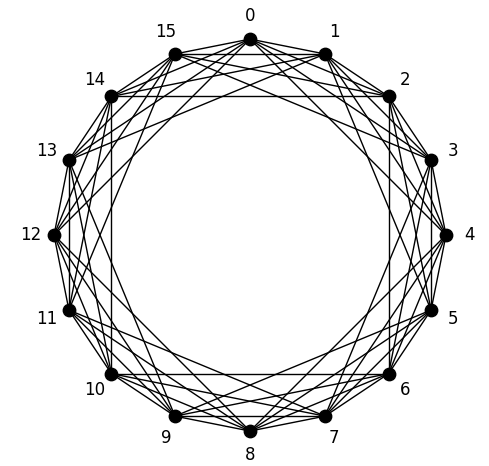
If \(n=2tk+r\), where \(k\) is some positive integer and \(r \in \{0, 1, \dots 2t-1\}\), then \(C_{n}(1, 2, \dots, t)\) has diameter \(k\) or \(k+1\) according as \(r \in \{0,1\}\) or \(r \in \{2, 3, \dots, 2t-1\}\). For example, the circulant graph \(C_{16}(1, 2, 3, 4)\) illustrated in Figure. 1 has diameter \(2\).
The outer cycle of the circulant graph \(G=C_{n}(1, 2, \dots, t)\) is a spanning subgraph of \(G\) in which each vertex \(i\) is adjacent to the vertices \(i \pm 1 \pmod {n}\). For any two vertices \(i, j \in V(C_n(1, 2, \dots, t))\), the circular distance between \(i\) and \(j\) is given by \(min\{|i-j|, n-|i-j|\}\).
From the definition of circulant graphs, it follows that two vertices \(i\) and \(j\) are adjacent if and only if \(min\{|i-j|, n-|i-j|\} \in \{1, 2, \dots ,t\}\). Therefore, a set \(W \subseteq V(C_{n}(1, 2, \dots, t))\) is independent if the circular distance between every pair of distinct vertices in \(W\) is greater than \(t\). In other words, each set of \(t+1\) consecutive vertices on the outercycle of \(C_{n}(1, 2, \dots, t)\) contains at most one vertex of the independent set \(W\). Hence, it follows that an independent set of cardinality \(l\) exists in \(C_{n}(1, 2, \dots, t)\) only if \(n \geq l(t+1).\) Further, note that when no independent resolving set exists, \(idim(G)\) is undefined.
Throughout the paper, all vertex labels in the circulant graph \(C_n(1,2,\dots,t)\) are interpreted modulo \(n\). In particular, for negative vertex labels, we adopt the convention \(-i \equiv n-i \pmod {n}.\)
We now present the known results on metric dimension of circulant graphs \(C_{n}(1, 2)\), \(C_{n}(1, 2, 3)\), \(C_{n}(1, 2, 3, 4)\) that will be used in the following sections.
Theorem 2.2. [2, 14] For \(n \geq 6\) we have, \[dim(C_{n}(1, 2))=\begin{cases} 3 &\text{for } n \equiv 0, 2, 3\pmod {4},\\ 4 & \text{for } n \equiv 1 \pmod {4}. \end{cases}\]
Theorem 2.3. [2, 10] For \(n \geq 8\) we have, \[dim(C_{n}(1, 2, 3))=\begin{cases} 4 &\text{for } n \equiv 0, 2, 3, 4, 5 \pmod {6},\\ 5 &\text{for } n \equiv 1 \pmod {6}. \end{cases}\]
Theorem 2.4. [7, 20] For \(n \geq6\), \(n\notin\{11, 19\}\), \[dim(C_{n}(1, 2, 3, 4))=\begin{cases} 4 &\text{for } n \equiv 4 \pmod {8}, \\ 5 &\text{for } n \equiv \pm 2 \text{ or } \pm 3 \pmod{8},\\ 6 &\text{for } n \equiv \pm 1 \text{ or } 0 \pmod{8}. \end{cases}\] and \(dim(C_{11}(1, 2, 3, 4))= dim(C_{19}(1, 2, 3, 4))= 4.\)
Remark 2.5. [4] Let \(G\) be a connected graph of order n, having an independent resolving set, then \(1\leq dim(G) \leq idim(G) \leq n-1\).
Theorem 3.1. For the circulant graph \(C_{n}(1, 2)\), \[idim(C_{n}(1, 2))=\begin{cases} 3 &\text{for } n \equiv 0, 2, 3 \pmod {4} \text{ and } n \geq 10,\\ 4 & \text{for }n \equiv 1 \pmod {4} \text{ and } n\geq 13. \end{cases}\]
Proof. Let \(G =C_{n}(1, 2)\). Using Theorem 2.2 we have, \(idim(G)\) \(\geq 3\) when \(n \equiv 0, 2, 3 \pmod{4}\) and \(idim(G)\) \(\geq 4\) when \(n \equiv 1 \pmod{4}\). Further, an independent set of cardinality at least \(3\) exists in \(G\) only if \(n \geq 9\). This implies that for \(n \equiv 0, 2, 3 \pmod{4}\), \(idim(G)\) is defined only if \(n \geq 10\). Similarly, for \(n \equiv 1 \pmod{4}\), \(idim(G)\) is defined only if \(n \geq 13.\) It remains to verify that \(idim(G) \leq 3\), when \(n \equiv 0, 2, 3 \pmod{4}\) and \(idim(G) \leq 4\), when \(n \equiv 1 \pmod{4}\). In each of the following cases, we identify a suitable independent set and prove that it resolves the vertices of \(G\).
Case 1. \(n\equiv 0 \pmod{4}\)
Let \(n=4k\) for some positive integer \(k\). Note that \(idim(G)\) is not defined when \(k=1\) and \(k=2\). Therefore, we assume that \(k\geq 3\). Consider \(W\)={\(n-3\), \(0\), \(3\)}. Since the circular distance between every pair of vertices in \(W\) exceeds 2, \(W\) forms an independent set. We have to prove that \(r(x|W) \neq r(y|W)\), for every \(x, y \in V(G) \setminus W\). Since \(G\) is vertex transitive, we fix one vertex, say \(0\), and partition \(V(G) \setminus \{0\}\) into two sets \(S\) and \(D\) as follows.
Let \(S= \{\pm 1, \pm2, \dots, \pm(2k-2)\}\) and \(D= \{2k-1, 2k, 2k+1\}\), where \(D\) consists of all vertices having diameter distance \(k\) from \(0\). The representations of vertices in \(D\), with respect to \(W\), are as follows: \(r(2k-1|W)=(k-1, k, k-2)\), \(r(2k|W)=(k-1, k, k-1)\), \(r(2k+1|W)=(k-2, k, k-1)\). It is evident that the vertices in \(D\) are pairwise resolved by some \(w \in W\). By definition, no vertex in \(S\) shares the same representation as any vertex in \(D\). Now, we consider the set \(S\). Each vertex in \(S\) is of the form \(\pm (2q+r)\), for some \(q \in \{0, 1, \dots, k-2\}\) and \(r \in \{1, 2\}\). Consider two vertices \(x, y \in S\) given by \(x= \pm (2q_1+r_1)\) and \(y= \pm (2q_2+r_2)\), where \(q_1, q_2 \in \{0, 1, \dots, k-2\}\) and \(r_1, r_2 \in \{1, 2\}\). Note that \(d(x, 0)=q_1+1\) and \(d(y, 0)=q_2+1\). Therefore, if \(q_1 \neq q_2\), then \(x\) and \(y\) are resolved by the vertex \(0\). Next, we examine the case where \(q_1=q_2=q\), where \(q \in \{0, 1, \dots, k-2\}\). In other words, we consider different vertex pairs at distance say \(q+1\) from \(0\) and show how each pair is resolved by some \(w \in W\). For \(x= \pm (2q+r_1)\) and \(y= \pm (2q+r_2)\), where \(q \in \{0, 1, \dots, k-2\}\) and \(r_1, r_2 \in \{1, 2\}\), we have the following possibilities:
\(x=2q+r_1\) and \(y=2q+r_2\), where \(q \in \{0, 1, \dots, k-2\}\) and \(r_1, r_2 \in \{1, 2\}\).
Assume that \(x<y\), which implies
\(r_1 <r_2\). Since \(r_1, r_2 \in \{1, 2\}\), we have \(r_1=1\) and \(r_2=2\). Then, \[\begin{aligned}
q=0 & \implies d(x, n-3)=2,\ d(y, n-3)=3,\\
1\leq q \leq k-2 &\implies d(x, 3)=q-1,\ d(y, 3)=q.
\end{aligned}\]
Therefore, in this case \(x\) and \(y\) are resolved either by the vertex \(3\) or by the vertex \(n-3\).
\(x=-(2q+r_1)\) and \(y=-(2q+r_2)\), where \(q \in \{0, 1, \dots, k-2\}\) and \(r_1, r_2 \in \{1, 2\}\).
Assuming \(x>y\), we obtain \(x=-(2q+1)\) and \(y=-(2q+2)\). Further, \[\begin{aligned} q=0 &\implies d(x, 3)=2,\ d(y, 3)=3, \\ 1\leq q \leq k-2 &\implies d(x, n-3)=q-1,\ d(y, n-3)=q. \end{aligned}\]
\(x=2q+r_1\) and \(y=-(2q+r_2)\), where \(q \in \{0, 1, \dots, k-2\}\) and \(r_1, r_2 \in \{1, 2\}\). \[\begin{aligned} q=0 &\implies d(x, 3)=1,\ d(y, 3) \in \{2, 3\},\\ 1\leq q \leq k-3 &\implies d(x, 3)\in \{q-1, q\},\ d(y, 3)\in\{q+2, q+3\},\\ q = k-2 &\implies d(x, 3)\in \{ k-2, k-3\},\ d(y, 3)=k. \end{aligned}\]
Therefore, vertices in \(S\) are also pairwise resolved by some \(w \in W\). Hence, \(W\) is an independent resolving set for \(G\) and it follows that \(idim(G)\leq 3\) when \(n \equiv 0 \pmod{4}\).
Case 2. \(n \equiv 1 \pmod{4}\)
Let \(n=4k+1\), where \(k\) is some positive integer. For \(k=1\) and \(k=2\), \(idim(G)\) is not defined. Let \(W=\{n-3, 0, 3, 6\}\). The circular distance between every pair of vertices in \(W\) is greater than \(2\) and hence \(W\) forms an independent set. Assume \(k=3\), then \(n=13\). The representation vectors of vertices in \(V(C_{13}(1, 2)) \setminus W\) with respect to \(W\) are as follows:
| \(r(1|W)=(2, 1, 1, 3)\), | \(r(2|W)=(3, 1, 1, 2)\), | \(r(4|W)=(3, 2, 1, 1)\), |
| \(r(5|W)=(3, 3, 1, 1)\), | \(r(7|W)=(2, 3, 2, 1)\), | \(r(8|W)=(1, 3, 3, 1)\), |
| \(r(9|W)=(1, 2, 3, 2)\), | \(r(11|W)=(1, 1, 3, 3)\), | \(r(12 |W)=(1, 1, 2, 3).\) |
Clearly, each vertex has a unique representation with respect to \(W\). Hence, it follows that \(idim(C_{13}(1, 2))=4\). Now, consider the case where \(k \geq 4\). When \(n \equiv 1 \pmod{4}\), we have \(V(G) \setminus \{0\}=\{\pm1, \pm2, \dots, \pm 2k\}\). Consider the elements \(x,y \in V(G) \setminus \{0\}\) given by \(x= \pm (2q_1+r_1)\) and \(y= \pm (2q_2+r_2)\), where \(q_1, q_2 \in \{0, 1, \dots, k-1\}\) and \(r_1, r_2 \in \{1, 2\}\). Since \(d(x, 0)=q_1+1\) and \(d(y, 0)=q_2+1\), the vertex \(0\) resolves \(x\) and \(y\), when \(q_1 \neq q_2\). Assume that \(q_1=q_2=q\). We now examine all possible pairs \(x= \pm (2q+r_1)\) and \(y= \pm (2q+r_2)\), where \(q \in \{0, 1, \dots, k-1\}\) and \(r_1, r_2 \in \{1, 2\}\). In each case we identify a vertex \(w \in W\) that resolves \(x\) and \(y\).
\(x=2q+r_1\) and \(y=2q+r_2\), \(q
\in \{0, 1, \dots, k-1\}\) and \(r_1,
r_2 \in \{1, 2\}\).
Assume that \(x<y\). Then \(x=2q+1\) and \(y=2q+2\) and we have \[\begin{aligned}
q=0 &\implies d(x, n-3)=2,\ d(y, n-3)=3,\\
1\leq q \leq k-1 &\implies d(x, 3)=q-1,\ d(y, 3)=q.
\end{aligned}\]
\(x=-(2q+r_1)\) and \(y=-(2q+r_2)\), \(q \in \{0, 1, \dots, k-1\}\) and \(r_1, r_2 \in \{1, 2\}\).
By symmetry (the map \(x \mapsto -x\))
of the circulant graph, if vertex \(i\)
resolves two vertices \(a, b \in S\),
it follows that \(-i\) resolves \(-a\) and \(-b\). Therefore, \[\begin{aligned}
q=0 &\implies d(x, 3)\neq d(y,3),\\
1 \leq q \leq k-1 & \implies d(x, n-3) \neq d(y, n-3).
\end{aligned}\]
\(x=2q+r_1\) and \(y=-(2q+r_2)\), \(q \in \{0, 1, \dots, k-1\}\) and \(r_1, r_2 \in \{1, 2\}\). \[\begin{aligned} q = k-1 &\implies d(x, 6)=k-3,\ d(y, 6)= k-2,\\ q = k-2 &\implies d(x, 3)\in \{ k-2, k-3\},\ d(y, 3)=k, \\ q=0 &\implies d(x, 3)=1,\ d(y, 3) \in \{2, 3\},\\ 1\leq q \leq k-3 &\implies d(x, 3)\in \{q-1, q\},\ d(y, 3)\in\{q+2, q+3\}. \end{aligned}\]
It follows that every pair of distinct vertices in \(V(G)\) is resolved by some \(w \in W\). Therefore, \(W\) is an independent resolving set for \(G\) and we obtain \(idim(G)\leq 4\).
Case 3. \(n\equiv 2 \pmod {4}\)
Let \(n=4k+2\), where \(k\) is some positive integer. It can be verified that \(idim(G)\) is not defined, when \(k=1\). Therefore, we assume that \(n=4k+2\), where \(k\geq 2\). In this case, we prove that the independent set \(W=\{n-3, 0, 3\}\) is a resolving set for \(G\). The only vertex diametrically opposite to \(0\) is \(2k+1\). Hence, it has a unique representation with respect to \(W\), given by \(r(2k+1|W) =(k-1, k+1, k-1)\). Consider the set \(S= V(G)\setminus\{0, 2k+1\} =\{\pm 1, \pm 2, \dots, \pm 2k\}\). Let \(x, y \in S\) be given by \(x=\pm (2q_1+r_1)\) and \(y= \pm (2q_2+r_2)\), where \(q_1, q_2 \in \{0, 1, \dots, k-1\}\) and \(r_1, r_2 \in \{1, 2\}\). As in Case 1, it can be verified that \(0\) resolves \(x, y\) when \(q_1 \neq q_2\). Suppose that \(q_1=q_2=q\). Consider \(x=\pm (2q+r_1)\) and \(y= \pm (2q+r_2)\), where \(q\in \{0, 1, \dots, k-1\}\) and \(r_1, r_2 \in \{1, 2\}\).
Suppose \(x=2q+r_1\) and \(y=2q+r_2\), with \(x<y\). Then, \[\begin{aligned} &d(x,3)=q-1, \ d(y, 3)=q, &\text{ for } 1 \leq q\leq k-1,\\ &d(x, n-3)=2, \ d(y, n-3)=3, &\text{ for }q=0. \end{aligned}\]
In other words, when \(1 \leq q\leq k-1\), the pair \((x,y)\) is resolved by the vertex \(3\) and when \(q=0\), the pair \((x,y)\) is resolved by the vertex \(n-3\).
Suppose \(x=-(2q+r_1)\) and \(y=-(2q+r_2)\), with \(x>y\).
By the symmetry of the circulant graphs (the map \(x \mapsto -x\)), \[\begin{aligned} &d(x,n-3)=q-1, \ d(y, n-3)=q, &\text{ for } 1 \leq q\leq k-1,\\ &d(x, 3)=2, \ d(y, 3)=3, &\text{ for }q=0. \end{aligned}\]
Let \(x=2q+r_1\) and \(y=-(2q+r_2)\). Then, \[\begin{aligned} q=0 &\implies d(x, 3)=1, \ d(y, 3) \in \{2, 3\},\\ q=k-1 &\implies d(x, 3) \in \{k-2, k-1\}, \ d(y, 3)=k,\\ 1\leq q \leq k-2 &\implies d(x, 3) \in \{q-1, q\}, \ d(y, 3) \in \{q+2, q+3\}. \end{aligned}\]
Therefore, we have \(r(x|W) \neq r(y|W)\), for every \(x,y \in S\). Hence, it follows that \(idim(G)\leq 3\) when \(n \equiv 2 \pmod {4}\).
Case 4. \(n \equiv 3 \pmod {4}\)
Let \(n=4k+3\), where \(k \geq 2\) (\(idim(G)\) is not defined when \(k=1\)). In this case we show that the independent set \(W=\{n-3, 0, 3\}\) resolves the vertices in \(G\). Define \(S= \{\pm 1, \pm2, \dots, \pm 2k\}\) and \(D= \{2k+1, 2k+2\}\). Note that \(2k+1\) and \(2k+2\), are the only vertices at distance \(k+1\) from \(0\). Further, since \(d(2k+1, 3)=k-1\) and \(d(2k+2, 3)=k\), we have \(r(2k+1|W)\neq r(2k+2|W)\). Consider \(x, y \in S\). Let \(x=\pm (2q_1+r_1)\), \(y = \pm (2q_2+r_2)\), where \(q_1, q_2 \in \{0, 1, \dots, k-1\}\) and \(r_1, r_2 \in \{1, 2\}\). It can be verified that \(d(x, 0) \neq d(y,0)\) when \(q_1 \neq q_2\). Assume that \(q_1=q_2=q\), where \(q \in \{0, 1, \dots, k-1\}\). Using the same reasoning as in Case 1, it follows that when \(x=2q+r_1\) and \(y=2q+r_2\) or \(x=-(2q+r_1)\) and \(y=-(2q+r_2)\), either \(d(x,3) \neq d(y, 3)\) or \(d(x,n-3) \neq d(y, n-3)\). It remains to consider the case where \(x=2q+r_1\) and \(y=-(2q+r_2)\). \[\begin{aligned} q=0 &\implies d(x, 3)=1,\ d(y, 3) \in \{2, 3\},\\ q=k-1 &\implies d(x, 3) \in \{k-2, k-1\},\ d(y, 3) \in \{k, k+1\},\\ 1\leq q \leq k-2 &\implies d(x, 3) \in \{q-1, q\},\ d(y, 3) \in \{q+2, q+3\}. \end{aligned}\]
Hence, \(r(x|W) \neq r(y|W)\) for all distinct \(x, y \in V(G) \setminus W\) and therefore, for \(n \equiv 3 \pmod {4}\) we obtain \(idim(G) \leq 3\). ◻
Theorem 4.1. For the circulant graph \(C_{n}(1, 2, 3)\), \[idim(C_{n}(1, 2, 3))=\begin{cases} 4 &\text{for } n \equiv 0, 2, 3, 4, 5\pmod {6} \text{ and } n \geq 16,\\ 5 &\text{for } n \equiv 1 \pmod {6} \text{ and } n \geq 25. \end{cases}\]
Proof. Let \(G =C_{n}(1, 2, 3 )\). Here, we show that \(idim(G)\leq 4\), when \(n \equiv 0, 2, 3, 4, 5 \pmod{6}\) and \(idim(G)\leq 5\), when \(n \equiv 1 \pmod{6}\) by identifying an appropriate independent resolving set. The result then follows from Theorem 2.3 and Remark 2.5. Also note that an independent set of cardinality at least \(4\) exists in \(G\) only if \(n \geq 16\). Therefore, when \(n \equiv 0, 2, 3, 4, 5 \pmod{6}\), \(idim(G)\) is defined only if \(n \geq 16\). Similarly, when \(n \equiv 1 \pmod {6}\), \(idim(G)\) is defined only for \(n \geq 25\).
Case 1. \(n \equiv 0 \pmod {6}\)
Let \(n=6k\), for some positive integer \(k \geq 3\). Observe that \(idim(G)\) is not defined when \(k=1\) and \(k=2\). We claim that the set \(W=\{0, 4, \frac{n}{2}, \frac{n}{2}+4\}\subset V(G)\) is a resolving set for \(G\). Since \(n \geq 18\), the circular distance between every pair of vertices in \(W\) exceeds \(3\). Therefore, the set \(W\) is independent. We fix one vertex say \(0\) and partition \(V(G) \setminus \{0\}\) into two sets \(S\) and \(D\) defined by \(S=\{\pm 1, \pm 2, \dots, \pm (3k-3)\}\) and \(D=\{3k-2, 3k-1, 3k, 3k+1, 3k+2\}\), where \(D\) consists of vertices whose distance from vertex \(0\) is equal to \(k\). By definition, it follows that no vertex in \(D\) shares the same representation as any vertex in \(S\). The representation vectors corresponding to the vertices in \(D\) are as follows:
| \(r(3k-2|W)=(k, k-2, 1, 2)\), | \(r(3k-1|W)=(k, k-1, 1, 2)\), |
| \(r(3k|W)=(k, k-1, 0, 2)\), | \(r(3k+1|W)=(k, k-1, 1, 1)\), |
| \(r(3k+2|W)=(k, k, 1, 1)\). |
It is evident that these vertices are pairwise resolved by some \(w \in W\). Therefore, each vertex in \(D\) has a unique representation with respect to \(W\). Next, we consider the set \(S\). The vertices in \(S\) can be represented using the parametrization \(\pm(3q+r)\), where \(q \in \{0, 1, \dots, k-2\}\) and \(r \in \{1,2,3\}\). Observe that for each fixed \(q \in \{0, 1, \dots, k-2\}\), the vertices \(\pm(3q+r)\), \(1 \leq r \leq 3\), have distance \(q+1\) from vertex \(0\). Consider two vertices \(x, y \in S\) given by \(x=\pm (3q_1+r_1)\), \(y=\pm (3q_2+r_2)\), where \(q_1, q_2 \in \{0, 1, \dots, k-2\}\) and \(r_1, r_2 \in \{1, 2, 3\}\). Since \(d(x, 0) =q_1+1\) and \(d(y, 0) =q_2+1\), it follows that the vertex \(0\) resolves \(x\) and \(y\), when \(q_1 \neq q_2\). Assume that \(q_1=q_2=q\), where \(q \in \{0, 1,\dots, k-2\}\). The following cases discuss how different pairs of vertices at distance \(q+1\) from \(0\) are resolved by vertices in \(W\).
\(x=3q+r_1\) and \(y=3q+r_2\), where \(q \in \{0, 1,\dots, k-2\}\) and \(r_1, r_2 \in \{1, 2, 3\}\).
Assume that \(x<y\). Hence, \(r_1 =1\) implies that \(r_2 \in \{2, 3\}\). Also, if \(r_1=2\) then \(r_2=3\).
When \(q=0,\) \[\begin{aligned}
x=1 &\implies d \left(x, \frac{n}{2}+4 \right)= k-1, \ d
\left(y, \frac{n}{2}+4 \right) =k, \text{where } y \in \{2, 3\},\\
x=2 &\implies d \left(x, \frac{n}{2} \right)= k, \ d
\left(y, \frac{n}{2} \right) =k-1, \text{where } y =3.
\end{aligned}\]
When \(q=k-2,\) \[\begin{aligned} x= 3q+1 & \implies d(x, 4)=k-3, \ d(y, 4)=k-2, \text{ where } y \in \{3q+2, 3q+3\},\\ x= 3q+2 & \implies d\left(x, \frac{n}{2} \right)=2, \ d\left(y, \frac{n}{2}\right)=1, \text{ where } y=3q+3. \end{aligned}\]
When \(1 \leq q \leq k-3,\) \[\begin{aligned} x=3q+1 &\implies d(x, 4)=q-1,\ d(y, 4)=q, \text{ where } y \in \{3q+2, 3q+3\},\\ x=3q+2 & \implies d\left(x, \frac{n}{2}\right)=k-q,\ d\left(y, \frac{n}{2}\right)=k-q-1, \text{ where } y=3q+3. \end{aligned}\]
\(x=-(3q+r_1)\) and \(y=-(3q+r_2)\), where \(q \in \{0, 1,\dots, k-2\}\) and \(r_1, r_2 \in \{1, 2, 3\}\).
Assume that \(x>y\). Therefore, we have \(r_1 <r_2\). Further, When \(q=0\), \[\begin{aligned} x=-1 & \implies d\left( x, \frac{n}{2}+4\right)=k-1,\ d\left( y, \frac{n}{2}+4\right)=k-2, \text{ where } y \in \{-2, -3\},\\ x=-2 & \implies d\left( x, \frac{n}{2}\right)=k, \ d\left( y, \frac{n}{2}\right)=k-1, \text{ where } y = -3. \end{aligned}\]
When \(q=k-2\), \[\begin{aligned} x=-(3q+1) & \implies d \left(x, \frac{n}{2}+4 \right)=1, \ d(y, \frac{n}{2}+4)=0, \text{ where } y = -(3q+2),\\ x=-(3q+1) & \implies d \left(x, \frac{n}{2} \right)=2, \ d(y, \frac{n}{2})=1, \text{ where } y = -(3q+1),\\ x=-(3q+2) & \implies d(x, \frac{n}{2})=2, \ d(y, \frac{n}{2})=1, \text{ where } y = -(3q+3). \end{aligned}\]
When \(1 \leq q \leq k-3\), \[\begin{aligned} x=-(3q+1) & \implies d \left(x, \frac{n}{2}+4 \right)=k-q-1, \ d \left(y, \frac{n}{2}+4 \right)=k-q-2, \\ x=-(3q+2) & \implies d \left(x, \frac{n}{2}\right)=k-q, \ d(y, \frac{n}{2})=k-q-1. \end{aligned}\]
\(x=3q+r_1\) and \(y=-(3q+r_2)\), where \(q \in \{0, 1,\dots, k-2\}\) and \(r_1, r_2 \in \{1, 2, 3\}\). \[\begin{aligned} q=0 & \implies d(x, 4)=1, \ d(y, 4)\in \{2, 3\},\\ q=k-2 & \implies d(x, 4)\in \{k-3, k-2\}, \ d(y, 4)=k,\\ 1 \leq q \leq k-3 & \implies d(x, 4) \in \{q-1, q\}, \ d(y, 4)\in \{q+2, q+3\}. \end{aligned}\]
Thus, vertices in \(S\) are also
pairwise resolved by some \(w \in W\).
Therefore, \(W\) is an independent
resolving set for \(G\) and hence \(idim(G) \leq 4.\)
Case 2. \(n \equiv 1 \pmod
{6}\)
Let \(n=6k+1\), \(k \geq 4\). Consider the set \(W=\{n-4, 0, 4, 8, \frac{n+1}{2}\} \subset V(G)\). Since \(n \geq 25\), the circular distance between each pair of vertices in \(W\) exceeds 3. Therefore, \(W\) forms an independent set. For every pair of distinct vertices \(x, y \in V(G) \setminus W\), we show that \(d(x, w) \neq d(y, w)\), for some \(w \in W\). Let \(S=\{\pm1, \pm2, \dots, \pm3(k-1)\}\) and \(D=\{3k-2, 3k-1, 3k, 3k+1, 3k+2, 3k+3\}\). Clearly, \(S \cup D =V(G)\setminus \{0\}\). From the representations given below, it is evident that the vertices in \(D\) are pairwise resolved by some \(w \in W\)
$$r(3k-2|W)=(k, k, k-2, k-3, 1), \,r(3k-1|W)=(k, k, k-1, k-3, 1), $$ $$r(3k|W)=(k-1, k, k-1, k-2, 1), \, r(3k+1|W)=(k-1, k, k-1, k-2, 0), $$ $$r(3k+2|W)=(k-1, k, k, k-2, 1), \, r(3k+3|W)=(k-2, k, k, k-1, 1).$$Further, being the only vertices at distance \(k\) from \(0\), the above representations are unique. It remains to prove that vertices in \(S\) are also pairwise resolved by some \(w \in W\). Let \(x, y \in S\) be given by \(x=\pm (3q_1+r_1)\) and \(y= \pm(3q_2+r_2)\), where \(q_1, q_2 \in \{0, 1, \dots, k-2\}\) and \(r_1, r_2 \in \{1, 2, 3\}\). Since, \(d(x, 0)= q_1+1\) and \(d(y, 0)=q_2+1\), we have \(d(x, 0) \neq d(y, 0)\) when \(q_1 \neq q_2\). Assuming \(q_1=q_2=q\), \(q\in \{0, 1, \dots, k-2\}\) we consider the following three cases.
\(x=3q+r_1\) and \(y=3q+r_2\), where \(q\in \{0, 1, \dots, k-2\}\), \(r_1, r_2 \in \{1, 2, 3\}\).
Assume that \(x<y\). For each vertex \(x\), we consider all possible vertices \(y\), with \(x < y\) and in each case identify the corresponding vertex \(w \in W\) such that \(d(x, w) \neq d(y, w)\).
When \(q=0\), \[\begin{aligned} x=1 &\implies d(x, 8)= 3, \ d(y, 8) =2,\\ x=2 &\implies d(x, n-4)= 2, \ d(y, n-4) =3. \end{aligned}\]
When \(q=k-2,\) \[\begin{aligned} x=3q+1 &\implies d(x, 4)= k-3,\ d(y, 4) =k-2,\\ x=3q+2 &\implies d(x, 8)= k-4,\ d(y, 8) =k-3. \end{aligned}\]
When \(1\leq q \leq k-3,\) \[\begin{aligned} x=3q+1 &\implies d(x, 4)=q-1,\ d(y, 4) =q,\\ x=3q+2 &\implies d(x, n-4)=q+2,\ d(y, n-4) =q+3. \end{aligned}\]
\(x=-(3q+r_1)\) and \(y=-(3q+r_2)\), where \(q\in \{0, 1, \dots, k-2 \}\), \(r_1, r_2 \in \{1, 2, 3\}\).
Assume that \(x>y\), which implies that \(r_1 < r_2\). Hence,
When \(q=0,\) \[\begin{aligned} x=-1 & \implies d(x, 8)=3, \ d(y, 8)=4, \\ x=-2 & \implies d(x, 4)=2, \ d(y, 4)=3. \end{aligned}\]
When \(q=k-2,\) \[\begin{aligned} x=-(3q+1) & \implies d(x, n-4)=k-3, \ d(y, n-4)=k-2,\\ x=-(3q+2) & \implies d \left(x, \frac{n+1}{2} \right)=2, \ d \left(y, \frac{n+1}{2} \right)=1. \end{aligned}\]
It has already been proved that for \(1\leq q \leq k-3\), the vertices \(3q+r_1\) and \(3q+r_2\), where \(r_1, r_2 \in \{1, 2, 3\}\), are resolved either by \(4\) or by \(n-4\). Therefore, by the automorphism \(x \mapsto -x\) inherent in circulant graphs, it follows that for \(1\leq q \leq k-3\), either \(d(x, 4) \neq d(y, 4)\) or \(d(x, n-4)\neq d(y, n-4)\).
\(x=3q+r_1\) and \(y=-(3q+r_2)\), where \(q \in \{0, 1, \dots, k-2\}\), \(r_1, r_2 \in \{1, 2, 3\}\). \[\begin{aligned} q=0 & \implies d(x,4)=1 , \ d(y,4) \in \{2, 3\},\\ q=k-2 & \implies d(x,4) \in \{k-2, k-3\},\ d(y,4)=k,\\ 1 \leq q \leq k-3 & \implies d(x,4)\in \{q-1, q\},\ d(y,4) \in \{q+2, q+3\}. \end{aligned}\]
Case 3. \(n \equiv 2 \pmod {6}\)
Take \(n=6k+2\), \(k \geq 3\). Here, we prove that \(W=\{n-4, 0, 4, 8\}\subset V(G)\) is an independent resolving set for \(G\). Since the circular distance between every pair of vertices in \(W\) exceeds 3, we can conclude that the set \(W\) is independent. When \(n=6k+2\), there exists exactly one vertex, say \(3k+1\), which is diametrically opposite to \(0\). Hence, it admits a unique representation with respect to \(W\). Let \(S=V(G) \setminus \{0, 3k+1\}=\{\pm 1, \pm 2, \dots, \pm 3k\}\). Consider \(x, y\in S\). Let \(x=\pm(3q_1+r_1)\) and \(y=\pm(3q_2+r_2)\), where \(q_1, q_2 \in \{0, 1, \dots, k-1\}\) and \(r_1, r_2 \in \{1, 2, 3\}\). Clearly, \(0\) resolves \(x\) and \(y\), if \(q_1 \neq q_2\). Suppose \(q_1 = q_2=q\), where \(q \in \{0, 1, \dots, k-1\}\). The following list shows how different pairs of vertices \(x=\pm (3q+r_1)\) and \(y=\pm (3q+r_2)\), \(q \in \{0, 1, \dots, k-1\}\) and \(r_1, r_2 \in \{1, 2, 3\}\) are resolved by some \(w \in W\).
\(x=3q+r_1\) and \(y=3q+r_2\), where \(q \in \{0, 1, \dots, k-1\}\) and \(r_1, r_2 \in \{1, 2, 3\}.\)
Assume that \(x<y\). \[\begin{aligned} x=1\ (q=0) &\implies d(x, 8)= 3, \ d(y, 8) =2,\\ x=2 \ (q=0) &\implies d(x, n-4)= 2, \ d(y, n-4) =3,\\ x=3q+1,\ q=k-1 &\implies d(x, 4)= k-2,\ d(y, 4) =k-1,\\ x=3q+2, \ q=k-1 &\implies d(x, 8)= k-3,\ d(y, 8) =k-2,\\ x=3q+1,\ 1\leq q \leq k-2 &\implies d(x, 4)=q-1,\ d(y, 4) =q,\\ x=3q+2, \ 1\leq q \leq k-2 &\implies d(x, n-4)=q+2,\ d(y, n-4) =q+3. \end{aligned}\]
Note that none of the vertices \(0\), \(4\) or \(n-4\) resolves the pair \((1, 2)\). However, \(d(1,8) \neq d(2,8)\). Similarly, for \(x=3q+2\) and \(y=3q+3\) with \(q=k-1\), we have \(d(x,8) \neq d(y,8)\). All remaining pairs \((x, y)\) are resolved by one of the vertices \(0\), \(4\) or \(n-4\).
\(x=-(3q+r_1)\) and \(y=-(3q+r_2)\), where \(q \in \{0, 1, \dots, k-1\}\) and \(r_1, r_2 \in \{1, 2, 3\}.\)
Assume that \(x>y\). \[\begin{aligned} x=-1 \ (q=0) & \implies d(x, 8)=3, \ d(y, 8)=4,\\ x=-2 \ ( q=0) & \implies d(x, 4)=2, \ d(y, 4)=3,\\ x=-(3q+1), \ q=k-1 & \implies d(x, n-4)=k-2, \ d(y, n-4)=k-1, \\ x=-(3q+2), \ q=k-1 & \implies d(x, 8)=k-1, \ d(y, 8)=k-2. \end{aligned}\]
By symmetry \((\text{the map }x \mapsto -x)\), it follows that for \(x=-(3q+r_1)\) and \(y=-(3q+r_2)\), with \(1\leq q \leq k-2\) and \(r_1, r_2 \in \{1, 2, 3\}\), either \(d(x, 4) \neq d(y, 4)\) or \(d(x, n-4) \neq d(y, n-4)\) holds.
\(x=3q+r_1\) and \(y=-(3q+r_2)\), where \(q \in \{0, 1, \dots, k-1\}\) and \(r_1, r_2 \in \{1, 2, 3\}.\) \[\begin{aligned} x=3q+r_1,\ q=0 & \implies d(x,4)=1 , \ d(y,4) \in \{2, 3\},\\ x=3q+r_1,\ q=k-1 & \implies d(x,4) \in \{k-1, k-2\},\ d(y,4)=k,\\ x=3q+r_1,\ 1 \leq q \leq k-2 & \implies d(x,4)\in \{q-1, q\},\ d(y,4) \in \{q+2, q+3\}. \end{aligned}\]
Case 4. \(n \equiv 3 \pmod {6}\)
Let \(n=6k+3\), where \(k \geq 3\). In this case, we show that \(W=\{0, 4, \frac{n-3}{2}, \frac{n-3}{2}+4\}\) is an independent resolving set. Since \(n \geq 21\), the circular distance between different pairs of vertices in \(W\) exceeds \(3\). Hence, the set \(W\) is independent. Let \(S=\{\pm1, \pm 2, \dots, \pm 3k\}\) and \(D=\{3k+1, 3k+2\}\). Clearly, \(V(G) \setminus \{0\}=S \cup D\). Observe that \(3k+1\) and \(3k+2\) are the only vertices whose distance from \(0\) equals \(k+1\). Further, since \(d(3k+1, 4)= k-1\) and \(d(3k+2, 4)= k\), these vertices admit unique representation with regard to \(W\). It remains to prove that the vertices in \(S\) are pairwise resolved by some \(w \in W\). Consider \(x, y \in S\) given by \(x=\pm(3q_1+r_1)\) and \(y=\pm(3q_2+r_2)\), where \(q_1, q_2 \in \{0, 1, \dots, k-1\}\) and \(r_1, r_2 \in \{1, 2, 3\}\). When \(q_1 \neq q_2\), we obtain \(d(x, 0) \neq d(y, 0)\). Next, consider the case where \(q_1=q_2=q\), \(q \in \{0, 1, \dots, k-1\}\).
\(x=3q+r_1\) and \(y=3q+r_2\), where \(q \in \{0, 1, \dots, k-1\}\) and \(r_1, r_2 \in \{1, 2, 3\}\).
Assume that \(x<y\). Let \(a=\frac{n-3}{2}\).
When \(q=0\),\[\begin{aligned} x=1 &\implies d(x, a+4)=k, \ d(y, a+4)=k+1,\\ x=2 &\implies d(x, a) =k, \ d(y, a)=k-1. \end{aligned}\]
When \(q=k-1\),\[\begin{aligned} x=3q+1 & \implies d(x, 4) = k-2, \ d(y, 4)=k-1,\\ x=3q+2 & \implies d(x, a) = 1, \ d(y, a)=0. \end{aligned}\]
When \(1\leq q \leq k-2\),\[\begin{aligned} x=3q+1 & \implies d(x, 4)=q-1,\ d(y, 4)=q,\\ x=3q+2 & \implies d(x, a) =k-q,\ d(y, a)=k-q-1. \end{aligned}\]
\(x=-(3q+r_1)\) and \(y=-(3q+r_2)\), where \(q \in \{0, 1, \dots, k-1\}\) and \(r_1, r_2 \in \{1, 2, 3\}\).
Assume that \(x>y\). Let \(a=\frac{n-3}{2}\).
When \(q=0\),\[\begin{aligned} x=-1 & \implies d(x,a+4)=k, \ d(y, a+4) =k-1,\\ x=-2 & \implies d(x, 4)=2,\ d(y, 4)=3. \end{aligned}\]
When \(q=k-1\),\[\begin{aligned} x=-(3q+1) & \implies d(x, 4)=k+1, \ d(y, 4)=k,\\ x=-(3q+2) & \implies d(x, a)=2, \ d(y, a)=1. \end{aligned}\]
When \(1\leq q \leq k-2\),\[\begin{aligned} x=-(3q+1) & \implies d(x, a+4)=k-q,\ d(y, a+4)=k-q-1,\\ x=-(3q+2) & \implies d(x, a)=k-q+1, \ d(y, a)=k-q. \end{aligned}\]
\(x=3q+r_1\) and \(y=-(3q+r_2)\), where \(q \in \{0, 1, \dots, k-1\}\) and \(r_1, r_2 \in \{1, 2, 3\}\). \[\begin{aligned} x=r_1, \ q=0 & \implies d(x, 4)=1,\ (y,4) \in \{2, 3\},\\ x=3q+r_1, \ q=k-1 & \implies d(x, 4)\in \{k-2, k-1\},\ d(y,4) \in \{k , k+1\},\\ x=3q+r_1, {\ 1 \leq q \leq k-2 }&\implies d(x, 4) \in \{q-1, q\}, \ d(y, 4)\in\{q+2, q+3\}. \end{aligned}\]
Case 5. \(n \equiv 4 \pmod {6}\)
Take \(n=6k+4\), where \(k \geq 2\). Consider the set \(W=\{n-4, 0, 4, 8\}\). For \(n \geq 16\), it can be verified that the circular distance between any two vertices in \(W\) is greater than \(3\). Therefore, the set \(W\) is independent. Define \(S =\{\pm1, \pm2, \dots, \pm3k\}\) and \(D =\{3k+1, 3k+2, 3k+3\}\), where \(D\) consists of all vertices at distance \(k+1\) from \(0\). The representations of vertices in \(D\) are as follows: \(r(3k+1|W)=(k, k+1, k-1, k-2)\), \(r(3k+2|W)=(k, k+1, k, k-2)\), \(r(3k+3|W)=(k-1, k+1, k, k-1)\). It is evident that these vertices are pairwise resolved by some \(w \in W\) and hence these representations are unique. Consider the vertices \(x, y \in S\) given by \(x=\pm(3q_1+r_1)\), \(y=\pm(3q_2+r_2)\), where \(q_1, q_2 \in \{0, 1, \dots, k-1\}\) and \(r_1, r_2 \in \{1, 2, 3\}\). Proceeding as in the previous case, we obtain \(d(x, 0) \neq d(y, 0)\) when \(q_1 \neq q_2\). Now, consider the case where \(q_1=q_2=q\), \(q \in \{0, 1, \dots, k-1\}\) .
\(x=3q+r_1\) and \(y=3q+r_2\), where \(q \in \{0, 1, \dots, k-1\}\) and \(r_1, r_2 \in \{1, 2, 3\}\).
Assume that \(x<y\). As proved in
Case 3, it follows that when \(q=0\),
the vertices \(x\) and \(y\) are resolved either by \(8\) or by \(n-4\). Further, for \(1\leq q \leq k-2\), either \(d(x,4) \neq d(y,4)\) or \(d(x,n-4) \neq d(y,n-4)\) holds.
When \(q=k-1\), \[\begin{aligned}
x=3q+1 &\implies d(x, 4)= k-2,\ d(y, 4) =k-1,\\
x=3q+2 &\implies d(x, n-4)= k+1,\ d(y, n-4) =k.
\end{aligned}\]
\(x=-(3q+r_1)\) and \(y=-(3q+r_2)\), where \(q \in \{0, 1, \dots, k-1\}\) and \(r_1, r_2 \in \{1, 2, 3\}\).
Assume that \(x>y\). Due to the symmetry of circulant graphs (the map \(x \mapsto -x\)), it follows that when \(q=0\), \(x\) and \(y\) are resolved either by \(4\) or by \(8\) and for \(1\leq q \leq k-2\), either \(d(x, 4) \neq d(y, 4)\) or \(d(x, n-4) \neq d(y, n-4)\) holds. When \(q=k-1\), \[\begin{aligned} x=-(3q+1) &\implies d(x, n-4)= k-2,\ d(y, n-4) =k-1, \\ x=-(3q+2) &\implies d(x, 4)= k+1,\ d(y, 4) =k. \end{aligned}\]
\(x=3q+r_1\) and \(y=-(3q+r_2)\), where \(q \in \{0, 1, \dots, k-1\}\) and \(r_1, r_2 \in \{1, 2, 3\}\). \[\begin{aligned} x=3q+r_1,\ q=0 & \implies d(x,4)=1 , \ d(y,4) \in \{2, 3\},\\ x=3q+r_1,\ q=k-1 & \implies d(x,4) \in \{k-1, k-2\},\ d(y,4) \in \{k, k+1\},\\ x=3q+r_1,\ 1 \leq q \leq k-2 & \implies d(x,4)\in \{q-1, q\},\ d(y,4) \in \{q+2, q+3\}. \end{aligned}\]
Therefore, the vertices in \(S\) are also pairwise resolved by some \(w \in W\) and it follows that \(W\) is a resolving set for \(G\).
Case 6. \(n \equiv 5 \pmod 6\)
Let \(n=6k+5\), \(k\geq2\). We show that the independent set \(W=\{n-4, 0, 4, 8\}\) resolves the vertices in \(G\). As in the previous cases, we fix one vertex say \(0\) and partition \(V(G) \setminus \{0\}\) into two sets \(S =\{\pm1, \pm2, \dots, \pm3k\}\) and \(D =\{3k+1, 3k+2, 3k+3, 3k+4\}\), where \(D\) consists of all vertices having distance \(k+1\) from \(0\). From the representations given below, it is clear that the vertices in \(D\) are pairwise resolved by some \(w \in W\).
$$r(3k+1|W) = (k, k+1, k-1, k-2), \, r(3k+2|W) = (k, k+1, k, k-2), $$ $$r(3k+3|W) = (k, k+1, k, k-1), \, r(3k+4|W) = (k-1, k+1, k, k-1). $$Further, from the definition of \(D\), it follows that these representations are unique. Next, we prove that the vertices in \(S\) are also pairwise resolved by some \(w \in W\). Let \(x, y \in S\) be given by \(x =\pm(3q_1+r_1)\), \(y =\pm(3q_2+r_2)\), where \(q_1, q_2 \in \{0, 1, \dots, k-1\}\) and \(r_1, r_2 \in \{1, 2, 3\}\). Since \(d(x, 0)=q_1+1\) and \(d(y, 0)=q_2+1\), the vertex \(0\) resolves \(x\) and \(y\) when \(q_1 \neq q_2\). Assume that \(q_1=q_2=q\). We examine all possible pairs \(x=\pm (3q+r_1)\), \(y= \pm (3q+r_2)\), where \(q \in \{0, 1, \dots, k-1\}\), \(r_1, r_2 \in \{1, 2, 3\}\) and identify the vertex that resolves each pair.
\(x=3q+r_1\) and \(y=3q+r_2\), \(q \in \{0, 1, \dots, k-1\}\) and \(r_1, r_2 \in \{1, 2, 3\}\).
Assume that \(x<y\). \[\begin{aligned} x=1\ (q=0) &\implies d(x, 8)= 3, \ d(y, 8) =2,\\ x=2 \ (q=0) &\implies d(x, n-4)= 2, \ d(y, n-4) =3,\\ x=3q+1,\ q=k-1 &\implies d(x, 4)= k-2,\ d(y, 4) =k-1,\\ x=3q+2, \ q=k-1 &\implies d(x, 8)= k-3,\ d(y, 8) =k-2,\\ x=3q+1,\ 1\leq q \leq k-2 &\implies d(x, 4)=q-1,\ d(y, 4) =q,\\ x=3q+2, \ 1\leq q \leq k-2 &\implies d(x, n-4)=q+2,\ d(y, n-4) =q+3. \end{aligned}\]
\(x=-(3q+r_1)\) and \(y=-(3q+r_2)\), \(q \in \{0, 1, \dots, k-1\}\) and \(r_1, r_2 \in \{1, 2, 3\}\).
Assume that \(x>y\). \[\begin{aligned}
x=-1 \ (q=0) & \implies d(x, 8)=3, \ d(y, 8)=4,\\
x=-2 \ ( q=0) & \implies d(x, 4)=2, \ d(y, 4)=3,\\
x=-(3q+1), \ q=k-1 & \implies d(x, n-4)=k-2, \ d(y,
n-4)=k-1,\\
x=-(3q+2), \ q=k-1\ & \implies d(x, 8)=k, \ d(y,
8)=k-1.
\end{aligned}\]
By symmetry (the map \(x \mapsto -x\) ), it follows that for \(x=-(3q+r_1)\) and \(y=-(3q+r_2)\), \(1\leq q \leq k-2\), we have either \(d(x, 4) \neq d(y, 4)\) or \(d(x, n-4) \neq d(y, n-4)\).
\(x=3q+r_1\) and \(y=-(3q+r_2)\), \(q \in \{0, 1, \dots, k-1\}\) and \(r_1, r_2 \in \{1, 2, 3\}\). \[\begin{aligned} q=0 & \implies d(x,4)=1 , \ d(y,4) \in \{2, 3\},\\ q=k-1 & \implies d(x,4) \in \{k-1, k-2\},\ d(y,4)=k+1,\\ 1 \leq q \leq k-2 & \implies d(x,4)\in \{q-1, q\},\ d(y,4) \in \{q+2, q+3\}. \end{aligned}\]
◻
Before establishing the main result, the cases \(n=20, 26, 31\) have to be treated separately.
Lemma 5.1. For the circulant graph \(G=C_{20}(1,2,3,4)\), \(idim(G)\) is not defined.
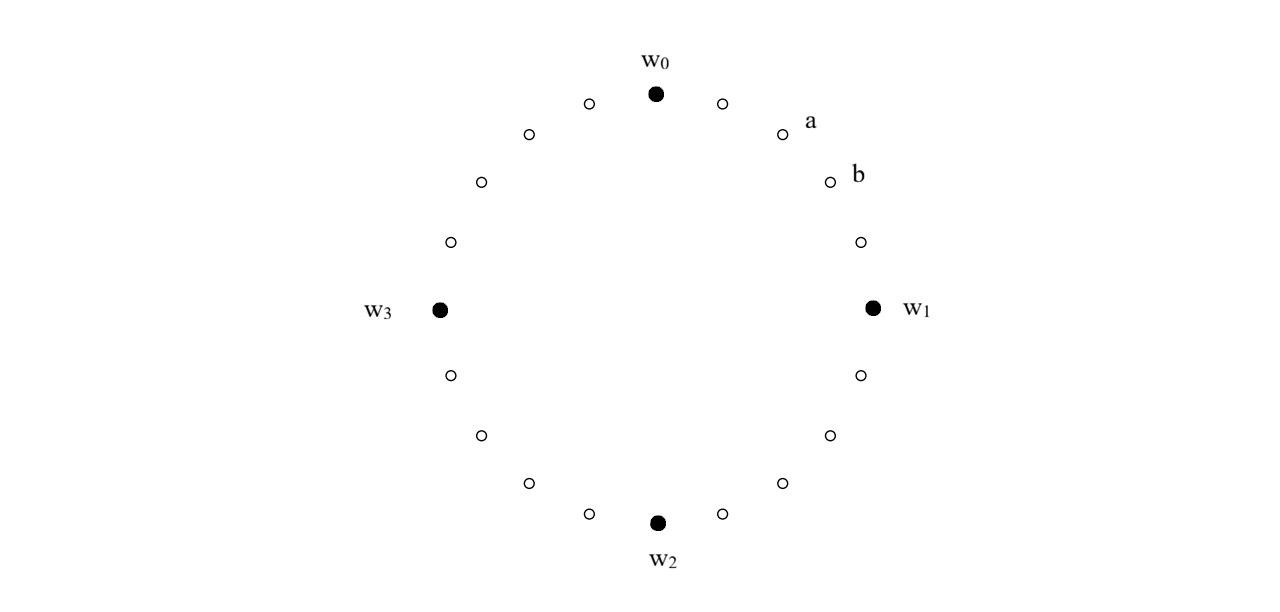
Proof. For \(n=8k+4\), taking \(k=2\) gives \(n=20\). From Theorem 2.4 and Remark 2.5, it follows that an independent resolving set for \(C_{20}(1, 2, 3, 4)\), if it exists, has cardinality at least \(4\). Further, it can be verified that, no set of \(5\) or more vertices is independent in \(C_{20}(1, 2, 3, 4)\). Hence, it suffices to examine only the independent sets having cardinality \(4\). Consider an arbitrary independent set \(W=\{w_0, w_1, w_2, w_3\} \subset V(C_{20}(1,2,3,4))\). The elements in \(W\) are indexed according to their cyclic order so that \(w_0<w_1<w_2<w_3\). Figure 2 illustrates the unique way, up to symmetry, to choose any independent set \(W\) from the graph. Note that the circular distance between each pair \((w_i, w_{i+1})\) is exactly \(5\), where the vertex indices are to be interpreted modulo \(4\). Consider the vertices \(a=w_0+2\) and \(b=w_0+3\) (taken modulo \(20\)). It can be verified that \(r(a|W)=r(b|W)=(1,1,2,2)\). Similarly, we have \(r(w_1+2|W)=r(w_1+3W)\), \(r(w_2+2|W)=r(w_2+3|W)\) and \(r(w_3+2|W)=r(w_3+3|W)\). Therefore, no independent resolving set of cardinality \(4\) exists in \(C_{20}(1,2,3,4)\). Hence, \(idim(C_n(1,2,3,4))\) is not defined when \(n=20\). ◻
Lemma 5.2. For the circulant graph \(G=C_{26}(1,2,3,4)\), \(idim(G)\) is not defined.
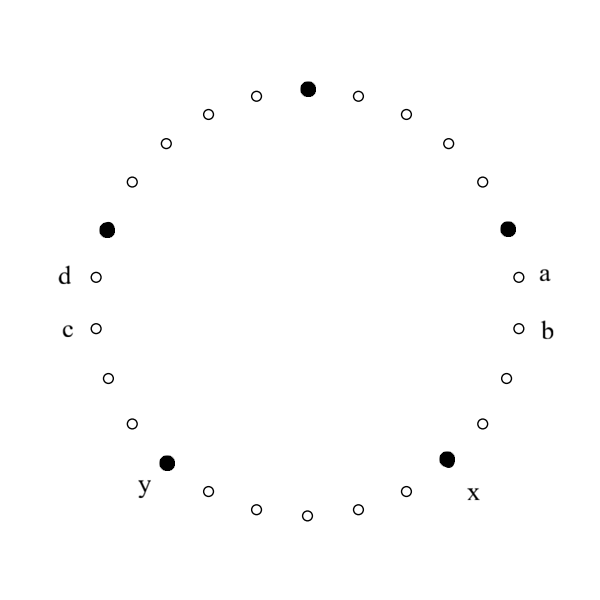
Proof. When \(n=8k+2\), taking \(k=3\) we obtain \(n=26\). Using Theorem 2.4 and Remark 2.5, it follows that an independent resolving set for \(C_{26}(1, 2, 3, 4)\), if it exists, has cardinality at least \(5\). Also, no set of \(6\) or more vertices is independent in \(C_{26}(1, 2, 3, 4)\). Thus, in this case, we consider only the independent sets having cardinality \(5\). Let \(W=\{w_0, w_1, w_2, w_3, w_4\}\) be an independent set in \(C_{26}(1, 2, 3, 4)\). Assume that the elements in \(W\) are indexed according to their cyclic order. Figure 3 shows the unique way(up to symmetry) to choose an independent set of cardinality \(5\) from \(C_{26}(1, 2, 3, 4)\). Among the vertex pairs \((w_i, w_{i+1})\), precisely one pair, say \((x, y)\), has circular distance \(6\), while all remaining pairs have circular distance \(5\). Consider the vertices \(a=x-4\), \(b=x-3\), \(c=y+3\), \(d=y+4\) (taken modulo \(n\)). It can be verified that \(r(a|W)=r(b|W)\) and \(r(c|W)=r(d|W)\). Therefore, no independent set of cardinality \(5\) can resolve the vertices of \(C_{26}(1, 2, 3, 4)\). Hence \(idim(C_{26}(1, 2, 3,4))\) is not defined. ◻
Lemma 5.3. For the circulant graph \(G=C_{31}(1,2,3,4)\), \(idim(G)\) is not defined.
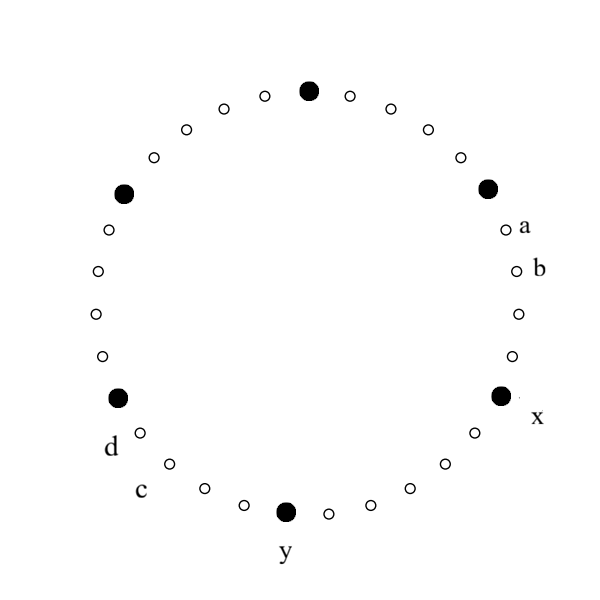
Proof. For \(n=8k+7\), \(k=3\) implies \(n=31\). From Theorem 2.4 and Remark 2.5, it follows that an independent resolving set for \(C_{31}(1, 2, 3, 4)\), if it exists, has cardinality at least \(6\). Consider an independent set \(W=\{w_0, w_1, w_2, w_3, w_4, w_5\}\) of cardinality \(6\) in \(C_{31}(1, 2, 3, 4)\). Assume that the elements in \(W\) are indexed according to their cyclic order. As shown in Figure 4, there is only one possible choice (up to symmetry) for choosing an independent set of cardinality \(6\) from \(C_{31}(1, 2, 3, 4)\). Among the vertex pairs \((w_i, w_{i+1})\), there is exactly one pair say \((x, y)\) with circular distance \(6\). All remaining pairs have circular distance \(5\). It can be verified that the vertices \(a=x-4\) and \(b=x-3\) (taken modulo 31) are not resolved by \(W\). Similarly, the vertices \(c=y+3\) and \(d=y+4\) also have same representation with respect to \(W\). Further, since no set of \(7\) or more vertices is independent in \(C_{31}(1, 2, 3, 4)\), we can conclude that \(idim(C_{31}(1, 2, 3, 4))\) is not defined. ◻
Theorem 5.4. For circulant graphs \(C_{n}(1, 2, 3, 4)\), \[idim(C_{n}(1, 2, 3, 4))=\begin{cases} 6 &\text{for } n \equiv 0, 1, 7 \pmod {8} \text{ and } n\geq 32,\\ 5 &\text{for } n \equiv 2, 3, 5, 6 \pmod {8} \text{ and } n\geq 27, \\ 4 &\text{for } n \equiv 4 \pmod {8} \text{ and } n\geq 28.\\ \end{cases}\]
Proof. Let \(G =C_{n}(1, 2, 3, 4 )\). By identifying an appropriate independent basis for \(G\), we show that \(idim(G)\leq 6\) when \(n \equiv 0, 1, 7 \pmod {8}\), \(idim(G)\leq 5\) when \(n \equiv 2, 3, 5, 6 \pmod {8}\) and \(idim(G)\leq 4\) when \(n \equiv 4 \pmod {8}\). The result then follows from Theorem 2.4 and Remark 2.5.
Case 1. \(n \equiv 2 \pmod {8}\)
Let \(n=8k+2\), where \(k\) is some positive integer. Theorem 2.4 implies that for \(n=8k+2\), an independent resolving set \(W\), if it exists, has cardinality at least \(5\). For this, \(G\) must contain at least \(25\) vertices, hence \(idim(G)\) is not defined when \(k=1\) and \(k=2\). The case when \(k=3\) is demonstrated using lemma 5.2. Assume that, \(k \geq 4\). Consider the set \(W=\{n-10, n-5, 0, 5, 10\}\subset V(G)\). Since, the circular distance between each pair exceeds 4, it follows that \(W\) is independent. It remains to prove that \(W\) is a resolving set for \(G\). Consider \(0 \in W\). First, we identify the vertices that are resolved by \(0\). The vertex \(4k+1\), being the only vertex having distance \(k+1\) from \(0\), admits a unique representation with respect to \(W\). Now, consider the remaining vertices. Let \(S= V(G)\setminus\{0, 4k+1\}= \{\pm1, \pm2, \dots, \pm4k\}\). The vertices in \(S\) may be represented using the parametrization \(\pm (4q+r)\), where \(q \in \{0, 1, \dots, k-1\}\) and \(r\in \{1, 2, 3, 4\}\). Let \(x, y \in S\) be given by \(x= \pm(4q_1+r_1)\) and \(y= \pm(4q_2+r_2)\), where \(q_1, q_2 \in \{0, 1, \dots, k-1\}\) and \(r_1, r_2 \in \{1, 2, 3, 4\}\). If \(q_1 \neq q_2\), then \(0\) resolves \(x\) and \(y\), since \(d(x, 0)=q_1+1\) and \(d(y, 0)=q_2+1\). For \(q_1 =q_2=q\), we examine the following cases.
\(x=4q+r_1\) and \(y=4q+r_2\), where \(q \in \{0, 1,\dots, k-1\}\) and \(r_1, r_2 \in \{1, 2, 3, 4\}\).
Assume that \(x<y\). For each vertex \(x\), we consider all possible vertices \(y\), with \(x < y\) and in each case identify the corresponding vertex \(w \in W\) such that \(d(x, w) \neq d(y, w)\). \[\begin{aligned} \text{When } q=0 \text{ or }1, \quad x=4q+1 &\implies d(x,10)= 3-q, \ d(y, 10)= 2-q,\\ x=4q+2 &\implies d(x, n-10) = q+3, \ d(y, n-10)= q+4,\\ x=4q+3 &\implies d(x, n-5) =q+2, \ d(y,n-5)= q+3. \end{aligned}\] \[\begin{aligned} \text{When } q=k-1,\quad x=4q+1 & \implies d(x, 5) = k-2 , \ d(y,5)= k-1,\\ x=4q+2 & \implies d(x, 10 ) = k-3 , \ d(y, 10)= k-2,\\ x=4q+3 & \implies d(x, n-10 ) = k-1, \ d(y, n-10)= k-2. \end{aligned}\] \[\begin{aligned} \text{When } 2\leq q \leq k-2, \quad x=4q+1 & \implies d(x, 5)=q-1,\ d(y, 5)=q,\\ x=4q+2 & \implies d(x,10) =q-2,\ d(y, 10)= q-1,\\ x=4q+3 & \implies d(x, n-5) = q+2,\ d(y, n-5)= q+3. \end{aligned}\]
\(x=-(4q+r_1)\) and \(y=-(4q+r_2)\), where \(q \in \{0, 1, \dots, k-1\}\) and \(r_1, r_2 \in \{1, 2, 3, 4\}\).
By symmetry \(( x \mapsto -x)\), it follows that for \(a, b \in \{1, 2, \dots, 4k\}\) \[\begin{aligned} d(a, 5)\neq\ d(b,5 ) &\implies d(-a, n-5)\neq\ d(-b, n-5 ), \\ d(a,n-5 )\neq\ d(b,n-5 ) &\implies d(-a, 5)\neq\ d(-b, 5 ), \\ d(a, 10)\neq\ d(b,10 ) &\implies d(-a, n-10)\neq\ d(-b, n-10 ), \\ d(a,n-10)\neq\ d(b,n-10 ) &\implies d(-a, 10)\neq\ d(-b, 10 ), \\ d(a, 0)\neq\ d(b,0 ) &\implies d(-a, 0)\neq\ d(-b, 0 ). \end{aligned}\]
Therefore, the vertices \(-(4q+r_1)\) and \(-(4q+r_2)\), \(q \in \{0, 1, \dots, k-1\}\) and \(r_1, r_2 \in \{1, 2, 3, 4\}\) are also resolved by some \(w \in W.\)
\(x=4q+r_1\) and \(y=-(4q+r_2)\), where \(q \in \{0, 1, \dots, k-1\}\) and \(r_1, r_2 \in \{1, 2, 3, 4\}\). \[\begin{aligned} x=r_1, \ q=0 & \implies d(x, 5 )=1,\ d(y, 5) \in \{2, 3\},\\ x=4q+r_1, \ q=k-1 & \implies d(x, 5)\in \{k-2, k-1\},\ d(y,5) = \ k,\\ x=4q+r_1, \ 1 \leq q \leq k-2 &\implies d(x, 5) \in \{q-1, q\}, \ d(y, 5)\in\{q+2, q+3\}. \end{aligned}\]
Case 2. \(n \equiv 5 \pmod {8}\)
Let \(n=8k+5\), where \(k\) is some positive integer. According to Theorem 2.4, if an independent resolving set exists, it has cardinality at least \(5\). For \(k=1\) and \(k=2\), it can be verified that, no set of \(5\) or more vertices is independent. Hence, \(idim(G)\) is not defined when \(k=1\) and \(k=2\). Assume that \(k \geq 3\). In this case, we prove that the independent set \(W=\{n-10, n-5, 0, 5, 10\}\subset V(G)\) is a resolving set for \(G\). Consider \(0 \in W\). We partition \(V(G) \setminus \{0\}\) into two subsets \(S\) and \(D\) given by \(S=\{\pm 1, \pm 2, \dots, \pm 4k\}\) and \(D= \{4k+1, 4k+2, 4k+3, 4k+4\}\), where \(D\) consists of all vertices having distance \(k+1\) from \(0\). Therefore, no vertex in \(D\) shares the same representation as any vertex in \(S\). Also, from the representions listed below it is clear that the vertices in \(D\) are pairwise resolved by some \(w \in W\).
$$r(4k+1|W)=(k-1, k, k+1, k-1, k-2),\, r(4k+2|W)=(k-1, k, k+1, k, k-2)$$ $$r(4k+3|W)=(k-2, k, k+1, k, k-1), \, r(4k+4|W)=(k-2, k-1, k+1, k, k-1)$$Thus, each vertex in \(D\) has a unique representation with respect to \(W\). Next, we consider the elements in \(S\). Let \(x= \pm(4q_1+r_1)\) and \(y= \pm(4q_2+r_2)\), where \(q_1, q_2 \in \{0, 1, \dots, k-1\}\) and \(r_1, r_2 \in \{1, 2, 3, 4\}\). If \(q_1 \neq q_2,\) then \(x\) and \(y\) are resolved by the vertex \(0\). For \(q_1 = q_2 = q\), with \(0 \leq q \leq k-2\), the vertices \(x=4q+r_1\) and \(y=4q+r_2\), \(r_1, r_2 \in \{1, 2, 3, 4\}\) are resolved as in Case 1. When \(q =k-1\), the vertices \(x=4q+r_1\) and \(y=4q+r_2\), where \(r_1, r_2 \in \{1, 2, 3, 4\}\) are resolved as follows: \[\begin{aligned} x=4q+1 & \implies d(x, 5)=k-2, \ d(y, 5)=k-1,\\ x=4q+2 & \implies d(x, 10)=k-3,\ d(y, 10)=k-2,\\ x=4q+3 & \implies d(x, n-5)=k+1, \ d(y, n-5)=k. \end{aligned}\]
Hence, the vertices \(x=4q+r_1\) and \(y=4q+r_2\), \(0 \leq q \leq k-1\), \(r_1, r_2 \in \{1, 2, 3, 4\}\) are resolved by some \(w \in W\). By symmetry (the map \(x \mapsto -x\)), it follows that the vertices \(-x=-(4q+r_1)\) and \(-y=-(4q+r_2)\), \(0 \leq q \leq k-1\), \(r_1, r_2 \in \{1, 2, 3, 4\}\) are also resolved by some \(w \in W\). Further, if \(x=4q+r_1\) and \(y=-(4q+r_2)\), \(0 \leq q \leq k-1\), \(r_1, r_2 \in \{1, 2, 3, 4\}\) then, \[\begin{aligned} q=0 & \implies d(x, 5)=1, (y, 5)\in\{2, 3\},\\ q=k-1 & \implies d(x, 5) \in \{k-2, k-1\}, \ d(y, 5) \in \{k, k+1\},\\ 1\leq q \leq k-2 & \implies d(x, 5) \in \{q-1, q\}, \ d(y, 5) \in \{q+2, q+3\}. \end{aligned}\]
Thus, we have shown that each pair \(x, y \in V(G) \setminus W\) is resolved by some \(w \in W.\) Therefore, \(W\) is a resolving set for \(G\) and we have \(idim(G) \leq 5.\)
Case 3. \(n \equiv 6 \pmod {8}\)
In this case, we can write \(n=8k+6\), where \(k\) is some positive integer. From Theorem 2.4 and Remark 2.5, it follows that \(idim(G) \geq 5\), provided \(idim(G)\) is defined. For \(n=8k+6\), an independent set of cardinality at least \(5\) exists in \(G\), only if \(n \geq 30\). Therefore, \(idim(G)\) is not defined when \(k=1\) and \(k=0\). Further, it can be verified that, when \(k=3\) the set \(W=\{0, 5, 12, 19, 24\}\) is an independent resolving set for \(C_{30}(1, 2, 3,4)\). Thus, we have \(idim(G) \leq 5\), when \(n=30\). Assume that \(k \geq 4\). Here, we prove that the independent set \(W=\{n-10, n-5, 0, 5, 10\}\) is a resolving set for \(G\). Consider the partition of \(V(G) \setminus \{0\}\) into disjoint subsets \(S\) and \(D\), defined by \(S =\{\pm1, \pm 2, \dots, \pm4k\}\) and \(D= \{4k+1, 4k+2, 4k+3, 4k+4, 4k+5\}\). Note that \(D\) consists of all vertices whose distance from \(0\) equals \(k+1\). Further, from the representations listed below, it is evident that these vertices are pairwise resolved by some \(w \in W\).
Therefore, vertices in \(D\) admit unique representation with respect to \(W\). Next, we consider the set \(S\). Let \(x, y \in S\) be represented by \(x=\pm(4q_1+r_1)\) and \(y=\pm(4q_2+r_2)\), where \(q_1, q_2 \in \{0, 1, \dots, k-1\}\) and \(r_1, r_2 \in \{1, 2, 3, 4\}\). If \(q_1 \neq q_2\), then \(d(x, 0)\neq d(y, 0)\). When \(q_1 = q_2=q\), the pairs of vertices \(x=4q+r_1\), \(y=4q+r_2\) and \(-x=-(4q+r_1)\), \(-y=-(4q+r_2)\), where \(q \in \{0, 1, \dots, k-1\}\), \(r_1, r_2 \in \{1, 2, 3, 4\}\) are resolved as in case 1. Now, consider the case where \(x=4q+r_1\) and \(y=-(4q+r_2)\), \(q \in \{0, 1, \dots, k-1\}\) and \(r_1, r_2 \in \{1, 2, 3, 4\}\) \[\begin{aligned} q=0 & \implies d(x, 5)=1, (y, 5)\in\{2, 3\},\\ q=k-1 & \implies d(x, 5) \in \{k-2, k-1\}, \ d(y, 5)=k+1,\\ 1\leq q \leq k-2 & \implies d(x, 5) \in \{q-1, q\}, \ d(y, 5) \in \{q+2, q+3\}. \end{aligned}\]
Therefore, \(W\) resolves every pair of vertices in \(G\) and hence for \(n=8k+6\), \(k \geq 3\) we have \(idim(G) \leq 5.\)
Case 4. \(n \equiv 7 \pmod {8}\)
Take \(n=8k+7\), where \(k\) is some positive integer. From Theorem
2.4, it follows that \(idim (G) \geq 6\), provided \(idim(G)\) is defined. It can be verified
that when \(k=1\) or \(k=2\), no set of \(6\) or more vertices is independent in
\(G\). Therefore, \(idim(G)\) is not defined when \(k=1\) and \(k=2\). Further, Lemma 5.3 shows
that \(idim(G)\) is not defined when
\(k=3\). Assume that \(k \geq 4\). Consider the set \(W=\{n-10, n-5, 0, 5, 10, 15\}\). Since
\(n \geq 39\), the circular distance
between every pair of vertices in \(W\)
exceeds \(4\). Hence, \(W\) forms an independent set. It remains to
prove that \(W\) is a resolving set for
\(G\). Consider \(0 \in W\). Let \(V(G)\setminus \{0\}=S\cup D\), where \(S=\{\pm1, \pm 2, \dots, \pm4k\}\) and \(D= \{4k+1, 4k+2, 4k+3, 4k+4, 4k+5,
4k+6\}\). Observe that the vertices in \(D\) are the only ones at distance \(k+1\) from \(0\). Further, from the representations
listed below, it is clear that these vertices are pairwise resolved by
some \(w \in W\).
\(r(4k+1|W)=(k-1, k+1, k+1, k-1, k-2,
k-3)\),
\(r(4k+2|W)=(k-1, k, k+1, k, k-2,
k-3)\),
\(r(4k+3|W)=(k-1, k, k+1, k, k-1,
k-3)\),
\(r(4k+4|W)=(k-1, k, k+1, k, k-1,
k-2)\),
\(r(4k+5|W)=(k-2, k, k+1, k, k-1,
k-2)\),
\(r(4k+6|W)=(k-2, k-1, k+1, k+1, k-1,
k-2)\).
Therefore, each vertex in \(D\) has a unique representation with respect to \(W\). It remains to show that each pair \((x, y)\in S\) is resolved by some \(w \in W\). Let \(x, y \in S\) be given by \(x=\pm(4q_1+r_1)\) and \(y=\pm(4q_2+r_2)\), where \(q_1, q_2 \in \{0, 1, \dots, k-1\}\) and \(r_1, r_2 \in \{1, 2, 3, 4\}\). If \(q_1 \neq q_2\), then \(0\) resolves \(x\) and \(y\). Assume that \(q_1 = q_2=q\). We consider the following cases:
\(x=4q+r_1\) and \(y=4q+r_2\), where \(q \in \{0, 1, \dots, k-1\}\) and \(r_1, r_2 \in \{1, 2, 3, 4\}\)
For \(0\leq q \leq k-2\), the vertices
\(x=4q+r_1\) and \(y=4q+r_2\) with \(x<y\) are resolved as in case 1. \[\begin{aligned}
\text{When } q=k-1,\quad x=4q+1 & \implies d(x, 5) =
k-2 , \ d(y,5)= k-1,\\
x=4q+2 & \implies d(x, 10 ) = k-3 , \ d(y, 10)= k-2,\\
x=4q+3 & \implies d(x, 15) = k-4, \ d(y, 15)= k-3.
\end{aligned}\]
Note that when \(x=4(k-1)+3\) and \(y=4(k-1)+4\) none of the vertices \(5\), \(10\), \(n-5\) or \(n-10\) resolves the pair \((x, y).\)
\(x=-(4q+r_1)\) and \(y=-(4q+r_2)\), where \(q \in \{0, 1, \dots, k-1\}\) and \(r_1, r_2 \in \{1, 2, 3, 4\}\)
If \(x=-(4q+r_1)\) and \(y=-(4q+r_2)\) with \(0 \leq q \leq k-2\), then \(x\) and \(y\) are resolved as in case 1. \[\begin{aligned}
\text{When } q=k-1,\quad x=-(4q+1) & \implies d(x,
n-5) = k-2 , \ d(y,n-5)= k-1,\\
x=-(4q+2) & \implies d(x, n-10 ) = k-3 , \ d(y, n-10)=
k-2,\\
x=-(4q+3) & \implies d(x, 15) = k-1, \ d(y, 15)= k-2.
\end{aligned}\]
When \(x=-(4(k-1)+3)\) and \(y=-(4(k-1)+4)\) none of the vertices \(5\), \(10\), \(n-5\) or \(n-10\) resolves the pair \((x, y).\)
\(x=4q+r_1\) and \(y=-(4q+r_2)\), where \(q \in \{0, 1, \dots, k-1\}\) and \(r_1, r_2 \in \{1, 2, 3, 4\}\) \[\begin{aligned} x=4q+r_1, \ q=0 & \implies d(x, 5 )=1,\ d(y, 5) \in \{2, 3\},\\ x=4q+r_1, \ q=k-1 & \implies d(x, 5)\in \{k-2, k-1\},\ d(y,5) = \ k+1,\\ x=4q+r_1, \ 1 \leq q \leq k-2 &\implies d(x, 5) \in \{q-1, q\}, \ d(y, 5)\in\{q+2, q+3\}. \end{aligned}\]
Case 5. \(n \equiv 0 \pmod {8}\)
Here, we consider \(n=8k\), where \(k\) is some positive integer. Theorem 2.4 implies that when \(n=8k\), \(idim(G) \geq 6\), provided \(idim(G)\) is defined. An independent set of cardinality at least \(6\) exists in \(G\) only if \(n \geq 32\). Therefore, we assume that \(k \geq 4\). Let \(W = \{n-5, 0, 5, \frac{n}{2}-5, \frac{n}{2}, \frac{n}{2}+5\}\). Since \(n \geq 32\), the circular distance between every pair of vertices in \(W\) exceeds 4. Therefore, the set \(W\) is independent in \(G\). Define \(S=\{\pm1, \pm 2, \dots, \pm 4(k-1)\}\) and \(D=\{4k-3, 4k-2, 4k-1, 4k, 4k+1, 4k+2, 4k+3\}\). Clearly, \(S \cup D = V(G)\setminus \{0\}\). From the representation vectors listed below, it can be verified that vertices in \(D\) are pairwise resolved by some \(w \in W\).
Let \(x, y \in S\) be given by \(x=\pm(4q_1+r_1)\) and \(y=\pm(4q_2+r_2)\) where \(q_1, q_2 \in \{0, 1, \dots, k-2\}\) and \(r_1, r_2 \in \{1, 2, 3, 4\}\). Since, \(q_1 \neq q_2\) implies \(d(x, 0)\neq d(y, 0)\), it suffices to consider the case where \(q_1 = q_2=q\).
\(x=4q+r_1\), \(y=4q=r_2\), where \(q_1, q_2 \in \{0, 1, \dots, k-2\}\) and \(r_1, r_2 \in \{1, 2, 3, 4\}\)
Assume that \(x<y.\) Let \(a = \frac{n}{2}\). \[\begin{aligned} \text{When $q=0$}, \, x=1 &\implies d(x, a+5) = k-1, \ d(y, a+5)= k,\\ x=2 &\implies d(x, a-5) = k-1, \ d(y, a-5)= k-2,\\ x=3 &\implies d(x, n-5) =2, \ d(y, n-5)= 3.\\ \text{When $q=k-2$},\, x=4q+1 & \implies d(x, 5) = k-3 , \ d(y, 5)= k-2,\\ x=4q+2 & \implies d(x, a-5) = 1 , \ d(4q+3, a-5)=0,\\ &d(4q+4, a-5)=1,\\ & \text{while } d(4q+2, a)=2,\ d(4q+4, a)=1,\\ x=4q+3 & \implies d(x,a) = 2, \ d(y,a)=1. \end{aligned}\]
\[\begin{aligned} \text{When } 1\leq q \leq k-3, x=4q+1 & \implies d(x, 5)=q-1,\ d(y, 5)=q,\\ x=4q+2 & \implies d(x, a-5) =k-q-1,\ d(y,a-5)= k-q-2,\\ x=4q+3 & \implies d(x, a) = k-q,\ d(y, a)=k-q-1. \end{aligned}\]
\(x=-(4q+r_1)\), \(y=-(4q+r_2)\), where \(q_1, q_2 \in \{0, 1, \dots, k-2\}\) and \(r_1, r_2 \in \{1, 2, 3, 4\}\)
By symmetry (the map \(x \mapsto -x\)), it follows that for \(x_1, x_2 \in \{1, 2, \dots, 4(k-1)\}\), \[\begin{aligned} d(x_1, 5)\neq\ d(x_2,5 ) &\implies d(-x_1, n-5)\neq\ d(-x_2, n-5 ), \\ d(x_1,n-5 )\neq\ d(x_2,n-5 ) &\implies d(-x_1, 5)\neq\ d(-x_2, 5 ), \\ d(x_1, 0)\neq\ d(x_2,0 ) &\implies d(-x_1, 0)\neq\ d(-x_2, 0 ),\\ d(x_1, a-5)\neq\ d(x_2,a-5 ) &\implies d(-x_1, a+5)\neq\ d(-x_2, a+5 ), \\ d(x_1,a+5)\neq\ d(x_2, a+5) &\implies d(-x_1, a-5)\neq\ d(-x_2, a-5 ), \\ d(x_1, a)\neq\ d(x_2,a ) &\implies d(-x_1, a)\neq\ d(-x_2, a ), \end{aligned}\] where \(a =\frac{n}{2}.\)
Since \(4q+r_1\) and \(4q+r_2\) are resolved by some \(w \in W\), it follows that \(-(4q+r_1)\) and \(-(4q+r_2)\) are also resolved by some \(w \in W\).
\(x=4q+r_1\) and \(y=-(4q+r_2)\), where \(q_1, q_2 \in \{0, 1, \dots, k-2\}\) and \(r_1, r_2 \in \{1, 2, 3, 4\}\) \[\begin{aligned} q=0 & \implies d(x, 5)=1, (y, 5)\in\{2, 3\},\\ q=k-2 & \implies d(x, 5) \in \{k-2, k-3\}, \ d(y, 5) =k,\\ 1\leq q \leq k-3 & \implies d(x, 5) \in \{q-1, q\}, \ d(y, 5) \in \{q+2, q+3\}. \end{aligned}\]
Therefore, the vertices in \(S\) are also pairwise resolved by some \(w \in W\). Further, by definition no vertex in \(D\) shares the same representation as any vertex in \(S\). Hence, \(W\) resolves every pair of vertices in \(G\) and it follows that \(idim(G)\leq 6.\)
Case 6. \(n \equiv 4 \pmod {8}\)
Let \(n=8k+4,\) where \(k\) is some positive integer. It follows from Theorem 2.4 that, when \(n=8k+4\), \(idim(G)\geq 4\), provided \(idim(G)\) is defined. It can be verified that for \(k=1\), no set of \(4\) or more vertices is independent in \(G\). Hence, \(idim(G)\) is not defined in this case. Further, Lemma 5.1 shows that \(idim(G)\) does not exist when \(k=2\). Thus, we assume \(k \geq 3\). Let \(W=\{0, 6, \frac{n}{2}+2, \frac{n}{2}+8\}\). Since \(n \geq 28\), the circular distance between every pair of vertices in \(W\) exceeds \(4\). Therefore, the set \(W\) is independent. Define \(S=\{\pm 1, \pm2, \dots, \pm4k\}\) and \(D=\{4k+1, 4k+2, 4k+3\}\). Clearly, \(S \cup D = V(G) \setminus \{0\}\). From the representation vectors given by \(r(4k+1|W)=(k+1, k-1, 1, 3)\), \(r(4k+2|W)=(k+1, k-1, 1, 2)\) and \(r(4k+3|W)=(k+1, k, 1, 2)\), we observe that the vertices in \(D\) are pairwise resolved by some \(w \in W\). We now examine the elements in \(S\). Let \(x, y \in S\) be given by \(x=\pm(4q_1+r_1)\) and \(y=\pm(4q_2+r_2)\) where \(q_1, q_2 \in \{0,1, \dots, k-1\}\) and \(r_1, r_2 \in \{1, 2, 3, 4\}\). Since the vertex \(0\) resolves \(x\) and \(y\) when \(q_1 \neq q_2\), it remains to consider the case where \(q_1=q_2=q\).
\(x=4q+r_1\), \(y=4q+r_2\), where \(q \in \{0,1, \dots, k-1\}\) and \(r_1, r_2 \in \{1, 2, 3, 4\}\)
Assume that \(x<y.\) Let \(a = \frac{n}{2}\)
When \(q=0 \text{ or }1,\) \[\begin{aligned} x=4q+1 &\implies d(x,6)=2-q, \ d(y, 6)= 1-q,\\ x=4q+2 &\implies d(x,a+8) = k+q-1, \ d(y, a+8)= k+q,\\ x=4q+3 &\implies d(x,a+2) = k-q+1, \ d(y,a+2 )= k-q. \end{aligned}\]
When \(2\leq q \leq k-1\), \[\begin{aligned} x=4q+1 & \implies d(x, a+8)= k-q+3,\ d(y, a+8)=k-q+2,\\ x=4q+2 & \implies d(x, 6) = q-1,\ d(y, 6)=q,\\ x=4q+3 & \implies d(x, a+2) = k-q+1,\ d(y, a+2)= k-q. \end{aligned}\]
\(x=-(4q+r_1)\), \(y=-(4q+r_2)\), where \(q \in \{0,1, \dots, k-1\}\) and \(r_1, r_2 \in \{1, 2, 3, 4\}\)
Assume \(x>y\). Let \(a=\frac{n}{2}\)
When \(0\leq q \leq k-2,\)\[\begin{aligned} x=-(4q+1) & \implies d(x, a+8)=k-q-1,\ d(y, a+8)=k-q-2,\\ x=-(4q+2) & \implies d(x, 6 ) = q+2,\ d(y, 6)= q+3,\\ x=-(4q+3) & \implies d(x, a+2) = k-q,\ d(y, a+2 )= k-q-1. \end{aligned}\]
When \(q=k-1\),\[\begin{aligned} x=-(4q+1) & \implies d(x, 6) = k+1 , \ d(y,6)=k,\\ x=-(4q+2) & \implies d(x, a+8) = 1 , \ d(y, a+8)= 2,\\ x=-(4q+3) & \implies d(x, a+2) = 1 , \ d(y, a+2)= 0. \end{aligned}\]
\(x=4q+r_1\) and \(y=-(4q+r_2)\), where \(q \in \{0,1, \dots, k-1\}\) and \(r_1, r_2 \in \{1, 2, 3, 4\}\) \[\begin{aligned} q=0 & \implies d(x, 6) \in \{1, 2\}, (y, 6)\in\{2, 3\},\\ & \text{with } d(1, 6)=d(n-1, 6)=d(n-2, 6)=2,\\ & \text{while } d(1, a+2)=k+1, d(n-1, a+2)=d(n-2, a+2)=k.\\ q=k-1 & \implies d(x, 6) \in \{k-2, k-1\}, \ d(y, 6) \in \{k, k+1\},\\ 1\leq q \leq k-2 & \implies d(x, 6) \in \{q-1, q\}, \ d(y, 6) \in \{q+2, q+3\}. \end{aligned}\]
Thus, the vertices in \(S\) are also pairwise resolved by some \(w \in W\). Also, no vertex in \(D\) shares the same representation as any vertex in \(S\). Therefore, \(W\) is a resolving set for \(G\). Hence, \(idim(G) \leq 4\) when \(n \equiv 4 \pmod {8}\).
Case 7. \(n \equiv 3 \pmod {8}\)
Let \(n=8k+3\), where \(k\) is some positive integer. Using Theorem 2.4, we have \(idim(G)\geq 5\), when \(n \equiv 3 \pmod {8}\), provided \(idim(G)\) is defined. Observe that no set of \(5\) or more vertices is independent in \(G\), when \(k=1\) or \(k=2\). Therefore, \(idim(G)\) is not defined when \(k=1\) or \(k=2\). Assume that \(k \geq 3.\) We claim that \(W=\{n-5, 0, 5, \frac{n+1}{2}-3, \frac{n+1}{2}+2\}\) is an independent resolving set for \(G\). It can be verified that the circular distance between every pair of vertices in \(W\) exceeds \(4\), when \(n \geq 27\). Therefore, \(W\) forms an independent set. It remains to prove that \(W\) is a resolving set for \(G\). We partition \(V(G) \setminus \{0\}\) into two sets \(S\) and \(D\) defined by \(S=\{\pm 1, \pm2, \dots, \pm4k\}\) and \(D=\{4k+1, 4k+2\}\). Observe that the only vertices having distance \(k+1\) from \(0\) is \(4k+1\) and \(4k+2\). The representations of vertices in \(D\) are as follows \(r(4k+1|W)=(k, k+1, k-1, 1, 1)\), \(r(4k+2|W)=(k-1, k+1, k, 1, 1)\). Clearly, \(r(4k+1|W) \neq r(4k+2|W)\). Next, we show that the elements in \(S\) are also pairwise resolved by some \(w \in W\). Let \(x, y \in S\) be given by \(x=\pm(4q_1+r_1)\) and \(y=\pm(4q_2+r_2)\), where \(q_1, q_2 \in \{0, 1, \dots, k-1\}\) and \(r_1, r_2 \in \{1, 2, 3, 4\}\). If \(q_1 \neq q_2\), then \(x\) and \(y\) are resolved by the vertex \(0\). Suppose \(q_1=q_2=q\).
\(x=4q+r_1\), \(y=4q+r_2\), where \(q \in \{0, 1, \dots, k-1\}\) and \(r_1, r_2 \in \{1, 2, 3, 4\}\)
Assume that \(x<y\). Let \(b=\frac{n+1}{2}\).
When \(q=0,\) \[\begin{aligned} x=1,\ y\in\{2, 3\} &\implies d(x, b+2)=k, \ d(y, b+2)= k+1,\\ x=1,\ y=4 &\implies d(1, n-5)=2,\ d(4, n-5)=3,\\ x=2 &\implies d(x, b-3 ) = k, \ d(y, b-3)= k-1,\\ x=3 &\implies d(x, n-5) =2, \ d(y, n-5)=3. \end{aligned}\]
When \(q=k-1\), \[\begin{aligned} x=4q+1 & \implies d(x, 5 ) = k-2 , \ d(y, 5 )= k-1,\\ x=4q+2, y=4q+3 & \implies d(x, b-3) = 1 , \ d(y, b-3)= 0, \\ x=4q+2, y=4q+4 & \implies d(x, b-3) = d(y, b-3)= 1, \end{aligned}\] whereas \[\begin{aligned} x=4q+2, y=4q+4 & \implies d(x, b+2)=2,\ d(y, b+2)=1\\ x=4q+3 & \implies d(x, b+2) = 2 , \ d(y, b+2 )= 1. \end{aligned}\]
When \(1\leq q \leq k-2\), \[\begin{aligned} x=4q+1 & \implies d(x, 5)=q-1,\ d(y, 5)=q,\\ x=4q+2 & \implies d(x, b-3) = k-q,\ d(y, b-3)= k-q-1,\\ x=4q+3 & \implies d(x, n-5) = q+2,\ d(y, n-5)= q+3. \end{aligned}\]
\(x=-(4q+r_1)\), \(y=-(4q+r_2)\), where \(q \in \{0, 1, \dots, k-1\}\) and \(r_1, r_2 \in \{1, 2, 3, 4\}\)
Assume \(x>y\). Let \(b=\frac{n+1}{2}\).
When \(q=0,\) \[\begin{aligned} x=-1 &\implies d(x, b-3)=k, \ d(-2, b-3)=d(-3, b-3)= k+1,\\ x=-1,\ y=-4 &\implies d(x,b+2)=k,\ d(y, b+2) =k-1,\\ x=-2 &\implies d(x, b+2) = k, \ d(y, b+2)= k-1,\\ x=-3 &\implies d(x, 5) =2, \ d(y, 5)=3. \end{aligned}\]
When \(1\leq q \leq k-2\), \[\begin{aligned} % \text{When }1\leq q \leq k-2,\hspace{0.5cm}\\ x=-(4q+1) & \implies d(x, n-5)=q-1,\ d(y, n-5)=q,\\ x=-(4q+2) & \implies d(x, b+2 ) = k-q,\ d(y, b+2)= k-q-1,\\ x=-(4q+3) & \implies d(x, 5) = q+2,\ d(y, 5 )= q+3. \end{aligned}\]
When \(q=k-1\), \[\begin{aligned} x=-(4q+1) & \implies d(x, n-5) = k-2 , \ d(y,n-5)=k-1,\\ x=-(4q+2), y=-(4q+3) & \implies d(x, b+2) = 1 , \ d(y, b+2)= 0,\\ x=-(4q+2), y=-(4q+4) & \implies d(x, b-3) = 2 , \ d(y, b-3)= 1,\\ x=-(4q+3) & \implies d(x, b-3) = 2 , \ d(y, b-3)= 1. \end{aligned}\]
\(x=4q+r_1\) and \(y=-(4q+r_2)\), where \(q \in \{0, 1, \dots, k-1\}\) and \(r_1, r_2 \in \{1, 2, 3, 4\}\) \[\begin{aligned} q=0 & \implies d(x, 5)=1, (y, 5)\in\{2, 3\},\\ q=k-1 & \implies d(x, 5) \in \{k-1, k-2\}, \ d(y, 5)\in \{k+1, k\}, \\ 1\leq q \leq k-2 & \implies d(x, 5) \in \{q-1, q\}, \ d(y, 5) \in \{q+2, q+3\}. \end{aligned}\]
Therefore, each pair of vertices in \(G\) is resolved by some \(w \in W\). Hence, \(W\) is a resolving set for \(G\) and we have \(idim(G)\leq 5\).
Case 8. \(n \equiv 1 \pmod {8}\)
Take \(n=8k+1,\) where \(k\) is some positive integer. From Theorem 2.4, it follows that \(idim(G)\geq6\), provided \(idim(G)\) is defined. Note that when \(k=1\), \(k=2\) or \(k=3\), no set of \(6\) or more vertices is independent in \(G\). Hence, \(idim(G)\) is not defined when \(k=1, 2\) or \(3\). Assume that \(k\geq 4\). Consider \(W=\{0, 5, 11, \frac{n-1}{2}, \frac{n-1}{2}+6, \frac{n-1}{2}+11\}\). Since, \(n \geq 33\), the circular distance between every pair of vertices in \(W\) exceeds 4 and hence \(W\) is an independent set. It remains to prove that \(W\) is a resolving set for \(G\). For this, we partition \(V(G)\setminus\{0\}\) into two sets \(S\) and \(D\) defined by \(S=\{\pm 1, \pm2, \dots, \pm4(k-1)\}\) and \(D=\{4k-3, 4k-2, 4k-1, 4k, 4k+1, 4k+2, 4k+3, 4k+4\}\). First, we examine the representations of the vertices in \(D.\)
| \(r(4k-3|W)=(k, k-2, k-3, 1, 3, 4 ),\) | \(r(4k-2|W)=(k, k-1, k-3, 1, 2, 4 ),\) | |
| \(r(4k-1|W)=(k, k-1, k-3, 1, 2, 3 ),\) | \(r(4k|W)=(k,k-1, k-2, 0, 2, 3 ),\) | |
| \(r(4k+1|W)=(k, k-1, k-2, 1, 2, 3 ),\) | \(r(4k+2|W)=(k, k, k-2, 1, 1, 3),\) | |
| \(r(4k+3|W)=(k, k, k-2, 1, 1, 2 ),\) | \(r(4k+4|W)=(k, k, k-1, 1, 1, 2 )\) |
It is clear that these vertices are pairwise resolved by some \(w \in W\). Next, we consider the elements in \(S\). Let \(x, y \in S\) be given by \(x=\pm(4q_1+r_1)\) and \(y=\pm(4q_2+r_2)\) where \(q_1, q_2 \in \{0, 1, \dots, k-1\}\) and \(r_1, r_2 \in \{1, 2, 3, 4\}\). If \(q_1 \neq q_2\), \(x\) and \(y\) are resolved by the vertex \(0\). Consider the case where \(q_1=q_2=q\).
\(x=4q+r_1\), \(y=4q+r_2\), where \(q \in \{0, 1, \dots, k-1\}\) and \(r_1, r_2 \in \{1, 2, 3, 4\}\).
Assume that \(x<y\). Let \(c=\frac{n-1}{2}\).
When \(q=0,\)\[\begin{aligned} x=1 &\implies d(x, c+6)=k-1, \ d(y, c+6)= k, \\ x=2 &\implies d(x, 11)=3,\ d(y, 11)=2,\\ x=3 &\implies d(x, c) =k, \ d(y, c)=k-1. \end{aligned}\]
When \(q=1,\) \[\begin{aligned} x=4q+1 &\implies d(x, 5)=0, \ d(y, 5)= 1, \\ x=4q+2 &\implies d(x, 11)=2,\ d(y, 11)=1,\\ x=4q+3 &\implies d(x, c) =k-1, \ d(y, c)=k-2. \end{aligned}\]
When \(q=2,\)\[\begin{aligned} x=4q+1 &\implies d(x, 5)=1, \ d(y, 5)= 2, \\ x=4q+2,\ y=4q+3 &\implies d(x, 11)=1,\ d(y, 11)=0,\\ x=4q+2,\ y=4q+4 &\implies d(x, c)=k-q,\ d(y, c)=k-q-1,\\ x=4q+3 &\implies d(x, c) =k-q, \ d(y, c)=k-q-1. \end{aligned}\]
When \(3\leq q \leq k-2\),\[\begin{aligned} x=4q+1 & \implies d(x, 5)=q-1,\ d(y, 5)=q,\\ x=4q+2 & \implies d(x, c+11) = k-q+3,\ d(y, c+11)= k-q+2,\\ x=4q+3 & \implies d(x, 11) = q-2,\ d(y, 11)= q-1. \end{aligned}\]
\(x=-(4q+r_1)\), \(y=-(4q+r_2)\), where \(q \in \{0, 1, \dots, k-1\}\) and \(r_1, r_2 \in \{1, 2, 3, 4\}\).
Assume that \(x>y\). Let \(c=\frac{n-1}{2}\).
When \(0\leq q \leq k-4\), \[\begin{aligned} x=-(4q+r_1) & \implies d(x, c+11)=k-q-2,\ d(y, c+11)=k-q-3,\\ x=-(4q+2) & \implies d(x, c+6) = k-q-1,\ d(y, c+6)= k-q-2,\\ x=-(4q+3) & \implies d(x, 5) = q+2,\ d(y, 5)= q+3. \end{aligned}\]
When \(q=k-3,\)\[\begin{aligned} x=-(4q+1), y=-(4q+2)\ &\implies d(x, c+11)=1, \ d(y, c+11)= 0, \\ x=-(4q+1), y \in\{-(4q+3), -(4q+4)\} \ &\implies d(x, c+6)=2, \ d(y, c+6)= 1, \\ x=-(4q+2) &\implies d(x, c+6)=2,\ d(y, c+6)=1,\\ x=-(4q+3) &\implies d(x, 5) =k-1, \ d(y, 5)=k. \end{aligned}\]
When \(q=k-2,\)\[\begin{aligned} x=-(4q+1) &\implies d(x, 11)=k, \ d(y, 11)= k-1, \\ x=-(4q+2),\ y=-(4q+3) &\implies d(x, c+11)=1,\ d(y, c+11)=2,\\ x=-(4q+3) &\implies d(x, c+6) =0, \ d(y, c+6)=1. \end{aligned}\]
\(x=4q+r_1\) and \(y=-(4q+r_2)\), where \(q \in \{0, 1, \dots, k-1\}\) and \(r_1, r_2 \in \{1, 2, 3, 4\}\). \[\begin{aligned} q=0 & \implies d(x, 5)=1, (y, 5)\in\{2, 3\},\\ q=k-2 & \implies d(x, 5) \in \{k-2, k-3\}, \ d(y, 5)=k, \\ 1\leq q \leq k-3 & \implies d(x, 5) \in \{q-1, q\}, \ d(y, 5) \in \{q+2, q+3\}. \end{aligned}\]
Thus, vertices in \(S\) are also pairwise resolved by some \(w \in W\). Further, no vertex in \(S\) shares the same representation as any vertex in \(D\). Therefore, \(W\) is a resolving set for \(G\). Hence \(idim(G) \leq 6\), when \(n \equiv 1\pmod{8}\). ◻
In this paper, we have obtained the independent metric dimension of the circulant graphs \(C_{n}(1, 2)\), \(C_{n}(1, 2, 3)\), \(C_{n}(1, 2, 3, 4)\) for sufficiently large \(n\). There is further scope for exploring the independent metric dimension of \(C_{n}(1,2,\dots, t)\), \(t \geq 5\). Further, we have shown that \(dim(C_n (1, 2)) = idim(C_n (1, 2))\), \(dim(C_n (1, 2, 3)) = idim(C_n (1, 2, 3))\) and \(dim(C_n (1, 2,3,4)) = idim(C_n (1, 2, 3, 4))\), provided independent resolving set exists. The extension of this result to the graphs \(C_n (1, 2, \dots, t)\) remains open.