
Circulant digraphs form a central class of Cayley digraphs on cyclic groups and have been extensively studied due to their rich algebraic structure and wide applicability in areas such as communication networks, parallel architectures, and combinatorial optimization. Their vertex-transitivity and regularity make them natural candidates for addressing extremal problems, most notably the degree/diameter problem, which seeks the largest possible number of vertices in a graph or digraph with given maximum degree and diameter (see Bermond, Delorme, and Quisquater [1], and the comprehensive survey by Miller and Širáň [3]).
A classical approach to studying distance-related properties in such graphs relies on embedding them into geometric structures. In particular, the representation of circulant digraphs by means of plane tessellations has proved to be a powerful tool to analyze distances, diameters, and shortest paths. This methodology, which can be traced back to the work of Wong and Coppersmith [6], was further developed in a series of papers by Morillo, Fiol, and Fàbrega [5], Morillo, Comellas, and Fiol [4], and Yebra, Fiol, Morillo, and Alegre [7]. In these papers, optimal constructions for families of graphs associated with planar tilings were obtained. These techniques provide both an intuitive geometric interpretation and an effective combinatorial framework for obtaining extremal results.
Let \(CD(N,a,b)\) denote the circulant digraph with vertex set \(\mathbb{Z}_N\) and generating set \(\{a,b\}\). Such digraphs are regular of degree two and vertex-transitive, and their (strongly) connectivity is determined by the condition \(\gcd(N,a,b)=1\). Traditionally, distances in \(CD(N,a,b)\) are defined by directed paths using only the generators \(a\) and \(b\). However, this standard notion does not exhaust all possible combinatorial structures that can arise from such generating sets.
In this paper, we introduce and investigate a new infinite family of circulant digraphs, which we call three-quarters digraphs. These digraphs are defined by allowing paths that use combinations of steps of the form \((+a,+b)\), \((+a,-b)\), and \((-a,+b)\). This modification induces a non-standard distance function that differs significantly from the classical directed distance. As a consequence, the resulting metric structure exhibits new geometric and combinatorial features that are not present in the usual circulant setting.
One of the main advantages of this model is that the vertices reachable from a fixed origin can be arranged in a planar pattern that resembles a discrete tessellation. In this representation, the number of vertices at distance exactly \(\ell\) grows linearly as \(3\ell+1\), leading to cumulative counts of the form \(1,5,12,22,\dots\). This observation enables us to derive upper bounds on the number of vertices attainable for a given diameter \(k\). However, unlike in previously studied cases, these optimal patterns do not always extend to valid digraphs, since the corresponding tiles fail to tessellate the plane periodically. This phenomenon highlights a fundamental obstruction linking combinatorial optimality with geometric feasibility.
To overcome this difficulty, we adopt a lattice-based approach inspired by earlier work on plane tessellations [5, 4]. By identifying suitable translation vectors that generate periodic tilings, we derive systems of linear equations whose solutions yield admissible pairs of generators \(a\) and \(b\). This approach allows us to construct infinite families of three-quarters digraphs and to distinguish between the cases of even and odd diameter. In particular, explicit formulas for the parameters are obtained by solving these systems over the integers, thereby providing constructive solutions to the degree/diameter problem within this framework.
The study of three-quarters digraphs thus combines algebraic, geometric, and combinatorial techniques. It contributes to the broader understanding of how modifications to path structures affect metric properties in Cayley digraphs and reveals new connections among planar tessellations, lattice theory, and extremal graph constructions. Moreover, these results complement previous work on circulant and related digraphs (see, for instance, Wong and Coppersmith [6],Morillo, Fiol, and Fàbrega [5] and Esqué, Aguiló and Fiol [2]), and may have further implications for the design of efficient interconnection networks and routing schemes.
The paper is organized as follows. In Section 2, we formally define three-quarters digraphs and describe their planar representation. We then analyze their distance structure and derive bounds on their diameter and order. Finally, we present constructive methods and computational results that illustrate the theoretical findings.
A digraph is defined as an ordered pair \(G=(V,A)\), where \(V\) is a non-empty set of objects called vertices, and \(A\) is a set of ordered pairs of vertices called arcs (or directed edges). A directed path in a digraph is a sequence of vertices where every adjacent pair is connected by a directed edge pointing from the first vertex to the second.
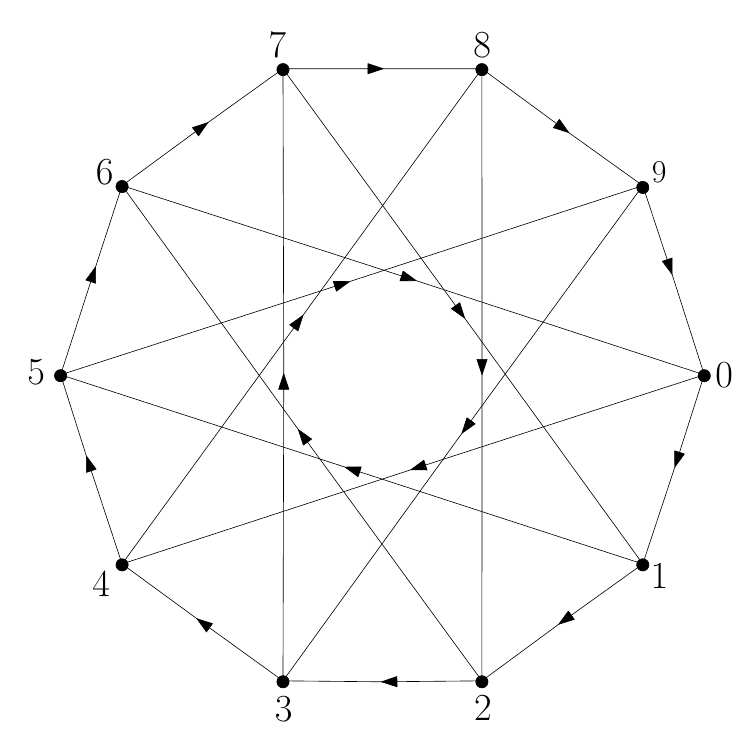
The circulant digraph \(CD(N,a,b)\) is the Cayley digraph on \(\mathbb Z_N\) with generating set \(a,b\). Then, its \(N\) vertices are identified with the integers modulo \(N\), and each vertex \(i\) is connected to the vertices \(i+a \ (\textrm{mod }N)\) and \(i+b \ (\textrm{mod }N)\) for the integers (called steps) \(a\) and \(b\), with \(1\le a,b\le N-1\). See Figure 1 for the circulant digraph \(CD(10,1,4)\).
Some simple properties of these digraphs are the following:
P1. The digraphs \(CD(N,a,b)\) are regular of degree 2.
P2. A necessary and sufficient condition for \(CD(N,a,b)\) to be strongly connected is \(\gcd(N,a,b)=1\).
P3. The digraphs \(CD(N,a,b)\) are vertex-symmetric. Thus, the study of its diameter can be done from any arbitrary vertex, say, 0.
Instead of considering only directed paths (with steps \(a\) and \(b\)), as usual, in this paper, we allow all paths between two vertices that consist of steps \((a,b)\), \((a,-b)\), or \((-a,b)\). Thus, intuitively, the ‘distance’ between two vertices \(i,j\) is defined as the minimum number of these steps in such a path from \(i\) to \(j\), and the diameter is defined consistently. More rigorously, for \(x,y\in \mathbb Z_N\), we define \(d(x,y):=d_{TQ}(x,y)\) as the minimum integer \(\ell\geq 0\) such that \(y-x\) can be written modulo \(N\) as \[y-x \equiv ma+nb,\qquad y-x \equiv -ma+nb,\qquad \text{or}\qquad y-x \equiv ma-nb,\] for some integers \(m,n\geq 0\) with \(m+n=\ell\). Equivalently, \(d(x,y)\) is the minimum length of a word from \(x\) to \(y\) using one of the three admissible directions determined by the pairs \((+a,+b)\), \((-a,+b)\), and \((+a,-b)\). Notice that this distance is translation invariant: \[d(x,y)=d(0,y-x).\]
However, it is not necessarily symmetric, since the admissible directions do not include the pair \((-a,-b)\). Therefore, \(d\) should be understood as a sector-constrained distance, rather than as a metric in the usual undirected sense. The diameter of \(TQ(N,a,b)\) is then defined by \[k:=k(TQ(N,a,b)) = \max_{x,y\in \mathbb Z_N} d(x,y) = \max_{z\in \mathbb Z_N} d(0,z).\]
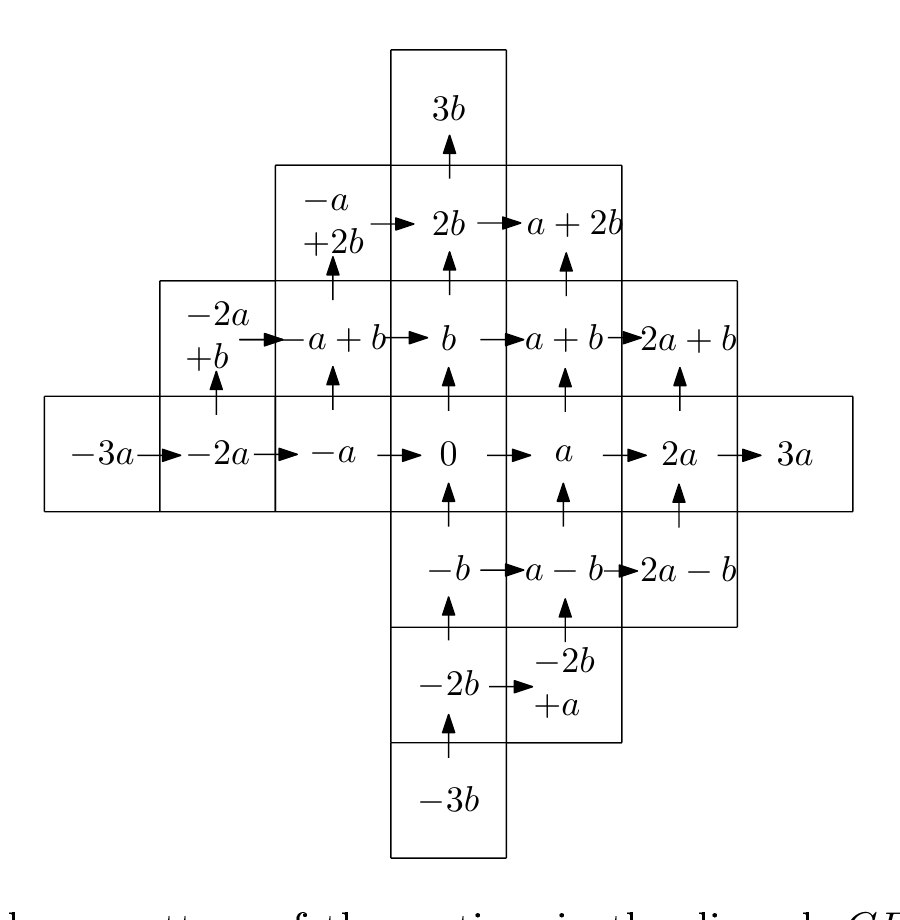
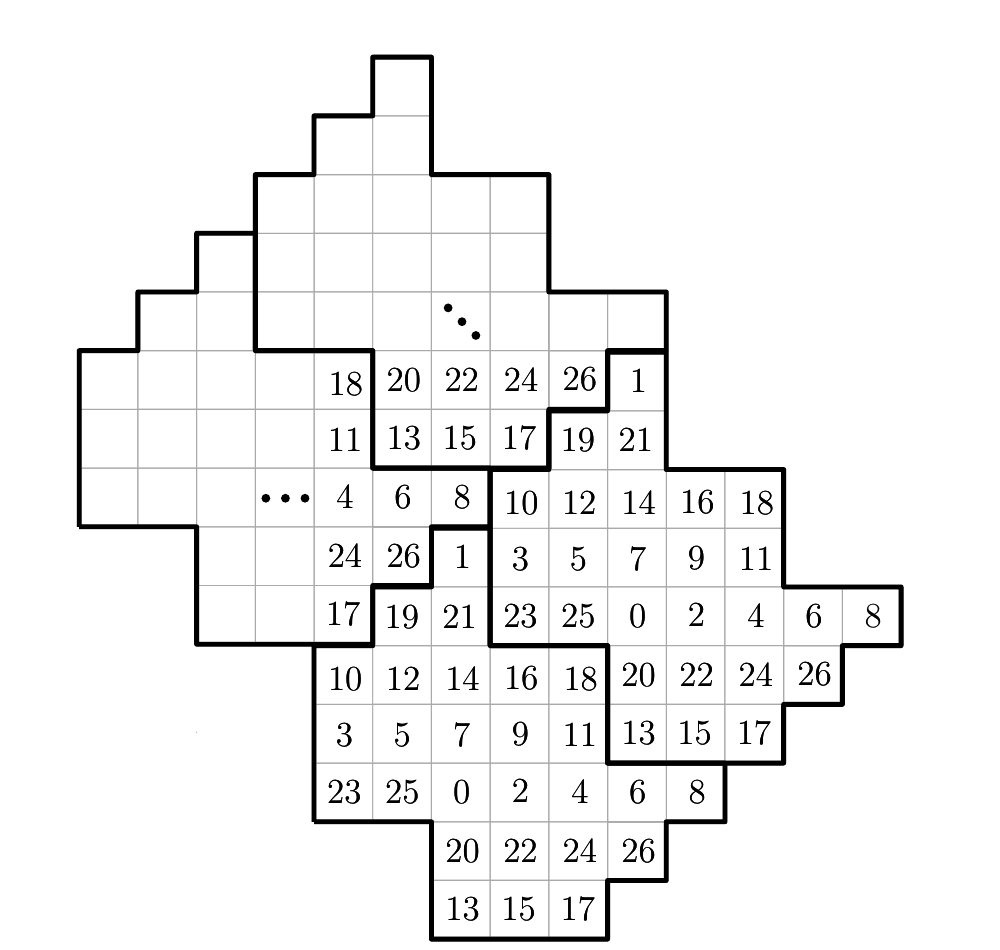
These digraphs can be represented as congruent tiles that tessellate the plane periodically. More precisely, if each vertex is represented by a numbered modulo \(N\) unit square, the vertices reached at distances \(0,1,2,\ldots\) from any given vertex can be arranged in a planar pattern, as shown in Figure 2 starting from vertex \(0\). From now on, we call these digraphs three-quarters digraphs (because only three of the four directions in the plane from a vertex 0 are admissible). Then, Figure 3 shows the distances from 0 to 4 of the different vertices and, in Figure 4, there is the plane tessellation representing the three-quarter digraph \(TQ(27,2,7)\).
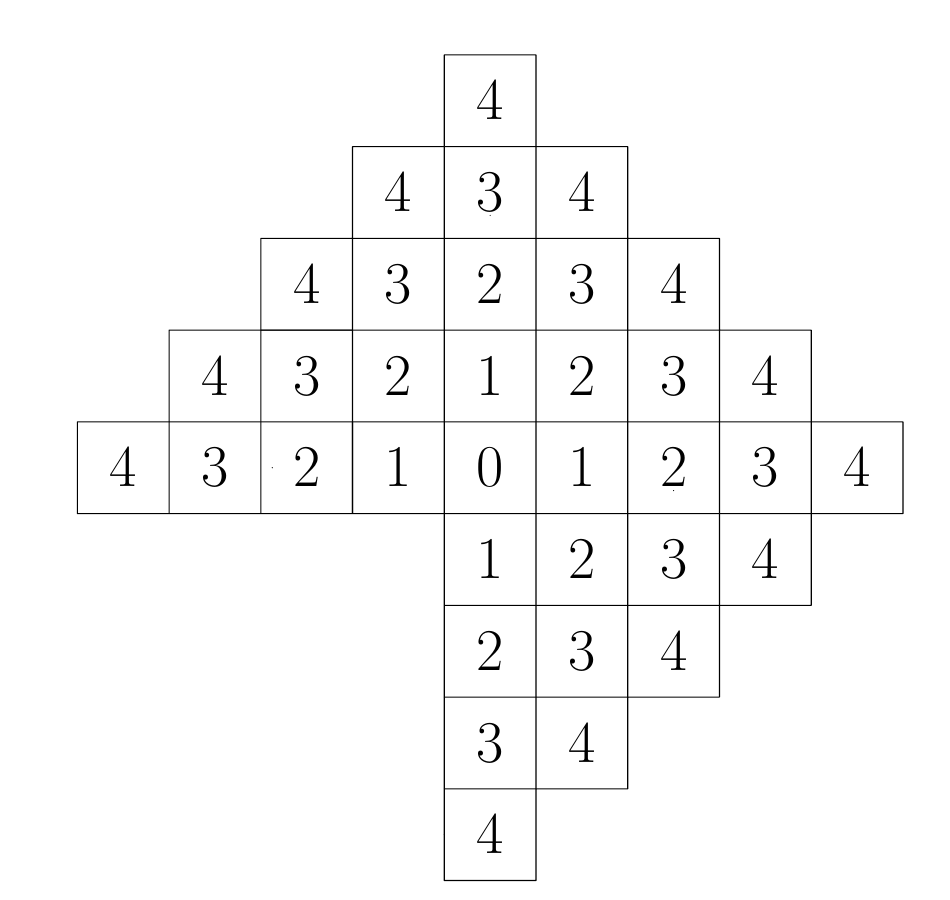
Since there are \(3\ell+1\) vertices at distance \(\ell(>0)\) from vertex \(0\), given a diameter \(k\), the number of vertices reached by exactly \(i\) steps is \(1,4,7,10,\ldots,3k+1\) (see Figure 3). Then, the maximum number of vertices of a three-quarters digraph with diameter \(k\) (ball size) would be \[N(k)=\sum_{r=0}^k(1+3r)= \frac{1}{2}\left(3k^2+5k+2\right),\tag{1}\] if all the numbers \(ma+nb\), \(-ma+nb\), and \(ma-nb\) (with \(m,n\ge 0\) and \(m+n\le k\)) were distinct modulo \(N(k)\). However, such a maximum cannot be attained for \(k>1\). The reason is that, for \(k>1\), the optimal tiles do not tessellate the plane.
The method used in [2, 5, 7] to obtain circulant digraphs with the maximum number of vertices consists of the following two steps:
(1) Using the planar pattern, find the ‘optimal tiles’ (that is, containing the maximum number of vertices for a given diameter \(k\)), and check that they periodically tessellate the plane.
(2) From the two basic translation vectors of the periodic tiling (generating the lattice of the positions of the \(0\) vertices), solve a linear system of equations to find the steps \(a\) and \(b\) satisfying P2.
In other words, the lattice construction can be described as follows. In the planar representation, moving one unit in the horizontal direction corresponds to adding \(a\), while moving one unit in the vertical direction corresponds to adding \(b\). Hence, a translation vector \((u,v)\) in the plane corresponds to the residue \[ua+vb \pmod N.\]
If two copies of the tile differ by a lattice translation, then they must represent the same vertex labels modulo \(N\). Therefore, for each translation vector \((u,v)\) of the lattice one must have \[ua+vb\equiv 0 \pmod N.\]
If the lattice is generated by two independent translation vectors \[(u_1,v_1),\qquad (u_2,v_2),\] then the generators \(a,b\) must satisfy \[u_1a+v_1b\equiv 0 \pmod N, \qquad u_2a+v_2b\equiv 0 \pmod N.\]
Equivalently, there exist integers \(\alpha,\beta\) such that \[\begin{pmatrix} u_1 & v_1\\ u_2 & v_2 \end{pmatrix} \begin{pmatrix} a\\ b \end{pmatrix} = N \begin{pmatrix} \alpha\\ \beta \end{pmatrix}.\]
The parameters \(\alpha\) and \(\beta\) record how many full periods modulo \(N\) are produced by the two fundamental lattice translations. Once the tile is fixed, the determinant \[N= \det \begin{pmatrix} u_1 & v_1\\ u_2 & v_2 \end{pmatrix},\] which is the area of the fundamental parallelogram spanned by the two lattice vectors, gives the number of distinct residue classes (labels of vertices) in one fundamental tile, see Esqué, Aguiló, and Fiol [2]. This is why the order \(N\) of the digraph is directly determined by the lattice. Solving the above linear system then yields admissible values of steps \(a\) and \(b\) provided that \(\alpha\) and \(\beta\) are chosen in such a way that \(\gcd(N,a,b)=1\). This last condition P2 assures that all the residues modulo \(N\) are obtained. Moreover, the value of the diameter \(k\) is imposed by the form of the tile (for instance, \(k=4\) if and only if the tile is a sub-tile of the one in Figure 3 containing some squares labeled with 4). Given a diameter \(k>1\), a good choice for the tiles that periodically tessellate the plane is the \(W\)-shaped tiles shaded in Figure 5 for \(k=4\) and \(k=5\). (The case \(k=1\) is trivial, giving the cross with arms of one unit). In such a figure, the vertices at the farthest distance from 0 are indicated by black dots.
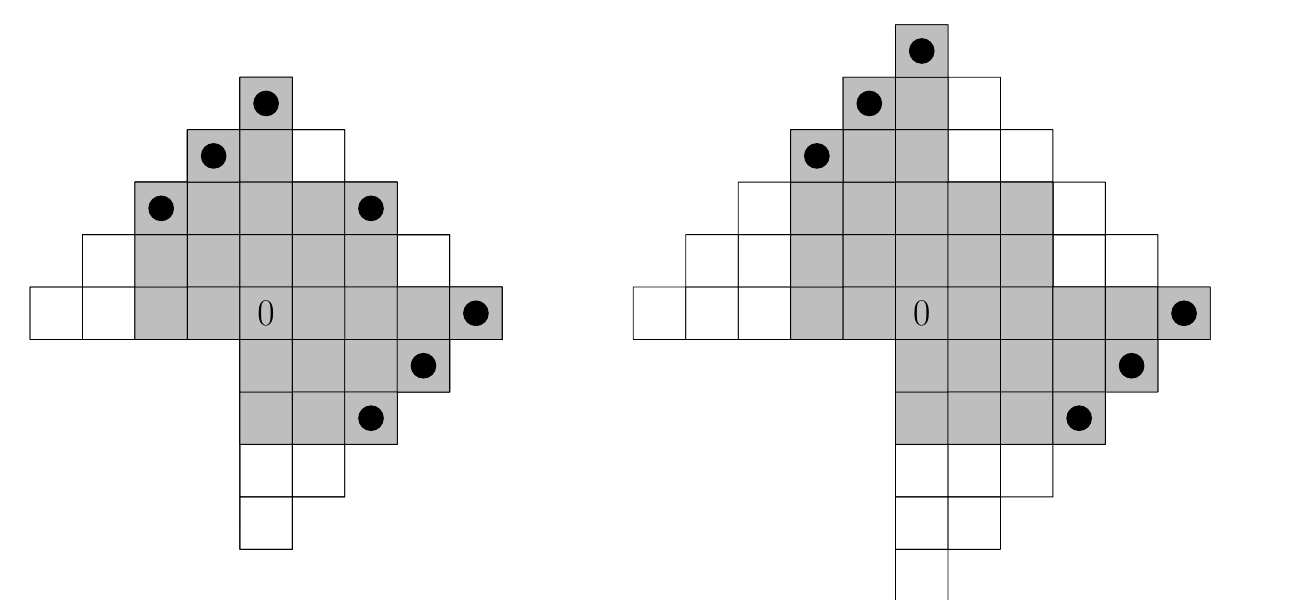
In our study of such tiles, we have to distinguish between even and odd diameters \(k\).
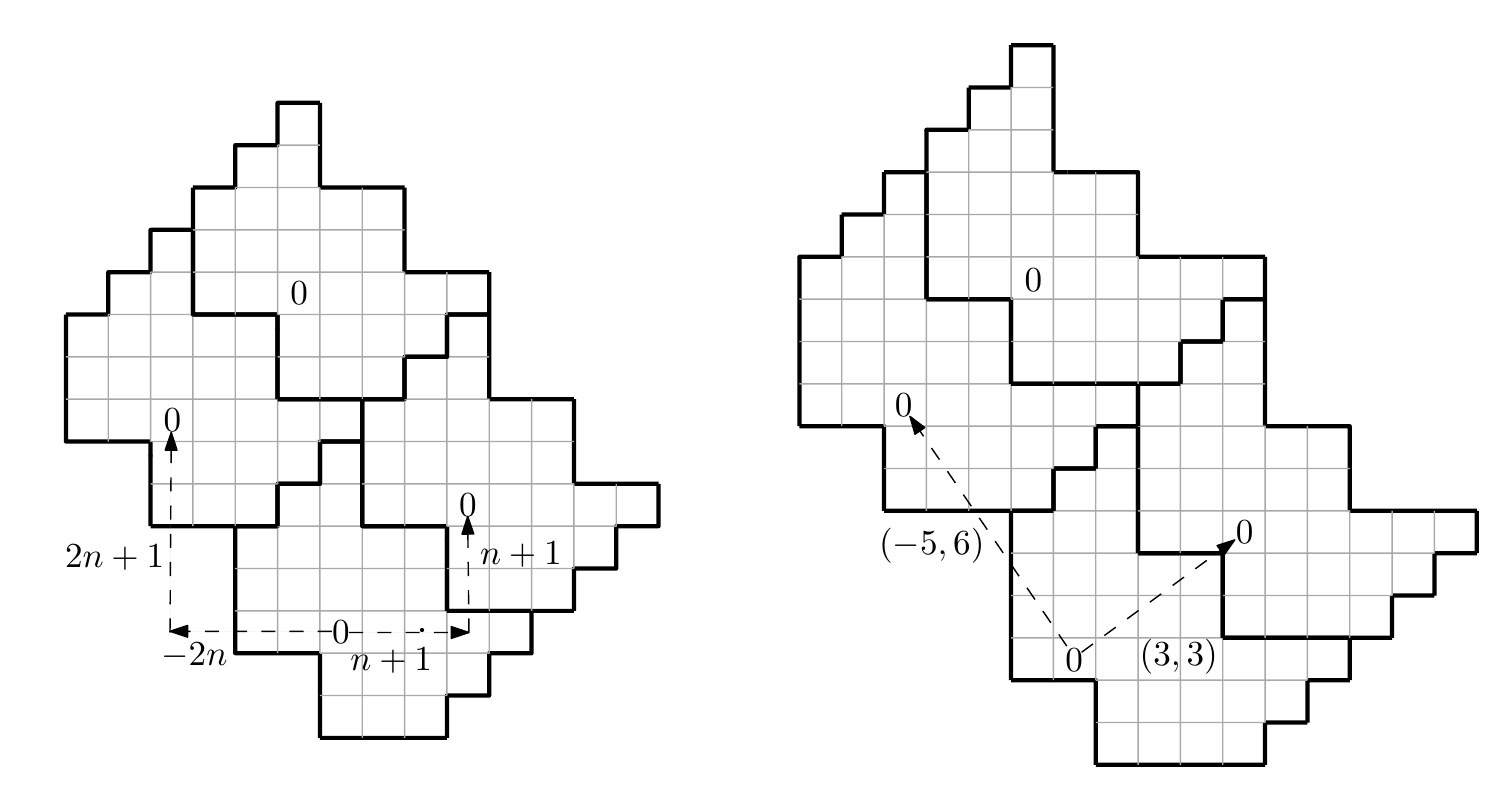
Proposition 2.1. There exists a three-quarter digraph \(TQ(N,a,b)\) for any even diameter \(k=2n\), \(N=k^2+\frac{5}{2}k+1\) vertices, and steps \(a=n\) and \(b=3n+1\).
Proof. For even \(k\), that is, \(k=2n\), the two vectors generating the lattice are \((n+1,n+1)\) and \((-2n,2n+1)\). See Figure 6 (left). Then, the equations for the distribution of the zeros (of the lattice) are \[(n+1)a+(n+1)b\equiv 0 \ (\textrm{mod }N),\quad\mbox{and}\quad -2na+(2n+1)b\equiv 0 \ (\textrm{mod }N).\]
Then, the pair of steps \(a\) and \(b\) satisfies the system \[\left(\begin{array}{cc} n+1 & n+1 \\ -2n & 2n+1 \end{array} \right) \left( \begin{array}{c} a \\ b \end{array} \right)=N\left(\begin{array}{c} \alpha \\ \beta \end{array} \right),\] for some integers \(\alpha,\beta\) and \(N=\det\left(\begin{array}{cc} n+1 & n+1 \\ -2n & 2n+1 \end{array} \right)=4n^2+5n+1=k^2+\frac{5}{2}k+1\). Solving the system, we have \[\left( \begin{array}{c} a \\ b \end{array} \right)= \left(\begin{array}{cc} 2n+1 & -(n+1) \\ 2n & n+1 \end{array} \right)\left(\begin{array}{c} \alpha \\ \beta \end{array} \right).\]
Taking, for instance, \(\alpha=\beta=1\), we get the steps \(a=n\) and \(b=3n+1\) satisfying Property P2. In the case of diameter \(k=2\), or \(n=1\), Figure 1 shows the three-quarters digraph \(TQ(10,1,4)\). \(\square\)
Proposition 2.2. There exists a three-quarter digraph \(TQ(N,a,b)\) for any odd diameter \(k=2n+1>1\), \(N=k^2+\frac{3}{2}k+\frac{1}{2}\) vertices, and steps \(a=n+1\) and \(b=3n+2\).
Proof. For odd \(k\), that is, \(k=2n+1\), the two vectors generating the lattice are \((n+1,n+1)\) and \((-(2n+1),2n+2)\). See Figure 6 (right). Then, the pair of steps satisfies the system \[\left(\begin{array}{cc} n+1 & n+1 \\ -(2n+1) & 2n+2 \end{array} \right) \left( \begin{array}{c} a \\ b \end{array} \right)=N\left(\begin{array}{c} \alpha \\ \beta \end{array} \right),\] where \(N=\det\left(\begin{array}{cc} n+1 & n+1 \\ -(2n+1) & 2n+2 \end{array} \right)=4n^2+7n+3=k^2+\frac{3}{2}k+\frac{1}{2}\). Solving the system, we have \[\left( \begin{array}{c} a \\ b \end{array} \right)= \left(\begin{array}{cc} 2n+2 & -(n+1) \\ 2n+1 & n+1 \end{array} \right)\left(\begin{array}{c} \alpha \\ \beta \end{array} \right).\]
Taking, for instance, \(\alpha=\beta=1\), we get the steps \(a=n+1\) and \(b=3n+2\). \(\square\)
For the particular case \(k=1\), we have the three-quarter digraph \(TQ(5,1,2)\).
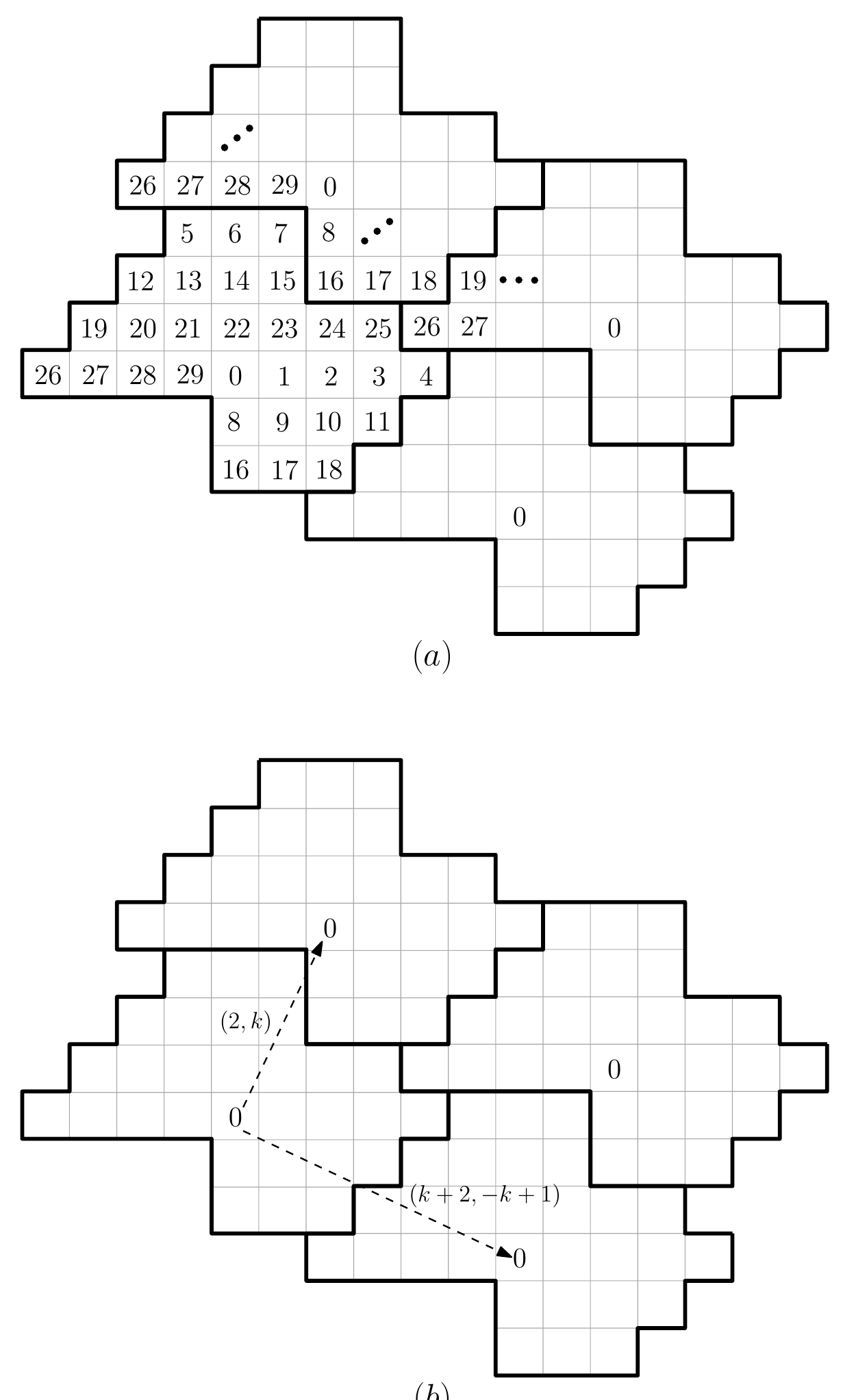
In Table 1, we show the minimum diameter \(k\) and steps \(a,b\) for each number of vertices \(N\le 208\) of three-quarters digraphs. The cases in which we get the maximum number of vertices for a given diameter are in boldface. Notice that such a maximum is greater than the values obtained with the \(W\)-shape tiles. For instance, for diameter \(k=4\), Proposition 2.1 gives \(N=27\) (see Figure 5), whereas, according to Table 1, we have a maximum of \(N=30\). The tiles that achieve the maximum values are more involved, as shown in Figure 7 for \(N=30\) and steps \(a=1\) and \(b=22=-8\).
As it was given in (1), for diameter \(k\), the number of vertices contained in the ideal ball of radius \(k\) is \(\frac{3}{2}k^2+\frac{5}{2}k+1\). This gives the natural Moore-type upper bound for the three-quarter distance model, provided that all represented residues are distinct modulo \(N\). Nevertheless, for \(k>1\), this ideal ball does not tessellate the plane. Hence, the upper bound is not achievable with a three-quarters circulant digraph. The constructions given in Propositions 2.1 and 2.2 should therefore be interpreted as explicit infinite families of large order, rather than as optimal constructions in general. More precisely, they give \[N(k)=k^2+\frac52k+1 \quad\text{for even }k,\] and \[N(k)=k^2+\frac32k+\frac12 \quad\text{for odd }k.\]
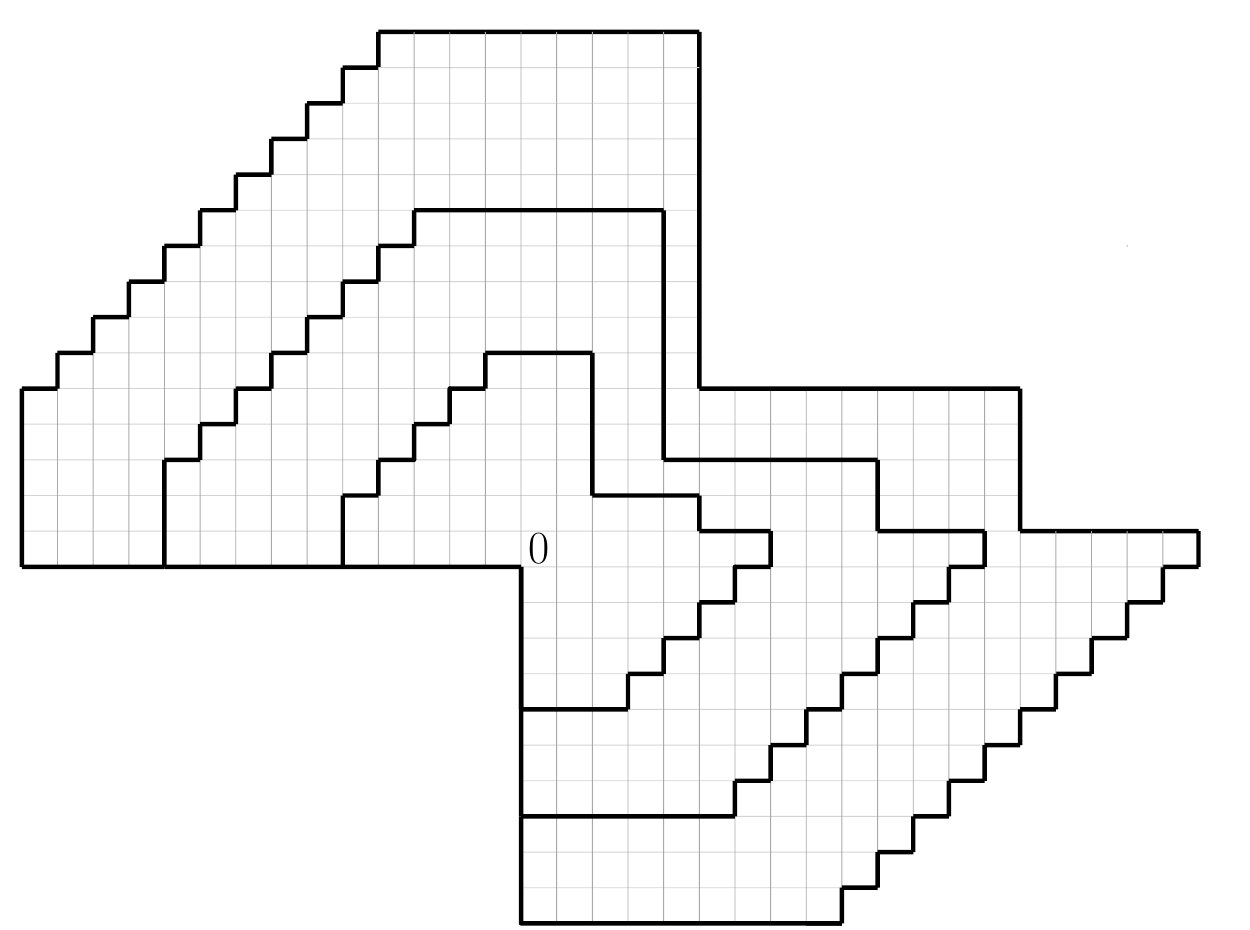
In contrast, according to Table 3, the maximum order for even diameter \(k\le 30\) is \(N(k)=\frac{9}{8}k^2 + \frac{22}{8}k + 1\), achieved with steps \(a=1\) and \(b(k)=7+23\left(\frac{k-2}{4}\right)+18\left(\frac{k-2}{4}\right)^2\) for \(k=2r\) with odd \(r\), and \(b(k)=22+41\left(\frac{k-4}{4}\right)+18\left(\frac{k-4}{4}\right)^2\) for \(k=2r\), with even \(r\). Experimental results suggest that these values are valid for any even diameter. The difficulty is that the associated tiles exhibit similar but apparently non-generalizable shapes. Examples include the cases \(k=6,12,18\) in Figure 8. Thus, one may add the following conjecture.
Conjecture 2.3. For every even diameter \(k\), there exists a three-quarter circulant digraph \(TQ(N,a,b)\) with \[N(k)=\frac98k^2+\frac{22}{8}k+1,\] and steps indicated as above. More precisely: if \(k=4s\) we have \(N(k)=18s^2+11s+1\), \(a=1\), and \(b(k)=18s^2+5s-1\); and if \(k=4s+2\) we have \(N(k)=18s^2+29s+11\), \(a=1\), and \(b(k)=18s^2+23s+7\). Moreover, such numbers of vertices \(N(k)\) are optimal among all three-quarter circulant digraphs of such diameters \(k\).
From the case of \(k=4\), we also have the following conjecture for general diameter, slightly improving that of Propositions 2.1 and 2.2.
Conjecture 2.4. Given an integer \(k\ge 1\), the lattice generated by the vectors \((u_1,v_1)=(k+2,-k+1)\) and \((u_2,v_2)=(2,k)\) corresponds to a tile of a three-quarters digraph with diameter \(k\). Then, there exists a three-quarter digraph \(TQ(N,a,b)\) with diameter \(k\), \(N=k^2+4k-2\) vertices, and steps \(a=1\) and \(b=-k-4\).
Looking at the case for \(k=4\) in the tables and also Figures 7 \((a)\) and \((b)\), the equations for the distribution of the zeros could be \[(k+2)a+(-k+1)b\equiv 0 \ (\textrm{mod }N),\quad\mbox{and}\quad 2a+kb\equiv 0 \ (\textrm{mod }N).\]
Then, the pair of steps \(a\) and \(b\) satisfies the system \[\left(\begin{array}{cc} k+2 & -k+1 \\ 2 & k \end{array} \right) \left( \begin{array}{c} a \\ b \end{array} \right)=N\left(\begin{array}{c} \alpha \\ \beta \end{array} \right),\] for some integers \(\alpha,\beta\) and \(N=\det\left(\begin{array}{cc} k+2 & -k+1 \\ 2 & k \end{array} \right)=k^2+4k-2\). Solving the system, we have \[\left( \begin{array}{c} a \\ b \end{array} \right)= \left(\begin{array}{cc} k & k-1 \\ -2 & k+2 \end{array} \right)\left(\begin{array}{c} \alpha \\ \beta \end{array} \right).\]
Taking, for instance, \(\alpha=1\) and \(\beta=-1\), we get the steps \(a=1\) and \(b=-k-4\) satisfying property P2.
The authors thank emergency medical doctor Susana Simó for her help with the name of these new digraphs.
The authors have no competing interests. All the data generated in this paper is included here.
This research has been supported by AGAUR from the Catalan Government under project 2021SGR00434 and MICINN from the Spanish Government under project PID2020-115442RB-I00.
| \(N\) | \(a\) | \(b\) | \(k\) | \(N\) | \(a\) | \(b\) | \(k\) | \(N\) | \(a\) | \(b\) | \(k\) | \(N\) | \(a\) | \(b\) | \(k\) | \(N\) | \(a\) | \(b\) | \(k\) |
|---|---|---|---|---|---|---|---|---|---|---|---|---|---|---|---|---|---|---|---|
| 4 | 1 | 2 | 1 | 45 | 1 | 20 | 6 | 86 | 1 | 20 | 8 | 127 | 1 | 24 | 10 | 168 | 1 | 15 | 12 |
| 5 | 1 | 2 | 1 | 46 | 1 | 14 | 6 | 87 | 1 | 12 | 8 | 128 | 1 | 30 | 10 | 169 | 1 | 27 | 12 |
| 6 | 1 | 2 | 2 | 47 | 1 | 9 | 6 | 88 | 1 | 14 | 8 | 129 | 1 | 14 | 10 | 170 | 1 | 14 | 12 |
| 7 | 1 | 2 | 2 | 48 | 1 | 9 | 6 | 89 | 1 | 41 | 8 | 130 | 1 | 60 | 10 | 171 | 1 | 54 | 12 |
| 8 | 1 | 3 | 2 | 49 | 1 | 15 | 6 | 90 | 1 | 66 | 8 | 131 | 1 | 18 | 10 | 172 | 1 | 67 | 12 |
| 9 | 1 | 4 | 2 | 50 | 1 | 8 | 6 | 91 | 1 | 28 | 8 | 132 | 1 | 16 | 10 | 173 | 1 | 17 | 12 |
| 10 | 1 | 4 | 2 | 51 | 1 | 30 | 6 | 92 | 1 | 76 | 8 | 133 | 1 | 62 | 10 | 174 | 1 | 17 | 12 |
| 11 | 1 | 7 | 2 | 52 | 1 | 12 | 6 | 93 | 1 | 13 | 9 | 134 | 1 | 12 | 11 | 175 | 1 | 19 | 12 |
| 12 | 1 | 4 | 3 | 53 | 1 | 10 | 6 | 94 | 1 | 82 | 8 | 135 | 1 | 115 | 10 | 176 | 1 | 19 | 12 |
| 13 | 1 | 3 | 3 | 54 | 1 | 24 | 6 | 95 | 1 | 61 | 8 | 136 | 1 | 32 | 10 | 177 | 1 | 69 | 12 |
| 14 | 1 | 4 | 3 | 55 | 1 | 35 | 6 | 96 | 1 | 18 | 9 | 137 | 1 | 15 | 11 | 178 | 1 | 42 | 12 |
| 15 | 1 | 6 | 3 | 56 | 1 | 9 | 7 | 97 | 1 | 30 | 9 | 138 | 1 | 124 | 10 | 179 | 1 | 16 | 12 |
| 16 | 1 | 10 | 3 | 57 | 1 | 45 | 6 | 98 | 1 | 12 | 9 | 139 | 1 | 15 | 11 | 180 | 1 | 84 | 12 |
| 17 | 1 | 5 | 3 | 58 | 1 | 48 | 6 | 99 | 1 | 12 | 9 | 140 | 1 | 122 | 10 | 181 | 1 | 82 | 12 |
| 18 | 2 | 15 | 3 | 59 | 1 | 11 | 7 | 100 | 1 | 16 | 9 | 141 | 1 | 44 | 10 | 182 | 1 | 22 | 12 |
| 19 | 1 | 8 | 3 | 60 | 1 | 14 | 7 | 101 | 1 | 11 | 9 | 142 | 1 | 14 | 11 | 183 | 1 | 13 | 13 |
| 20 | 1 | 6 | 4 | 61 | 1 | 14 | 7 | 102 | 1 | 14 | 9 | 143 | 1 | 14 | 11 | 184 | 1 | 18 | 12 |
| 21 | 1 | 4 | 4 | 62 | 1 | 10 | 7 | 103 | 1 | 24 | 9 | 144 | 1 | 34 | 11 | 185 | 1 | 20 | 12 |
| 22 | 1 | 5 | 4 | 63 | 1 | 10 | 7 | 104 | 1 | 32 | 9 | 145 | 1 | 13 | 11 | 186 | 1 | 137 | 12 |
| 23 | 1 | 7 | 4 | 64 | 1 | 12 | 7 | 105 | 1 | 77 | 9 | 146 | 1 | 20 | 11 | 187 | 1 | 59 | 12 |
| 24 | 1 | 7 | 4 | 65 | 1 | 9 | 7 | 106 | 1 | 20 | 9 | 147 | 1 | 16 | 11 | 188 | 1 | 30 | 13 |
| 25 | 1 | 11 | 4 | 66 | 1 | 20 | 7 | 107 | 1 | 13 | 9 | 148 | 1 | 16 | 11 | 189 | 1 | 36 | 12 |
| 26 | 1 | 6 | 4 | 67 | 1 | 26 | 7 | 108 | 1 | 42 | 9 | 149 | 1 | 18 | 11 | 190 | 1 | 140 | 12 |
| 27 | 1 | 8 | 4 | 68 | 1 | 40 | 7 | 109 | 1 | 15 | 9 | 150 | 1 | 42 | 11 | 191 | 1 | 17 | 13 |
| 28 | 1 | 12 | 4 | 69 | 1 | 11 | 7 | 110 | 1 | 96 | 9 | 151 | 1 | 24 | 11 | 192 | 1 | 42 | 13 |
| 29 | 1 | 23 | 4 | 70 | 1 | 58 | 7 | 111 | 1 | 10 | 10 | 152 | 1 | 84 | 11 | 193 | 1 | 114 | 12 |
| 30 | 1 | 22 | 4 | 71 | 1 | 52 | 7 | 112 | 1 | 72 | 9 | 153 | 1 | 15 | 11 | 194 | 1 | 16 | 13 |
| 31 | 1 | 5 | 5 | 72 | 1 | 10 | 8 | 113 | 1 | 18 | 10 | 154 | 1 | 48 | 11 | 195 | 1 | 177 | 12 |
| 32 | 1 | 6 | 5 | 73 | 1 | 8 | 8 | 114 | 1 | 14 | 10 | 155 | 1 | 128 | 11 | 196 | 1 | 176 | 12 |
| 33 | 1 | 10 | 5 | 74 | 1 | 9 | 8 | 115 | 1 | 27 | 9 | 156 | 1 | 136 | 11 | 197 | 1 | 15 | 13 |
| 34 | 1 | 8 | 5 | 75 | 1 | 23 | 7 | 116 | 1 | 14 | 10 | 157 | 1 | 17 | 11 | 198 | 1 | 24 | 13 |
| 35 | 1 | 8 | 5 | 76 | 1 | 12 | 8 | 117 | 1 | 102 | 9 | 158 | 1 | 140 | 11 | 199 | 1 | 24 | 13 |
| 36 | 1 | 14 | 5 | 77 | 1 | 18 | 8 | 118 | 1 | 33 | 10 | 159 | 1 | 141 | 11 | 200 | 1 | 32 | 13 |
| 37 | 1 | 7 | 5 | 78 | 1 | 18 | 8 | 119 | 1 | 13 | 10 | 160 | 1 | 50 | 11 | 201 | 1 | 18 | 13 |
| 38 | 1 | 24 | 5 | 79 | 1 | 11 | 8 | 120 | 1 | 13 | 10 | 161 | 1 | 22 | 12 | 202 | 1 | 18 | 13 |
| 39 | 1 | 9 | 5 | 80 | 1 | 11 | 8 | 121 | 1 | 23 | 10 | 162 | 2 | 117 | 11 | 203 | 1 | 22 | 13 |
| 40 | 1 | 12 | 5 | 81 | 1 | 13 | 8 | 122 | 1 | 12 | 10 | 163 | 1 | 31 | 11 | 204 | 1 | 20 | 13 |
| 41 | 1 | 26 | 5 | 82 | 1 | 10 | 8 | 123 | 1 | 15 | 10 | 164 | 1 | 16 | 12 | 205 | 1 | 20 | 13 |
| 42 | 1 | 8 | 6 | 83 | 1 | 47 | 8 | 124 | 1 | 15 | 10 | 165 | 1 | 18 | 12 | 206 | 1 | 49 | 13 |
| 43 | 1 | 19 | 5 | 84 | 1 | 38 | 8 | 125 | 1 | 35 | 10 | 166 | 1 | 18 | 12 | 207 | 1 | 17 | 13 |
| 44 | 1 | 7 | 6 | 85 | 1 | 16 | 8 | 126 | 1 | 20 | 10 | 167 | 1 | 108 | 11 | 208 | 1 | 88 | 13 |
| \(N\) | \(a\) | \(b\) | \(k\) | \(N\) | \(a\) | \(b\) | \(k\) | \(N\) | \(a\) | \(b\) | \(k\) | \(N\) | \(a\) | \(b\) | \(k\) | \(N\) | \(a\) | \(b\) | \(k\) |
|---|---|---|---|---|---|---|---|---|---|---|---|---|---|---|---|---|---|---|---|
| 11 | 1 | 7 | 2 | 58 | 35 | 56 | 6 | 95 | 27 | 32 | 8 | 141 | 4 | 77 | 10 | 141 | 41 | 49 | 10 |
| 11 | 1 | 8 | 2 | 58 | 36 | 37 | 6 | 95 | 28 | 83 | 8 | 141 | 5 | 61 | 10 | 141 | 41 | 112 | 10 |
| 11 | 2 | 3 | 2 | 58 | 41 | 54 | 6 | 95 | 28 | 93 | 8 | 141 | 5 | 79 | 10 | 141 | 43 | 59 | 10 |
| 11 | 2 | 5 | 2 | 58 | 47 | 52 | 6 | 95 | 29 | 59 | 8 | 141 | 7 | 26 | 10 | 141 | 44 | 103 | 10 |
| 11 | 3 | 10 | 2 | 58 | 50 | 53 | 6 | 95 | 29 | 69 | 8 | 141 | 7 | 29 | 10 | 141 | 46 | 50 | 10 |
| 11 | 4 | 6 | 2 | 95 | 1 | 61 | 8 | 95 | 31 | 41 | 8 | 141 | 8 | 13 | 10 | 141 | 46 | 110 | 10 |
| 11 | 4 | 10 | 2 | 95 | 1 | 81 | 8 | 95 | 31 | 86 | 8 | 141 | 8 | 70 | 10 | 141 | 49 | 62 | 10 |
| 11 | 5 | 7 | 2 | 95 | 2 | 27 | 8 | 95 | 32 | 52 | 8 | 141 | 10 | 17 | 10 | 141 | 50 | 85 | 10 |
| 11 | 6 | 9 | 2 | 95 | 2 | 67 | 8 | 95 | 34 | 79 | 8 | 141 | 10 | 122 | 10 | 141 | 53 | 76 | 10 |
| 11 | 8 | 9 | 2 | 95 | 3 | 53 | 8 | 95 | 34 | 94 | 8 | 141 | 11 | 61 | 10 | 141 | 53 | 139 | 10 |
| 30 | 1 | 22 | 4 | 95 | 3 | 88 | 8 | 95 | 36 | 66 | 8 | 141 | 11 | 106 | 10 | 141 | 55 | 107 | 10 |
| 30 | 2 | 11 | 4 | 95 | 4 | 39 | 8 | 95 | 37 | 52 | 8 | 141 | 13 | 74 | 10 | 141 | 56 | 67 | 10 |
| 30 | 4 | 7 | 4 | 95 | 4 | 54 | 8 | 95 | 37 | 72 | 8 | 141 | 14 | 52 | 10 | 141 | 56 | 91 | 10 |
| 30 | 8 | 29 | 4 | 95 | 6 | 11 | 8 | 95 | 41 | 91 | 8 | 141 | 14 | 58 | 10 | 141 | 58 | 59 | 10 |
| 30 | 13 | 16 | 4 | 95 | 6 | 81 | 8 | 95 | 42 | 77 | 8 | 141 | 16 | 26 | 10 | 141 | 62 | 136 | 10 |
| 30 | 14 | 17 | 4 | 95 | 7 | 47 | 8 | 95 | 42 | 92 | 8 | 141 | 16 | 140 | 10 | 141 | 64 | 104 | 10 |
| 30 | 19 | 28 | 4 | 95 | 7 | 92 | 8 | 95 | 43 | 58 | 8 | 141 | 17 | 43 | 10 | 141 | 64 | 137 | 10 |
| 30 | 23 | 26 | 4 | 95 | 8 | 13 | 8 | 95 | 43 | 63 | 8 | 141 | 19 | 119 | 10 | 141 | 65 | 88 | 10 |
| 58 | 1 | 48 | 6 | 95 | 8 | 78 | 8 | 95 | 44 | 49 | 8 | 141 | 19 | 131 | 10 | 141 | 67 | 128 | 10 |
| 58 | 2 | 23 | 6 | 95 | 9 | 64 | 8 | 95 | 46 | 51 | 8 | 141 | 20 | 34 | 10 | 141 | 70 | 119 | 10 |
| 58 | 3 | 28 | 6 | 95 | 9 | 74 | 8 | 95 | 48 | 78 | 8 | 141 | 20 | 103 | 10 | 141 | 71 | 133 | 10 |
| 58 | 4 | 17 | 6 | 95 | 11 | 36 | 8 | 95 | 48 | 88 | 8 | 141 | 22 | 71 | 10 | 141 | 73 | 101 | 10 |
| 58 | 5 | 8 | 6 | 95 | 12 | 22 | 8 | 95 | 49 | 74 | 8 | 141 | 22 | 122 | 10 | 141 | 73 | 110 | 10 |
| 58 | 6 | 11 | 6 | 95 | 12 | 67 | 8 | 95 | 51 | 71 | 8 | 141 | 23 | 25 | 10 | 141 | 74 | 85 | 10 |
| 58 | 7 | 46 | 6 | 95 | 13 | 33 | 8 | 95 | 54 | 64 | 8 | 141 | 23 | 55 | 10 | 141 | 76 | 101 | 10 |
| 58 | 9 | 26 | 6 | 95 | 14 | 89 | 8 | 95 | 56 | 71 | 8 | 141 | 25 | 113 | 10 | 141 | 79 | 92 | 10 |
| 58 | 10 | 57 | 6 | 95 | 14 | 94 | 8 | 95 | 56 | 91 | 8 | 141 | 28 | 104 | 10 | 141 | 80 | 130 | 10 |
| 58 | 12 | 51 | 6 | 95 | 16 | 26 | 8 | 95 | 59 | 84 | 8 | 141 | 28 | 116 | 10 | 141 | 80 | 136 | 10 |
| 58 | 13 | 44 | 6 | 95 | 16 | 61 | 8 | 95 | 62 | 77 | 8 | 141 | 29 | 100 | 10 | 141 | 82 | 83 | 10 |
| 58 | 14 | 45 | 6 | 95 | 17 | 47 | 8 | 95 | 62 | 82 | 8 | 141 | 31 | 68 | 10 | 141 | 82 | 98 | 10 |
| 58 | 15 | 24 | 6 | 95 | 17 | 87 | 8 | 95 | 63 | 68 | 8 | 141 | 31 | 95 | 10 | 141 | 83 | 127 | 10 |
| 58 | 16 | 39 | 6 | 95 | 18 | 33 | 8 | 95 | 68 | 93 | 8 | 141 | 32 | 52 | 10 | 141 | 86 | 118 | 10 |
| 58 | 18 | 33 | 6 | 95 | 18 | 53 | 8 | 95 | 69 | 79 | 8 | 141 | 32 | 139 | 10 | 141 | 89 | 109 | 10 |
| 58 | 19 | 42 | 6 | 95 | 21 | 46 | 8 | 95 | 73 | 83 | 8 | 141 | 34 | 86 | 10 | 141 | 89 | 127 | 10 |
| 58 | 20 | 27 | 6 | 95 | 21 | 86 | 8 | 95 | 82 | 87 | 8 | 141 | 35 | 130 | 10 | 141 | 91 | 95 | 10 |
| 58 | 21 | 22 | 6 | 95 | 22 | 72 | 8 | 95 | 84 | 89 | 8 | 141 | 37 | 77 | 10 | 141 | 92 | 100 | 10 |
| 58 | 25 | 40 | 6 | 95 | 23 | 58 | 8 | 141 | 1 | 44 | 10 | 141 | 37 | 113 | 10 | 141 | 97 | 140 | 10 |
| 58 | 30 | 55 | 6 | 95 | 23 | 73 | 8 | 141 | 1 | 125 | 10 | 141 | 38 | 97 | 10 | 141 | 98 | 124 | 10 |
| 58 | 31 | 38 | 6 | 95 | 24 | 39 | 8 | 141 | 2 | 88 | 10 | 141 | 38 | 121 | 10 | 141 | 106 | 137 | 10 |
| 58 | 32 | 49 | 6 | 95 | 24 | 44 | 8 | 141 | 2 | 109 | 10 | 141 | 40 | 65 | 10 | 141 | 107 | 121 | 10 |
| 58 | 34 | 43 | 6 | 95 | 26 | 66 | 8 | 141 | 4 | 35 | 10 | 141 | 40 | 68 | 10 | 141 | 112 | 134 | 10 |
| \(N\) | \(a\) | \(b\) | \(k\) |
|---|---|---|---|
| 11 | 1 | 7 | 2 |
| 30 | 1 | 22 | 4 |
| 58 | 1 | 48 | 6 |
| 95 | 1 | 81 | 8 |
| 141 | 1 | 125 | 10 |
| 196 | 1 | 176 | 12 |
| 260 | 1 | 238 | 14 |
| 333 | 1 | 307 | 16 |
| 415 | 1 | 387 | 18 |
| 506 | 1 | 474 | 20 |
| 606 | 1 | 572 | 22 |
| 715 | 1 | 677 | 24 |
| 833 | 1 | 793 | 26 |
| 960 | 1 | 916 | 28 |
| 1096 | 1 | 1050 | 30 |
The values in Tables 1–3 were obtained by exhaustive computation over all admissible triples \((N,a,b)\) satisfying \[\gcd(N,a,b)=1.\]
For each triple, the diameter \(k(TQ(N,a,b))\) was computed iteratively from the vertex \(0\), considering only the admissible directions \[(+a,+b), \qquad (-a,+b), \qquad (+a,-b).\]
Since the direction \((-a,-b)\) is not allowed, representations containing simultaneous negative uses of both steps were excluded.
The computational procedure is summarized below.
| 1: | Input: Integers \(N,a,b\) |
| 2: | Output: The diameter \(k(TQ(N,a,b))\) |
| 3: | \(L_\ell\): vertices reached for the first time at level \(\ell\) |
| 4: | \(S\): set of all reached vertices |
| 5: | Initialize \[L_0=\{0\}, \qquad S=\{0\}, \qquad \ell=0\] |
| 6: | repeat |
| 7: | Set \(L_{\ell+1}=\emptyset\) |
| 8: | for each \(x\in L_\ell\) do |
| 9: | Generate \[x+a,\quad x-a,\quad x+b,\quad x-b \pmod N\] |
| 10: | Discard paths using simultaneously \(-a\) and \(-b\) |
| 11: | Add to \(L_{\ell+1}\) all vertices not contained in \(S\) |
| 12: | end for |
| 13: | Update \[S\gets S\cup L_{\ell+1}\] |
| 14: | Increase \[\ell\gets \ell+1\] |
| 15: | until \(L_\ell=\emptyset\) |
| 16: | return \[k(TQ(N,a,b))=\ell-1\] |
| 1: | Input: Integer \(N\) |
| 2: | Output: Triples \((N,a,b)\) attaining minimum diameter |
| 3: | Initialize \[k_{\min}=\infty\] |
| 4: | for all pairs \((a,b)\) satisfying \(1\le a<b\le N-1\) and \(\gcd(N,a,b)=1\) do |
| 5: | Compute \(k(TQ(N,a,b))\) using Algorithm A1 |
| 6: | if \(k(TQ(N,a,b))<k_{\min}\) then |
| 7: | Update \(k_{\min}\) |
| 8: | Record \((N,a,b)\) |
| 9: | end if |
| 10: | end for |
Some comments: