
Constitutional interpretation, like ordinary legal interpretation, also involves separation of powers, and if the same governmental body were to formulate, amend, and interpret the Constitution, that body would surely metamorphose into a synonym for autocracy [12]. Thus, “even in the Western countries that have adopted a unitary system, the supreme power of interpretation of the constitution is not vested in the enacting body, but is entrusted to another independent body. The doctrine of separation of powers requires the opposite, that whoever makes it cannot interpret it, at least not with supreme power of interpretation” [9, 13]. The separation of the formulation, implementation and interpretation of the constitution and laws as a means of ensuring that no group or individual can formulate laws to suit their particular purposes and interests is the institutional basis for the allocation of the power to interpret the constitution [7].
In a decentralized political system, who has the right to interpret the Constitution? Theoretically, each branch of government has the right to interpret the Constitution within its discretion, i.e., each branch representing the interests of the government enjoys the power to interpret the Constitution. If this premise is valid, it is constitutional for each branch of government to interpret the Constitution, the legislature interprets the Constitution by enacting legislation, the executive interprets the Constitution by enforcing the law, and the judiciary interprets the Constitution by adjudicating the law [6, 10].
Although all branches of government have the right to interpret the Constitution, the distribution of the right to interpret the Constitution shows different patterns in different systems. In the system of “localism”, the right to interpret the Constitution is equally enjoyed by the three branches of government, and the final determination of the meaning of the Constitution depends on the mutual movement of the “preference zones” of the three branches, namely the legislative, the executive and the judiciary, and the interpretation of any one of them is subject to the constraints of “exogenous” factors arising from the systematic decentralization and “endogenous” factors within each of the branches. The interpretation of any branch will be subject to the institutional decentralization of the “exogenous” factors caused by the constraints and each branch of the internal “endogenous” constraints [14, 16]. Under the system of “judicialism”, the judiciary enjoys the final interpretation of the constitution because of “judicial supremacy”, and the court utilizes “judicial review” to expand the discretionary space of the judicial branch, making it capable of restraining the legislative branch and the executive branch. The court uses “judicial review” to expand the discretionary space of the judicial branch, so that it has the ability to constrain the scope of interpretation of the legislative branch and the executive branch, and to delimit their interpretation area, which in turn makes the preference of other branches unconsciously close to the court’s “preference zone”. It can be seen from here, “judicialism” will be the constitutional interpretation activities defined as a purely judicial process and the exclusive technical activities of the judiciary, the court is fully capable of according to the “constitutional rights” of the consensual and deterministic procedures to complete the identification of the nature of the rights and rights of the conflict resolution task, the judge as long as the judge is not a member of the court. The task of conflict resolution, judges can make the highest rational authority decision according to their own inner moral conscience, they only need to be responsible for themselves [2, 1, 15]. However, in the modern value pluralistic society, the constitutional rights conflict does not exist “rational consensus”, the judicial branch to rely on the rule of law terminal procedures to resolve the rights conflict is very likely to degenerate into the elite-dominated “tyranny of the minority”, politically neither representative, nor responsible. The “localism” of the judiciary branch is not only a political problem, but also a political problem. The “localism” pattern of distribution of interpretive power avoids the danger of monopolization of constitutional interpretation by the judicial branch, and it views constitutional interpretation as a democratic process, that is, constitutional interpretation under the decentralization model is a democratic process of equalization and substantive participation by the branches of government and other pluralistic social forces, and the policy preferences of the branches of government and the behavioral preferences of the pluralistic social forces jointly determine the meaning of the Constitution. The policy preferences of the branches of government and the behavioral preferences of the pluralistic social forces together determine the constitutional meaning [4, 3, 11].
In recent years, some constitutional scholars have begun to pay keen attention to “constitutional interpretation”, which some scholars believe is conducive to the birth of national constitutional hermeneutics, solves the problem of the domestic constitutional validity of the void, as well as can become the theoretical cornerstone of the creation of a constitutionally oriented unified legal order [17, 5]. However, some scholars have argued that China’s existing constitutional review system is not really effective, and China’s people’s courts do not have the legal power to interpret the Constitution and laws, so there is no need for constitutional interpretation to be applied in China’s judicial field [8].
The study constructs a system of assessment indicators for the development of judicial practice in China from three dimensions: justice indicators, efficiency indicators and effectiveness indicators. It collects data on the development of judicial practice in China from 2010 to 2020, and combines the fuzzy comprehensive evaluation method to assess the comprehensive quality of the development of judicial practice in China, and analyzes its development in terms of fairness, efficiency and effectiveness. Based on this, the research hypothesis of constitutional hermeneutics and China’s judicial practice is proposed, and explanatory variables, interpreted variables, control variables, and mechanism variables are set to construct a multi-period DID model to assess the policy effects of constitutional hermeneutics. After collecting data on relevant variables, benchmark regression analysis is conducted to explore the role of constitutional hermeneutics in influencing the development of judicial practice in China. Robustness tests such as parallel trend test, PSM-DID regression, replacing the sample time interval, endogeneity problem treatment, and adjusting the sample capacity are also carried out, and finally, the mechanism of action test is conducted to validate the proposed research hypotheses.
Constitutional interpretation is “an activity that, according to certain procedures, explores the meaning of constitutional norms and adapts them to changing social life, with the goal of pursuing the rationality and legitimacy of the interpretation, the stability of the constitutional order, and the adaptability of the constitutional norms to the reality of life”. Constitutional hermeneutics is the technique of discovering, understanding, clarifying and interpreting the meaning of a constitutional text, so as to translate the meaning of the norms of the text into their application in individual cases.
According to the existing theories of constitutional interpretation, the functions of the constitutional interpretation system are usually summarized as: resolving the “conflict between norms and reality” in social change, realizing the guarantee of the Constitution for the fundamental rights of the citizens, safeguarding the authority of the Constitution, and building the people’s confidence in the Constitution, constitutionalism, human rights and the rule of law. In addition, according to Parsons’ theory of structure and function, structure represents the way or order in which the components of a system are interconnected and interact with each other, which exists universally at all levels of the system of all things, while at the same time having its own special properties. Functions, on the other hand, are the characteristics and capabilities of the internal components of a structure as they interact with external situations. Therefore, according to the function and function of constitutional norms, it can be divided into four major departments: “economic constitution”, “political constitution”, “social constitution” and “cultural constitution”. By extension, the functions of the system of constitutional interpretation also include the realization of political demands (good governance, separation of powers and checks and balances, and protection of human rights) and economic efficiency (cost-benefit analysis), the maintenance of ideology, and the adaptation of people’s lifestyles to social changes. Constitutional interpretation promotes the effective implementation of the Constitution by specifying, in the name of the State, the meaning, nature and limits of the constitutional norms by a specific subject, thus adapting the Constitution to changing social conditions.
This chapter assesses the quality of China’s judicial practice through the construction of an evaluation index system for the subsequent establishment of a computational model of constitutional hermeneutics and China’s judicial practice.
| Primary index | Secondary index |
|---|---|
| Fair indicator (11) | The change rate, the trial rate of the trial, the change rate of the trial, the change rate of the second trial, the trial of the second trial, the retrial rate, the change rate of the effective case, the change rate of the retrial, the review of the interrogation rate, the judicial compensation rate and the evaluation of the judges’ documents |
| Efficiency indicator(10) | The time of the legal period, the application of the trial summary, the registration rate of the court, the legal review rate, the average time index, the average execution time index, the extension of the limit of the examination, the equilibrium of the case, the number of people in the court, the number of people in the court, the number of people in the court |
| Effect indicator(10) | The rate of conciliation, the rate of suspension, the actual execution rate, the number of executions, the performance rate of the referee, the application execution rate, the review rate of the retrial, the rate of complaint visit, and the public satisfaction |
With reference to the evaluation system of case quality, the evaluation indicators of the quality of judicial practice in China were selected from the three dimensions of fairness indicators, efficiency indicators and effectiveness indicators. The evaluation indicators of the quality of judicial practice are shown in Table 1, which contains 31 secondary indicators, such as the rate of filing changes, the rate of filing within the legal deadline, and the rate of actual implementation. The weights of the indicators at each level in the evaluation index system are different, and the comprehensive indicator of the quality of judicial practice is 100%, of which the indicators of trial justice account for 40%, and the indicators of trial efficiency and trial effectiveness each account for 30%. among the three first-level indicators, the indicator of justice accounts for the largest number of weights, which is 10% higher than that of the other two second-level indicators, so it can be seen that judicial justice is particularly important to the work of the courts.
The fuzzy comprehensive evaluation method can be applied to a variety of non-qualitative problem solving. Using the fuzzy comprehensive evaluation method to comprehensively analyze the evaluated objects with multiple indicators, it is able to derive the results of the difficult evaluation and analysis challenges that are difficult to digitize through the principle of affiliation. This chapter utilizes the fuzzy comprehensive evaluation method to assess the judicial practice in China.
According to the constructed evaluation index system, the factor set \(U\) is established: \[\label{GrindEQ__1_} U=\{ U_{1} ,U_{2} ,U_{3} ,\cdots ,U_{i} \} , \tag{1}\] where \(U_{1} ,U_{2} ,U_{3} ,\cdots ,U_{i}\) represents the factor indicators obtained from risk identification.
Rubric set \(V\) is built according to the degree of impact of each assessment indicator on the quality of judicial practice: \[\label{GrindEQ__2_} V=\left\{v_{1} ,v_{2} ,v_{3} ,v_{4} ,v_{5} \right\}. \tag{2}\]
When conducting fuzzy comprehensive evaluation, the weights occupied by each risk factor are different for the final assessment results. The weight set \(A\) in this paper refers to the analysis results in the hierarchical analysis model: \[\label{GrindEQ__3_} A=\{ a_{1} ,a_{2} ,a_{3} ,\cdots ,a_{i} \} , \tag{3}\] where \(a_{i}\) represents the weight of risk factor \(i\) and \(a_{1} +a_{2} +\ldots \ldots +a_{i} =1\).
By judging the affiliation matrix, determine the degree of affiliation \(q_{ij}\) of the assessment result \(V_{i}\) of each factor \(U_{i}\) to the set \(V\), carry out the quantification of fuzzy relationship from \(U\) to \(V\), and finally summarize the fuzzy relationship matrix: \[\label{GrindEQ__4_} q_{ij} =\frac{r_{ij} }{\sum\limits_{j=1}^{n}r_{ij} } , \tag{4}\] where \(q_{ij}\) indicates the likelihood that the \(i\)nd factor \(U_{i}\) belongs to the \(j\)th assessment level \(V_{j}\). \(r_{ij}\) denotes the number of experts within the factor set of the assessment object for the \(j\)th assessment level based on the \(i\)th factor. This results in a fuzzy relationship matrix \(Q\): \[\label{GrindEQ__5_} Q=\left[\begin{array}{cccc} {q_{11} } & {q_{12} } & {\cdots } & {q_{1n} } \\ {q_{21} } & {q_{22} } & {\cdots } & {q_{2n} } \\ {\vdots } & {\vdots } & {\vdots } & {\vdots } \\ {q_{m1} } & {q_{m2} } & {\cdots } & {a_{mn} } \end{array}\right]. \tag{5}\]
On the basis of determining the weight vector \(A\) and the fuzzy judgment matrix \(Q\), the fuzzy vectors on \(U\) are changed into fuzzy vectors \(B\) on the quantity \(\; V\) by transformation, and \(B\) represents the final evaluation calculation results. That is: \[\label{GrindEQ__6_} B=A\times Q=(b_{1} ,b_{2} ,\cdots ,b_{n} ). \tag{6}\]
The final comprehensive assessment was: \[\label{GrindEQ__7_} F=B\times E. \tag{7}\]
The calculation of the assessment indicators is supported by a huge amount of data, which is collected in three main ways: first, the data generated by the judicial statistical reports, which is the key source of data for measuring the assessment indicators. The second is the data from the court’s comprehensive information management system. The third is data for assessing public satisfaction, the main source of which is currently collected by courts at all levels through questionnaire surveys organized by the courts themselves of groups such as case parties, agents or lawyers.
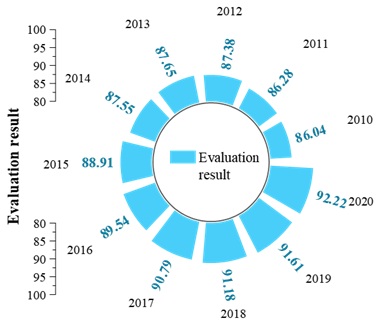
Taking China’s judicial practice from 2010 to 2020 as the object of study, the comprehensive assessment of judicial practice is shown in Figure 1, based on the fuzzy comprehensive evaluation of the collected index data.The comprehensive assessment scores of China’s judicial practice during the 10-year period of 2010-2020 ranged from 86.04 to 92.22, and in general, China’s comprehensive index of the quality of judicial practice showed an upward trend. Only the 2014 composite index of the quality of judicial practice declined slightly from 2013 (-0.1 percentage points), but it was higher than the composite indexes of both 2010-2012. Although the composite index of the quality of judicial practice in China showed a slight decline in 2014, most of the decline was due to the beneficial effects of procedural indicators, while substantive indicators reflecting the quality of judicial practice, such as some of the fairness indicators and the effectiveness indicators, continued to maintain an increasing trend, indicating that the quality of judicial practice in China as a whole is being optimized.
The quality of judicial practice is mainly assessed and measured by the situation of the three indicators of trial fairness, trial efficiency and trial effectiveness, which assess the fairness, efficiency and effectiveness indicators of China’s judicial practice, and the assessment results of the first-level indicators of judicial practice are shown in Figure 2. From the physical justice indicators, the quality of court case trials in judicial practice is on the rise (85.91\(\mathrm{\sim}\)92.80). Between 2010 and 2020, the number of cases received by the courts has risen all the way up, but the fairness indicators in the assessment index have not declined as a result of the increase in the number of cases. The Comprehensive Index of Judicial Practice shows that the efficiency indicator, although declining in 2014, still shows an overall upward trend (85.84\(\mathrm{\sim}\)92.24). The effectiveness indicators of judicial practice also maintained a favorable trend (83.56\(\mathrm{\sim}\)91.44).
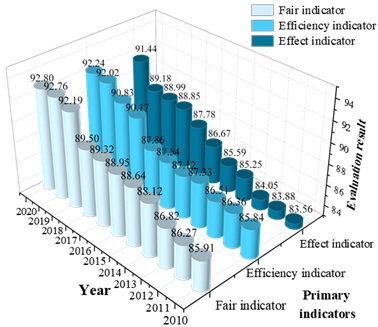
From the data of the assessment indicators, no matter from the fairness indicators or the effectiveness indicators and efficiency indicators, the first-level assessment indicators of the quality of judicial practice in China are optimized as a whole, which also fully demonstrates that the quality of judicial practice in China as a whole is showing an upward trend.
On the basis of measuring judicial practice in China, this chapter constructs a multi-period DID econometric model to explore the impact of constitutional hermeneutics on judicial practice in China.
The purpose of constitutional hermeneutics is to discover norms, which must be transformed from the justification of political rule to norm discovery with the help of the normative turn in the purpose of interpretation. The justification of political rule is manifested in a series of normative propositions deduced from Marxist theory, socialist constitutional theory and the writings and speeches of leaders, etc., and the normative interpretation of the Constitution is to clarify the normative meaning of the Constitution by interpreting the actual provisions of the Constitution, which in fact is to cite a new proposition to provide a basis for dispute resolution. The reason why we need to clarify the normative meaning, first, because the constitution has many principle provisions, need to be specific in individual cases. The second reason is that the Constitution is not silent on all facts. The former need to specify the principle-based provisions of the Constitution, that is, the value of the supplement, the latter need to supplement the constitutional norms, that is, loophole filling.
Summarizing the above analysis, this paper proposes the following research hypotheses:
Hypothesis 1: Constitutional hermeneutics helps to promote judicial practice in China.
Hypothesis 2: Constitutional hermeneutics promotes China’s judicial practice through value supplementation and loophole filling effects.
In order to test the impact effect of constitutional hermeneutics on judicial practice in China, this paper establishes a multi-period DID model to assess the impact effect of constitutional hermeneutics: \[\label{GrindEQ__8_} q_{it} =b_{0} +Y_{i} p_{1} +X_{i} p_{2} +Z_{i} p_{3} +P_{i} p_{4} +T_{i} p_{5} +v_{it} . \tag{8}\]
In the above equation, \(q\) denotes the explanatory variable to measure judicial practice in China, subscript \(i\) denotes the region studied, \(t\) denotes the time studied, \(Y\) denotes the explanatory variable to represent constitutional hermeneutics, \(Z\) denotes a control variable such as population, \(P\) denotes province, \(T\) denotes time, and \(v\) denotes residuals.
The sources and measures of China’s judicial practice from 2010 to 2020 are shown in the previous section.
Constitutional hermeneutics is measured by the double difference variable CH \(\mathrm{\times}\) Phase. Where CH is an experimental and control group dummy variable, judicial practices involving constitutional hermeneutics are judged to be experimental (CH=1) and the rest to be control (CH=0).Phase is a constitutional hermeneutics time dummy variable, being in the constitutional hermeneutics phase phase=1 and non-constitutional hermeneutics phase=0.
The control variables in this paper include: first, the level of economic development (GDP), measured by GDP. The second is the level of infrastructure (BAS), measured by the logarithm of road miles per capita. The third is population density status (POP), measured by the logarithm of the number of people per square kilometer.
Mechanism variables include first, value addition (AV), expressed as the logarithm of the number of complementary and generalized terms for uncertain normative concepts. The second is loophole filling (LF), expressed as the logarithm of the number of loopholes filled by judges based on jurisprudence.
In this paper, data belonging to the district and county level in the pilot cities as well as some cities with serious lack of statistical data are excluded, and the sample data of 200 prefecture-level cities in mainland China for the years 2010-2020 are finally selected. The raw data of relevant variables are mainly from the China Urban Statistical Yearbook, EPS database and the National Economic and Social Development Statistical Bulletin of each city. In this paper, the individual data of some missing cities are made up by interpolation.
This paper presents the results of the baseline regression of constitutional hermeneutics on judicial practice using a stepwise regression strategy, and the results of the baseline regression test are shown in Table 2, with ***, **, and * denoting significance at the 1%, 5%, and 10% levels, respectively.
On a two-way fixed effects basis, Column (1) reports the results of the estimation with the inclusion of only the core explanatory variables, whose estimated coefficients are significantly positive at the 1% level. Column (2) reports the same estimation results as Column (1) after including control variables on the basis of individual fixed effects only. Column (3) further controls for time fixed effects based on Column (2), and the estimates of the core explanatory variables remain the same. This suggests that constitutional hermeneutics has a significant role in promoting judicial practice in China, thus verifying Hypothesis H1. Among them, Column (3) has the highest R-squared value of 0.445 in the estimation results, indicating the optimal model fit, and the estimated coefficient of its constitutional hermeneutics variable is 0.327, indicating that constitutional hermeneutics improves the level of judicial practice in China by 32.7%, reflecting the net effect of constitutional hermeneutics. From the estimated coefficients of the control variables, it can be seen that the level of economic development, the level of infrastructure, and the status of population density all have a significant impact on judicial practice in China.
| Interpretation variable | (1) | (2) | (3) | |
|---|---|---|---|---|
| CJP | CJP | CJP | ||
| CH\(\mathrm{\times}\)Phase | Coefficient | 0.472*** | 0.325*** | 0.327*** |
| S.E. | 0.102 | 0.148 | 0.152 | |
| GDP | Coefficient | 0.023** | 0.004** | |
| S.E. | 0.562 | 0.613 | ||
| BAS | Coefficient | 0.012* | 0.016* | |
| S.E. | 0.293 | 0.248 | ||
| POP | Coefficient | 0.022*** | 0.031*** | |
| S.E. | 0.656 | 0.372 | ||
| Constant term | Coefficient | 3.586*** | -1.724*** | -2.329*** |
| S.E. | 0.389 | 2.253 | 3.646 | |
| Time fixed | Yes | No | Yes | |
| Individual fixed | Yes | Yes | Yes | |
| R\({}^{2}\) | 0.421 | 0.385 | 0.445 | |
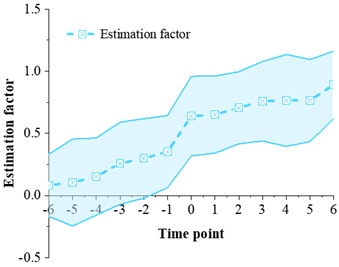
The parallel trend test is conducted on the data, and the interaction term of the experimental group with the year dummy variable for the six years before and after the implementation of constitutional hermeneutics is regressed as the core explanatory variable, and the results of the test of parallel trend are shown in Figure 3. The estimated coefficients of the policy effect variables in the years before constitutional hermeneutics did not pass the 5% significance test, indicating that there is no significant difference in the trend of the experimental group and the control group before the implementation of constitutional hermeneutics, i.e., the samples passed the parallel trend test, and the policy effects can be estimated using the double-difference model. Meanwhile, the policy effect of the implementation of constitutional hermeneutics is immediate and very significant from the year of implementation. Except for the third and fifth years, which pass the test only at the 10% significance level, the rest of the years pass the test at the 5% significance level, indicating that the dynamic effect of the policy continues to be significant and the estimated coefficients increase in value from year to year, which verifies the conclusion that the implementation of the constitutional hermeneutics promotes China’s judicial practice.
In order to alleviate the problem of sample selection bias, this paper utilizes the PSM-DID model to strip away the uncertainty interference caused by sample bias on the benchmark regression results. Firstly, control variables such as economic development level, infrastructure level and population density status are selected as matching variables to screen the study sample, secondly, the nearest neighbor matching method is used for the selection and matching of the control group, and finally, the regression test is re-run based on the matched sample. The standardized deviation of control variables is shown in Figure 4. The absolute values of the deviations of the control variables of the experimental group and the control group after propensity score matching are all significantly reduced and kept within 10%, indicating that the matching variables and methods selected in this paper are reasonable.
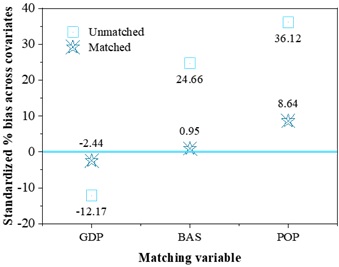
Table 3 presents the results of the robustness tests. Column (1) shows the test results after propensity score matching, and CH \(\mathrm{\times}\) Phase is the matched constitutional hermeneutics dummy variable, whose regression coefficients are significantly positive, reconfirming that the results of the previous benchmark test are reliable and robust.
In order to ensure that the assessment of the impact effect of constitutional hermeneutics on judicial practice in China is not disturbed by the sample time window, this paper re-generates a new time window to re-examine the impact of constitutional hermeneutics on judicial practice using the multi-period DID model. Replacing the sample time interval in Column (2) did not affect the baseline test results, whose regression coefficient of 0.0042 is greater than zero.
| Variables | PSM-DID | Change the sample time interval | Endogenous problem processing | Adjusted sample capacity | |
| (1) | (2) | (3) | (4) | ||
| CH\(\mathrm{\times}\)Phase | Coefficient | 0.0043*** | 0.0042*** | 0.0037*** | 0.0046*** |
| S.E. | 0.2507 | 0.2276 | 0.2109 | 0.2019 | |
| Constant term | Coefficient | -0.1793*** | -0.2587*** | -0.2344*** | -0.2193*** |
| S.E. | -0.2956 | -0.1843 | -0.1765 | -0.2516 | |
| Control variables | Yes | Yes | Hysteresis | Yes | |
| Time fixed | Yes | Yes | Yes | Yes | |
| R\({}^{2}\) | 0.7291 | 0.7358 | 0.7003 | 0.7269 | |
| F statistics | 31.2053*** | 29.1286*** | 32.2439*** | 30.2141*** | |
In order to minimize the potential endogeneity problem, the regression is re-run with all control variables lagged by one period, and the results of the endogeneity problem treatment in column (3) and the adjusted sample size in column (4) show that constitutional hermeneutics still contributes to the enhancement of judicial practice in China.
The previous theoretical analysis and benchmark test show that constitutional hermeneutics helps promote judicial practice, but the mechanism of action behind it has to be further analyzed. This part of the mechanism test is still estimated using the multi-period DID method, and the results of the mechanism of action test are shown in Table 4. The regression coefficients of constitutional hermeneutics (CH \(\mathrm{\times}\) Phase) are both significantly positive (0.0362 and 0.0324), suggesting that constitutional hermeneutics can promote China’s judicial practice through value supplementation and loophole filling, and that the mechanism of action of the previous hypothesis 2 is valid.
| Variables | Additional value | Loophole filling | |
|---|---|---|---|
| (1) | (2) | ||
| CH\(\mathrm{\times}\)Phase | Coefficient | 0.0363*** | 0.0324*** |
| S.E. | 2.0177 | 2.2774 | |
| Constant term | Coefficient | -0.1338*** | -0.1436*** |
| S.E. | -1.2588 | -1.2764 | |
| Control variables | Yes | Yes | |
| Time fixed | Yes | Yes | |
| R\({}^{2}\) | 0.7258 | 0.7575 | |
| F statistics | 64.1817*** | 57.0946*** | |
Constitutional interpretation seeks and discovers norms and thus realizes justice in individual cases. In this paper, we first assess China’s judicial practice through the construction of an evaluation index system. It then selects relevant variables and uses a multi-period DID regression measurement model to explore the impact of constitutional hermeneutics on Chinese judicial practice.
The quality of China’s judicial practice in the study interval shows an overall upward trend, with comprehensive evaluation scores ranging from 86.04 to 92.22. Its fairness, efficiency and effectiveness indicators also maintain an increasing trend, with the corresponding evaluation scores ranging from 85.91 to 92.80, 85.84 to 92.24, and 83.56 to 91.44. China’s judicial practice as a whole develops relatively well and is constantly optimized.
Through the regression results, it is found that constitutional hermeneutics has a significant promotion effect on China’s judicial practice, and its estimated coefficient is significantly positive at the 1% level, and passes a series of robustness tests, proving that the results of the empirical tests are robust. Among them, the promotion effect of constitutional hermeneutics on Chinese judicial practice is 52.7%. Meanwhile, the regression coefficients of the mechanism of action test are all significantly positive, verifying the hypothesized mechanism of action, i.e., constitutional hermeneutics can promote the development of China’s judicial practice through value supplementation and loophole filling.
Constitutional interpretation is related to the consolidation of democracy and the development of the rule of law, and it is necessary to interpret the content of the constitutional provisions, truly implement the mechanism of constitutional interpretation procedures, revitalize the life of the Constitution, safeguard the authority of the Constitution, and ultimately realize the purpose of safeguarding the fundamental rights of citizens and promote the development and enhancement of China’s judicial practice.