
Throughout our paper, we only consider finite, simple and undirected graphs. A graph \(G\) is called planar if it can be embedded in the plane such that any two edges intersect only at their ends. For a plane graph \(G\), let \(V(G)\), \(E(G)\), \(F(G)\), \(|E(G)|\), \(\delta(G)\) and \(\Delta(G)\) denote the vertex set, edge set, face set, size, minimum degree and maximum degree of \(G\), respectively. For \(v\in V(G)\), let \(d_G(v)\) denote the degree of \(v\) in \(G\) and call \(v\) a \(k\)-vertex if \(d(v)=k\) and a \(k^+\)-vertex if \(d(v)\ge k\). For a face \(f\in F(G)\), we use \(b(f)\) to denote its boundary walk and write \(f=[v_{1}v_{2}\ldots v_{n}]\) if \(v_{1},v_{2},\ldots,v_{n}\) are lying on \(b(f)\).
An entire \(k\)-coloring of a plane graph \(G\) is a mapping \(\pi\): \(V(G)\cup E(G)\cup F(G)\rightarrow\{1,2,\ldots,k\}\) such that any two adjacent or incident elements in \(V(G)\cup E(G)\cup F(G)\) receive distinct colors. The entire chromatic number, denoted \(\chi_{vef}(G)\), of \(G\) is the least integer \(k\) such that \(G\) has an entire \(k\)-coloring. This concept was first introduced in [6] by Kronk and Mitchem who conjectured that every simple plane graph is entirely (\(\Delta(G)+4\))-colorable. Moreover, in the same paper, the authors positively confirmed this conjecture for \(\Delta(G)\le 3\). We notice that for a complete graph \(K_4\), \(\chi_{vef}(K_{4})=7=\Delta(G)+4\), and thus the bound \(\Delta(G)+4\) is tight. In 1989, Borodin [1] affirmed the conjecture for \(\Delta(G)\ge 12\), and later strengthened this to \(\Delta(G)\ge 7\) in [2]. Sanders and Zhao [8] further provided a proof of \(\Delta(G)\ge 6\) for the conjecture. However, there is a mistake in [11] which has been corrected by Wang and Zhu [11]. Finally, Wang and Zhu [11] positively settled the whole conjecture.
As a relaxation of the entire coloring of plane graphs, the concept of the facial entire coloring of plane graphs was first investigated by Fabrici, Jendrol’ and Vrbjarová [5] in 2016. Let \(G\) be a plane graph. Two edges \(e_1, e_2\in E(G)\) are called facially adjacent if they are adjacent and consecutive on the boundary walk of a face of \(G\). A facial entire \(k\)-coloring of \(G\) is a mapping \(\pi\) from \(V(G)\cup E(G)\cup F(G)\) to a \(k\) color set \(\{1,2,\ldots,k\}\) such that any two facially adjacent edges, adjacent vertices, adjacent faces, and incident elements in \(V(G)\cup E(G)\cup F(G)\) receive distinct colors. The facial entire chromatic number, denoted \(\bar{\chi}_{vef}(G)\), of \(G\) is the smallest integer \(k\) such that \(G\) has a facial entire \(k\)-coloring. It is obvious that \(\bar{\chi}_{vef}(G)\le \chi_{vef}(G)\). Moreover, the parameter \(\bar{\chi}_{vef}(G)\) is independent on \(\Delta(G)\). The reader is referred to [3, 4, 9, 10, 12] for some results on edge-face coloring and facially edge-face coloring.
Fabrici, Jendrol’ and Vrbjarová [5] showed us that \(\bar{\chi}_{vef}(G)\le 8\) for any connected, loopless and bridgeless plane graph \(G\). Moreover, in [5], they characterized the facial entire chromatic number of wheel graphs, and put forward the following conjecture.
Conjecture 1.1. Every connected, loopless and bridgeless plane graph is facially entire \(7\)-colorable.
As far as we know, Conjecture 1.1 is widely open. In this paper, we focus on studying the facial entire coloring of \(K_{4}\)-minor-free graphs. A graph \(H\) is said to be a minor of a graph \(G\) if \(H\) can be obtained from \(G\) by a series of vertex deletions, edge deletions, and edge contractions. Further, \(G\) is called \(H\)-minor-free if \(G\) does not contain \(H\) as a minor. It is known that the class of \(K_4\)-minor free graphs is a special type of planar graphs.
For \(u, v\in V(G)\), The distance between \(u\) and \(v\), denoted \(d_G(u,v)\), is the length of a shortest path connecting them. For convenience, let \(N_i(u)=\{v\mid v\in V(G)\) and \(d_G(u,v)=i\}\). Moreover, we let \(T(u,v)\) denote the set of all \(2\)-vertices in \(G\) which are adjacent to both \(u\) and \(v\). Let \(G\) be a \(K_{4}\)-minor-free graph. We define:
\(D_G(u)=\{v \mid d_{G}(v)\ge 3\) such that either \(uv\in E(G)\) or there is a \(2\)-vertex \(x\) such that \(ux, xv\in E(G)\}.\)
The following key structural lemma appeared in [7].
Lemma 2.1. Let \(G\) be a \(K_{4}\)-minor-free graph. Then \(G\) contains one of the following configurations (C1), (C2) and (C3).
(C1) \(\delta(G)\le 1\);
(C2) there exist two adjacent \(2\)-vertices;
(C3) there is a \(3^{+}\)-vertex \(u\) with \(|D_{G}(u)|\le2\) .
This section is devoted to establishing the main result of this paper.
Theorem 3.1. If \(G\) is a \(K_4\)-minor-free graph, then \(\bar{\chi}_{vef}(G)\le 7\).
Proof. We prove the theorem by induction on \(|E(G)|\). Let \(\mathcal{C}=\{1, 2, \ldots, 7\}\) denote a set of seven colors. W.l.o.g., we may assume that \(G\) is a connected graph embedded in the plane. If \(|E(G)|\le 3\), then \(\Delta(G)\le 3\), we deduce that \(\bar{\chi}_{vef}(G)\le \chi_{vef}(G)\le \Delta(G)+4\le 7\). So assume that \(G\) is a \(K_{4}\)-minor-free graph with \(|E(G)|\ge 4\). By Lemma 2.1, \(G\) contains one of the configurations (C1), (C2) and (C3). In each of following cases, we will construct a graph \(G^*\) such that \(|E(G^*)|<|E(G)|\). Firstly, we have the following:
Case 1. \(G\) is \(2\)-connected.
Proof. Suppose to the contrary that there exists a cut vertex \(v\in V(G)\) and let \(G_1\) and \(G_2\) be two connected subgraphs such that \(V(G_1)\cap V(G_2)=\{v\}\) and \(G_1\cup G_2=G\). Clearly, \(G_1\) and \(G_2\) are both connected \(K_{4}\)-minor-free graphs and have at least two vertices, respectively. For \(i=1,2\), by the induction hypothesis, each \(G_i\) admits a facial entire \(7\)-coloring, say \(\pi_i\). Now assume w.l.o.g., that \(d_{G_{1}}(v)=m\) and \(d_{G_{2}}(v)=k\) such that \(k\ge m\). Note that \(k\ge m\ge 1\).
Denote by \(f_1\) and \(f_2\) the outer faces of \(G_1\) and \(G_2\), respectively. For convenience, we use \(v_{11}, \ldots, v_{1m}\) to denote all neighbors of \(v\) in \(G_1\) such that \(vv_{11}\) and \(vv_{1m}\) are lying on the boundary of \(f_1\). Similarly, let \(v_{21},\ldots, v_{2k}\) denote all neighbors of \(v\) in \(G_2\) such that \(vv_{21}\) and \(vv_{2k}\) are lying on the boundary of \(f_2\). First permute the colors in \(G_2\) such that \(\pi_2(v)=\pi_1(v)\) and \(\pi_2(f_2)=\pi_1(f_1)\). We have to discuss two cases in light of the value of \(m\) and \(k\).
\(\bullet\) \(m=1\).
Notice that it might be the case that \(k=1\). If \(\pi_2(vv_{21}) \ne \pi_1(vv_{11})\) and \(\pi_2(vv_{2k}) \ne \pi_1(vv_{11})\), then \(\pi_1\cup \pi_2\) is just a facial entire 7-coloring of \(G\). Otherwise, w.l.o.g., assume that \(\pi_2(vv_{21})=\pi_1(vv_{11})\). Then we can switch the colors \(\pi_2(vv_{21})\) and \(\alpha\in \mathcal{C}\setminus \{\pi_1(vv_{11}), \pi_2(v),\pi_2(f_2), \pi_2(vv_{2k})\}\). One may verify that the obtained coloring of \(G\) is a facial entire 7-coloring.
\(\bullet\) \(m\ge 2\).
Then \(k\ge 2\). Similarly, if \(\pi_2(vv_{21})\ne \pi_1(vv_{11})\) and \(\pi_2(vv_{2k})\ne \pi_1(vv_{1m})\), then \(\pi_1\cup \pi_2\) itself is a facial entire 7-coloring of \(G\). Otherwise, assume w.l.o.g., that \(\pi_2(vv_{21})=\pi_1(vv_{11})\). Noting that \(\pi_2(vv_{2k})\ne \pi_2(vv_{21})\), in order to establish a facial entire 7-coloring of \(G\), it suffices to switch colors \(\pi_2(vv_{21})\) and \(\pi_2(vv_{2k})\) in \(G_2\). ◻
Given a partial facial entire coloring \(\pi\) of \(G\) and an uncolored element \(x\in V(G)\cup E(G)\cup F(G)\), let \(F(x)\) denote the set of colors forbidden to use on \(x\), and let \(f(x)=|F(x)|\). By Claim 1, we are sure that \(G\) does not contain (C1).
Case 1. \(G\) contains (C2): two adjacent 2-vertices \(u\) and \(v\).
Let \(u_1\) denote the neighbor of \(u\) other than \(v\), and \(v_1\) the neighbor of \(v\) other than \(u\). We have two subcases below.
Subcase 1.1. \(u_1=v_1\).
Write \(u_1=v_1=u^*\). Then \(uvu^*u\) is a 3-cycle. By Claim 1, we ensure that \(u^*\) is a 2-vertex, implying that \(|E(G)|=3\), which contradicts the assumption that \(|E(G)|\ge 4\).
Subcase 1.2. \(u_1\ne v_1\).
Let \(G^*\) be a graph obtained from \(G\) by contracting the edge \(uv\) into a new vertex \(w\). Obviously, \(G^*\) is a \(K_4\)-minor-free graph with \(|E(G^*)|<|E(G)|\). By the induction hypothesis, \(G^*\) has a facial entire \(7\)-coloring \(\pi^*\) by using the color set \(\mathcal{C}\).
To extend \(\pi^*\) to the graph \(G\), we first assign \(\pi^*(u_1w)\) to \(u_1u\), \(\pi^*(v_1w)\) to \(v_1v\), and \(\pi^*(w)\) to \(v\). Then we color \(uv\) and \(u\) in order with a color in \(\mathcal{C}\setminus F(uv)\) and \(\mathcal{C}\setminus F(u)\), respectively. This is available because \(f(uv)\le 5\) and \(f(u)\le 5\).
Case 2. \(G\) contains (C3): There is a \(3^{+}\)-vertex \(u\) with \(|D_{G}(u)|\le 2\).
By the proof of Case 1, we may assume that \(|D_{G}(u)|\ge 1\). Let \(d_G(u)=k\) and denote \(u_1, u_2, \ldots, u_k\) be adjacent to \(u\) in cyclic order. It remains us to deal with two subcases in terms of \(|D_{G}(u)|\).
Subcase 2.1. \(|D_{G}(u)|=1\), say \(D_G(u)=\{v\}\).
It means that all neighbors of \(u\) are either \(v\) or some neighbors of \(v\). Namely, \(v\in N_1(u)\cup N_2(u)\). The following claims will be helpful in the rest of our paper.
Claim 2. Let \(u\) be a \(3^+\)-vertex in \(G\) and let \(u_1, u_2, \ldots, u_{d_G(u)}\) consecutively be adjacent to \(u\). If there exist a \(3^+\)-vertex \(u_{i}\) and a \(2\)-vertex \(u_{i+1}\) such that \([uu_iu_{i+1}]\) is a \(3\)-face, then \(G\) is facially entire \(7\)-colorable.
Proof. Let \(G^*=G-u_{i+1}\). Then \(G^*\) is a \(K_4\)-minor-free graph and \(|E(G^{*})|<|E(G)|\). By the induction hypothesis, \(G^*\) has a facial entire \(7\)-coloring \(\pi^{*}\) by using \(\mathcal{C}\). Since \(f([uu_iu_{i+1}])\le 5\), \(f(uu_{i+1})\le 4\), \(f(u_{i}u_{i+1})\le 4\) and \(f(u_{i+1})\le 3\), one may color \([uu_iu_{i+1}]\), \(uu_{i+1}\), \(u_{i}u_{i+1}\), and \(u_{i+1}\) in succession. It is easy to check that the obtained coloring of \(G\) is a facial entire 7-coloring and thus we are done. ◻
Claim 3. Let \(u\) be a \(3^+\)-vertex in \(G\) and let \(u_1, u_2, \ldots, u_{d_G(u)}\) consecutively be adjacent to \(u\). If there exists a vertex \(v\notin N_1(u)\) such that \(d_G(u_{i})=d_G(u_{i+1})=2\) and \([uu_ivu_{i+1}]\) is a \(4\)-face, then \(G\) is facially entire \(7\)-colorable.
Proof. Let \(G^*=G-\{u_{i},u_{i+1}\}+uv\). Obviously, \(G^*\) is a \(K_4\)-minor-free graph with \(|E(G^{*})|<|E(G)|\). Thus, \(G^*\) has a facial entire \(7\)-coloring \(\pi^{*}\) by the induction hypothesis. We will show how to extend \(\pi^*\) to the whole graph \(G\).
First, assign \(\pi^*(uv)\) to both \(uu_i\) and \(u_{i+1}v\). Then, one can color \([uu_ivu_{i+1}]\), \(uu_{i+1},u_{i}v, u_{i}\) and \(u_{i+1}\) in order successfully due to the fact that \(f([uu_ivu_{i+1}])\le 5\), \(f(uu_{i+1})\le 4\), \(f(u_{i}v)\le 4\) and \(f(u_{i})=f(u_{i+1})=4\). Thus, \(G\) is facially entire \(7\)-colorable. ◻
The following proof of Subcase 2.1 is divided into two cases below, according to the situation of \(v\).
\(\bullet\) \(v\in N_1(u)\).
W.l.o.g., assume that \(v=u_1\). Then \(d_G(u_i)=2\) for all \(i=2,3,\ldots, k\), and thus \(T(u,v)=\{u_2, \ldots, u_k\}\). By Claim 1, we are sure that \(v\) cannot be adjacent to any other vertices apart from \(u, u_2, \ldots, u_k\). This guarantees us that \(G\) has been fixed, as depicted in the left configuration of Figure 1.
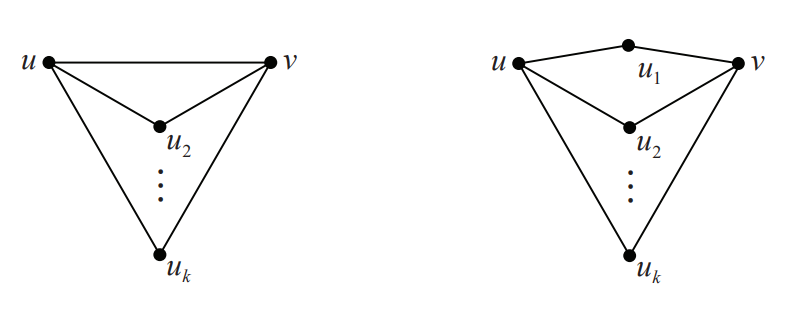
For this case, we notice that \(u\) and \(v\) are both \(3^{+}\)-vertices, and \(u_{2}\) is a 2-vertex such that \([uvu_2]\) is a 3-face. So by Claim 2, one can conclude that \(G\) is facially entire 7-colorable.
\(\bullet\) \(v\in N_2(u)\).
Then \(uv\notin E(G)\). It follows immediately that \(T(u, v)=\{u_1, \ldots, u_k\}\). By Claim 1, neither \(u\) nor \(v\) can be a cut vertex, and hence \(G\) has been fixed, as shown in the right configuration of Figure 1.
At this moment, we observe that both \(u\) and \(v\) are \(3^+\)-vertices, and \(d_G(u_{1})=d_G(u_{2})=2\) such that \([uu_1vu_2]\) is a 4-face. Moreover, \(uv\notin E(G)\). Consequently, \(G\) is facially entire 7-colorable by Claim 3.
Subcase 2.2. \(|D_{G}(u)|=2\), say \(D_G(u)=\{v,w\}\).
It follows that \(d_G(v)\ge 3\) and \(d_G(w)\ge 3\). Moreover, the neighbors of \(u\) is either \(v\), or \(w\), or a 2-vertex that is adjacent to \(v\) or \(w\). That is, \(v, w\in N_{1}(u)\cup N_{2}(u)\). To obtain a facial entire 7-coloring of the graph \(G\), we have to consider three possibilities according to the situations of \(v\) and \(w\).
\(\bullet\) \(N_{2}(u)=\{v,w\}\).
Then \(uv\notin E(G)\) and \(d_G(u_i)=2\) for all \(i=1,2,\ldots, k\). By the planarity of \(G\), assume w.l.o.g., that \(T(u,v)=\{u_1, \ldots, u_j\}\) and \(T(u,w)=\{u_{j+1}, \ldots, u_k\}\), and suppose that \(j\ge 2\) due to \(k\ge 3\). Note that \([uu_1vu_2]\) (if \(j=2\) then \(u_2=u_j\)) is a 4-face; otherwise, \(v\) has some neighbor inside of the 4-cycle \(uu_1vu_2u\) and thus \(v\) becomes a cut vertex of \(G\), which contradicts Claim 1. Hence, by Claim 3, \(G\) is facially entire 7-colorable.
\(\bullet\) \(N_1(u)=\{v, w\}\).
As \(k\ge 3\), we have that either \(|T(u,v)|\ge 1\) or \(|T(u,w)|\ge 1\). W.l.o.g., assume that \(|T(u,v)|\ge 1\). It implies that there is a 2-vertex \(u_{i}\in T(u,v)\) such that \([uu_{i}v]\) is a 3-face, and therefore \(G\) is facially entire 7-colorable by applying Claim 2.
\(\bullet\) By symmetry, suppose that \(v\in N_1(u)\) and \(w\in N_2(u)\).
If \(T(u,v)\ne \emptyset\), then there exists a 2-vertex \(u_{i}\in T(u,v)\) such that \([uu_iv]\) is a 3-face. Hence, by Claim 2, \(G\) is facially entire 7-colorable. Otherwise, assume that \(|T(u,w)|\ge 2\). Namely, there are consecutive two 2-vertices, say \(u_j, u_{j+1}\in T(u,w)\), so that \([uu_{j}wu_{j+1}]\) is a 4-face. By Claim 3, we conclude that \(G\) is facially entire 7-colorable.
This completes the proof of Theorem 3.1. ◻
This research was supported by the Zhejiang Natural Science Foundation of China (Grant Nos. LZ23A010004, LR25A010002) and the National Natural Science Foundation of China (Grant No. 12371360).