
This work is part of a larger research project, [6, 7, 3], that seeks to find and classify the graded contractions of various \(\mathbb{Z}^3_2\)-gradings on all the exceptional complex Lie algebras simultaneously. A graded contraction of a \(G\)-graded Lie algebra \(L\), for a finite abelian group \(G\), is another Lie algebra \(L^\varepsilon\) which can be obtained from the original algebra \(L\) and from a particular map \(\varepsilon\colon G\times G\to \mathbb C\). Obtaining the new Lie algebra entails modifying the bracket of homogeneous elements by scaling them with a constant determined by the map \(\varepsilon\). Finding the graded contractions means finding the maps \(\varepsilon\) that turn \(L^\varepsilon\) into a Lie algebra, which incidentally, is usually ‘‘more abelian’’ than the original one. The notion of graded contraction was introduced by physicists in the early 1990s [2, 4] as a generalisation of Wigner-Inönü contractions. There is a plethora of different concepts regarding contractions, degenerations and deformations, which physicists study in connection with limit theories (see [9, Chapter 5] on applications of the Lie theory to physics). From an algebraic point of view, the graded contractions can contribute significantly to the ongoing classification of solvable Lie algebras. This contribution tends to come about by providing unknown and unexpected examples, in dimensions which pose difficulties.
A pair of sufficient conditions for a map \(\varepsilon\) to produce a graded contraction are given by \(\varepsilon_{jk}=\varepsilon_{kj}\) and \(\varepsilon_{jk}\varepsilon_{l,j+k}=\varepsilon_{jl}\varepsilon_{k,j+l}=\varepsilon_{kl}\varepsilon_{j,k+l}\), if \(G=\{g_0,\dots, g_n\}\) and \(\varepsilon_{jk}:=\varepsilon(g_j,g_k)\). (These are also necessary conditions if the grading under study is sufficiently symmetrical, as the ones considered in [3].) In particular, the set of pairs \(\{\{j,k\} : \varepsilon_{jk} \neq 0\}\), called the support of \(\varepsilon\), satisfies a certain absorbing property. We call any set of pairs satisfying this property, in the case \(G=\mathbb Z_2^3\), a generalised nice set (see Definition 2.5). This terminology is chosen because these sets formally extend the nice sets introduced in [6]. There it was shown that nice sets coincide with the supports of the graded contractions of the \(\mathbb{Z}_2^3\)-grading \(\Gamma_{\mathfrak g_2}\) on the exceptional Lie algebra \(\mathfrak g_2\). This grading is itself induced by the natural \(\mathbb{Z}_2^3\)-grading \(\Gamma_{\mathcal O}\) on the complex octonions described in [8]. The classification of nice sets up to collineations played a central role in [6], where it enabled a complete classification of the graded contractions of \(\Gamma_{\mathfrak g_2}\). In the same spirit, the classification of generalised nice sets is the first step towards understanding the graded contractions of the gradings on the exceptional Lie algebras \(\mathfrak f_4\), \(\mathfrak e_6\), \(\mathfrak e_7\), and \(\mathfrak e_8\) induced by \(\Gamma_{\mathcal O}\) via Tits’ construction. These ideas have been further developed in [3], where the results of the present work are used to construct a large family of new solvable and nilpotent Lie algebras arising from such contractions, whose nilpotency and solvability indices can be determined directly from the support.
Previous results of this kind, computing the graded contractions of a fixed \(G\)-graded Lie algebra \(L\), appear in [14, 13] for Lie algebras \(L\) of dimension \(8\). Their calculations rely heavily on computer algebra systems. In [6] we explored the nice sets as a tool to classify the \(\mathbb Z_2^3\)-graded contractions of the complex exceptional Lie algebra \(\mathfrak g_2\), of dimension \(14\), without computer assistance. Our new combinatorial object, the generalised nice set, allows us to obtain graded contractions for algebras of dimensions as large as \(52\), \(78\), \(133\), and \(248\), also without computer assistance! This is a challenging task: for comparison, there are only \(24\) nice sets up to collineations, while there are \(245\) pairwise non-collinear generalised nice sets (see Section 8). Although we will provide our classification of generalised nice sets without computer, we have added Section 7, where we use computer algorithms to give an independent, alternative proof of the exact equivalence classes in the classification of generalised nice sets. The assistance these algorithms offer lies mainly in the verification of the many technical calculations involved in describing all the distinct equivalence classes. In the computational approach, one considers all \(2^{36}\) initial possibilities and reduces them to a few hundred candidates, after which identifying the exact distinct classes becomes a subtle affair. Computer assistance helps avoid small technical errors that may arise when distinguishing among the many equivalence classes, but it plays no role in the manual classification itself.
The paper is structured as follows. In Section 2 we introduce the main object of this paper, namely the generalised nice sets, after recalling some preliminary background on nice sets and collineations. We prove some general properties that allow us to split the combinatorial classification problem into four mutually exclusive cases, depending on the specific forms that generalised nice sets may take. We address these cases in the following four sections: Section 3 deals with generalised nice sets contained in the set \(X\) of edges of the Fano plane, Section 4 is devoted to generalised nice sets having empty intersection with \(X\), in Section 5 we study generalised nice sets whose intersection with \(X\) is not generalised nice, and lastly, generalised nice sets whose non-empty intersection with \(X\) is generalised nice are considered in Section 6. Our main results are Corollary 3.3, Proposition 4.2, Theorem 5.8 and Theorem 6.3, which give exact criteria to determine whether a set is generalised nice. The equivalence classes up to collineations are shown in tables scattered throughout the work. A short summary is provided in Section 8. As a bonus, Section 7 provides computer algorithms implemented in Maple as an alternative method to find the exact equivalence classes in the classification of generalised nice sets.
Our problem can also be viewed as a combinatorial one on abelian groups (see, for instance, [5, 10] for related approaches). Generalised nice sets correspond bijectively to subsets of \(G \times G\) satisfying a suitable absorbing property, while collinearity corresponds to passage through an automorphism of the group. For our abelian group \(G = \mathbb Z_2^3\), the simple group \(\mathrm{Aut}(\mathbb Z_2^3)\) is isomorphic to the group of collineations of the Fano plane.
Our generalised nice sets may also be interpreted as configurations consisting of points and segments (portions of lines between two points) in an extended Fano plane. The Fano plane — the unique projective plane of order 2 — appears repeatedly throughout mathematics (see the survey [16]). Combinatorial and geometric configurations often remain dormant for some time before their usefulness becomes apparent, and the literature provides many examples of this phenomenon (see, e.g., [1] and the references therein). In particular, a rich collection of open problems concerning point–line geometries in finite projective spaces can be found in [12]. The work [15] is especially relevant here, as it links classical line configurations with exceptional complex Lie algebras of type E; some of the octonionic gradings appearing there are precisely those to which the results of this paper apply.
Let \(I := \{1,\ldots,7\}\) and \(I_0 := I \cup \{0\}\). Consider the following pictorial summary of the Fano plane with its 7 lines, each consisting of 3 points in \(I\):
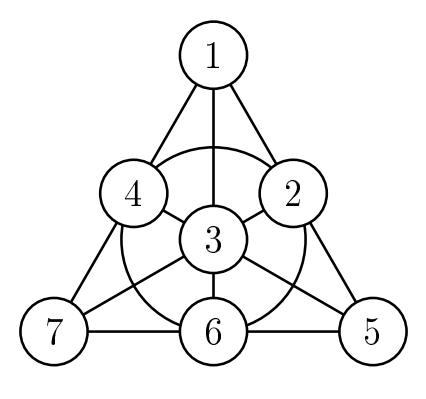
That is, \({\bf L} = \{\{1,2,5\},\, \{5,6,7\},\, \{7,4,1\},\, \{1,3,6\},\, \{6,4,2\},\, \{2,7,3\},\, \{3,4,5\}\}\). Note that the lines are not ordered and that any two different lines intersect at exactly one point. For \(i,j \in I\), \(i \ne j\), we let \(i \ast j\) denote the unique element in \(I \setminus \{i,j\}\) which lies on the same line as \(i\) and \(j\) in the above picture. Furthermore, we denote by \(\ell_{ij}\) the line containing both \(i\) and \(j\), i.e. \(\ell_{ij} = \{i,j,i \ast j\} \in {\bf L}\). We extend \(\ast\) to an operation on \(I_0\) by setting \(0 \ast i = i \ast 0 = i\), \(0 \ast 0 = 0\), and \(i \ast i = 0\) for any \(i \in I\).
A collineation (also called an automorphism or symmetry) of the Fano plane is a permutation of \(I\) which preserves collinearity. That is, it must carry collinear points (points on the same line) to collinear points. In other words, a bijective map \(\sigma\colon I \to I\) is called a collineation if \(\sigma(i * j) = \sigma(i) * \sigma(j)\) for all \(i, j \in I\) with \(i \ne j\). We write \(S_\ast(I)\) for the group consisting of all collineations of the Fano plane. We extend this definition to maps on \(I_0\) by setting \(S_\ast(I_0)=\{\sigma\colon I_0 \to I_0\ \text{bijective} : \sigma(i * j)=\sigma(i)*\sigma(j)\text{ for all } i,j\in I_0\}\). Any \(\sigma\in S_\ast(I_0)\) automatically fixes \(0\), since \(0\) is the neutral element for the extended operation. Thus the restriction map \(S_\ast(I_0)\to S_\ast(I)\) given by \(\sigma\mapsto\sigma|_I\) is well defined and preserves composition. Moreover, this map is an isomorphism. Indeed, every \(\tau\in S_\ast(I)\) extends uniquely to an element of \(S_\ast(I_0)\) by fixing \(0\). Since \(\tau(i * j)=\tau(i)*\tau(j)\) for all distinct \(i,j\in I\), the extension also respects the extended operation on \(I_0\). For simplicity, we will therefore refer to elements of \(S_\ast(I_0)\) as collineations.
As in [6, Definition 3.9 and 3.12], we call pairwise distinct elements \(i, j, k \in I\) generative if \(k\neq i\ast j\). We may also refer to the whole triplet \(\{i,j,k\}\) as generative because the definition is independent of the order of the elements. Collineations preserve generative triplets in the following sense: if \(\{i,j,k\}\) is generative, then the image \(\{\sigma(i),\sigma(j),\sigma(k)\}\) is also generative for every \(\sigma\in S_\ast(I)\). Furthermore, any two generative triplets \(\{i, j, k\}\) and \(\{i', j', k'\}\) determine a unique \(\sigma\in S_\ast(I)\) such that \(\sigma(i)=i'\), \(\sigma(j)=j'\), and \(\sigma(k)=k'\). In particular, if \(i, j, k\) are generative, setting \(\sigma(1)=i\), \(\sigma(2)=j\), and \(\sigma(3)=k\) uniquely determines \(\sigma\in S_\ast(I)\), since the remaining values of \(\sigma\) are forced by the preservation of \(\ast\). This collineation will be denoted \(\sigma_{ijk}\). Thus the whole group \(S_\ast(I)=\{\sigma_{ijk}\colon i,j,k\in I\ \text{generative}\}\) has \(7\cdot 6\cdot 4=168\) elements: we may choose \(i\in I\) arbitrarily, \(j\ne i\), and finally \(k\ne i,j,i*j\). This group is the well-known simple group \(\mathrm{PGL}(3,2)\) ([11, p.131]).
The work [6] classified admissible graded contractions of a fine \(\mathbb Z_2^3\)-grading on the complex simple Lie algebra \(\mathfrak{g}_2\), up to certain equivalence relations. To solve this problem, the authors adopted a combinatorial approach based on the so-called nice sets. These are the subsets of the set of edges of the Fano plane, \[\label{eq:Xdef} X := \{\{i, j\} : i, j \in I,\ i \neq j\},\] which satisfy a certain absorbing property.
Definition 2.1. ([6, Definition 3.9]) A subset \(T\) of \(X\) is called nice if the presence of \(\{i, j\}, \{i\ast j, k\} \in T\), for some generative \(i, j, k \in I\), implies that the set \[\label{eq_defP} P_{\{i,j,k\}} := \{\{i, j\}, \{j,k\}, \{k,i\}, \{i, j\ast k\}, \{j, k\ast i\}, \{k, i\ast j\}\}, \tag{1}\] is fully contained in \(T\).
Notice that for generative \(i,j,k\in I\), the set \(P_{\{i,j,k\}}\) is nice, has cardinality \(6\), and is independent of the order of the indices \(i,j,k\). For any line \(\ell \in \mathbf{L}\) and any \(i \in I\), some further examples of nice sets in \(X\) are:
– \(X_{\ell} := \{\{i,j\} \in X : i,j \in \ell\}\);
– \(X_{\ell^C} := \{\{i,j\} \in X : i,j \notin \ell\}\);
– \(X_{(i)} := \{\{i,j\} \in X : j \ne i\}\);
– \(X^{(i)} := \{\{j,k\} \in X : j * k = i\}\).
If \(\{i,j,k\}\) is a generative triplet, the following set of cardinality \(10\) is also nice: \[\begin{aligned} \label{eq_losTes} T_{(i,j,k)} :=& P_{\{i,j,k\}} \cup \big\{\{ i,i*j \},\{ i,i*k \},\{ i*j,i*k \},\{ i,i*j*k \}\big\} \\[3pt] =& P_{\{i, j, k\}} \cup P_{\{i, j,\, i \ast k\}} \cup P_{\{i,\, i \ast j, k\}} \\[3pt] =& X_{(i)} \cup \big\{\{ i*k,i*j \},\{ j,i*k \},\{ j,k \},\{ k,i*j \}\big\}. \end{aligned}\]
Note that the definition of \(T_{(i,j,k)}\) does depend on the order of its indices. In particular, the first index \(i\) plays a different role from the other two indices \(j\) and \(k\). The complete list of nice sets can be extracted from [6, Proposition 3.23 and 3.25]:
Theorem 2.2. ([7, Theorem 3.9]) The nice sets are exactly the following: \(X\), \(X\setminus X_{\ell^C}\), \(P_{\{i,j,k\}}\), \(T_{(i,j,k)}\), \(X^{(i)}\), and any subset of \(X_{\ell}\), \(X_{\ell^C}\), or \(X_{(i)}\), for some \(\ell\in\mathbf{L}\), \(i\in I\), \(j\in I\) with \(i\ne j\), and \(k\in I\) with \(k\notin\ell_{ij}\).
According to [6, Remark 3.29], there are exactly 779 nice sets. Each nice set induces a new \(\mathbb Z_2^3\)-graded Lie algebra obtained by graded contraction of \(\mathfrak g_2\) ([6, Proposition 3.11]), as well as two further Lie algebras obtained by graded contraction of the orthogonal Lie algebras \(\mathfrak{so}(7,\mathbb C)\) and \(\mathfrak{so}(8,\mathbb C)\) (see Definitions 3.1 and 3.10 in [7]). However, in all three cases, the Lie algebras associated to collinear nice sets are necessarily isomorphic.
Remark 2.3. ([6, Definition 3.16]) A natural action of the group \(S_\ast(I)\) on \(X\) is given by \(\widetilde{\sigma}(\{i,j\})=\{\sigma(i),\sigma(j)\}\), for \(\sigma\in S_\ast(I)\) and \(\{i,j\}\in X\). Hence there is an induced natural action of \(S_\ast(I)\) on \(\mathcal{P}(X)\). This yields an equivalence relation on the set of all nice sets: we write \(T \sim_c T'\) if there exists \(\sigma\in S_\ast(I)\) such that \(\widetilde{\sigma}(T)=T'\). In this case we say that \(T\) and \(T'\) are collinear. (The terminology is admittedly somewhat misleading—the sets \(T\) and \(T'\) need not consist of points lying on a single geometric line—but we retain it for consistency with [6, 7].)
The classification of nice sets up to collineations is made interesting by the combination of the facts that any nice set induces a Lie algebra and that collinear nice sets induce isomorphic Lie algebras. This classification is achieved in [6, Theorem 3.27], according to which there exist exactly 24 classes of nice sets up to collineations. Moreover, three of these classes give rise to infinite families of non-isomorphic Lie algebras depending on parameters ([6, Theorem 4.13]).
Now, inspired by the nice sets described above, we introduce a new type of structure. It is shown in [3] that this structure appears as the support of every graded contraction of the \(\mathbb Z_2^3\)-gradings induced from the complex octonion algebra on the four exceptional complex Lie algebras other than \(\mathfrak g_2\). A philosophy similar to that of [7] yields interesting new families of high-dimensional solvable Lie algebras. This is the main motivation for defining and studying the generalised nice sets, introduced below.
Denote by \(X_0 := \{ \{i, j\} : i, j \in I_0\}\) a set of cardinality \(36\) containing all \(21\) edges in \(X\). The extension of notation from nice sets to the current context introduces some ambiguity. In particular, \(X_0\) is not a subset of \(\mathcal P(I_0)\), since \(\{i, j\}\) does not refer to a subset of \(I_0\) but instead to an unordered pair with two (not necessarily distinct) elements in \(I_0\). To clarify, the pairs \(\{i, i\}\) belong to \(X_0\). Consider also the sets \[X_E := \big\{\{i, i\} : i \in I_0 \big\}, \qquad X_F := \big\{\{0, i\} : i \in I_0 \big\},\] so that \(X_0 = X \cup X_E \cup X_F\). We also continue to use the notation \(P_{\{i,j,k\}}\) from (1), this time using arbitrary indices \(i, j, k \in I_0\) instead of generative \(i, j, k \in I\).
Remark 2.4. It is useful to have the different possible forms of the subsets \(P_{\{i,j,k\}}\) written explicitly. To be precise, if \(i\) and \(j\) in \(I\) are distinct, then:
\(P_{\{0,0,0\}} = \big\{ \{0,0\} \big\};\)
\(P_{\{0,0,i\}} = \big\{ \{0,i\}, \{0,0\} \big\};\)
\(P_{\{i,i,i\}} = \big\{ \{0,i\}, \{i,i\} \big\};\)
\(P_{\{0,i,i\}} = \big\{ \{0,i\}, \{i,i\}, \{0,0\} \big\};\)
\(P_{\{i,i,j\}} = \big\{ \{i,i\}, \{i,j\}, \{j,0\}, \{i,i\ast j\} \big\};\)
\(P_{\{0,i,j\}} = \big\{ \{0,i\}, \{0,j\}, \{0,i\ast j\}, \{i,j\} \big\};\)
\(P_{\{i,j,i\ast j\}} = \big\{ \{i,j\}, \{j,i\ast j\}, \{i,i\ast j\}, \{i,i\}, \{j,j\}, \{i\ast j,i\ast j\} \big\}.\)
Observe that the cardinalities are, respectively, \(1, 2, 2, 3, 4, 4\), and \(6\), in contrast with the case where \(i,j,k\in I\) are generative (where the cardinality is always \(6\)).
Definition 2.5. A subset \(T\) of \(X_0\) is said to be a generalised nice set if \(\,\{i,j\},\,\{i\ast j,k\} \in T\) implies \(P_{\{i,j,k\}} \subseteq T\), for any \(i,j,k \in I_0\).
The term we have assigned to it, generalised, may cause some confusion because a nice set need not be generalised. If \(T \subseteq X\) is a generalised nice set, then \(T\) is nice, but, for instance, the nice set \(X\) is not a generalised nice set. The justification for the use of this term is the formal similarity between the two definitions.
We begin by noticing some trivial facts.
Lemma 2.6. The following hold for a generalised nice set \(T \subseteq X_0\) and for any \(i, j \in I\).
\(T \cap X\) is a nice set;
if \(\{i,0\} \in T\), then \(\{0,0\} \in T\);
if \(\{i, i \ast j\}\) and \(\{j, i \ast j\} \in T\), then \(\{i \ast j, i \ast j\} \in T\);
if \(T \subseteq X\), then \(T \cup \big\{\{0,0\}\big\}\) is generalised nice.
Proof. The proof of (i) is immediate. For (ii), if \(\{i,0\} \in T\), then \(\{0,0\} \in P_{\{i,0,0\}} \subseteq T\), so the claim follows. A similar argument proves (iii): if \(\{i, i \ast j\}\) and \(\{j, i \ast j\} \in T\), then \(P_{\{i,\, i \ast j,\, i \ast j\}} \subseteq T\). For (iv), assume that \(\{i,j\}\) and \(\{i \ast j, k\} \in T \cup \{\{0,0\}\}\), and let us verify that \(P_{\{i,j,k\}} \subseteq T \cup \{\{0,0\}\}\). If \(i = j = 0\), then \(\{0,k\} \in T \cup \{\{0,0\}\}\) forces \(k = 0\), and \(P_{\{0,0,0\}} = \{\{0,0\}\} \subseteq T \cup \{\{0,0\}\}\). If this is not the case but \(i \ast j = k = 0\), then \(i = j \neq 0\), which contradicts the fact that \(\{i,j\}\in T \subseteq X\) (since elements of \(X\) always have distinct entries). Finally, if both \(\{i,j\}\) and \(\{i \ast j, k\}\) lie in \(T\) itself, then the conclusion follows directly from the fact that \(T\) is generalised nice. ◻
Remark 2.7. In contrast to the context of nice sets, we see that sets of the form \(P_{\{i,j,k\}}\) are not necessarily generalised nice. For instance, \(P_{\{i, i, i\}}\) is not for \(i\neq 0\), since it does not satisfy Lemma 2.6(ii). In what follows, we write \(\langle S \rangle\) to denote the smallest generalised nice set containing a given subset \(S\subseteq X_0\). It is easy to check that \(\langle P_{\{i, i, i\}} \rangle = P_{\{0, i, i\}}\). Similarly, \(P_{\{i, i, j\}}\) is not generalised nice, and \[\label{eq_auxiliar} \langle P_{\{i, j, i\}} \rangle = \big\{\{0,0\},\{0,i\},\{0,j\},\{0,i\ast j\}, \{i,i\},\{i,j\},\{i,i\ast j\}\big\}. \tag{2}\]
Indeed, if \(T\) is any generalised nice set containing \(P_{\{i,j,i\}}\), then \(\{i,i\ast j\}\) and \(\{j,0\}\) belong to \(T\), and so \(\{0,i\},\{0,i\ast j\}\in P_{\{i,i\ast j,0\}}\subseteq T\). Recall that \(\{0,0\}\in T\) by Lemma 2.6(ii). Thus, the set on the right-hand side of (2) is contained in \(T\). We are finished because that set is already generalised nice.
The notion of collinearity recalled in Remark 2.3 extends to our setting without change: the group \(S_\ast(I_0)\) acts on \(X_0\) by \(\widetilde{\sigma}(\{i,j\}) = \{\sigma(i),\sigma(j)\}\) for \(\sigma \in S_\ast(I_0)\) and \(\{i,j\} \in X_0\). Therefore, \(S_\ast(I_0)\) acts on \(\mathcal{P}(X_0)\) as well. Two generalised nice sets \(T\) and \(T'\) are said to be collinear, denoted \(T \sim_c T'\), if there exists \(\sigma \in S_\ast(I_0)\) such that \(\widetilde{\sigma}(T) = T'\).
The main aim of this paper is to obtain a classification of generalised nice sets up to collineation. Notice that any generalised nice set \(T \subseteq X_0\) can be written as \(T = (T \cap X) \cup (T \setminus X)\), where \(T \cap X\) is a nice set by Lemma 2.6(i). In order to make this combinatorial problem more manageable, we will split our study of generalised nice sets into the following four cases:
\(T \subseteq X;\)
\(T \cap X = \emptyset;\)
\(T \cap X\) is not generalised nice;
\(T \cap X \neq \emptyset\) and \(T \cap X\) is generalised nice.
We close this section with a result relating the parts \(T \setminus X\) and \(T \cap X\) from the previous decomposition of \(T\):
Proposition 2.8. The following are equivalent for a generalised nice set \(T\) with both \(T \setminus X\) and \(T \cap X\) non-empty:
\(T \setminus X\) is not a generalised nice set.
There exist distinct \(i, j \in I\) such that \(\langle P_{\{i,j,i\}} \rangle \subseteq T\).
There exist distinct \(i, j \in I\) such that \(\{i,i\},\,\{0,j\} \in T\).
\(T \cap X\) is not a generalised nice set.
Proof. (i) \(\Rightarrow\) (ii). There exist \(a, b, c \in I_0\) such that \(\{a, b\}, \{a \ast b, c\} \in T \setminus X\) but \(P_{\{a, b, c\}} \nsubseteq T \setminus X\). As \(P_{\{a, b, c\}} \subseteq T\), this means that \(P_{\{a, b, c\}} \cap X \neq \emptyset\). Since \(\{a, b\}, \{a \ast b, c\} \in \big\{\{i,i\} : i \in I_0\big\} \cup \big\{\{i,0\} : i \in I\big\}\), we can narrow the possibilities for \(\{a,b,c\}\) to \[\{0,0,0\},\ \{0,0,i\},\ \{0,i,i\},\ \{i,i,i\},\ \{i,i,j\},\] with \(i\) and \(j\) distinct elements of \(I\). In the first four cases the corresponding sets \(P_{\{0,0,0\}}\), \(P_{\{0,0,i\}}\), \(P_{\{0,i,i\}}\) and \(P_{\{i,i,i\}}\) are contained in \(T \setminus X\). Therefore none of those possibilities can occur. The only remaining possibility is \(\{a,b,c\} = \{i,i,j\}\), and then \(P_{\{i,i,j\}} \subseteq T\).
(ii) \(\Rightarrow\) (iii) is clear, since \(\{i,i\}\) and \(\{0,j\}\) both belong to \(P_{\{i,i,j\}}\).
(iii) \(\Rightarrow\) (i). Let \(i, j \in I\) with \(i \neq j\) and \(\{i,i\}, \{0,j\} \in T\). Since \(T\) is generalised nice, we have \(P_{\{i,i,j\}} \subseteq T\). Notice that both \(\{i,i\}\) and \(\{0,j\}\) lie in \(T \setminus X\). If \(T \setminus X\) were itself a generalised nice set, then \(P_{\{i,i,j\}} \subseteq T \setminus X\). This is impossible, because \(\{i,j\} \in P_{\{i,i,j\}}\) but \(\{i,j\} \in X\).
(ii) \(\Rightarrow\) (iv). Let \(i, j \in I\) with \(i \neq j\) and \(\langle P_{\{i,i,j\}} \rangle \subseteq T\). In particular, \(\{i,j\}\) and \(\{i \ast j, i\}\) belong to \(T \cap X\). However, \(P_{\{i,j,i\}} \nsubseteq T \cap X\) (since \(\{i,i\} \notin X\)), and thus (iv) holds.
(iv) \(\Rightarrow\) (ii). Since \(T \cap X\) is not generalised nice, there exist pairwise distinct \(i,j,k \in I\) such that \(\{i,j\}, \{i \ast j, k\} \in T \cap X\) but \(P_{\{i,j,k\}} \nsubseteq T \cap X\). If \(i,j,k\) were generative, then all the elements of \(P_{\{i,j,k\}}\) would lie in \(X\), and since \(P_{\{i,j,k\}} \subseteq T\), we would obtain the contradiction \(P_{\{i,j,k\}} \subseteq T \cap X\). Therefore \(k\) must be either \(i\) or \(j\) (note that \(k \neq i \ast j\) because \(\{i \ast j, k\} \in X\)). Relabelling if necessary, we may assume \(k = i\), so that \(P_{\{i,j,i\}} \subseteq T\). Since \(T\) is generalised nice, it follows that \(\langle P_{\{i,j,i\}} \rangle \subseteq T\). ◻
Corollary 2.9. Let \(T\) be a generalised nice set with \(T \cap X \neq \emptyset\) and \(T \setminus X \neq \emptyset\). Then \(T \setminus X\) is generalised nice if and only if \(T \cap X\) is generalised nice.
We begin by characterising the generalised nice sets that are contained in \(X\).
Proposition 3.1. A subset \(T\) of \(X\) is a generalised nice set if and only if it satisfies the following two conditions:
\(T\) is a nice set.
There is no \(i \in I\) such that \(\{i,j\},\,\{i,i \ast j\} \in T\) for some \(j \in I\) with \(j \neq i\).
Remark 3.2. Notice that condition (ii) above can be equivalently rephrased as:
(ii)’ \(\quad |T \cap X_{\ell_{ij}}| \le 1\), where \(X_{\ell_{ij}}=\big\{\{i,j\},\,\{i,i\ast j\},\,\{j,i\ast j\}\big\}\).
Proof. Suppose first that \(T \subseteq X\) is a generalised nice set. Then \(T\) clearly satisfies (i). Assume that \(T\) does not satisfy (ii). Then there exists \(i \in I\) and some \(j \in I\) with \(j \neq i\) such that \(\{i,j\},\,\{i,i \ast j\} \in T\). This implies that \(P_{\{i,j,i\}} \subseteq T\), and therefore \(\{i,i\} \in T\), a contradiction since we are assuming \(T \subseteq X\). Conversely, assume that \(T \subseteq X\) satisfies (i) and (ii). Take \(i,j,k \in I_0\) such that \(\{i,j\},\,\{i \ast j, k\} \in T\). Since \(T \subseteq X\), we necessarily have \(i,j \in I\) with \(i \neq j\), and also \(i\ast j \neq k \in I\). Moreover, (ii) ensures that \(k \notin \{i,j\}\). Thus \(i,j,k\) are generative, and by (i) we obtain \(P_{\{i,j,k\}} \subseteq T\). ◻
Corollory 3.3. There are 14 generalised nice sets contained in \(X\) up to collineation: the empty set and
– Cardinal 1: \(\, \, \big\{ \{1, 2\} \big\}\).
– Cardinal 2: \(\, \, \big\{ \{1, 2\}, \, \{1, 3\} \big\}, \, \, \big\{ \{1, 2\}, \, \{6, 7\} \big\}\).
– Cardinal 3: \(\, \, \big\{ \{1, 2\}, \, \{1, 3\}, \{1, 4\} \big\}, \, \, \big\{ \{1, 2\}, \, \{1, 3\}, \{1, 7\} \big\}\),
\(\qquad \qquad \qquad\,\, \big\{ \{1, 2\}, \, \{1, 6\}, \{2, 6\} \big\}, \, \, \, \big\{ \{1, 2\}, \, \{1, 6\}, \{6, 7\} \big\}\), \(\big\{ \{2, 5\}, \, \{3, 6\}, \{4, 7\} \big\}\).
– Cardinal 4: \(\, \, \big\{ \{1, 2\}, \, \{1, 6\}, \{1, 7\}, \{2, 6\} \big\}, \, \, \big\{ \{1, 2\}, \, \{1, 6\}, \{2, 7\}, \{6, 7\} \big\}.\)
– Cardinal 5: \(\, \, \big\{ \{1, 2\}, \, \{1, 6\}, \{1, 7\}, \{2, 6\}, \{2, 7\} \big\}\).
– Cardinal 6: \(\, \, \big\{ \{3, 4\}, \, \{3, 6\}, \{3, 7\}, \{4, 6\}, \{4, 7\}, \{6, 7\} \big\}\),
\(\qquad \qquad \qquad \,\, \big\{ \{1, 2\}, \, \{1, 3\}, \{2, 3\}, \{1, 7\}, \{2, 6\}, \{3, 5\} \big\}\).
Proof. The list \(\{T_i : i = 1, \dots, 24\}\) in [6, Theorem 3.27] exhibits all nice sets up to collineations. (Two subsets of \(X\) are collinear if and only if they are so as subsets of \(X_0\).) Now we only have to check which of these sets satisfy condition (ii) in Proposition 3.1. A direct inspection shows that \(T_2\), \(T_3\), \(T_5\), \(T_7\), \(T_8\), \(T_{10}\), \(T_{11}\), \(T_{12}\), \(T_{15}\), \(T_{16}\), \(T_{18}\), \(T_{19}=X_{\ell_{12}^c}\), and \(T_{21}=P_{\{1,2,3\}}\) are the only non-empty nice sets which are also generalised nice. ◻
In this section, we determine all the generalised nice sets (up to collineations) that have an empty intersection with \(X\). We begin by noticing a trivial, but useful, fact.
Lemma 4.1. If \(T\) is a generalised nice set such that \(T \cap X = \emptyset\), there are no distinct \(i,j \in I\) such that \(\{0,i\}\) and \(\{j,j\} \in T\).
Proof. This is clear since \(\{i,j\} \in P_{\{j,j,i\}} \cap X.\) (Alternatively, it is an immediate consequence of (iii)\(\Rightarrow\)(iv) in Proposition 2.8, since \(\emptyset\) is a generalised nice set.) ◻
Proposition 4.2. If \(T\) is a generalised nice set such that \(T \cap X = \emptyset\), then either
there is \(i \in I\) with \(T = P_{\{0,i,i\}} = \big\{\{0,i\}, \{i,i\}, \{0,0\}\big\}\), or
\(\big\{\{0,0\}\big\} \subseteq T \subseteq X_F = \big\{\{0,i\} : i \in I_0\big\}\), or
\(T \subseteq X_E \setminus \big\{\{0,0\}\big\} = \big\{\{i,i\} : i \in I\big\}\).
Moreover, any set \(T \subseteq X_0 \setminus X\) satisfying one of the cases in (a), (b) or (c) is a generalised nice set.
Proof. First, it is clear that all these sets are generalised nice. In case (b), for each \(\{0,i\} \in T\), we must have \(P_{\{0,0,i\}} = \{\{0,i\}, \{0,0\}\} \subseteq T\). In case (c) there is nothing to check, because there are no \(a,b,c\) with \(\{a,b\}, \{a \ast b, c\} \in T\), since \(\{0,c\} \notin T\).
Second, assume that \(\emptyset \neq T \subseteq X_0 \setminus X\) is generalised nice. By Lemma 4.1, either there exists \(i \in I\) with \(\{0,i\}, \{i,i\} \in T\), or \(T \subseteq X_F = \big\{\{0,i\} : i \in I_0\big\}\), or \(T \subseteq X_E = \big\{\{i,i\} : i \in I_0\big\}\). In the first situation, \(\{0,0\} \in P_{\{0,i,i\}} \subseteq T\), and then \(P_{\{0,i,i\}} = T\), because any element of \(T \setminus P_{\{0,i,i\}}\) would be either \(\{0,j\}\) with \(j \neq i\) (contradicting \(\{i,i\} \in T\)), or \(\{j,j\}\) with \(j \neq i\) (contradicting \(\{i,0\} \in T\)). If \(T \subseteq X_F\), either \(\{0,0\} \in T\) or there exists \(i \in I\) with \(\{0,i\} = \{i,0\} \in T\). In either case, \(\{0,0\} \in T\), since \(\{0,0\} \in P_{\{0,i,0\}}\). If \(T \subseteq X_E\), note that \(\{i,i\}, \{0,0\} \in T\) would imply \(\{0,i\} \in P_{\{i,i,0\}} \subseteq T\), a contradiction. Thus, if \(\big\{\{0,0\}\big\} \neq T \subseteq \big\{\{i,i\} : i \in I_0\big\}\), we may conclude that \(\{0,0\} \notin T\). ◻
The above proposition describes all the generalised nice sets having empty intersection with \(X\); we now only need to be cautious to avoid collinear repetitions. First, \(P_{\{0,i,i\}} = \big\{\{0,0\}, \{0,i\}, \{i,i\}\big\} \sim_c P_{\{0,1,1\}}\) for any \(i \in I\). Second, if \(J, J' \subseteq I\), then the generalised nice sets \(\big\{\{0,0\}, \{0,i\} : i \in J\big\}\) and \(\big\{\{0,0\}, \{0,i\} : i \in J'\big\}\) are collinear if and only if \(J\) and \(J'\) are collinear. This means that we have one possibility for each cardinality \(|J| = 0, 1, 2, 5, 6,\) or \(7\) (for instance, choosing 5 indices from \(I\) is equivalent to choosing the remaining two). The other two possibilities are \(|J| = 3\) or \(4\). If \(|J| = 3\), we must distinguish whether the three elements in \(J\) form a line or not. Similarly, if \(|J| = 4\), the complementary set \(I \setminus J\) may or may not form a line. This leaves 10 different possibilities with \(\big\{\{0,0\}\big\} \subseteq T \subseteq X_F\). Finally, the discussion for \(\big\{\{i,i\} : i \in J\big\}\), with \(J \subseteq I\), is exactly the same. Such a set is collinear to \(\big\{\{i,i\} : i \in J'\big\}\) if and only if \(J\) and \(J'\) are collinear. Hence the same possibilities arise as before, that is, 10 possibilities with \(T \subseteq X_E\), including the empty set. In total, we obtain 21 generalised nice sets up to collineations which do not intersect \(X\). These are compiled in the Table 1.
| Generalised nice sets \(T\) such that \(T \cap X = \emptyset\) | |
|---|---|
| \(|T|\) | All possible \(T\)’s |
| \(|T|\) | All possible \(T\)’s |
| 0 | \(\emptyset\) |
| 1 | \(\big\{ \{0,0\} \big\}\) |
| \(\big\{ \{1,1\} \big\}\) | |
| 2 | \(\big\{ \{0,0\}, \{0,1\} \big\}\) |
| \(\big\{ \{1,1\}, \{2,2\} \big\}\) | |
| 3 | \(\big\{ \{0,0\}, \{0,1\}, \{0,2\} \big\}\) |
| \(\big\{ \{0,0\}, \{0,1\}, \{1,1\} \big\}\) | |
| \(\big\{ \{1,1\}, \{2,2\}, \{3,3\} \big\}\) | |
| \(\big\{ \{1,1\}, \{2,2\}, \{5,5\} \big\}\) | |
| 4 | \(\big\{ \{0,0\}, \{0,1\}, \{0,2\}, \{0,3\} \big\}\) |
| \(\big\{ \{0,0\}, \{0,1\}, \{0,2\}, \{0,5\} \big\}\) | |
| \(\big\{ \{1,1\}, \{2,2\}, \{3,3\}, \{4,4\} \big\}\) | |
| \(\big\{ \{1,1\}, \{2,2\}, \{3,3\}, \{5,5\} \big\}\) | |
| 5 | \(\big\{ \{0,0\}, \{0,1\}, \{0,2\}, \{0,3\}, \{0,4\} \big\}\) |
| \(\big\{ \{0,0\}, \{0,1\}, \{0,2\}, \{0,3\}, \{0,5\} \big\}\) | |
| \(\big\{ \{1,1\}, \{2,2\}, \{3,3\}, \{4,4\}, \{5,5\} \big\}\) | |
| 6 | \(\big\{ \{0,0\}, \{0,1\}, \{0,2\}, \{0,3\}, \{0,4\}, \{0,5\} \big\}\) |
| \(\big\{ \{1,1\}, \{2,2\}, \{3,3\}, \{4,4\}, \{5,5\}, \{6,6\} \big\}\) | |
| 7 | \(\big\{ \{0,i\} : i = 0,\ldots,6 \big\}\) |
| \(\big\{ \{i,i\} : i = 1,\ldots,7 \big\}\) | |
| 8 | \(X_F = \big\{ \{0,i\} : i = 0,\ldots,7 \big\}\) |
Here, we focus our attention on the generalised nice sets \(T\) such that \(T \cap X\) is not generalised nice (in particular, \(\emptyset \neq T \cap X\) and \(T \not\subseteq X\)). Proposition 2.8 tells us that this is equivalent to requiring that \(\langle P_{\{i,j,i\}} \rangle \subseteq T\) for some distinct \(i, j \in I\). Without loss of generality, we may assume \(i=1\) and \(j=2\), so that \[\langle P_{\{1,2,1\}} \rangle = \big\{\{0,0\}, \{0,1\}, \{0,2\}, \{0,5\}, \{1,1\}, \{1,2\}, \{1,5\}\big\} \subseteq T.\] As will become clear later, it is convenient to analyse what happens when we enlarge \(T\) by adding elements of \(X_0\).
Lemma 5.1. Let \(T\) be a generalised nice set such that \(\langle P_{\{1, 2, 1\}} \rangle \subseteq T\). If there exists \(\{i, j\} \in X^{(1)}=\big\{\{2, 5\}, \{3, 6\}, \{4, 7\}\big\}\) such that \(T \cap \big\{\{i, i\}, \{j, j\}, \{i, j\}\big\} \neq \emptyset\), then \(\big\{\{i, i\}, \{j, j\}, \{i, j\}\big\} \subseteq T\).
Proof. Suppose first that \(\{i,i\} \in T\). Since \(\{0,1\} \in T\), we obtain \(P_{\{i,i,1\}} \subseteq T\), and therefore \(\{i, i\ast 1\} = \{i,j\} \in T\). Now assume that \(\{i,j\} \in T\). Since \(\{1,1\} \in T\), we obtain \(P_{\{i,j,1\}} \subseteq T\), and hence \(\{i,i\}, \{j,j\} \in T\). ◻
Lemma 5.2. Let \(T\) be a generalised nice set such that \(\langle P_{\{1, 2, 1\}} \rangle \cup \big\{\{1,k\}\big\} \subseteq T\) for some \(k = 3,4,6,7\). Then:
\(|T \cap X| \geq 4\). More precisely, \(\big\{\{1,2\}, \{1,k\}, \{1,5\}, \{1,k*1\}\big\} \subseteq T\).
If \(\{2,5\} \in T\), then \(\{2,k\} \in T\).
Proof. From \(\{0,1\} \in T\), we obtain \(P_{\{0,1,k\}} \subseteq T\); in particular \(\{0,k*1\} \in T\). From \(\{1,1\}, \{0,k*1\} \in T\), we obtain \(P_{\{1,1,k*1\}} \subseteq T\), and hence \(\{1,k*1\} \in T\). This proves (i). Also, from \(\{2,5\}\) and \(\{1,k\} \in T\) we obtain \(P_{\{2,5,k\}} \subseteq T\), and therefore \(\{2,k\} \in T\). ◻
Lemma 5.3. Let \(T\) be a generalised nice set such that \(\langle P_{\{1,2,1\}} \rangle \subseteq T\). If \(T\) contains either \(\{0,k\}\) or \(\{1,k\}\) with \(k \ne 1\), then \(\{\{0,k\}, \{0,k*1\}, \{1,k\}, \{1,k*1\}\} \subseteq T.\)
Proof. We may assume \(k = 3,4,6,7\) (for \(k = 2,5\) there is nothing to prove). Suppose first that \(\{0,k\} \in T\). From \(\{1,1\} \in T\) we obtain \(P_{\{1,1,k\}} \subseteq T\), and therefore \(\{1,k\}, \{1,k*1\} \in T\). Next, from \(\{0,k\}, \{k,1\} \in T\) we get \(P_{\{0,k,1\}} \subseteq T\), which implies \(\{0,k*1\} \in T\).
Now assume instead that \(\{1,k\} \in T\). By Lemma 5.2(i) we already have \(\{1,k\}, \{1,k*1\} \in T\). Then, from \(\{0,1\}, \{1,k\} \in T\) we obtain \(P_{\{0,1,k\}} \subseteq T\), and hence \(\{0,k\}, \{0,k*1\} \in T\) as well. ◻
Proposition 5.4. The following assertions hold for a generalised nice set \(T\) such that \(\langle P_{\{1,2,1\}} \rangle \subseteq T\). Let \(j \in \{2,5\}\) and \(k \in \{3,4,6,7\}\).
If \(\{j,k\} \in T\), then \(T_{(1,j,k)} \subseteq T \cap X\).
If \(\{j*k,k\} \in T\), then \(T_{(1,j*k,k)} \subseteq T \cap X\).
Proof. (i) First recall that \(\{1,j\}\) and \(\{1,j*1\}\) belong to \(P_{\{1,2,1\}} \subseteq T\). From \(\{1,j*1\}, \{j,k\} \in T\) we deduce that \(P_{\{1,j*1,k\}} \subseteq T\), and therefore \(\{k,j*1\}, \{j*1,k*1\} \in T\). Next, from \(\{1,j\}, \{j*1,k*1\} \in T\) we get \(P_{\{1,j,k*1\}} \subseteq T\), and from \(\{1,j\}, \{j*1,k\} \in T\) we obtain \(P_{\{1,j,k\}} \subseteq T\). Altogether this shows that \(T_{(1,j,k)} = P_{\{1,j,k\}} \cup P_{\{1,j,k*1\}} \cup P_{\{1,k,j*1\}} \subseteq T .\)
(ii) From \(\{j*k,k\}, \{j,1\} \in T\) we deduce \(P_{\{j*k,k,1\}} \subseteq T\), hence \(\{j*k,k*1\}\) and \(\{j*k*1,k\}\) also belong to \(T\). Using the elements \(\{j*k,k*1\}\) and \(\{j*1,1\} \in T\), we obtain \(P_{\{j*k,k*1,1\}} \subseteq T\), and using \(\{j*k*1,k\}\) and \(\{j*1,1\} \in T\) we similarly get \(P_{\{j*k*1,k,1\}} \subseteq T\). These imply that \(T_{(1,j*k,k)} \subseteq T \cap X\), as required. ◻
Corollary 5.5. Let \(T\) be a generalised nice set such that \(\langle P_{\{1,2,1\}} \rangle \subseteq T\). If \(\{k,k\} \in T\) for some \(k \in \{3,4,6,7\}\), then \(\{k, k*2\} \in T\). Moreover, \(T \cap X\) is either equal to \(X\) or equal to \(X \setminus X_{\ell^C_{1k}}\).
Proof. From \(\{k,k\}, \{0,2\} \in T\) we deduce that \(P_{\{k,k,2\}} \subseteq T\), and hence \(\{2,k\}, \{k,k*2\} \in T\). Now Proposition 5.4 tells us that \(T_{(1,2,k)} \cup T_{(1,k,k*2)} \subseteq T \cap X\). From this we obtain \(\{k,2\}, \{k*2,k*1\} \in T\), which implies \(P_{\{k,2,k*1\}} \subseteq T\) and therefore \(\{k,k*1\} \in T\). The same argument can be repeated by replacing the index \(2\) with the index \(5\). Thus, \[X \setminus X_{\ell^C_{1k}} = T_{(1,2,k)} \cup T_{(1,5,k)} \cup T_{(1,k,k*2)} \cup T_{(1,k,k*5)} \cup \big\{\{k,k*1\}\big\} \subseteq T \cap X.\]
If this containment is strict, [6, Theorem 3.27] shows that \(T \cap X = X\), which is the only nice set with more than 15 elements. ◻
Theorem 5.6. Let \(T\) be a generalised nice set such that \(\langle P_{\{1,2,1\}} \rangle \subseteq T\). Then the following hold:
If \(|T \cap X_E| = 2\), then \(|T \cap X| \in \{2,4,6,10\}\). More precisely:
if \(|T \cap X| = 2\), then \(T \cap X = \{\{1,2\},\{1,5\}\}\);
if \(|T \cap X| = 4\), then \(T \cap X = \{\{1,2\},\{1,k\},\{1,5\},\{1,k*1\}\}\) for some \(k \in \{3,4,6,7\}\);
if \(|T \cap X| = 6\), then \(T \cap X = X_{(1)} = \{\{1,2\},\{1,3\},\{1,4\},\{1,5\},\{1,6\},\{1,7\}\}\);
if \(|T \cap X| = 10\), then \(T \cap X = T_{(1,j,k)}\) or \(T_{(1,j*k,k)}\) for some \(j \in \{2,5\}\) and \(k \in \{3,4,6,7\}\).
If \(|T \cap X_E| > 2\), then \(|T \cap X| \in \{3,15,21\}\). More concretely:
if \(|T \cap X| = 3\), then \(T \cap X = X_{\ell_{12}}\);
if \(|T \cap X| = 15\), then there exists \(s \in I \setminus \{1\}\) such that \(T \cap X = X \setminus X_{\ell^C_{1s}}\);
if \(|T \cap X| = 21\), then \(T \cap X = X\).
Proof. Let us begin by recalling that the possible cardinals for non-empty nice sets are \(\{1,2,3,4,5,6,10,15,21\}\) by [6, Theorem 3.27]. By Lemma 2.6(i), \(T \cap X\) is nice.
(i) If \(|T \cap X_E| = 2\), then \(T \cap X_E = \big\{\{0,0\}, \{1,1\}\big\}\) since \(\langle P_{\{1,2,1\}} \rangle \subseteq T\). In this case \(\big\{\{2,5\}, \{3,6\}, \{4,7\}\big\} \cap T = \emptyset\) by Lemma 5.1. This already shows that \(T \cap X \ne X\).
First, let us check that the only possibilities for \(|T \cap X| \le 9\) are \(2\), \(4\), and \(6\). We know that \(\{1,2\}, \{1,5\} \in T\), so \(T \cap X\) has at least two elements. For any \(j = 2,5\) and any \(k = 3,4,6,7\), we have \(\{j,k\} \notin T\) by Proposition 5.4(i). Similarly, \(\{j*k,k\} \notin T\) by Proposition 5.4(ii). Therefore, the only possible elements in \(T \cap X\) distinct from \(\{1,2\}\) and \(\{1,5\}\) are of the form \(\{1,k\} \in T\) for some \(k = 3,4,6,7\). If \(\{1,k\} \in T\), then \(\big\{\{1,2\}, \{1,k\}, \{1,5\}, \{1,k*1\}\big\} \subseteq T\) by Lemma 5.2(i). If, moreover, there is another element in \(T \cap X\) besides those four, it must be of the form \(\{1,k'\}\) with \(k' \in \{3,4,6,7\}\), and then Lemma 5.2(i) again applies to give \(X_{(1)} \subseteq T \cap X\). These sets are necessarily equal, since there are no further elements of \(X\) left to add.
Second, consider the case \(|T \cap X| = 10\), that is, there exist generative \(\{i,j,k\}\) with \(T \cap X = T_{(i,j,k)}\). Since \(\{1,2\}, \{1,5\} \in T_{(i,j,k)}\), we must have \(i = 1\). The possibilities for \(j\) and \(k\) (interchangeable) with \(j*k \ne 1\) follow immediately.
Third, if \(|T \cap X| = 15\), then \(T \cap X = X \setminus X_{\ell^C_{ij}}\) for some \(i,j \in I\), \(i \ne j\). This set contains the elements \(\{i,l\}, \{j,l\}\) and \(\{i*j,l\}\) for every \(l \in I\). In particular, \(\{i,j\}, \{i,i*j\}, \{j,i*j\} \in T\), so \(P_{\{j,i,j\}} \subseteq T\), which yields \(\{j,j\} \in T \cap X_E\), and analogously \(\{i,i\}, \{i*j,i*j\} \in T \cap X_E\). This contradicts the assumption that \(|T \cap X_E| = 2\).
(ii) Suppose now that \(|T \cap X_E| > 2\). We distinguish two cases.
Case 1: \(T \cap X_E\) contains \(\{k,k\}\) for some \(k = 3,4,6,7\). Then Corollary 5.5 applies and shows that \(T \cap X\) equals either \(X\) or \(X \setminus X_{\ell^C_{1k}}\).
Case 2: \(T \cap X_E\) contains no element \(\{k,k\}\) with \(k = 3,4,6,7\). Thus it contains either \(\{2,2\}\) or \(\{5,5\}\), and in fact it contains both by Lemma 5.1. Moreover, \(\{2,5\} \in T \cap X\). If \(|T \cap X| = 3\), then \(T \cap X = \big\{\{1,2\}, \{1,5\}, \{2,5\}\big\} = X_{\ell_{12}}\). Otherwise, assume \(|T \cap X| > 3\). Then there exist \(j \in \{2,5\}\) and \(k \in \{3,4,6,7\}\) such that one of \(\{j,k\}\), \(\{j*k,k\}\), \(\{1,k\}\), or \(\{1*k,k\}\) belongs to \(T\) (all elements of \(X \setminus X_{\ell_{12}}\) have one of these forms). We claim that in each of these cases \(|T \cap X| \ge 11\). Indeed:
If \(\{j,k\} \in T\), then Proposition 5.4(i) gives \(T_{(1,j,k)} \subseteq T \cap X\). Since \(\{2,5\} \notin T_{(1,j,k)}\), the containment is strict.
If \(\{j*k,k\} \in T\), then Proposition 5.4(ii) gives \(T_{(1,j*k,k)} \subseteq T \cap X\), and again \(\{2,5\} \notin T_{(1,j*k,k)}\).
If \(\{1,k\} \in T\), then Lemma 5.2(ii) yields \(\{2,k\} \in T\), and we apply (a).
If \(\{k*1,k\} \in T\), then using \(\{1,2\} \in T\) we obtain \(P_{\{k*1,k,2\}} \subseteq T\), hence \(\{2,k\} \in T\), and again (a) applies.
As \(T \cap X \ne X\) (since \(\langle X \rangle = X_0\) contains \(X_E\)), there exist indices \(i,s\) such that \(T \cap X = X \setminus X_{\ell^C_{i,s}}\). As in the proof of (i), the three elements \(\{i,i\}, \{s,s\}, \{i*s,i*s\} \in T \cap X_E\), so \(\{i,s,i*s\} = \{1,2,5\}\) and therefore \(T \cap X = X \setminus X_{\ell^C_{1,2}}\). ◻
Corollary 5.7. Let \(T\) be a generalised nice set such that \(\langle P_{\{1,2,1\}} \rangle \subseteq T\). Then there exists \(\sigma \in S_\ast(I_0)\) with \(\tilde\sigma(\langle P_{\{1,2,1\}} \rangle) = \langle P_{\{1,2,1\}} \rangle\) such that \(\tilde\sigma(T \cap X)\) equals one of the following nice sets:
– \(\big\{\{1,2\}, \{1,5\}\big\};\)
– \(X_{\ell_{12}} = \big\{\{1,2\}, \{1,5\}, \{2,5\}\big\};\)
– \(\big\{\{1,2\}, \{1,3\}, \{1,5\}, \{1,6\}\big\};\)
– \(X_{(1)} = \{\{1,l\} : l = 2,\dots,7\};\)
– either \(T_{(1,2,3)}\) or \(T_{(1,3,4)}\);
– either \(X \setminus X_{\ell^C_{12}}\) or \(X \setminus X_{\ell^C_{13}}\);
– \(X.\)
Keeping this in mind, we can finally determine the generalised nice sets whose intersection with \(X\) is not generalised nice.
Theorem 5.8. There are 8 generalised nice sets \(T\) up to collineation such that \(T\cap X\) is not a generalised nice set:
– Cardinal 7: \(\langle P_{\{1, 2, 1\}} \rangle= \big\{\{0,0\},\{0,l\},\{1,l\}:l\in\{1,2,5\}\big\}\);
– Cardinal 10: \(\langle P_{\{1, 2, 1\}} \rangle \cup \big\{\{2, 2\}, \{2, 5\}, \{5, 5\}\big\}=\langle P_{\{1, 2, 5\}}\rangle\);
– Cardinal 11: \(\langle P_{\{1, 2, 1\}} \rangle \cup \big\{\{0, 3\}, \{0, 6\}, \{1, 3\}, \{1, 6\}\big\}\);
– Cardinal 15: \(\big\{\{0,0\},\{0,l\},\{1,l\}:l=1,\dots,7\big\}\);
– Cardinal 19: \(\big\{\{0,0\},\{0,l\},\{1,l\}:l=1,\dots,7\big\}\cup\big\{\{2, 3\}, \{5, 3\}, \{2,6\}, \{5,6\}\big\}\);
– Cardinal 26: \(X_0\setminus\big\{\{k,l\}:k,l\in\{3,4,6,7\}\big\}\);
– Cardinal 36: \(X_0.\)
Proof. We can assume, as in Theorem 5.6, that \(\langle P_{\{1, 2, 1\}} \rangle \subseteq T\). Then the set \(P := \big\{\{0,0\}, \{0,1\}, \{0,2\}, \{0,5\}, \{1,1\}\big\}\) is contained in \(T \setminus X\). Recall that \(T = (T \cap X) \cup (T \cap X_E) \cup (T \cap X_F)\). In what follows, we examine all the possibilities for \(T \cap X\) as in Corollary 5.7. We will repeatedly use Theorem 5.6 (and its proof) without further mention.
– If \(T \cap X = \big\{\{1,2\}, \{1,5\}\big\}\), then \(|T \cap X_E| = 2\). Also, \(\{0,k\} \notin T\) for \(k = 3,4,6,7\) by Lemma 5.3, and therefore \(T = \langle P_{\{1, 2, 1\}} \rangle\).
– If \(T \cap X = X_{\ell_{12}}\), then \(\{2,5\} \in T\), which implies \(\{2,2\}, \{5,5\} \in T\) by Lemma 5.1. Again, for any \(k = 3,4,6,7\), we have \(\{0,k\} \notin T\) by Lemma 5.3 and \(\{k,k\} \notin T\) by Corollary 5.5. This implies \(T \setminus X = P \cup \big\{\{2,2\}, \{5,5\}\big\}\), and therefore \(T = \langle P_{\{1, 2, 1\}} \rangle \cup \big\{\{2,2\}, \{2,5\}, \{5,5\}\big\}\).
– If \(T \cap X = \big\{\{1, 2\}, \{1, 3\}, \{1, 5\}, \{1, 6\}\big\}\), we know \(T \cap X_E=\big\{\{0, 0\}, \{1,1\}\big\}\) (by Theorem 5.6), and \(\{0, 3\}, \{0, 6\} \in T \setminus X\), while \(\{0, 4\}, \{0, 7\} \notin T\) by Lemma 5.3. From here, \(T \setminus X = P \cup \big\{\{0, 3\}, \{0, 6\}\big\}\) and \(T = \langle P_{\{1, 2, 1\}} \rangle \cup \big\{\{0, 3\}, \{0, 6\}, \{1, 3\}, \{1, 6\}\big\}.\)
– Similarly, if \(T \cap X = X_{(1)}\), again \(T \cap X_E=\big\{\{0,0\}, \{1,1\}\big\}\), but now \(\{0,k\} \in T \setminus X\) for all \(k=3,4,6,7\) by Lemma 5.3. We get \(T \setminus X = P \cup \big\{\{0,3\}, \{0,4\}, \{0,6\}, \{0,7\}\big\},\) so that \(T = \langle P_{\{1, 2, 1\}} \rangle \cup \big\{\{0,3\}, \{0,4\}, \{0,6\}, \{0,7\}, \{1,3\}, \{1,4\}, \{1,6\}, \{1,7\}\big\}.\)
– Next consider the case \(|T \cap X|=10\), corresponding to \(T \cap X_E=\big\{\{0,0\}, \{1,1\}\big\}\). Up to a suitable collineation, we may assume \(T \cap X\) equals either \(T_{(1,2,3)}\) or \(T_{(1,3,4)}\). In either case, since \(\{1,k\} \in T\) for any \(k=3,4,6,7\), Lemma 5.3 implies \(\{0,k\} \in T\), and thus \(T \setminus X = X_F \cup \big\{\{1,1\}\big\}.\) Hence \(T = \langle P_{\{1,2,1\}} \rangle \cup X_F \cup (T \cap X).\) These two cases give, respectively, \[\label{conjuntouno} \big\{\{0,0\},\{0,l\},\{1,l\}:l=1,\dots,7\big\}\cup\big\{\{2,3\},\{5,3\},\{2,6\},\{5,6\}\big\}, \tag{3}\] and \[\label{conjuntodos} \big\{\{0,0\},\{0,l\},\{1,l\}:l=1,\dots,7\big\}\cup\big\{\{3,4\},\{4,6\},\{6,7\},\{7,3\}\big\}. \tag{4}\]
Although no collineation \(\sigma\) satisfies simultaneously \(\tilde\sigma(\langle P_{\{1,2,1\}}\rangle)=\langle P_{\{1,2,1\}}\rangle\) and \(\tilde\sigma(T_{(1,2,3)})=T_{(1,3,4)}\), the sets in (3) and (4) are collinear via, for instance, \(\sigma_{143}\).
– Assume \(T \cap X = X \setminus X_{\ell^C_{1k}}\) for some \(k\ne 1\). As \(\{1, l\}\in T\) for all \(l\in I\), Lemma 5.3 says that \(\{0, l\}\in T\) too. We need to find the elements in \(T \cap X_E\). We claim that \(\{l, l\}\in T\) if \(l=0,1,k,k*1\), and \(\{l, l\}\notin T\) otherwise. Indeed, as \(\{k, 1\},\{k*1,k\}\in T\cap X\), then \(P_{\{k,1,k\}}\subseteq T\) and \(\{k, k\}\in T\). Similarly, \(\{k*1, k*1\}\in T\) (as above, since \(\{k*1, 1\},\{k*1,k\}\in T\cap X\)). If we further assume there is \(l\in I\), \(l\ne 1,k,k*1\) with \(\{l, l\}\in T\), we will reach a contradiction. In fact, since \(\{0, 1\}\in T\) we have \(P_{\{l,l,1\}}\subseteq T\), so that \(\{l, l*1\}\in T\cap X\). This forces either \(l\) or \(l*1\) to belong to \(\ell_{1k}=\{1,k,k*1\}\), which is our contradiction. We conclude that the only elements in \(X_0 \setminus T\) are those of the form \(\{l, l'\}\) with \(l,l'\ne 1,k,k*1\) (\(l'\) possibly equal to \(l\)). This set is clearly collinear to the one obtained from any other choice of \(k\).
– If \(T \cap X = X\), then since \(\{2,5\},\{3,6\},\{4,7\} \in T\), Lemma 5.1 implies \(X_E\subseteq T\). Also, \(\{1,k\}\in T\) for all \(k=3,4,6,7\), hence \(\{0,k\}\in T\) by Lemma 5.3. Thus \(T=X_0\).
Finally, we must show that all the sets listed in the statement are generalised nice. Since \(T \cap X\) is nice and \(\{0,0\} \in T\), it is enough to check the following closure conditions for any distinct indices \(i,j \in I\):
If \(\{i,i\} \in T\), then \(\{0,i\} \in T\);
If \(\{0,i\}, \{i,j\} \in T\), then \(\{0,j\}, \{0,i*j\} \in T\);
If \(\{0,i\}, \{j,j\} \in T\), then \(\{i,j\}, \{j,i*j\} \in T\);
If \(\{i,i*j\}, \{i,j\} \in T\), then \(\{i,i\}, \{0,j\} \in T\);
If \(\{i*j,i*j\}, \{i,j\} \in T\), then \(\{i,i\}, \{j,j\}, \{j,i*j\}, \{i,i*j\} \in T\).
A direct verification shows that all the sets in the theorem satisfy these conditions. ◻
Given a generalised nice set \(T \subseteq X_0\), we write, as before, \(T = (T \cap X) \cup (T \setminus X)\). In this section, we study the remaining case, namely when both \(T \cap X\) and \(T \setminus X\) are non-empty and generalised nice (see Proposition 2.8). Notice that \(T \cap X\) is a nice set by Lemma 2.6(i), and so, up to collineation, it must be one of the nice sets listed in Corollary 3.3. Concerning \(T \setminus X\), since it clearly has empty intersection with \(X\), it must be collinear to one of the generalised nice sets displayed in Table 1. At first sight, one might expect that this reduces to simply putting the pieces of a puzzle together. Unfortunately, matters are not so straightforward, since not every possible combination produces a generalised nice set. To illustrate this, consider \(\big\{\{1, 1\}, \{2, 2\}\big\}\) and \(\big\{\{2, 5\}, \{3, 6\}, \{4, 7\}\big\}\). The union of these two sets is not generalised nice, because the resulting set \(T\) does not contain the set \(P_{\{2, 5, 1\}}\).
We begin by proving necessary conditions for \(T \setminus X\) to be generalised nice:
Lemma 6.1. Let \(T\) be a generalised nice set such that \(T \setminus X\) is generalised nice. Then there are no distinct \(i, j \in I\) such that \(\{i, i\}, \{j, i \ast j\} \in T\).
Proof. Suppose, to the contrary, that \(\{j, i \ast j\}, \{i, i\} \in T\) for some \(i, j \in I\) with \(i \neq j\). Then \(P_{\{j, i \ast j, i\}} \subseteq T\). In particular, \(\{i, j\} \in T\), and since \(\{i \ast j, j\} \in T\), we obtain \(P_{\{i, j, j\}} \subseteq T\). Therefore \(\{0, i\}, \{j, j\} \in T\), and by Proposition 2.8 this implies that \(T \setminus X\) is not generalised nice, a contradiction. ◻
Lemma 6.2. The following conditions hold for a generalised nice set \(T\) containing \(\{0, i\}\), for some \(i \in I\).
If \(\{i, j\} \in T \cap X\) for \(j \in I\) with \(j \neq i\), then \(\{0, j\}\) and \(\{0, i \ast j\}\) belong to \(T \setminus X\).
If \(\{j, k\} \in (T \cap X) \cap X^{(i)}\) for \(j, k \in I\), then \(\{0, j\}\) and \(\{0, k\}\) belong to \(T \setminus X\).
Proof. (i) Since \(T\) is generalised nice, we have \(P_{\{0, i, j\}} \subseteq T\), which implies \(\{0, j\}\) and \(\{0, i \ast j\} \in T\).
(ii) As \(j \ast k = i\), from \(\{j, k\}, \{i, 0\} \in T\) we obtain \(P_{\{j, k, 0\}} \subseteq T\), because \(T\) is generalised nice. Thus \(\{0, j\}\) and \(\{0, k\} \in T \setminus X\). ◻
The next step is to consider sufficient conditions for obtaining a generalised nice set \(T\) as the combination of two generalised nice sets, namely \(T \cap X\) and \(T \setminus X\). Recall from Proposition 4.2 (applied to \(T \setminus X\)) that either \(T \setminus X \subseteq X_E \setminus \big\{\{0, 0\}\big\} =: X_E^*\), or \(\{0,0\} \in T \setminus X \subseteq X_F\), or \(T \setminus X = P_{\{0, i, i\}}\) for some \(i \in I\), and every such set is generalised nice. We analyse these three situations in the following theorem.
Theorem 6.3. Take a nonempty generalised nice set \(\emptyset \ne S \subseteq X\), and a subset \(J \subseteq I\).
\(S_J := S \cup \big\{ \{j,j\} : j \in J \big\}\) is a generalised nice set if and only if \(S \cap X^{(j)} = \emptyset\) for every \(j \in J\).
This is equivalent to the condition \(J \cap J_S = \emptyset\), where \(J_S := \{ a*b : \{a,b\} \in S \}\).
\(S'_J := S \cup \big\{ \{0,0\}, \{0,j\} : j \in J \big\}\) is a generalised nice set if and only if, for every \(\{a,b\} \in S\), we have either \(\ell_{ab} \cap J = \emptyset\) or \(\ell_{ab} \subseteq J\).
Denote \(I_S := \bigcup_{\{a,b\}\in S} \ell_{ab} = \{ a,b,a*b : \{a,b\}\in S \}\). Then:
If \(J \cap I_S = \emptyset\), then \(S'_J\) is a generalised nice set. These conditions are equivalent when \(|J| \le 2\).
If \(I_S \subseteq J\), then \(S'_J\) is a generalised nice set. These conditions are equivalent when \(|J| \ge 5\).
If \(I_S = I\), then the only generalised nice set \(T = S \cup (T \setminus X)\) with \(\emptyset \ne T \setminus X \subseteq X_F\) is the one satisfying \(T \setminus X = X_F\).
\(\tilde S_i := S \cup P_{\{0,i,i\}}\) is a generalised nice set if and only if \(i \notin I_S\).
Proof. (a) Let us first consider the case \(T \setminus X \subseteq X_E^*\), that is, \(T = S_J\). In Lemma 6.1 we saw that, in order for \(S_J\) to be generalised nice, it is necessary that \(S \cap X^{(j)} = \emptyset\) for every \(j \in J\). However, this condition is also sufficient. Indeed, we must check that \(\{k,l\}, \{k*l, m\} \in S_J\) implies \(P_{\{k,l,m\}} \subseteq S_J\). If both pairs lie in \(X\), there is nothing to check, since \(S = S_J \cap X\) is generalised nice. Thus we only need to consider the case where one of the two pairs is \(\{j,j\}\) with \(j \in J\). If \(\{j,j\} = \{k,l\}\), then we obtain the contradiction \(\{0,m\} \in S_J\). Otherwise, \(\{j,j\} = \{k*l, m\}\), so that \(k*l = j\), that is, \(\{k,l\} \in X^{(j)}\). But \(\{k,l\} \in S\) (if \(\{k,l\} \in S_J \setminus S\), then \(k*l = 0\), which is impossible since \(j \ne 0\)), contradicting the hypothesis \(S \cap X^{(j)} = \emptyset\).
(b) Next assume that \(S'_J\) is a generalised nice set and take \(\{a,b\} \in S\) such that \(\ell_{ab} \cap J \ne \emptyset\). If either \(a\) or \(b\) belongs to \(J\), then \(\ell_{ab} = \{a,b,a*b\} \subseteq J\) by Lemma 6.2(i). Otherwise, the index belonging to \(J\) is \(a*b\), and we obtain \(\ell_{ab} \subseteq J\) by Lemma 6.2(ii). Conversely, assume that for every \(\{a,b\} \in S\) either \(\ell_{ab} \cap J = \emptyset\) or \(\ell_{ab} \subseteq J\), and let us prove that \(S'_J\) is generalised nice. Take \(\{k,l\}, \{k*l, m\} \in S'_J\) and let us check that \(P_{\{k,l,m\}} \subseteq S'_J\). If both pairs lie in \(X\), there is nothing to check, so assume that one of them coincides with either \(\{0,0\}\) or \(\{0,j\}\) for some \(j \in J\). If \(k = l = m = 0\), then \(P_{\{0,0,0\}} = \big\{\{0,0\}\big\} \subseteq S'_J\). If \(k = l = 0 \ne m\), then \(\{0,m\} \in S'_J\), and again it is clear that \(P_{\{0,0,m\}} = \big\{\{0,0\}, \{0,m\}\big\} \subseteq S'_J\). It is not possible that \(\{k,l\} \ne \{0,0\} = \{k*l, m\}\), since \(k = l\) but the only element in \(S'_J \cap X_E\) is \(\{0,0\}\). So assume that neither pair is \(\{0,0\}\). If \(\{k*l,m\} = \{0,j\}\) with \(j \in J\), then \(k = l\), which is impossible because \(\{k,k\} \notin S'_J\). Thus the only remaining possibility is \(\{k,l\} = \{0,j\}\), which gives \(k*l = 0*j = j\) and \(\{j,m\} \in S\). Since also \(j \in \ell_{jm} \cap J\), the hypothesis yields \(\ell_{jm} \subseteq J\), and hence the three elements \(\{0,j\}, \{0,m\}\) and \(\{0,j*m\}\) lie in \(S'_J\). Therefore \(P_{\{0,j,m\}} = \big\{\{0,j\}, \{0,m\}, \{0,j*m\}, \{j,m\}\big\} \subseteq S'_J\), which finishes case (b).
Next, let us consider the particular cases mentioned within (b).
(i) Since for every \(\{a,b\}\in S\) we have \(\ell_{ab}\subseteq I_S\), if \(J\cap I_S=\emptyset\) then \(\ell_{ab}\cap J=\emptyset\), and therefore \(S'_J\) is generalised nice. Moreover, when \(|J|\le 2\), the converse holds: if \(S'_J\) is generalised nice, then necessarily \(\ell_{ab}\cap J=\emptyset\) for every \(\{a,b\}\in S\) (because \(J\) cannot contain a line with three elements), which is equivalent to \(J\cap I_S=\emptyset\).
(ii) If \(I_S \subseteq J\), then for every \(\{a,b\} \in S\) we have \(\ell_{ab} \subseteq J\), which is one of the conditions ensuring that \(S'_J\) is generalised nice. If \(|J| \ge 5\), the converse also holds: if \(S'_J\) is generalised nice, then \(\ell_{ab} \subseteq J\) for every \(\{a,b\} \in S\), since \(J\) intersects each of the seven lines (\(I\setminus J\) has at most two elements, and therefore contains no line).
(iii) First, it is clear that if \(J = I\), then \(S'_J\) is generalised nice by (ii). Second, let us show that we obtain a contradiction if we assume \(I_S = I\), \(\emptyset \ne J \ne I\), and \(S'_J\) generalised nice. We may take \(j \in J\) and \(a \in I\setminus J\), by the condition on \(J\). Since \(j \in I_S\), there exists \(k \in I\) with either \(\{j,k\} \in S\) or \(\{j*k, k\} \in S\). As \(j \in \ell_{jk} \cap J\), we obtain \(\ell_{jk} \subseteq J\). Similarly, \(a \in I_S\) implies that there exists \(b \in I\) with either \(\{a,b\} \in S\) or \(\{a*b,b\} \in S\). Since \(\ell_{ab} \not\subseteq J\), it follows that \(\ell_{ab} \cap J = \emptyset\). But any two lines intersect, so \(\ell_{ab} \cap \ell_{jk} \ne \emptyset\). Since \(\ell_{jk} \subseteq J\) while \(\ell_{ab} \cap J = \emptyset\), their intersection would have to be simultaneously contained in \(J\) and disjoint from \(J\), a contradiction.
(c) Finally, assume that \(\tilde S_i=S\cup P_{\{0, i, i\}}\) is a generalised nice set. If \(i\in I_S\), then there is \(k\in I\) different from \(i\) such that either \(\{i, k\}\in S\) or \(\{i*k, k\}\in S\). In the first case, \(\{0,i\}\in \tilde S_i\) gives \(P_{\{0,i,k\}}\subseteq \tilde S_i\) and thus \(\{0,k\}\in \tilde S_i\setminus X\). In the second case, \(P_{\{i*k,k,0\}}\subseteq \tilde S_i\), and we obtain the same contradiction \(\{0,k\}\in \tilde S_i\setminus X = P_{\{0,i,i\}}\).
Conversely, take \(i\notin I_S\) and \(\{k,l\},\{k*l,m\}\in \tilde S_i\), with at least one of these two pairs not in \(S\). Let us check that \(P_{\{k,l,m\}}\subseteq \tilde S_i\). If \(\{k,l\}=\{0,0\}\), then \(k*l=0\) and the other element \(\{k*l,m\}\) belongs to \(\big\{\{0,0\},\{0,i\}\big\}\); in either case \(P_{\{0,0,0\}}\) and \(P_{\{0,0,i\}}\) are contained in \(\tilde S_i\). If \(\{k*l,m\}=\{0,0\}\ne\{k,l\}\), then \(k=l\), so \(\{k,l\}=\{i,i\}\), and clearly \(P_{\{i,i,0\}}\subseteq \tilde S_i\). Otherwise, either \(\{k,l\}=\{i,i\}\) or \(\{k,l\}=\{0,i\}\). In the first case \(\{k*l,m\}=\{0,i\}\) and \(P_{\{i,i,i\}}\subseteq \tilde S_i\). In the second case, \(\{k*l,m\}=\{i,m\}\in S\). As \(i\notin I_S\), necessarily \(m\) equals \(0\) or \(i\), and we fall back into a previously discussed situation. ◻
Let us continue by constructing generalised nice sets \(T\) as combinations of the generalised nice sets \(T \setminus X\) and \(T \cap X\), taken from Table 1 and Corollary 3.3, respectively (following the combination criteria given in Theorem 6.3). We may assume that \(T \cap X\) is, not only collinear but, equal to one of the generalised nice sets from Corollary 3.3, and go through all possibilities for \(T \setminus X\) up to collineation. For instance, if \(T \cap X = \big\{\{1, 2\}\big\}\) and \(T \setminus X \sim_c \big\{\{1, 1\}\big\}\), then there is \(i\in I\) with \(T \setminus X = \big\{\{i, i\}\big\}\), and Theorem 6.3(a) says that \(T\) is a generalised nice set for all \(i\ne 5\). Among the six possible combinations that yield a generalised nice set, there are only two that are not collinear: \(\big\{\{1,1\},\{1,2\}\big\}\) and \(\big\{\{3,3\},\{1,2\}\big\}\). Analogously, Theorem 6.3 allows us to determine which elements of \(X_0\setminus X\) can be added to each of the cases in Corollary 3.3 so that the resulting disjoint union is a generalised nice set; and our task then consists of checking the possible collineations.
We provide separate tables for each possible cardinality of \(T \setminus X\) and up to collinearity of \(T \setminus X\). More precisely, we will consider the following possibilities:
\(T \setminus X \subseteq X_E \setminus \big\{\{0,0\}\big\}=X_E^*\);
\(\{0,0\}\in T \setminus X \subseteq X_F\);
\(T \setminus X = P_{\{0,i,i\}}\) for some \(i\in I\).
To apply Theorem 6.3, it is convenient to compute beforehand the sets \(I_S\) and \(J_S\) defined there, for every nice set \(S\) listed in Corollary 3.3. This computation is straightforward. Table 2 presents the auxiliary indices for the Gns contained in \(X\).
| \(I_S\) | \(S\) | \(J_S\) |
|---|---|---|
| \(\{1,2,5\}\) | \(\big\{ \{1, 2\}\big\}\) | \(\{5\}\) |
| \(\{1,2,3,5,6\}\) | \(\big\{ \{1, 2\}, \{1, 3\}\big\}\) | \(\{5,6\}\) |
| \(\{1,2,5,6,7\}\) | \(\big\{ \{1, 2\}, \{6, 7\}\big\}\) | \(\{5\}\) |
| \(I=\{1,2,3,4,5,6,7\}\) | \(\big\{ \{2, 5\}, \{3, 6\}, \{4, 7\}\big\}\) | \(\{1\}\) |
| \(I\) | \(\big\{ \{1, 2\}, \{1, 3\}, \{1, 4\}\big\}\) | \(\{5,6,7\}\) |
| \(I\) | \(\big\{ \{1, 2\}, \{1, 3\}, \{1, 7\}\big\}\) | \(\{4, 5, 6\}\) |
| \(\{1,2,3,4,5,6\}=I-\{7\}\) | \(\big\{ \{1, 2\}, \{1, 6\}, \{2, 6\}\big\}\) | \(\{3,4,5\}\) |
| \(\{1,2,3,5,6,7\}=I-\{4\}\) | \(\big\{ \{1, 2\}, \{1, 6\}, \{6, 7\}\big\}\) | \(\{3,5\}\) |
| \(I\) | \(\big\{ \{1, 2\}, \{1, 6\}, \{1, 7\}, \{2, 6\}\big\}\) | \(\{3,4,5\}\) |
| \(\{1,2,3,5,6,7\}=I-\{4\}\) | \(\big\{ \{1, 2\}, \{1, 6\}, \{2, 7\}, \{6, 7\}\big\}\) | \(\{3,5\}\) |
| \(I\) | \(\big\{ \{1, 2\}, \{1, 6\}, \{1, 7\}, \{2, 6\}, \{2, 7\}\big\}\) | \(\{3,4,5\}\) |
| \(I\) | \(X_{\ell^c_{12}}\) | \(\{1,2,5\}\) |
| \(I\) | \(P_{\{1, 2, 3\}}\) | \(\{4,5,6,7\}\) |
Recall that the generalised nice sets of cardinality \(1\) contained in \(X_0 \setminus X\) are all of the form \(\big\{\{i,i\}\big\}\), for \(i \in I_0\). Moreover, Lemma 2.6(iv) tells us that \(S \cup \big\{\{0,0\}\big\}\) is generalised nice for any \(S\) as in Corollary 3.3. The resulting generalised nice sets are collected in the Table 3.
| Gns \(T\) such that both \(T \cap X\) and \(T \setminus X\) are non-empty gns | ||
| \(T \setminus X\) | \(T \cap X\) | All possible \(T\)’s |
| \(T \setminus X\) | \(T \cap X\) | All possible \(T\)’s |
| \(\big\{ \{0, 0\}\big\}\) | \(\big\{ \{1, 2\}\big\}\) | \(\big\{ \{0, 0\}, \{1, 2\}\big\}\) |
| \(\big\{ \{0, 0\}\big\}\) | \(\big\{ \{1, 2\}, \{1, 3\}\big\}\) | \(\big\{ \{0, 0\}, \{1, 2\}, \{1, 3\}\big\}\) |
| \(\big\{ \{0, 0\}\big\}\) | \(\big\{ \{1, 2\}, \{6, 7\}\big\}\) | \(\big\{ \{0, 0\}, \{1, 2\}, \{6, 7\}\big\}\) |
| \(\big\{\{0, 0\}\big\}\) | \(\big\{ \{2, 5\}, \{3, 6\}, \{4, 7\}\big\}\) | \(\big\{\{0, 0\}, \{2, 5\}, \{3, 6\}, \{4, 7\}\big\}\) |
| \(\big\{\{0, 0\}\big\}\) | \(\big\{ \{1, 2\}, \{1, 3\}, \{1, 4\}\big\}\) | \(\big\{\{0, 0\}, \{1, 2\}, \{1, 3\}, \{1, 4\}\big\}\) |
| \(\big\{ \{0, 0\}\big\}\) | \(\big\{ \{1, 2\}, \{1, 3\}, \{1, 7\}\big\}\) | \(\big\{\{0, 0\}, \{1, 2\}, \{1, 3\}, \{1, 7\}\big\}\) |
| \(\big\{ \{0, 0\}\big\}\) | \(\big\{ \{1, 2\}, \{1, 6\}, \{2, 6\}\big\}\) | \(\big\{\{0, 0\}, \{1, 2\}, \{1, 6\}, \{2, 6\}\big\}\) |
| \(\big\{ \{0, 0\}\big\}\) | \(\big\{ \{1, 2\}, \{1, 6\}, \{6, 7\}\big\}\) | \(\big\{\{0, 0\}, \{1, 2\}, \{1, 6\}, \{6, 7\}\big\}\) |
| \(\big\{ \{0, 0\}\big\}\) | \(\big\{ \{1, 2\}, \{1, 6\}, \{1, 7\}, \{2, 6\}\big\}\) | \(\big\{\{0, 0\}, \{1, 2\}, \{1, 6\}, \{1, 7\}, \{2, 6\}\big\}\) |
| \(\big\{ \{0, 0\}\big\}\) | \(\big\{ \{1, 2\}, \{1, 6\}, \{2, 7\}, \{6, 7\}\big\}\) | \(\big\{\{0, 0\}, \{1, 2\}, \{1, 6\}, \{2, 7\}, \{6, 7\}\big\}\) |
| \(\big\{ \{0, 0\}\big\}\) | \(\big\{ \{1, 2\}, \{1, 6\}, \{1, 7\}, \{2, 6\}, \{2, 7\}\big\}\) | \(\big\{ \{0, 0\}, \{1, 2\}, \{1, 6\}, \{1, 7\}, \{2, 6\}, \{2, 7\}\big\}\) |
| \(\big\{ \{0, 0\}\big\}\) | \(X_{\ell^c_{12}}\) | \(\big\{\{0, 0\}\big\} \cup X_{\ell^c_{12}}\) |
| \(\big\{ \{0, 0\}\big\}\) | \(P_{\{1, 2, 3\}}\) | \(\big\{\{0, 0\}\big\} \cup P_{\{1, 2, 3\}}\) |
Next, we consider generalised nice sets \(T\) such that \(T \setminus X\) is of the form \(\big\{\{i,i\}\big\}\) for \(i \in I\). As a direct application of Theorem 6.3(a), with the notations therein, we obtain:
Corollary 6.4. If \(S\subseteq X\) is a generalised nice set, then \(S_{\{j\}} = S \cup \big\{\{j,j\}\big\}\) is a generalised nice set if and only if \(S \cap X^{(j)} = \emptyset\), or equivalently, if \(j \notin J_S\).
Thus, to obtain the generalised nice sets \(T\) such that \(T \setminus X\) is of the form \(\big\{\{i,i\}\big\}\), for \(i \in I\) and \(T \cap X\) coinciding with a fixed generalised nice set \(S\), we only need to keep track of how many equivalence classes appear. Note that any \(\sigma\) such that \(\tilde\sigma(S_{\{i\}})=S_{\{j\}}\) (for \(i,j\notin J_S\)) also satisfies \(\tilde\sigma(S)=S\), so \(\sigma\) preserves \(I_S\) and \(J_S\), as well as the subsets of indices in \(I_S \setminus J_S\) with the same number of occurrences in elements of \(S\). Next we give a detailed description of how to use these tools.
\(-\) \(S=\big\{\{1,2\}\big\}\). As in the above corollary, \(S_{\{i\}}=\big\{\{1,2\},\{i,i\}\big\}\) is a generalised nice set if and only if \(i\ne5\). Now \(S_{\{1\}}\) is collinear to \(S_{\{2\}}\); for instance, \(\tilde\sigma(S_{\{1\}})=S_{\{2\}}\) for \(\sigma=\sigma_{213}\). Notice also that \(S_{\{3\}}\sim_c S_{\{4\}}\sim_c S_{\{6\}}\sim_c S_{\{7\}}\) are collinear to one another, since for any \(k\notin \ell_{12}\) the collineation \(\sigma=\sigma_{12k}\) satisfies \(\tilde\sigma(S_{\{3\}})=S_{\{k\}}\). However, \(S_{\{1\}}\) is not collinear to \(S_{\{3\}}\), because \(\sigma\) must preserve \(I_S \setminus J_S = \{1,2\}\), and therefore \(\tilde\sigma(\{1,1\}) \neq \{3,3\}\).
\(-\) \(S=\big\{\{1,2\},\{1,3\}\big\}\). In this case \(S_{\{i\}}\) is a generalised nice set whenever \(i\ne5,6\). Any collineation interchanging two of these sets must preserve the sets \(\{1\}\) and \(\{2,3\}\), so it must be either \(\sigma=\mathop{\mathrm{id}}\) or \(\sigma=\sigma_{132}\). In either case, \(\sigma\) sends \(7=2*3\) to \(7\), and therefore sends \(4=1*7\) to \(4\). Thus \(S_{\{2\}}\sim_c S_{\{3\}}\) (indeed, \(\sigma_{132}\) works), but the sets \(S_{\{i\}}\) for \(i=1,2,4,7\) are pairwise non-collinear.
\(-\) \(S=\big\{\{1,2\},\{6,7\}\big\}\). Although we may adjoin \(\big\{\{i,i\}\big\}\) to \(S\) for any \(i\ne5\) and obtain a generalised nice set, only two distinct equivalence classes occur: \(S_{\{1\}} \sim_c S_{\{2\}} \sim_c S_{\{6\}} \sim_c S_{\{7\}}\) and \(S_{\{3\}} \sim_c S_{\{4\}}\). Note that \(S_{\{1\}}\not\sim_c S_{\{3\}}\), since any collineation must preserve the subsets \(\{1,2,6,7\}\) and \(\{3,4\}\).
\(-\) \(S=\big\{ \{2, 5\}, \{3, 6\}, \{4, 7\}\big\}\) can be combined with \(\big\{\{i,i\}\big\}\) for \(i\ne1\). There is only one class because all the elements \(2,3,4,5,6,7\) play the same role in \(S\). For instance, \(\sigma_{1ik}\) sends \(S_{\{2\}}\) to \(S_{\{i\}}\) for any \(k\notin\ell_{1i}\).
\(-\) \(S=\big\{ \{1, 2\}, \{1, 3\}, \{1,4\}\big\}\) can be enlarged by \(\big\{\{i,i\}\big\}\) for \(i=1,2,3,4\) to obtain a generalised nice set. Two classes arise: \(S_{\{1\}}\) and \(S_{\{2\}}\sim_c S_{\{3\}}\sim_c S_{\{4\}}\), since \(\sigma_{132}\) and \(\sigma_{142}\) send \(S_{\{2\}}\) to \(S_{\{3\}}\) and \(S_{\{4\}}\), respectively.
\(-\) \(S=\big\{ \{1, 2\}, \{1, 3\}, \{1,7\}\big\}\). This case is very similar to the previous one, giving two equivalence classes: \(S_{\{1\}}\) and \(S_{\{2\}}\sim_c S_{\{3\}}\sim_c S_{\{7\}}\).
\(-\) \(S=\big\{ \{1, 2\}, \{1, 6\}, \{6, 7\}\big\}\). Here \(S_{\{i\}}\) is generalised nice whenever \(i\notin J_S=\{3,5\}\). Any collineation between two such sets must preserve \(\{1,6\}\) and \(\{2,7\}\) (because of their number of occurrences in \(S\)), as well as \(I\setminus I_S=\{4\}\). Hence \(S_{\{1\}}\), \(S_{\{2\}}\) and \(S_{\{4\}}\) cannot be collinear. The map \(\sigma_{673}\) shows that \(S_{\{1\}}\) is collinear to \(S_{\{6\}}\), and \(S_{\{2\}}\) to \(S_{\{7\}}\). Thus we obtain exactly three equivalence classes.
\(-\) \(S=\big\{ \{1, 2\}, \{1, 6\}, \{1, 7\}, \{2, 6\}\big\}\). First observe that the index \(1\) appears three times in the elements of \(S\), the indices \(2\) and \(6\) each appear twice, and \(7\) appears once. Therefore any admissible collineation must preserve the sets \(\{1\}\), \(\{2,6\}\) and \(\{7\}\), which leads to three classes: \(S_{\{1\}}\), \(S_{\{2\}}\sim_c S_{\{6\}}\), and \(S_{\{7\}}\).
\(-\) \(S=\big\{ \{1, 2\}, \{1, 6\}, \{2, 7\}, \{6, 7\}\big\}\). Since \(I\setminus I_S=\{4\}\), we see that \(S_{\{4\}}\) is not collinear to \(S_{\{i\}}\) for any \(i\in I_S\setminus J_S=\{1,2,6,7\}\). Moreover, it is straightforward to check that \(S_{\{i\}}\) is collinear to \(S_{\{j\}}\) for any two indices \(i,j\in I_S\setminus J_S\).
\(-\) \(S=\big\{ \{1, 2\}, \{1, 6\}, \{1, 7\}, \{2, 6\}, \{2, 7\}\big\}\). Proceeding as in the previous cases, we obtain two equivalence classes: \(S_{\{1\}}\sim_c S_{\{2\}}\) and \(S_{\{6\}}\sim_c S_{\{7\}}\).
\(-\) \(S=X_{\ell^c_{12}}\). Here there is only one possibility up to collineation, since \(S_{\{i\}}\) is generalised nice only for \(i\in I\setminus\{1,2,5\}\). These four indices all play the same role in \(S\), and it is straightforward to find the corresponding collineation.
\(-\) \(S=P_{\{1, 2, 3\}}\). Again, there is only one class, namely \(S_{\{1\}}\sim_c S_{\{2\}}\sim_c S_{\{3\}}\).
We thus obtain exactly 27 generalised nice sets \(T\) with \(|T \setminus X|=1\), not containing \(\{0,0\}\). These are collected in the Table 4.
| Gns \(T\) for which both \(T \cap X\) and \(T \setminus X\) are non-empty gns | ||
| \(T \setminus X\) | \(T \cap X\) | All possible \(T\)’s |
| \(\big\{ \{1, 1\}\big\}\) | \(\big\{ \{1, 2\}\big\}\) | \(\big\{ \{1, 1\}, \{1, 2\}\big\}\) |
| \(\big\{ \{3, 3\}\big\}\) | \(\big\{ \{3, 3\}, \{1, 2\}\big\}\) | |
| \(\big\{ \{1, 1\}\big\}\) | \(\big\{ \{1, 2\}, \{1, 3\}\big\}\) | \(\big\{ \{1, 1\}, \{1, 2\}, \{1, 3\}\big\}\) |
| \(\big\{ \{2, 2\}\big\}\) | \(\big\{ \{2, 2\}, \{1, 2\}, \{1, 3\}\big\}\) | |
| \(\big\{ \{4, 4\}\big\}\) | \(\big\{ \{4, 4\}, \{1, 2\}, \{1, 3\}\big\}\) | |
| \(\big\{ \{7, 7\}\big\}\) | \(\big\{ \{7, 7\}, \{1, 2\}, \{1, 3\}\big\}\) | |
| \(\big\{ \{1, 1\}\big\}\) | \(\big\{ \{1, 2\}, \{6, 7\}\big\}\) | \(\big\{ \{1, 1\}, \{1, 2\}, \{6, 7\}\big\}\) |
| \(\big\{ \{3, 3\}\big\}\) | \(\big\{ \{3, 3\}, \{1, 2\}, \{6, 7\}\big\}\) | |
| \(\big\{ \{2, 2\}\big\}\) | \(\big\{ \{2, 5\}, \{3, 6\}, \{4, 7\}\big\}\) | \(\big\{ \{2, 2\}, \{2, 5\}, \{3, 6\}, \{4, 7\}\big\}\) |
| \(\big\{\{1, 1\}\big\}\) | \(\big\{ \{1, 2\}, \{1, 3\}, \{1, 4\}\big\}\) | \(\big\{\{1, 1\}, \{1, 2\}, \{1, 3\}, \{1, 4\}\big\}\) |
| \(\big\{\{2, 2\}\big\}\) | \(\big\{\{2, 2\}, \{1, 2\}, \{1, 3\}, \{1, 4\}\big\}\) | |
| \(\big\{ \{1, 1\}\big\}\) | \(\big\{ \{1, 2\}, \{1, 3\}, \{1, 7\}\big\}\) | \(\big\{\{1, 1\}, \{1, 2\}, \{1, 3\}, \{1, 7\}\big\}\) |
| \(\big\{ \{2, 2\}\big\}\) | \(\big\{\{2, 2\}, \{1, 2\}, \{1, 3\}, \{1, 7\}\big\}\) | |
| \(\big\{ \{1, 1\}\big\}\) | \(\big\{ \{1, 2\}, \{1, 6\}, \{2, 6\}\big\}\) | \(\big\{\{1, 1\}, \{1, 2\}, \{1, 6\}, \{2, 6\}\big\}\) |
| \(\big\{ \{7, 7\}\big\}\) | \(\big\{\{7, 7\}, \{1, 2\}, \{1, 6\}, \{2, 6\}\big\}\) | |
| \(\big\{ \{1, 1\}\big\}\) | \(\big\{ \{1, 2\}, \{1, 6\}, \{6, 7\}\big\}\) | \(\big\{\{1, 1\}, \{1, 2\}, \{1, 6\}, \{6, 7\}\big\}\) |
| \(\big\{ \{2, 2\}\big\}\) | \(\big\{\{2, 2\}, \{1, 2\}, \{1, 6\}, \{6, 7\}\big\}\) | |
| \(\big\{ \{4, 4\}\big\}\) | \(\big\{\{4, 4\}, \{1, 2\}, \{1, 6\}, \{6, 7\}\big\}\) | |
| \(\big\{ \{1, 1\}\big\}\) | \(\big\{ \{1, 2\}, \{1, 6\}, \{1, 7\}, \{2, 6\}\big\}\) | \(\big\{\{1, 1\}, \{1, 2\}, \{1, 6\}, \{1, 7\}, \{2, 6\}\big\}\) |
| \(\big\{ \{2, 2\}\big\}\) | \(\big\{\{2, 2\}, \{1, 2\}, \{1, 6\}, \{1, 7\}, \{2, 6\}\big\}\) | |
| \(\big\{ \{7, 7\}\big\}\) | \(\big\{\{7, 7\}, \{1, 2\}, \{1, 6\}, \{1, 7\}, \{2, 6\}\big\}\) | |
| \(\big\{ \{1, 1\}\big\}\) | \(\big\{ \{1, 2\}, \{1, 6\}, \{2, 7\}, \{6, 7\}\big\}\) | \(\big\{\{1, 1\}, \{1, 2\}, \{1, 6\}, \{2, 7\}, \{6, 7\}\big\}\) |
| \(\big\{ \{4, 4\}\big\}\) | \(\big\{\{4, 4\}, \{1, 2\}, \{1, 6\}, \{2, 7\}, \{6, 7\}\big\}\) | |
| \(\big\{ \{1, 1\}\big\}\) | \(\big\{ \{1, 2\}, \{1, 6\}, \{1, 7\}, \{2, 6\}, \{2, 7\}\big\}\) | \(\big\{ \{1, 1\}, \{1, 2\}, \{1, 6\}, \{1, 7\}, \{2, 6\}, \{2, 7\}\big\}\) |
| \(\big\{ \{6, 6\}\big\}\) | \(\big\{ \{6, 6\}, \{1, 2\}, \{1, 6\}, \{1, 7\}, \{2, 6\}, \{2, 7\}\big\}\) | |
| \(\big\{ \{3, 3\}\big\}\) | \(X_{\ell^c_{12}}\) | \(\big\{\{3,3\}\big\} \cup X_{\ell^c_{12}}\) |
| \(\big\{ \{1, 1\}\big\}\) | \(P_\{1, 2, 3\}\) | \(\big\{\{1, 1\}\big\} \cup P_\{1, 2, 3\}\) |
Let \(T\) be a generalised nice set such that \(T \setminus X\) is generalised nice and all its elements are of the form \(\{i, i\}\) for \(i \in I\). The result below is an immediate consequence of Theorem 6.3(a).
Corollary 6.5. Let \(S\subseteq X\) be a generalised nice set, and \(i,j\in I\) with \(i\ne j\). Then \(S_{\{i, j\}}\) is a generalised nice set if and only if \(i,j\notin J_S\).
As we increase the cardinality of \(T \setminus X\), the size of the resulting set \(T\) (obtained by taking the union of the sets listed in the first two columns) naturally grows. For this reason, we have chosen to omit the third column (as in Table 4) in the next few tables.
| Gns \(T\) such that both \(T \cap X\) and \(T \setminus X\) are non-empty gns | |
| \(T \setminus X\) | \(T \cap X\) |
| \(T \setminus X\) | \(T \cap X\) |
| \(\big\{ \{1, 1\}, \{2, 2\} \big\}\) | \(\big\{ \{1, 2\}\big\}\) |
| \(\big\{ \{1, 1\}, \{3, 3\} \big\}\) | |
| \(\big\{ \{3, 3\}, \{4, 4\} \big\}\) | |
| \(\big\{ \{3, 3\}, \{6,6\} \big\}\) | |
| \(\big\{ \{1, 1\}, \{2, 2\} \big\}\) | \(\big\{ \{1, 2\}, \{1, 3\}\big\}\) |
| \(\big\{ \{1, 1\}, \{4, 4\}\big\}\) | |
| \(\big\{ \{1, 1\}, \{7, 7\}\big\}\) | |
| \(\big\{ \{2, 2\}, \{3, 3\} \big\}\) | |
| \(\big\{ \{2, 2\}, \{4, 4\} \big\}\) | |
| \(\big\{ \{2, 2\}, \{7, 7\} \big\}\) | |
| \(\big\{ \{4, 4\}, \{7, 7\} \big\}\) | |
| \(\big\{ \{1, 1\}, \{2, 2\} \big\}\) | \(\big\{ \{1, 2\}, \{6, 7\}\big\}\) |
| \(\big\{ \{1, 1\}, \{3, 3\}\big\}\) | |
| \(\big\{ \{1, 1\}, \{6, 6\}\big\}\) | |
| \(\big\{ \{3, 3\}, \{4, 4\}\big\}\) | |
| \(\big\{ \{2, 2\}, \{3, 3\} \big\}\) | \(\big\{ \{2, 5\}, \{3, 6\}, \{4, 7\}\big\}\) |
| \(\big\{ \{2, 2\}, \{5, 5\} \big\}\) | |
| \(\big\{ \{1, 1\}, \{2, 2\} \big\}\) | \(\big\{ \{1, 2\}, \{1, 3\}, \{1, 4\}\big\}\) |
| \(\big\{ \{2, 2\}, \{3, 3\} \big\}\) | |
| \(\big\{ \{1, 1\}, \{2, 2\}\big\}\) | \(\big\{ \{1, 2\}, \{1, 3\}, \{1, 7\}\big\}\) |
| \(\big\{ \{2, 2\}, \{3, 3\} \big\}\) | |
| \(\big\{ \{1, 1\}, \{2, 2\} \big\}\) | \(\big\{ \{1, 2\}, \{1, 6\}, \{2, 6\}\big\}\) |
| \(\big\{\{1, 1\}, \{7, 7\}\big\}\) | |
| \(\big\{ \{1, 1\}, \{2, 2\}\big\}\) | \(\big\{ \{1, 2\}, \{1, 6\}, \{6, 7\}\big\}\) |
| \(\big\{ \{1, 1\}, \{4, 4\} \big\}\) | |
| \(\big\{ \{1, 1\}, \{6, 6\}\big\}\) | |
| \(\big\{ \{1, 1\}, \{7, 7\}\big\}\) | |
| \(\big\{ \{2, 2\}, \{4, 4\}\big\}\) | |
| \(\big\{ \{2, 2\}, \{7, 7\}\big\}\) | |
| \(\big\{ \{1, 1\}, \{2, 2\} \big\}\) | \(\big\{ \{1, 2\}, \{1, 6\}, \{1, 7\}, \{2, 6\}\big\}\) |
| \(\big\{ \{1, 1\}, \{7, 7\} \big\}\) | |
| \(\big\{ \{2, 2\}, \{6, 6\} \big\}\) | |
| \(\big\{\{2, 2\}, \{7, 7\}\big\}\) | |
| \(\big\{ \{1, 1\}, \{2, 2\}\big\}\) | \(\big\{ \{1, 2\}, \{1, 6\}, \{2, 7\}, \{6, 7\}\big\}\) |
| \(\big\{\{1, 1\}, \{4, 4\}\big\}\) | |
| \(\big\{\{1, 1\}, \{7, 7\}\big\}\) | |
| \(\big\{ \{1, 1\}, \{2, 2\} \big\}\) | \(\big\{ \{1, 2\}, \{1, 6\}, \{1, 7\}, \{2, 6\}, \{2, 7\}\big\}\) |
| \(\big\{ \{1, 1\}, \{6, 6\} \big\}\) | |
| \(\big\{ \{6, 6\}, \{7, 7\} \big\}\) | |
| \(\big\{ \{3, 3\}, \{4, 4\} \big\}\) | \(X_{\ell^c_{12}}\) |
| \( \big\{ \{1, 1\}, \{2, 2\}\big\} \) | \(P_\{1, 2, 3\}\) |
Taking into account Corollary 6.5, the only difficulty in assembling this table lies in avoiding collinear sets. We illustrate a few examples. For \(S=\big\{ \{1, 2\}\big\}\), any \(S_{\{i,j\}}\) with \(i,j\in I\setminus \{5\}\) is generalised nice. The cases to be distinguished are: both \(i,j\in\{1,2\}\); exactly one index (we may assume \(1\)) belonging to \(\{1,2\}\); and \(i,j\notin\{1,2,5\}\). In the last case, we have two possibilities, according to whether \(i*j=5=1*2\) or \(i*j\ne 5\). In this way, \(S_{\{3, 4\}}\) is not collinear to \(S_{\{3,6\}}\).
For each possible \(S\) the discussion is slightly different, always keeping in mind that a choice of three indices (each non-zero and not forming a line) determines a unique collineation. As a second example, for \(S=\big\{ \{1, 2\}, \{6, 7\}\big\}\), any \(S_{\{i,j\}}\) with \(i,j\in I\setminus\{5\}\) is generalised nice. If \(i\in\{1,2,6,7\}\), we may assume \(i=1\), and then we must distinguish between \(j=2\) (the companion of \(1\)), \(j\in\{6,7\}\), and \(j\in\{3,4\}\). This gives exactly three possibilities with \(i=1\). Otherwise, both \(i,j\in\{3,4\}\), and we obtain one additional equivalence class: \(S_{\{3,4\}}\).
We present one final example, namely \(S=\big\{ \{1, 2\}, \{1, 3\}\big\}\), and leave the remaining cases to the reader. If a collineation \(\sigma\) sends \(S_{\{i,j\}}\) to \(S_{\{i',j'\}}\) (these sets are generalised nice if and only if \(i,j,i',j'\ne 5,6\)), then \(\sigma(1)=1\) and \(\sigma\) preserves \(\{2,3\}\). Hence, either \(\sigma=\mathop{\mathrm{id}}\), or \(\sigma(2)=3\) and \(\sigma(3)=2\). In both cases, \(\sigma(4)=4\) (since \(4=1*2*3\)) and \(\sigma(7)=7\). This implies that \(S_{\{1,2\}}\) (which is collinear to \(S_{\{1,3\}}\)), \(S_{\{1,4\}}\), and \(S_{\{1,7\}}\) are pairwise non-collinear. Moreover, if at least one of the indices \(i,j\) lies in \(\{2,3\}\), we may assume \(i=2\), and then \(j=3,4,\) or \(7\). This yields three pairwise non-collinear generalised nice sets (because \(3\in I_S\setminus J_S\), whereas \(4,7\in I\setminus I_S\), but \(7=2*3\) belongs to \((I_S\setminus J_S)*(I_S\setminus J_S)\) and \(4\) does not). Finally, if \(i,j\notin\{1,2,3\}\), then both \(i,j\in\{4,7\}\), producing one additional generalised nice set; the seventh possibility attached to \(S\). The remaining cases present no further difficulties.
In Table 5 we covered one case where \(T \setminus X\) has cardinality 2. The only remaining possibility for \(T \setminus X\) is \(\big\{\{0, 0\}, \{0, i\}\big\}\) for some \(i \in I\). Now Theorem 6.3 implies the following:
Corollary 6.6.Let \(S\subseteq X\) be a generalised nice set, and let \(i \in I\). The set \(S'_{\{i\}}= S\cup \big\{\{0, 0\},\{0,i\}\big\}\) is a generalised nice set if and only if \(i\notin I_S\).
In particular, there is no \(i \in I\) such that \(S \cup \big\{\{0, 0\}, \{0, i\}\big\}\) is generalised nice, for \(S\) any of the sets below. In fact, for all these cases we have \(I_S=I\), according to Table 2. \[\label{losdeI_S=I} \begin{array}{c} \big\{\{2, 5\}, \{3, 6\}, \{4, 7\}\big\};\ \big\{\{1, 2\}, \{1, 3\}, \{1, 4\}\big\};\ \big\{\{1, 2\}, \{1, 3\}, \{1, 7\}\big\};\\ \big\{\{1, 2\}, \{1, 6\}, \{1, 7\}, \{2, 6\}\big\};\ \big\{\{1, 2\}, \{1, 6\}, \{1, 7\}, \{2, 6\}, \{2, 7\}\big\};\ X_{\ell^c_{12}};\ P_{\{1, 2, 3\}}. \end{array} \tag{5}\] We obtain fewer cases now, since \(I_S\) strictly contains \(J_S\):
| Gns \(T\) such that both \(T \cap X\) and \(T \setminus X\) are non-empty gns | |
| \(T \setminus X\) | \(T \cap X\) |
| \(T \setminus X\) | \(T \cap X\) |
| \(\big\{ \{0, 0\}, \{0, 3\} \big\}\) | \(\big\{ \{1, 2\}\big\}\) |
| \(\big\{ \{0, 0\}, \{0, 4\} \big\}\) | \(\big\{ \{1, 2\}, \{1, 3\}\big\}\) |
| \(\big\{ \{0, 0\}, \{0, 7\}\big\}\) | |
| \(\big\{ \{0, 0\}, \{0, 3\} \big\}\) | \(\big\{ \{1, 2\}, \{6, 7\}\big\}\) |
| \(\big\{ \{0, 0\}, \{0, 7\} \big\}\) | \(\big\{ \{1, 2\}, \{1, 6\}, \{2, 6\}\big\}\) |
| \(\big\{ \{0, 0\}, \{0, 4\}\big\}\) | \(\big\{ \{1, 2\}, \{1, 6\}, \{6, 7\}\big\}\) |
| \(\big\{ \{0, 0\}, \{0, 4\}\big\}\) | \(\big\{ \{1, 2\}, \{1, 6\}, \{2, 7\}, \{6, 7\}\big\}\) |
As in Table 1, there are several different types of generalised nice sets contained in \(X_0 \setminus X\). Namely:
\(\big\{ \{i, i\}, \{j, j\}, \{k, k\} \big\}\), for generative \(i, j, k \in I\);
\(\big\{ \{i, i\}, \{j, j\}, \{i \ast j, i \ast j\} \big\}\), for distinct \(i, j \in I\);
\(\big\{ \{0, 0\}, \{0, i\}, \{0, j\} \big\}\), for distinct \(i, j \in I\);
\(\big\{ \{0, 0\}, \{0, i\}, \{i, i\} \big\}\), for \(i \in I\).
We begin by recalling what Theorem 6.3 states in the first two cases.
Corollary 6.7. If \(S\subseteq X\) is a generalised nice set and \(i,j,k\in I\) are distinct, then \(S_{\{i,j,k\}}=S\cup \big\{\{i, i\},\{j,j\},\{k,k\}\big\}\) is a generalised nice set if and only if \(i,j,k\notin J_S\).
From here, all the sets obtained as the union of the two columns of the following table are generalised nice sets. We have first considered the case where \(i,j,k\) are generative.
| Gns \(T\) such that both \(T \cap X\) and \(T \setminus X\) are non-empty gns | |
| \(T \setminus X\) | \(T \cap X\) |
| \(T \setminus X\) | \(T \cap X\) |
| \(\big\{ \{1, 1\}, \{2, 2\}, \{3, 3\} \big\}\) | \(\big\{ \{1, 2\}\big\}\) |
| \(\big\{ \{1, 1\}, \{3, 3\}, \{4, 4\} \big\}\) | |
| \(\big\{ \{3, 3\}, \{4, 4\}, \{6, 6\} \big\}\) | |
| \(\big\{ \{1, 1\}, \{2, 2\}, \{3, 3\} \big\}\) | \(\big\{ \{1, 2\}, \{1, 3\}\big\}\) |
| \(\big\{ \{1, 1\}, \{2, 2\}, \{4, 4\} \big\}\) | |
| \(\big\{ \{1, 1\}, \{2, 2\}, \{7, 7\}\big\}\) | |
| \(\big\{ \{2, 2\}, \{3, 3\}, \{4, 4\}\big\}\) | |
| \(\big\{ \{2, 2\}, \{4, 4\}, \{7, 7\} \big\}\) | |
| \(\big\{ \{1, 1\}, \{2, 2\}, \{3, 3\} \big\}\) | \(\big\{ \{1, 2\}, \{6, 7\}\big\}\) |
| \(\big\{ \{1, 1\}, \{2, 2\}, \{6, 6\}\big\}\) | |
| \(\big\{ \{1, 1\}, \{3, 3\}, \{4, 4\}\big\}\) | |
| \(\big\{ \{1, 1\}, \{3, 3\}, \{7, 7\}\big\}\) | |
| \(\big\{ \{2, 2\}, \{3, 3\}, \{4, 4\} \big\}\) | \(\big\{ \{2, 5\}, \{3, 6\}, \{4, 7\}\big\}\) |
| \(\big\{ \{2, 2\}, \{3, 3\}, \{5, 5\} \big\}\) | |
| \(\big\{ \{1, 1\}, \{2, 2\}, \{3, 3\} \big\}\) | \(\big\{ \{1, 2\}, \{1, 3\}, \{1, 4\}\big\}\) |
| \(\big\{ \{2, 2\}, \{3, 3\}, \{4, 4\} \big\}\) | |
| \(\big\{ \{1, 1\}, \{2, 2\}, \{3, 3\} \big\}\) | \(\big\{ \{1, 2\}, \{1, 3\}, \{1, 7\}\big\}\) |
| \(\big\{ \{1, 1\}, \{2, 2\}, \{6, 6\}\big\}\) | \(\big\{ \{1, 2\}, \{1, 6\}, \{2, 6\}\big\}\) |
| \(\big\{\{1, 1\}, \{2, 2\}, \{7, 7\}\big\}\) | |
| \(\big\{ \{1, 1\}, \{2, 2\}, \{4, 4\} \big\}\) | \(\big\{ \{1, 2\}, \{1, 6\}, \{6, 7\}\big\}\) |
| \(\big\{\{1, 1\}, \{2, 2\}, \{6, 6\}\big\}\) | |
| \(\big\{\{1, 1\}, \{2, 2\}, \{7, 7\}\big\}\) | |
| \(\big\{\{1, 1\}, \{4, 4\}, \{6, 6\}\big\}\) | |
| \(\big\{\{2, 2\}, \{4, 4\}, \{7, 7\}\big\}\) | |
| \(\big\{ \{1, 1\}, \{2, 2\}, \{6, 6\} \big\}\) | \(\big\{ \{1, 2\}, \{1, 6\}, \{1, 7\}, \{2, 6\}\big\}\) |
| \(\big\{ \{1, 1\}, \{2, 2\}, \{7, 7\} \big\}\) | |
| \(\big\{\{2, 2\}, \{6, 6\}, \{7, 7\}\big\}\) | |
| \(\big\{ \{1, 1\}, \{2, 2\}, \{4, 4\} \big\}\) | \(\big\{ \{1, 2\}, \{1, 6\}, \{2, 7\}, \{6, 7\}\big\}\) |
| \(\big\{\{1, 1\}, \{2, 2\}, \{6, 6\}\big\}\) | |
| \(\big\{ \{1, 1\}, \{2, 2\}, \{6, 6\} \big\}\) | \(\big\{ \{1, 2\}, \{1, 6\}, \{1, 7\}, \{2, 6\}, \{2, 7\}\big\}\) |
| \(\big\{ \{1, 1\}, \{6, 6\}, \{7, 7\} \big\}\) | |
| \(\big\{ \{3, 3\}, \{4, 4\}, \{6, 6\} \big\}\) | \(X_{\ell^c_{12}}\) |
| \(\big\{ \{1, 1\}, \{2, 2\}, \{3, 3\} \big\}\) | \(P_\{1, 2, 3\}\) |
The difficulty again lies in being careful with possible collinear sets. Some examples follow. For \(S=\big\{\{1, 2\}, \{1, 3\}\big\}\), \(S_{\{i,j,k\}}\) is generalised nice for any distinct \(i,j,k\ne 5,6\). This gives \(\binom53=10\) possibilities, but many of them are collinear. Let us consider the case \(k\ne i*j\). We may assume that \(\{i,j,k\}\cap\{1,2,3\}\) is one of the following: \(\{1,2,3\}\), \(\{1,2\}\), \(\{2,3\}\), \(\{1\}\), or \(\{2\}\). We analyse how many possibilities correspond to these cases. If \(i=1\) and \(j=2\) (with \(k\ne 3\)), then \(k\) can be \(4\) or \(7\). These two possibilities are not collinear because \(7=2*3\) is fixed by any collineation preserving the set \(\{2,3\}\). If \(i=2\) and \(j=3\), then \(k\ne 1,5,6,7\) leaves \(k=4\). If \(i=1\) and \(j,k\ne 2,3,5,6\), the only possibilities for \(j\) and \(k\) are \(4\) and \(7\), but \(1*4=7\). If \(i=2\) and \(j,k\ne 1,3,5,6\), then \(j=4\) and \(k=7\). Hence there are 5 pairwise not collinear generalised nice sets \(S_{\{i,j,k\}}\) with \(k\ne i*j\).
Now we discuss another example: \(S=\big\{\{1, 2\}, \{1, 6\}, \{1, 7\}, \{2, 6\}, \{2, 7\}\big\}\). The generalised nice sets are \(S_J\) for \(J\subseteq I \setminus J_S=\{1,2,6,7\}\). Note that the collineations leave invariant the sets \(\{1,2\}\) and \(\{6,7\}\), according to the number of occurrences of these indices in elements of \(S\). Thus there are two non-collinear \(S_J\)’s, depending on whether the unique index in \(\{1,2,6,7\}\setminus J\) belongs to \(\{1,2\}\) or to \(\{6,7\}\).
An easy example is \(S = X_{\ell_{12}^c}\). Here \(S_{\{i,j,k\}}\) is generalised nice for any choice of \(i,j,k \in \{3,4,6,7\}\). The four indices all play the same role, and therefore any \(S_{\{i,j,k\}}\) is collinear to any \(S_{\{i',j',k'\}}\). The final example, \(S = P_{\{1,2,3\}}\), has \(I \setminus J_S = \{1,2,3\}\). Hence there is only one possibility, namely, \(S_{\{1,2,3\}}\).
The remaining cases can be discussed in the same way (no new difficulties arise), and we leave this to the reader. Moreover, to ensure that no collinear sets have been overlooked, we have used computer assistance to check all possible cases (see Section 7).
Suppose now that \(T \setminus X\) is of the form \(\big\{\{i, i\}, \{j, j\}, \{i \ast j, i \ast j\}\big\}\), for distinct \(i, j \in I\). As before, Corollary 6.7 applies and shows that the following generalised nice sets, contained in \(X\) (as in Corollary 6.3), cannot be combined with \(T \setminus X\): \[\label{J_Scontieneline} \begin{array}{c} \big\{\{1, 2\}, \{1, 3\}, \{1, 4\}\big\};\ \big\{\{1, 2\}, \{1, 6\}, \{2, 6\}\big\};\ \big\{\{1, 2\}, \{1, 6\}, \{1, 7\}, \{2, 6\}\big\};\\ \big\{\{1, 2\}, \{1, 6\}, \{1, 7\}, \{2, 6\}, \{2, 7\} \big\};\ X_{\ell^c_{12}};\ P_{\{1, 2, 3\}}. \end{array} \tag{6}\] The reason is that there is a line \(\ell \subseteq J_S\) for each of these possible \(S\)’s, according to Table 2. As any two lines intersect, there is no line \(\ell_{ij}=\{i,j,i*j\}\) contained in \(I \setminus J_S\), and so \(S_{\{i,j,i*j\}}\) is not generalised nice. By contrast, there is a line contained in \(I \setminus J_S\) for all the remaining sets in Corollary 3.3.
The discussion about the possible collineations is quite simple now. Only in the case \(S=\big\{ \{1, 2\}, \{1, 3\}\big\}\) do the two lines contained in \(I \setminus J_S=\{1,2,3,4,7\}\) satisfy \(|\ell_{14}\cap I_S|=1\) while \(|\ell_{23}\cap I_S|=2\), so that the sets \(S_{\ell_{14}}\) and \(S_{\ell_{23}}\) are not collinear. Each of the remaining sets gives rise to one possibility up to collineations. Indeed, there is only one line in \(I \setminus J_S\) if \(S=\big\{ \{1, 2\}, \{1, 3\}, \{1, 7\}\big\}\). For the sets \(S\) with \(J_S=\{j\}\), there are four lines in \(I \setminus J_S\), but \(S\subseteq X^{(j)}\) and each pair in \(S\) contains exactly one index of each line. Thus it is easy to find a collineation \(\sigma\) with \(\tilde\sigma(S)=S\) and \(\sigma(\ell)=\ell'\) for any \(\ell,\ell'\subseteq I \setminus J_S\). Finally, for the last two sets \(S\), there are two lines in \(I \setminus \{3,5\}\), namely \(\ell_{14},\ell_{24}\), but \(\tilde\sigma_{673}(S_{\ell_{14}})=S_{\ell_{24}}\).
We collect the resulting generalised nice sets in the following Table 8.
| Gns \(T\) such that both \(T \cap X\) and \(T \setminus X\) are non-empty gns | |
| \(T \setminus X\) | \(T \cap X\) |
| \(T \setminus X\) | \(T \cap X\) |
| \(\big\{ \{1, 1\}, \{3, 3\}, \{6, 6\} \big\}\) | \(\big\{ \{1, 2\}\big\}\) |
| \(\big\{ \{1, 1\}, \{4, 4\}, \{7, 7\} \big\}\) | \(\big\{ \{1, 2\}, \{1, 3\}\big\}\) |
| \(\big\{ \{2, 2\}, \{3, 3\}, \{7, 7\} \big\}\) | |
| \(\big\{ \{1, 1\}, \{3, 3\}, \{6, 6\} \big\}\) | \(\big\{ \{1, 2\}, \{6, 7\}\big\}\) |
| \(\big\{ \{2, 2\}, \{3, 3\}, \{7, 7\} \big\}\) | \(\big\{ \{2, 5\}, \{3, 6\}, \{4, 7\}\big\}\) |
| \(\big\{ \{2, 2\}, \{3, 3\}, \{7, 7\} \big\}\) | \(\big\{ \{1, 2\}, \{1, 3\}, \{1, 7\}\big\}\) |
| \(\big\{ \{1, 1\}, \{4, 4\}, \{7, 7\} \big\}\) | \(\big\{ \{1, 2\}, \{1, 6\}, \{6, 7\}\big\}\) |
| \(\big\{ \{1, 1\}, \{4, 4\}, \{7, 7\} \big\}\) | \(\big\{ \{1, 2\}, \{1, 6\}, \{2, 7\}, \{6, 7\}\big\}\) |
Next, we assume that our \(T \setminus X\) (the part of \(T\) contained in \(X_0 \setminus X\)) is of the form \(\big\{\{0, 0\}, \{0, i\}, \{0, j\}\big\}\) for some distinct \(i, j \in I\). Again, Theorem 6.3 allows us to rule out many cases, since \(|I_S|\ge 6\) whenever \(S\) is one of the following sets: \[\begin{array}{c} \big\{\{2, 5\}, \{3, 6\}, \{4, 7\}\big\};\ \big\{\{1, 2\}, \{1, 3\}, \{1, 4\}\big\};\ \big\{\{1, 2\}, \{1, 3\}, \{1, 7\}\big\};\\ \big\{\{1, 2\}, \{1, 6\}, \{2, 6\}\big\};\ \big\{\{1, 2\}, \{1, 6\}, \{6, 7\}\big\};\ \big\{\{1, 2\}, \{1, 6\}, \{1, 7\}, \{2, 6\}\big\}; \\ \big\{\{1, 2\}, \{1, 6\}, \{2, 7\}, \{6, 7\}\big\};\ \big\{\{1, 2\}, \{1, 6\}, \{1, 7\}, \{2, 6\}, \{2, 7\}\big\};\ X_{\ell^c_{12}};\ P_{\{1, 2, 3\}}. \end{array}\]
This theorem also tells us that there is only one set of the form \(\big\{\{0,0\}, \{0,i\}, \{0,j\}\big\}\) to be combined with \(S=\big\{\{1,2\}, \{1,3\}\big\}\), since \(i,j\) have to belong to \(I \setminus I_S=\{4,7\}\). The situation is the same for \(S=\big\{\{1,2\}, \{6,7\}\big\}\). On the other hand, \(\big\{\{0,0\}, \{0,i\}, \{0,j\}\big\} \cup \big\{\{1,2\}\big\}\) is a generalised nice set if and only if \(i,j\in\{3,4,6,7\}\). There are just two non-collinear possibilities now: according to whether \(i*j=1*2\) or \(i*j\in\{1,2\}\). To summarize, we obtain the following generalised nice sets up to collineations:
| Gns \(T\) such that both \(T \cap X\) and \(T \setminus X\) are non-empty gns | |
| \(T \setminus X\) | \(T \cap X\) |
| \(T \setminus X\) | \(T \cap X\) |
| \(\big\{\{0,0\}, \{0,3\}, \{0,4\}\big\}\) | \(\big\{\{1,2\}\big\}\) |
| \(\big\{\{0,0\}, \{0,3\}, \{0,7\}\big\}\) | |
| \(\big\{\{0,0\}, \{0,4\}, \{0,7\}\big\}\) | \(\big\{\{1,2\}, \{1,3\}\big\}\) |
| \(\big\{\{0,0\}, \{0,3\}, \{0,4\}\big\}\) | \(\big\{\{1,2\}, \{6,7\}\big\}\) |
To finish the cardinality 3 section, we now assume that \(T \setminus X=\big\{\{0,0\}, \{0,i\}, \{i,i\}\big\}\), for some \(i \in I\). Any generalised nice set \(S\) with \(I_S=I\) cannot be combined with \(T \setminus X\), that is, precisely those listed in Eq. (5).
From Theorem 6.3(c), \(\tilde S_i = S \cup \big\{\{0,0\}, \{0,i\}, \{i,i\}\big\}\) is generalised nice if and only if \(i \notin I_S\), for any of the remaining sets \(S\) in Corollary 3.3. Thus \(\big\{\{0,0\}, \{0,i\}, \{i,i\}, \{1,2\}\big\}\) is generalised nice for any \(i \in \{3,4,6,7\}\), although the four possibilities are clearly collinear. The same happens for \(\big\{\{0,0\}, \{0,i\}, \{i,i\}, \{1,2\}, \{6,7\}\big\}\) with \(i=3,4\). In contrast, the only two generalised nice sets of the form \(\big\{\{0,0\}, \{0,i\}, \{i,i\}, \{1,2\}, \{1,3\}\big\}\), obtained for \(i=4\) and \(7\), are not collinear. Finally, for the three remaining sets with \(|S|\ge 3\), we have \(|I_S|=6\), and only one index \(i\) makes \(\tilde S_i\) generalised nice.
| Gns \(T\) such that both \(T \cap X\) and \(T \setminus X\) are non-empty gns | |
| \(T \setminus X\) | \(T \cap X\) |
| \(T \setminus X\) | \(T \cap X\) |
| \(\big\{ \{0, 0\}, \{0, 3\}, \{3, 3\} \big\}\) | \(\big\{ \{1, 2\}\big\}\) |
| \(\big\{ \{0, 0\}, \{0, 4\}, \{4, 4\} \big\}\) | \(\big\{ \{1, 2\}, \{1, 3\}\big\}\) |
| \(\big\{ \{0, 0\}, \{0, 7\}, \{7, 7\} \big\}\) | |
| \(\big\{ \{0, 0\}, \{0, 3\}, \{3, 3\} \big\}\) | \(\big\{ \{1, 2\}, \{6, 7\}\big\}\) |
| \(\big\{ \{0, 0\}, \{0, 7\}, \{7, 7\} \big\}\) | \(\big\{ \{1, 2\}, \{1, 6\}, \{2, 6\}\big\}\) |
| \(\big\{ \{0, 0\}, \{0, 4\}, \{4, 4\} \big\}\) | \(\big\{ \{1, 2\}, \{1, 6\}, \{6, 7\}\big\}\) |
| \(\big\{ \{0, 0\}, \{0, 4\}, \{4, 4\} \big\}\) | \(\big\{ \{1, 2\}, \{1, 6\}, \{2, 7\}, \{6, 7\}\big\}\) |
As per Table 1, there are four different types of generalised nice sets contained in \(X_0 \setminus X\), namely
\(\big\{ \{i,i\}, \{j,j\}, \{k,k\}, \{l,l\} \big\}\), for \(i,j,k,l \in I\) such that any three are generative;
\(\big\{ \{i,i\}, \{j,j\}, \{i \ast j,\, i \ast j\}, \{k,k\} \big\}\), for distinct \(i,j \in I\) and \(k \notin \ell_{ij}\);
\(\big\{ \{0,0\}, \{0,i\}, \{0,j\}, \{0,k\} \big\}\), for generative \(i,j,k \in I\);
\(\big\{ \{0,0\}, \{0,i\}, \{0,j\}, \{0, i \ast j\} \big\}\), for distinct \(i,j \in I\).
We then study which of these can be added to the generalised nice sets in Corollary 3.3.
Corollary 6.8. Let \(S\subseteq X\) be a non-empty generalised nice set. Then
\(S\cup \big\{ \{i,i\}, \{j,j\}, \{k,k\}, \{l,l\} \big\}\), for distinct \(i,j,k,l \in I\), is a generalised nice set if and only if \(\{i,j,k,l\}\cap J_S=\emptyset\).
\(S\cup \big\{ \{0,0\}, \{0,i\}, \{0,j\}, \{0,k\} \big\}\), for generative \(i,j,k\in I\), is a generalised nice set if and only if \(\{i,j,k\}\cap I_S=\emptyset\). In particular, \(|S|=1\).
\(S\cup \big\{ \{0,0\}, \{0,i\}, \{0,j\}, \{0,i*j\} \big\}\), for distinct \(i,j\in I\), is a generalised nice set if and only if \(\{i,j,i*j\}=I_S\). In particular, \(|S|=1\).
Proof. Theorem 6.3 immediately gives (a).
For (b), the claim is clear because \(J=\{i,j,k\}\) contains no line, so the condition for \(S'_J\) to be generalised nice is that \(\ell_{ab}\cap J=\emptyset\) for every \(\{a,b\}\in S\). In other words, \(J\cap I_S=\emptyset\). This is impossible if \(S\) has at least two elements, since \(|I \setminus I_S|\le 2\).
For (c), note that \(J=\{i,j,i*j\}=\ell_{ij}\), and Theorem 6.3(ii) tells us that \(J=I_S\) is a sufficient condition for \(S'_J\) to be generalised nice. Conversely, assume that \(S'_J\) is generalised nice. If \(\{a,b\}\in S\), then Theorem 6.3(b) asserts that either \(\ell_{ab}\cap \ell_{ij}=\emptyset\) (which is impossible), or \(\ell_{ab}=\ell_{ij}=J\). Thus \(\{a,b,a*b\}\subseteq J\) for every \(\{a,b\}\in S\); that is, \(I_S\subseteq J\). Since \(S\ne\emptyset\), the two sets must in fact coincide. Finally, Table 2 shows that \(|I_S|=3\) if and only if \(|S|=1\). ◻
Now we obtain the list of related generalised nice sets. We begin by discussing the situation in which \(T \setminus X = \big\{ \{i,i\}, \{j,j\}, \{k,k\}, \{l,l\} \big\}\), and any three indices from \(\{i,j,k,l\}\) form a generative triplet. A few cases can be ruled out. First, \[\big\{ \{1, 2\}, \{1, 3\}, \{1, 7\}\big\},\] since \(I \setminus J_S = \{1,2,3,7\}\) contains the line \(\ell_{23}\); and second, \[P_{\{1, 2, 3\}} = \big\{\{1, 2\}, \{1, 3\}, \{1, 7\}, \{2, 3\}, \{2, 6\}, \{3, 5\}\big\},\] since \(|I \setminus J_S| = 3\). Keeping Corollary 6.8 in mind, we obtain the following new generalised nice sets.
| Gns \(T\) such that both \(T \cap X\) and \(T \setminus X\) are non-empty gns | |
| \(T \setminus X\) | \(T \cap X\) |
| \(T \setminus X\) | \(T \cap X\) |
| \(\big\{ \{1, 1\}, \{2, 2\}, \{3, 3\}, \{4, 4\} \big\}\) | \(\big\{ \{1, 2\}\big\}\) |
| \(\big\{ \{3, 3\}, \{4, 4\}, \{6, 6\}, \{7, 7\} \big\}\) | |
| \(\big\{ \{1, 1\}, \{2, 2\}, \{3, 3\}, \{4, 4\} \big\}\) | \(\big\{ \{1, 2\}, \{1, 3\}\big\}\) |
| \(\big\{ \{1, 1\}, \{2, 2\}, \{3, 3\}, \{4, 4\} \big\}\) | \(\big\{ \{1, 2\}, \{6, 7\}\big\}\) |
| \(\big\{ \{1, 1\}, \{2, 2\}, \{6, 6\}, \{7, 7\} \big\}\) | |
| \(\big\{ \{2, 2\}, \{3, 3\}, \{5, 5\}, \{6, 6\} \big\}\) | \(\big\{ \{2, 5\}, \{3, 6\}, \{4, 7\}\big\}\) |
| \(\big\{ \{1, 1\}, \{2, 2\}, \{3, 3\}, \{4, 4\} \big\}\) | \(\big\{ \{1, 2\}, \{1, 3\}, \{1, 4\}\big\}\) |
| \(\big\{ \{1, 1\}, \{2, 2\}, \{6, 6\}, \{7, 7\} \big\}\) | \(\big\{ \{1, 2\}, \{1, 6\}, \{2, 6\}\big\}\) |
| \(\big\{ \{1, 1\}, \{2, 2\}, \{6, 6\}, \{7, 7\} \big\}\) | \(\big\{ \{1, 2\}, \{1, 6\}, \{6, 7\}\big\}\) |
| \(\big\{ \{1, 1\}, \{2, 2\}, \{6, 6\}, \{7, 7\} \big\}\) | \(\big\{ \{1, 2\}, \{1, 6\}, \{1, 7\}, \{2, 6\}\big\}\) |
| \(\big\{ \{1, 1\}, \{2, 2\}, \{6, 6\}, \{7, 7\} \big\}\) | \(\big\{ \{1, 2\}, \{1, 6\}, \{2, 7\}, \{6, 7\}\big\}\) |
| \(\big\{ \{1, 1\}, \{2, 2\}, \{6, 6\}, \{7, 7\} \big\}\) | \(\big\{ \{1, 2\}, \{1, 6\}, \{1, 7\}, \{2, 6\}, \{2, 7\}\big\}\) |
| \(\big\{ \{3, 3\}, \{4, 4\}, \{6, 6\}, \{7, 7\} \big\}\) | \(X_{\ell^c_{12}}\) |
According to Corollary 6.8, if \(J\) is the complement of a line and \(S \subseteq X\) is generalised, then \(S_J\) is generalised if and only if \(J \cap J_S = \emptyset\), that is, if \(J_S\) is contained in the line \(I \setminus J\). As usual, the only point of care is to avoid possible collineations. For \(S=\big\{ \{1,2\}\big\}\), there are three lines containing the index \(5\), but only two equivalence classes: \(S_{I \setminus \ell_{12}}\) and \(S_{I \setminus \ell_{34}} \sim_c S_{I \setminus \ell_{67}}\). The case \(S=\big\{ \{1,2\}, \{6,7\}\big\}\) is quite similar, since again \(J_S=\{5\}\); however, now \(S_{I \setminus \ell_{12}} \sim_c S_{I \setminus \ell_{67}}\), whereas \(S_{I \setminus \ell_{34}}\) is not collinear to either of them. The third and last case in which \(J_S\) is contained in more than one line (that is, \(|J_S|=1\)) is \(S=\big\{ \{2,5\}, \{3,6\}, \{4,7\}\big\}\), but here only one equivalence class appears: \(S_{I \setminus \ell_{25}} \sim_c S_{I \setminus \ell_{36}} \sim_c S_{I \setminus \ell_{47}}\). Each of the remaining cases gives rise to only one new generalised nice set, since \(|J_S|\ge 2\) and only one line can contain \(J_S\).
Next, let \(T \setminus X\) be of the form \(\big\{ \{i,i\}, \{j,j\}, \{i \ast j,\, i \ast j\}, \{k,k\} \big\}\), for distinct \(i,j \in I\) and \(k \notin \ell_{ij}\). No set in Eq. (6) can be combined with such a \(T \setminus X\), since there is a line contained in \(J_S\), and hence no line is contained in \(I \setminus J_S\). For the remaining sets \(S\), we collect below the generalised nice sets obtained in this way:
| Gns \(T\) such that both \(T \cap X\) and \(T \setminus X\) are non-empty gns | |
| \(T \setminus X\) | \(T \cap X\) |
| \(T \setminus X\) | \(T \cap X\) |
| \(\big\{ \{1, 1\}, \{3, 3\}, \{6, 6\}, \{2, 2\} \big\}\) | \(\big\{ \{1, 2\}\big\}\) |
| \(\big\{ \{1, 1\}, \{3, 3\}, \{6, 6\}, \{7, 7\} \big\}\) | |
| \(\big\{ \{2, 2\}, \{3, 3\}, \{7, 7\}, \{1, 1\} \big\}\) | \(\big\{ \{1, 2\}, \{1, 3\}\big\}\) |
| \(\big\{ \{1, 1\}, \{4, 4\}, \{7, 7\}, \{2, 2\} \big\}\) | |
| \(\big\{ \{2, 2\}, \{3, 3\}, \{7, 7\}, \{4, 4\} \big\}\) | |
| \(\big\{ \{1, 1\}, \{3, 3\}, \{6, 6\}, \{2, 2\} \big\}\) | \(\big\{ \{1, 2\}, \{6, 7\}\big\}\) |
| \(\big\{ \{1, 1\}, \{3, 3\}, \{6, 6\}, \{4, 4\} \big\}\) | |
| \(\big\{ \{3, 3\}, \{4, 4\}, \{5, 5\}, \{2, 2\} \big\}\) | \(\big\{ \{2, 5\}, \{3, 6\}, \{4, 7\}\big\}\) |
| \(\big\{ \{2, 2\}, \{3, 3\}, \{7, 7\}, \{1, 1\} \big\}\) | \(\big\{ \{1, 2\}, \{1, 3\}, \{1, 7\}\big\}\) |
| \(\big\{ \{2, 2\}, \{4, 4\}, \{6, 6\}, \{1, 1\} \big\}\) | \(\big\{ \{1, 2\}, \{1, 6\}, \{6, 7\}\big\}\) |
| \(\big\{ \{1, 1\}, \{4, 4\}, \{7, 7\}, \{2, 2\} \big\}\) | |
| \(\big\{ \{2, 2\}, \{4, 4\}, \{6, 6\}, \{1, 1\} \big\}\) | \(\big\{ \{1, 2\}, \{1, 6\}, \{2, 7\}, \{6, 7\}\big\}\) |
Here we have omitted most of the discussions on collineations. As a sample, if \(S=\big\{ \{1,2\}, \left\{1,\right.\\\left. 6\right\}, \{6,7\}\big\}\), then there are four possibilities for \(J=\ell_{ij}\cup\{k\}\subseteq I\setminus J_S\), namely: \(\ell_{24}\cup\{1\}\), \(\ell_{24}\cup\{7\}\), \(\ell_{14}\cup\{2\}\), and \(\ell_{14}\cup\{6\}\). The first and the fourth associated generalised nice sets \(S_J\) are collinear, and so are the second and the third (in both cases one may use \(\sigma_{673}\)). These two equivalence classes are not collinear, because any such collineation \(\sigma\) would have to preserve \(S\), and in particular the set \(\{1,6\}\), whose indices occur twice each in elements of \(S\). Thus \(\sigma\) cannot send \(\{2,4,6,1\}\) to \(\{1,4,7,2\}\).
The discussion varies slightly depending on the particular choice of \(S\). For instance, in the case \(S=\big\{ \{1,2\}\big\}\), there are four lines contained in \(I\setminus J_S = I\setminus\{5\}\), and one may fix any of them, say \(\ell_{13}\). To obtain non-collinear sets, the fourth element \(k\) must be either the remaining element of the pair \(\{1,2\}\) not used in the initial line, or an index different from both \(1\) and \(2\). This yields exactly two possibilities.
Although these were the guiding principles in all remaining examples, we have also verified the analysis using computer assistance. The algorithm is described in detail in Section 7.
Let us apply Corollary 6.8 to \(T \setminus X=\big\{ \{0,0\}, \{0,i\}, \{0,j\}, \{0,k\} \big\}\), for pairwise distinct \(i,j,k\in I\) (whether generative or not), in order to complete the analysis of the cardinality 4 case.
Proposition 6.9. If \(\emptyset\ne S\subseteq X\) and \(S'_J\) are generalised nice sets such that \(J\subseteq I\) has cardinality \(3\), then \(|S|=1\), and \(S'_J\) is collinear to one of the following:
\(\big\{ \{0,0\}, \{0,3\}, \{0,4\}, \{0,7\}, \{1,2\}\big\}\);
\(\langle P_{\{0,1,2\}}\rangle = \big\{\{0,0\}, \{0,1\}, \{0,2\}, \{0,5\}, \{1,2\}\big\}\).
Proof. By Corollary 6.8 we may assume that \(S=\big\{ \{1,2\}\big\}\), and hence \(I_S=\{1,2,5\}\). Any choice of three indices \(i,j,k\) (necessarily generative) in \(I\setminus I_S=\{3,4,6,7\}\) yields a generalised nice set, but the four possible choices are all collinear.
If \(k=i*j\), the only possibility is that \(\ell_{ij}=I_S\). ◻
As Table 1 shows, there are three different types of generalised nice sets contained in \(X_0 \setminus X\), namely:
\(\big\{ \{i,i\}, \{j,j\}, \{i \ast j,\, i \ast j\}, \{k,k\}, \{l,l\} \big\}\), for distinct \(i,j,k,l \in I\) such that \(k \ast l = i \ast j\);
\(\big\{ \{0,0\}, \{0,i\}, \{0,j\}, \{0,k\}, \{0,l\} \big\}\), where \(i,j,k,l \in I\) are such that any triplet among them is generative;
\(\big\{ \{0,0\}, \{0,i\}, \{0,j\}, \{0,i \ast j\}, \{0,k\} \big\}\), for generative \(i,j,k \in I\).
Suppose first that \(T \setminus X \subseteq X_E^*\) with \(|T \setminus X|=5\). (Note that any five distinct indices in \(I\) are the union of two lines.) Then \(T \cap X\) cannot be any of the sets in Eq. (6), nor \(\big\{\{1,2\}, \{1,3\}, \{1,7\}\big\}\), since these seven sets are precisely those for which \(|J_S|\ge3\). All the remaining cases give rise to generalised nice sets:
| Gns \(T\) such that both \(T \cap X\) and \(T \setminus X\) are non-empty gns | |
| \(T \setminus X\) | \(T \cap X\) |
| \(\big\{ \{1, 1\}, \{3, 3\}, \{6, 6\}, \{2, 2\}, \{4, 4\} \big\}\) | \(\big\{ \{1, 2\}\big\}\) |
| \(\big\{ \{3, 3\}, \{6, 6\}, \{1, 1\}, \{4, 4\}, \{7, 7\} \big\}\) | |
| \(\big\{ \{1, 1\}, \{4, 4\}, \{7, 7\}, \{2, 2\}, \{3, 3\} \big\}\) | \(\big\{ \{1, 2\}, \{1, 3\}\big\}\) |
| \(\big\{ \{1, 1\}, \{3, 3\}, \{6, 6\}, \{2, 2\}, \{4, 4\} \big\}\) | \(\big\{ \{1, 2\}, \{6, 7\}\big\}\) |
| \(\big\{ \{6, 6\}, \{1, 1\}, \{3, 3\}, \{2, 2\}, \{7, 7\} \big\}\) | |
| \(\big\{ \{2, 2\}, \{6, 6\}, \{4, 4\}, \{3, 3\}, \{5, 5\} \big\}\) | \(\big\{ \{2, 5\}, \{3, 6\}, \{4, 7\}\big\}\) |
| \(\big\{ \{2, 2\}, \{6, 6\}, \{4, 4\}, \{1, 1\}, \{7, 7\} \big\}\) | \(\big\{ \{1, 2\}, \{1, 6\}, \{6, 7\}\big\}\) |
| \(\big\{ \{2, 2\}, \{6, 6\}, \{4, 4\}, \{1, 1\}, \{7, 7\} \big\}\) | \(\big\{ \{1, 2\}, \{1, 6\}, \{2, 7\}, \{6, 7\}\big\}\) |
These are generalised nice sets because none of the five indices belongs to \(J_S\) (see Table 2). In this case it is easier to discuss possible collineations. If \(|J_S|=2\), there is only one choice, so nothing needs to be analysed. Thus, we only have to study the three cases with \(|J_S|=1\). In all of them the generalised nice sets are \(S_J\) for \(J = I \setminus \{5,k\}\). Let us begin with \(S=\big\{\{1,2\}\big\}\). Here one equivalence class arises from \(k\in I_S \setminus J_S=\{1,2\}\), and the other from \(k\in I \setminus I_S=\{3,4,6,7\}\), clearly giving two non-collinear generalised nice sets. A very similar situation occurs for \(S=\big\{\{1,2\},\{6,7\}\big\}\): again two non-collinear generalised nice sets arise, according to whether \(k\in I_S \setminus J_S=\{1,2,6,7\}\) or \(k\in I \setminus I_S=\{3,4\}\). In contrast, all \(k\in\{2,3,4,5,6,7\}\) play exactly the same role in the case \(S=\big\{\{2,5\},\{3,6\},\{4,7\}\big\}\), which therefore gives rise to only one generalised nice set \(S_{I \setminus \{5,k\}}\).
Let us consider the last two cases together: \(T \setminus X=\big\{\{0,0\},\{0,i\},\{0,j\},\{0,k\},\{0,l\}\big\}\), where \(i,j,k,l\in I\) are distinct.
Proposition 6.10. If \(S\subseteq X\) and \(S'_J:=S\cup \big\{ \{0,0\},\{0,j\}: j\in J\big\}\) are non-empty generalised nice sets such that \(J\subseteq I\) has cardinality 4, then \(|S|=1\), and \(S'_J\) is collinear to one of the following sets:
\(\big\{\{0,0\}, \{0,3\}, \{0,4\}, \{0,6\}, \{0,7\}, \{1,2\}\big\};\)
\(\langle P_{\{0,1,2\}}\rangle \cup \big\{\{0,3\}\big\} = \big\{\{0,0\}, \{0,1\}, \{0,2\}, \{0,3\}, \{0,5\}, \{1,2\}\big\}.\)
Proof. Recall from Theorem 6.3 that for any \(\{a,b\}\in S\) we have either \(\ell_{ab}\cap J=\emptyset\) or \(\ell_{ab}\subseteq J\).
First, assume that every triplet among the elements of \(J\) is generative; that is, \(J\) does not contain a line. Then \(\ell_{ab}\cap J=\emptyset\) for all \(\{a,b\}\in S\), so \(I_S\subseteq I\setminus J\). This implies \(|I_S|\le |I\setminus J|=3\), and hence \(|S|=1\) by Table 2. Assuming \(S=\big\{\{1,2\}\big\}\), the set in (i) is clearly the only possibility.
Second, consider the case where \(J\) contains a line. Since every line meets \(J\), the condition above forces \(\ell_{ab}\subseteq J\) for every \(\{a,b\}\in S\). In other words, \(I_S\subseteq J\) and \(|I_S|\le |J|=4\). Once again Table 2 shows that \(|S|=1\). If \(S=\big\{\{1,2\}\big\}\), then there exists \(i\in\{3,4,6,7\}\) such that \(J=\ell_{12}\cup\{i\}\), but the four corresponding choices all lead to collinear sets. ◻
Table 1 shows that there are two types of generalised nice sets contained in \(X_0 \setminus X\), namely:
\(\big\{ \{i,i\}: i\in J \big\}\), where \(J\subseteq I\) and \(|J|=6\);
\(\big\{ \{0,0\}, \{0,i\}: i\in J \big\}\), where \(J\subseteq I\) and \(|J|=5\).
Assume first that \(T \setminus X\) is of the first type. Then one can prove the following.
Corollary 6.11. Let \(S\) be a generalised nice set. For any \(k\in I\), the set \(S_{I \setminus \{k\}}\) is generalised nice if and only if \(S\subseteq X^{(k)}\).
Proof. Note that \(S\subseteq X^{(k)}\) is equivalent to \(J_S=\{k\}\). By Theorem 6.3, \(S_J\) is generalised nice if and only if \(J\) does not intersect \(J_S\). Since \(|J|=6\), this forces \(J=I \setminus \{k\}\). ◻
In this way we obtain exactly three new generalised nice sets up to collineations (the first two sets are taken inside \(X^{(5)}\) in order to agree with the choices in Corollary 3.3):
| Gns \(T\) such that both \(T \cap X\) and \(T \setminus X\) are non-empty gns | |
| \(T \setminus X\) | \(T \cap X\) |
| \(T \setminus X\) | \(T \cap X\) |
| \(\big\{ \{1, 1\}, \{3, 3\}, \{6, 6\}, \{2, 2\}, \{4, 4\}, \{7, 7\} \big\}\) | \(\big\{ \{1, 2\}\big\}\) |
| \(\big\{ \{1, 1\}, \{3, 3\}, \{6, 6\}, \{2, 2\}, \{4, 4\}, \{7, 7\} \big\}\) | \(\big\{ \{1, 2\}, \{6, 7\}\big\}\) |
| \(\big\{ \{5, 5\}, \{3, 3\}, \{6, 6\}, \{2, 2\}, \{4, 4\}, \{7, 7\} \big\}\) | \(X^(1)=\big\{ \{2, 5\}, \{3, 6\}, \{4, 7\}\big\}\) |
To finish, we consider the only remaining form of \(T \setminus X\) with cardinality 6:
Proposition 6.12. If \(S\subseteq X\) and \(S'_J:=S\cup \big\{\{0,0\},\{0,j\}: j\in J\big\}\) are non-empty generalised nice sets such that \(J\subseteq I\) has cardinality 5, then \(|S|\le 2\) and \(S'_J\) is collinear to one of the following sets:
\(\langle P_{\{0,1,2\}}\rangle \cup \big\{\{0,6\},\{0,7\}\big\} = \big\{\{0,0\},\{0,1\},\{0,2\},\{0,5\},\{0,6\},\{0,7\},\{1,2\}\big\};\)
\(\langle P_{\{0,1,2\}}\rangle \cup \big\{\{0,6\},\{0,3\}\big\} = \big\{\{0,0\},\{0,1\},\{0,2\},\{0,5\},\{0,3\},\{0,6\},\{1,2\}\big\};\)
\(\langle P_{\{0,1,2\}}\rangle \cup \langle P_{\{0,6,3\}}\rangle = \big\{\{0,0\},\{0,1\},\{0,2\},\{0,5\},\{0,3\},\{0,6\},\{1,2\},\{1,3\}\big\};\)
\(\langle P_{\{0,1,2\}}\rangle \cup \langle P_{\{0,6,7\}}\rangle = \big\{\{0,0\},\{0,1\},\{0,2\},\{0,5\},\{0,6\},\{0,7\},\{1,2\},\{6,7\}\big\}.\)
Proof. Recall from Theorem 6.3 that, since \(|J|\ge 5\), a necessary and sufficient condition for \(S'_J\) to be generalised nice is that \(I_S\subseteq J\). This implies \(|I_S|\le 5\), and therefore \(|S|\le 2\) according to Table 2.
If \(|S|=2\), then \(|I_S|=5\), so necessarily \(I_S=J\), and cases (iii) and (iv) clearly appear as the unique possibilities.
If \(|S|=1\), we must analyse the possible sets \(J\) of cardinality \(5\) containing \(I_S\). Fix \(S=\big\{\{1,2\}\big\}\). Then \(J=\ell_{12}\cup \ell_{ab}\) for some line \(\ell_{ab}\). There are two cases to consider: either \(\ell_{12}\cap \ell_{ab}\) is one of the two indices occurring in \(S\), or \(\ell_{12}\cap\ell_{ab}=\{5\}\). These two possibilities are evidently not collinear. ◻
Looking at Table 1, we obtain the following generalised nice sets contained in \(X_0 \setminus X\):
\(X_E^*=\big\{ \{1, 1\}, \{2, 2\}, \{3, 3\}, \{4, 4\}, \{5, 5\}, \{6, 6\}, \{7, 7\}\big\};\)
\(\big\{ \{0, 0\}, \{0, i\}: i\in J \big\},\) for \(J\subseteq I\), \(|J|=6\).
In the first case, \(S\cup X_E^*=S_I\) is never a generalised nice set, by Theorem 6.3(a) (indeed, \(I\) intersects \(J_S\)). We therefore consider the only alternative for \(T \setminus X\) with cardinality \(7\), and obtain the following from Theorem 6.3(ii).
Corollary 6.13. Let \(S\subseteq X\) be a non-empty generalised nice set, and let \(k\in I\). Then \(S'_{I \setminus \{k\}}\) is a generalised nice set if and only if \(k\notin I_S\).
In particular, \(S\) cannot be any of the sets with \(I_S=I\), namely those listed in Eq. (5). Any other \(S\) can be combined with \(T \setminus X=\big\{ \{0, 0\}, \{0, i\}: i\ne k \big\}\), for any choice of \(k\notin I_S\). We obtain
| Gns \(T\) such that both \(T \cap X\) and \(T \setminus X\) are non-empty gns | |
| \(T \setminus X\) | \(T \cap X\) |
| \(\big\{ \{0, 0\}, \{0, 1\}, \{0, 2\}, \{0, 5\}, \{0, 3\}, \{0, 4\}, \{0, 6\}\big\}\) | \(\big\{ \{1, 2\}\big\}\) |
| \(\big\{ \{0, 0\}, \{0, 1\}, \{0, 2\}, \{0, 5\}, \{0, 3\}, \{0, 4\}, \{0, 6\}\big\}\) | \(\big\{ \{1, 2\}, \{1, 3\}\big\}\) |
| \(\big\{ \{0, 0\}, \{0, 1\}, \{0, 2\}, \{0, 5\}, \{0, 3\}, \{0, 7\}, \{0, 6\}\big\}\) | |
| \(\big\{ \{0, 0\}, \{0, 1\}, \{0, 2\}, \{0, 5\}, \{0, 3\}, \{0, 6\}, \{0, 7\}\big\}\) | \(\big\{ \{1, 2\}, \{6, 7\}\big\}\) |
| \(\big\{ \{0, 0\}, \{0, 1\}, \{0, 2\}, \{0, 5\}, \{0, 3\}, \{0, 4\}, \{0, 6\}\big\}\) | \(\big\{ \{1, 2\}, \{1, 6\}, \{2, 6\}\big\}\) |
| \(\big\{ \{0, 0\}, \{0, 1\}, \{0, 2\}, \{0, 5\}, \{0, 3\}, \{0, 6\}, \{0, 7\}\big\}\) | \(\big\{ \{1, 2\}, \{1, 6\}, \{6, 7\}\big\}\) |
| \(\big\{ \{0, 0\}, \{0, 1\}, \{0, 2\}, \{0, 5\}, \{0, 3\}, \{0, 6\}, \{0, 7\}\big\}\) | \(\big\{ \{1, 2\}, \{1, 6\}, \{2, 7\}, \{6, 7\}\big\}\) |
We only need to be concerned with those sets with \(|I_S|<6\), corresponding to \(|S|\le 2\), where there are several choices for \(k\) and we must decide whether they produce collinear sets when combining \(S\) and \(T\setminus X\). For \(S=\big\{\{1, 2\}, \{6, 7\}\big\}\), the index \(k\) can be either \(3\) or \(4\), but these choices lead to collinear sets (for instance, \(\sigma_{124}\) is a suitable collineation). In contrast, if \(S=\big\{\{1, 2\}, \{1, 3\}\big\}\), the index \(k\) can be either \(4\) or \(7\), but the corresponding generalised nice sets are not collinear: any such collineation would have to preserve \(\{1\}\) and \(\{2,3\}\), and hence also \(\{7\}\).
There is only one generalised nice set contained in \(X_0 \setminus X\) of cardinality \(8\), namely \(X_F=\big\{\{0, 0\}, \{0, i\} : i\in I\big\}.\) From Theorem 6.3(a) it follows that
Corollary 6.14. For any generalised nice set \(S\) given in Corollary 3.3, the set \(S\cup X_F\) is also a generalised nice set.
In this section, we describe the algorithms that have enabled us to verify the above classification in an alternative way. The first one returns the set of all collineations which act as equivalences between two generalised nice sets. The second one checks whether a given set is generalised nice.
Here, we describe an algorithm which, given two generalised nice sets \(S\) and \(T,\) identifies all collineations \(\sigma \in S_\ast(I)\) which act as \(\tilde \sigma(S)=T\) or \(\tilde \sigma (T)= S.\) We begin by introducing some definitions.
To ease the notation, in what follows, we will refer to the elements of \(X_0\) as pairs.
Definition 7.1. Fix \(i\in I_0,\) \(S\) a generalised nice set, and \(p, q\) pairs in \(S.\)
\(\vert \{ \{a, b\}\in S \, \lvert \, a\ast b=i\}\vert\) is called the height of \(i\) in \(S.\)
The number of occurrences of \(i\) in the pairs in \(S\) (that is, up to twice per pair) is called the weight of \(i\) in \(S.\)
For \(0 \leq n \leq 9\), the subset \(\mathop{\mathrm{freq}}(n, S)\) of \(I\) consisting of all the elements of weight \(n\) in \(S\) is called the frequency set of weight \(n\) in \(S.\)
We say that \(\{a \ast b \, \lvert \, \{a,b\}\in S\}\) is the set of points in \(S.\)
We define the actions of a collineation \(\sigma\) on:
\(I\) given by \(\bar \sigma(J)= \{\sigma(j) \, \lvert \, j\in J\}\) for all \(J\subseteq I,\) and
\(X_0\) given by \(\tilde \sigma(S) = \left\{\{\sigma(s_1), \sigma(s_2)\} \vert \{s_1, s_2\}\in S\right\}.\)
This following result will be very useful when searching for collineations between generalised nice sets. The proof is straightforward and we omit it here.
Lemma 7.2. The actions \(\ \bar{} \ \) and \(\ \tilde{} \ \) preserve frequency sets: \(\bar\sigma\left(\mathop{\mathrm{freq}}(n,S)\right)= \mathop{\mathrm{freq}}(n, \tilde \sigma(S)),\) for all generalised nice sets \(S\) and \(\sigma \in S_\ast(I)\). Moreover, if \(S\) and \(T\) are collinear generalised nice sets, then \(|\mathop{\mathrm{freq}}(n,S)| = |\mathop{\mathrm{freq}}(n,T)|\) for all \(0 \leq n \leq 9\).
Lemma 7.2 reduces our search to collineations \(\sigma\) which obey \(\tilde \sigma \left(\mathop{\mathrm{freq}}(n,S)\right)= \mathop{\mathrm{freq}}(n, T)\) for all \(0 \leq n \leq 9.\) Moreover, each pair of frequency sets \(\mathop{\mathrm{freq}}(n,S)\) and \(\mathop{\mathrm{freq}}(n,T)\) provides a necessary condition on \(\sigma\) which depends on the cardinality of the given frequency set. More precisely, for \(\mathop{\mathrm{freq}}(n,S) =\{s_1, \ldots, s_c\}\) and \(\mathop{\mathrm{freq}}(n,T) =\{t_1, \ldots, t_c\}\) we illustrate this process:
In the singleton case we must have \(\sigma(s_1)=t_1.\)
In this case, we find \(\sigma(s_1 \ast s_2)=t_1\ast t_2.\)
We have two possibilities:
If \(s_1, s_2, s_3\) are generative then \(\sigma(s_1\ast s_2 \ast s_3)= t_1 \ast t_2 \ast t_3.\)
Otherwise, \(s_1, s_2, s_3\) form a line \(L_S\) which \(\sigma\) must send to \(L_T,\) the analogous line for \(T.\) That is, \(\sigma(L_S)=L_T.\)
Instead of considering \(\mathop{\mathrm{freq}}(n,S)\) and \(\mathop{\mathrm{freq}}(n,T)\) we consider \(I \setminus \mathop{\mathrm{freq}}(n,S)\) and \(I-\mathop{\mathrm{freq}}(n,T).\) This leaves us in the case \(c=3.\)
Again, we consider \(I-\mathop{\mathrm{freq}}(n,S)\) and \(I-\mathop{\mathrm{freq}}(n,T)\) and we are in the case \(c=2.\)
We consider \(I-\mathop{\mathrm{freq}}(n,S)\) and \(I-\mathop{\mathrm{freq}}(n,T),\) each of which are singletons. We are in the case \(c=1.\)
Next, we consider the set consisting of all collineations adhering to all the conditions above. If there exist any collineations mapping \(S\) onto \(T,\) they must belong to this set.
Remark 7.3. Take collinear generalised nice sets \(S\) and \(T\). Then we have a disjoint union \(I= \bigcup_{0\leq n \leq 9} \mathop{\mathrm{freq}}(n, S).\) Furthermore, if this disjoint union consists of two non-empty frequency sets (necessarily of different weights) of \(S,\) then these two frequency sets each offer us the same information about collineations.
For example, let us suppose that \(S=\{\{1,1\}, \{2,2\}\}\) and \(T=\{\{2,2\}, \{3,3\}\}.\) Then \(I= \mathop{\mathrm{freq}}(0,S)\cup \mathop{\mathrm{freq}}(2, S)= \{3,4,5,6,7\} \cup \{1,2\}\) and \(I=\mathop{\mathrm{freq}}(0, T)\cup \mathop{\mathrm{freq}}(2, T)=\{1,4,5,6,7\}\cup \{2,3\}.\) Both of these respective pairs of sets offer us the same necessary condition; namely, \(\sigma(1\ast 2)= 2\ast 3,\) for any \(\sigma\in S_\ast(I)\) acting via \(\tilde{} \ \) (as an equivalence between \(S\) and \(T\)).
A similar situation occurs whenever there is a disjoint union \(I=\mathop{\mathrm{freq}}(n_1, S)\cup \mathop{\mathrm{freq}}(n_2, S),\) with respective cardinalities \(c_1\) and \(c_2= 7-c_1,\) such that \(1\leq c_1 \leq 6.\)
Here we describe the variables used in the algorithms. The variable
sigma will be used to track the information we
have found regarding the necessary conditions for collineations between
\(S\) and \(T.\) In fact,
sigma is a list with seven elements. For \(1\leq i \leq 7,\) if the value of
sigma[i] is
non-zero, then this indicates that \(\sigma(i)\) is equal to the value of
sigma[i];
0, then this indicates that we are not yet sure of the value of \(\sigma(i).\)
The five variables
used2, used31, used32, used4, and
used5 are used to track whether a
complementary subset (as per in Remark 7.3) exists amongst the
frequency sets of \(S.\) Note that
there are two types of frequency sets of cardinality 3: lines or
generative triplets. These types correspond to
used31 and used32,
respectively.
We find it convenient to implement a generalised nice set \(S\) as a list of ordered pairs. To be more precise, these lists take the form \[S=[[s_{11}, s_{12}], \ldots, [s_{m1}, s_{m2}]], \tag{7}\] where each \(s_{ij} \in I_0.\) Furthermore, we will assume the following properties:
\(s_{i1}\leq s_{i2}\) for all \(1\leq i \leq 7,\)
\(s_{i1} \leq s_{(i+1) 1}\) for all \(1\leq i \leq 6,\)
\(s_{i2} \leq s_{(i+1) 2}\) for all \(1\leq i \leq 6.\)
In practice, ’sorting’ generalised nice sets (realised as lists of ordered pairs) is straightforward. This achieves the properties described above.
In this short section, we provide pseudo code for the algorithms used. We have used the mathematics software Maple in our implementation of each of the following algorithms.
The following algorithm describes a method to construct the set of all collineations between two given generalised nice sets.
Input: Two generalised nice sets \(S\) and \(T\) with \(|S|=m\) and \(|T|=n.\)
Output: The set \(C\) of all
collinear permutations under whose action \(S\) and \(T\) are collinear.
\(C\leftarrow \emptyset.\)
If \(|S| \neq |T|\) or \(| \{i\in I \, \lvert \, \exists \{i,j\} \in S\}| \neq | \{i\in I_0 \, \lvert \, \exists \{i,j\} \in T\}|\) or \(|\text{freq}(0,S)| \neq |\text{freq} (0,T)|,\) then return \(\emptyset\) fi:
For \(1 \leq
{\tt i} \leq 10\) do If \(|\mathop{\mathrm{freq}}({\tt i},S)| \neq
|\mathop{\mathrm{freq}}({\tt i},T)|,\) then
return \(\emptyset\)
fi:
od:
If \(\vert \{a\ast b \, \lvert \, \{a,b\} \in S\}\vert \neq \vert \{a\ast b \, \lvert \, \{a, b\}\in T\} \vert\) then return \(\emptyset\) fi:
\({\tt sigma} \leftarrow [0,0,0,0,0,0,0].\)
used2, used31, used32, used4, used5
\(\leftarrow\) false.
used3Count \(\leftarrow1.\)
For \(1 \leq {\tt i} \leq 10\) do
case 1: \(|\text{freq}({\tt i}, S)|=1\)
If \({\tt
sigma}[\text{freq}({\tt i},S)[1]]=0\)
and \(\text{freq}({\tt i},T)[1] \neq 0\)
then \({\tt
sigma}[\text{freq}({\tt i},S)[1]]\leftarrow
\mathop{\mathrm{freq}}({\tt i},T)[1].\)
If sigma has exactly two
non-zero elements, \({\tt sigma}[m]\)
and \({\tt sigma}[n],\)
then \({\tt sigma}[m\ast n]
\leftarrow {\tt sigma}[m]\ast {\tt sigma}[n].\)
fi: fi:
case 2: \(|\text{freq}({\tt i}, S)|=2\) and
not used5 \({\tt p} \leftarrow \mathop{\mathrm{freq}}({\tt i},
S)[1] \ast \mathop{\mathrm{freq}}({\tt i}, S)[2], \ {\tt q} \leftarrow
\mathop{\mathrm{freq}}({\tt i}, T)[1] \ast \mathop{\mathrm{freq}}({\tt
i}, T)[2]\) fi: If
sigma\([{\tt
p}]=0\) and \({\tt p}
\neq 0\) and \({\tt
p}\not\in \mathop{\mathrm{freq}}({\tt i},S)\)
then sigma\([{\tt p}]\leftarrow{\tt q}.\)
fi: If sigma
has exactly two non-zero elements, \({\tt
sigma}[m]\) and \({\tt
sigma}[n]\) then \({\tt sigma}[m\ast n] \leftarrow {\tt sigma}[m]\ast
{\tt sigma}[n].\) fi:
od:
case 3: \(|\text{freq}({\tt i}, S)|=3\) and
not used4 If exactly
one of \(\mathop{\mathrm{freq}}({\tt i},
S)\) or \(\mathop{\mathrm{freq}}({\tt
i},T)\) constitutes a line then return \(\emptyset.\) fi:
If \(\mathop{\mathrm{freq}}({\tt i}, S)\) is a
generative triplet then \({\tt p} \leftarrow \mathop{\mathrm{freq}}({\tt i},
S)[1] \ast \mathop{\mathrm{freq}}({\tt i}, S)[2] \ast
\mathop{\mathrm{freq}}({\tt i}, S)[3].\) \({\tt q} \leftarrow \mathop{\mathrm{freq}}({\tt i},
T)[1] \ast \mathop{\mathrm{freq}}({\tt i}, T)[2] \ast
\mathop{\mathrm{freq}}({\tt i}, T)[3].\) If
sigma\([{\tt
p}]=0\) and \({\tt
q}\notin \{0\} \cup \text{freq}({\tt i},T)\) and
\(0\notin \mathop{\mathrm{freq}}({\tt
i},T)\) then \({\tt
sigma[p]}\leftarrow {\tt sigma[q]}.\) fi:
If sigma has exactly two
non-zero elements,\({\tt sigma}[m]\)
and \({\tt sigma}[n],\)
then \({\tt sigma}[m\ast n]
\leftarrow {\tt sigma}[m]\ast {\tt sigma}[n].\)
fi: else \(\text{all}3[\text{used3Count}]\leftarrow
\{\theta\in S_\ast \, \lvert \, \theta(L)=L\}.\)
used3\([\)used3Count\(] \leftarrow\) true,
used3Count\(\leftarrow\)used3Count\(+1.\) fi:
\(|\text{freq}(i,S)|=4\)
and not used3\([1]\) \(J
\leftarrow I\setminus \text{freq}(i,S).\) follow
case 3 with \(J.\) If \(J\) forms a line \(L\) then \({\tt all}4 \leftarrow \{\theta\in S_\ast \, \lvert
\, \theta(L)=L\}.\) used\(4 \leftarrow\) true.
\(|\text{freq}(i,S)|=5\)
and not used2 \(J \leftarrow I\setminus \text{freq}(i,S).\)
follow case 2 with \(J.\) used5
=true.
\(|\text{freq}(i,S)|=6\) \(J\leftarrow I\setminus \text{freq}(i,S)\).
follow case 1 with \(J.\)
If the information in
sigma uniquely defines a collineation \(\sigma\) then return \(\{\sigma\}\).
\(A \leftarrow \{\sigma \in S_\ast(I) \vert \ \sigma \text{ obeys all the information in {\tt sigma}\}}.\)
If used3[1]= true
then \(A \leftarrow A \cup
{\tt all}3[1]\) fi:
If used3[2]= true
then \(A \leftarrow A \cap
{\tt all}3[2]\) fi:
If used4
then \(A \leftarrow A\cap
\text{all}4\) fi:
For each \(\theta\in A\) do If \(S\) and \(T\) are collinear under \(\theta\) then \(C\leftarrow C \cup \{\theta\}\) fi:
Return \(C.\)
We now describe an algorithm which checks whether a given subset of \(X_0\) is a generalised nice set.
Input: A subset \(S\subseteq
X_0.\)
Output: True or false indicating whether \(S\) is generalised nice.
check \(\leftarrow\) false,
bank \(\leftarrow
\emptyset.\)
For \({\tt i}\)
from \(1\)
to \(|S|-1\)
do For \({\tt j}\) from \({\tt i}+1\) to \(|S|\) do \({\tt c} \leftarrow S[{\tt i}][1] \ast S[{\tt
i}][2].\) If \({\tt
c}=S[{\tt j}][1]\) then \({\tt a} \leftarrow S[{\tt i}][1],\ {\tt b}
\leftarrow S[{\tt i}][2], \ {\tt c} \leftarrow S[{\tt j}][2],\)
check \(\leftarrow\) true. Elif
\({\tt c}= S[{\tt j}][2]\)
then \({\tt a} \leftarrow
S[{\tt i}][1],\ {\tt b} \leftarrow S[{\tt i}][2], \ {\tt c} \leftarrow
S[{\tt j}][1],\) check \(\leftarrow\) true. fi:
If check =false
then \({\tt c} \leftarrow
S[{\tt j}][1] \ast S[{\tt j}][2]\) If \({\tt c}=S[{\tt i}][2]\)
then \({\tt a} \leftarrow
S[{\tt j}][1],\ {\tt b} \leftarrow S[{\tt j}][2], \ {\tt c} \leftarrow
S[{\tt i}][1],\) check \(\leftarrow\) true. Elif
\({\tt c}=S[{\tt i}][1]\)
then \({\tt a} \leftarrow
S[{\tt j}][1],\ {\tt b} \leftarrow S[{\tt j}][2], \ {\tt c} \leftarrow
S[{\tt i}][2],\) check \(\leftarrow\) true. fi:
fi: If check
= true and \(\{a,b,c\}
\notin\) bank then
If \(P_{\{a,b,c\}}\in
S\) then bank \(\leftarrow\) bank
\(\cup \ \{a,b,c\}.\) Else
return false. fi: fi:
od: od:
Return true.
Here we provide a brief summary of the results achieved and the next steps in this research project.
Let \(T\) denote a generalised nice set. Up to collineations, we found a total of 245 such sets. More precisely, besides the empty set, there are:
13 with \(T\) contained in \(X\), detailed in Corollary 3.3;
20 with \(T\) having empty intersection with \(X\), described in Table 1;
7 such that \(T \cap X\) is not generalised nice, listed in Theorem 5.8;
204 satisfying \(T \cap X \neq \emptyset\) and \(T \cap X\) being generalised nice:
With \(|T \setminus X|=1\): 13 in Table 3, and 27 in Table 4;
With \(|T \setminus X|=2\): 41 in Table 5, and 7 in Table 6;
With \(|T \setminus X|=3\): 33 in Table 7, 8 in Table 8, 4 in Table 9, and 7 in Table 10;
With \(|T \setminus X|=4\): 13 in Table 11, 12 in Table 12, and 2 in Proposition 6.9;
With \(|T \setminus X|=5\): 8 in Table 13, and 2 in Proposition 6.10;
With \(|T \setminus X|=6\): 3 in Table 14, and 4 in Proposition 6.12;
With \(|T \setminus X|=7\): 7 in Table 15;
With \(|T \setminus X|=8\): 13 in Corollary 6.14.
This classification has allowed us, in [3], to find new families of Lie algebras obtained by graded contractions of suitable \(\mathbb Z_2^3\)-gradings on exceptional Lie algebras. The role played by the notion of a generalised nice set in this research is similar to that of a nice set in [6, §5].
The first and third authors were supported by Junta de Andalucı́a through project FQM-336. The first author was supported by the Spanish Ministerio de Ciencia e Innovación through projects PID2020-118452GB-I00 and PID2023-152673NB-I00, all of them with FEDER funds. The second author also received a University of Cape Town Science Faculty PhD Fellowship and the Harry Crossley Research Fellowship. The third author is supported by an URC fund 459269.
Part of this research was undertaken while the second author visited the Department of Algebra, Geometry and Topology of the University of Málaga in the fall of 2022. He thanks the department for their hospitality.
No data was used for the research described in the article.