
This section reviews several notations and definitions that will be used throughout this paper. Let \(\mathscr{H}\) denote a simple, connected, and undirected graph with the sets of edges \(\mathscr{E}(\mathscr{H})\) and vertices \(\mathscr{V}(\mathscr{H})\). For any vertex \(a \in \mathscr{V}(\mathscr{H})\), its degree, denoted by \(\deg_{\mathscr{H}}(a)\), is the number of vertices connected to \(a\). The distance, defined as the number of edges in the shortest path connecting vertices \(a\) and \(y\) (for \(a, y \in \mathscr{V}(\mathscr{H})\)), is represented by \(\mathsf{d}_{\mathscr{H}}(a, y)\). The smallest value of the maximum distance between a vertex and every other vertex in a graph is its radius and also the greatest distance between any two vertices in a graph is its diameter. A vertex \(a\) in \(\mathscr{H}\) with degree one is referred to as a pendent vertex, and an edge with one endpoint as a pendent vertex is known as a pendent edge. In the graph \(\mathscr{H}\), the set of all vertices of degree one is represented by \(P_{\mathscr{H}}\), while the subset of \(P_{\mathscr{H}}\) connected to a particular vertex \(a\) is denoted by \(P_{\mathscr{H}}(a)\). An edge in \(\mathscr{H}\) is classified as a cut edge if its removal results in the graph being disconnected into at least two components. Let \(P_s\), \(S_s\), and \(C_s\) denote the path, star, and cycle graphs of order \(s\), respectively. A path of length \(s-1\) and order \(s\) is denoted by \(P_s\). A path with endpoints \(a_1\) and \(a_s\) is written as \(a_1a_2, \dots, a_s\) and if the degree of atleast one end vertex of path is \(1\) then it is called pendent path. The vertices \(a_2, a_3, \dots, a_{s-1}\) are referred to as the internal vertices of this path. A graph is called a tree if it is connected and contains no cycles. An acyclic graph of order \(s\) is termed a star graph \(S_s\), consisting of \(s-1\) vertices of degree one. In a tree, a branch vertex is a vertex with a degree greater than 2.
Chemical graph theory and mathematical chemistry utilize topological indices as graph invariants, playing a significant role in chemical and pharmaceutical sciences. These indices are used to predict physicochemical properties, chemical reactivity, and biological activity of chemical structures [10, 11]. Over the years, topological invariants have demonstrated substantial utility across various fields such as toxicology, drug discovery, and chemistry. These mathematical measures are also invaluable for characterizing the structural properties of networks in complex network theory [18]. The advancement of such topological indices has been crucial in QSAR studies for a wide range of chemical compounds [8, 9]. Significant efforts have been directed toward integrating the principles of quantum chemistry with graph theory to enhance our understanding of structure-activity relationships (SAR) and quantitative structure-activity relationships (QSAR) [9]. This interdisciplinary approach enables a more comprehensive analysis of molecular interactions and provides better predictive potential for models used in chemical research and drug discovery.
Topological invariants are classified into various categories, such as degree, distance, eccentricity, and spectrum. A distance-based index is one derived from the distances between the edges or vertices of a graph. The most important and oldest topological invariant is the Wiener index [42], which, along with the Harary index [32] and the Balaban index [46], belongs to the class of distance-dependent invariants. Another well-studied category is degree-dependent invariants, the first of which was introduced as the Randić index [34]. In [22, 39, 40], a comprehensive theory of degree- and distance-based indices is presented. The recently introduced Mostar index [17] falls under the category of bond-additive indices, as it captures the graph’s properties by summing the contributions of different edges. An edge is considered peripheral if more vertices are located closer to one of its endpoints than to the other. Specifically, a periphery position of an edge \(e=gx \in \mathscr{E}(\mathscr{H})\) is characterized as the magnitude difference among \(\mathfrak{n}_g(e|\mathscr{H})\) and \(\mathfrak{n}_x(e|\mathscr{H}|),\) where \(\mathfrak{n}_g(e|\mathscr{H})\) represents the cardinality of vertices more closely located to \(g\) compare to \(x\), and \(\mathfrak{n}_x(e|\mathscr{H})\) represents the cardinality of vertices more closely located to \(x\) compare to \(g\). The Mostar index [17] of a graph \(\mathscr{H}\) is interpreted as: \[\label{eq1} Mo_{v}(\mathscr{H})=\sum\limits_{e=gx\in \mathscr{E}(\mathscr{H})}\left|\mathfrak{n}_g(e|\mathscr{H})-\mathfrak{n}_x(e|\mathscr{H})\right|. \tag{1}\]
Arockiaraj et al. [7] presented the edge Mostar index with the following mathematical expression: \[\label{eq2} \mathsf{Mo}_e(\mathscr{H})=\sum\limits_{e=gx\in \mathscr{E}(\mathscr{H})}\left|\mathfrak{m}_g(e|\mathscr{H})-\mathfrak{m}_x(e|\mathscr{H})\right|, \tag{2}\] where \(\mathfrak{m}_g(e|\mathscr{H})\) (or \(\mathfrak{m}_x(e|\mathscr{H})\)) presents the number of edges closer to \(g\) (or \(x\)) compare to \(x\) (or \(g\)). For simplicity, for an edge \(e=gx,\) we denote \(\varphi(e)\) as \(\varphi(e)=\left|\mathfrak{m}_g(e|\mathscr{H})-\mathfrak{m}_x(e|\mathscr{H})\right|\).
Identifying the extremal graphs, both minimum and maximum, for a fixed class of graphs or within their sub-classes is a significant area of research that has received extensive attention in recent years. For example, Liu and Deng [30] determined the maximum Mostar index for unicyclic graphs of a specified diameter. Doslić et al. [17] identified all the graphs that maximize and minimize the Mostar index within the classes of all trees and unicyclic graphs. Tepeh [37] listed the bicyclic graphs with the smallest and largest Mostar indices. In [26], Hayat and Zhou obtained the extremal graphs for the Mostar index among fixed-order cacti. In [27], Hayat and Zhou determined all the graphs that either maximize or minimize the Mostar index among all trees with fixed parameters such as the number of pendent vertices, the highest degree, and the diameter. For tricyclic graphs, Hayat and Xu [23] introduced a lower bound for the Mostar index and also described the graphs that achieve this lower bound. Meanwhile, for trees with a fixed degree sequence, Deng and Li [15] focused on finding those trees with the maximal Mostar index. For a given number of segments in the sequence, the extremal trees for the Mostar index were addressed in [16]. In [14], the authors determined the smallest and largest Mostar indices among all chemical trees of a given diameter and order. In [1], the authors employed the cut method to calculate the Mostar indices for several chemical graphs. For cacti graphs, Liu et al. [31] computed the extremal values of the edge Mostar index. In [29], the edge Mostar index for chemical structures was computed using graph operations. Extremal graphs with respect to the edge Mostar index within the categories of unicyclic graphs and trees were reported in [31]. The maximum and minimum values of the edge Mostar index for cactus graphs with a specified number of cycles [45], cycle-related graphs [12], polymers [21], and bicyclic graphs were presented in [20, 24, 25]. Further relevant studies on Mostar indices can be found in [2, 3, 4, 5, 6, 7, 13, 19, 28, 29, 33, 38, 41, 43, 44], and the references therein.
The structure of this paper is outlined as follows: The next section presents several key lemmas that form the foundation for the primary results discussed in Section 3. In Section 3, we explore the extremal values of the edge Mostar index, specifically identifying the trees that exhibit the maximum and minimum edge Mostar indices within the set of trees of a given order. This analysis is conducted for specified parameters, such as the diameter and the number of pendent vertices. In Section 4, we have discussed the correlation of \(\mathsf{Mo}_e\) with different properties of octanes and some useful chemicals.
Here, we present several lemmas which will be utilized in Section 3.
Lemma 2.1. [31] Let \(\mathfrak{T}\) be an \(s\)-vertex tree \((s>3)\) and \({\mathfrak{e}}=xy\in \mathscr{E}(\mathfrak{T})\) be a non-pendent edge. Assume that \(\mathfrak{T}-xy=\mathfrak{T}_{1}\cup \mathfrak{T}_{2}\) with vertex \(x\in \mathscr{V}(\mathfrak{T}_{1})\) and \(y\in \mathscr{V}(\mathfrak{T}_{2})\). Let \(\mathcal{T'}\) be the tree formed by merging, the vertex \(x\) with vertex \(y\) and attaching a pendent vertex \(w\) to \(x(=y)\). Then \(\mathsf{Mo}_e(\mathfrak{T})< \mathsf{Mo}_e(\mathcal{T'})\).
Assume \(\mathscr{H}\) is a non-trivial connected graph including \(t\) as a vertex of \(\mathscr{H}\). For \(p,q\in \mathbb{Z}^+\), we describe \(\mathscr{H}_{t;p,q}\), as the graph constructed from \(\mathscr{H}\) by connecting two pendent paths of size \(p\) and \(q\) to the vertex \(t\). Notably, \(\mathscr{H}_{t;0,0}=\mathscr{H}\) and \(\mathscr{H}_{t;p,0}\) is constructed by \(\mathscr{H}\) when joining a pendent path having length \(p\).
Lemma 2.2.[31] For a connected and a non-trivial graph \(\mathscr{H}\) having \(t\in \mathscr{V}(\mathscr{H})\) and \(p\geq q\geq 1\), the following inequality holds \[\mathsf{Mo}_e(\mathscr{H}_{t;p,q})>\mathsf{Mo}_e(\mathscr{H}_{t;p+1,q-1}).\]
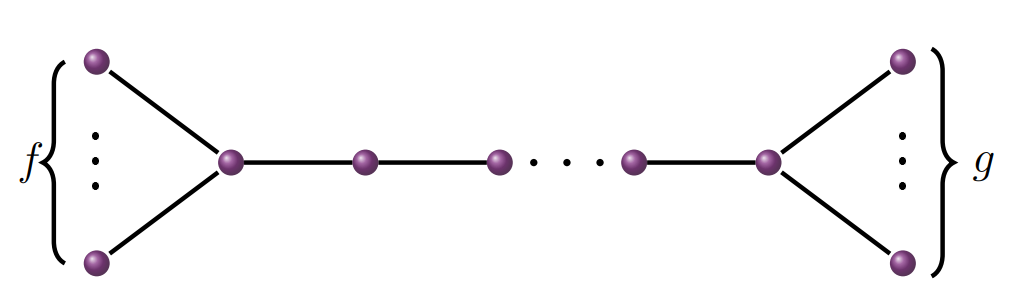
Let \(\mathcal{A}_{s}(f,g)\) be the tree of order \(s\), obtained from a path by connecting \(f\) and \(g\) count of pendent vertices associated with the terminal vertices of the path, where \(s-f-g\geq 2\) and \(f\geq g\geq 0\).
Lemma 2.3. Let \(f\) and \(g\) be two positive integers, where \(f\geq g+2\), then \(\mathsf{Mo}_e(\mathcal{A}_{s}(f-1,g+1))<\mathsf{Mo}_e(\mathcal{A}_{s}(f,g))\), having \(|\mathscr{E}(\mathcal{A}_{s}(f,g))|={q}\).
Proof. If we have \(f\leq \frac{q}{2}\) then \(g+1< f\leq\frac{q}{2}\), and otherwise \(g+1<q-f< \frac{q}{2}\). Also let \(r_1,r_2,\dots, r_k\) be the vertices of internal path in \(\mathcal{A}_{s}(f,g)\). Then \[\label{eq:moe_formula} \mathsf{Mo}_e(A_s(f,g))= (f+g)(q-3) + \sum\limits_{j=1}^{k-1}|2j – k + f-g+1|. \tag{3}\]
Now we calculate the edge Mostar index of \(\mathcal{A}_{s}(f-1,g+1)\) by replacing \(f=f-1\) and \(g=g+1\) in (3), \[\mathsf{Mo}_e(A_s(f-1,g+1))= (f+g)(q-3) + \sum\limits_{j=1}^{k-1}|2j – k + f-g-1|=|2g+2-q|-|2f-q|.\]
Using the definition of absolute values and above conditions, we have \[\begin{aligned} \begin{split} \mathsf{Mo}_e(\mathcal{A}_{s}(f,g))-\mathsf{Mo}_e(\mathcal{A}_{s}(f-1,g+1))&=-(2g+2-q)+(2f-q) \\ &=-2g-2+q+2f-q=-2(g+1)+2f. \end{split} \end{aligned}\]
Since \(g+1< f\) this implies that \(\mathsf{Mo}_e(\mathcal{A}_{s}(f,g))-\mathsf{Mo}_e(\mathcal{A}_{s}(f-1,g+1))>0\). ◻
Lemma 2.4. For a tree \(\mathfrak{T}\) with \(r,t \in\mathscr{V}(\mathfrak{T})\). Assume that in the path connecting \(r\) and \(t\), the pendent vertices \(r_{1},r_{2},\dots,r_{l}\) and \(t_{1},t_{2},\dots,t_{q}\) are connected to \(r\) and \(t\), respectively. Let \(r'\) and \(t'\) be respectively the neighbors of \(r\) and \(t\), and \[\begin{aligned} \begin{split} \mathcal{T'}&=(\mathfrak{T}-\{rr_{m}:m=1,2,\dots,l\})+\{r'r_{m}:m=1,2,\dots,l\} \\ \mathcal{T''}&=(\mathfrak{T}-\{ss_{m}:m=1,2,\dots,q\})+\{s's_{m}:m=1,2,\dots,q\}. \end{split} \end{aligned}\]
Then \(\mathsf{Mo}_e(\mathfrak{T})<\mathsf{Mo}_e(\mathcal{T'})\) or \(\mathsf{Mo}_e(\mathfrak{T})<\mathsf{Mo}_e(\mathcal{T''})\).
Proof. Let \(\mathfrak{e}'=rr'\) and \(\mathfrak{e}''=tt'\). Assume that \(r\) and \(s\) are adjacent, then we have \(r'=t\) and \(t'=r\). By the constructions of \(\mathcal{T'}\) and \(\mathcal{T''}\), we acquire that \(\varphi_{\mathfrak{T}}(\mathfrak{e})=\varphi_{\mathcal{T'}}(\mathfrak{e})\), for all \(\mathfrak{e}\in \mathscr{E}(\mathfrak{T})\backslash\{\mathfrak{e}'\}\) and \(\varphi_{\mathfrak{T}}(\mathfrak{e})=\varphi_{\mathcal{T''}}(\mathfrak{e})\), for all \(\mathfrak{e}\in \mathscr{E}(\mathfrak{T})\backslash\{\mathfrak{e}''\}\), respectively. Let \(\mathfrak{m}_{z}(y)=\mathfrak{m}_{z}(y|\mathfrak{T})\), where \(z\in\{r,r'\}\) if \(y=\mathfrak{e}'\), and \(z\in\{t,t'\}\) if \(y=\mathfrak{e}''\). Then, we have \[\begin{aligned} \begin{split} \mathsf{Mo}_e({\mathfrak{T}})-\mathsf{Mo}_e({\mathcal{T'}})&=\varphi_{\mathfrak{T}}(\mathfrak{e})-\varphi_{\mathcal{T'}}(\mathfrak{e}) \\ &=\left|\mathfrak{m}_{r}(\mathfrak{e}')-\mathfrak{m}_{r'}(\mathfrak{e}')\right|- \left|\mathfrak{m}_{r}(\mathfrak{e}')-l-\mathfrak{m}_{r'}(\mathfrak{e}')-l\right|, \end{split} \end{aligned}\] since \(\mathfrak{m}_{r'}(\mathfrak{e}')\geq \mathfrak{m}_{t}(\mathfrak{e}'')\) and \(\mathfrak{m}_{t'}(\mathfrak{e}'')\geq \mathfrak{m}_{r}(\mathfrak{e}')\). If \(\mathfrak{m}_{r}(\mathfrak{e}')> \mathfrak{m}_{r'}(\mathfrak{e}')\) and \(\mathfrak{m}_{t}(\mathfrak{e}'')> \mathfrak{m}_{t'}(\mathfrak{e}'')\) then \(\mathfrak{m}_{r}(\mathfrak{e}')>\mathfrak{ m}_{r'}(\mathfrak{e}')\geq \mathfrak{m}_{t}(\mathfrak{e}'')>\mathfrak{m}_{t'}(\mathfrak{e}'')\geq \mathfrak{m}_{r}(\mathfrak{e}')\), that is a contradiction. Therefore, \(\mathfrak{m}_{r}(\mathfrak{e}')< \mathfrak{m}_{r'}(\mathfrak{e}')\) and also we obtain \[\begin{aligned} \begin{split} \mathsf{Mo}_e({\mathfrak{T}})-\mathsf{Mo}_e({\mathcal{T'}})&=\mathfrak{m}_{r'}(\mathfrak{e}')-\mathfrak{m}_{r}(\mathfrak{e}')-\mathfrak{m}_{r'}(\mathfrak{e}')+\mathfrak{m}_{r}(\mathfrak{e}')-2l<0. \end{split} \end{aligned}\] Similarly, we have \(\mathfrak{m}_{s}(\mathfrak{e}'')< \mathfrak{m}_{s'}(\mathfrak{e}'')\) and \[\begin{aligned} \begin{split} \mathsf{Mo}_e({\mathfrak{T}})-\mathsf{Mo}_e({\mathcal{T''}})&=\varphi_{\mathfrak{T}}(\mathfrak{e})-\varphi_{\mathcal{T''}}(\mathfrak{e}) \\ &=\left|\mathfrak{m}_{t}(\mathfrak{e}'')-\mathfrak{m}_{t'}(\mathfrak{e}'')\right|- \left|\mathfrak{m}_{t}(\mathfrak{e}'')-q-\mathfrak{m}_{t'}(\mathfrak{e}'')-q\right| \\ &=\mathfrak{m}_{t'}(\mathfrak{e}'')-\mathfrak{m}_{t}(\mathfrak{e}'')-\mathfrak{m}_{t'}(\mathfrak{e}'')+\mathfrak{m}_{t}(\mathfrak{e}'')-2q <0. \end{split} \end{aligned}\]
Therefore, \(\mathsf{Mo}_e(\mathfrak{T})< \mathsf{Mo}_e(\mathcal{T'})\) or \(\mathsf{Mo}_e(\mathfrak{T})<\mathsf{Mo}_e(\mathcal{T''})\). ◻
First, we identify the extreme values for the edge Mostar index for trees having the specific count of pendent vertices. Next, we find the extreme values for trees with a fixed diameter.
A starlike tree is an acyclic graph having a root vertex with a degree at least \(3\) and all other vertices have degree \(1\) or \(2\). Let \(\mathbb{TS}_{(s,p)}\), for \(3\leq p \leq s-2\), be a starlike tree having \(s\) as an order of it and \(p\) as the number of pendent paths whose pendent paths differ in length by at most one.
Theorem 3.1.For \(3 \leq p \leq s – 2\), \(\mathbb{TS}_{(s, p)}\) is the unique tree that achieves the largest edge Mostar invariant among all trees of order \(s\) with \(p\) pendent vertices.
Proof. Consider a tree \(\mathfrak{T}\) for which \({\mathsf{Mo}_e}(\mathfrak{T})\) is maximal of the order \(s\) having \(p\) pendent vertices.
Claim: There is just one root vertex in \(\mathfrak{T}\).
Assume, on the other hand, that \(\mathfrak{T}\) has at least \(2\) root vertices. There is a choice of selecting those two \(u\) and \(v\) root vertices, in such a way \(d_{\mathfrak{T}}(u,v)\) is so small. Let there exist a path \(\mathcal{P}\) that connects \(u\) and \(v\). If the length of \(\mathcal{P}\) is greater than \(1\), then the degree of every internal vertex is two. Suppose \({q}_{u}\) (\({q}_{v}\), resp.) is the size of \(\mathfrak{T}- \mathscr{E}(\mathcal{P})\), that is the component of \(\mathfrak{T}\), contains \(u\) (\(v\), resp.). Consider that \({q}_{u}\geq {q}_{v}\), clearly \({q}_{v}\leq \frac{|\mathscr{E}(\mathfrak{T})|}{2}\). Suppose that \(x\) and \(y\) are the neighbors of \(v\), where \(x \in \mathscr{V}(\mathcal{P})\) and \(y\in \mathscr{V}(\mathfrak{T}- \mathscr{E}(\mathcal{P}))\). Let \(\mathfrak{T'}=\mathfrak{T}-vy+xy\). Clearly, \(|\mathscr{E}(\mathfrak{T})|\) is the size of tree \(\mathfrak{T}\) having \(p\) pendant vertices. Suppose that \(\varphi_{\mathfrak{T}}(\mathfrak{e})=\varphi_{\mathfrak{T'}}(\mathfrak{e})\), for all \(\mathfrak{e}\in \mathscr{E}(\mathfrak{T})\setminus\{xv,vy\}=\mathscr{E}(\mathfrak{T'})\setminus\{xv,xy\}\) and \(\varphi_{\mathfrak{T}}(vy)=\varphi_{\mathfrak{T'}}(xy)\). Thus \[\begin{aligned} \begin{split} \mathsf{Mo}_e(\mathfrak{T})-\mathsf{Mo}_e(\mathfrak{T'})&=\varphi_{\mathfrak{T}}(xy)-\varphi_{\mathfrak{T'}}(xy) \\ &=|\mathfrak{m}_{x}(xy|\mathfrak{T})-\mathfrak{m}_{y}(xy|\mathfrak{T})|-|\mathfrak{m}_{x}(xy|\mathfrak{T'})-\mathfrak{m}_{y}(xy|\mathfrak{T'})| \\ &=|{q}_{v}-|\mathscr{E}(\mathfrak{T})|+{q}_{v}|-|{q}_{v}-\mathfrak{m}_{y}(vy|\mathfrak{T}) -|\mathscr{E}(\mathfrak{T})|-{q}_{v}+\mathfrak{m}_{y}(vy|\mathfrak{T})| \\ &=|2{q}_{v}-|\mathscr{E}(\mathfrak{T})||-|-|\mathscr{E}(\mathfrak{T})||. \end{split} \end{aligned}\]
There exists two cases:
If \({q}_{v}>\left|\mathscr{E}(\mathfrak{T})\right|\) and since \({q}_{v}\leq\frac{|\mathscr{E}(\mathfrak{T})|}{2}\), then we get \[\begin{aligned} \begin{split} \mathsf{Mo}_e(\mathfrak{T})-\mathsf{Mo}_e(\mathfrak{T'})&=2{q}_{v}-|\mathscr{E}(\mathfrak{T})|-|\mathscr{E}(\mathfrak{T})| =2({q}_{v}-|\mathscr{E}(\mathfrak{T})|)<0. \end{split} \end{aligned}\]
If \(\left|\mathscr{E}(\mathfrak{T})\right|>{q}_{v}\), then we get \[\begin{aligned} \begin{split} \mathsf{Mo}_e(\mathfrak{T})-\mathsf{Mo}_e(\mathfrak{T'})&=|\mathscr{E}(\mathfrak{T})|-|\mathscr{E}(\mathfrak{T})|-2{q}_{v}=-2{q}_{v}<0. \end{split} \end{aligned}\]
In either cases, we acquire \(\mathsf{Mo}_e(\mathfrak{T})<\mathsf{Mo}_e(\mathfrak{T'})\), which is a contraction. This proves the claim.
By the claim, the tree \(\mathfrak{T}\) has exactly one central vertex incident with all \(p\) pendent paths. Suppose \(l_{1}\geq l_{2}\geq\dots\geq l_{rp}\geq1\) are the sizes of pendent paths. Consider that \(|l_{i}-l_{j}|\geq2\) with \(1\leq i<j\leq p\) and the vertex \(b\) having largest degree \(p\). Then \(\mathfrak{T}\cong \mathcal{G}_{b;l_{i},l_{j}}\), where \(\mathcal{G}_{b;l_{i},l_{j}}\) is constructed from \(\mathfrak{T}\) by removing all the vertices having degree \(2\) or \(1\) from the pendent paths having lengths \(l_{i}\) and \(l_{j}\), respectively. Clearly, \(\mathcal{G}_{b;l_{i}-1,l_{j}+1}\) is a tree having size \(|\mathscr{E}(\mathfrak{T})|\) and \(p\) pendent vertices, from Lemma 2.2 \({\mathsf{Mo}_e}(\mathfrak{T})< {\mathsf{Mo}_e}(\mathcal{G}_{b;l_{i}-1,l_{j}+1})\), a contradiction. Therefore \(|l_{i}-l_{j}|=0,1\) for \(1\leq i<j\leq p\). That is \(\mathfrak{T}\cong \mathbb{TS}_{(s,p)}\). ◻
By Theorem 3.1 and simple calculations, the following are the outcomes:
Corollary 3.2. Suppose \(\mathfrak{T}\) be a tree with \(3\leq p\leq s-2\) and \(s\geq4\), then \[{\mathsf{Mo}_e}(\mathfrak{T})\leq {\mathsf{Mo}_e(\mathbb{TS}_{(s,p)})} =(s-2)p+\dfrac{p-1}{p}s^2-\dfrac{p^2+2p-2}{p}s+\dfrac{t^2-(p+2)t+2p(p+1)}{p},\] where \(1\leq t\leq p\).
Theorem 3.3. For \(3 \leq p \leq s – 2\), \(A_{s}\left(\lceil \frac{p}{2} \rceil, \lfloor \frac{p}{2} \rfloor \right)\) (see Figure 1) is the unique tree with the smallest edge Mostar invariant among all trees of order \(s\) with \(p\) pendent vertices.
Proof. Consider a tree \(\mathfrak{T}\) with \({\mathsf{Mo}_e}(\mathfrak{T})\) to the smallest extent possible of order \(s\) with \(p\) pendent vertices.
Claim: There are at most two root vertices in \(\mathfrak{T}\).
On the other hand, assume \(\mathfrak{T}\) has at least \(3\) root vertices. We have the choice of selecting \(a\) and \(b\) as two root vertices and \(d_{\mathfrak{T}}(a,b)\) is so large. There exists a path \(\mathcal{P}\) between \(a\) and \(b\). Suppose \({q}_{a}\) (\({q}_{b}\), resp.) is the size of \(\mathfrak{T}- \mathscr{E}(\mathcal{P})\), that is a component of \(\mathfrak{T}\), contains \(a\) (\(b\), resp.). There exist root vertices of \(\mathfrak{T}\) that are some internal vertices of \(\mathcal{P}\). Consider two root vertices \(x,y\in \mathscr{V}(\mathcal{P})\) having \({\mathsf{d}}_{\mathfrak{T}}(a,y)\) and \({\mathsf{d}}_{\mathfrak{T}}(x,b)\) are so small. Suppose that \({q}_{a}+{\mathsf{d}}_{\mathfrak{T}}(a,y) \geq {q}_{b}+ {\mathsf{d}}_{\mathfrak{T}}(x,b)\). Then \({q}_{b}+ {\mathsf{d}}_{\mathfrak{T}}(x,b)\leq \frac{|\mathscr{E}(\mathfrak{T})|}{2}\). Let \(t={\mathsf{d}}_{\mathfrak{T}}(x,b)\) and \(x_{0}\geq\dots \geq x_{t}\) be the path from \(x\) to \(b\), where \(x_{0}=x\) and \(x_{t}=b\). Let \(v_{1},\dots,v_{l}\) be the vertices joined with \(x\) and belongs to \(\mathscr{V}(\mathfrak{T})\setminus \mathscr{V}(\mathcal{P})\), where \(l={\mathsf{d}}_{\mathfrak{T}}(x)-2\). Constructs \(\mathfrak{T'}=\mathfrak{T}-\{xv_{k}:k=1,2,\dots,l\}+\{bv_{k}:k=1,2,\dots,l\}\) and also \(\mathfrak{T'}\) is a tree having \(s\) vertices and pendent vertices \(p\). Let \({q}'_{x}\) denotes the total cardinality of edges of \(\mathfrak{T}-x\), having one of \(v_{1},\dots,v_{l}\). Also, \({q}_{b}+t-k< \min\{{q}_{b}+{q}'_{x}+t-k, |\mathscr{E}(\mathfrak{T})|-({q}_{b}+{q}'_{x}+t-k)\}\leq \frac{|\mathscr{E}(\mathfrak{T})|}{2}\), for \(k=0,\dots,t\), implying that \[\begin{aligned} \begin{split} \varphi_{\mathfrak{T}}(x_{k-1}x_{k})&=|\mathfrak{m}_{x_{k-1}}(x_{k-1}x_{k}|\mathfrak{T})-\mathfrak{m}_{x_k}(x_{k-1}x_{k}|\mathfrak{T})| \\ &=|({q}_{b}+t-k)- (|\mathscr{E}(\mathfrak{T})|-({q}_{b}+t-k))| \\ &>|({q}_{b}+{q}'_{x}+t-k)-(|\mathscr{E}(\mathfrak{T})|-({q}_{b}+{q}'_{x}+t-k))| \\ &=\varphi_{\mathfrak{T'}}(x_{k-1}x_{k}). \end{split} \end{aligned}\]
Therefore \[\begin{aligned} \begin{split} \mathsf{Mo}_e(\mathfrak{T})-\mathsf{Mo}_e(\mathfrak{T'})&=\sum\limits_{k=1}^{t}\varphi_{\mathfrak{T}}(x_{k-1}x_{k}) -\varphi_{\mathfrak{T'}}(x_{k-1}x_{k})>0, \end{split} \end{aligned}\] implies that \(\mathsf{Mo}_e(\mathfrak{T})>\mathsf{Mo}_e(\mathfrak{T'})\) gives a contradiction. Therefore the statement in the claim is correct.
From the claim, \(\mathfrak{T}\) has exactly \(1\) or \(2\) root vertices. If \(\mathfrak{T}\) has only one root vertex, then that vertex has degree \(p\) (number of pendent vertices) and it becomes a starlike tree. Lemma 2.2 gives that \(\mathfrak{T}\cong A_{s}(p-1,1)\) and also from Lemma 2.3, we have \(p=3\) and \(\mathfrak{T}\cong A_{s}(\lceil\frac{p}{2}\rceil,\lfloor\frac{p}{2}\rfloor)\), (Since from Lemma 2.2, we have \[\mathsf{Mo}_e\!\big(\mathscr{H}_{t;\lceil P/2\rceil,\lfloor P/2\rfloor}\big)>\mathsf{Mo}_e\!\big(\mathscr{H}_{t;\lceil P/2\rceil+1,\lfloor P/2\rfloor-1}\big)>\cdots>\mathsf{Mo}_e\!\big(\mathscr{H}_{t;P-1,1}\big).\]
Assume that \(\mathfrak{T}\) has only \(2\) root vertices \(a\) and \(b\). Then \(u=\deg_{\mathfrak{T}}(a)-1\) and \(v=\deg_{\mathfrak{T}}(b)-1\). Therefore from Lemma 2.2, \(u\) and \(v\) has \(a\) and \(b\) pendent paths respectively, for all \(a,b\geq 2\), only one has length one. Let \({q}_{a}\) (\({q}_{b}\), resp.) be the size of \(\mathfrak{T}- \mathscr{E}(\mathcal{P})\) (\(\mathcal{P}\) is the path having \(a\) and \(b\)) contains \(a\) (\(b\),resp.). Assume that \({q}_{a}\geq {q}_{b}\), than \({q}_{a}\leq \frac{|\mathscr{E}(\mathfrak{T})|}{2}\). Let \(b\) has a pendent path \(b_{0},\dots,b_{z}\), where \(b_{0}=b\) and it has at least length \(2\). Let \(\mathfrak{T''}=\mathfrak{T}-\{br:r\in P_{\mathfrak{T}}(b)\}+\{b_{t}r:r\in P_{\mathfrak{T}}(b)\}\), with \(P_{\mathfrak{T}}(b)\) is the collection of pendent vertices at \(b\). Clearly, \(\mathfrak{T''}\) has the same order and pendent vertices as \(\mathfrak{T}\). Now, \(t<{q}_{b}-1<\frac{|\mathscr{E}(\mathfrak{T})|}{2}\), we obtain \[\begin{aligned} \begin{split} \mathsf{Mo}_e(\mathfrak{T})-\mathsf{Mo}_e(\mathfrak{T'})&=\varphi_{\mathfrak{T}}(b_{0}b_{z})-\varphi_{\mathfrak{T''}}(b_{0}v_{b}) \\ &=|z-|{\mathscr{E}}(\mathfrak{T})|+z|-|{q}_{b}-1-|\mathscr{E}(\mathfrak{T})|+{q}_{b}-1|>0, \end{split} \end{aligned}\] implies that \(\mathsf{Mo}_e(\mathfrak{T})>\mathsf{Mo}_e(\mathfrak{T'})\) gives contradiction. Therefore, \(b\) has only the paths with length one. Now, Assume that \({q}_{a}>\frac{|\mathscr{E}(\mathfrak{T})|}{2}\) and \(a\) has a pendent path with size at least \(2\). Let \(\mathcal{P}=a=x_{0}\dots x_{t}=v\) and \(w\) be connected as a pendent vertex at \(a\). Let \(\mathfrak{T'''}=\mathfrak{T}-aw+bw\) and \(\mathfrak{T'''}\) has same order and number of pendent vertices as \(\mathfrak{T}\), we have \[\begin{aligned} \begin{split} \mathsf{Mo}_e(\mathfrak{T})-\mathsf{Mo}_e(\mathfrak{T})&=\varphi_{\mathfrak{T}}(x_{t-1}x_{t})-\varphi_{\mathfrak{T'''}}(x_{0}x_{t}) \\ &=|{q}_{v}-|{\mathscr{E}}(\mathfrak{T})|+{q}_{b}| -|{q}_{a}-1-|\mathscr{E}(\mathfrak{T})|+{q}_{a}-1|. \end{split} \end{aligned}\]
If \({q}_{a}>\frac{|\mathscr{E}(\mathfrak{T})|+1}{2}\) it means that \({q}_{a}>\frac{|\mathscr{E}(\mathfrak{T})|}{2}+1\), then as \({q}_{b}<|\mathscr{E}(\mathfrak{T})|-{q}_{a}+1\leq \frac{|\mathscr{E}(\mathfrak{T})|}{2}\), we have \(\mathsf{Mo}_e(\mathfrak{T})>\mathsf{Mo}_e(\mathfrak{T'''})\) this implies that \(\mathsf{Mo}_e(\mathfrak{T})>\mathsf{Mo}_e(\mathfrak{T'})\) that gives a contradiction. Thus \({q}_{a}=\frac{|\mathscr{E}(\mathfrak{T})|+1}{2}\) and then \({q}_{b}=\frac{|\mathscr{E}(\mathfrak{T})|+1}{2}-p\). If \(t\geq 2\), then \({q}_{b}< {q}_{a}-1<\frac{|\mathscr{E}(\mathfrak{T})|}{2}\), implies that \(\mathsf{Mo}_e(\mathfrak{T})>\mathsf{Mo}_e(\mathfrak{T'''})\), gives a contradiction. So, when \(t = 1\), and \({q}_{b}={q}_{a}-1\), then it gives \(\mathsf{Mo}_e(\mathfrak{T})=\mathsf{Mo}_e(\mathfrak{T'''})\). Now assume that the tree \(\mathfrak{T'''}\) and \(u \geq 3\). Then the size of \(\mathfrak{T}-\{ab\}\) of including \(a\) is minimum according to \(\frac{|\mathscr{E}(\mathfrak{T})|}{2}\). Similarly, \(\mathfrak{T'''}-P_{\mathfrak{T}}(a)\) and joining all the vertices of \(P_{\mathfrak{T}}(a)\) to the connected vertices of \(a\) in the pendent path having at least size \(2\) to construct \(\mathfrak{T''''}\) with same order and number of pendent vertices, gives \(\mathsf{Mo}_e(\mathfrak{T'''})>\mathsf{Mo}_e(\mathfrak{T''''})\). Therefore, \(\mathsf{Mo}_e(\mathfrak{T})>\mathsf{Mo}_e(\mathfrak{T''''})\) gives contradiction. Thus, there exists only one case \(u=2\), and \(\mathfrak{T'''}\cong A_{s}(1,v+1)\) having \(v + 2 = p \geq 4\). Lemma 2.3 give the result, \(\mathsf{Mo}_e(\mathfrak{T})=\mathsf{Mo}_e(\mathfrak{T'''})> A_{s}(\lceil\frac{p}{2}\rceil,\lfloor\frac{p}{2}\rfloor)\), give contradiction. Therefore, \(a\) has only paths of length one (it follows similarly if \({q}_{u}\leq \frac{|\mathscr{E}(\mathfrak{T})|}{2}\)). Thus, \({\mathfrak{T}}\cong A_{s}(u,v)\), with \(u + v = p\) and \(u\geq v\geq2\). By Lemma 2.3, we have \(\mathfrak{T}\cong A_{s}(\lceil\frac{p}{2}\rceil,\lfloor\frac{p}{2}\rfloor)\). ◻
By Theorem 3.3 and simple calculations, the following are the outcomes:
Corollary 3.4. Suppose \(\mathfrak{T}\) be a tree with \(3\leq p\leq s-2\) and \(s\geq4\), then \[{\mathsf{Mo}_e}(\mathfrak{T})\geq\left(\left\lceil\frac{p}{2}\right\rceil+\left\lfloor\frac{p}{2}\right\rfloor\right)(s-2) +\dfrac{s^2}{2}-(p+1)s+\left\{ \begin{array}{ll} \dfrac{p^2}{2}+p, & \mbox{if $s$ and $p$ are even,} \\ \dfrac{p^2}{2}+p+\dfrac{1}{2}, & \mbox{if $s$ is even and $p$ is odd,} \\ \dfrac{p^2}{2}+p+\dfrac{1}{2}, & \mbox{if $s$ is odd and $p$ is even,} \\ \dfrac{p^2}{2}+p+1, & \mbox{if $s$ and $p$ are odd,} \end{array} \right.\] equality holds if \(\mathfrak{T}\cong A_{s}(\lceil\frac{p}{2}\rceil,\lfloor\frac{p}{2}\rfloor)\).
Here, we discuss the maximum and minimum values for trees with the fixed diameter \({\sigma}\). Let \(\mathcal{P}_{s,\sigma,l}\) be the tree constructed by the \(\mathcal{P}_{\sigma+1}=u_0u_1\dots,u_{\sigma}\) path by connecting \(s-\sigma-1\) pendent vertices at \(u_l\), with \(1\leq l \leq \left\lfloor\dfrac{\sigma}{2}\right\rfloor\) (see Figure 2).
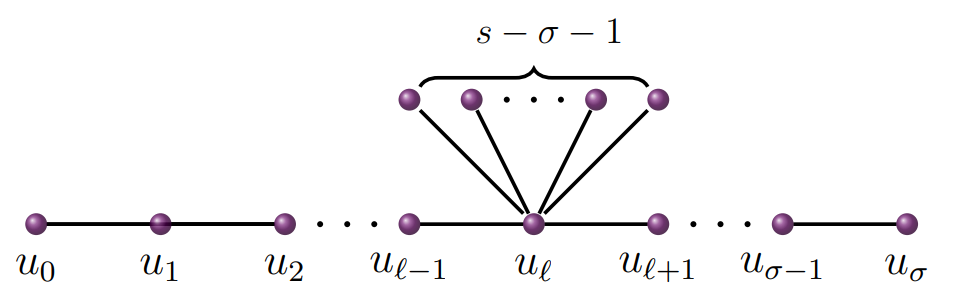
Theorem 3.5. For \(3 \leq \sigma \leq s – 2\), \(\mathcal{P}_{s,\sigma,\lfloor \frac{\sigma}{2} \rfloor}\) is the unique tree that achieves the greatest edge Mostar index among all trees of order \(s\) with diameter \(\sigma\).
Proof. Consider a tree \(\mathfrak{T}\) with \({\mathsf{Mo}_e}(\mathfrak{T})\) to the greatest extent possible of order \(s\) with diameter \(\sigma\). Let \(\mathcal{P}=u_{0}u_{1}\dots u_{\sigma}\) be a diametrical path in \(\mathfrak{T}\). By repeatedly employing the Lemma 2.1, we generate a sequence of trees \(\mathfrak{T},\mathfrak{T}_{1},\mathfrak{T}_{2},\dots,\mathfrak{T}_{l}\), such that \(\mathfrak{T}_{l}\) belongs to a set of caterpillars where \(s-\sigma-1\) pendent vertices attached to the vertices \(u_{1},u_{2},\dots,u_{\sigma-1}\).
Now, we aim to prove that all the pendent vertices other than \(u_0\) and \(u_{\sigma}\) are connecting to exactly one vertex of \(u_{1},\dots,u_{\sigma-1}\). Suppose on the other hand, there are two vertices \(u_{f}\) and \(u_{g}\) \((1\leq f\leq g\leq \sigma-1)\) of \(\mathcal{P}\) having degree at least \(3\) in \(\mathfrak{T}\). Let \(u_{i}\) and \(u_{j}\) are connection with a path \(\mathcal{P}\). From Lemma 2.4, it is an inconsistency. As a consequence, all pendent vertices other than \(u_0\) and \(u_{\sigma}\) are joined to a single vertex of \(u_{1},\dots,u_{\sigma-1}\). That is \(\mathfrak{T}\cong \mathcal{P}_{s,\sigma,h}\). Then, for \(1\leq h\leq \lfloor\frac{\sigma}{2}\rfloor\), there are \(|\mathscr{E}(\mathfrak{T})|-\sigma-1\) pendent vertices adjacent to a vertex \(u_{h}\) and \(|\mathscr{E}(\mathfrak{T})|-(2h+2)\geq 0\). Let \(h<\lfloor\frac{\sigma}{2}\rfloor\) and \(\mathfrak{T'}=\mathcal{P}_{s,\sigma,h+1}\). As \(h-1< \min\{\sigma-h, |\mathscr{E}(\mathfrak{T})|-(\sigma-h)\}\leq\frac{|\mathscr{E}(\mathfrak{T})|}{2}\), we have \[\begin{aligned} &&\mathsf{Mo}_e(\mathfrak{T})-\mathsf{Mo}_e(\mathfrak{T'})\\&&=\varphi_{\mathfrak{T}}(u_{h}u_{h+1})-\varphi_{\mathfrak{T}}(u_{h}u_{h+1}) \\ &&= \left||\mathscr{E}(\mathfrak{T})|-h+1-s+\sigma+1-|\mathscr{E}(\mathfrak{T})|+h\right|- \left||\mathscr{E}(\mathfrak{T})|-h+1-|\mathscr{E}(\mathfrak{T})|+h+s-\sigma-1\right| \\ &&=\left|-s+\sigma+2\right|- \left|s-\sigma\right|. \end{aligned}\]
Since \(s>\sigma\), implies that \(s-\sigma>0\) and \(\mathsf{Mo}_e(\mathfrak{T})-\mathsf{Mo}_e(\mathfrak{T'})=-2<0\). A contradiction, thus \(h=\lfloor\frac{\sigma}{2}\rfloor\) and \(\mathfrak{T}\cong \mathcal{P}_{s,\sigma,\lfloor\frac{\sigma}{2}\rfloor}\). ◻
By Theorem 3.5 and simple calculations, the following are the outcomes:
Corollary 3.6. Suppose \(\mathfrak{T}\) be a tree, then \[{\mathsf{Mo}_e}(\mathfrak{T})\leq {\mathsf{Mo}_e}\left(\mathcal{P}_{s,\sigma,\left\lfloor\frac{\sigma}{2}\right\rfloor}\right)=\left\{ \begin{array}{ll} \left\lfloor\frac{(s-1)^{2}}{2}\right\rfloor, & \mbox{if $s=\sigma+1$,} \\ 2(s-1), & \mbox{if $\sigma=2$ and $s\geq \sigma+2$,} \\ s^{2}-3s, & \mbox{if $\sigma=3$ and $s\geq \sigma+2$,} \\ s^{2}-3s-4\sigma+14, & \mbox{if $\sigma\geq 4$ and $s\geq \sigma+2$.} \end{array} \right.\]
The proof of next theorem is analogous as Theorem 3.3, therefore we omit its proof here.
Theorem 3.7. Among all trees of order \(s\) and diameter \(\sigma\), \(A_{s}(\lceil \frac{\sigma}{2} \rceil, \lfloor \frac{\sigma}{2} \rfloor)\) (see Figure 1) is the unique tree with the smallest edge Mostar invariant, for \(3 \leq \sigma \leq s – 2\).
By Theorem 3.7 and simple calculations, the following are the outcomes:
Corollary 3.8. Suppose \(\mathfrak{T}\) be a tree with \(3\leq \sigma\leq s-2\) and \(s\geq4\), then \[{\mathsf{Mo}_e}(\mathfrak{T})\geq\left(\left\lceil\frac{\sigma}{2}\right\rceil+\left\lfloor\frac{\sigma}{2}\right\rfloor\right)(s-2)+\dfrac{s^2}{2}-(\sigma+1)s+\left\{ \begin{array}{ll} \dfrac{\sigma^2}{2}+\sigma, & \mbox{if $s$ and $\sigma$ are even,} \\ \dfrac{\sigma^2}{2}+\sigma+\dfrac{1}{2}, & \mbox{if $s$ is even and $\sigma$ is odd,} \\ \dfrac{\sigma^2}{2}+\sigma+\dfrac{1}{2}, & \mbox{if $s$ is odd and $\sigma$ is even,} \\ \dfrac{\sigma^2}{2}+\sigma+1, & \mbox{if $s$ and $\sigma$ are odd,} \end{array} \right.\] equality holds if \(\mathfrak{T}\cong A_{s}(\lceil\frac{\sigma}{2}\rceil,\lfloor\frac{\sigma}{2}\rfloor)\).
Topological indices are increasingly accessible, with their numbers steadily growing. Many of these indices are approached purely through mathematical methods, often neglecting their relevance to chemistry. To address this, a set of practical criteria has been developed to aid in selecting a suitable molecular descriptor from a wide range of options. Among these criteria is the ability to predict molecular properties and behaviors. To evaluate the predictive effectiveness of topological indices, researchers frequently perform quantitative structure-property relationship (QSPR) analyses, which compare theoretical attributes to experimental data for specific reference compounds. Randić and Trinajstić [35] suggested using octanes as benchmark data for initial testing of invariants. We have observed that the \({\mathsf{Mo}_e}\) index has strong correlation with acentric factor (\(AF\)) of octanes. The following regression equation is analyzed to evaluate the performance of the \({\mathsf{Mo}_e}\) index. \[\begin{aligned} \label{EQN1} P = mT + c, \end{aligned} \tag{4}\] where \(P\) denotes the property being studied, \(m\) represents the slope, \(T\) corresponds to the topological index, and \(c\) is the intercept. The regression analysis also incorporates additional parameters such as the sample size (\(I\)), standard error (\(SE\)), F-test value (\(F\)), and significance \(F\) (\(SF\)) for a more comprehensive assessment. Additionally, the coefficient of determination (\(r^2\)) is used, with \(r\) representing the correlation coefficient. First we consider the octane isomers. For \({\mathsf{Mo}_e}\), the relationship in Eq. (4) can be expressed as follows: \[\begin{aligned} \label{EQN8} AF =& -0.004\,{\mathsf{Mo}_e}+0.616,~r^{2}=&0.757,~SE=0.018,~F=49.799,~SF=2.71 \times 10^{-6}. \end{aligned} \tag{5}\]
The linear fitting of \({\mathsf{Mo}_e}\) with \(AF\) for octanes is depicted in Figure 3.
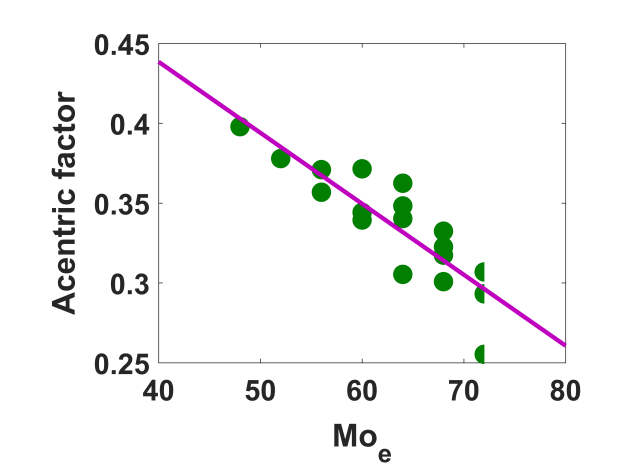
It is clear from the regression relation (5) and Figure 3 that the \({\mathsf{Mo}_e}\) index has strong linear relation with \(AF\) of octanes.
We also correlated the \({\mathsf{Mo}_e}\) values of some chemicals useful in drug design [36] with their properties. It is observed that the \({\mathsf{Mo}_e}\) is strongly correlated with the boiling point (\(BP\)) and molar refraction (\(MR\)). The relationship in Eq. (4) can be expressed as follows: \[\begin{aligned} \label{EQN9} BP = 0.225\,{\mathsf{Mo}_e}+365.925,~ r^{2}=0.728,~SE=87.381,~F=40.268,~SF=1.31 \times 10^{-5}. \end{aligned} \tag{6}\] \[\begin{aligned} \label{EQN10} MR = 0.043\,{\mathsf{Mo}_e}+54.046,~ r^{2}=0.857,~SE=11.159,~F=89.726,~SF=1.01 \times 10^{-7}. \end{aligned} \tag{7}\]
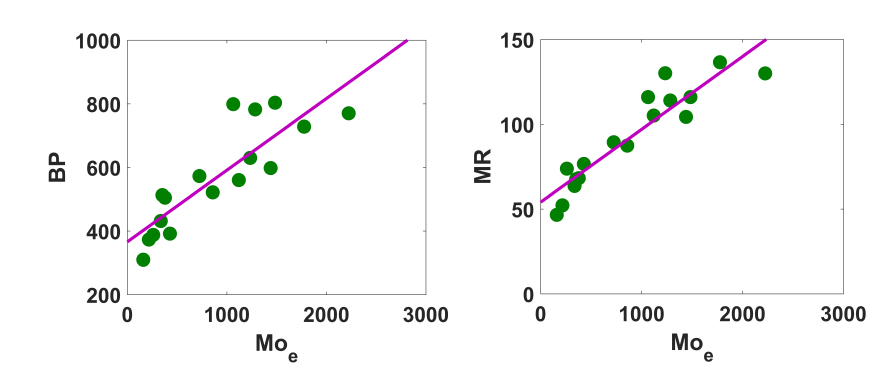
The linear fitting of \({\mathsf{Mo}_e}\) with \(BP\) and \(MR\) is depicted in Figure 4. It is evident from the regression relations (6), (7) and Figure 4 that the \({\mathsf{Mo}_e}\) index is strongly correlated with \(MR\) for the chemicals under investigation.
QSAR and QSPR models establish connections between chemical structure and chemical reactivity, physical properties, and biological activity, leading to valuable applications through topological descriptors. The edge Mostar index has been introduced as a novel measure, although it has yet to see widespread application in physicochemical or biological research. We have investigated the extremal values associated with the edge Mostar index. The maximal and minimal trees have been characterized for the edge Mostar index when the tree order and number of leaves are given. The sharp upper and lower bounds of \({\mathsf{Mo}_e}\) for the class of trees have been estimated as functions of tree order and diameter. The extremal trees, where the bounds appear have also been identified. We have observed that the edge Mostar index correlate well with the acentric factor of octanes. Also the \({\mathsf{Mo}_e}\) exerts significant correlations with boiling point and molar refraction of some chemicals useful in drug development. In future, the extremal graphs of this index can be explored for given other parameters including chromatic number, clique number, matching number, vertex and edge connectivity, and so on.
Not applicable.
The authors declare no conflict of interest.
Zahid Raza is supported by the University of Sharjah Research Grant No. 25021440174.