
The sequence of spread polynomials \(( S_{n}( x))_{n\geq 1}\) of Norman J. Wildberger is uniquely defined by the requirement \[\begin{aligned} S_{n}\left(\sin^{2} \theta \right) =\sin^{2}( n\theta ) . \end{aligned} \tag{1}\]
The spread polynomials play a central role in Wildberger’s rational trigonometry [8]. In order to make plane geometry free of transcendental expressions and square roots he suggests to replace lengths by their squares, which are referred to as quadrances, and angles by spreads. In the right angled triangle with sides \(a,b\) and \(c\)
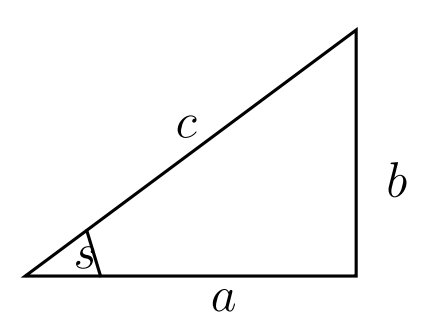
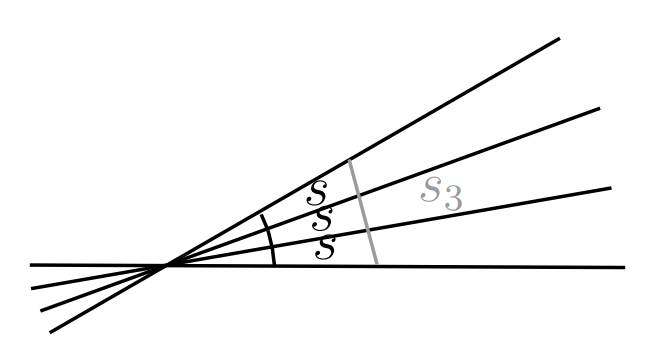
the spread \(s\in [ 0,1]\) is defined as the ratio \(s=b^{2} /c^{2}\) of the quadrance of the opposite leg \(b\) by the quadrance of the hypothenuse \(c\). Let \(s_n\) be the spread between the extremal lines of an arrangement of \(n+1\) lines which all meet in a single point and whose spreads of neighboring lines all coincide. Then \[\begin{aligned} s_{n} =S_{n}( s), \end{aligned} \tag{2}\] states the geometric property of the spread polynomials that makes them play a central role in rational trigonometry.
The spread polynomials can be written in terms of the Lucas polynomials \(L_{n}( x)\) \[\begin{aligned} S_{n}( x) =\frac{2-L_{n}( 2-4x)}{4} . \end{aligned} \tag{3}\]
Following [3] we consider the closely related polynomials \[\begin{aligned} \label{eq:Zdef} Z_{n}( x) =4S_{n}\left(\frac{x}{4}\right) =2-L_{n}( 2-x) . \end{aligned} \tag{4}\]
A conjecture of Wildberger’s honours student Shuxiang Goh (see [9]), stated in terms of \(Z_{n}( x)\), claims the following.
Theorem 1.1. There is a sequence of polynomials \(( \Psi _{d}( x))_{d\geq 1}\), \(\Psi_d(x)\in\mathbb{Z}[x]\), which are closely related to the cyclotomic polynomials \(\Phi_d(x)\), such that \(Z_{n}( x) =\prod _{d|n} \Psi _{d}( x)\) and \(\deg( \Psi _{d}) =\varphi ( d)\), where \(\varphi ( d)\) is Euler’s totient function.
The aim of this note is to prove the theorem as a consequence of (4) and known results about the Chebyshev polynomials obtained in [1], [2] and [7]. Moreover, we obtain some concrete facts about the polynomials \(\Psi _{d}( x)\), some of which had already been conjectured in [3].
The Lucas polynomials \(L_{n}( x)\)
are defined by the recursion \[\begin{aligned}
L_{n}( x) =xL_{n-1}( x) -L_{n-2}( x),
\end{aligned} \tag{5}\] for \(n\geq 2\)
with initial values \(L_{0}( x) =2\)
and \(L_{1}( x) =x\).2 The
first terms are (cf. [6, entry A034807]):
\[\begin{aligned}
\begin{array}{ c|c c c c c c }
n & 0 & 1 & 2 & 3 & 4 & 5 \\
\hline
L_{n}( x) & 2 & x & -2+x^{2} & -3x+x^{3} & 2-4x^{2}
+x^{4} & 5x-5x^{3} +x^{5}
\end{array} \\
\ \ \
\begin{array}{c c }
6 & \cdots \\
\hline
-2+9x^{2} -6x^{4} +x^{6} & \cdots
\end{array}.
\end{aligned}\]
Binet’s formula gives \[\begin{aligned} L_{n}( x) =( \alpha ( x))^{n} +( \beta ( x))^{n}, \end{aligned} \tag{6}\] with \(\alpha ( x) =\frac{x+\sqrt{x^{2} -4}}{2}\) and \(\beta ( x) =\frac{1}{\alpha ( x)} =\frac{x-\sqrt{x^{2} -4}}{2}\). The Lucas polynomials are related to the Chebyshev polynomials of the first kind \(T_{n}( x)\) by \[\begin{aligned} L_{n}( x) =2T_{n}\left(\frac{x}{2}\right), \end{aligned} \tag{7}\] and are characterized by \[\begin{aligned} \label{eq:LucTrig} L_{n}\left( z+\frac{1}{z}\right) =z^{n} +\frac{1}{z^{n}}, \end{aligned} \tag{8}\] for \(n\geq 1\) and \(z\neq 0\) because \(z^{n} +\frac{1}{z^{n}} =\left( z +\frac{1}{z}\right)\left( z^{n-1} +\frac{1}{z^{n-1}}\right) -\left( z^{n-2} +\frac{1}{z^{n-2}}\right)\). For \(z=e^{\sqrt{-1} \theta }\) Eq. (8) implies \[\begin{aligned} L_{n}( 2\cos \theta ) =2\cos( n\theta ). \end{aligned} \tag{9}\]
Eq. (8) also implies \[\begin{aligned} \label{eq:Lmultiplicative} L_{mn}( x) =L_{m}( L_{n}( x)), \end{aligned} \tag{10}\] for all \(m,n\geq 0\) since \(z^{mn} +\frac{1}{z^{mn}} =\left( z^{n}\right)^{m} +\left(\frac{1}{z^{n}}\right)^{m}\).
Let us also mention that \(z^{2n} +\frac{1}{z^{2n}} -2=\left( z^{n} +\frac{1}{z^{n}} -2\right)\left( z^{n} +\frac{1}{z^{n}} +2\right)\) implies \[\begin{aligned} \label{eq:L1stBinomi} L_{2n}( x) -2=( L_{n}( x) -2)( L_{n}( x) +2), \end{aligned} \tag{11}\] and that \[\begin{aligned} \label{eq:Levensq} L_{2n}( x) +2=( L_{n}( x))^{2}, \end{aligned} \tag{12}\] because \(z^{2n} +\frac{1}{z^{2n}} +2=\left( z^{n} +\frac{1}{z^{n}}\right)^{2}\).
Proposition 3.1. For \(n\geq 1\) the roots of \(f_n(x):=L_{n}( x) -2\) are \(\nu _{k} =2\cos\left(\frac{2\pi k}{n}\right)\) with \(0\leq k\leq \frac{n}{2}\). For odd \(n=2m+1\) the roots \(\nu _{k}\) with \(1\leq k\leq m\) are double roots and \(\nu _{0} =2\) is a simple root. For even \(n=2m\) the roots \(\nu _{k}\) with \(1\leq k< m\) are double roots and \(\nu _{0} ,\nu _{m}\) are simple roots.
Proof. Since \(f_{n}\left( 2\cos\left(\frac{2\pi k}{n}\right)\right) =L_{n}\left( 2\cos\left(\frac{2\pi k}{n}\right)\right) -2=2\cos( 2\pi k) -2=0\) each \(\nu _{k} =2\cos\left(\frac{2\pi k}{n}\right)\) for \(k\in \mathbb{Z}\) is a root of \(f_{n}( x)\). All different roots of this form are given by \(0\leq k\leq \frac{n}{2}\).
We claim that in this way we obtain all the roots of \(f_{n}( x)\) because the number of roots above, counted with multiplicity, in fact already amounts to \(n\).
To show the claim for \(n=2m+1\) it suffices to show that \[\begin{aligned} \label{eq:evenSqId} ( L_{2m+1}( x) -2)( x-2) =( L_{m+1}( x) -L_{m}( x))^{2}, \end{aligned} \tag{13}\] which is a square of a polynomial. For \(n=2m\) in turn it suffices to show the identity \[\begin{aligned} ( L_{2m}( x) -2)( x-2)( x+2) =( L_{m+1}( x) -L_{m-1}( x))^{2} . \end{aligned} \tag{14}\]
Since both sides of these identities are linear combinations of \(\alpha^{2n},\beta^{2n}\) and \(1^n\) they satisfy the same recurrence of order 3. More precisely since \[\begin{aligned} (z-\alpha^2)(z-\beta^2)(z-1)=z^3+(1-x^2)z^2+(x^2-1)z-1 , \end{aligned} \tag{15}\] they satisfy \[\begin{aligned} f(n+3)+(1-x^2)f(n+2)+(x^2-1)f(n+1)-f(n)=0. \end{aligned} \tag{16}\]
Thus to prove these identities it suffices to verify them for \(0\leq n \leq 2.\) ◻
Next we use the fact that a polynomial \(p( x)\) with an algebraic number \(a\) as a root has the minimal polynomial of \(a\) as a factor.
The minimal polynomial \(\psi _{n}( x)\) of 2\(\cos\left(\frac{2\pi }{n}\right)\) is \[\begin{aligned} \label{eq:psin} \psi _{n}( x) \ =\prod _{\gcd( j,n) =1,\ 0< j< n/2}\left( x-2\cos\frac{2\pi j}{n}\right), \end{aligned} \tag{17}\] for \(n >2\) with \(\psi _{1}( x) =x-2\) and \(\psi _{2}( x) =x+2\). The first examples are: \[\begin{aligned} \begin{array}{ c|c c c c c c c c } n & 1 & 2 & 3 & 4 & 5 & 6 & 7 & 8 \\ \hline \psi _{n}( x) & -2+x & 2+x & 1+x & x & -1+x+x^{2} & -1+x & -1-2x+x^{2} +x^{3} & -2+x^{2} \end{array}\\ \ \ \ \begin{array}{ c c } 9 & \cdots \\ \hline 1-3x+x^{3} & \cdots \end{array}. \end{aligned}\]
Theorem 3.2. Let \(\alpha ( x) =\frac{x+\sqrt{x^{2} -4}}{2}\) and \(\Phi_{n}( x)\) be the \(n\)th cyclotomic polynomial. Then for \(n\geq 3\) the minimal polynomial of \(2\cos\left(\frac{2\pi }{n}\right)\) is \[\begin{aligned} \psi _{n}( x) =\frac{\Phi_{n}( \alpha ( x))}{( \alpha ( x))^{\varphi ( n) /2}} . \end{aligned} \tag{18}\]
Proof. For \(n\geq 3\) the cyclotomic polynomial \(\Phi_{n}( x)\) is a symmetric polynomial with integer coefficients of even degree \(\varphi ( n)\). For example: \[\begin{aligned} \begin{array}{ c|c c c c c c } n & 3 & 4 & 5 & 6 & 7 & 8 \\ \hline \Phi_{n}( x) & 1+x+x^{2} & 1+x^{2} & 1+x+x^{2} +x^{3} +x^{4} & 1-x+x^{2} & 1+x+\cdots +x^{6} & 1+x^{4} \end{array}\\ \ \ \ \begin{array}{ c c } 9 & \cdots \\ \hline 1+x^{3} +x^{6} & \cdots \end{array}. \end{aligned}\]
Therefore \(\frac{\Phi_{n}(x)}{x^{\varphi ( n) /2}}\) is a sum of terms of the form \(x^{k} +\frac{1}{x^{k}}\) with integer coefficients. Since \(L_{k} =\alpha ^{k} +\frac{1}{\alpha ^{k}}\) we can write \[\frac{\Phi_{n}( \alpha ( x))}{( \alpha ( x))^{\varphi ( n) /2}} =\sum _{k=0}^{\varphi ( n) /2} c_{k} L_{k}( x) \in \mathbb{Z}[ x],\] with integer coefficients \(c_{k}\) and note that this polynomial is of degree \(\varphi ( n) /2\). Since \(\alpha ( 2\cos \theta ) =\cos \theta +\sqrt{\cos^{2} \theta -1} =\cos \theta +\sqrt{-\sin^{2} \theta } =e^{\sqrt{-1} \theta }\) we get \[\Phi_{n}\left( \alpha \left( 2\cos\frac{2\pi }{n}\right)\right) =\Phi_{n}\left( e^{2\sqrt{-1} \pi /n}\right) =0.\]
Therefore \(\frac{\Phi_{n}( \alpha ( x))}{( \alpha ( x))^{\varphi ( n) /2}}\) is a monic polynomial of degree \(\varphi ( n) /2\) with integer coefficients and root \(2\cos\frac{2\pi }{n}\). Consequently it must coincide with the minimal polynomial \(\psi _{n}( x)\). ◻
For example, \(\frac{\Phi_{9}( x)}{x^{3}} =1+x^{3} +\frac{1}{x^{3}}\) gives \(\frac{\Phi_{9}( \alpha ( x))}{( \alpha ( x))^{3}} =1+( \alpha ( x))^{3} +\frac{1}{( \alpha ( x))^{3}} =1+L_{3}( x) =1-3x+x^{3} =\psi _{9}( x)\).
Corollary 3.3. For \(n\geq 1\) we have \(\psi _{2^{n+2}}( x) =L_{2^{n}}( x)\).
Proof. Since \(\Phi_{2^{n+2}}( x) =x^{2^{n+1}} +1\) we get \(\frac{\Phi_{2^{n+2}}( x)}{x^{2^{n}}} =x^{2^{n}} +\frac{1}{x^{2^{n}}}\) and \(( \alpha ( x))^{2^{n}} +\frac{1}{( \alpha ( x))^{2^{n}}} =L_{2^{n}}( x) .\) ◻
Proposition 3.4. [1, Proposition 2.2] For \(n\geq 1\) we have \[L_{n}( x) -2=\psi _{1}( x) \left(\psi _{2}(x)\right)^{e_{n}}\prod _{k|n,k\neq 1,2} \psi _{k}^{2}( x),\] with \(e_{n} =\left( 1+( -1)^{n}\right) /2\).
Proof. This follows from the multiplicities of the roots of \(L_{n}( x) -2\) and the fact that for \(\gcd( j,n) =d\) the minimal polynomial of \(2\cos( 2\pi j/n)\) is \(\psi _{n/d}( x)\). ◻
The formula \(Z_{n}( x) =2-L_{n}( 2-x)\) shows that \(Z_{n}( x)\) is closely related to the Lucas polynomials \(L_{n}( x)\). The first terms are: \[\begin{aligned} \begin{array}{ c|c c c c } n & 1 & 2 & 3 & 4 \\ \hline Z_{n}( x) & x & 4x-x^{2} & 9x-6x^{2} +x^{3} & 16x-20x^{2} +8x^{3} -x^{4} \end{array}\\ \ \ \ \begin{array}{ c c} 5 & \cdots \\ \hline 25x-50x^{2} +35x^{3} -10x^{4} +x^{5} & \cdots \end{array}. \end{aligned}\]
Note that \(-Z_{n}( -x)\) is a monic polynomial of degree \(n\) with positive coefficients. Since \(L_{n}( 2) =2\) we have \(Z_{n}( 0) =0\).
Let \(c( n,k) =\left[ x^{k}\right] L_{n}( 2+x)\). From \(L_{n}( 2+x) =( 2+x) L_{n-1}( 2+x) -L_{n-2}( 2+x)\) we get \(c( n,k) =2c( n-1,k) +c( n-1,k-1) -c( n-2,k)\). Since \(c( 0,1) =0\) and \(c( 1,1) =1\) we get with induction that \(c( n,1) =n^{2}\). In the same way \(c( n,k) =\binom{n+k-1}{n-k}\frac{n}{k}\). Therefore, we get \[\begin{aligned} \label{eq:binfo} Z_{n}( x) =\sum _{k=1}^{n}( -1)^{k-1}\frac{n}{k}\binom{n+k-1}{n-k}x^{k} . \end{aligned} \tag{19}\]
With \(\lambda ( x) =\alpha ( 2-x) =\frac{2-x+\sqrt{x^{2} -4x}}{2}\) we get \[\begin{aligned} Z_{n}( x) =-\frac{\left( \lambda ( x)^{n} -1\right)^{2}}{\lambda ( x)^{n}}, \end{aligned} \tag{20}\] because \(Z_{n}( x) =2-L_{n}( 2-x) =2-\left(( \lambda ( x))^{n} +\frac{1}{( \lambda ( x))^{n}}\right) =-\frac{\left(( \lambda ( x))^{n} -1\right)^{2}}{( \lambda ( x))^{n}}.\)
The polynomials \(Z_{n}(x)\) satisfy the recursion \[\begin{aligned} Z_{n+3}(x)+(x-3)Z_{n+2}(x)+(3-x)Z_{n+1}(x)-Z_{n}(x)=0, \end{aligned} \tag{21}\] because they are a linear combination of \(\lambda ( x))^{n},\frac{1}{( \lambda ( x))^{n}}, 1^n\) and \[\begin{aligned} (z- \lambda ( x))(z-\frac{1}{ \lambda ( x)})(z-1)=z^3+(x-3)z^2+(3-x)z-1. \end{aligned} \tag{22}\]
Another connection with the Lucas polynomials is the following.
Proposition 4.1. \[\begin{aligned} Z_{2n+1}\left( x^{2}\right) =( L_{2n+1}( x)^{2} ,\\ Z_{2n}\left( x^{2}\right) =4-( L_{2n}( x))^{2} . \end{aligned}\]
Proof. For odd \(m\) we have \(Z_{m}\left( x^{2}\right) =2-L_{m}\left( 2-x^{2}\right) =2-L_{m}( -L_{2}( x)) =2+L_{2m}( x) =( L_{m}( x))^{2}\) because of Eq. (12). The second identity follows from \[\begin{aligned} Z_{2n}\left( x^{2}\right) &=2-L_{2n}\left( 2-x^{2}\right) =2-L_{2n}\left( 2-\left( z+\frac{1}{z}\right)^{2}\right) =2-L_{2n}\left( z^{2} +\frac{1}{z^{2}}\right)\\ & =2-\left( z^{4n} +\frac{1}{z^{4n}}\right) =4-\left( z^{2n} +\frac{1}{z^{2n}}\right)^{2} =4-( L_{2n}( x))^{2} . \end{aligned}\] ◻
Proposition 4.2. For arbitrary \(u\neq 0\) we have \[ Z_{n}\left( -\left( u-\frac{1}{u}\right)^{2}\right) =-\left( u^{n} -\frac{1}{u^{n}}\right)^{2} ,\ \tag{23}\] \[Z_{mn}( x) =Z_{m}( Z_{n}( x)) . \tag{24}\]
Proof. Note that \(Z_{n}\left( -\left( u-\frac{1}{u}\right)^{2}\right) =2-L_{n}\left( 2+\left( u-\frac{1}{u}\right)^{2}\right) =2-L_{n}\left( u^{2} +\frac{1}{u^{2}}\right) =2-\left( u^{2n} +\frac{1}{u^{2n}}\right) =-\left( u^{n} -\frac{1}{u^{n}}\right)^{2}\). On the other hand, \(Z_{mn}( x) =2-L_{mn}( 2-x) =2-L_{m}( L_{n}( 2-x)) =2-L_{m}( 2-Z_{n}( x)) =Z_{m}( Z_{n}( x))\). ◻
Let \(z_{n}( x) =( -1)^{n-1} Z_{n}( x) =( -1)^{n-1}( 2-L_{n}( 2-x))\) be the monic versions of the \(Z_{n}( x)\). The first terms are: \[\begin{aligned} \begin{array}{ c|c c c c } n & 1 & 2 & 3 & 4 \\ \hline z_{n}( x) & x & -4x+x^{2} & 9x-6x^{2} +x^{3} & -16x+20x^{2} -8x^{3} +x^{4} \end{array}\\ \ \ \ \begin{array}{ c c } 5 & \cdots \\ \hline 25x-50x^{2} +35x^{3} -10x^{4} +x^{5} & \cdots \end{array}. \end{aligned}\]
Proposition 3.4 gives \[\begin{aligned} z_{n}( x) =\psi _{1}( 2-x)( \psi _{2}( 2-x))^{e_{n}}\prod _{k|n,\ k\neq 1,2}( \psi _{k}( 2-x))^{2} . \end{aligned} \tag{25}\]
Since all the \(z_{n}( x)\) are monic we can replace all the polynomials of the right hand side by their monic versions. This gives \[\begin{aligned} \label{eq:zFact} z_{n}( x) =\phi _{1}(x)( \phi _{2}(x))^{e_{n}}\prod _{k|n,\ k\neq 1,2}( \phi _{k}( x))^{2}, \end{aligned} \tag{26}\] with \(\phi _{1}( x) =x,\ \phi _{2}( x) =x-4,\ \phi _{n}( x) =( -1)^{\varphi ( n) /2} \psi _{n}( 2-x)\).
Observing that \(2-2\cos\left(\frac{2\pi k}{n}\right) =4\sin^{2}\left(\frac{k\pi }{n}\right)\) we get from Eq. (17) by changing \(x\mapsto 2-x\) \[\begin{aligned} \phi _{n}( x) =\prod _{\gcd( k,n) =1,\ 0< k< n/2}\left( x-4\sin^{2}\left(\frac{k\pi }{n}\right)\right) =( -1)^{\varphi ( n) /2}\frac{\Phi_{n}( \lambda ( x))}{( \lambda ( x))^{\varphi ( n) /2}}, \end{aligned} \tag{27}\] for \(n\geq 3\) with \(\lambda ( x) =\alpha ( 2-x) =\frac{2-x+\sqrt{x^{2} -4x}}{2}\). Thus \(\phi _{n}( x)\) is the minimal polynomial of \(4\sin^{2}\left(\frac{\pi }{n}\right)\). The first terms are: \[\begin{aligned} \begin{array}{ c|c c c c c c c } n & 1 & 2 & 3 & 4 & 5 & 6 & 7\\ \hline \phi _{n}( x) & x & -4+x & -3+x & -2+x & 5-5x+x^{2} & -1+x & -7+14x-7x^{2} +x^{3} \end{array} \\ \ \ \ \ \ \ \ \ \ \ \ \ \ \ \ \ \ \ \ \ \ \ \ \ \ \ \ \ \ \begin{array}{ c c c } 8 & 9 & \cdots \\ \hline 2-4x+x^{2} & -3+9x-6x^{2} +x^{3} & \cdots \end{array} . \end{aligned}\]
(see [6, entry A232633]).
Let \[\begin{aligned} \label{eq:Phi} \Psi _{n}( x) &:=( \phi _{n}( x))^{2} \ \text{for} \ n\geq 3,\\ \nonumber\Psi _{1}( x) &:=x,\ \Psi _{2}( x) :=4-x=-\phi _{2}( x), \end{aligned} \tag{28}\] such that \(\phi _{1}( x)( \phi _{2}( x))^{e_{n}} =( -1)^{n-1} \Psi _{1}( x)( \Psi _{2}( x))^{e_{n}}\). Then \(\Psi _{n}( x) \in \mathbb{Z}[ x]\) with \(\deg \Psi _{n} =\varphi ( n)\).
With this the proof of Theorem 1.1 is a consequence of Eq. (26).
For odd \(m\) we know from Proposition 4.1 that \(Z_{m}\left( x^{2}\right) =( L_{m}( x))^{2}\). This implies \[\begin{aligned} L_{m}( x) =x\prod _{d|m,\ d >1} \phi _{d}\left( x^{2}\right). \end{aligned} \tag{29}\]
The Möbius inversion formula then gives for odd \(m>1\) \[\begin{aligned} \phi_m\left(x^2\right)=\prod_{d|m}\left(L_{\frac{m}{d}}(x) \right)^{\mu(d)}. \end{aligned} \tag{30}\]
Observing that \(Z_{2^{k}}( x) =\prod _{j=0}^{k} \Psi _{2^{j}}( x)\) and \(\Psi _{2^{k}}( x) = \phi _{2^{k}}^2( x)\) for \(k\geq 2\) we get \[\begin{aligned} \Psi _{2^{k}}( x) =\frac{Z_{2^{k}}( x)}{Z_{2^{k-1}}( x)} =\frac{1}{ \lambda^{2^{k-1}} ( x)}\left(\frac{\lambda^{2^{k}} ( x) -1}{ \lambda^{2^{k-1}} ( x) -1}\right)^{2}& =\frac{\left( \lambda^{2^{k-1}} ( x) +1\right)^2} { \lambda^{2^{k-1}} ( x)}\\ &=\left( \lambda^{2^{k-2}} ( x) +\frac{1}{\lambda^{2^{k-2}} ( x)}\right)^2, \end{aligned}\] which gives \[\begin{aligned} \label{eq:phiRecPo2} \phi_{2^k}(x)=L_{2^{k-2}}\left(\lambda(x)+\frac{1}{\lambda(x)} \right)=L_{2^{k-2}}(2-x), \end{aligned} \tag{31}\] for \(k\geq 3\). From \(L_{2^{n+1}}(x)=L_2\left(L_{2^n}(x)\right)=L_{2^n}^2(x)-2\), we get the recursion \[\begin{aligned} \phi_{2^{k+1}}(x)=\phi_{2^k}^2(x)-2. \end{aligned} \tag{32}\]
It should also be noted that \[\begin{aligned} \phi_{2^{n+1}}\left(x^2\right)=L_{2^n}(x), \end{aligned} \tag{33}\] for \(n\geq 1\). This follows from \[\begin{aligned} \phi_{2^{n+1}}\left(x^2\right)=L_{2^{n-1}}\left(2-x^2\right)=L_{2^{n-1}}\left(x^2-2\right)=L_{2^{n-1}}\left(L_2(x)\right)=L_{2^n}(x). \end{aligned}\]
Theorem 6.1. For odd \(m\geq 3\) and \(k\geq 2\) \[ \label{eq:phievenComp}\phi _{2m}( x) =( -1)^{\varphi (m) /2} \phi _{m}( 4-x) =( -1)^{\varphi (m) /2}( \phi _{m} \circ \Psi _{2})( x) ,\ \tag{34}\] \[\label{eq:phiPot2Comp}\phi _{2^{k} m}( x) =\phi _{m}\left(\phi _{2^{k}}^2( x)\right) =( \phi _{m} \circ \Psi _{2^{k}})( x) . \tag{35}\]
The main idea of the following proof is due to Tri Nguyen [4].
Proof. To prove (34), observe that \(\phi_{2m}(x)\) and \(\left(\phi_m\circ\Psi_2 \right)(x)\) have the same degree \(\frac{\varphi(m)}{2}\) and that \(\phi_{2m}(x)\) is irreducible with root \(\alpha=4\sin^2\left(\frac{\pi}{2m}\right)\). If we show that \(\alpha\) is also a root of \(\left(\phi_m\circ\Psi_2 \right)(x)=\phi_m(4-x)\), then \(\phi_m(4-x)=(-1)^{\frac{\varphi(m)}{2}}\phi_{2m}(x)\). This follows from \[\begin{aligned} \phi_m(4-\alpha)&=\phi_m\left(4-4\sin^2\left(\frac{\pi}{2m}\right)\right)=\phi_m\left(4\cos^2\left(\frac{\pi}{2m}\right)\right)\\ &=\phi_m\left(4\sin^2\left(\frac{\pi}{2}-\frac{\pi}{2m} \right) \right) =\phi_{m}\left(4\sin^2\left(\frac{(m-1)\pi}{2m} \right) \right)=0. \end{aligned}\]
For the last step, observe that \(m-1=2k\) is even and \(\gcd(k,n)=1\). Therefore, \[\begin{aligned} \phi_m\left(4\sin^2\left(\frac{(m-1)\pi}{2m} \right) \right)=\phi_m\left(4\sin^2\left(\frac{k\pi}{m}\right)\right)=0. \end{aligned}\]
For the proof of (35), it is sufficient to show that the root \(\gamma_k=4\sin^2\left(\frac{\pi}{2^km}\right)\) of \(\phi_{2^km}\) is also a root of \(\phi_m\left(\phi_{2^k}^2(x)\right)\) as \(\phi_{{2^k}m}(x)\) is irreducible and \[\begin{aligned} \deg\phi_{m}\left(\phi_{2^k}^2(x)\right)=\frac{\varphi(m)}{2}2^{k-1}=\frac{\varphi\left(2^{k}m\right)}{2}=\deg\left(\phi_{2^{k}m}(x)\right). \end{aligned}\]
Using the formula \(L_n(2\cos\theta)=2\cos(n\theta)\), we get \[\begin{aligned} \phi_{2^k}\left(\gamma_k\right)=L_{2^{k-2}}\left(2-\gamma_k\right)&=L_{2^{k-2}}\left(2-4\sin^2\left(\frac{\pi}{2^{k}m} \right) \right)\\ &=L_{2^{k-2}}\left(2\cos\left(\frac{\pi}{2^{k-1}m} \right) \right)=2\cos\left(\frac{\pi}{2m} \right). \end{aligned}\]
By (34) \[\begin{aligned} \phi_m\circ\phi_{2^k}^2\left(\gamma_k\right)&=\phi_m\left(4\cos^2\left(\frac{\pi}{2m} \right) \right)\\ &=\phi_m\left(4-4\sin^2\left(\frac{\pi}{2m} \right) \right) =(-1)^{\frac{\varphi(m)}{2}}\phi_{2m}\left(4\sin^2\left(\frac{\pi}{2m} \right) \right)=0. \end{aligned}\] ◻
Let us finally show some connection with the Fibonacci numbers \(( F_{n})_{n\geq 0} =( 0,1,1,2,\) \(3,5,8,13,21,\dotsc )\). They satisfy \(F_{n} =F_{n-1} +F_{n-2}\) for \(n\geq 2\) with \(F_{0} =0,\ F_{1} =1\) and Binet’s Formula gives \[\begin{aligned} F_{n} =\frac{\rho ^{n} -\sigma ^{n}}{\rho -\sigma }, \end{aligned} \tag{36}\] with \(\rho =\frac{1+\sqrt{5}}{2}\) and \(\sigma =\frac{-1}{\rho } =\frac{1-\sqrt{5}}{2}\). It is known (see [5]) that the Fibonacci numbers form what is called a divisibility sequence.
Since \(\lambda ( 5) =\frac{2-5+\sqrt{25-20}}{2} =\frac{-3+\sqrt{5}}{2} =-\left(\frac{1-\sqrt{5}}{2}\right)^2 =-\sigma ^{2}\) we get \(( \lambda ( 5))^{n} +\frac{1}{( \lambda ( 5))^{n}} =( -1)^{n}\left( \sigma ^{2n} +\rho ^{2n}\right) =( -1)^{n}\left( 5\left(\frac{\rho ^{n} -\sigma ^{n}}{\sqrt{5}}\right) +2( -1)^{n}\right) =5( -1)^{n} F_{n}^{2} +2,\) which implies \[\begin{aligned} Z_{n}( 5) =( -1)^{n-1} 5F_{n}^{2} . \end{aligned} \tag{37}\]
Theorem 1.1 gives then the factorization of the Fibonacci numbers into primitive parts (cf. [6, entry A061446] and [5]) \[F_{n} =\prod _{d|n} p_{d},\] with \(p_1=1\) and \(p_{n} =|\phi _{n}( 5) |\) for \(n\geq 2\). We get: \[\begin{array}{ c|c c c c c c c c c c c c c c c c c } n & 1 & 2 & 3 & 4 & 5 & 6 & 7 & 8 & 9 & 10 & 11 & 12 & 13 & 14 & 15 & 16 & \\ \hline \phi _{n}( 5) & 5 & 1 & -2 & -3 & 5 & -4 & -13 & 7 & -17 & 11 & -89 & 6 & 233 & -29 & 61 & 47 & \cdots \end{array} .\]
For example \[\begin{array}{ c|c c c c c c c c c } n & 1 & 2 & 3 & 4 & 5 & 6 & 7 & 8 & 9\\ \hline F_{n} =\prod _{d|n} p_{d} & 1 & 1\cdot 1 & 1\cdot 2 & 1\cdot 1\cdot 3 & 1\cdot 5 & 1\cdot 1\cdot 2\cdot 4 & 1\cdot 13 & 1\cdot 1\cdot 3\cdot 7 & 1\cdot 2\cdot 17 \end{array} .\]
We would like to thank Tri Nguyen for generously sharing the idea [4] with us.