
Let \(G = (V, E)\) be a simple graph, where \(V=V(G)\) denotes the set of vertices and \(E=E(G)\) denotes the set of edges. For a vertex \(u \in V(G)\), the degree of \(u\), denoted by \(d_G(u)\) or \(d(u)\), is the number of edges incident to it. The neighborhood of \(u\), denoted by \(N(u)\), is the set of all vertices adjacent to \(u\).
Chemical topological indices are applications of graph theory in chemistry that mathematically quantify key features of molecular structures to predict the physicochemical properties and biological activities of compounds.The Randić index is one of the most classical topological indices in chemical graph theory, developed by Milan Randić in 1975 [18]. For a simple connected graph \(G=(V,E)\), its Randić index is defined as \[R(G)=\sum\limits_{uv\in E(G)}\frac{1}{\sqrt{d(u)d(v)}}.\]
This parameter is very useful in mathematical chemistry and has been studied extensively in the monograph [13]. For some results, we refer to [14, 20, 21, 22, 9, 4].
In 1998, Bollobás and Erdős generalized the Randić index in [3], known as the General Randić Index, which is defined as \[R^{\alpha}(G)=\sum\limits_{uv\in E(G)}(d(u)d(v))^{\alpha},\] where \(\alpha\) is real. For detailed results, see [15, 5, 11, 10].
In 2019, Juan Rada proposed an exponential version of the Randić index in [17] that substantially enhanced its discriminative power. The exponential Randić index is formally defined as \[ER(G)=\sum\limits_{uv\in E(G)}e^{\frac{1}{\sqrt{d(u)d(v)}}}.\]
The generalized Randić index of a graph G is defined as \[ER^{\alpha}(G)=\sum\limits_{uv\in E(G)}e^{(d(u)d(v))^{\alpha}}.\]
Cruz, Monsalve and Rada [8] proved that the exponential Randić index attains its maximum value in the path \(P_n\). Cruz et al. [7] established that over the set \(\mathcal{T}_n\) of trees with \(n\) vertices, the minimal value of the exponential of the generalized Randić index is attained in the path \(P_n\) when \(\alpha>0\), and in the star \(S_n\) when \(\alpha<0\). Lin and Zhu [16] gave the sharp lower and upper bounds on the exponential Randić index of unicyclic graphs. Bera and Das [2] characterize the minimal molecular trees in relation to the exponential Randić index.
The line graph \(L(G)\) of a graph \(G\) is a graph whose vertex set corresponds to \(E(G)\), where two vertices are adjacent if and only if their corresponding edges in \(G\) share a common vertex. The line graph transformation is a pivotal tool in chemical graph theory, with the ability to encode edge adjacency relationships into vertices. This transformation facilitates the characterization of bond-specific topological indices, offering unique insights into conjugated systems and reactive sites that are obscured in conventional vertex-based representations.
Ranjini et al. [19] used the concept of subdivision to give Zagreb indices for line graphs of tadpole, wheel, and step graphs. In order to enhance QSAR/QSPR modeling, Aslam et al. [1] developed topological indices for subdivided graph line graphs, in particular for complete bipartite graphs. The relation between Wiener index of a graph and that of its line graph was investigated in [12, 24, 6]. Wang and Wu [23] gave a lower bounds for the harmonic index for line graph of tree and unicyclic graph.
Recently, Zhang and Wu [25] proved that \(R(L(T))>\frac{n}{4}\) for any tree \(T\) of order \(n\ge3\). In this paper, we extend this line of inquiry and prove that for any tree \(T\) of order \(n\ge3\), \(ER(L(T))>\frac{n}{4}e^{\frac{1}{2}}\).
Lemma 2.1. For any positive integers \(x, y \in \mathbb{Z}^+\) define \[f(x, y)=xe^{\frac{1}{x}}-xe^{\frac{1}{\sqrt{(x+y)x}}}+ye^{\frac{1}{y}}-ye^{\frac{1}{\sqrt{(x+y)y}}}.\]
Then the following inequality holds: \[f(x, y) < e.\]
Proof. For any positive integers \(t,a \in \mathbb{Z}^+\), we define the function \(g(t,a)=t\big(e^{\frac{1}{t}}-e^{\frac{1}{\sqrt{t(t+a)}}}\big)\) Then \(f(x,y)=g(x,y)+g(y,x)\).
By the Fundamental Theorem of Calculus, \(g(t, a)\) can be expressed as the following integral \[g(t,a)=t\int_{\frac{1}{\sqrt{t(t+a)}}}^{\frac{1}{t}} e^s\,ds.\]
Since \(e^s\) is increasing on the interval, we have \[g(t,a)\le t e^{\frac{1}{t}}\left(\frac{1}{t}-\frac{1}{\sqrt{t(t+a)}}\right) = e^{\frac{1}{t}}\left(1-\sqrt{\frac{t}{t+a}}\right).\]
Applying this bound to \(f(x, y)\), and noting that \(e^{\frac{1}{x}} \le e\) and \(e^{\frac{1}{y}} \le e\) for all \(x, y \ge 1\), we obtain \[\begin{aligned} f(x,y)&<e^{\frac{1}{x}}\left(1-\sqrt{\frac{x}{x+y}}\right) + e^{\frac{1}{y}}\left(1-\sqrt{\frac{y}{x+y}}\right)\\ &<e\left(1-\sqrt{\frac{x}{x+y}}\right) +e\left(1-\sqrt{\frac{y}{x+y}}\right)\\ &=e\left(2-\frac{\sqrt{x}+\sqrt{y}}{\sqrt{x+y}}\right). \end{aligned}\]
To complete the proof, observe that for any \(x, y > 0\), the triangle inequality or simple squaring yields \(\sqrt{x} + \sqrt{y} > \sqrt{x+y}\), which implies \(\frac{\sqrt{x} + \sqrt{y}}{\sqrt{x+y}} > 1\). Consequently, \[2 – \frac{\sqrt{x} + \sqrt{y}}{\sqrt{x+y}} < 1,\] which leads to the desired result \[f(x, y) < e \cdot 1 = e.\]
The proof is completed. ◻
Lemma 2.2. The function \(f(x)=e^{\frac{1}{\sqrt{px}}}-e^{\frac{1}{\sqrt{(p+q)x}}}\) is monotonically decreasing for \(x>0\), where \(p>0\), \(q>0\).
Proof. We define the function: \[g(t)=\frac{1}{\sqrt{t}}e^{\frac{1}{\sqrt{tx}}}.\]
Taking the derivative of \(g(t)\) with respect to \(t\), we obtain: \[\frac{dg(t)}{dt}=-\frac{1}{2t\sqrt{t}}e^{\frac{1}{\sqrt{xt}}}(1+\frac{1}{\sqrt{xt}})<0,\] which implies that \(g(t)\) is strictly decreasing for \(t>0\). Since \(p+q>p>0\), it follows that \[\frac{1}{\sqrt{p+q}}e^{\frac{1}{\sqrt{(p+q)x}}}<\frac{1}{\sqrt{p}}e^{\frac{1}{\sqrt{px}}},\] which further implies that for any \(x>0\), \[\begin{aligned} \frac{df(x)}{dx}=\frac{1}{2x\sqrt{x}}(\frac{1}{\sqrt{p+q}}e^{\frac{1}{\sqrt{(p+q)x}}}-\frac{1}{\sqrt{p}}e^{\frac{1}{\sqrt{px}}})<0. \end{aligned}\]
Therefore, the function \(f(x)=e^{\frac{1}{\sqrt{px}}}-e^{\frac{1}{\sqrt{(p+q)x}}}\) is monotonically decreasing for \(x > 0\), where \(p > 0\) and \(q > 0\). The proof is completed. ◻
Lemma 2.3. Let \(G_1\)and \(G_2\) be two non-trivial connected disjoint graphs. If G is a graph formed by identifying \(u\in V(G_1)\) and \(v\in V(G_2)\), then
\[\label{t2} ER(G)=ER(G_1)+ER(G_2)-c, \tag{1}\] where \[\begin{aligned} c &= \sum\limits_{u_i\in N_{G_1}(u)}e^{\frac{1}{\sqrt{d_{G_1}(u)\cdot d_{G_1}(u_i)}}} + \sum\limits_{v_j\in N_{G_2}(v)}e^{\frac{1}{\sqrt{d_{G_2}(v)\cdot d_{G_2}(v_j)}}} \\ &\hspace{3ex} – \left( \sum\limits_{u_i\in N_{G_1}(u)}e^{\frac{1}{\sqrt{(d_{G_1}(u)+d_{G_2}(v))\cdot d_{G_1}(u_i)}}} + \sum\limits_{v_j\in N_{G_2}(v)}e^{\frac{1}{\sqrt{(d_{G_1}(u)+d_{G_2}(v))\cdot d_{G_2}(v_j)}}} \right), \end{aligned}\] \(u_i\in N_{G_1}(u)\) and \(v_j\in N_{G_2}(v)\).
Furthermore, if \(G_1=L(T_1)\) and \(G_2=L(T_2)\) are line graphs of trees, and the identified vertices \(u\) and \(v\) correspond to pendant edges in \(T_1\) and \(T_2\), respectively, then \(c<e\).
Proof. For convenience, let \(d_{G_1}(u)=k\), \(d_{G_2}(v)=l\) and \(N_{G_1}(u)=\{u_1,u_2,…,u_k\}\), \(N_{G_2}(v)=\{v_1,v_2,…,v_l\}\) with \(d_{G_1}(u_i)=k_i\), \(d_{G_2}(v_j)=l_j\) for each \(i\in\{1,2,…,k\},j\in\{1,2,…,l\}\).
In addition, given that both \(u\) and \(v\) are non-isolated vertices, it can be deduced that \(k \ge 1\) and \(l \ge 1\). Furthermore, since \(G_1=L(T_1)\) and \(G_2=L(T_2)\) are line graphs of trees, we choose \(u\) and \(v\) corresponding to pendant edges in \(T_1\) and \(T_2\), respectively. Let \(e=xy\) be a pendant edge in a tree \(T_1\), where \(x\) is a leaf. Then all edges adjacent to \(e\) are incident with \(y\). Hence, in \(G_1=L(T_1)\), the neighborhood \(N_{G_1}(u)\) induces a clique. Similarly, \(N_{G_2}(v)\) is a clique.Consequently, for any \(i\), there is \(k_i\ge k\) and for any \(j\), there is \(l_j\ge l\). \[\begin{aligned} c &= \sum\limits_{i=1}^{k}e^{\frac{1}{\sqrt{k\cdot k_i}}} + \sum\limits_{j=1}^{l}e^{\frac{1}{\sqrt{l\cdot l_j}}}-\left(\sum\limits_{i=1}^{k}e^{\frac{1}{\sqrt{((k+l)\cdot k_i}}} + \sum\limits_{j=1}^{l}e^{\frac{1}{\sqrt{(k+l)\cdot l_j}}}\right) \\ &=\sum\limits_{i=1}^{k}\left( e^{\frac{1}{\sqrt{k\cdot k_i}}}-e^{\frac{1}{\sqrt{((k+l)\cdot k_i}}} \right)+\sum\limits_{j=1}^{l}\left(e^{\frac{1}{\sqrt{l\cdot l_j}}}-e^{\frac{1}{\sqrt{(k+l)\cdot l_j}}}\right)\\ &\le \sum\limits_{i=1}^{k}\left( e^{\frac{1}{k}}-e^{\frac{1}{\sqrt{((k+l)\cdot k}}} \right)+\sum\limits_{j=1}^{l}\left(e^{\frac{1}{l}}-e^{\frac{1}{\sqrt{(k+l)\cdot l}}}\right)\\ &=k\left( e^{\frac{1}{k}}-e^{\frac{1}{\sqrt{((k+l)\cdot k}}} \right)+l\left(e^{\frac{1}{l}}-e^{\frac{1}{\sqrt{(k+l)\cdot l}}}\right)\\ &=f(k,l). \end{aligned}\]
By Lemma 2.1 and Lemma 2.2, it follows that \(c\le f(k,l)<2\). The proof is completed. ◻
Lemma 2.4. Let \(G\) be a simple graph of order \(n\). If \(d(v)=1\), then \[ER(G)-ER(G-v)\ge0.\]
Proof. First, we assume that \(v\) is a leaf vertex of graph \(G\), and \(u\) is the neighbor of \(v\). For the convenience of subsequent proof, let \(d_G(u)=x\), \(N_G(u)=\{v,u_1,u_2,\ldots,u_{x-1}\}\), and \(d_G(u_i)=x_i\) for \(i=1,2,\ldots,x-1\). \[\begin{aligned} ER(G)-ER(G-v)&=\sum_{i=1}^{x-1}e^{\frac{1}{\sqrt{xx_i}}}+e^{\frac{1}{\sqrt{x}}}-\sum_{i=1}^{x-1}e^{\frac{1}{\sqrt{(x-1)x_i}}}\\ &=\sum_{i=1}^{x-1}\left(e^{\frac{1}{\sqrt{xx_i}}}-e^{\frac{1}{\sqrt{(x-1)x_i}}}\right)+e^{\frac{1}{\sqrt{x}}}\\ &=\sum_{i=1}^{x-1}m_i+e^{\frac{1}{\sqrt{x}}}. \end{aligned}\]
By the Lagrange Mean Value Theorem, we have: \[m_i=e^{\xi_i}\left(\frac{1}{\sqrt{xx_i}}-\frac{1}{\sqrt{(x-1)x_i}}\right)=e^{\xi_i}\frac{\sqrt{x-1}-\sqrt{x}}{\sqrt{x_ix(x-1)}},\] where \(\xi_i\in \left(\frac{1}{\sqrt{xx_i}},\frac{1}{\sqrt{(x-1)x_i}}\right)\). Based on the condition \(x_i\ge 1\), we derive \(\frac{1}{\sqrt{x_i}}\le 1\), which implies \(e^{\xi_i}<e^{\frac{1}{\sqrt{(x-1)x_i}}}\le e^{\frac{1}{\sqrt{x_i}}}\le e\). Consequently, we obtain: \[\begin{aligned} ER(G)-ER(G-v)&=e^{\frac{1}{\sqrt{x}}}-\frac{\sqrt{x}-\sqrt{x-1}}{\sqrt{x(x-1)}}\sum_{i=1}^{x-1}\frac{1}{\sqrt{x_i}}e^{\xi_i}\\ &>e^{\frac{1}{\sqrt{x}}}-\frac{\sqrt{x}-\sqrt{x-1}}{\sqrt{x(x-1)}}\sum_{i=1}^{x-1}\frac{1}{\sqrt{x_i}}e^{\frac{1}{\sqrt{x_i}}}\\ &>e^{\frac{1}{\sqrt{x}}}-\frac{\sqrt{x}-\sqrt{x-1}}{\sqrt{x(x-1)}}(x-1)e\\ &=e^{\frac{1}{\sqrt{x}}}-(\sqrt{x-1}-\sqrt{x}+\frac{1}{\sqrt{x}})e. \end{aligned}\]
Let \(h(x)=e^{\frac{1}{\sqrt{x}}}-e\left(\sqrt{x-1}-\sqrt{x}+\frac{1}{\sqrt{x}}\right)\). The proof now reduces to showing that \(h(x)>0\) for all \(x\in \mathbb{Z}^+\) with \(x>1\).
The function \(h(x)\) can then be reformulated as a function of \(t\), denoted by \(H(t)\): \[H(t) = e^t – e \left( \frac{\sqrt{1-t^2}}{t} – \frac{1}{t} + t \right) = e^t – e \frac{\sqrt{1-t^2} – 1 + t^2}{t}. \tag{2}\]
To prove \(H(t) > 0\) for \(t \in (0, 1)\), it is equivalent to show that \[\label{eq:goal} e^{t-1} > \frac{\sqrt{1-t^2} – (1 – t^2)}{t}. \tag{3}\]
We apply a scaling argument to the right-hand side of (3). We can obtain \[\sqrt{1-t^2} < 1 – \frac{t^2}{2}. \tag{4}\]
Consequently, the following upper bound holds for the expression in (3): \[\frac{\sqrt{1-t^2} – 1 + t^2}{t} < \frac{(1 – \frac{t^2}{2}) – 1 + t^2}{t} = \frac{t}{2}. \tag{5}\]
Therefore, it suffices to demonstrate that \(e^{t-1} > \frac{t}{2}\) for \(t \in (0, 1)\). Let \(\phi(t) = e^{t-1} – \frac{t}{2}\). A straightforward calculation shows that \(\phi'(t) = e^{t-1} – \frac{1}{2}\), and the minimum value of \(\phi(t)\) on \((0, 1)\) is attained at \(t_0 = 1 – \ln 2\). At this point, \(\phi(t_0)=\frac{\ln2}{2}> 0\).
Thus, \(H(t) > 0\) is established, which completes the proof. ◻
Lemma 2.5. Let \(p\ge1, q\ge2\) be integers, \[g(p,q)=\frac{2(p+q+1)(p+q)-p-2q}{4}e^{\frac{1}{2}}-e.\]
Then \(g(p,q)>0\) always holds.
Proof. Let \(s=p+q\). Given \(p\ge 1\) and \(q\ge 2\), it follows that \(s\ge 3\).We rewrite the numerator of \(g(p,q)\). \[g(p,q)=\frac{2(p+q+1)(p+q)-p-2q}{4}e^{\frac{1}{2}}-e=\frac{2s^2+s-q}{4}e^{\frac{1}{2}}-e,\]
For a fixed \(s\), \(g(p,q)\) is strictly decreasing with respect to \(q\). Since \(p\ge 1\), we have \(q=s-p\le s-1\). The lower bound for any fixed \(s\) is attained at \(q=s-1\): \[\begin{aligned} g(p,q) \geq g(1,s-1) &= \frac{2s^2 +s-(s-1)}{4}e^{\frac{1}{2}}-e= \frac{2s^2+1}{4}e^{\frac{1}{2}}-e. \end{aligned}\]
Define \(h(s) = \frac{2s^2 + 1}{4}e^{\frac{1}{2}} – e\). The derivative \(h'(s) = se^{\frac{1}{2}}\) is clearly positive for \(s \ge 3\), implying that \(h(s)\) is monotonically increasing on \([3, +\infty)\). Consequently, \(g(p,q) \ge h(3)=\frac{19}{4}e^{\frac{1}{2}}-e>0\). This completes the proof. ◻
Theorem 3.1. For any tree \(T\) of order \(n\ge 3\), \(ER(L(T))>\frac{n}{4}\cdot e^{\frac{1}{2}}\).
Proof. First, we start with trees of special structures and consider the exponential Randić index of the line graphs of star \(S_n\) and path \(P_n\). The line graph of the star graph \(S_n\) is the complete graph \(K_{n-1}\) of order \(n-1\). According to the definition of the exponential Randić index, we obtain: \[ER(L(S_n)) = ER(K_{n-1}) = \frac{(n-1)(n-2)}{2} e^{\frac{1}{n-2}}.\]
The line graph of the path graph \(P_n\) is the path graph \(P_{n-1}\) of order \(n-1\), and its exponential Randić index is easily derived as: \[ER(L(P_n)) = ER(P_{n-1}) = 2e^{\frac{1}{\sqrt{2}}} + (n-4)e^{\frac{1}{2}}.\]
From this, it can be seen that the exponential Randić indices of the line graphs of the \(n\)-vertex star graph \(S_n\) and the \(n\)-vertex path graph \(P_n\) are both greater than \(\frac{n}{4}e^{\frac{1}{2}}\), satisfying the theorem.
Next, we proceed by induction on \(n\). Assume that \(T_n\) is an \(n\)-vertex tree graph that is neither isomorphic to \(S_n\) nor to the path \(P_n\), where \(n \geq 5\).
Let \(P_t = v_0v_1\ldots v_{t-1}\) be a longest path in \(T_n\). Let \(T_{v_1}\) be the tree containing \(v_1\) after removing the edge \(v_1v_2\), and \(T_{v_2}\) be the tree containing \(v_2\) after removing the edge \(v_1v_2\). Let \(T_1 = T_{v_1} + v_1v_2\) and \(T_2 = T_{v_2} + v_1v_2\). The degree of \(v_1\) in the tree \(T_n\) is denoted as \(d_T(v_1)\). For convenience in subsequent proofs, we set \(d_1 = d_T(v_1) – 1\). Since \(P_t\) is the longest path, all neighbors of \(v_1\) other than \(v_2\) must be leaf vertices; otherwise, it would contradict the assumption that \(P_k\) is the longest path. Therefore, \(T_1\) is a star graph, and: \[ER(L(T_1)) = \frac{d_1(d_1 + 1)}{2} e^{\frac{1}{d_1}}.\]
Meanwhile, by the induction hypothesis, we have: \[ER(L(T_2)) > \frac{n – d_1}{4} e^{\frac{1}{2}}.\]
Case 1. \(d_1\geq2\).
According to Lemma 2.3, we know that \(c<e\). Therefore, from Eq. (1) we can directly obtain: \[\begin{aligned} ER(L(T))&=ER(L(T_1))+ER(L(T_2))-c\\ &>\frac{d_1(d_1+1)}{2}e^{\frac{1}{d_1}}+\frac{n-d_1}{4}e^{\frac{1}{2}}-e\\ &=\frac{n}{4}e^{\frac{1}{2}}+\frac{d_1(d_1+1)}{2}e^{\frac{1}{d_1}}-\frac{d_1}{4}e^{\frac{1}{2}}-e. \end{aligned}\]
We define the function \(g(x)=\frac{x(x+1)}{2}e^{\frac{1}{x}}-\frac{x}{4}e^{\frac{1}{2}}-e\), To determine the monotonicity of \(g(x)\), we take its derivative \(g'(x) = ( x – \frac{1}{2x} ) e^{\frac{1}{x}} – \frac{1}{4}e^{\frac{1}{2}}\). Since \(d_1\geq2\), it is clear that when \(x\geq2\), \(g'(x)>0\) , \(g(x)=\frac{x(x+1)}{2}e^{\frac{1}{x}}-\frac{x}{4}e^{\frac{1}{2}}-e\) is monotonically increasing and \(g(x)\geq g(2)>0\). Thus, \(g(d_1)=\frac{d_1(d_1+1)}{2}e^{\frac{1}{d_1}}-\frac{d_1}{4}e^{\frac{1}{2}}-e>0\). Consequently, when \(d_1\geq2\), we have \(ER(L(T))>\frac{n}{4}e^{\frac{1}{2}}\).
Case 2. \(d_1=1\).
Since \(d_1=1\), we have \(d_T(v_1)=2\), which means vertex \(v_1\) has no neighbors other than \(v_0\) and \(v_2\). We now examine the neighborhood distribution of \(v_2\). Let \(d_T(v_2)\) denote the degree of \(v_2\) in \(T_n\), and set \(d_2 = d_T(v_2)-1\). As \(P_k\) is the longest path, all neighbors of \(v_2\) except \(v_1\) and \(v_3\) must be vertices of degree 1 or 2.
Let \(T'_{v_2}\) be the subtree containing \(v_2\) after removing edge \(v_2v_3\), and \(T'_{v_3}\) the subtree containing \(v_3\) after removing \(v_2v_3\). Define \(T'_1 = T'_{v_2} + v_2v_3\) and \(T'_2 = T'_{v_3} + v_2v_3\).The frame diagrams of \(T_n\) and \(T'_1\) are presented in Figures 1 and 2, respectively.
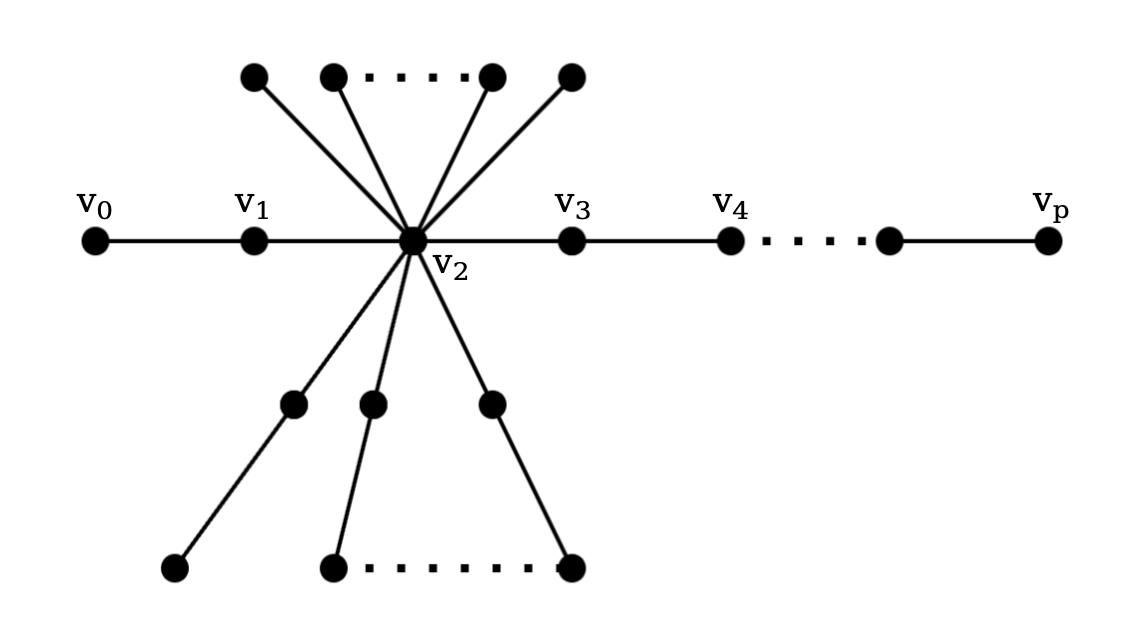
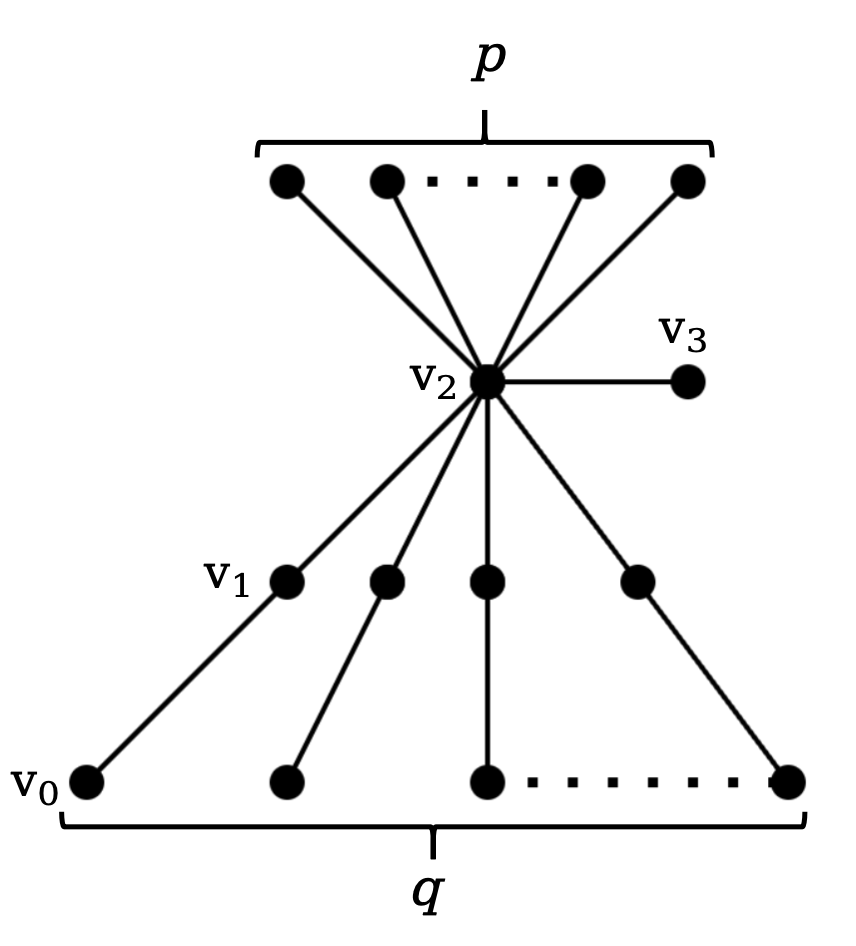
Denote \(T'_{v_2}\) by \(S_{p,q}\), where \(p\) and \(q\) be the numbers of neighbors of \(v_2\) having degrees 1 and 2, respectively. Then the exponential Randić index of \(L(T'_1)\) can be expressed as: \[\label{t1} ER(L(T'_1))=qe^{\frac{1}{\sqrt{p+q+1}}}+\binom{q}{2}e^{\frac{1}{p+q+1}}+\binom{p+1}{2}e^{\frac{1}{p+q}}+(p+1)qe^{\frac{1}{\sqrt{(p+q)(p+q+1)}}}.\]
By Lemma 2.4, we obtain: \[ER(L(T'_1)) > ER(K_{p+q+1}) = \frac{(p+q+1)(p+q)}{2}e^{\frac{1}{p+q}}.\]
Meanwhile, from the induction hypothesis we have: \[ER(L(T'_2)) > \frac{n-p-2q}{4}e^{\frac{1}{2}}.\]
Subcase 1. \(d_2=1\).
In this case, \(d_T(v_2)=2\), implying vertex \(v_2\) has no neighbors other than \(v_1\) and \(v_3\). Substituting \(d_1=1\) and \(d_2=1\) into the computation: \[\begin{aligned} ER(L(T))&=ER(L(T'_1))+ER(L(T'_2))-c\\ &>e+\frac{n-1}{4}e^{\frac{1}{2}}-\left(d_1\left(e^{\frac{1}{d_1}}-e^{\frac{1}{\sqrt{(d_1+d_2)\cdot d_1}}}\right)+d_2\left(e^{\frac{1}{d_2}}-e^{\frac{1}{\sqrt{(d_1+d_2)\cdot d_2}}}\right)\right)\\ &=\frac{n}{4}e^{\frac{1}{2}}+2e^{\frac{1}{\sqrt{2}}}-e-\frac{1}{4}e^{\frac{1}{2}}\\ &>\frac{n}{4}e^{\frac{1}{2}}. \end{aligned}\]
Thus, the theorem holds when \(d_2=1\).
Subcase 2. \(d_2\geq2\).
Subcase 2.1. \(p\geq 2\).
By Lemma 2.5, we obtain \(g(p,q)=\frac{2(p+q+1)(p+q)-p-2q}{4}e^{\frac{1}{2}}-e>0\), when \(p\) and \(q\) are positive integers with \(p\ge2\) and \(q\ge1\). Applying Lemma 2.4 we have \[\begin{aligned} ER(L(T))&=ER(L(T'_1))+ER(L(T'_2))-c\\ &>\frac{(p+q+1)(p+q)}{2}e^{\frac{1}{p+q}}+\frac{n-p-2q}{4}e^{\frac{1}{2}}-e\\ &>\frac{n}{4}e^{\frac{1}{2}}+\frac{2(p+q+1)(p+q)-p-2q}{4}e^{\frac{1}{2}}-e\\ &>\frac{n}{4}e^{\frac{1}{2}}. \end{aligned}\]
Therefore, the theorem holds in this case.
Subcase 2.2. \(p=1\).
In this case, with \(p=1\) and \(q\geq 1\), substituting \(p\) and \(q\) into equation(6) we have that \[ER(L(T'_1))=qe^{\frac{1}{\sqrt{q+2}}}+\binom{q}{2}e^{\frac{1}{q+2}}+e^{\frac{1}{q+1}}+2qe^{\frac{1}{\sqrt{(q+1)(q+2)}}}>\frac{1+2q}{4}e^{\frac{1}{2}}+e.\]
Consequently, we obtain that \[\begin{aligned} ER(L(T))&=ER(L(T'_1))+ER(L(T'_2))-c\\ &>ER(L(T'_1))+\frac{n-1-2q}{4}e^{\frac{1}{2}}-e\\ &=\frac{n}{4}e^{\frac{1}{2}}+ER(L(T'_1))-\frac{1+2q}{4}e^{\frac{1}{2}}-e\\ &>\frac{n}{4}e^{\frac{1}{2}}. \end{aligned}\]
Subcase 2.3. \(p=0\).
In this case, \(v_2\) has only degree-2 neighbors. Substituting \(p=0\) into equation(6), we obtain that \[ER(L(T'_1))=qe^{\frac{1}{\sqrt{q+1}}}+\binom{q}{2}e^{\frac{1}{q+1}}+qe^{\frac{1}{\sqrt{q(q+1)}}}>\frac{1}{2}qe^{\frac{1}{2}}+e.\]
Since \(d_2=p+q\) and \(p=0\), we have \(d_2=q\geq2\). Therefore, \[\begin{aligned} ER(L(T))&=ER(L(T'_1))+ER(L(T'_2))-c\\ &>ER(L(T'_1))+\frac{n-2q}{4}e^{\frac{1}{2}}-e\\ &=\frac{n}{4}e^{\frac{1}{2}}+ER(L(T'_1))-\frac{1}{2}qe^{\frac{1}{2}}-e\\ &>\frac{n}{4}e^{\frac{1}{2}}. \end{aligned}\]
The proof is completed. ◻
In this paper, we have studied a lower bound on the exponential Randić index for the line graph of any tree \(T_n\) and proved that for any tree \(T\) of order \(n\ge 3\), \(ER(L(T))>\frac{n}{4}\cdot e^{\frac{1}{2}}\). Our findings contribute to a deeper understanding of how structural graph invariants behave under line graph transformations.
In future work, it would be interesting to explore whether similar bounds hold for broader graph classes such as unicyclic graphs, potentially offering new insights and potential applications in the field of chemical graph theory.
The authors declare that they have no conflict of interest.