
Let \(G=(V, E)\) be a connected graph of order \(p\) and size \(q\). A bijection \(f: E\rightarrow \{1, 2, \dots, q\}\) is called a local antimagic labeling if \(f^{+}(u)\neq f^{+}(v)\) whenever \(uv\in E\), where \(f^{+}(u)=\sum_{e\in E(u)}f(e)\) and \(E(u)\) is the set of edges incident to \(u\). The mapping \(f^{+}\) which is also denoted by \(f^+_G\) is called a vertex labeling of \(G\) induced by \(f\), and the labels assigned to vertices are called induced colors under \(f\). The color number of a local antimagic labeling \(f\) is the number of distinct induced colors under \(f\), denoted by \(c(f)\). Moreover, \(f\) is called a local antimagic \(c(f)\)-coloring and \(G\) is local antimagic \(c(f)\)-colorable. The local antimagic chromatic number \(\chi_{la}(G)\) is defined to be the minimum number of colors taken over all colorings of \(G\) induced by local antimagic labelings of \(G\) [1] (also see [3] that introduced the concept of local antimagic labeling independently). Let \(G+H\) and \(mG\) denote the disjoint union of graphs \(G\) and \(H\), and \(m\) copies of \(G\), respectively. For integers \(c < d\), let \([c,d] = \{n\in\mathbb Z\;|\; c\le n\le d\}\). Very few results on the local antimagic chromatic number of regular graphs are known (see [1, 3]). Throughout this paper, we let \(O_m\) and \(aP_2\) be the families of 0-regular (or null) and 1-regular graphs, respectively with \(V(aP_2\vee O_m) = \{u_i, v_i, x_j\;|\; 1\le i\le a, 1\le j\le m\}\) and \(E(aP_2 \vee O_m) = \{u_ix_j, v_ix_j, u_iv_i\;|\; 1\le i\le a, 1\le j\le m\}\). We also let \(V(a(P_2\vee O_m)) = \{u_i, v_i, x_{i,j}\;|\; 1\le i\le a, 1\le j\le m\}\) and \(E(a(P_2\vee O_m)) = \{u_ix_{i,j}, v_ix_{i,j}, u_iv_i\;|\; 1\le i\le a, 1\le j\le m\}\).
In [5], the author proved that all connected graphs without a \(P_2\) component admit a local antimagic labeling. Thus, local antimagic chromatic number is well defined for all graphs without a \(P_2\) component. Clearly, \(O_m, m\ge 1,\) is the only family of (regular) graphs with local antimagic chromatic number 1 while \(aP_2, a\ge 1,\) is the only family of regular graphs without local antimagic chromatic number. In [1], it was shown that \(\chi_{la}(aP_2\vee O_1) = 1\) for \(a\ge 1\). In the following sections, we extend the ideas in [14] to prove that \(\chi_{la}((2k+1)P_2 \vee O_m) = 3\) for all \(k\ge 1\), \(m\ge 2\). Moreover, we also obtain other families of (possibly regular) tripartite graphs with local antimagic chromatic number 3. Interested readers may refer to [2, 4, 6, 11, 7, 8, 9, 12, 13, 14, 15, 16, 17, 18] for the many results on the join of graphs with a regular graph or some results on trees.
Consider the graph \((2k+1)(P_2 \vee O_{2n})\) of order \((2k+1)(2n+2)\) and size \((2k+1)(4n+1)\).
| i | 1 | 2 | 3 | \(\cdots\) | k | k+1 | common diff. |
| \(f(u_ix_i,1)\) | k+1+n(8k+4) | k +n(8k+4) | k-1+n(8k+4) | \(\cdots\) | 2 +n(8k+4) | 1 +n(8k+4) | \(-1\) |
| \(f(u_ix_i,2)\) | -3k-1 +n(8k+4) | -3k +n(8k+4) | -3k+1 +n(8k+4) | \(\cdots\) | -2k-2 +n(8k+4) | -2k-1 +V | \(+1\) |
| \(\vdots\) | \(\vdots\) | \(\vdots\) | \(\vdots\) | \(\cdots\) | \(\vdots\) | \(\vdots\) | |
| \(f(u_ix_i,2n-2j+1)\) | k+1+j(8k+4) | k +j(8k+4) | k-1+j(8k+4) | \(\cdots\) | 2 +j(8k+4) | 1 +j(8k+4) | \(-1\) |
| \(f(u_ix_i,2n-2j+2)\) | -3k-1 +j(8k+4) | -3k +j(8k+4) | -3k+1 +j(8k+4) | \(\cdots\) | -2k-2 +j(8k+4) | -2k-1 +j(8k+4) | \(+1\) |
| \(\vdots\) | \(\vdots\) | \(\vdots\) | \(\vdots\) | \(\cdots\) | \(\vdots\) | \(\vdots\) | |
| \(f(u_ix_i,2n-1)\) | 10k+5 | 10k+3 | 10k+1 | \(\cdots\) | 8k+7 | 8k+5 | -2 |
| \(f(u_ix_i,2n)\) | 5k+3 | 5k+4 | 5k+5 | \(\cdots\) | 6k+2 | 6k+3 | +1 |
| \(f(u_iv_i)\) | 1 | 2 | 3 | \(\cdots\) | k | k+1 | +1 |
| \(f(v_ix_i,1\)) | 3k+2 | 3k+3 | 3k+4 | \(\cdots\) | 4k+1 | 4k+2 | +1 |
| \(f(v_ix_i,2\)) | 8k+4 | 8k+2 | 8k | \(\cdots\) | 6k+6 | 6k+4 | -2 |
| \(\vdots\) | \(\vdots\) | \(\vdots\) | \(\vdots\) | \(\cdots\) | \(\vdots\) | \(\vdots\) | |
| \(f(v_ix_i,2j-1)\) | -5k-2 +j(8k+4) | -5k-1 + j(8k+4) | -5k +j(8k+4) | \(\cdots\) | -4k-3 +j(8k+4) | -4k-2 +j(8k+4) | \(+1\) |
| \(f(v_ix_i,2j)\) | -k +j(8k+4) | -k-1 +j(8k+4) | -k-2 +j(8k+4) | \(\cdots\) | -2k+1 + j(8k+4) | -2k +j(8k+4) | \(-1\) |
| \(\vdots\) | \(\vdots\) | \(\vdots\) | \(\vdots\) | \(\cdots\) | \(\vdots\) | \(\vdots\) | |
| \(f(v_ix_i,2n-1)\) | -5k-2 +n(8k+4) | -5k-1 +n(8k+4) | -5k +n(8k+4) | \(\cdots\) | -4k-3 +n(8k+4) | -4k-2 +n(8k+4) | \(+1\) |
| \(f(v_ix_i,2n)\) | -k +n(8k+4) | -k-1 + n(8k+4) | -k-2 +n(8k+4) | \(\cdots\) | -2k+1 +n(8k+4) | -2k +n(8k+4) | \(-1\) |
Thus, for \(i\in [1,2k+1]\) and \(j\in [2,n]\), we need the following \((4n+1)\times (2k+1)\) matrix with entries in \([1, (4n+1)(2k+1)]\) that correspond to \(f(u_ix_{i,j})\), \(f(u_iv_i)\), \(f(v_ix_{i,j})\), \(1\le i\le 2k+1\), \(1\le j\le 2n\), bijectively. For \(n=1\), the required \(5 \times (2k+1)\) matrix has entries \(f(u_ix_{i,2n-1})\), \(f(u_ix_{i,2n})\), \(f(u_iv_i)\), \(f(v_ix_{i,1})\) and \(f(v_ix_{i,2})\), \(1\le i\le 2k+1\), given by the middle five rows. In the following, we split the matrix into Table 1 (for \(i\in [1,k+1]\)) and Table 2 (for \(i\in [k+2,2k+1]\)) with \(2\le j\le n\).
| i | k+2 | k+3 | \(\cdots\) | 2k-1 | 2k | 2k+1 | common diff. |
| \(f(u_ix_i,1)\) | 2k+1+ n(8k+4) | 2k+ n(8k+4) | \(\cdots\) | k+4+n(8k+4) | k+3+n(8k+4) | k+2+n(8k+4) | \(-1\) |
| \(f(u_ix_i,2)\) | -4k-1+n(8k+4) | -4k+n(8k+4) | \(\cdots\) | -3k-4+ n(8k+4) | -3k-3+n(8k+4) | -3k-2+ n(8k+4) | \(+1\) |
| \(\vdots\) | \(\vdots\) | \(\vdots\) | \(\cdots\) | \(\vdots\) | \(\vdots\) | \(\vdots\) | |
| \(f(u_ix_i,2n-2j+1)\) | 2k+1+j(8k+4) | 2k+j(8k+4) | \(\cdots\) | k+4+j(8k+4) | k+3+j(8k+4) | k+2+j(8k+4) | \(-1\) |
| \(f(u_ix_i,2n-2j+2)\) | -4k-1+j(8k+4) | -4k+ j(8k+4) | \(\cdots\) | -3k-4+j(8k+4) | -3k-3+j(8k+4) | -3k-2+j(8k+4) | \(+1\) |
| \(\vdots\) | \(\vdots\) | \(\vdots\) | \(\cdots\) | \(\vdots\) | \(\vdots\) | \(\vdots\) | |
| \(f(u_ix_i,2n-1)\) | 10k+4 | 10k+2 | \(\cdots\) | 8k+10 | 8k+8 | 8k+6 | -2 |
| \(f(u_ix_i,2n)\) | 4k+3 | 4k+4 | \(\cdots\) | 5k | 5k+1 | 5k+2 | +1 |
| \(f(u_iv_i)\) | k+2 | k+3 | \(\cdots\) | 2k-1 | 2k | 2k+1 | +1 |
| \(f(v_ix_i,1)\) | 2k+2 | 2k+3 | \(\cdots\) | 3k-1 | 3k | 3k+1 | +1 |
| \(f(v_ix_i,2)\) | 8k+3 | 8k+1 | \(\cdots\) | 6k+9 | 6k+7 | 6k+5 | -2 |
| \(\vdots\) | \(\vdots\) | \(\vdots\) | \(\cdots\) | \(\vdots\) | \(\vdots\) | \(\vdots\) | |
| \(f(v_ix_i,2j-1)\) | -6k-2+j(8k+4) | -6k-1+ j(8k+4) | \(\cdots\) | -5k-5+j(8k+4) | -5k-4+j(8k+4) | -5k-3 +j(8k+4) | \(+1\) |
| \(f(v_ix_i,2j)\) | 0+ j(8k+4) | -1+j(8k+4) | \(\cdots\) | -k+3+j(8k+4) | -k+2+j(8k+4) | -k+1+ j(8k+4) | \(-1\) |
| \(\vdots\) | \(\vdots\) | \(\vdots\) | \(\cdots\) | \(\vdots\) | \(\vdots\) | \(\vdots\) | |
| \(f(v_ix_i,2n-1)\) | -6k-2+n(8k+4) | -6k-1+n(8k+4) | \(\cdots\) | -5k-5+n(8k+4) | -5k-4+n(8k+4) | -5k-3 +n(8k+4) | \(+1\) |
| \(f(v_ix_i,2n)\) | 0+n(8k+4) | -1+n(8k+4) | \(\cdots\) | -k+3+n(8k+4) | -k+2+n(8k+4) | -k+1+n(8k+4) | \(-1\) |
We now have the following observations.
(1) For a fixed \(j\in [2, n]\), \(\{f(u_i, x_{i, 2n-2j+1}), f(u_i, x_{i, 2n-2j+2}), f(v_i, x_{i, 2j-1}), f(v_i, x_{i, 2j})\;|\; 1\le i\le 2k+1 \}=[-6k-2+j(8k+4),\ 2k+1+j(8k+4)].\) Thus, when \(j\) runs through \([2,n]\), the integers from \(10k+6\) to \(2k+1+n(8k+4)\) are used. From the middle 5 rows, one may see that the integers from \(1\) to \(10k+5\) are used. Thus all integers in \([1, (4n+1)(2k+1)]\) are used once.
(2) For each \(i\in [1,2k+1]\), the sum of the first \(2n+1\) entries is \(f^+(u_i) = 8n^2k+ 6nk +4n^2 +4n+k+1\).
(3) For each \(i\in [1,2k+1]\), the sum of the last \(2n+1\) entries is \(f^+(v_i) = 8n^2k+ 2nk +4n^2 +2n+k+1\).
(4) Suppose \(n=1\). For \(j=1,2\), we let \(S_j =\{f^+(x_{i,j})=f(u_ix_{i,j})+f(v_ix_{i,j})\;|\; 1\le i\le 2k+1\}\). Thus, the elements of \(S_j\) form an arithmetic sequence with first term \(13k+7\) and last term \(11k+7\) with common difference \(-1\). The sum of all the elements in \(S_j\) is \((2k+1)(12k+7)\).
(5) Suppose \(n\ge 2\). For \(j \in [1,2n]\), we also let \(S_j =\{f^+(x_{i,j})=f(u_ix_{i,j})+f(v_ix_{i,j})\mid 1\le i\le 2k+1\}\). If \(j=2, 2n-1\), the elements of \(S_j\) form an arithmetic sequence with first term \(5k+3+n(8k+4)\) and last term \(3k+3+n(8k+4)\) with common difference \(-1\). For each \(j\in [1,2n]\setminus \{2,2n-1\}\), \(S_j = \{(4k+3)+n(8k+4), \ldots, (4k+3)+n(8k+4)\}\) with multiplicity \(2k+1\). Thus, the sum of all the elements in each \(S_j\), \(1\le j\le 2n\), is \((2k+1)[(4k+3) + n(8k+4)]\).
(6) Suppose \(2k+1= (2r+1)(2s+1)\), \(r,s\ge 1\). Note that, each \(S_j\) is an arithmetic sequence with common difference either \(0\) or \(-1\). If \(S_j\) is an arithmetic sequence with common difference \(-1\), then \(S_j\) can be partitioned into \(2r+1\) blocks of size \(2s+1\) such that sum of all elements in each block is \((2k+1)[(4k+3)+n(8k+4)]/(2r+1) = (2s+1)[(4k+3) + n(8k+4)]\) by the existence of \((2r+1)\times (2s+1)\) magic rectangle. If \(S_j\) is an arithmetic sequence with common difference 0, then the partition is obvious. This corresponds to partition the \(2k+1\) columns into \(2r+1\) blocks of \(2s+1\) columns so that for each \(j\in [1,2n]\), \(\sum [f(u_ix_{i,j}) + f(v_ix_{i,j})] = (2s+1)[(4k+3)+n(8k+4)]\) over all the \(2s+1\) columns in the same block. Moreover, the partition of \(S_1\) to \(S_{2n}\) may be all distinct.
Theorem 2.1. For \(n,k\ge 1\), \(\chi_{la}((2k+1)P_2 \vee O_{2n}) = 3\).
Proof. Note that \(\chi_{la}((2k+1)P_2 \vee O_{2n})\ge \chi((2k+1)P_2 \vee O_{2n}) = 3\). Let \(G = (2k+1)(P_2 \vee O_{2n})\) be defined at the beginning of this section. We now define a bijection \(f: E(G) \to [1, (2k+1)(4n+1)]\) according to the table above. Clearly, for \(1\le i\le 2k+1\), \(f^+(u_i) = 8n^2k+ 6nk +4n^2 +4n+k+1 > f^+(v_i) = 8n^2k+ 2nk +4n^2 +2n+k+1\). Now, for each \(j\in [1, 2n]\), merging the vertices \(x_{i,j}, 1\le i\le 2k+1\), to form new vertex \(x_j\) of degree \(4k+2\), we get the graph \((2k+1)P_2 \vee O_{2n}\). From Observations (2) to (5) above, we get that \((2k+1)P_2 \vee O_{2n}\) that admits a bijective edge labeling \(f\) with
(a) \(f^+(x_j) = (2k+1)[(4k+3)+n(8k+4)]\),
(b) \(f^+(u_i) = 8n^2k+ 6nk +4n^2 +4n+k+1\) and
(c) \(f^+(v_i) = 8n^2k+ 2nk +4n^2 +2n+k+1\).
Now, \[\begin{aligned} (a) – (b) &= 16k^2n-8kn^2+8k^2 +10kn-4n^2 +9k+2 \\ & = 8kn(2k – n) + 8k^2 + 2kn + 4n(2k-n) + 9k + 2 \\ & = (8kn+4n)(2k-n) + 8k^2 + 2kn + 9k + 2\\ & > 0 \quad \mbox{ if $2k\ge n$.} \end{aligned}\]
Otherwise, if \(n\ge 2k+1\) (equivalently, \(-n \le -2k-1\)) we get that \((a) – (b) \le -8kn – 4n + 8k^2 + 2kn + 9k+2 \le 6k(-2k-1)+4(-2k-1)+8k^2+9k+2 < 0\). Thus, \(f^+(x_j)\ne f^+(u_i)\). Similarly, \[\begin{aligned} (a) – (c) & = 16k^2n-8kn^2 + 8k^2 +14kn – 4n^2 +9k+2n+2 \\ &= 8kn(2k-n) + 8k^2 + 6kn + 4n(2k-n) + 9k + 2n + 2 \\ &= (8kn+4n)(2k-n) + 8k^2 + 6kn+9k+2n+2\\ & > 0 \quad\mbox{ if $2k\ge n$.} \end{aligned}\]
If \(n = 2k+1\), we can get \((a) – (c) = 4k^2 + 3k > 0\). Otherwise, if \(n\ge 2k+2\) (equivalently, \(-n \le -2k-2\)) we get that \((a) – (c) \le -16kn + 8k^2 + 6kn – 8n + 9k + 2n + 2 \le 10k(-2k-2) + 8k^2 +6(-2k-2)+9k+2 < 0\). Thus, \(f^+(x_j)\ne f^+(v_i)\). Consequently, \(f\) is a local antimagic 3-coloring and \(\chi_{la}((2k+1)P_2 \vee O_{2n})\le 3\). This completes the proof. ◻
Example 2.2. Consider \(n=2, k=4\). The \(9\times 9\) matrix and the \(9(P_2\vee O_4)\) with the defined edge labeling are given below. For each \(j\in[1,4]\), merge the vertices in \(\{x_{i,j}\mid 1\le i\le 9\}\) to get the vertex \(x_j\) of degree 18 gives the \(9P_2 \vee O_4\) with the defined labeling as required. The induced vertex labels of \(u_i, v_i, x_j\) are 205, 169, 819 respectively.
| i | 1 | 2 | 3 | 4 | 5 | 6 | 7 | 8 | 9 |
|---|---|---|---|---|---|---|---|---|---|
| \(f(u_ix_{i,1})\) | 77 | 76 | 75 | 74 | 73 | 81 | 80 | 79 | 78 |
| \(f(u_ix_{i,2})\) | 59 | 60 | 61 | 62 | 63 | 55 | 56 | 57 | 58 |
| \(f(u_ix_{i,3})\) | 45 | 43 | 41 | 39 | 37 | 44 | 42 | 40 | 38 |
| \(f(u_ix_{i,4})\) | 23 | 24 | 25 | 26 | 27 | 19 | 20 | 21 | 22 |
| \(f(u_iv_i)\) | 1 | 2 | 3 | 4 | 5 | 6 | 7 | 8 | 9 |
| \(f(v_ix_{i,1})\) | 14 | 15 | 16 | 17 | 18 | 10 | 11 | 12 | 13 |
| \(f(v_ix_{i,2})\) | 36 | 34 | 32 | 30 | 28 | 35 | 33 | 31 | 29 |
| \(f(v_ix_{i,3})\) | 50 | 51 | 52 | 53 | 54 | 46 | 47 | 48 | 49 |
| \(f(v_ix_{i,4})\) | 68 | 67 | 66 | 65 | 64 | 72 | 71 | 70 | 69 |
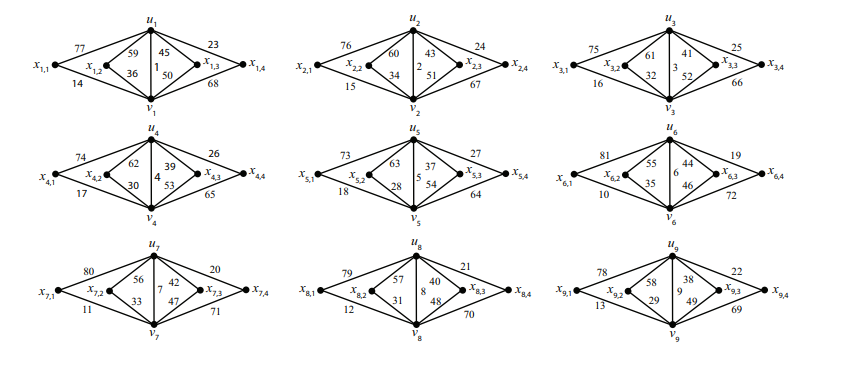
Let \(2k+1 = (2r+1)(2s+1)\) for \(r,s\ge 1\). Consider \((2k+1)(P_2 \vee O_2)\) with the bijective edge labeling as defined in the proof of Theorem 2.1. Recall that the \(i\)-th \(P_2\vee O_2\) has two degree 3 vertices \(u_i, v_i\) and two degree 2 vertices \(x_{i,j}\), \(j = 1,2\), with induced vertex labels \(f^+(u_i) = 15k+9\), \(f^+(v_i) = 11k+7\), and \(f^+(x_{i,j}) = 13k+8-i\) for \(1\le i\le 2k+1\). We now have \(S_j = \{f^+(x_{i,j})\mid 1\le i\le 2k+1\}\). By Observations (4) and (6) above, we can now partition \(S_j\) into \(2r+1\) blocks of size \(2s+1\) each such that in each block, the sum of the induced vertex labels is the constant \((2s+1)(12k+7)\). Now, let \(\mathcal G_2(2r+1,2s+1)\) be the set of all the graphs obtained by merging all the \(2s+1\) vertices of degree 2 with induced vertex labels in the same block to get a new vertex of degree \(4s+2\) with induced vertex label \((2s+1)(12k+7)\). Since the partition of each \(S_j\) may not be unique, \(\mathcal G_2(2r+1,2s+1)\) may contain more than one graph (see Example 2.5).
Theorem 2.3. Let \(2k+1 = (2r+1)(2s+1)\) for \(r,s\ge 1\). If \(G\in \mathcal G_2(2r+1,2s+1)\) is defined as above, then \(\chi_{la}(G) = 3\).
Proof. By the discussion above, we know each graph in \(\mathcal G_2(2r+1,2s+1)\) admits a local antimagic 3-coloring with distinct induced vertex labels \(15k+9\), \(11k+7\), \((2s+1)(12k+7)\). Thus, \(\chi_{la}(G) \le 3\). Since \(\chi_{la}(G) \ge \chi(G) = 3\), the theorem holds. ◻
Corollary 2.4. For \(r,s\ge 2\), \(\chi_{la}((2r+1)[(2s+1)P_2\vee O_2]) = 3\).
Proof. Let the partition of \(S_1\) and \(S_2\) be equal, then the resulting graph is \((2r+1)[(2s+1)P_2 \vee O_2]\). ◻
Example 2.5. Consider \(k=4\) so that \(r=s=1\). We have the following \(5\times 9\) matrix and a magic square \(M\) of order 3.
| i | 1 | 2 | 3 | 4 | 5 | 6 | 7 | 8 | 9 |
| \(f(u_ix_i,1)\) | 45 | 43 | 41 | 39 | 37 | 44 | 42 | 40 | 38 |
| \(f(u_ix_i,2)\) | 23 | 24 | 25 | 26 | 27 | 19 | 20 | 21 | 22 |
| \(f(u_iv_i)\) | 1 | 2 | 3 | 4 | 5 | 6 | 7 | 8 | 9 |
| \(f(v_ix_i,1)\) | 14 | 15 | 16 | 17 | 18 | 10 | 11 | 12 | 13 |
| \(f(v_ix_i,2)\) | 36 | 34 | 32 | 30 | 28 | 35 | 33 | 31 | 29 |
For \(j=1,2\), partition \(S_j\) into blocks \(\{f^+(x_{1,j}), f^+(x_{5,j}), f^+(x_{9,j})\}\), \(\{f^+(x_{2,j}), f^+(x_{6,j}),\\ f^+(x_{7,j})\}\), \(\{f^+(x_{3,j}), f^+(x_{4,j}), f^+(x_{8,j})\}\) by using the rows of \(M\). We get \(G=3(3P_2\vee O_2)\in \mathcal G_2(3,3)\) as required. The induced vertex labels are \(69,51,165\) respectively.
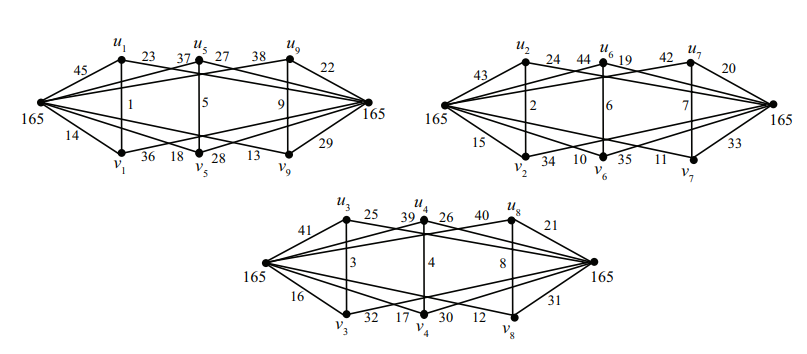
If we keep the partition of \(S_1\) and partition \(S_2\) into blocks \(\{f^+(x_{1,2}), f^+(x_{6,2}), f^+(x_{8,2})\},\\ \{f^+(x_{2,2}),\) \(f^+(x_{4,2}), f^+(x_{9,2})\}\) and \(\{f^+(x_{3,2}), f^+(x_{5,2}), f^+(x_{7,2})\}\) by using the columns of \(M\), then we get a connected graph as follow with the same induced vertex labels.
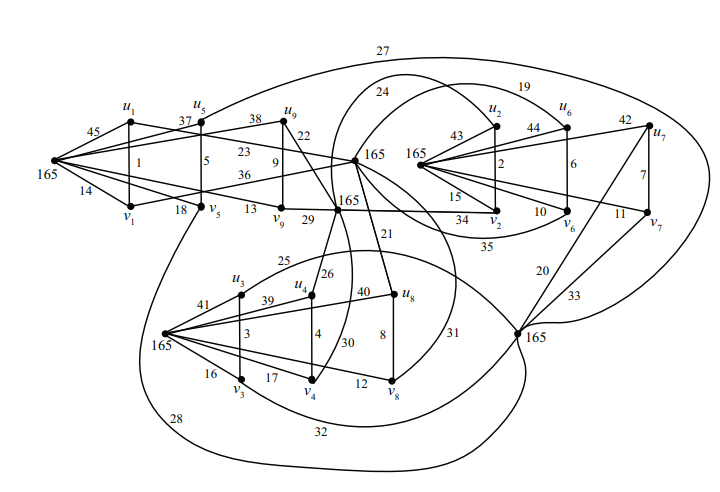
The degree 6 vertices are indicated with their induced vertex label 165.
Let \(2k+1 = (2r+1)(2s+1)\) for \(r,s\ge 1\). Consider \((2k+1)(P_2 \vee O_{2n}), n\ge 2,\) with the bijective edge labeling as defined in the proof of Theorem 2.1. Similar to the discussion above for \((2k+1)(P_2 \vee O_2)\), and by Observations (5) and (6), we also have the set of graphs \(\mathcal G_{2n}(2r+1,2s+1)\). Each of the graph has vertices \(u_i\) and \(v_i\), \(1\le i\le 2k+1\), of degree \(2n+1\) with induced vertex labels \(f^+(u_i) = 8n^2k+6nk+4n^2+4n+k+1\), \(f^+(v_i) = 8n^2k+2nk+4n^2+2n+k+1\), and \(2n(2r+1)\) vertices of degree \(2(2s+1)\) with induced vertex label \((2s+1)[(4k+3)+n(8k+4)]\). Note that, since \(S_1\) is a constant sequence, there are at least two different partitions of \(S_1\). Thus \(\mathcal G_{2n}(2r+1,2s+1)\) contains at least two graphs.
Theorem 2.6. For \(n\ge 2\), \(r,s\ge 1\) and \(G\in \mathcal G_{2n}(2r+1,2s+1)\), \(\chi_{la}(G) = 3\).
Proof. By the discussion above, we know each \(G\in \mathcal G_{2n}(2r+1,2s+1)\) admits a local antimagic 3-coloring with each degree \(2(2s+1)\) vertex has induced vertex label \((a) = (2s+1)[(4k+3)+n(8k+4)]\) whereas for \(1\le i\le 2k+1\), the vertices \(u_i, v_i\) of degree \(2n+1\) have induced vertex labels \((b) = f^+(u_i) = 8n^2k+6nk+4n^2+4n+k+1\) and \((c) = f^+(v_i) = 8n^2k+2nk+4n^2+2n+k+1\).
Clearly, \((b) > (c)\). Now, \[\begin{aligned} (a) – (b) &= 16kns-8kn^2 +2kn+8ks +8ns-4n^2+3k+6s+2\\ &= (8kn+ 4n)(2s-n) + 2kn+8ks+3k+6s+2\\ &> 0 \quad\mbox{ if $2s\ge n$.} \end{aligned}\]
Otherwise, if \(n\ge 2s+1\) (equivalently, \(-n\le -2s-1\)), \((a) – (b) \le -6kn – 4n + 8ks + 3k +6s + 2\le 6k(-2s-1) + 4(-2s-1) + 8ks + 3k + 6s + 2<0\). Thus, \((a) \ne (b)\). Similarly,
\[\begin{aligned} (a) – (c) &= 16kns-8kn^2+6kn+8ks-4n^2 +8ns+3k+2n+6s+2\\ &= (8kn+4n)(2s-n)+6kn+8ks+3k+2n+6s+2\\ &> 0 \quad \mbox{ if $2s\ge n$.} \end{aligned}\]
If \(n=2s+1\), \((a) – (c) =(-2k-2)(2s+1)+8ks+3k+6s+2 > 0\). Otherwise, if \(n\ge 2s+2\) (equivalently, \(2s-n\le -2\)), \((a) -(c) \le -10kn – 6n + 8ks + 3k + 6s + 2 \le (10k+6)(-2s-2) + 8ks + 3k + 6s + 2 < 0\). Thus, \((a) \ne (c)\).
Consequently, \(\chi_{la}(G)\le 3\). Since \(\chi_{la}(G) \ge \chi(G) = 3\), the theorem holds. ◻
Corollary 2.7. For \(n\ge 2, r,s\ge 1\), \(\chi_{la}((2r+1)[(2s+1)P_2 \vee O_{2n}]) = 3\).
Proof. By using the rows of a \((2r+1)\times (2s+1)\) magic rectangle to partition \(S_2\). Partition other \(S_j\) so that they have the same partition as \(S_2\). The resulting graph is \((2r+1)[(2s+1)P_2 \vee O_{2n}]\). ◻
Example 2.8. Consider \(n=2, k= 4\) as in Example 2.2. We can only have \(r=s=1\). For \(1\le j\le 4\), if we partition \(S_j\) into blocks as in Example 2.5, we can get \(G = 3(3P_2 \vee O_4) \in \mathcal G_4(3,3)\) as follow. The induced vertex labels are 205, 169, 273 respectively.
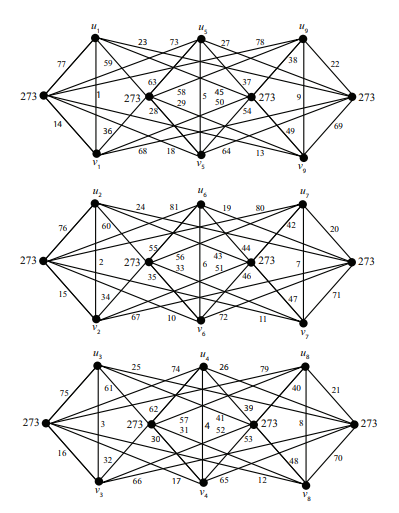
If we keep the partitions of \(S_1, S_2, S_4\) and partition \(S_3\) into blocks \(\{f^+(x_{1,3}), f^+(x_{6,3}),\\ f^+(x_{8,3})\}\), \(\{f^+(x_{2,3}), f^+(x_{4,3}), f^+(x_{9,3})\}\) and \(\{f^+(x_{3,3}), f^+(x_{5,3}), f^+(x_{7,3})\}\), then we get a connected graph as follow with the same induced vertex labels.
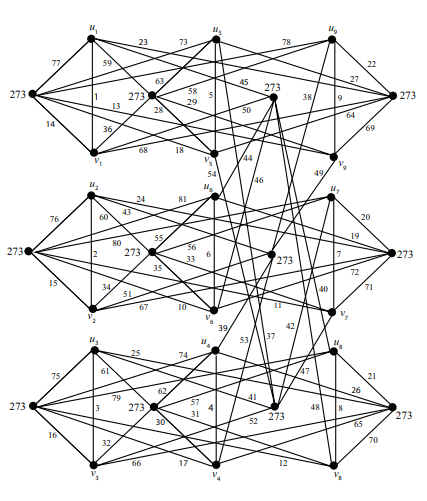
The degree 6 vertices are indicated with their induced vertex label 273. Note that there are many more ways to do the partitioning of \(S_1\) to \(S_4\) accordingly to get more non-isomorphic graphs all with local antimagic chromatic number 3.
Recall that for \(n\ge 2\), \(1\le i\le 2k+1\) and each \(j\in [1,2n]\setminus \{2,2n-1\}\), the bijective edge labeling of \((2k+1)(P_2 \vee O_{2n})\) defined above has the property that \(f^+(x_{i,j}) = (4k+3)+n(8k+4) = f^+(x_{k+1, 2}) = f^+(x_{k+1, 2n-1})\). Thus, each \(G\in \mathcal G_{2n}(2r+1,2s+1)\) has \((2n-2)(2r+1)\) vertices of degree \(4s+2\) each of with is incident to \(2s+1\) pairs of edges with labels sum \((4k+3)+n(8k+4)\) and also 2 vertices of degree \(4s+2\) each of which is incident to a pair of edges with labels sum \((4k+3)+n(8k+4)\).
For \(n\ge 2\), \(r,s\ge 1\), and a graph \(G\in \mathcal G_{2n}(2r+1,2s+1)\), choose two distinct vertices of degree \(4s+2\), say \(x\) and \(x'\), such that
(a) \(xu_i, xv_i\) are edges with labels sum \((4k+3)+n(8k+4)\), while \(x'u_{i'}, x'v_{i'}\) are also edges with labels sum \((4k+3)+n(8k+4)\), and
(b) \(x\) and \(x'\) do not have common neighbors.
Delete the edges \(xu_i\), \(xv_i\), \(x'u_{i'}\) and \(x'v_{i'}\); and add the edges \(xu_{i'}\) and \(xv_{i'}\) with labels \(f(x'u_{i'})\) and \(f(x'v_{i'})\) respectively; and add the edges \(x'u_i\) and \(x'v_i\) with labels \(f(xu_i)\) and \(f(xv_i)\) respectively. Repeat this delete-add process so long as we get another new graph not isomorphic to \(G\). Let \(\mathcal H_{2n}(2r+1,2s+1)\) be the set of all the graphs such obtained. Note that the graphs in \(\mathcal H_{2n}(2r+1,2s+1)\) may not be connected.
Theorem 2.9. For \(n\ge 2, r,s\ge 1\), if \(H\in \mathcal H_{2n}(2r+1,2s+1)\), then \(\chi_{la}(H) = 3\).
Proof. By definition and the discussion above, we immediately have each graph \(H \in \mathcal H_{2n}(2r+1,2s+1)\) also admits a a local antimagic 3-coloring with induced vertex labels as for each graphs \(G\in \mathcal G_{2n}(2r+1,2s+1)\). Moreover, \(\chi(H) = 3\). This completes the proof. ◻
Example 2.10. Using the \(3(3P_2\vee O_3)\) in Example 2.8, we may let \(x\) be the vertex adjacent to \(u_1\), \(v_1\) and \(x'\) be the vertex adjacent to \(u_7\), \(v_7\), satisfying \(f(xu_1) + f(xv_1) = f(x'u_7) + f(x'v_7) = 91\) and \(x,x'\) do not have common neighbors. Note that this graph is not a possible graph of \(\mathcal G_4(3,3)\) since two of the degree 6 vertices are obtained by merging vertices with induced vertex labels in \(\{f^+(x_{7,4}), f^+(x_{5,1}), f^+(x_{9,1})\}\) and \(\{f^+(x_{1,1}), f^+(x_{2,4}), f^+(x_{6,4})\}\) which are not subsets of \(S_1\) nor \(S_4\).
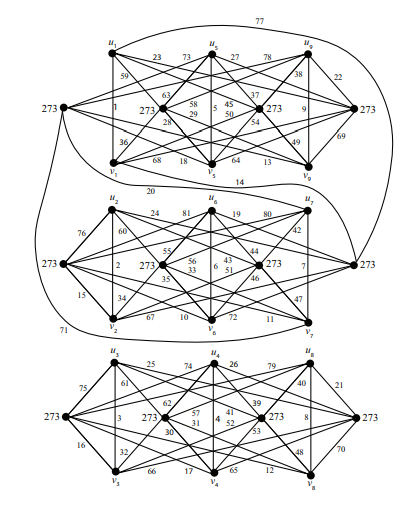
Note that a new connected graph is obtained if we apply the same process to the graph in Figure 6 by choosing the vertices incident to edges with labels \(76,15\) and \(21,70\).
Consider \((2k+1)(P_2\vee O_{2n+1})\) of order \((2k+1)(2n+3)\) and size \((2k+1)(4n+3)\) for \(k,n\ge 1\). Thus, for \(1\in [1,2k+1]\) and \(j\in [1,n]\), we need the following \((4n+3)\times (2k+1)\) matrix with entries in \([1, (4n+3)(2k+1)]\) bijectively. For \(n=1\), the required \(7\times (2k+1)\) matrix has entries \(f(u_ix_{i,1})\), \(f(u_ix_{i,2})\), \(f(u_ix_{i,3})\), \(f(u_iv_i)\), \(f(v_ix_{i,1})\), \(f(v_ix_{i,2})\), \(f(v_ix_{i,3})\) given by the first 2, middle 3 and last 2 rows.
| i | 1 | 2 | 3 | \(\cdots\) | 2k | 2k+1 | common diff. |
| \(f(u_ix_{i,1})\) | 6k+3+ | 6k+2 + | 6k+1 | \(\cdots\) | 4k+4 + | 4k+3 + | \(-1\) |
| 2n(4k+2) | 2n(4k+2) | 2n(4k+2) | 2n(4k+2) | 2n(4k+2) | |||
| \(f(u_ix_{i,2})\) | 2k+2 + | 2k+3 + | 2k+4 + | \(\cdots\) | 4k+1 + | 4k+2 + | \(+1\) |
| 2n(4k+2) | 2n(4k+2) | 2n(4k+2) | 2n(4k+2) | 2n(4k+2) | |||
| \(\vdots\) | \(\vdots\) | \(\vdots\) | \(\vdots\) | \(\cdots\) | \(\vdots\) | \(\vdots\) | \(\vdots\) |
| \(f(u_ix_{i,2n-2j+1})\) | 6k+3 + | 6k+2 + | 6k+1 | \(\cdots\) | 4k+4 + | 4k+3 + | \(-1\) |
| (n+j)(4k+2) | (n+j)(4k+2) | (n+j)(4k+2) | (n+j)(4k+2) | (n+j)(4k+2) | |||
| \(f(u_ix_{i,2n-2j+2})\) | 2k+2 + | 2k+3 + | 2k+4 + | \(\cdots\) | 4k+1 + | 4k+2 + | \(+1\) |
| (n+j)(4k+2) | (n+j)(4k+2) | (n+j)(4k+2) | (n+j)(4k+2) | (n+j)(4k+2) | |||
| \(\vdots\) | \(\vdots\) | \(\vdots\) | \(\vdots\) | \(\cdots\) | \(\vdots\) | \(\vdots\) | \(\vdots\) |
| \(f(u_ix_{i,2n+1})\) | 2k+1 + | 2k+ | (2k-1)+ | \(\cdots\) | 2 + | 1 + | \(-1\) |
| (n+1)(4k+2) | (n+1)(4k+2) | (n+1)(4k+2) | (n+1)(4k+2) | (n+1)(4k+2) | |||
| \(f(u_iv_i)\) | 1 | 2 | 3 | \(\cdots\) | 2k | 2k+1 | +1 |
| \(f(v_ix_i,1)\) | 4k+2 | 4k+1 | 4k | \(\cdots\) | 2k+3 | 2k+2 | -1 |
| \(\vdots\) | \(\vdots\) | \(\vdots\) | \(\vdots\) | \(\cdots\) | \(\vdots\) | \(\vdots\) | \(\vdots\) |
| \(f(v_ix_{i,2j})\) | 2k+1 + | 2k + | 2k-1 + | \(\cdots\) | 2 + | 1 + | \(-1\) |
| j(4k+2) | j(4k+2) | j(4k+2) | j(4k+2) | j(4k+2) | |||
| \(f(v_ix_{i,2j+1})\) | 2k+2 + | 2k+3 + | 2k+4 + | \(\cdots\) | 4k+1 + | 4k +2 + | \(+1\) |
| j(4k+2) | j(4k+2) | j(4k+2) | j(4k+2) | j(4k+2) | |||
| \(\vdots\) | \(\vdots\) | \(\vdots\) | \(\vdots\) | \(\cdots\) | \(\vdots\) | \(\vdots\) | \(\vdots\) |
| \(f(v_ix_{i,2n})\) | 2k+1 + | 2k + | 2k-1 + | \(\cdots\) | 2 + | 1 + | \(-1\) |
| n(4k+2) | n(4k+2) | n(4k+2) | n(4k+2) | n(4k+2) | |||
| \(f(v_ix_{i,2n+1})\) | 2k+2 + | 2k+3 + | 2k+4 + | \(\cdots\) | 4k+1 + | 4k +2 + | \(+1\) |
| n(4k+2) | n(4k+2) | n(4k+2) | n(4k+2) | n(4k+2) |
We now have the following observations.
(1) For a fixed \(j\in [1,n]\), \(\{f(v_i, x_{i, 2j}, f(v_i, x_{i, 2j+1})\;|\; 1\le i\le 2k+1 \} = [1 + j(4k+2), \ 4k+2+j(4k+2)].\) Thus, when \(j\) runs through \([1,n]\), the integers from \(4k+3\) to \((n+1)(4k+2)\) are used. Similarly, for a fixed \(j\in [1,n]\), \(\{f(u_i, x_{i, 2n-2j+1}), f(u_i, x_{i, 2n-2j+2})\;|\; 1\le i\le 2k+1 \}=[2k+2 + (n+j)(4k+2), \ 6k+3 + (n+j)(4k+2)]\). Thus, when \(j\) runs through \([1,n]\), the integers from \(2k+2 + (n+1)(4k+2)\) to \(2k+1 + (2n+1)(4k+2) = (4n+3)(2k+1)\) are used. From rows \(f(u_iv_i)\) and \(f(v_ix_{i,1})\) with entries 1 to \(4k+2\), and rows \(f(u_ix_{i,2n+1})\) with entries \(1+(n+1)(4k+2)\) to \(2k+1+(n+1)(4k+2)\), we see that all integers in \([1, (4n+3)(2k+1)\) are used once.
(2) For each column, the sum of the first \(2n+2\) entries is \(f^+(u_i) = 12n^2k+16nk+6n^2+9n+6k+4\).
(3) For each column, the sum of the last \(2n+2\) entries is \(f^+(v_i) = 4n^2k+8nk + 2n^2 + 5n + 4k+3\).
(4) For \(S_1 = \{ f^+(x_{i,1})= f(u_ix_{i,1}) + f(v_ix_{i,1})\mid 1\le i\le 2k+1\}\), the elements form an arithmetic sequence with first term \(10k+5 + 2n(4k+2)\), last term \(6k+5+2n(4k+2)\) and common difference 2. The sum of all these terms is \((2k+1)[(8k+5)+2n(4k+2)]\).
(5) For \(j\in[2, 2n+1]\), \(S_j = \{ f^+(x_{i,j})=f(u_ix_{i,j}) + f(v_ix_{i,j})\mid 1\le i\le 2k+1\} = \{8k+5 + 2n(4k+2), \ldots, 8k+5 + 2n(4k+2)\}\) with multiplicity \(2k+1\). The sum of all the terms is \((2k+1)[(8k+5)+2n(4k+2)]\).
Theorem 3.1. For \(n, k\ge 1\), \(\chi_{la}((2k+1)P_2 \vee O_{2n+1}) = 3\).
Proof. Note that \(\chi_{la}((2k+1)P_2 \vee O_{2n+1}) \ge \chi((2k+1)P_2 \vee O_{2n}) = 3\). Let \(G=(2k+1)(P_2 \vee O_{2n+1})\) for \(n, k\ge 1\). We now define a bijection \(f : E(G) \to [1, (4n+3)(2k+1)]\) according to the table above. Now, for each \(j\in [1,2n+1]\), merging the vertices in \(\{x_{i,j} \mid 1\le i\le 2k+1\}\), to form new vertex \(x_j\) of degree \(4k+2\), we get the graph \((2k+1)P_2\vee O_{2n+1}\). From Observations (2) to (5) above, we get that \((2k+1)P_2 \vee O_{2n+1}\) admits a bijective edge labeling \(f\) with
(a) \(f^+(x_j) = (2k+1)[(8k+5)+2n(4k+2)]\),
(b) \(f^+(u_i) =12n^2k+16nk+6n^2+9n+6k+4\), and
(c) \(f^+(v_i) = 4n^2k+8nk + 2n^2 + 5n +
4k+3\),
for \(1\le i\le 2k+1\) and \(1 \le j\le 2n+1\).
Clearly, for \(1\le i\le 2k+1\), \(f^+(u_i)> f^+(v_i)\). Now, \[\begin{aligned} (a) – (b) &= 16k^2n-12kn^2+16k^2-6n^2 +12k-5n+1\\ &=(4kn+4k+2n+3)(4k-3n)+4kn+4n+1\\ &> 0 \mbox{ if $4k\ge 3n$.} \end{aligned}\] If \(3n = 4k+1\), then \((a) – (b) = -(4kn+4k+2n+3) + 4kn + 4n + 1 = -4k + 2n – 2 = -n-1 < 0\). Otherwise, if \(3n \ge 4k+2\), we get that \((a) – (b) \le -2(4kn+4k+2n+3) + 4kn + 4n + 1 = -4kn – 8k – 5 < 0\). Thus, \(f^+(x_j) \ne f^+(u_i)\). Similarly, \[\begin{aligned} (a) – (c) &= 16k^2 n-4kn^2 +16k^2 +8kn-2n^2 +14k-n+2\\ &= (4kn+2n+1)(4k-n)+16k^2+10k+2\\ &> 0 \mbox{ if $n\le 4k$.} \end{aligned}\] Otherwise, if \(n\ge 4k + 1\) (equivalent, \(-n \le -4k-1\)), we get that \((a) – (c) \le -4kn-2n + 16k^2 + 10k + 1\le (-4k-1)(4k+2)+16k^2+10k+1 < 0\). Thus, \(f^+(x_j) \ne f^+(v_i)\).
Consequently, \(f\) is a local antimagic 3-coloring and \(\chi_{la}((2k+1)P_2 \vee O_{2n+1}) \le 3\). This completes the proof. ◻
Example 3.2. Consider \(n=2, k=4\). The \(11\times 9\) matrix and the \(9(P_2 \vee O_5)\) with the defined edge labeling are given below. For each \(j\in[1,5]\), merge the vertices in \(\{x_{i,j}\mid 1\le i\le 9\}\) to get the vertex \(x_j\) of degree 18 gives the \(9P_2 \vee O_5\) as required. The induced vertex labels of \(u_i, v_i, x_j\) are \(390, 165, 981\) respectively.
| i | 1 | 2 | 3 | 4 | 5 | 6 | 7 | 8 | 9 |
|---|---|---|---|---|---|---|---|---|---|
| \(f(u_ix_{i,1})\) | 99 | 98 | 97 | 96 | 95 | 94 | 93 | 92 | 91 |
| \(f(u_ix_{i,2})\) | 82 | 83 | 84 | 85 | 86 | 87 | 88 | 89 | 90 |
| \(f(u_ix_{i,3})\) | 81 | 80 | 79 | 78 | 77 | 76 | 75 | 74 | 73 |
| \(f(u_ix_{i,4})\) | 64 | 65 | 66 | 67 | 68 | 69 | 70 | 71 | 72 |
| \(f(u_ix_{i,5})\) | 63 | 62 | 61 | 60 | 59 | 58 | 57 | 56 | 55 |
| \(f(u_iv_i)\) | 1 | 2 | 3 | 4 | 5 | 6 | 7 | 8 | 9 |
| \(f(v_ix_{i,1})\) | 18 | 17 | 16 | 15 | 14 | 13 | 12 | 11 | 10 |
| \(f(v_ix_{i,2})\) | 27 | 26 | 25 | 24 | 23 | 22 | 21 | 20 | 19 |
| \(f(v_ix_{i,3})\) | 28 | 29 | 30 | 31 | 32 | 33 | 34 | 35 | 36 |
| \(f(v_ix_{i,4})\) | 45 | 44 | 43 | 42 | 41 | 40 | 38 | 38 | 37 |
| \(f(v_ix_{i,5})\) | 46 | 47 | 48 | 49 | 50 | 51 | 52 | 53 | 54 |
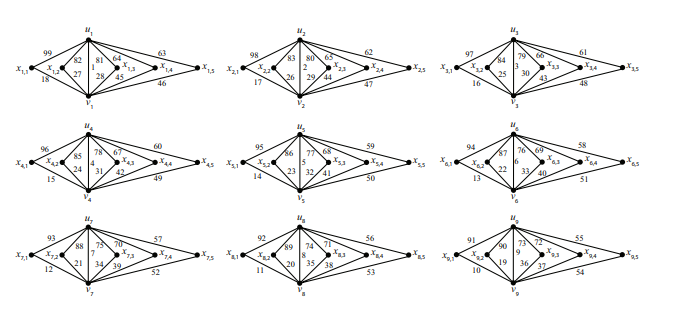
Similar to Theorem 2.6, we also define \(\mathcal G_{2n+1}(2r+1,2s+1)\) accordingly for \(n,r,s\ge 1\).
Theorem 3.3. For \(n,r,s\ge 1\) and \(G\in \mathcal G_{2n+1}(2r+1,2s+1)\), \(\chi_{la}(G) = 3\).
Proof. Using the ideas as in the proof of Theorem 4.4, we can conclude that \(G\) admits a bijective edge labeling with each degree \(2(2s+1)\) vertex has induced vertex label \((a) = (2s+1)[(8k+5)+2n(4k+2)]\) whereas for \(1\le i\le 2k+1\), the vertices \(u_i\), \(v_i\) of degree \(2n+2\) have induced vertex labels \((b) = f^+(u_i) = 12n^2k+16nk+6n^2+9n+6k+4\) and \((c) = f^+(v_i) = 4n^2k+8nk + 2n^2 + 5n + 4k+3\). Clearly, \((b) > (c)\). Now,
\[\begin{aligned} (a) – (b) & = 16kns-12kn^2 -8kn+16ks-6n^2+8ns+2k-5n+10s+1\\ & = (4kn+4k+2n+2)(4s-3n)+4kn+2k+2s+n+1 > 0 \mbox{ if $4s\ge 3n$.} \end{aligned}\] Otherwise, if \(4s\le 3n -1\), \((a) – (b) \le 2s-2k-n-1<0\). Thus, \((a)\ne (b)\). Similarly, \[\begin{aligned} (a) – (c) &= 16kns-4kn^2 +16ks+8ns-2n^2 +4k-n+10s+2\\ &= (4kn+2n+1)(4s-n)+16ks+6s+4k+2\\ &> 0 \mbox{ if $4s\ge n$.} \end{aligned}\] If \(4s \le n-1\) (equivalent, \(-n\le -4s-1\)), \((a) – (c) \le -4kn-2n+16ks + 6s + 4k + 1\le (-4s-1)(4k+2) + 16ks + 6s + 4k + 1 < 0\). Thus, \((a) \ne (c)\).
Consequently, \(\chi_{la}(G)\le 3\). Since \(\chi_{la}(G) \ge \chi(G) = 3\), the theorem holds. ◻
Corollary 3.4. For \(n, r, s\ge 1\), \(\chi_{la}((2r+1)[(2s+1)P_2 \vee O_{2n+1}]) = 3\).
Proof. Partition \(S_1\) so that each of the block corresponsds to a block of the partition of \(S_j, 2\le j\le n\), with elements in the same column of the matrix. ◻
Example 3.5. Consider \(n=2\), \(k=4\). We can only have \(r=s=1\). For \(1\le j\le 5\), partition \(S_j\) into blocks \(\{f^+(x_{1,j}), f^+(x_{5,j}), f^+(x_{9j})\}\), \(\{f^+(x_{2,j}), f^+(x_{6,j}), f^+(x_{7,j})\}\), \(\{f^+(x_{3,j}), f^+(x_{4,j}),\) \(f^+(x_{8,j})\}\), we get 6-regular \(3(3P_2 \vee O_5) \in \mathcal G_5(3,3)\) as required. The induced vertex labels are \(390, 165, 327\) respectively as in Figure 8. The unlabeled vertices have induced vertex label 327. Similar to Figure 5 in Example 2.8, we can also keep the partition of \(S_j, 1\le j\le 4\) and partition \(S_5\) into blocks \(\{f^+(x_{i,5})\;|\; 1\le i\le 3\}\), \(\{f^+(x_{i,5})\;|\; 4\le i\le 6\}\), and \(\{f^+(x_{i,5})\mid 7\le i\le 9\}\) to get a connected graph in \(\mathcal G_5(3,3)\).
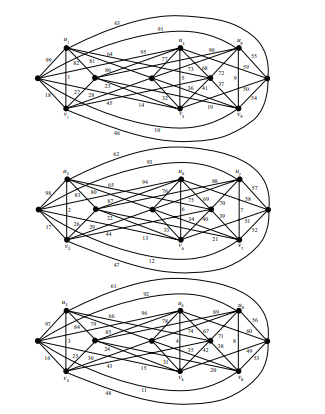
Similar to Theorem 2.9, we also have the following theorem without proof.
Theorem 3.6. For \(n,r,s\ge 1\), if \(H\in \mathcal H_{2n+1}(2r+1,2s+1)\), then \(\chi_{la}(H) = 3\).
Similar to Example 2.10, a (disconnected) graph in \(\mathcal H_{2n+1}(2r+1,2s+1)\) can be obtained by applying the delete-add process to a graph in \(\mathcal G_{2n+1}(2r+1,2s+1)\) that has two vertices without common neighbors with a pair of incident edges with equal labels sum. For example, the \(3(3P_2 \vee O_5) \in \mathcal G_5(3,3)\) and the two vertices with incident edges labels \(54,55\) and \(52,57\), respectively.
Corollary 3.7. Each graph (i) \(G=(2k+1)P_2\vee O_{4k+1}\), \(k\ge 1\), is a connected \((4k+2)\)-regular graph of order \(8k+3\) and size \((2k+1)(8k+3)\), \(G \in \mathcal G_{4s+1}(2r+1,2s+1)\) or \(G\in \mathcal H_{4s+1}(2r+1,2s+1)\), \(s\ge 1\), is a (possibly disconnected) \((4s+2)\)-regular graph of order \((2r+1)(8s+3)\) and size \((2r+1)(2s+1)(8s+3)\) with \(\chi_{la}(G) = 3\).
Proof. (i) Let \(n=2k\), each \(G = (2k+1)P_2\vee O_{4k+1}\) is a connected \((4k+2)\)-graph. (ii) Let \(n = 2s\), each graph in \(\mathcal G_{4s+1}(2r+1,2s+1)\) or \(\mathcal H_{4s+1}(2r+1,2s+1)\) is a \((4s+2)\) regular graph. ◻
For \(k\ge 1\), we now consider the following \((4n+1)\times (2k+1)\) matrix for \(2\le j\le n\) that we split into Table 7 and Table 8. Note that when \(n=1\), the required \(5\times (2k+1)\) matrix is given by rows \(f(u_i, x_{i,1})\), \(f(u_i, x_{i,2})\), \(f(u_iv_i)\), \(f(v_ix_{i,1})\) and \(f(v_1x_{i,2})\) of the matrix below. Moreover, the entries in column \(k+1\) appears in both Tables 7 and 8.
| i | 1 | 2 | 3 | \(\cdots\) | k-1 | k | k+1 |
| \(f(u_ix_{i,1})\) | k+2+ | k+3 + | k+4+ | \(\cdots\) | 2k+ | 2k+1+ | 1+ |
| n(8k+4) | n(8k+4) | n(8k+4) | n(8k+4) | n(8k+4) | n(8k+4) | ||
| \(f(u_ix_{i,2})\) | -2k-2+ | -2k-4 + | -2k-6+ | \(\cdots\) | -4k+2+ | -4k | – 2k-1+ |
| n(8k+4) | n(8k+4) | n(8k+4) | n(8k+4) | n(8k+4) | n(8k+4) | ||
| \(\vdots\) | \(\vdots\) | \(\vdots\) | \(\vdots\) | \(\cdots\) | \(\vdots\) | \(\vdots\) | \(\vdots\) |
| \(f(u_ix_{i,2j-1})\) | 9k+6 | 9k+7 | 9k+8 | \(\cdots\) | 10k+4 | 10k+5 | 8k+5 |
| (n-j)(8k+4) | (n-j)(8k+4) | (n-j)(8k+4) | (n-j)(8k+4) | (n-j)(8k+4) | (n-j)(8k+4) | ||
| \(f(u_ix_{i,2j})\) | 5k+2 | 5k+1 | 5k | \(\cdots\) | 4k+4 | 4k+3 | 6k+3 |
| (n-j)(8k+4) | (n-j)(8k+4) | (n-j)(8k+4) | (n-j)(8k+4) | (n-j)(8k+4) | (n-j)(8k+4) | ||
| \(\vdots\) | \(\vdots\) | \(\vdots\) | \(\vdots\) | \(\cdots\) | \(\vdots\) | \(\vdots\) | \(\vdots\) |
| \((u_iv_i) \) | 1 | 2 | 3 | \(\cdots\) | k-1 | k | k+1 |
| \(f(v_ix_i,1)\) | 3k+2 | 3k+3 | 3k+4 | \(\cdots\) | 4k | 4k+1 | 4k+2 |
| \(f(v_ix_i,2)\) | 8k+4 | 8k+2 | 8k | \(\cdots\) | 6k+8 | 6k+6 | 6k+4 |
| \(\vdots\) | \(\vdots\) | \(\vdots\) | \(\vdots\) | \(\cdots\) | \(\vdots\) | \(\vdots\) | \(\vdots\) |
| \(f(v_ix_{i,2j-1})\) | -5k-2+ | -5k-1+ | -5k+ | \(\cdots\) | -4k-4+ | -4k-3+ | -4k-2 + |
| j(8k+4) | j(8k+4) | j(8k+4) | j(8k+4) | j(8k+4) | j(8k+4) | ||
| \(f(v_ix_{i,2j})\) | -k+ | -k-1+ | -k-2+ | \(\cdots\) | -2k+3+ | -2k+1+ | -2k+ |
| j(8k+4) | j(8k+4) | j(8k+4) | j(8k+4) | j(8k+4) | j(8k+4) | ||
| \(\vdots\) | \(\vdots\) | \(\vdots\) | \(\vdots\) | \(\cdots\) | \(\vdots\) | \(\vdots\) | \(\vdots\) |
| i | k+1 | k+2 | k+3 | \(\cdots\) | 2k-1 | 2k | 2k+1 |
| \(f(u_ix_{i,1})\) | 1+ | 2+ | 3+ | \(\cdots\) | k-1+ | k+ | k+1+ |
| n(8k+4) | n(8k+4) | n(8k+4) | n(8k+4) | n(8k+4) | n(8k+4) | ||
| \(f(u_ix_{i,2})\) | -2k-1+ | -2k-3+ | -2k-5+ | \(\cdots\) | -4k+3+ | -4k+1+ | -4k-1+ |
| n(8k+4) | n(8k+4) | n(8k+4) | n(8k+4) | n(8k+4) | n(8k+4) | ||
| \(\vdots\) | \(\vdots\) | \(\vdots\) | \(\vdots\) | \(\cdots\) | \(\vdots\) | \(\vdots\) | \(\vdots\) |
| \(f(u_ix_{i,2j-1})\) | 8k+5 | 8k+6 | 8k+7 | \(\cdots\) | 9k+3 | 9k+4 | 9k+5 |
| (n-j)(8k+4) | (n-j)(8k+4) | (n-j)(8k+4) | (n-j)(8k+4) | (n-j)(8k+4) | (n-j)(8k+4) | ||
| \(f(u_ix_{i,2j})\) | 6k+3 | 6k+2 | 6k+1 | \(\cdots\) | 5k+5 | 5k+4 | 5k+3 |
| (n-j)(8k+4) | (n-j)(8k+4) | (n-j)(8k+4) | (n-j)(8k+4) | (n-j)(8k+4) | (n-j)(8k+4) | ||
| \(\vdots\) | \(\vdots\) | \(\vdots\) | \(\vdots\) | \(\cdots\) | \(\vdots\) | \(\vdots\) | \(\vdots\) |
| \(f(u_iv_i) \) | k+1 | k+2 | k+3 | \(\cdots\) | 2k-1 | 2k | 2k+1 |
| \(f(v_ix_i,1) \) | 4k+2 | 2k+2 | 2k+3 | \(\cdots\) | 3k-1 | 3k | 3k+1 |
| \(f(v_ix_i,2)\) | 6k+4 | 8k+3 | 8k+1 | \(\cdots\) | 6k+9 | 6k+7 | 6k+5 |
| \(\vdots\) | \(\vdots\) | \(\vdots\) | \(\vdots\) | \(\cdots\) | \(\vdots\) | \(\vdots\) | \(\vdots\) |
| \(f(v_ix_{i,2j-1})\) | -4k-2+ | -6k-2+ | -6k-1+ | \(\cdots\) | -5k-5+ | -5k-4+ | -5k-3+ |
| j(8k+4) | j(8k+4) | j(8k+4) | j(8k+4) | j(8k+4) | j(8k+4) | ||
| \(f(v_ix_{i,2j})\) | -2k+ | 0+ | -1+ | \(\cdots\) | -k+3+ | -k+2+ | -k+1+ |
| j(8k+4) | j(8k+4) | j(8k+4) | j(8k+4) | j(8k+4) | j(8k+4) | ||
| \(\vdots\) | \(\vdots\) | \(\vdots\) | \(\vdots\) | \(\cdots\) | \(\vdots\) | \(\vdots\) | \(\vdots\) |
We now have the following observations.
(a) For \(n\ge 2\) and each \(i\in [1,2k+1]\), the sum of the first \(2n+1\) row entries is \(f^+(u_i)= 2n(8k+4)-k+1+\sum\limits^{n}_{j=2} [2(n-j)(8k+4)+14k+8] = 8kn^2+6kn+4n^2+k+4n+1\). Note that, this formula also holds when \(n=1\).
(b) For \(n\ge 2\) and each \(i\in [1,2k+1]\), the sum of the last \(2n+1\) row entries is \(f^+(v_i) = 11k+7+\sum\limits^{n}_{j=2} [2j(8k+4)-6k-2] = 8kn^2+2kn+4n^2+k+2n+1\). Note that, this formula also holds when \(n=1\).
(c) For each \(i\in [1,k]\) and \(j\in [1,2n]\), each of \(f(u_ix_{i,j}) + f(v_{2k+2-i}x_{2k+2-i,j})\), \(f(v_ix_{i,j}) + f(u_{2k+2-i}x_{2k+2-i,j})\) and \(f(u_{k+1}x_{k+1,j}) + f(v_{k+1}x_{k+1,j})\) is a constant \(n(8k+4)+4k+3\).
(d) Suppose \(2k+1=(2r+1)(2s+1)\), \(r,s\ge 1\). For each \(a \in [1,r]\) and j \(\in [1,2n]\), each of \[ \sum^{2s+1}_{b=1} [f(u_{(a-1)(2s+1)+b}x_{(a-1)(2s+1)+b,j}) + f(v_{2k+2-(a-1)(2s+1)-b}x_{2k+2-(a-1)(2s+1)-b,j})],\label{eq-d1}\ \tag{1}\] \[\sum^{2s+1}_{b=1} [f(v_{(a-1)(2s+1)+b}x_{(a-1)(2s+1)+b,j}) + f(u_{2k+2-(a-1)(2s+1)-b}x_{2k+2-(a-1)(2s+1)-b,j})],\label{eq-d2}\ \tag{2}\] \[\sum^{2s+1}_{b=1} [f(u_{r(2s+1)+b}x_{r(2s+1)+b,j}) + f(v_{2k+2-r(2s+1)-b}x_{2k+2-r(2s+1)-b,j})],\label{eq-d3} \tag{3}\] is a constant \((2s+1)[n(8k+4)+4k+3]\).
Consider \(G = (2k+1)P_2 \vee O_{2n}\). By Observations (a) and (b) above, we can now define a bijection \(f : E(G) \to [1, (4n+1)(2k+1)]\) according to the table above. Clearly, for \(1\le i\le 2k+1\), \(f^+(u_i) > f^+(v_i)\).
Now, for each \(i\in [1,k]\) and \(j\in [1,2n]\), first delete the edges \(v_ix_{i,j}\) and \(v_{2k+2-i}x_{2k+2-i,j}\), and then add the edges \(v_{2k+2-i}x_{i,j}\) and \(v_ix_{2k+2-i,j}\) with labels \(f(v_{2k+2-i}x_{2k+2-i,j})\) and \(f(v_ix_{i,j})\), respectively. Finally, we rename \(x_{i,j}\) by \(y_{i,j}\) and \(x_{2k+2-i,j}\) by \(z_{i,j}\). We still denote this new labeling by \(f\). By Observation (c), \(f^+(y_{i,j})=f^+(z_{i,j})=n(8k+4)+4k+3\). It is easy to verify that \(f^+(u_i) \ne f^+(v_i) \ne f^+(y_{i,j})\) for all possible \(n, k\). We denote the resulting graph by \(G_{2n}(k+1)\). Note that \(G_{2n}(k+1)\) has \(k+1\) components.
Theorem 4.1. For \(n, k\ge 1\), we have \(\chi_{la}(G_{2n}(k+1)) = 3\).
Proof. From the above discussion, we know that \(G_{2n}(k+1)\) is a tripartite graph with \(k+1\) components that admits a local antimagic 3-coloring. The theorem holds. ◻
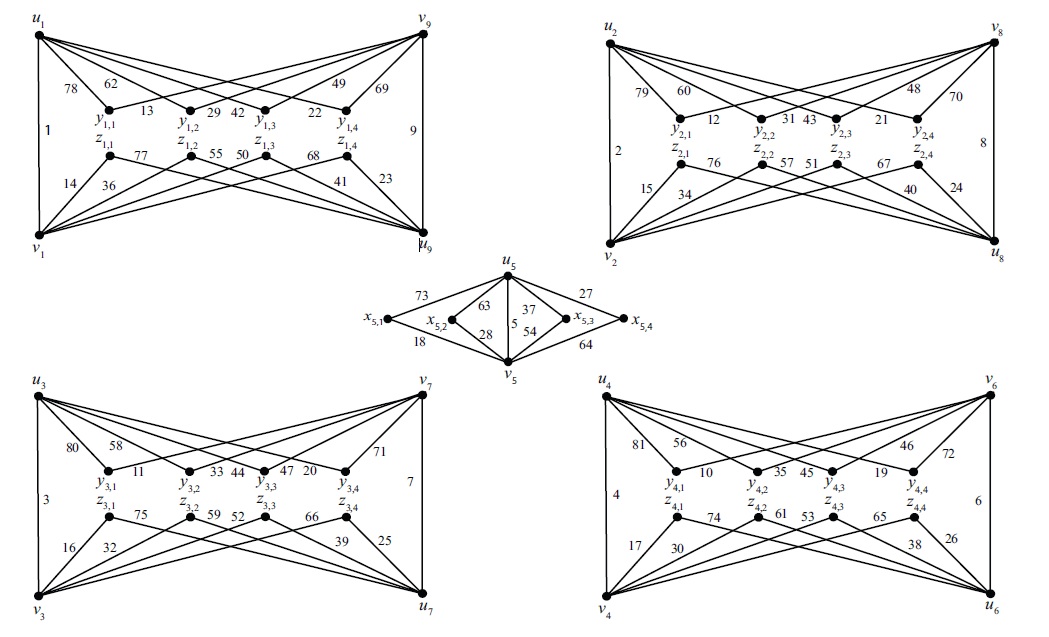
Example 4.2. Consider \(n = 2\) and \(k=4\). We have the following table.
| i | 1 | 2 | 3 | 4 | 5 | 6 | 7 | 8 | 9 |
|---|---|---|---|---|---|---|---|---|---|
| \(f(u_ix_{i,1})\) | 78 | 79 | 80 | 81 | 73 | 74 | 75 | 76 | 77 |
| \(f(u_ix_{i,2})\) | 62 | 60 | 58 | 56 | 63 | 61 | 59 | 57 | 55 |
| \(f(u_ix_{i,3})\) | 42 | 43 | 44 | 45 | 37 | 38 | 39 | 40 | 41 |
| \(f(u_ix_{i,4})\) | 22 | 21 | 20 | 19 | 27 | 26 | 25 | 24 | 23 |
| \(f(u_iv_i)\) | 1 | 2 | 3 | 4 | 5 | 6 | 7 | 8 | 9 |
| \(f(v_ix_{i,1})\) | 14 | 15 | 16 | 17 | 18 | 10 | 11 | 12 | 13 |
| \(f(v_ix_{i,2})\) | 36 | 34 | 32 | 30 | 28 | 35 | 33 | 31 | 29 |
| \(f(v_ix_{i,3})\) | 50 | 51 | 52 | 53 | 54 | 46 | 47 | 48 | 49 |
| \(f(v_ix_{i,4})\) | 68 | 67 | 66 | 65 | 64 | 72 | 71 | 70 | 69 |
By the construction above Theorem 4.1, we have the graph \(G_4(5)\) as shown below.
We may make use of Observation (d) to construct a new graph with local antimagic chromatic number 3 from \(G_{2n}(k+1)\). Let us show an example first. Suppose \(2k+1= (2r+1)(2s+1)\), \(r, s\ge 1\).
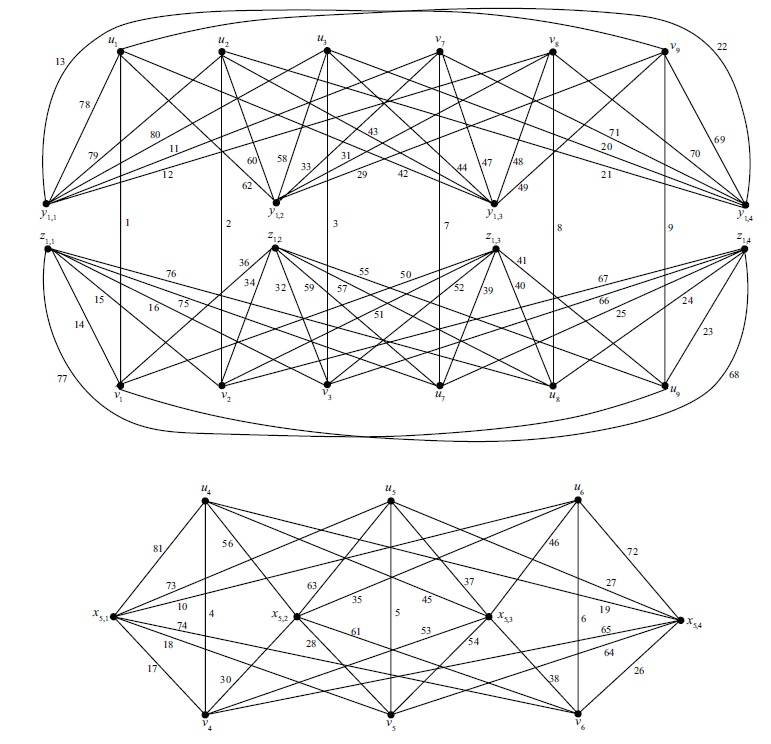
Example 4.3. Consider \(n = 2\), \(k=4\) again. Now we have \(r=s=1\). Consider the graph \(G=G_{2n}(k+1)\). Now \(V(G)=\{u_i, v_i\;|\; 1\le i\le 9\}\cup\{y_{i,j}, z_{i,j}\;|\; 1\le i\le 4, 1\le j\le 4\}\). From Observation (d) we have \[\begin{aligned} f^+(y_{1,j})+f^+(y_{2,j})+f^+(y_{3,j}) &=[f(u_1x_{1,j})+f(v_9x_{9,j})]+[f(u_2x_{2,j})+f(v_8x_{8,j})]\\& \quad +[f(u_3x_{3,j})+f(v_7x_{7,j})]=273,\\ f^+(z_{1,j})+f^+(z_{2,j})+f^+(z_{3,j}) & =[f(v_1x_{1,j})+f(u_9x_{9,j})]+[f(v_2x_{2,j})+f(u_8x_{8,j})]\\& \quad+[f(v_3x_{3,j})+f(u_7x_{7,j})]=273,\\ f^+(y_{4,j})+f^+(x_{5,j})+f^+(z_{4,j}) &=[f(u_4x_{1,j})+f(v_6x_{2,j})]+[f(u_5x_{5,j})+f(v_5x_{5,j})]\\& \quad+[f(u_6x_{6,j})+f(v_4x_{4,j})]=273. \end{aligned}\]
For each \(j\in[1,4]\), we (i) merge the vertices \(y_{1,j}, y_{2,j}, y_{3,j}\) as a new vertex (still denote by \(y_{1,j}\)) of degree 6; (ii) merge the vertices \(z_{1,j}, z_{2,j}, z_{3,j}\) as a new vertex (still denote by \(z_{1,j}\)) of degree 6; and (iii) merge \(y_{4,j}, x_{5,j}, z_{4,j}\) (denote by \(x_{5,j}\)) of degree 6.
Suppose \(2k+1 = (2r+1)(2s+1)\), \(r,s\ge 1\). Consider the graph \(G_{2n}(k+1)\). For each \(a\in[1,r]\) and \(j\in[1,2n]\), we can merge all \(2s+1\) vertices in \(\{y_{(a-1)(2s+1)+b, j}\;|\;b\in[1, 2s+1]\}\), \(\{z_{(a-1)(2s+1)+b, j}\;|\;b\in[1, 2s+1]\}\), and \(\{x_{r(2s+1)+b, j}\;|\;b\in[1, 2s+1]\}\). The new vertices are denoted by \(y_{(a-1)(2s+1)+1,j}\), \(z_{(a-1)(2s+1)+1,j}\) and \(x_{k+1,j}\), respectively. By Eqs. (1), (2) and (3), we have \(f^+(y_{(a-1)(2s+1)+1,j})=f^+(z_{(a-1)(2s+1)+1,j})=f^+(x_{k+1,j})=(2s+1)[n(8k+4)+4k+3]\). Let the graph just obtained be \(G_{2n}(2r+1,2s+1)\). Note that \(G_{2n}(2r+1,2s+1)\) has \(r+1\) components.
Theorem 4.4. For \(n,r,s\ge 1\), we have \(\chi_{la}(G_{2n}(2r+1,2s+1)) = 3\).
Proof. From the above discussion, we know that \(2k+1 = (2r+1)(2s+1)\), \(r,s\ge 1\) and \(G_{2n}(2r+1,2s+1)\) is a tripartite graph with \(r+1\) components that admits a bijective edge labeling \(f\) with induced vertex labels \((1) = (2s+1)[n(8k+4)+4k+3]\), \((2) = 8kn^2+6kn+4n^2+k+4n+1\), and \((3) = 8kn^2+2kn+4n^2+k+2n+1\). Clearly, \((2) > (3)\). We now show that \((1)\ne (2), (3)\). Now, \[\begin{aligned} (1) – (2) & = 16kns-8kn^2+2kn+8ks-4n^2+8ns+3k+6s+2 \\ &= (8kn+4n+3)(2s-n) + 2kn+8ks+3k+3n+2\\ & > 0 \quad \mbox{ if } 2s\ge n. \end{aligned}\] Otherwise, \(2s -n \le – 1\) (equivalently, \(-n\le -2s-1\)), \((1) – (2) \le -6kn – n -1 + 8ks + 3k = -n(6k+1) – 1 + 8ks + 3k \le (-2s-1)(6k+1) – 1 + 8ks + 3k = – 4ks-3k-2s-2 < 0\). Thus, \((1) \ne (2)\). Similarly, \[\begin{aligned} (1)-(3) & = 16kns-8kn^2+6kn+8ks-4n^2+8ns+3k+2n+6s+2\\ &= (8kn+4n+3)(2s-n) + 6kn + 8ks + 3k + 5n + 2 \\ & > 0 \quad \mbox{ if } 2s \ge n. \end{aligned}\] If \(2s-n = -1\), \((1)-(3) = -2kn-n-1+8ks+3k=-n(2k+1)-1+8ks+3k = (-2s-1)(2k+1)-1+8ks+3k = 4ks+k-2s-2 > 0\) since \(k\ge 4\). Otherwise, \(2s-n\le -2\) (equivalently, \(-n\le -2s-2\)), \((1) – (3) \le -10kn-3n-4+8ks+3k \le (-2s-2)(10k+3)-4+8ks+3k < 0\). Thus, \((1) \ne (3)\). Therefore, \(f\) is a local antimagic 3-coloring. The theorem holds. ◻
In what follows, we refer to the following \((4n+3)\times (2k+1)\) matrix to obtain results similar to Theorems 4.1 and 4.4. For \(1\le j\le n\), we have
| i | 1 | 2 | 3 | \(\cdots\) | 2k | 2k+1 |
| \(\vdots\) | \(\vdots\) | \(\vdots\) | \(\vdots\) | \(\cdots\) | \(\vdots\) | \(\vdots\) |
| \(f(u_ix_{i,2j-1})\) | 10k+5 + | 10k+4 + | 10k+3 | \(\cdots\) | 8k+6 + | 8k+5 + |
| (2n-j)(4k+2) | (2n-j)(4k+2) | (2n-j)(4k+2) | (2n-j)(4k+2) | (2n-j)(4k+2) | ||
| \(f(u_ix_{i,2j})\) | 6k+4 + | 6k+5 + | 6k+6 + | \(\cdots\) | 8k+3 + | 8k+4 + |
| (2n-j)(4k+2) | (2n-j)(4k+2) | (2n-j)(4k+2) | (2n-j)(4k+2) | (2n-j)(4k+2) | ||
| \(\vdots\) | \(\vdots\) | \(\vdots\) | \(\vdots\) | \(\cdots\) | \(\vdots\) | \(\vdots\) |
| \(f(u_ix_{i,2n+1})\) | 2k+1 + | 2k+ | (2k-1)+ | \(\cdots\) | 2 + | 1 + |
| (n+1)(4k+2) | (n+1)(4k+2) | (n+1)(4k+2) | (n+1)(4k+2) | (n+1)(4k+2) | ||
| \(f(u_iv_i)\) | 1 | 2 | 3 | \(\cdots\) | 2k | 2k+1 |
| \(f(v_ix_i,1)\) | 4k+2 | 4k+1 | 4k | \(\cdots\) | 2k+3 | 2k+2 |
| \(\vdots\) | \(\vdots\) | \(\vdots\) | \(\vdots\) | \(\cdots\) | \(\vdots\) | \(\vdots\) |
| \(f(v_ix_{i,2j})\) | 4k+3 + | 4k+4 + | 4k+5 + | \(\cdots\) | 6k+2 + | 6k+3 + |
| (j-1)(4k+2) | (j-1)(4k+2) | (j-1)(4k+2) | (j-1)(4k+2) | (j-1)(4k+2) | ||
| \(f(v_ix_{i,2j+1})\) | 8k + 4 + | 8k+3 + | 8k+2 + | \(\cdots\) | 6k+5 + | 6k+4 + |
| (j-1)(4k+2) | (j-1)(4k+2) | (j-1)(4k+2) | (j-1)(4k+2) | (j-1)(4k+2) | ||
| \(\vdots\) | \(\vdots\) | \(\vdots\) | \(\vdots\) | \(\cdots\) | \(\vdots\) | \(\vdots\) |
We now have the following observations.
(1) For each column, the sum of the first \(2n+2\) entries is \(f^+(u_i) = (n+1)(3n+1)(4k+2) + n + 2k+2\).
(2) For each column, the sum of the last \(2n+2\) entries is \(f^+(v_i) = (n+1)^2(4k+2)+n+1\).
(3) For each \(i\in[1,k]\) and \(j\in[1,2n+1]\), each of \(f(u_ix_{i,j}) + f(v_{2k+2-i}x_{2k+2-i,j})\), \(f(v_ix_{i,j}) + f(u_{2k+2-i}x_{2k+2-i,j})\), and, \(f(u_{k+1}x_{k+1,j}) + f(v_{k+1}x_{k+1,j})\) is a constant \((2n+2)(4k+2)+1\).
(4) Suppose \(2k+1=(2r+1)(2s+1)\), \(r,s\ge 1\). For each \(a\in[1,r]\) and \(j\in[1,2n+1]\), each of \[\sum^{2s+1}_{b=1} [f(u_{(a-1)(2s+1)+b}x_{(a-1)(2s+1)+b,j}) + f(v_{2k+2-(a-1)(2s+1)-b}x_{2k+2-(a-1)(2s+1)-b,j})],\label{eq-d4}\ \tag{4}\] \[\sum^{2s+1}_{b=1} [f(v_{(a-1)(2s+1)+b}x_{(a-1)(2s+1)+b,j}) + f(u_{2k+2-(a-1)(2s+1)-b}x_{2k+2-(a-1)(2s+1)-b,j})],\label{eq-d5}\ \tag{5}\] \[\sum^{2s+1}_{b=1} [f(u_{r(2s+1)+b}x_{r(2s+1)+b,j}) + f(v_{2k+2-r(2s+1)-b}x_{2k+2-r(2s+1)-b,j})],\label{eq-d6} \tag{6}\] is a constant \((2s+1)[ (2n+2)(4k+2)+1]\).
Similar to graph \(G_{2n}(k+1)\) in Theorem 4.1, we also define \(G_{2n+1}(k+1)\) of \(k+1\) components similarly such that the \(i\)-th component has vertex set \(\{u_i, v_i, u_{2k+2-i}, v_{2k+2-i}, y_{i,j}, z_{i,j} \mid 1\le j\le 2n+1\}\) and edge set \(\{u_iv_i, u_{2k+2-i}v_{2k+2-i}, u_iy_{i,j}, v_{2k+2-i}y_{i,j}, v_iz_{i,j}, u_{2k+2-i}z_{i,j}\mid 1\le j\le 2n+1\}\) for \(1\le i\le k\), and the \((k+1)\)-st component is the \(P_2\vee O_{2n+1}\) with vertex set \(\{u_{k+1}, v_{k+1}, x_{k+1,j} \mid 1\le j\le 2n+1\}\) and edge set \(\{u_{k+1}v_{k+1}, u_{k+1}x_{k+1,j}, v_{k+1}x_{k+1,j}\mid 1\le j\le 2n+1\}\). Moreover, by Observation (3), \(f^+(y_{i,j}) = f^+(z_{i,j}) = (2n+2)(4k+2)+1\). It is easy to verify that \(f^+(u_i) \ne f^+(v_i) \ne f^+(y_{i,j})\) for all possible \(n,k\).
Theorem 5.1. For \(n, k\ge 1\), \(\chi_{la}(G_{2n+1}(k+1)) = 3\).
Proof. From the discussion above, we know \(G_{2n+1}(k+1)\) is a tripartite graph with \(k+1\) components that admits a local antimagic 3-coloring. The theorem holds. ◻
For \(2k+1 = (2r+1)(2s+1), r,s\ge 1\), by Observation (4) above, we also define \(G_{2n+1}(2r+1,2s+1)\) as in Theorem 4.4 with \(r+1\) components and similar vertex set with vertices \(y_{(a-1)(2s+1)+1,j}\), \(z_{(a-1)(2s+1)+1,j}\) and \(x_{k+1,j}\) for \(1\le a\le 2r+1\), \(1\le j\le 2n+1\). By equations (4), (5) and (6), we have \(f^+(y_{(a-1)(2s+1)+1,j})=f^+(z_{(a-1)(2s+1)+1,j})=f^+(x_{k+1,j})=(2s+1)[(2n+2)(4k+2)+1]\).
Theorem 5.2. For \(n, r ,s\ge 1\), we have \(\chi_{la}(G_{2n+1}(2r+1,2s+1)) = 3\).
Proof. Similar to the proof of Theorem 4.4, we know \(2k+1 = (2r+1)(2s+1)\), \(r,s\ge 1\) and \(G_{2n+1}(2r+1,2s+1)\) is a tripartite graph with \(r+1\) components that admits a bijective edge labeling \(f\) with induced vertex labels \((1) = (2s+1)[(2n+2)(4k+2)+1]\), \((2) = (n+1)(2n+1)(4k+2)+n+2k+2\) and \((3) = (n+1)^2(4k+2)+n+1\). Clearly, \((2) > (3)\). We now show that \((1) \ne (2), (3)\).
Now, \[\begin{aligned} (1) – (2) & = -8kn^2 +16kns-4kn+16ks-4n^2 +8ns+2k-3n+10s+1\\ & = (8kn+4n+4k+5)(2s-n) + 2n + 8ks + 2k + 1\\ & > 0 \quad \mbox{ if } 2s\ge n. \end{aligned}\] If \(2s-n \le -1\), \((1) -(2) \le -8kn -2n-2k-4+8ks \le (-2s-1)(8k+2) – 2k-4+8ks < 0\). Thus, \((1) \ne (2)\). Similarly,
\[\begin{aligned} (1) -(3) & = -4kn^2 +16kns+16ks-2n^2 +8ns+4k-n+10s+2\\ & = (4kn+2n+2)(4s-n) + n + 16ks + 2s + 4k + 2 \\ & > 0 \quad \mbox{ if } 4s\ge n. \end{aligned}\] If \(4s – n \le -1\), \((1)- (3) \le -4kn – n + 16ks + 2s + 4k \le (-4s-1)(4k+1) + 16ks+2s+4k = -2s -1 < 0\). Thus, \((1) \ne (3)\). Therefore, \(f\) is a local antimagic 3-coloring. The theorem holds. ◻
Example 5.3. Take \(n=2\), \(k=4\), we have the following table and graph \(G_5(5)\) with the defined labeling.
| i | 1 | 2 | 3 | 4 | 5 | 6 | 7 | 8 | 9 |
|---|---|---|---|---|---|---|---|---|---|
| \(f(u_ix_{i,1})\) | 99 | 98 | 97 | 96 | 95 | 94 | 93 | 92 | 91 |
| \(f(u_ix_{i,2})\) | 82 | 83 | 84 | 85 | 86 | 87 | 88 | 89 | 90 |
| \(f(u_ix_{i,3})\) | 81 | 80 | 79 | 78 | 77 | 76 | 75 | 74 | 73 |
| \(f(u_ix_{i,4})\) | 64 | 65 | 66 | 67 | 68 | 69 | 70 | 71 | 72 |
| \(f(u_ix_{i,5})\) | 63 | 62 | 61 | 60 | 59 | 58 | 57 | 56 | 55 |
| \(f(u_iv_i)\) | 1 | 2 | 3 | 4 | 5 | 6 | 7 | 8 | 9 |
| \(f(v_ix_{i,1})\) | 18 | 17 | 16 | 15 | 14 | 13 | 12 | 11 | 10 |
| \(f(v_ix_{i,2})\) | 19 | 20 | 21 | 22 | 23 | 24 | 25 | 26 | 27 |
| \(f(v_ix_{i,3})\) | 36 | 35 | 34 | 33 | 32 | 31 | 30 | 29 | 28 |
| \(f(v_ix_{i,4})\) | 37 | 38 | 39 | 40 | 41 | 42 | 43 | 44 | 45 |
| \(f(v_ix_{i,5})\) | 54 | 53 | 52 | 51 | 50 | 49 | 48 | 47 | 46 |
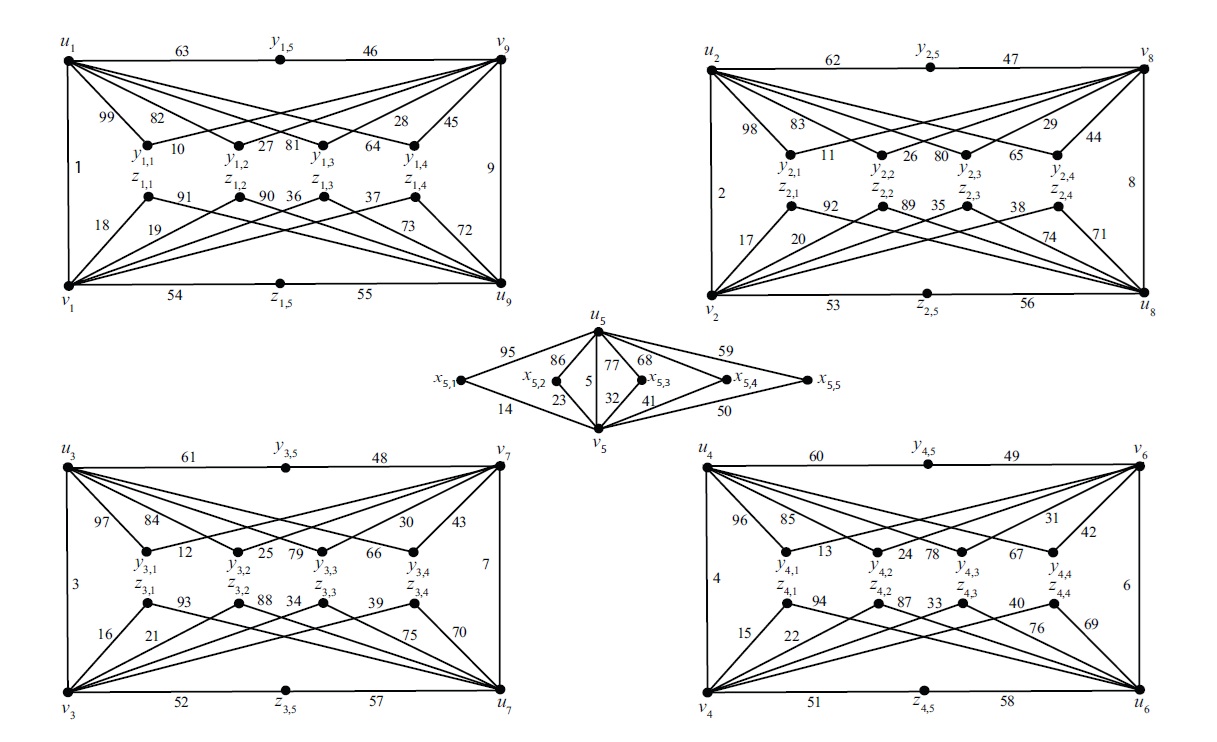
If we take \(r=s=1\), we can get \(G_5(3,3)\) which is a 6-regular graph.
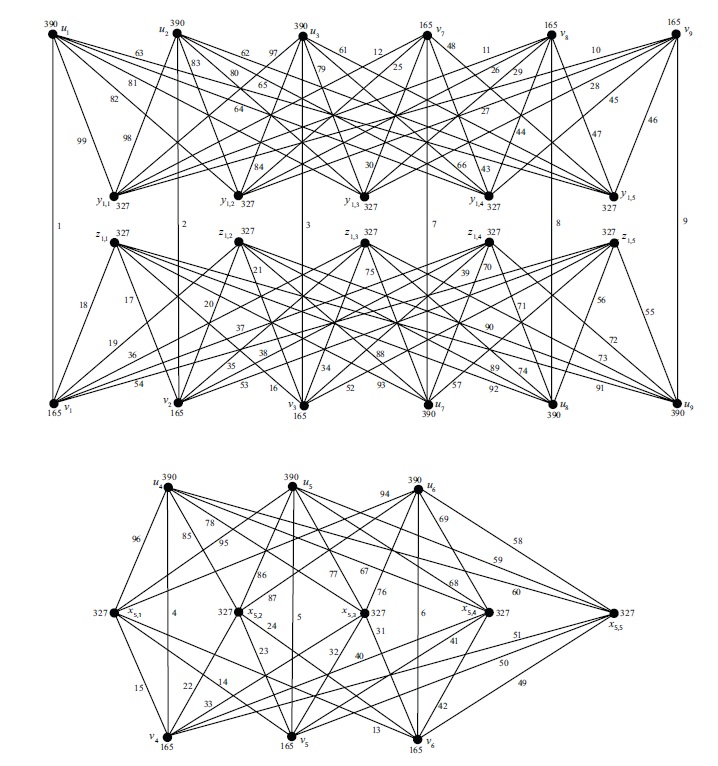
Note that we may also apply the delete-add process that gives us Theorem 2.9 to the graphs \(G_{2n}(2r+1,2s+1)\) and \(G_{2n+1}(2r+1,2s+1)\) to obtain two new families of (possibly connected or regular) tripartite graphs with local antimagic chromatic number 3. Denote the respective families of graph as \(\mathcal R_{2n}(2r+1,2s+1)\) and \(\mathcal R_{2n+1}(2r+1,2s+1)\). For example, from graph \(G_4(3,3)\), we may remove the edges \(v_9y_{1,1}\), \(u_1y_{1,1}\) with labels \(13,78\) and \(u_4x_{5,1}, u_6x_{5,1}\) with labels \(81,10\) respectively; and add the edges \(v_9x_{5,1}\) with label 13, \(u_1x_{5,1}\) with label 78, \(u_4y_{1,1}\) with label 81, and \(u_6y_{1,1}\) with label 10. The new graph is in \(\mathcal R_4(3,3)\) and is connected. If we apply this process to \(G_5(3,3)\) involving the edges with labels \(99,10\) and \(96,13\) respectively, we get a connected 6-regular graph is in \(\mathcal R_5(3,3)\). Thus, we have the following corollary with the proof omitted.
Corollary 5.4. For \(n, r, s\ge 1\), if \(n=2s\), \(\mathcal R_{2n+1}(2r+1,2s+1)\) is a family of (possibly connected) \((2n+2)\)-regular tripartite graphs with local antimagic chromatic number \(3\).
In this paper, we obtained \(\chi_{la}((2k+1)P_2 \vee O_m) = 3\) for all \(k\ge 1, m\ge 2\). The local antimagic chromatic number of many other families of tripartite graphs are also obtained. As a natural extension, in [11], we make use of matrices of size \((2m+1)\times 2k\) to show that \(\chi_{la}((2k)P_2 \vee O_m) = 3\) for all \(k\ge 1, m\ge 2\). Similarly, we also obtain the local antimagic chromatic number of many families of bipartite and tripartite graphs. Interested readers may refer to [10] for new families of (regular) tripartite graphs having same size as \((2k+1)P_2 \vee O_{2n+1}\) \((k, n\ge 1)\), with local antimagic chromatic number 3.
The authors declare no conflict of interest.