
Metacognition was proposed by American psychologist Flavell in the 1970s, and in less than two decades after its proposal, it has become a concept used exclusively with high frequency in psychology and has become an important element in the study of learning strategies [22,10,18]. And metacognitive modulation is the control and regulation of learning methods and strategies oriented by individuals in the cognitive process, and its application in the design of constructivist learning environment model is of great significance [10,4,16].
Constructivism is an educational theory and learning method that emphasizes learners’ active construction and cognition of knowledge, and its core view is that learning is a process of students’ active construction and meaning building of new knowledge, and learners construct new knowledge and meaning through understanding and interpreting existing knowledge [14,9,28,26]. In the constructivist learning environment, the status and role of teachers and students have changed greatly compared with traditional teaching, and it is believed that knowledge is not obtained through the teacher’s teaching, but rather the learner obtains it in a certain situation, i.e., in a socio-cultural context, by means of the help of other people in the learning process (including the teacher and the learning partners), by utilizing the necessary learning materials, and by means of the construction of meaning [25,23,7,30]. Therefore, constructivist learning theory emphasizes that “context”, “collaboration”, “conversation”, and “meaning-making” are the four major elements or attributes of the learning environment. Constructivism is not only applicable to the field of education, it can also be applied to other disciplines and fields [11,12,8,2].
Literature [6] demonstrated the important contribution of metacognitive modulation to the comprehension of illustrative digital texts by examining the application of metacognitive modulation in e-learning environments and based on a questionnaire. Whereas, literature [21] started from the programming education profession and obtained through a literature review that metacognition plays a role in the development of programming courses and supporting students, among others. Literature [24] investigated the effectiveness of TgfU’s tactical gaming approach in improving students’ metacognitive regulation and performance in physical education classes by conducting a comparative experiment. Based on these studies, it can be seen that metacognitive regulation is not only widely used in various fields, but also plays a more obvious role in various fields.
Literature [17] proposed a constructivist-constructivist learning environment as a teaching strategy to develop chemical knowledge and 21st century skills simultaneously, proving that this approach plays an important role in improving the acquisition of knowledge and skills. Literature [31] analyzed the application of constructivism and constructivist learning theory in education. Insights and recommendations were provided on constructivist learning theory and constructivist pedagogy in supporting other approaches to improve learning and teaching, among others. Whereas, literature [15] by examining the key role of constructivist learning environments in the self-regulation and volition of students in engineering education and informs teachers in conducting engineering education. From this we can see that the application of constructivist learning environments in the field of education contributes to the improvement of students in terms of knowledge, psychological and other aspects, and contributes to the improvement of the quality of education.
Literature [5] discusses the relationship between pre-service science teachers’ pedagogical concerns, sense of efficacy, and classroom environment preferences, and concludes that there is a positive correlation between both teachers’ sense of efficacy and concerns, and constructivist learning environments. Literature [27] reveals that students’ learning environments are being trivialized in current education and emphasizes the diversity of students’ learning styles in constructivist learning environments through a survey. Literature [3] explored the impact of the Constructivist Learning Design and Learning Analytics (CLDLA) model on students’ engagement and self-regulation and demonstrated the positive impact of the model on students’ engagement and self-regulation. It can be found that although constructivist learning environments are conducive to the overall improvement of educational quality, there are relatively few studies related to the design of constructivist learning environment models based on enhanced metacognitive regulation.
This paper combines constructivist theory to design a model of learning environment characteristics in metacognitive regulation. Relevant factors affecting learners’ cognitive ability are proposed and quantitatively analyzed. Combining metacognition as well as cognitive regulation, a multi-channel-based Att-BiGRU metacognitive ability model is constructed. Design a theoretical model of learning environment oriented to improve metacognitive ability, and analyze the functional modules of the learning environment system. Designed a metacognitive ability improvement activity integrating constructivism theory, and divided the whole teaching activity into preparation stage, implementation stage and evaluation stage. Carry out the teaching activities of metacognitive regulation and analyze the changes of students’ metacognitive ability before and after the implementation of constructivist teaching activities.
The object of metacognition: the object of metacognition is the cognitive system.
The essence of metacognition: the essence of metacognition is the self-reference of cognitive system to itself. The self-reference of metacognition to the cognitive system includes the representation of cognitive entities (i.e., knowledge about cognition) and the computation of cognitive entities (i.e., regulation of cognition).
Purpose of metacognition: the purpose of metacognition is to achieve adaptation of cognitive systems to complex cognitive situations and tasks.
The operation of metacognition: In order to realize the above “adaptation”, metacognition needs to perceive, abstract and regulate the elements and processes in the cognitive system [13,19].
Combined with the above analysis, this study defines metacognition as: metacognition is a higher-order cognitive agent in the cognitive system, which is a cognitive subsystem that realizes self-reference in the cognitive system. That is, it takes the cognitive system itself as an object for representation and computation, which involves cognition-related knowledge (i.e., cognitive knowledge, the representation of cognitive states) and regulation directed to cognition (i.e., cognitive regulation, including consciousness, voluntary control, etc., the computation of cognitive states). The aim is to adapt the cognitive system to various kinds of complex cognitive situations and tasks by perceiving, abstracting and regulating the elements and processes in the cognitive system.
Self-indication of the cognitive system consists of the representation of cognitive entities and the computation of cognitive entities, where the former is called cognitive knowledge and the latter is called cognitive regulation.
Cognitive modulation is the practice of monitoring and regulating cognitive activities in which the learner utilizes the cognitive knowledge he or she possesses and applies it to cognitive activities. Based on the theoretical position of this study, it is known that cognitive regulation is the computational operation of cognitive entities such as cognitive elements and cognitive processes in the cognitive system guided by specific cognitive knowledge. Its purpose is to achieve adaptation to complex cognitive situations and cognitive tasks through the regulation of the cognitive system. For the cognitive regulation of metacognitive system, it includes six cognitive operations: monitoring, planning, characterization, updating, evaluation and regulation, so as to realize the metacognitive perception, abstraction and regulation of cognitive system.
In this paper, the design of an environment characterization model involves the translation of these abstract theoretical characterization elements into the knowledge content, learning component tools and system functionality of the actual learning cognitive environment. In this way, a cognitive context in which the learner’s cognitive activities are carried out is created to support metacognitive diagnostic research in identifying, observing, and capturing the learner’s specific behavioral responses related to metacognition in this context.
This paper summarizes the design of two key points for the design of contextual feature models in constructivism:
(1) Using the analysis of the feature elements in the rule of evidence model, designing specific, authentic learning environments to induce learners to produce specific behavioral responses related to metacognition.
(2) Identifying, structuring, and capturing the specific behaviors that learners produce in the learning environment.
Therefore, the design of the environment characterization model consists of two elements: learning environment design and data structure design. The core logic of the environment feature model is shown in Figure 1.
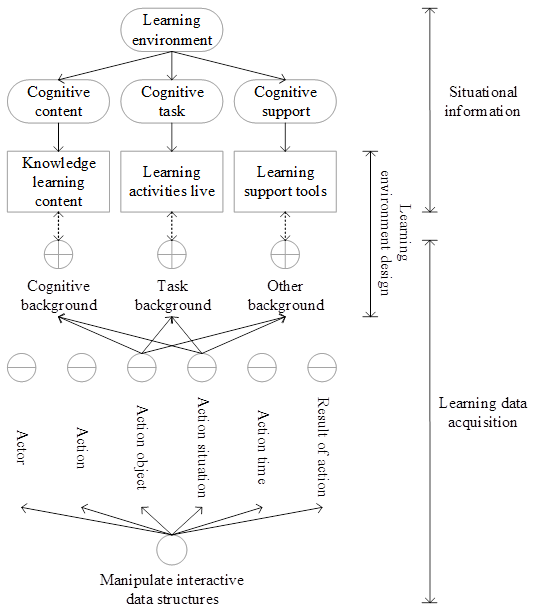
Cognitive content design in the learning environment is to provide knowledge-level computational and representational objects for cognitive activities, and is the knowledge context in which learning cognitive activities take place.
Metacognitive diagnosis adopts problem-solving tasks as the main form of cognitive tasks, requiring learners to learn cognitive knowledge content in order to understand, learn, and master the knowledge of cutting-edge fields of learning science. Then the internalized mastered knowledge is used to solve the tasks in real situations.
The types of cognitive activity tools used in this study include data presentation, knowledge organization, content creation, and learning management.
The learning environment has been designed to build an authentic digital learning environment that supports the conduct of metacognitive diagnostic research. And the cognitive content, cognitive tasks and cognitive support have been designed to induce and visualize learners’ metacognitive behavioral responses.
Constructivism emphasizes that knowledge is not static, but is only an assumption in a particular social context and is not the final answer to a question. Knowledge is constantly changing or expanding in scope and condition as society progresses.
Constructivism pays more attention to the experience of knowledge construction, the journey and the cognitive perspective of the cognizer and other aspects of the cognitive process, which is the process of the cognizer to make reasonable explanations and assumptions about the problem using the original experience [19,1].
focusing on students’ original cognitive experience, students are using their original experience to continuously assimilate and adapt to new knowledge. Emphasize the positivity and initiative of students’ internal psychological cognitive construction, oppose the mechanical memory of students’ knowledge in the traditional teaching process, and focus on students’ understanding and active exploration of knowledge.
Learning is not instilled in students by the teacher, but is a process of students’ active learning and construction, i.e., the process of interaction and reorganization through existing experience and new knowledge. There are three main features:
Active constructive: the construction of new knowledge, the transformation and organization of previous experience.
Activity contextual: constructivism emphasizes that knowledge is acquired through certain social practices, stresses that learning should be in a real and effective context, using the appropriate context, can make abstract problems concrete, visualization, so that students form a perceptual awareness of knowledge, true understanding of knowledge.
Social interaction: interaction emphasizes the importance of communication, cooperation and negotiation among students in the process of knowledge acquisition.
This paper introduces the following concepts in a novel model of knowledge representation that supports tacit knowledge:
schema knowledge at the low level of the schema knowledge level, which is the indivisible smallest unit of the level and is directly abstracted from basic knowledge.
schema knowledge at the high level of the schema knowledge level, which is constructed from a combination of atomic schema knowledge.
the set of all basic knowledge that can be externalized by a schema knowledge is the coverage set of that schema knowledge.
Cognitive ability is defined as the level at which a learner can utilize acquired schema knowledge to absorb new external knowledge inputs or to combine and construct to form new schema knowledge in order to adapt to new knowledge inputs. Therefore, the factors affecting cognitive ability in the evaluation model of learners’ cognitive ability for online teaching are considered in terms of the attributes associated with the schema knowledge mastered by the learners themselves and the combinatorial construction relationship between schema knowledge.
In the novel knowledge expression model, schema knowledge is described in the form of a quaternion. The quaternion consists of the feature vector of schema knowledge, the set of teaching examples associated with schema knowledge, the set of test examples, and the set of predecessor and successor knowledge associated with schema knowledge.
Since a learner’s cognitive ability is reflected by the level of “absorption” of new knowledge by the schema knowledge acquired by the learner, the influencing factors of the learner’s cognitive ability are also closely related to the elements of the quaternion describing the schema knowledge.
The influence factor of learners’ cognitive ability is mainly divided into two aspects: pattern knowledge characteristic points and pattern knowledge combination construction relationship. The subordinate indicators of schema feature points are the test score of feature points, the degree of learning degradation of feature points, and the distribution of feature points over associated use cases.
According to the analysis of the factors influencing the cognitive ability of learners, each of them will be described in detail and its quantification method will be given here, as follows:
a. Characteristic point test score: the score obtained by the learner for each characteristic point test of his/her mastered schema knowledge. For a certain schema knowledge, since its different feature point test scores have different impacts on its whole, there exists a score weight to measure the impact of a certain feature point on the whole schema knowledge relative to the score of each feature point of the schema knowledge. Assuming that a schema knowledge \(PK_{i}\) in the knowledge domain D has \(n\) feature points with feature vector \(C=(c_{1} ,c_{2} ,\ldots ,c_{n} )\), then the score corresponding to each feature point can be represented by a matrix of \(n\times 1\), i.e., the feature point score matrix is: \[\label{GrindEQ__1_} CS_{i} =[cs_{1} ,cs_{2} ,\cdots ,cs_{n} ] . \tag{1}\]
Correspondingly, its feature point score weights can then be represented by a matrix of \(1\times n\) as: \[\label{GrindEQ__2_} SW_{i} =[sw_{1} ,sw_{2} ,\cdots ,sw_{n} ]^{-1} . \tag{2}\]
This resulted in an overall PS for the model’s knowledge feature point test scores of: \[\label{GrindEQ__3_} PS_{i} =CS_{i} \times SW_{i} . \tag{3}\]
b. Degree of feature point learning degradation: this paper introduces the human memory over time curve of cultural works, and will adjust its parameters to adapt to the learning degradation of pattern knowledge feature points, so the feature point learning degradation curve LDC is: \[\label{GrindEQ__4_} LDC(d)=\frac{N}{p+r-q} \left[(p-q)e^{-(p+r)d} +re^{-qd} \right] , \tag{4}\] where \(d\) is the time interval over which the learner learns. \(n\) denotes the initial communicative memory, and \(p,q\) and \(r\) are the parameters affecting the decline of communicative and cultural memory, respectively.
c. Distribution of feature points in associated use cases: In this paper, we utilize the meaning of variance to measure the distribution of feature points in associated teaching and testing cases. Assuming that a certain pattern knowledge PK in knowledge domain D has \(n\) feature points with feature vector \(C=(c_{1} ,c_{2} ,…,c_{n} )\), and the number of times these feature points appear in the set of teaching cases TC and the set of test cases QC associated with this pattern knowledge is \(X=(x_{1} ,x_{2} ,\ldots x_{n} )\), the variance of the distribution of the feature points of this pattern knowledge in the associated cases \(\sigma _{i}\) is: \[\label{GrindEQ__5_} \sigma _{i} =\sqrt{\frac{\sum _{1\le j\le n}(A-x_{j} )^{2} }{n} } , \tag{5}\] where \(A\) is the average number of times the \(\; n\) feature points appear in all teaching and testing cases associated with that pattern knowledge.
The level of pattern knowledge combination construction relationship mainly refers to the way in which atomic pattern knowledge points are combined with each other to construct a higher abstraction level of composite pattern knowledge. From the perspective of cognitive process, this reflects to some extent the learners’ ability to face new knowledge input. The ability to reconstruct and combine new pattern knowledge is one of the most important reflections of learners’ cognitive ability. The learner’s comprehensive and good mastery of composite schema knowledge at higher levels of abstraction also reflects that his/her combinatorial construction of atomic schema knowledge is effective.
In this study, it is assumed that all learners’ learning behavior records are defined as a corpus. At the same time, a series of learning behavior records performed by a particular learner \(s\) is regarded as a small set of behaviors \(W_{s}\), and all learning behaviors are regarded as a vocabulary set \(U(W_{s} \in U)\). The vector representation of the behavioral item is obtained by learning the connection between all the learners’ behavioral records, and the specific objective function is shown in Eqs. (6) and (7): \[\label{GrindEQ__6_} {\rm L}=\frac{1}{M} \sum _{i=1}^{M}\sum _{j\ne i}^{M}\log P(W_{i} |W_{j} ) , \tag{6}\] \[\label{GrindEQ__7_} P(W_{i} |W_{j} )= \sigma (s_{i}^{T} v_{j} )\prod _{k=1}^{N}\sigma (-s_{i}^{T} v_{k} ) , \tag{7}\] where \(\sigma (x)=1/(1+exp(-x)),s\in W_{i} ,v\in W_{j}\), \(N\) are the number of negative samples taken for each positive sample. Vector representations enable sequences of behaviors to be recognized and computed by computer programs, and behavior vectors need to express as much behavioral information as possible. The Item2Vec algorithm can be used to map the learned behaviors to a vector representation in a low-dimensional space, avoiding data sparsity while learning potential relationships between different behavioral items.
The idea of attention mechanism comes from human visual attention, and the introduction of attention mechanism in neural network can allow the network to pay more attention to the information that is useful for the target task from the dataset and suppress other useless information.
The way of its specific calculation is mainly divided into the following three steps:
Step 1: the element Query of Target and each Key value in Source are calculated for similarity thus obtaining the corresponding weight value, as shown in Eq. (8): \[\label{GrindEQ__8_} f(Q,K)=QK^{T} . \tag{8}\]
Step 2: the weight values are normalized using Softmax function as shown in Eq. (9): \[\label{GrindEQ__9_} a_{i} =Soft\max (f(Q,K_{i} ))=\frac{\exp (f(Q,K_{i} ))}{\sum _{j}\exp (f(Q,K_{j} ))} . \tag{9}\]
Step 3: the weight \(a_{i}\) obtained from normalization is weighted and summed with the corresponding key values to obtain the final Attention value, as shown in Eq. (10): \[\label{GrindEQ__10_} {\rm Attention}(Q,K,V)= \sum a_{i} V , \tag{10}\] where, \(Q\) represents the query, \(K-V\) represents the key-value pairs of the vector and \(a_{i}\) is the normalized weight value.
Self-attention mechanism is a special case belonging to Attention mechanism. It no longer relies on partially external information, but occurs between internal elements and only needs to be trained on its own information to update the weight parameters, as shown in Eq. (11): \[\label{GrindEQ__11_} {\rm SelfAttention}=\text{Softmax}\left(\frac{Q\cdot K^{T} }{\sqrt{d_{k} } } \right){\rm V} , \tag{11}\] where \(X\in R^{d}\) represents a \(d\)-dimensional vector, and \(\sqrt{d_{k} }\) represents a moderator to avoid the situation where the value of the inner product of \(X\cdot X^{T}\) is too large resulting in a Softmax value of either 0 or 1. In general it specifically refers to the dimension of the input vector, in this paper it refers to the dimension of the input behavior vector or word vector.
In this paper, we construct a metacognitive ability model to mine and quantify learners’ metacognitive level. The model mainly consists of two BiGRU models based on Self-Attention mechanism to form a kind of multi-channel network. The network model mainly consists of an input layer, a vector layer, a feature extraction layer, a feature fusion layer and an output layer. One of the dual-channel channels takes the learner’s behavioral sequences and fuses the current cognitive level of the learner as input, mainly extracting the learner’s metacognitive monitoring and regulation features implied in the behavioral sequences. The other channel takes the interactive text data posted in the learner’s classroom discussion forum as input, and mainly extracts the metacognitive knowledge and metacognitive experience implicit in the text.
In this paper, we consider the learner behavior sequence features on the basis of the learner’s current cognitive level, and fuse the learning behavior sequence with the current cognitive level to obtain the fusion feature vector \(M_{i} \in R^{(n+1)\times d}\), as in Eq. (12): \[\label{GrindEQ__12_} M_{i} =\text{concat}(V_{i} ,C_{i} ) . \tag{12}\]
The feature extraction layer is mainly composed of Self-Attention mechanism and BiGRU network. For the two vectors \(M_{i} \in R^{(n+1)\times d}\) and \(W_{i} \in R^{n\times d}\) obtained from the output of the vector layer, they are further inputted into the Self-Attention mechanism, the specific formula of which is shown in Eq. (13): \[\label{GrindEQ__13_} N_{i} =\text{Attention}(M_{i} W^{Q} ,M_{i} W^{K} ,M_{i} W^{V} ) , \tag{13}\] where \(W^{Q} ,W^{K}\) and \(W^{v}\) denote three different projection matrices and \(N_{i}\) denotes the output of the Self-Attention mechanism network. Similarly, the word vector \(W_{i} \in R^{n\times d}\) is computed by the Self-Attention mechanism and the output vector is denoted as \(S_{i}\).
The bi-directional GRU network can better extract the temporal sequences in the behavioral sequences and the contextual semantic information in the interactive text. The output vectors \(N_{i}\) and \(S_{i}\) after the Attention mechanism layer are further inputted into the BiGRU network, also taking \(N_{i}\) as an example, the specific formulas are shown in Eqs. (14) to (16): \[\label{GrindEQ__14_} \overrightarrow{U_{i} }=\overrightarrow{GRU}(N_{i} ) , \tag{14}\] \[\label{GrindEQ__15_} \overleftarrow{U_{i} }=\overleftarrow{GRU}(N_{i} ) , \tag{15}\] \[\label{GrindEQ__16_} U_{i} =[\overrightarrow{U_{i} },\overleftarrow{U_{i} }],U_{i} \in R^{k} , \tag{16}\] where, \(\overrightarrow{U_{i} }\) is the hidden layer state of forward GRU, \(\overleftarrow{U_{i} }\) is the hidden layer state of reverse GRU, and \(u_{i}\) is the final output after forward and reverse GRU. Similarly, \(S_{i}\) is the final output \(G_{i} \in R^{k}\) after bidirectional GRU computation.
The feature fusion layer mainly fuses the metacognitive features extracted from the two-channel Att-BiGRU model, and outputs the fused features after a fully connected layer \(Z\in R^{k}\).
The output layer mainly categorizes learners’ metacognitive abilities into those with higher metacognitive abilities and those with lower metacognitive abilities, and the output of the feature fusion layer \(Z\in R^{k}\) is a high-dimensional feature representation of the input data. The probability of each category to which the learner’s metacognitive ability belongs is finally calculated after the softmax function, as shown in Eq. (17): \[\label{GrindEQ__17_} p=\text{softmax}(W_{c} Z+b_{c} ) . \tag{17}\]
In this paper, the gradient descent algorithm is used to train the model, and the objective function is the cross-entropy loss function, which is calculated as shown in Eq. (18): \[\label{GrindEQ__18_} L=-\sum _{d}p_{d_{j} } \log p_{d_{j} } , \tag{18}\] where \(p_{dj}\) is the probability that the metacognitive ability of learner \(d\) belongs to category \(j\). The training goal of the model is to minimize the cross-entropy loss function.
According to the metacognitive strategies for improving students’ metacognitive ability and the design principles of constructivist learning environment, this paper tries to construct a theoretical model of learning environment for improving students’ metacognitive ability.
Referring to the views on the theoretical model of learning environment, this paper follows the previous viewpoints to classify the theoretical model of learning environment for improving students’ metacognitive ability vertically into three kinds: physical environment, technological environment and emotional environment. Horizontally it abides by students’ metacognitive processes, where elements of the physical environment influence the design of the technical environment, and the affective environment in turn reacts to the technical environment.
The theoretical model of the learning environment is shown in Figure 2.
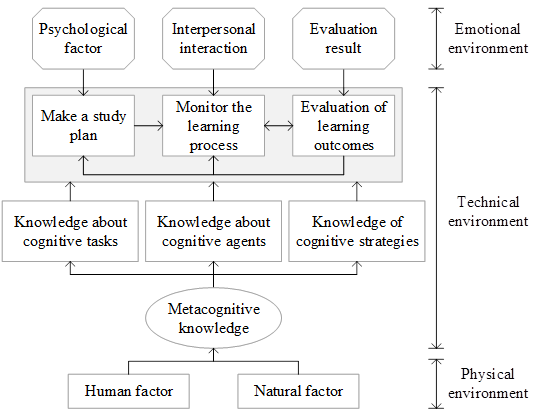
The physical environment consists of both human factors and natural factors. Human factors refer to the hardware and software configuration of the computer used by the learner, whether the network is stable, the learning resource library and other factors that can be improved manually. Natural factors refer to the light, noise, air, etc. in the learning environment, which basically cannot be improved manually.
Natural factors generally have an impact on the learner’s mood, while human factors not only have an impact on the learner’s mood, but also have a certain impact on the learner’s learning efficiency and effectiveness.
The technical environment is designed according to the cognitive process of the learner, and the metacognitive knowledge controls the whole cognitive process, which includes three steps: making learning plans, monitoring the learning process and evaluating the learning results.
The affective environment generally includes the psychological factors that develop during the learning process, the emotional experience of the learner during the interpersonal interaction process and the impact of the evaluation results on the learner.
Combined with the above discussion on the theoretical model of learning environment for improving students’ metacognitive ability, the constructivist learning environment to be constructed in this paper is mainly designed from the dimensions of the “learning process” and the “support mechanism” of the system for the learning process. In general, the system tries to “visualize” the cognitive process of students and present the metacognitive process.
Combined with the overall functions of the system, it can be seen that a constructivist learning environment aimed at improving students’ metacognitive abilities should reflect students’ metacognitive processes. The system mainly provides some support mechanisms, and the functional model of this learning environment is shown in Figure 3. Vertically, the functional model is divided into three levels: “system support”, “cognitive processes” and “learning tools”. Horizontally, the function of the learning environment should be divided into three stages according to the cognitive process, namely, the “planning and preparation” stage, the “implementation and monitoring” stage and the “evaluation and feedback” stage. These three phases do not exist in isolation, but are an interrelated and cyclical process.
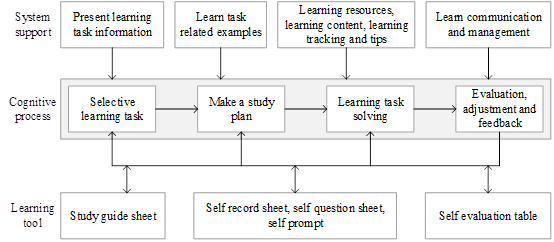
As can be seen from the figure, firstly, the system provides learners with relevant learning task information and learning examples, and users judge the learning tasks they need to carry out according to the task information. According to the learning tasks, the user develops a macro learning plan with the help of the learning guide table. Then, according to the steps in the guidance table, the user will make a corresponding learning plan for each stage. After the study plan is submitted, the system presents the learning resources and contents that the user needs, and the user uses these resources to study and solve the learning tasks. In this process, the user can track the learning process with the help of self-record sheets, self-questionnaires and self-prompts. The system can also provide some appropriate encouragement and prompts to the user at the corresponding time, which will help the user to learn continuously. At the end of the learning process, users can independently evaluate, feedback and timely adjustment of their own learning. At this time, the user can use the self-evaluation form to help the user self-assessment.
The effectiveness of developing learners’ metacognitive skills through the development of constructivist teaching activities depends on the learners’ familiarity with the nature of constructivist learning activities and their own situation, and their ability to experience a conscious process of monitoring and regulating and to produce positive learning outcomes.
The study designed the flow of teaching activities in such a way as to integrate the development of metacognitive skills with the constructivist teaching process. The corresponding dimensions of metacognitive abilities in each session facilitate the use of multiple approaches to enhance students’ metacognitive abilities.
First, teachers should guide students to have some knowledge about the constructivist teaching task and their own abilities so that they can enter the learning state quickly. Second, before the inquiry activity begins, students should be provided with a plan design scaffold to guide them to make appropriate arrangements for the activity. Then, during the inquiry activity, students should be guided to consciously monitor and regulate their learning behaviors during inquiry learning. Finally, students should be guided to summarize, assess, reflect, and remediate at the end of the activity to internalize and integrate what they have learned.
Based on the constructivist learning theory, the advantages of constructivist teaching should be utilized in teaching to provide students with rich learning resources and as authentic an environment as possible. And integrate information technology knowledge and metacognitive skills development in constructivist teaching tasks, and guide students to carry out self-monitored and regulated inquiry learning activities. It promotes students to think deeply, study carefully, apply knowledge, and accomplish the enhancement of knowledge and skills, so that metacognitive ability can be effectively cultivated.
In the preparation stage, teachers first fully analyze the teaching materials. It mainly includes the analysis of teaching content, the analysis of teaching objectives and the characterization of learners, and then determines the theme content of the project and provides rich learning resources. As the teaching activities are student-oriented and aim to enhance students’ metacognitive ability, teachers should prepare for guidance and provide students with learning scaffolds. Ensure that the teaching activities can be carried out smoothly and achieve the purpose of cultivating students’ metacognitive ability.
This link involves developing students’ metacognitive knowledge. Therefore, in this link, the teacher should not only present the pre-designed project theme that is close to students’ lives to students through a visual context. It is also necessary to explain to students the tasks and specific requirements of the project theme, provide scaffolding (task analysis book), and present metacognitive knowledge in written form.
As a facilitator, the teacher should guide students to develop a detailed and rigorous project plan, divide the work in groups, and provide students with planning guidance. In this session, the teacher should provide students with a pre-designed program template, clarify the elements of the project plan, and allow students to fill in and complete the project plan.
In this section, the teacher in addition to providing students with learning resources and tools to ensure the smooth development of teaching activities, but also to provide students with guidance on cognitive monitoring.
) Production Teachers do not intervene too much in this session, so that students are immersed in the practice of work production. However, students should be prompted to communicate well, to do a good job in all aspects of satisfactory work, or when students encounter difficulties and helplessness, to provide the necessary help. Discussing with peers how the work is made can help students to better examine their own understanding of the learning materials.
Teachers organize students to present and report the results of the project, providing students with the core explanation points of “Thinking Out Loud”, such as design concepts, problems and solutions encountered during the production process, features and functions of the work, and so on.
Teachers lead students to analyze the evaluation dimensions of the project outcome evaluation scale, so that students can experience how to do evaluation. Students view their learning outcomes from multiple viewpoints and enhance their evaluation skills through self-evaluation, other evaluation and teacher evaluation. At the end of the evaluation activity, students are provided with a “Learning Reflection Journal” for a comprehensive review of their learning process.
In order to comprehensively evaluate student learning and metacognitive use, the study documented student learning behaviors with the help of a constructivist project analysis book, a project planner, a project learning monitoring checklist, and a learning reflection log.
At the end of the project, students’ project outcomes were quantitatively assessed using the project implementation evaluation form. Self-examination of metacognitive use was conducted using the Metacognitive Status Evaluation Form. Quantitative data and qualitative data corroborate and complement each other in order to provide a comprehensive picture of student performance in the program.
The purpose of this study was to explore whether metacognitive monitoring strategy training can improve self-regulation and subsequently improve academic performance.
The subjects were freshmen undergraduates of the class of 2023 in a polytechnic institute. The researchers randomly selected two teaching classes with a total of 123 students. There were 60 students in the experimental class and 63 students in the control class.
The research instruments included questionnaires and tests. The questionnaire was divided into two times before and after the experiment with the same content. The questionnaire was a metacognitive monitoring strategy survey. Metacognitive monitoring strategy survey mainly focuses on metacognitive awareness, determining learning goals and making learning plans, self-monitoring, feedback and regulation to understand the use of students’ metacognitive monitoring strategy. The questionnaire options were graded in the form of a five-point Likert scale. Depending on the content, the questionnaire options ranged from very clear to unclear, very good to poor, and were assigned a value from 5 to 1.
This study starts from the core of metacognition and proposes to stimulate students’ independent learning, improve self-regulation, and improve academic performance through metacognitive monitoring strategy training.
This section focuses on exploring the impact of metacognitive scaffolding on students’ metacognitive abilities in teaching and learning by analyzing students’ metacognitive ability questionnaire data. Among them, metacognitive ability is analyzed in terms of three ability dimensions: planning, monitoring and evaluating. At the same time, the correlation analysis between students’ computational thinking and metacognitive ability was launched to analyze whether they are related.
Before the formal start of the experiment, this study utilized the Metacognitive Ability Questionnaire to pre-test the metacognitive ability of students in the experimental class and the control class respectively. Then SPSS software was used to analyze the data of the pre-test with independent samples t-test data in order to determine whether there is a difference between the metacognitive abilities of students in the experimental class and the control class before the formal experiment.
The results of the pre-test analysis of metacognitive ability are shown in Table 1. As can be seen from the table, in terms of overall metacognitive ability, the mean values of the students in the experimental class and the students in the control class were 115.05 and 123.31, respectively. The mean value of the students in the control class is higher than that of the experimental class, and based on the results of the independent samples t-test, P=0.329\(\mathrm{>}\) 0.05, which indicates that there is no significant difference between the metacognitive abilities of the students in the experimental class and the control class. Therefore, it indicates that the level of metacognitive ability of the students in the experimental class and the control class before the official start of the experiment is comparable.
On all dimensions of metacognitive ability, the p-values of planning ability, monitoring ability, and assessment ability of the students in the experimental class and the students in the control class are greater than 0.05. This indicates that there is no significant difference between the experimental class students and the control class students on all dimensions of metacognitive ability. Therefore, the level of planning ability, monitoring ability, and assessment ability of the students in the experimental class and the students in the control class are more comparable.
At the end of the teaching experiment, this study again distributed the metacognitive ability questionnaire to the students in the experimental and control classes. A metacognitive ability posttest was administered to the students in the two classes, and an independent samples t-test was implemented on the posttest data using SPSS to determine whether there was a difference in the metacognitive ability level of the experimental class students and the control class students after the teaching experiment. The results of the metacognitive ability posttest analysis are shown in Table 2.
In terms of overall metacognitive skills, the mean values of the students in the experimental class and the control class were 132.62 and 119.58, respectively. The mean values of the students in the experimental class were significantly higher than those of the students in the control class and the results of the independent samples t-test showed that the p-value was less than 0.05. It shows that there is a difference between the metacognitive ability of the students in the experimental class and the control class, which indicates that after a period of learning support in metacognitive scaffolding, the metacognitive ability level of the students in the experimental class is better than that of the students in the control class. This shows that metacognitive scaffolding helps students’ metacognitive ability in constructivist teaching.
| Metacognitive ability | Class | Number | mean\(\pm \)Standard deviation | t | P |
| Whole | Laboratory class | 60 | 115.05\(\pm \)12.361 | 1.235 | 0.329 |
| Cross-reference class | 63 | 123.31\(\pm \)12.699 | |||
| Plan | Laboratory class | 60 | 46.95\(\pm \)5.885 | 1.328 | 0.172 |
| Cross-reference class | 63 | 47.55\(\pm \)4.207 | |||
| Monitoring | Laboratory class | 60 | 50.21\(\pm \)7.469 | 0.956 | 0.344 |
| Cross-reference class | 63 | 53.03\(\pm \)7.223 | |||
| Evaluate | Laboratory class | 60 | 17.89\(\pm \)3.071 | 0.169 | 0.693 |
| Cross-reference class | 63 | 22.73\(\pm \)3.124 |
| Metacognitive ability | Class | N | mean\(\pm \)Standard deviation | t | P |
| Whole | Laboratory class | 60 | 132.62\(\pm \)21.121 | -3.551 | 0.027 |
| Cross-reference class | 63 | 119.58\(\pm \)20.745 | |||
| Plan | Laboratory class | 60 | 50.23\(\pm \)8.436 | -2.896 | 0.019 |
| Cross-reference class | 63 | 48.54\(\pm \)7.021 | |||
| Monitoring | Laboratory class | 60 | 55.61\(\pm \)7.233 | -3.567 | 0.006 |
| Cross-reference class | 63 | 50.07\(\pm \)7.652 | |||
| Evaluate | Laboratory class | 60 | 26.78\(\pm \)2.867 | -3.521 | 0.042 |
| Cross-reference class | 63 | 20.97\(\pm \)3.265 |
At the end of the teaching experiment, this study conducted a Pearson correlation analysis using data from the post-test of the questionnaire on computational thinking and metacognitive abilities of students in two classes. in order to determine whether there is a correlation between metacognitive ability and computational thinking and what kind of correlation exists.
The results of the correlation analysis between metacognitive ability and computational thinking are shown in Table 3. It can be seen that the Pearson correlation r = 0.753, with a p-value of 0.000, which is less than 0.01. It indicates that the students’ metacognitive ability shows a significant positive correlation with computational thinking. Therefore, in constructivist teaching, the higher the students’ metacognitive ability, the higher the students’ computational thinking.
The data were analyzed by bivariate correlation using SPSS 25.0 software, and the relationship between the usual grades, total scores and the level of metacognitive strategies is shown in Table 4. Students’ total test scores and usual scores are closely related to planning strategies, monitoring strategies, and regulating strategies, with significance (two-tailed) reaching the level of 0.000\(\mathrm{<}\)0.01. This indicates that the higher the students’ scores, the higher the corresponding level of metacognitive strategies. Further analysis shows that metacognitive strategies are strongly correlated with their sub-dimensional strategies, implying that they are highly related to each other.
| Metacognitive ability | Computational thinking | ||
| Metacognitive ability | Pearson correlation | 1.000 | 0.753** |
| Significance (double tail) | 0.000 | ||
| Case number | 123 | 123 | |
| Computational thinking | Pearson correlation | 0.753** | 1 |
| Significance (double tail) | 0.000 | ||
| Case number | 123 | 123 | |
| Total score | Normal math | Planning strategy | Monitoring strategy | Regulating strategy | Metacognitive strategy | |
| Total score | 1.000 | |||||
| Normal math | -0.382** | 1.000 | ||||
| Planning strategy | -0.195** | 0.267** | 1.000 | |||
| Monitoring strategy | -0.213** | 0.407** | 0.797** | 1.000 | ||
| Regulating strategy | -0.104** | 0.465** | 0.754** | 0.757** | 1.000 | |
| Metacognitive strategy | -0.256** | 0.322** | 0.899** | 0.828** | 0.869** | 1.000 |
The mean value of each learning strategy was utilized to indicate the frequency of use of that strategy, and there was a positive correlation between the mean value and the frequency of use. The relationship between mean value and frequency of use is shown in Table 5. The mean value of each item was categorized into three hierarchical levels: high, medium, and low, with the high level ranging between 3.5 and 5.0, which mainly consisted of frequent use and always use. The medium level ranged between 2.5 and 3.4 and included only sometimes use. The low level is between 1.0 and 2.4 and consists mainly of never and seldom use.
| Mean | Usage frequency |
| 4.5\(\mathrm{<}\) Mean\(\mathrm{\le}\)5.0 | Always use |
| 3.5\(\mathrm{<}\) Mean\(\mathrm{\le}\)4.5 | Frequent use |
| 2.5\(\mathrm{<}\) Mean\(\mathrm{\le}\)3.5 | Sometimes used |
| 1.5\(\mathrm{<}\) Mean\(\mathrm{\le}\)2.5 | Rarely use |
| 1.0\(\mathrm{<}\) Mean\(\mathrm{\le}\)1.5 | Never use |
The 24 questions in the first part of the questionnaire were categorized into four main groups; planning strategies, selective attention strategies, monitoring strategies, and evaluation strategies. The overall mean values of these four strategies can be calculated using SPSS 26.0. The overall use of metacognitive strategies is shown in Table 6. The overall mean of the four categories of strategies is 3.33 points, which tends to be used sometimes.
| Project | N | Min | Max | Mean | Standard deviation |
| Planning strategy | 123 | 2.321 | 4.521 | 3.68 | 0.535 |
| Choice of attention strategy | 123 | 2.869 | 4.207 | 3.42 | 0.269 |
| Monitoring strategy | 123 | 2.235 | 4.183 | 3.26 | 0.415 |
| Evaluation strategy | 123 | 1.996 | 3.968 | 2.97 | 0.336 |
| Total mean | 123 | 2.355 | 4.220 | 3.33 | 0.389 |
In order to better mobilize students’ use of planning strategies during constructivist teaching and learning activities, the influencing factors of planning strategies were understood. A one-way linear regression analysis was conducted with the seven sub-factors of the influencing factors as independent variables and the planning strategies as dependent variables.
The one-way linear regression analysis of influencing factors on planning strategies is shown in Table 7. The significance of the level of metacognitive development and planning strategy was 0.007, which is less than 0.05. It can be concluded that the level of metacognitive development is significantly related to planning strategy. The significance of learning material difficulty and planning strategy is less than 0.05, and learning material difficulty is significantly related to planning strategy.
While the significance of original background knowledge, learning attribution style, self-efficacy, instructional information feedback, and teacher factors with planning strategies are all greater than 0.05. Therefore, the level of metacognitive development and the difficulty of the learning materials have an impact on planning strategies to a high degree. That is, the influencing factors of planning strategy are metacognitive development level and learning material difficulty.
| Dependent variable | Independent variable | \(R^2 \) | F | B | Beta | t | Sig. |
| Planning strategy | Background | 0.239 | 185.634 | 0.052 | 0.86 | 0.986 | 0.316 |
| Learning attribution | 0.203 | 67.556 | 0.091 | 0.135 | 3.251 | 0.017 | |
| Self-efficacy | 0.418 | 183.112 | 0.153 | 0.152 | 1.824 | 0.082 | |
| Metacognitive development | 0.436 | 192.868 | 0.235 | 0.236 | 3.262 | 0.007 | |
| Difficulty in learning data | 0.316 | 145.326 | 0.568 | 0.751 | 12.365 | 0.001 | |
| Teaching information feedback | 0.253 | 80.965 | 0.006 | 0.002 | 0.032 | 0.965 | |
| Teacher factor | 0.331 | 132.245 | 0.0237 | 0.096 | 1.256 | 0.125 |
A one-way linear regression analysis was conducted with the seven subfactors of the influencing factors as independent variables and the choice of attention strategy as the dependent variable.
The one-way linear regression analysis of the influence factors on choice of attention strategies is shown in Table 8. The significance of original background knowledge, self-efficacy, instructional information feedback, and teacher factors on choice of attention strategy were 0.006, 0.003, 0.032, and 0.021, respectively, which were less than 0.05. It can be concluded that original background knowledge, self-efficacy, instructional information feedback, and teacher factors were all significantly related to choice of attention strategy.
| Dependent variable | Independent variable | \(R^2 \) | F | B | Beta | t | Sig. |
| Choice of attention strategy | Background | 0.235 | 71.856 | 0.186 | 0.458 | 9.656 | 0.006 |
| Learning attribution | 0.067 | 30.204 | 0.035 | 0.095 | 1.733 | 0.125 | |
| Self-efficacy | 0.236 | 88.965 | 0.142 | 0.324 | 3.278 | 0.003 | |
| Metacognitive development | 0.185 | 74.635 | 0.086 | 0.142 | 1.706 | 0.096 | |
| Difficulty in learning data | 0.069 | 30.421 | -0.067 | -0.213 | -1.523 | 0.142 | |
| Teaching information feedback | 0.123 | 56.669 | 0.085 | 0.156 | 2.336 | 0.032 | |
| Teacher factor | 0.075 | 28.996 | -0.123 | -0.299 | -2.694 | 0.021 |
In order to better understand the influencing factors on monitoring strategies, a one-way linear regression analysis was conducted with the seven sub-factors of the influencing factors as independent variables and monitoring strategies as dependent variables.
The one-way linear regression analysis of the influencing factors on monitoring strategies is shown in Table 9. Original background knowledge, learning attribution style, self-efficacy, level of metacognitive development, instructional information feedback, and teacher factors had a correlational relationship with metacognitive reading monitoring strategies.
| Dependent variable | Independent variable | \(R^2 \) | F | B | Beta | t | Sig. |
| Monitoring strategy | Background | 0.496 | 185.654 | 0.124 | 0.198 | 3.326 | 0.035 |
| Learning attribution | 0.187 | 59.418 | 0.236 | 0.423 | 8.212 | 0.004 | |
| Self-efficacy | 0.412 | 196.332 | 0.659 | 0.754 | 15.263 | 0.003 | |
| Metacognitive development | 0.321 | 145.012 | 0.421 | 0.562 | 12.028 | 0.008 | |
| Difficulty in learning data | 0.235 | 85.332 | -0.035 | -0.036 | -0.521 | 0.724 | |
| Teaching information feedback | 0.211 | 112.056 | 0.135 | 0.213 | 3.296 | 0.036 | |
| Teacher factor | 0.196 | 126.234 | 0.565 | 0.552 | 12.331 | 0.001 |
| Dependent variable | Independent variable | \(R^2 \) | F | B | Beta | t | Sig. |
| Evaluation strategy | Background | 0.189 | 78.696 | 0.033 | 0.098 | 0.896 | 0.421 |
| Learning attribution | 0.066 | 12.632 | 0.086 | 0.124 | 4.533 | 0.003 | |
| Self-efficacy | 0.193 | 70.221 | -0.006 | -0.003 | -0.085 | 0.859 | |
| Metacognitive development | 0.232 | 78.993 | 0.021 | 0.055 | 0.821 | 0.526 | |
| Difficulty in learning data | 0.280 | 90.351 | 0.121 | 0.236 | 5.003 | 0.001 | |
| Teaching information feedback | 0.032 | 23.542 | 0.235 | 0.521 | 5.219 | 0.000 | |
| Teacher factor | 0.156 | 65.321 | 0.136 | 0.153 | 3.546 | 0.213 |
In order to better understand the influencing factors of the evaluation strategy, a one-way linear regression analysis was conducted with the seven sub-factors of the influencing factors as independent variables and the evaluation strategy as the dependent variable.
The one-way linear regression analysis of influencing factors on evaluation strategies is shown in Table 10. Learning attribution style, learning material difficulty, and instructional information feedback were significantly correlated with metacognitive evaluation strategies (significance less than 0.05).
This paper unites constructivist theory and metacognitive strategies to build a model of the teaching environment, implemented in the practice of constructivist teaching activities. The correlation between metacognitive regulation and students’ performance is analyzed, and the use of metacognitive strategies in the dimensions of the constructivist learning environment is proposed.
There is no significant difference in the metacognitive abilities of the investigated subjects before the implementation of the constructivist teaching activity. The mean value of the experimental class was significantly higher than that of the control class after the constructivist teaching activity with P\(\mathrm{<}\)0.05, and there was a significant difference between the experimental class and the control class in the dimension of metacognitive ability. There is a correlation relationship between metacognitive ability and computational thinking, i.e. the higher the students’ metacognitive ability, the higher the students’ computational thinking. And there is a significant correlation between students’ total test scores, usual grades, and planning strategies, monitoring strategies, and regulating strategies, indicating that the higher the students’ scores, the higher the corresponding level of metacognitive strategies.
Combined with the analysis of the level of metacognitive strategy use in the survey sample, this paper here proposes the use of metacognitive strategies in a constructivist learning environment.
(1) The planning strategy session focuses on developing students’ cognitive development level and on the difficulty of learning materials.
(2) The selective attention strategy session focuses on the learner’s prior background knowledge, self-efficacy, and instructional information feedback. Teacher roles are effectively utilized in the design of instructional activities.
(3) The monitoring strategy session organizes and regulates the students’ original background knowledge, learning attribution style, self-efficacy, metacognitive development level, and teaching information feedback, and strengthens the role of the teacher’s factors in constructivist teaching activities.
(4) In the reading evaluation strategy session, the three dimensions of learning attribution style, learning material difficulty, and teaching information feedback are analyzed from the constructivist view of learning and teaching.
This research received no specific grant from any funding agency, commercial or not-for-profit sectors.
The Ethical Review Board approved the study in Khon Kaen University, Khon Kaen, Thailand. (ReferenceNo. : HE673312).