
Zadeh [23] established the Fuzzy Set theory model to approach ambiguous or uncertain things. In 1975, Zadeh [24] pioneered fuzzy numbers. Further, the conjecture of fuzzy numbers was established by several authors like Dubois, R. Yager Mizomoto, and J. Buckley. Triangular fuzzy numbers and Trapezoidal fuzzy numbers play a very important role in fuzzy numbers. In the last decade, the fuzzy numbers were enriched with various numbers [5], [22] ,[13], [14],[6],[20] and [2] . fuzzy numbers have been functional in various areas, such as engineering, medication, business, decision-making, and so on. Several authors like Yager [21], Cheng’s [7], Chu and Tsao’s [9], Rao and Shankar [16], Abbasbandy [1] devised and discussed many ranking methods using the centroid points of different fuzzy numbers , with their strengths and shortcomings. Decision-making plays a significant role in human life. Several authors have applied the theoretical fuzzy number idea in social issues to find the optimal solution.
Neff [12] applied the fuzzy set theoretical concept to study the poverty level. Revathi et al. [17] identified the social problems of farmers using Fuzzy mathematics. Thakre et al. [19] employed a fuzzy logic multicriteria approach to evaluate the teacher’s performance. Kumar and Pathinathan [11] applied the Pentagonal Fuzzy decision-making technique in “Sieving out the Poor”. In Greece, during the COVID-19 epidemic, Chrysafiadi et al. [8] evaluated the E- learning acceptance and effectiveness of computer science students. Siva and RamKumar [18] applied Fuzzy cognitive concepts to study the poverty rate in a pandemic scenario in Tamil Nadu. Several authors applied Fuzzy Mathematical concepts and Fuzzy Logic evaluation methods to social problems [10], [15].
An emerging new type of fuzzy number called prism fuzzy number (PrFN) [2]. prism fuzzy number has its own membership value, properties, and operations. The combination of Trapezoidal fuzzy numbers and other fuzzy numbers enhances the prism fuzzy number (PrFN) in different ways of approaching crisp values for better results with precise descriptions.
The conjectural ideas are accomplished when they are implemented. Numerous mathematical ideas have been used in realistic condition. The main objective of the study is to apply its findings to society. Education is one of the essential things for the growth of country. Higher education fosters knowledge, ethics, and it improves the technology. The development of society depends on the growth of an individual person which depends on the higher education. Education was seen as a difficult endeavor in the past, and scholars were viewed as achievers by the community. Nowadays, enrollment in higher education and the level of placement for job reveals that student’s interests are slowly decline towards education. In this study, we investigate the main factors influencing students’ decisions regarding jobs and higher education. In general, society believes that financial status plays a significant role in shaping a student’s future choices. We also examine whether economic status is the sole factor behind a student’s decision to pursue a job. Whenever two extreme cases exist for a problem, the prism fuzzy number helps in determining the optimal solution based on the given circumstances. Choosing a job or pursuing higher education are both good decisions; one cannot be deemed the best while the other is the worst. Such cases can be effectively analyzed using the prism fuzzy number to determine the most suitable choice.
In this artifact, Section 2 gives the preliminaries to understand the types and operations in fuzzy numbers. Section 3 presents the centroid of prism fuzzy number and Section 4 provides the comparative analysis that supports our suggested outcome. The grading value with the alpha cuts and an improved prism fuzzy number technique are presented in Section 5. Section 6 employs the improved prism fuzzy number technique to investigate the student’s interest in pursuing higher education and employment. Additionally, we investigate the main factors influencing students’ decisions regarding their future. The statistical analysis using the Python programme is presented in section 8. Section 9 gives the discussion of the study. The conclusion and potential directions for further prism fuzzy number analysis are presented in Section 10.
Defnition 2.1(Triangular fuzzy number [4] ). A Triangular fuzzy number \(T=(\, t_1,t_2,t_3)\,\) where \(t_1,t_2,t_3\) are real numbers is a fuzzy set which is a subset of real line R. The membership function \(\mu_{T}(\,x)\,\) satisfies the conditions as given below:
\[\nonumber \mu_{T}(\,x)\,= \begin{cases} % 0, & \text{$ x < t_1$}\\ \frac{(\,x-t_{1})\,}{t_{2}-t_{1}}, & \text{for $t_{1}\leq x\leq t_{3}$},\\ \frac{(\,t_{3}-x)\,}{t_{3}-t_{2}}, & \text{for $t_{2}\leq x\leq t_{3}$},\\ 0 , & \text{otherwise}. \end{cases}\]
Defnition 2.2 (Trapezoidal fuzzy number [5]).A Trapezoidal fuzzy number \(Tr=(\,Tr_1, Tr_2,Tr_3,\\ Tr_4)\,\), \((\,Tr_1 \leq Tr_2 \leq Tr_3 \leq Tr_4)\,\) is defined in R. Its membership function is represented as: \[\nonumber \mu_{Tr}(\,x)\,= \begin{cases} 0, &\text{$x<Tr_{1}$},\\ \frac{x- Tr_{1}}{Tr_{2}-Tr_{1}}, & \text{for $Tr_{1}\leq x\leq Tr_{2}$},\\ 1, & \text{for $ Tr_{2}\leq x\leq Tr_{3}$},\\ \frac{Tr_{4}-x}{Tr_{4}-Tr_{3}}, & \text{for $Tr_{3}\leq x\leq Tr_{4}$},\\ 0 , & \text{$x> Tr_{4}$}. \end{cases}\]
Defnition 2.3 (prism fuzzy number [2]).A prism fuzzy number \(P=\{a_1,a_2,a_3, a_4, a_5;\beta\}\) is defined on the real line R, whose degree of membership is defined as follows: \[\nonumber \mu_{P}(\,x)\,= \begin{cases} \frac{(\,x-a_{1})\,}{a_{3}-a_{1}}, & \text{for $a_{1}\leq x\leq a_{3}$},\\ \frac{(\,a_{5}-x)\,}{a_{5}-a_{3}}, & \text{for $a_{3}\leq x\leq a_{5}$},\\ \beta, & \text{base},\\ \frac{(\,a_{1}-x)\,}{a_{1}-a_{2}}, & \text{for $a_{1}\leq x\leq a_{2}$},\\ 1, & \text{for $a_{2}\leq x\leq a_{4}$},\\ \frac{(\,x-a_{5})\,}{a_{4}-a_{5}}, & \text{for $a_{4}\leq x\leq a_{5}$},\\ 0 , & \text{otherwise}. \end{cases}\]
Defnition 2.4 (Operations on prism fuzzy number [2]).Consider two prism fuzzy number \(Px=\{Px_1,Px_2,Px_3,Px_4,Px_5\}\), \(Py=\{Py_1,Py_2,Py_3,Py_4,Py_5\}\)
1. Addition of two prism fuzzy number: \(Px+Py=\{Px_1 +Py_1,Px_2+Py_2 ,Px_3+Py_3,Px_4+Py_4,Px_5+Py_5\}\)
2. Subtraction of two prism fuzzy number: \(Px-Py=\{Px_1 -Py_1,Px_2-Py_2 ,Px_3-Py_3,Px_4-Py_4,Px_5-Py_5\}\)
3. A scalar multiplication of prism fuzzy number: \(kPx=\{kPx_1,kPx_2,kPx_3,kPx_4,kPx_5\}\)
Partition the prism fuzzy number into three triangles, with \((\, a_1, 0)\, , (\, a_2, w)\,\) and \((\, a_3, w)\,\) as the first triangle’s vertex, \((\, a_2, w)\, ,(\, a_3, w)\,\) and \((\, a_4, w)\,\) as the second triangle’s vertex, and \((\, a_4, w)\, , (\, a_3, w)\,\) and \((\, a_5, 0)\,\)as the third triangle’s vertex and centroids \(GPr_1, GPr_2, GPr_3\) respectively [2] which are depicted in Figure 1.

The centroid of \(GPr_1, GPr_2 , GPr_3\) is \[\label{eq1} GPr^* (\,x_0, y_0)\,= \bigg( \frac {a_1+2a_2+3a_3+2a_4+a_5}{9}, \frac{7w}{9} \bigg). \tag{1}\]
The three points on each triangle that balance each other are known as \(GPr_1, GPr_2,\) and \(GPr_3.\) So, let us use this as a starting point and identify the circumcenter of these balancing points. Consider the prism fuzzy number as \(Pr\)= \((a_1,a_2,a_3,a_4,a_5: w).\) \(GPr_2\) does not lie on the line connecting \(GPr_1\) and \(GPr_3,\) and the equation of the line involving \(GPr_1\) and \(GPr_3\) is \(y= 2w/3.\) It indicates the points are not collinear. Thus, it creates a triangle. The circumcenters of these centroid points are distributed equally among each of their vertices.
The circumcenter of the prism fuzzy number is \[GP_r (\,x_0,y_0)\, = \bigg( \frac{a_1+a_2+2a_3+a_4+a_5}{6},\frac{(\,a_1-a_4 )\, (\,a_5-a_2 )\,+5w^2}{6w}\bigg). \tag{2}\]
It provides the appropriate balancing point for the plane and is uniformly spaced from every vertex. This is the best ranking strategy.
Transform the generalized prism fuzzy number into a Trapezoidal fuzzy number by assuming that \(a_3=0.\) Hence, \(GPr\{Tr\}(\,x_0,y_0)\, = \bigg( \frac {a_1+a_2+a_4+a_5}{6}, \frac{(\,a_1-a_4 )\,(\,a_5-a_2 )\,+5w^2}{6w} \bigg)\).
Deduce the Triangular fuzzy number from the generalized prism fuzzy number by substituting \(a_2=a_4=0.\) Hence we get, \(GPr\{T\}(\,x_0,y_0)\, = \bigg( \frac{(\,a_1+2a_3+a_5)\, }{6},\frac {(\,a_1-a_4 )\,(\,a_5-a_2 )\,+5w^2}{6w}\bigg)\).
For any decision maker \(R(Pr)= (x_0,y_0)\) gives the ranking value of the generalized prism fuzzy number.
Many authors recommended different rating systems and made decisions. This section compares the deduced generalized Trapezoidal Fuzzy value to other existing models in order to validate our findings.
Consider the fuzzy numbers: \(P_1= (\,0.3, 0.4,0.5, 0.6: 1)\, , P_2= (\,0.1,0.2,0.4,0.7: 1)\,\).
| Method | \(GP_1Tr\) | \(GP_2Tr\) | \(R(\,P_1)\,\) | \(R(\,P_1)\,\) | Result |
| Yager’s Method [21] | (0.45) | 0.35 | – | – | \(P_2<P_1\) |
| Cheng’s Method [7] | (0.45, 0.33) | (0.358,0.33) | 0.5598 | 0.469 | \(P_2<P_1\) |
| Azman et al. Method [3] | (0.3916,0.416) | (0.245,0.416) | 0.571 | 0.4837 | \(P_2<P_1\) |
| Proposed Method | (0.3,0.826) | (0.233,0.8083) | 0.2478 | 0.1883 | \(P_2<P_1\) |
Remark 4.1. From the centroid of prism fuzzy number Eq. (1), the inferred Trapezoidal formula yields \[GPr^*\{Tr\}=\bigg( \frac{(\,a_1+2a_2+2a_4+a_5)\,}{9}, \frac{7w}{9} \bigg).\]
With this formula, \(P_1\) and \(P_2\) have values of \((\,0.3,0.777)\,\) and \((\,0.222,0.777)\,\) respectively. Then \(R(\,P_1)\,=0.2331,\) \(R(\,P_2)\, = 0.1724\) which also results in \(R(\,P_2)\,< R(P_1).\)
A grading value \(\rho\) is the function \(\rho : F \times R\) which maps all the fuzzy number on the real set into the real quantity.
Definition 5.1 (Grading value). i) The grade of Triangular fuzzy number is \(\rho \{T\}=\frac{(\,a+2b+c)\,}{2}.\)
ii) The grade of Trapezoidal fuzzy number is \(\rho \{T_r\}=\frac{(\,a+b+c+d)\,}{2}\)
The grading value of prism fuzzy number is the sum of integral of \(L_1 (\,\alpha)\, ,L_2 (\, \alpha)\, ,R_1 (\, \alpha)\,\) and \(R_2 (\, \alpha)\,.\) \[\rho(\,Pr)\,=\int_0^1\bigg(L_1 (\,\alpha)\,+ L_2 (\,\alpha)\,+R_1 (\,\alpha)\,+R_2 (\,\alpha)\,\bigg ) d\alpha,\] where \(L_1 (\, \alpha)\,=(\,a_3-a_2 )\,\alpha+a_1,\) \(L_2 (\, \alpha)\,=a_5+(\,a_5-a_3)\, \alpha,\) \(R_1 (\,\alpha)\,=a_1-(\,a_1-a_2)\, \alpha,\) and \(R_2 (\,\alpha)\,=(\,a_4-a_5)\,\alpha+a_5.\) \[\rho(\,Pr)\,=\frac{ (\,2a_1+a_2+2a_3+a_4+2a_5)\,}{ 2} .\]
Let \(Pr_1\) and \(Pr_2\) be two prism fuzzy numbers. The grading of \(Pr_1\) and \(Pr_2\) can be assessed by the following principle:
i) If \(\rho Pr_1> \rho Pr_2\) then \(Pr_1> Pr_2.\)
ii) If \(\rho Pr_1< \rho Pr_2\) then \(Pr_1< Pr_2.\)
iii) If \(\rho Pr_1 = \rho Pr_2\) then \(Pr_1= Pr_2.\)
fuzzy numbers help us find solutions where uncertainty exists. Triangular, Trapezoidal, and Pentagonal fuzzy numbers play a significant role in Fuzzy Set theory. For a problem, these fuzzy numbers assess the values on one side of possibility and do not take the other side into account. So, the comparison between two sides of an issue cannot be done with the existing method. For example, suppose the person wants to choose a job from three choices. fuzzy numbers help the person find the optimal solution with one way of assessing the data. The current imprecise data does not justify evaluating the situation in terms of two extremes.
However, the upgraded tool of prism fuzzy number makes it easy to justify the benefits of a certain job for a person. One-sided grading is insufficient to quantify a quantity and choose the best course of action. Every problem has its pros and cons, or the two extremes. The only method for evaluating a problem’s two extreme levels with a common basis is the prism fuzzy number ( PrFN) . The suggested methodology based on grading technique depends on the common base.
Let us consider, \(Pr_1=\{1,2,3,4,5\}\) and \(Pr_2=\{ 3,4,5,6,7\}\) be two prism fuzzy numbers.
| Assumptions | \(\rho Pr_1\) | \(\rho Pr_2\) |
| \(a_2=a_4=0\) | 9 | 15 |
| \(a_3=0\) | 9 | 15 |
Table 2 indicates that the upper and lower sections of the prism fuzzy number are given equal significance by the suggested grading value. This helps us to fix our two extremes of a problem in two sections of prism fuzzy number. Then the grading value facilitates the results with extreme yields being the most beneficial.
Case i. A person wants to travel from City A to City B. He has two options: either to travel by car or by bike. Let \(Pr_1 = (\,0.3, 1, 0.6, 1, 0.4)\,\) stand for the individual’s preference among a car and a bike.In this instance, the upper portion of the prism fuzzy number \((\,a_3)\,\) indicates the desire to choose a car, and the lower part \((\,a_2, a_4)\,\) indicates the interest in choosing a bike. The common traits of the bike and car are indicated by \((\, a_1,\) \(a_5)\,\). As soon as we perceive the value, it is clear that the individual has a strong interest in bike (lower section).
| Assumptions | \(\rho Pr_1\) | Outcome |
| \(a_2=a_4=0\) | 1.3 | \(1.3 < 1.7\) |
| \(a_3=0\) | 1.7 | To choose bike |
| Assumptions | \(\rho Pr_2\) | Outcome |
| \(a_2=a_4=0\) | 1.7 | \(1.7 > 1.3\) |
| \(a_3=0\) | 1.3 | To choose car |
The outcome is depicted in Table 3, which demonstrates that an individual’s interests and circumstances make him to choose a bike.
Case ii. For \(Pr_2= (\,0.3, 0.6, 1, 0.6, 0.4)\,\) the outcome is illustrated in Table 4.
Education fosters personal growth, which is the driving force behind societal advancement. In recent years, there has been a marked decline in the desire to go to college. Students interest in pursuing higher education can be influenced by a variety of variables, including their financial situation, lack of motivation for learning, ignorance about opportunities for higher education, etc. There are a variety of reasons why students choose to work, including the need to provide financial support for their families, a lack of enthusiasm in their studies, an exaggerated perception of higher education, or parental pressure. The integrated prism fuzzy number tool allows us to quickly figure out whether a student is interested in pursuing further education or finding work. Figure 2 illustrates the flowchart for the data analysis process. In this segment, we look into the primary motivators behind the choices that students make regarding their future.

1. Data is collected through a Google Form
questionnaire that focuses on information about the financial state of
the family, the influence of the parents, the interest in education, the
interest in a job, social networks, and background information about the
family.
2. Converting crisp data into prism fuzzy number
data.
3. Translating each questionnaire’s scores into a
linguistic value on a 5- point scale.
4. Use the grading value principle to evaluate the
standard of scores.
5. Results
6. Findings
Step 1: Data collection
Data from the final year UG and PG students at the colleges in the Vellore and Ranipet district were collected using a questionnaire in order to determine the psychological reasons behind the students’ decisions. The questionnaire includes information on the financial status of the student (FS), interest in studies (IS), interest in a job (IJ), parents’ obligation to support higher education (PH), the influence of social networks on higher education (SN), fee structure (FES), interest in future studies (IF), and other reasons (ORH) for pursuing higher education, such as being forced to marry, not wanting to stay at home simply. Parents’ compulsion to work (PW), students’ financial need to support their families (SFF), misunderstandings about higher education (OHS), transportation options (TF), and additional factors that influence employment decisions (AFE).
Step 2: Adaptation of the crisp number into a prism fuzzy number
Scaling Value: Very Low(\(V_L\))= (0,0.05,0.1,0.15,0.2)
Low(L)= (0.2,0.25,0.3,035,0.4)
Moderate(M)= (0.4,0.45,0.5,0.55,0.6)
High(H)=(0.6,0.65,0.7,0.75,0.8)
Very High(\(V_H\))=(0.8,0.85,0.9,0.95,1.0)
Step 3: Adaptation scores
The adapatation scores of linguistic values for higher studies and employment are presented in Table 5 and Table 7.
| \(V_L\) | \(L\) | \(M\) | H | \(V_H\) | |
| FS | (0,4.7,9.5, | (6.6,8.2,9.9, | (3.6,4.05,4.5, | (5.4,5.8,6.3, | (4.8,5.1, |
| 14.2,19) | 11.5,13.2) | 4.9,5.4) | 6.7,7.2) | 5.4,5.7,6) | |
| PH | (0,3.7,7.4, | (5.4,6.7,8.1, | (6,6.7,7.5, | (12.6,13.6,14.7, | (12,12.7, |
| 11.1,14.8) | 9.4,10.8) | 8.2,9) | 15.7,16.8) | 13.5,14.2,15) | |
| SN | (0,1.8,3.7, | (4.7,5.8,7.0, | (15.1,16.9,18.8, | (16.6,18,19.4, | (20.4,21.6, |
| 5.6,7.5) | 8.2,9.4) | 20.7,22.6) | 20.8,22.2) | 22.9,24.2,25.5) | |
| FES | (0,0.9,1.9, | (3,3.7,4.5 | (19.6,22.,24.5 | (20.4,22.1,23.8, | (28,29.7, |
| 2.8,3.8) | 5.25,6) | 26.9,29.4) | 25.5,27.2) | 31.5,33.2,35) | |
| IS | (0,0.3,0.6, | (2.1,2.6,3.1, | (7.4,8.3,9.2, | (14.7,15.9,17.1, | (73.6,78.2, |
| 0.9,1.3) | 3.6,4.2) | 10.1,11.1) | 18.3,19.6) | 82.8,87.4,92) | |
| IF | (0,0.5,1, | (2.6,3.2,3.9, | (6.4,7.2,8, | (19.2,20.8,22.4, | (64.8,68.8, |
| 1.5, 2) | 4.5,5.2) | 8.8,9.6) | 24,25.6) | 72.9,76.9,81) | |
| ORH | (0,2.8,5.6, | (3.5,4.3, 5.2 | (11,12.3,13.7, | (8.1,8.7,9.4, | (29.6,31.4, |
| 8.47,11.3) | 5.2,6.1,7) | 15.1,16.5) | 10.1,10.8) | 33.3,35.1,37) |
| Criteria | FS | PH | SN | FES | IS | IF | OR |
| \(V_L \) | 38 | 29.6 | 15 | 7.6 | 2.6 | 4 | 22.6 |
| \(L \) | 39.6 | 32.4 | 28.2 | 18 | 12.6 | 15.6 | 21 |
| \(M\) | 18 | 30 | 75.49 | 98 | 37 | 32 | 55 |
| \(H\) | 25.2 | 58.8 | 77.69 | 95.2 | 68.6 | 89.6 | 37.8 |
| \(V_H\) | 21.6 | 54 | 91.8 | 126 | 331 | 291.6 | 133.2 |
Step 4: Grading value( \(\rho Pr )\,\)
The grading values for higher studies and employment are presented in Table 6 and Table 8.
Step 5: Results
MATLAB software is used to analyze the data, and the following are simulation results, which are represented in Figures 3 and 4.
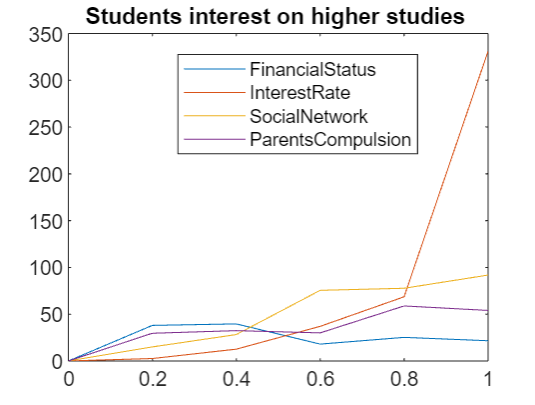
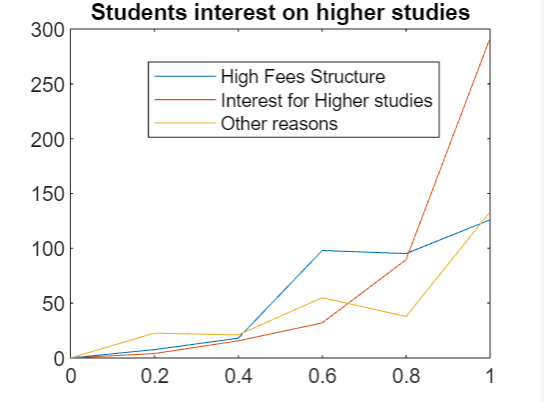
1. The influence of social media, parental pressure, and financial situation do not significantly influence a student’s decision to pursue further education.
2. The decision to pursue higher education is mostly influenced by the student’s own interests in their courses, the cost, and other factors.
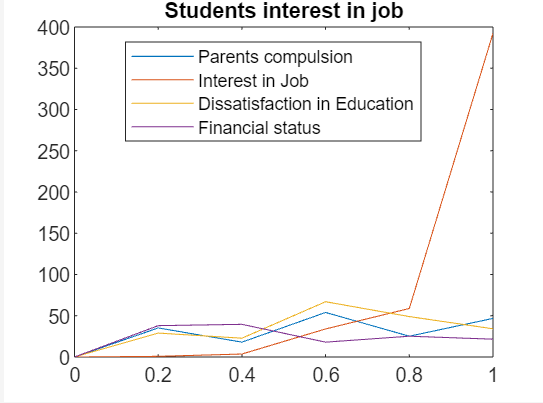
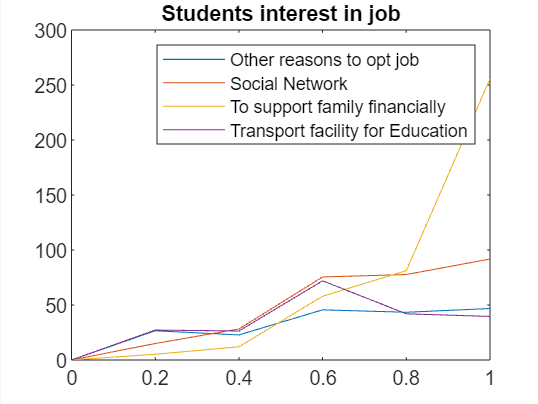
The figures 5 and 6 depicts the following results:
1. The primary factor influencing a student’s decision to work is their level of interest in the job.
2. Financial support for the family is the secondary motivation for employment.
3. Other factors, such as parental pressure, social networks, rates of education dissatisfaction, misinterpretation of higher education job opportunities, financial situation, and transportation options, do not significantly influence employment decisions.
| \(V_L\) | \(L\) | \(M\) | H | \(V_H\) | |
| PW | (0,4.4,8.8, | (3,3.7,4.5, | (10.8,12.1,13.5, | (5.4,5.8,6.3, | (10.4,11, |
| 13.2,17.6) | 5.2,6) | 14.8,16.2) | 6.7,7.2) | 11.7,12.3,13) | |
| SFF | (0,0.6,1.3, | (2,2.5,3, | (11.6,13,14.5, | (17.4,18.8,20.3, | (56.8,60.3, |
| 1.95,2.6) | 3.5,4) | 15.9,17.4) | 21.7,23.2) | 63.9,67.4,71) | |
| IJ | (0,0.1,0.2, | (0.6,0.7,0.9, | (6.8,7.6,8.5, | (12.6,13.6,14.7, | (87.2,92.6, |
| 0.3,0.4) | 1.05,1.2) | 9.3,10.2) | 15.7,16.8) | 98,103,109) | |
| OHS | (0,3.6,7.2, | (3.8,4.7,5.7, | (13.4,15,16.7, | (10.5,11.4,12.2, | (7.6,8, |
| 10.8,14.5) | 6.6,7.6) | 18.4,20.1) | 13.1,14) | 8.5,9,9.5) | |
| TF | (0,3.4,6.8, | (4.4,5.5,6.6, | (14.4,16.2,18, | (9,9.7,10.5, | (8.8,9.3, |
| 10.2,13.6) | 7.7,8.8) | 19.8,21.6) | 11.25,12) | 9.9,10.4,11) | |
| AFE | (0,3.3,6.6, | (3.8,4.7,5.7, | (7.6,9.5,11.4, | (9.3,10,10.8, | (10.4,11.05, |
| 9.9,13.3) | 6.6,7.6) | 13.3,15.2) | 11.6,12.4) | 11.7,12.3,13) |
| Criteria | PW | SFF | IJ | OHS | TF | AFE |
| \(V_L\) | 35.2 | 5.2 | 0.8 | 29 | 27.2 | 26.6 |
| \(L\) | 18 | 12 | 3.6 | 22.8 | 26.4 | 22.8 |
| \(M\) | 54 | 58 | 34 | 67 | 72 | 45.6 |
| \(H\) | 25.2 | 81.2 | 58.8 | 49 | 42 | 43.4 |
| \(V_H\) | 46.8 | 255.6 | 392.37 | 34.2 | 39.6 | 46.8 |
Step 6: Findings
Based on the statistics, the simulation results, which are represented in Figure 6, illustrate that the students are more interested in finding a job than in going to college. In our modern era, smart work is what people do to enjoy their lives. Additionally, it influences students to select a career over continuing their education.

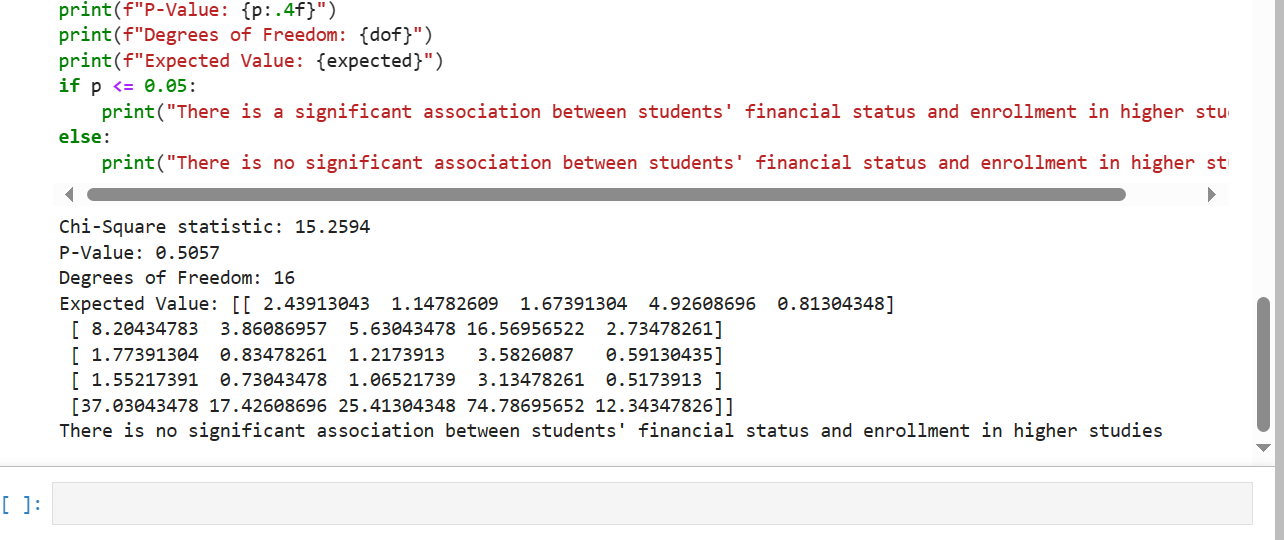
To ensure that financial status is not the major key to the decline in enrollment in higher studies. We examine the relationship between a student’s financial situation and their decision to engage in higher education. Python 3.11.5 is used for statistical analysis of the data. The observed values are shown in Table 9, the Chi-square statistic value is 15.2594, and the P-value is 0.5057 are shown in Figure 8. Chi-square statistically tests the difference between the observed and expected frequencies. In this case, the p-value is greater than the significance level of 0.05. It witnesses that there is no statistically significant association between a student’s financial status and their decision to enroll in higher education.
The study indicates that interest levels play a crucial role in higher education, even for students from low-income families, regardless of their financial situation. To encourage students to enroll in higher education, it is suggested to emphasize the importance of education through schooling and social media, highlighting scholarships, free education, and loan availability. Interest in employment increases with employment rates, with passion for the profession being the primary driver. Social media platforms can effectively highlight the significance of loans, scholarships, and part-time work for higher education, especially for low-income students who may need to balance their studies and family finances. Also, the study found that there is no significant relation between students financial status and their decision to pursue higher education.
| FS\(\backslash\) HS | H | L | M | \(V_H\) | \(V_L\) |
| \(H\) | 4 | 0 | 3 | 4 | 0 |
| \(L\) | 7 | 3 | 5 | 21 | 1 |
| \(M\) | 0 | 0 | 1 | 6 | 1 |
| \(V_H\) | 1 | 0 | 2 | 3 | 1 |
| \(V_L\) | 39 | 21 | 24 | 69 | 14 |
In this artifact, the centroid of the prism fuzzy number is defined with inferred Triangular and Trapezoidal centroid values. We conducted a comparison analysis using the proposed centroid value to corroborate our findings. A grading value is defined with alpha cuts of a prism fuzzy number. As an application, we investigate the student’s interest in job and higher studies. The MATLAB simulation results were established using the proposed grading tool. Discussions on the major factors that influenced the student’s decision and recommendations were offered on the conclusions drawn about the student’s future decision. Additionally, the Python programme was used to perform the statistical analysis. In the forthcoming work, the application of PrFN can be implemented in various fields such as operation research, medication, business statistics, and decision-making.
The authors declare that they have no conflicts of interest.