
Throughout this paper, we consider finite, simple and connected graphs with vertex set \(V(G)\) and edge set \(E(G)\). For a vertex \(v \in V(G)\), let \(N_G(v)\) be the set of all vertices adjacent to \(v\) in \(G\) and \(|N_G(v)| = deg_G(v)\). Let \(A\) be an additive Abelian group with identity 0. A mapping \(l : V(G) \to A \setminus \{0\}\) is said to be a \(A\)-vertex magic labeling of \(G\) if there exists a \(\mu\) in \(A\) such that \(w(v) = \sum\limits_{u \in N_G(v)} l(u) = \mu\) for any vertex \(v\) of \(G\). If \(G\) admits such a labeling, then it is called an \(A\)-vertex magic graph and \(\mu\) is called magic constant. Several works have been done on A-vertex magic graphs in [1, 3, 2, 7].
For basic graph-theoretic notion, we refer to Bondy and Murty [5]. Let \(R\) be a commutative ring with unity, we denote the multiplicative group of all units in \(R\) by \(U(R)\). For concepts in group theory, we refer to Herstein [6].
Definition 1.1. Let \(G\) be an \(A\)-vertex magic graph. Then \(gdms(G,A)=\{ \lambda \in A: \lambda\) is a magic constant of some \(A\)-vertex magic labeling of \(G\}\) is called the group distance magic set of \(G\) with respect to the abelian group \(A\).
Since \(gdms(G,A) \subseteq A\), the following fundamental problem arises naturally, which is the main focus of this paper.
Problem 1.2. For a given graph \(G\) and an Abelian group \(A\), when \(gdms(G,A)\) is a subgroup of \(A\)?
We need the following definitions and results.
Definition 1.3. The tensor product \(G \otimes H\) of graphs \(G\) and \(H\) is a graph with vertex set \(V(G) \times V(H)\) and vertices \((g,h)\) and \((g',h')\) are adjacent in \(G \otimes H\) if and only if \(g\) is adjacent to \(g'\) in \(G\) and \(h\) is adjacent to \(h'\) in \(H\).
Observation 1.4. Let \(G_1\) and \(G_2\) be two simple graphs. The graphs \(G_1\) and \(G_2\) have odd degree vertices if and only if \(G_1 \otimes G_2\) has odd degree vertices.
Observation 1.5. Let \(G_i\) \((1 \leq i \leq k \, ; \, k \geq 2)\) be simple graphs and \(G = \otimes_{i=1}^k G_i\). Then \(G\) is Eulerian if and only if at least one of the \({G_i}'s\) is Eulerian.
Definition 1.6 ([4, 8]). Let \(H\) be a graph with \(V(H) = \{v_1,v_2,\ldots,v_k\}\). Let \(\mathcal{F}= \{G_1,G_2,\ldots,G_k \}\) be a family of graphs. Then the graph \(G\) with \(V(G)= \displaystyle \bigcup_{i=1}^k V(G_i)\) and \(E(G) = \displaystyle \big(\bigcup_{i=1}^k E(G_i) \big) \cup \{uv : u \in V(G_i), v \in V(G_j) \text{ and } v_iv_j \in E(H) \}\) is called the graph obtained by \(H\)-join operation of the graph \(G_1,G_2,\ldots,G_k\) is denoted as \(G=H[G_1,G_2,\ldots,G_k]\). If \(G'\cong G_i\), for \(1\leq i\leq k\), then \(H[G_1,G_2,\ldots, G_k]\) is denoted by \(H[G']\). We observe that \(H[G']\), is the lexicographic product of \(H\) and \(G'\).
Lemma 1.7. [2] Let \(A\) be an Abelian group with at least three elements. If \(n \geq 2\) and \(a \in A\), then there exists \(a_1,a_2,\ldots,a_n\) in \(A\setminus \{0\}\) such that \(a = \sum\limits_{i=1}^n a_i\).
Observation 1.8. [3] A graph \(G\) is \(\mathbb{Z}_2\) magic if and only if degree of every vertex in \(G\) is of same parity.
The following Proposition is an interesting result in group theory whose proof is trivial.
Proposition 1.9. Let \(p_i\)’s be distinct prime numbers and \(n=p_1^{\alpha_1}p_2^{\alpha_2}\ldots p_m^{\alpha_m}, \alpha_i > 0\) for all \(i=1,2,\ldots,m\). The group \(A\) has an element a such that \(o(a)|n\) if and only if \(A\) has a subgroup isomorphic to \(\mathbb{Z}_{p_i}\) for some \(i=1,2,\ldots,m\).
In this section, we present a few necessary conditions for \(gdms(G,A)\) to be a subgroup of a given group \(A\).
Lemma 2.1. Let \(G\) be an \(A\)-vertex magic graph with minimum degree \(\delta = 1\). Then \(gdms(G,A)\) is not a subgroup of \(A\).
Proof. Let \(v\) be a pendent vertex of \(G\) and let \(N_G(v)= \{u\}\). Let \(l\) be any \(A\)-vertex magic labeling of \(G\) with magic constant \(\mu\). Then \(\mu = w(v)=l(u) \neq 0\). Thus \(0 \not \in gdms(G,A)\) and hence the result follows. ◻
Lemma 2.2. Let \(G\) be an \(A\)-vertex magic graph. If \(a \in gdms(G,A)\), then \(-a \in gdms(G,A)\).
Proof. Let \(l\) be an \(A\)-vertex magic labeling of \(G\) with magic constant \(a\). It can be easily verified that \(l' : V(G) \to A \setminus \{0\}\) defined by \(l'(v)= -l(v),\) is an \(A\)-vertex magic labeling with magic constant \(-a\). Hence \(-a \in gdms(G,A)\). ◻
Corollary 2.3. \(gdms(G,A)\) is a subgroup of \(A\) if and only if \(0 \in gdms(G,A)\) and \(gdms(G,A)\) is closed under addition.
Lemma 2.4. Let \(G\) be a \(\mathbb{Z}_2\)-vertex magic graph. Then \(gdms(G,\mathbb{Z}_2)\) is a subgroup of \(\mathbb{Z}_2\) if and only if \(G\) is Eulerian. In this case, \(gdms(G, \mathbb{Z}_2) = \{0\}.\)
Proof. Let \(l\) be a \(\mathbb{Z}_2\)-vertex magic labeling of \(G\). Clearly, \[w(v) = \begin{cases} \text{$0$} &\quad\text{if $deg(v)$ is even}\\ \text{$1$} &\quad\text{if $deg(v)$ is odd.} \end{cases}\] Hence \[gdms(G,\mathbb{Z}_2) = \begin{cases} \text{$\{0\}$} &\quad\text{if $G$ is Eulerian}\\ \text{$\{1\}$} &\quad\text{if $deg(v)$ is odd for all $v \in V(G)$.} \end{cases}\] Since \(G\) is a \(\mathbb{Z}_2\)-vertex magic, by observation 1.8 it follows that the degree of all vertices have same parity, \(gdms(G, \mathbb{Z}_2) = \{0\}\) if and only if \(G\) is Eulerian. ◻
Lemma 2.5. Let \(R\) be a commutative ring with identity and let \(a\) be a unit in \(R\). Let \(A=(R,+)\). Let \(G\) be an \(A\)-vertex magic graph. If \(\mu \in gdms(G,A)\), then \(a\mu \in gdms(G,A)\).
Proof. Let \(l\) be an \(A\)-vertex magic labeling of \(G\) with magic constant \(\mu\). Then \(l' : V(G) \to A\setminus \{0\}\) defined by \(l'(v) = al(v)\) is an \(A\)-vertex magic labeling of \(G\) with magic constant \(a \mu\). Hence \(a\mu \in gdms(G,A)\). ◻
Corollary 2.6. Let \(A=(\mathbb{Z}_p, \oplus)\), where \(p\) is a prime number. Let \(G\) be an \(A\)-vertex magic graph. If \(a \in gdms(G,A)\) and \(a \neq 0\), then \(\mathbb{Z}_p \setminus \{0\} \subseteq gdms(G,A)\).
Proof. Since every non-zero element of \(\mathbb{Z}_p\) is a unit, the result follows. ◻
Corollary 2.7. Let \(G\) be an \(A\)-vertex magic graph where \(A=(\mathbb{Z}_p, \oplus)\). Then \(gdms(G,A)\) is a subgroup of \(G\) if and only if \(0 \in gdms(G,A)\).
We now proceed to prove that a similar result holds for the Klein 4-group \(V_4\).
Lemma 2.8. Let \(G\) be a \(V_4\)-vertex magic graph. Then \(gdms(G,V_4)\) is a subgroup of \(V_4\) if and only if \(0 \in gdms(G,V_4)\).
Proof. Let \(V_4 = \{0,a,b,c\}\). If \(gdms(G,V_4) = \{0\}\), there is nothing to prove. Suppose \(a \in gdms(G,V_4)\) and let \(l\) be a \(V_4\)-vertex magic labeling of \(G\) with magic constant \(a\). Let \(v \in V(G)\). Since \(2a=2b=2c=0\), it follow that \(a = w(v)= r_1a+r_2b+r_3c\), where \(r_i \in \{0,1\}\). If \(r_1a \neq 0\), then \(r_1a = a\) and \(r_2b+r_3c =a = b +c\). Now, the labeling \(l_1\) obtained from \(l\) by replacing the labels \(a,b,c\) by \(b,c,a\) respectively is a \(V_4\)-vertex magic labeling of \(G\) and \(w(v)= c+a = b\). Hence \(b \in gdms(G,V_4)\). Similarly, \(c \in gdms(G,V_4)\) and the result follows. ◻
Corollary 2.9. If \(G\) is \(V_4\)-vertex magic and \(gdms(G,V_4)\) is a subgroup of \(V_4\), then \(gdms(G,V_4)= V_4\) or \(\{0\}\).
Theorem 2.10. Let \(p\) be a prime number and \(a \in \mathbb{Z}_p \setminus \{0\}\). If \(a \in gdms(G,\mathbb{Z}_p)\), then \(\mathbb{Z}_p\setminus\{0\}\subset gdms(G,\mathbb{Z}_p)\).
Proof. Let \(a \in \mathbb{Z}_p\setminus \{0\}\). Then there exists a labeling \(l\) such that the label of every vertex is a multiple of \(a\) and \(w(v)=a\), for all \(v \in V(G)\). Let \(v \in V(G)\). Since \(a\) generates \(\mathbb{Z}_p\), we have \[w(v) = r_1a+r_22a+\cdots+r_iia+\cdots+r_{p-1}(p-1)a, \, 0 \leq r_j \leq deg_G(v),\] for all \(j \in \{1,2,\ldots,p-1\}\).
Hence, \[w(v) = (r_1+2r_2+\cdots+ir_i+\cdots+(p-1)r_{p-1})a=a.\]
Therefore, \((r_1+2r_2+\cdots+ir_i+\cdots+(p-1)r_{p-1}) \equiv
1({\rm mod} \, p)\).
Hence \((r_1+2r_2+\cdots+ir_i+\cdots+(p-1)r_{p-1})ka
=ka\), where \(0 < k \leq
p-1\).
Now \(l': V(G) \to \mathbb{Z}_p \setminus \{0\}\) defined by \(l'(v_i)=kl(v_i)\) is a \(\mathbb{Z}_p\)-vertex magic labeling of \(G\) with magic constant \(ka\). Hence \(ka \in gdms(G, \mathbb{Z}_p)\) and therefore \(\mathbb{Z}_p\setminus \{0\}\subset gdms(G,\mathbb{Z}_p)\). ◻
Corollary 2.11. Let \(G\) be a \(\mathbb{Z}_p\)-vertex magic graph. Then \(gdms(G,\mathbb{Z}_p)\) is a subgroup of \(\mathbb{Z}_p\) if and only if \(0 \in gdms(G,\mathbb{Z}_p)\).
Since the existence of \(A\)-vertex magicness of any cycle \(C_n\) and any complete \(k\)-partite graph are studied in [3], it is interesting to study their group distance magic set.
Theorem 2.12. \(gdms(C_n,A)\) is a subgroup of \(A\) if and only if one of the following holds.
(i) \(n \equiv 0 (\textrm{mod}\ 4)\).
(ii) \(n \not\equiv 0 (\textrm{mod}\ 4)\) and \(A\) has a subgroup isomorphic to \(\mathbb{Z}_2\).
Proof. Let \(C_n= (v_1,v_2,\ldots,v_n,v_1)\). Let \(l\) be an \(A\)-vertex magic labeling of \(C_n\). A simple computation shows that, \[\label{BP4equ1} l(v_i)=l(v_{(i+4)(\textrm{mod}\ n)}). \tag{1}\]
Assume that \(gdms(C_n,A)\) is a subgroup of \(A\). If \(n \equiv 0 (\textrm{mod}\ 4)\), then there is nothing to prove. Let \(n \not\equiv 0 (\textrm{mod}\ 4)\). we consider two cases.
Case 1. \(n\) is odd.
It follows from Eq. (1) that \(l(v_i)=l(v_j) = a\)(say) for all \(i,j \in \{1,2,\ldots,n\}\). Hence \(w(v_i)=2a\) for all \(i\). Therefore \(gdms(C_n,A)= \{2a : a\in A\setminus \{0\}\}\). Since \(gdms(C_n,A)\) is subgroup of \(A\), it follows that \(2a = 0\) for some \(a \in A \setminus \{0\}\). Hence \(\{ 0, a\}\) is subgroup of \(A\) which is isomorphic to \(\mathbb{Z}_2\).
Case 2. \(n \not\equiv 0(\textrm{mod}\ 4)\) and \(n\) is even.
It follows from Eq. (1) that \(l(v_1)=l(v_3)=l(v_5)=\cdots=l(v_{(n-1)})\) and \(l(v_2)=l(v_4)=l(v_6)=\cdots=l(v_n)\). Assume that \(l(v_1)=a\) and \(l(v_2)=b\). Then \[w(v_i)= \begin{cases} \text{$2a$} &\quad\text{if $i$ is even},\\ \text{$2b$} &\quad\text{if $i$ is odd.} \end{cases}\]
Therefore, \(gdms(C_n,A)= \{2a : a \in A\setminus \{0\}\}\). Since \(gdms(C_n,A)\) is a subgroup of \(A\), it follows that \(2a = 0\) for some \(a \in A \setminus \{0\}\). Hence \(\{ 0, a\}\) is subgroup of \(A\) which is isomorphic to \(\mathbb{Z}_2\).
Conversely, first let us assume that \(n \not\equiv 0 (\textrm{mod}\ 4)\) and \(A\) has an element \(x\) of order \(2\). Then \(l_1 : V(C_n) \to A\setminus \{0\}\) defined by \(l_1(v_i) = x\), for all \(i\), \(1 \leq i \leq n\) is an \(A\)-vertex magic labeling of \(C_n\) with magic constant \(0\). Hence, \(0 \in gdms(C_n,A)\). Also, \(gdms(C_n,A)= \{2a : a \in A\setminus \{0\}\}\). Clearly \(gdms(C_n,A)\) is closed under addition and \(0 \in gdms(C_n,A)\). Hence, by Corollary 2.3, \(gdms(C_n,A)\) is a subgroup of \(A\). Now, let \(n \equiv 0(\textrm{mod}\ 4)\). Let \(l\) be any \(A\)-vertex magic labeling of \(C_n\) with magic constant \(a\). Then \(a = l(v_1) + l(v_3) = l(v_2) + l(v_4)\). Thus \(gdms(C_n,A) = \{a+b : a,b \in A\setminus \{0\} \}\). Clearly \(x-y \in gdms(C_n,A)\) for all \(x,y \in gdms(C_n,A)\) and hence \(gdms(C_n,A)\) is a subgroup of \(A\). ◻
We now proceed to study the group distance magic set of a complete \(k\)-partite graph. Let \(G= K_{n_1,n_2,\ldots,n_k}\). Let \(V_1,V_2,\ldots,V_k\) be the partite sets of \(G\) and let \(V_i = \{v_{i1},v_{i2},\ldots,v_{in_i}\}\), \(1\leq i \leq k\). For any function \(l : V(G) \to A\setminus\{0\}\), let \(l(V_i) = \sum\limits_{v \in V_i}l(v)\).
Proposition 2.13. A complete \(k\)-partite graph \(G\) is \(A\)-vertex magic if and only if there exists a function \(l : V(G) \to A\setminus \{0\}\) such that \(l(V_i) = a\), for all \(i\), \(1\leq i \leq k\).
Proof. Suppose \(G\) is \(A\)-vertex magic and let \(l : V(G) \to A\setminus \{0\}\) be an \(A\)-vertex magic labeling of \(G\). Then \(w(v_{ir}) = l(V_1) + l(V_2)+ \ldots + l(V_{i-1})+l(V_{i+1})+ \ldots + l(V_k)\), for all \(v_{ir} \in V_i\). Since \(w(v_{ir}) = w(v_{is})\), it follows that \(l(V_i) = l(V_j)\). Thus, \(l(V_i)= a\) for all \(i\), \(1 \leq i \leq k\). Conversely, if there exists a labeling \(\ell\) with \(l(V_i) = a\), \(1 \leq i \leq k\), then \(w(v) = (k-1)a\), for all \(v \in V(G)\). Hence \(l\) is an \(A\)-vertex magic labeling of \(G\) with magic constant \((k-1)a\). ◻
Theorem 2.14. Let \(G= K_{n_1,n_2,\ldots,n_k}\) where \(1 = n_1 \leq n_2 \leq \ldots \leq n_k\) and \(k \geq 3\). Let \(A\) be an Abelian group with \(|A|\geq 3\). Then \(gdms(G,A)\) is a subgroup of \(A\) if and only if there exists an element \(x\) in \(A\) such that \(o(x)|(k-1)\).
Proof. Let \(V_1 = \{v_{11}\}\). It follows from Proposition 2.13 that for any \(A\)-vertex magic labeling \(l\) of \(G\), the magic constant is \((k-1)l(v_{11})\). Hence \(gdms(G,A) = \{(k-1)a : a \in A\setminus \{0\} \}\). Clearly, \(gdms(G,A)\) is closed under addition. Hence \(gdms(G,A)\) is a subgroup of \(A\) if and only if there exists \(x \in A\) such that \((k-1)x = 0\). Clearly, \(o(x)| (k-1)\). ◻
Corollary 2.15. Let \(G = K_n\), where \(n \geq 3\). Then gdms\((G,A)\) is a subgroup of \(A\) if and only if there exists an element \(x\in A\) such that \(o(x)|n-1\).
Corollary 2.16. Let \(G = K_{n_1,n_2,\ldots,n_k}\) where \(2 \leq n_1 \leq n_2 \ldots \leq n_k\). Let \(A\) be an Abelian group with \(|A|\geq 3\). Then \(gdms(G,A)\) is a subgroup of \(A\). If \(G\) is complete bipartite, then \(gdms(G,A)= A\).
Proof. It follows from Proposition 2.13 and Theorem 2.14 that \(gdms(G,A) =\{(k-1)a : a\in A\}\). Clearly, \(gdms(G,A)\) is a subgroup of \(A\) and \(gdms(G,A) =A\) if \(k =2\). ◻
Thus, if \(A\) is an Abelian group with \(|A| \geq 3\), then \(gdms(G,A) = A\) if \(G = C_{4n}\) or \(G\) is complete bipartite. Hence the following problem arises.
Problem 2.17. Characterize \(A\)-vertex magic graphs \(G\) for which \(gdms(G,A) = A\), where \(|A| \geq 3.\)
In this section, we recall the concept of reduced graph \(H\) of a given graph \(G\) and prove that \(gdms(H,A) = gdms(G,A)\), for any Abelian group \(A\) with \(|A| \geq 3\). Since \(|V(H)| < |V(G)|\), this gives a nice tool for determining \(gdms(G,A)\).
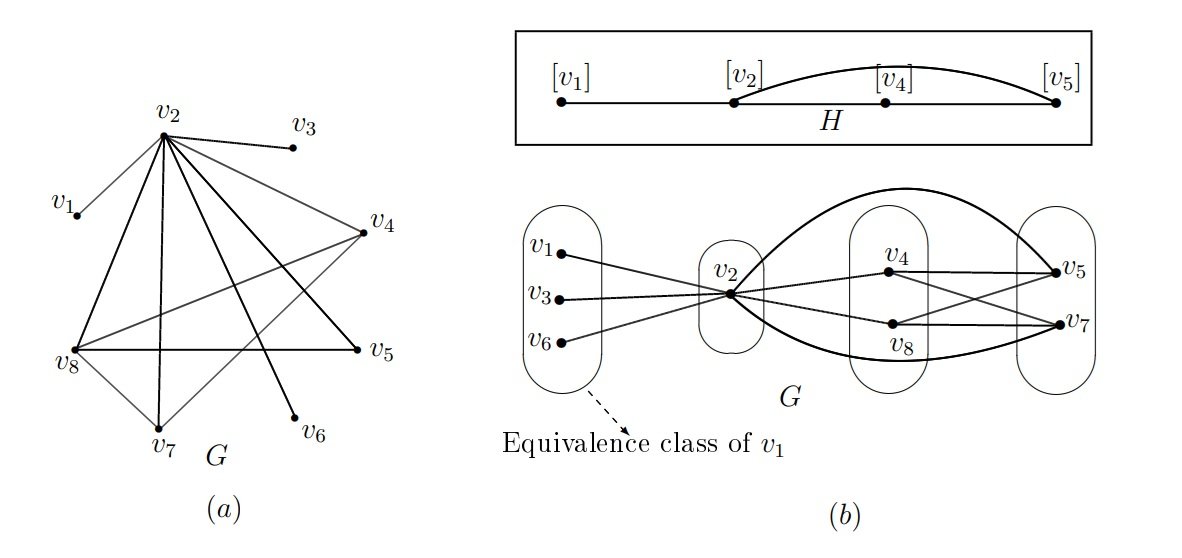
Let \(G =(V(G),E(G))\) be a graph. The relation \(\sim\) defined on \(V(G)\) by \(u\sim v\) if and only if \(N_G(u) = N_G(v)\) is an equivalence relation (see [4]). The equivalence class containing \(u\) is denoted by \([u]\). Let \(S =\{ [u_1], [u_2],\ldots,[u_k]\}\) be the set of all equivalence classes. The reduced graph \(H\) of \(G\) is the graph with \(V(H)= S\) and two vertices \([u_i]\) and \([u_j]\) are adjacent in \(H\) if and only if \(u_i\) and \(u_j\) are adjacent in \(G\). Clearly, \(H\) is isomorphic to the induced subgraph \(G[\{u_1,u_2,\ldots,u_k\}]\) of \(G\) and each \([u_i]\) is an independent set in \(G\). Hence, the induced subgraph \(G_i = G\big[ [u_i ]\big]\) is \(\overline{K_{n_i}}\) where \(n_i = |[u_i]|\). Also, \(G\) is isomorphic to the \(H\)-join \(H[G_1,G_2,\ldots,G_k]\).
Example 3.1. For the graph \(G\) given in Figure 1a, the reduced graph \(H\) and representation of \(G\) as \(H\)-join are given in Figure 1b.
Observation 3.2. Let \(A\) be an Abelian group with \(|A| \geq 3\). If \(G\) is a graph and if \(|[u]| \geq 2\) for every equivalence class \([u]\) in \(G\), then \(0 \in gdms(G,A)\).
Proof. Using Lemma 1.7, we can label the vertices of each equivalence class with elements of \(A\) whose sum is zero. Hence \(0 \in gdms(G,A)\). ◻
Observation 3.3. Let \(A\) be an Abelian group with \(|A|\geq 2\). Let \(G = H[\overline{K_{n_1}},\overline{K_{n_2}}, \ldots,\overline{K_{n_k}}]\) where \(H\) be any graph of order \(k\) and \(|n_i| \geq 2\) for each \(i\). Then \(0 \in gdms(G,A)\).
Proof. Since the reduced graph of \(G\) is \(H\) with \(V(\overline{K_{n_i}})\) as equivalence classes, the result follows from the Observation 3.2. ◻
Sabeel et al. [7] proved that any graph \(G\) is an induced subgraph of an \(A\)-vertex magic graph, where \(A\) is a finite Abelian group. The following theorem is a generalization of the above result.
Theorem 3.4. Any graph can be embedded as an induced subgraph of a group vertex magic graph.
Proof. Let \(G\) be any graph of order \(n\) and let \(A\) be an Abelian group. Let \(H\) be the reduced graph of \(G\). Let \(H'\) be the graph obtained from \(H\) by adding a new vertex \(x_i\) to each equivalence class \([u_i]\) where \(|[u_i]|\) is odd and joining \(x_i\) to all the vertices in \(N_G(u_i)\). Clearly, \(H'\) is an Eulerian graph. It follows from Lemma 2.4 and Observation 3.2 that \(H'\) is \(A\)-vertex magic and \(G\) is an induced subgraph of \(H'\). ◻
It has been proved in [2] that if the reduced graph \(H\) of \(G\) is \(A\)-vertex magic where \(|A| \geq 3\), then \(G\) is \(A\)-vertex magic.
Lemma 3.5. Let \(H\) be the reduced graph of \(G\). Then \(gdms(H,A) \subseteq gdms(G,A)\).
Proof. Let \(b \in gdms(H,A)\) and let \(V(H) = \{[u_1],[u_2],\ldots,[u_k]\}\). Let us assume that \(l\) is an \(A\)-vertex magic labeling of \(H\) with magic constant \(b\) and \(l([u_i])= a_i\), where \(a_i \in A \setminus \{0\}\), for \(i = 1,\ldots,k\). Let \(u_{ij} \in [u_i]\) for \(1 \leq j \leq n_i\). Define \(l': V(G) \to A\setminus\{0\}\) as follows, If \(|[u_i]|\) is odd, then \[l'(u_{ij})= \begin{cases} \text{$a_i$} &\quad\text{if $j = 1$},\\ \text{$a$} &\quad\text{if $j>1$ and $j$ is odd},\\ \text{$-a$} &\quad\text{if $j$ is even,}\\ \end{cases}\] for some \(a \in A\setminus \{0\}\). If \(|[u_i]|\) is even, then define \[l'(u_{ij})= \begin{cases} \text{$a_i+a$} &\quad\text{if $j = 1$},\\ \text{$a$} &\quad\text{if $j>1$ and $j$ is odd},\\ \text{$-a$} &\quad\text{if $j$ is even,}\\ \end{cases}\]where \(a_i \neq -a\). Let \(v \in V(G)\). Then \(v \in [u_i]\), for some \(i\). By our definition of \(l'\), we see that \(w(v)=w([u_i])\), corresponding to the labeling \(l\) in \(H\). Hence \(w(v)=b\). Thus \(G\) is an \(A\)-vertex magic graph with magic constant \(b\) and we have \(gdms(H,A) \subseteq gdms(G,A)\). ◻
We now introduce the reduced group distance magic set(rgdms) of a graph \(G\) and prove that the gdms and rgdms of a graph \(G\) with respect to an abelian group \(A\) are the same when \(|A| \geq 3\).
Definition 3.6. Let \(G\) be a graph and let \(A\) be an Abelian group. Let \(H\) be the reduced graph of \(G\). We say that \(H\) is \(A'\)-vertex magic if there exists a labeling \(l:V(H)\to A\) such that \(0\) can also be used to label a vertex \([u]\in V(H)\) whenever \(|[u]|\geq 2\) and \(\displaystyle \sum\limits_{[u]\in N_H([v])} l([u]) = \mu\), for all \([v] \in V(H)\). The collection of all such \(\mu\) is called the reduced group distance magic set of the graph \(G\) with respect to the Abelian group \(A\) and is denoted by \(rgdms(G,A)\).
Proposition 3.7. Let \(G\) be any graph and let \(A\) be an Abelian group with \(|A| \geq 3\). Then \(gdms(G,A)= rgdms(G,A)\).
Proof. Let \(a \in gdms(G,A)\). Let \(l\) be an \(A\)-vertex magic labeling of \(G\) with magic constant \(a\). Then \(l' : V(H) \to A\) defined by \(l'([u])= \displaystyle \sum\limits_{v \in N_G(u)} l(v)\) is an \(A'\)-vertex magic labeling of \(H\) with magic constant \(a\). Hence \(a \in rgdms(G,A)\) and so \(gdms(G,A) \subseteq rgdms(G,A)\).
Now, let \(a \in rgdms(G,A)\). Let \(l'\) be an \(A'\)-vertex magic labeling of the reduced graph \(H\) with magic constant \(a\). We now define \(l : V(G) \to A \setminus \{0\}\) as follows. If \(|[v]| =1\), define \(l(v) = l'(v)\). If \(|[v]| = n_i \geq 2\), by Lemma 1.7, we can choose \(a_1,a_2,\ldots,a_{n_i} \in A\setminus \{0\}\) such that \(a_1 + a_2 + \ldots + a_{n_i} = a\). Now label the elements of \([v]\) with \(a_1,a_2,\ldots,a_{n_i}\). It can be easily verified that \(w(v) = a\) for all \(v \in V(G)\) and hence \(a \in gdms(G,A)\). Thus \(rgdms(G,A) \subseteq gdms(G,A)\) and so \(gdms(G,A) = rgdms(G,A)\). ◻
The above theorem provides a nice tool for finding \(gdms(G,A)\) by transforming \(G\) to its reduced graph. We illustrate this with an example.
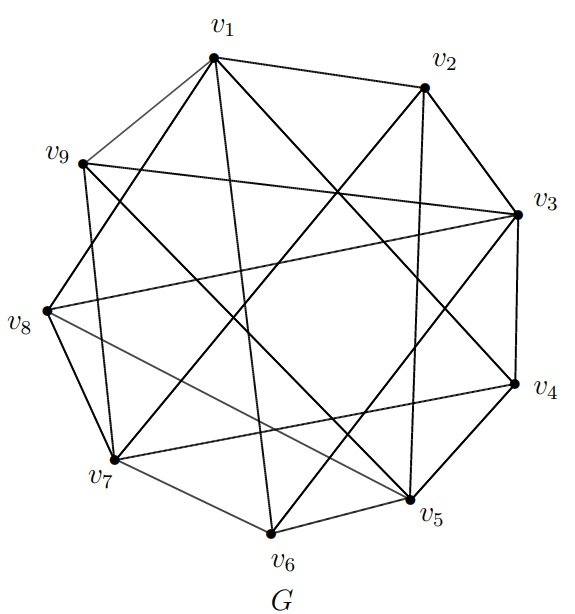
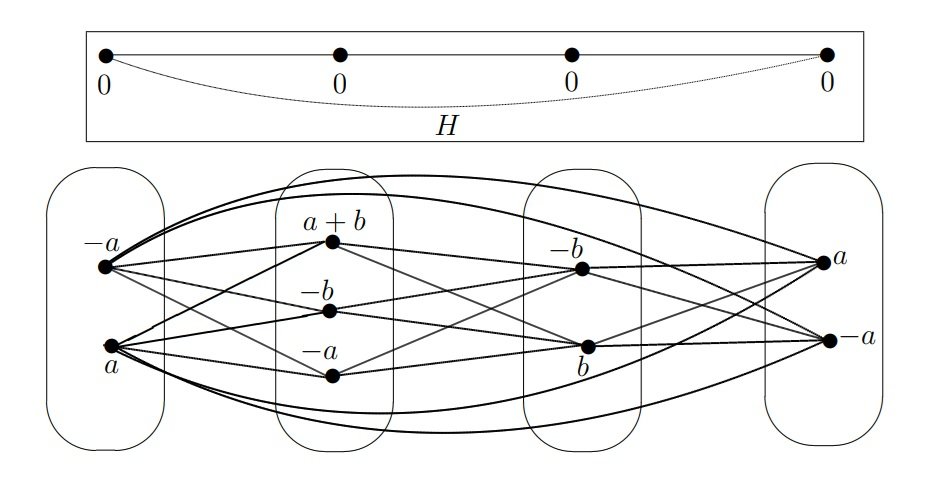
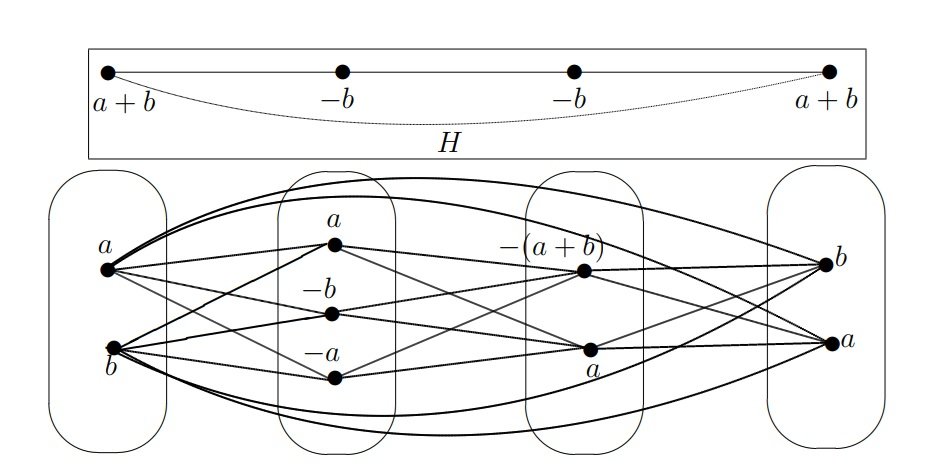
Example 3.8. For the graph \(G\) given in Figure 2, the reduced graph \(H\) is \(C_4\). Let \(A\) be any Abelian group with \(|A| \geq 3\). Figure 3 gives an \(A'\)-vertex magic labeling of \(C_4\) with magic constant \(0\). Figure 4 gives an \(A'\)-vertex magic labeling of \(C_4\) with magic constant \(a\) for any \(a \in A \setminus \{0\}\). Hence by Proposition 3.7, \(gdms(G) = rgdms(G) =A\).
Theorem 3.9. Let \(A\) be an Abelian group with \(|A| \geq 3\). Let \(P_k= (u_1,u_2,\ldots,u_k)\) be the path on \(k\) vertices where \(k\) is even and let \(G = P_k[\overline{K_{n_1}},\overline{K_{n_2}}, \ldots,\overline{K_{n_k}}]\). Then \(0 \in gdms(G,A)\) if and only if \(n_i \geq 2\) for each \(i\), \(1 \leq i \leq k\).
Proof. Let \(0 \in gdms(G,A)\). Let \(l\) be an \(A\)-vertex magic labeling of \(G\) with magic constant \(0\). Clearly, \([u_i] = V(\overline{K_{n_i}})\), \(1 \leq i \leq k\) are the equivalence classes of \(G\). Let \(v \in [u_k]\). Since \(N_G(v) = [u_{k-1}]\), we have \(w(v) = \displaystyle\sum\limits_{u \in [u_{k-1}]}l(u) = 0\). Hence \(|[u_{k-1}]| = n_{k-1} \geq 2\).
Now let \(v \in [u_{k-2}]\). Since \(w(v) = 0\), \(N_G(v) = [u_{k-1}] \cup [u_{k-3}]\), \(\displaystyle \sum\limits_{u \in [u_{k-1}]} l(u) =0\), and \(w(v) = 0\), it follows that \(\displaystyle\sum\limits_{u \in [u_{k-3}]} l(u) = 0\). Hence \(n_{k-1} = |[u_{k-2}]| \geq 2\). Continuing this argument, we get \(n_i \geq 2\) if \(i\) is odd. Now let \(v \in [u_1]\). Since \(N_G(v) = [u_2]\), it follows that \(n_2 \geq 2\) and proceeding as before we get \(n_i \geq 2\) if \(i\) is even. The converse follows from Observation 3.3. ◻
Theorem 3.10. Let \(A\) be an Abelian group with \(|A| \geq 3\). Let \(P_k=(u_1,u_2,\ldots,u_k)\) be the path on \(k\) vertices, where \(k\) is odd, and let \(G = P_k[\overline{K_{n_1}},\overline{K_{n_2}}, \ldots,\overline{K_{n_k}}]\). Then \(0 \in gdms(G,A)\) if and only if \(n_i >1\) if \(i\) is even and \(1 \leq i \leq k\).
Proof. If \(0 \in gdms(G,A)\), then proceeding as in Theorem \(\ref{BP4011}\), we get \(n_i \geq 2\) if \(i\) is even. Conversely, suppose \(n_i \geq 2\) if \(i\) is even. The reduced graph of \(G\) is \(P_k\). Let \(l : V(P_k) \to A\) defined by \[l(u_i) = \begin{cases} \text{$a$} &\quad\text{if $i \equiv 1 (\textrm{mod}\ 4)$},\\ \text{$-a$} &\quad\text{if $i \equiv 3 (\textrm{mod}\ 4)$},\\ \text{$0$} &\quad\text{otherwise}. \end{cases}\]
Clearly, \(l\) is an \(A'\)-vertex magic labeling of \(P_k\) with magic constant \(0\). Hence \(0 \in rgdms(G,A) = gdms(G,A)\). ◻
Theorem 3.11. Let \(A\) be an Abelian group with \(|A| \geq 3\). Let \(G\) be any graph with equivalence classes \([v_1], [v_2], \ldots,[v_k]\), where \(|[v_i]| \geq 2\) for each \(i\). Let \(G'\) be the graph obtained from \(G\) by adding \(r_i\) vertices to \([v_i]\), where \(r_i > 0\) for at least one \(i\) and joining these \(r_i\) vertices to all vertices in \(N_G(v_i)\). Then \(gdms(G,A) = gdms(G',A)\).
Proof. Since \(G\) and \(G'\) have the same reduced graph, \(rgdms(G) = rgdms(G')\) and the result follows from Proposition 3.7. ◻
Theorem 3.12. Let \(\{G_1,G_2,\ldots,G_n\}\) be a collection of graphs. If \(0 \in gdms(G_k,A)\), for some \(k\), then \(0 \in gdms(\otimes_{k=1}^n G_k, A)\).
Proof. Without loss of generality, we assume that \(0 \in gdms(G_1,A)\). Let \(l\) be an \(A\)-vertex magic labeling of \(G_1\) with magic constant \(0\). Let \(v_i \in V(G_i)\), where \(i = 1,2,\ldots,n\). Let \(N_{G_i}(v_i)=\{u_{i_1},u_{i_2}\ldots,u_{i_{n_i}}\}\). Then \(N_{\otimes_{k=1}^n G_k}((v_1,v_2,\ldots,v_n))= \\ \{(u_{1_{j_1}},u_{2_{j_2}},\ldots, u_{k_{j_k}},\ldots, u_{n_{j_n}}) : j_k= 1,2,\ldots,n_{k} \text{ and } k = 1,2,\ldots,n \}\). Now, define \(l' : V(\otimes_{k=1}^n G_k) \to A\setminus\{0\}\) by \(l'((v_1,v_2,\ldots,v_n))=l(v_1)\). Then \[\begin{aligned} w((v_1,v_2,\ldots,v_n))&= \sum\limits_{j_1=1}^{n_1}\cdots \sum\limits_{j_n=1}^{n_n} l'((u_{1_{j_1}},u_{2_{j_2}},\ldots, u_{n_{j_n}}))\\ &= n_2\cdots n_{i} \cdots n_n\sum\limits_{j_1=1}^{n_1}l(v_{j_i}) \\ &= 0. \end{aligned}\]
Since \((v_1,v_2,\ldots,v_n)\) is arbitrary, \(w(v)= 0\), for all \(v \in V(\otimes_{i=1}^n G_i)\). ◻
Definition 3.13. [8] Let \(H\) be a graph of order \(k\) and let \(V(H) = \{v_1,v_2,\ldots,v_k\}\). Let \(\{G_1,G_2,\ldots,G_k\}\) be a collection of \(k\) graphs. Then the graph obtained by joining \(v_i\) to all the vertices in \(G_i\), where \(1 \leq i \leq k\), is called the generalized corona and is denoted by \(H \tilde{\circ} \wedge_{i=1}^{k} G_i\). If \(G_i \cong G\), for each \(i\), then the resulting graph is called the corona of \(H\) and \(G\) and is denoted by \(H \circ G\).
Theorem 3.14. Let \(A\) be an Abelian group with \(|A| \geq 3\). Let \(G = H \tilde{\circ} \wedge_{i=1}^{k} K_{n_i}^c\) where \(n_i \geq 2\), for all \(i\). Then \(gdms(G,A)= A\setminus \{0\}\).
Proof. Let \(V(H) = \{v_1,v_2,\ldots,v_k\}\) and \(V(\overline{K_{n_i}}) = \{v_{i1},v_{i2},\ldots,v_{in_i}\}\). Since \(\delta(G) = 1\), it follows Lemma 2.1, \(0 \not \in gdms(G,A)\). Now, let \(a \in A \setminus \{0\}\). Define \(l : V(G) \to A\setminus \{0\}\) as follows. \(l(v_i)=a\) for all \(i\), \(1 \leq i \leq k\). By Lemma 1.7, we label the vertices \(v_{ij}\) satisfying the condition \(\sum\limits_{j=1}^{n_i}l(v_{ij})= (1 – deg_H(v_i))a\). Clearly, \(l\) is an \(A\)-vertex magic labeling of \(G\) with magic constant \(a\). Hence \(gdms(G,A) = A\setminus\{0\}\). ◻
In this paper, we have introduced the concept of group distance magic set of a graph. Furthermore, we have constructed an infinite family of graphs with gdms containing zero. Additionally, we have established sufficient conditions for the presence of \(0\) in \(gdms(G,A)\), specifically in certain product graphs. We propose the following problems for further investigation.
1) Identify family of graphs whose gdms forms a subgroup.
2) Establish necessary conditions for a graph’s group distance magic set to be a subgroup.
3) Characterize graph \(G\) for which \(gdms(G,A) = A\), where \(|A| \geq 3.\)
The authors would like to thank the Department of Science and Technology, Government of India, for providing support to carry out this work under the scheme FIST (SR/FST/MS- I/2023/131).The work of S. Balamoorthy is supported by a Junior Research Fellowship from CSIR-UGC, India (UGC-Ref.No.:1085/(CSIR-UGC NET JUNE 2019)).