
In \(1930\) Szpilrajn [16] proved that any order relation on a set \(X\) can be extended to a linear order on \(X\). It also follows that any order relation is the intersection of its linear extensions. In \(1941\) Dushnik and Miller [5] introduced the concept of the (order) dimension of poset \(P\) as the minimum number of linear extensions of \(P\) whose intersection is exactly \(P\). It is known that the problem of finding dimension of posets is NP-complete. In \(1955\) Hiraguchi [8] proved that the dimension of a poset does not exceed its width. Hiraguchi [8] also showed that the dimension of the poset \(P\) on \(n\) elements is \(\leq \frac{n}{2}\). Komm [12] showed that dimension of the poset consisting of all subsets of an \(n\) element set ordered by inclusion is \(n\). For more results on dimension of posets, see [7, 9, 11, 19]. In this paper, we will restrict ourselves to the finite posets and lattices.
In \(2002\) Thakare, Pawar, and Waphare [17] introduced the concept of an adjunct sum of two lattices. In \(2020\) Bhavale and Waphare [4] introduced the concepts of a nullity of a poset, a basic block associated to a poset, and a fundamental basic block associated to a dismantlable lattice. Recently, Bhavale [3] introduced the concept of a complete fundamental basic block on \(r\) comparable reducible elements.
In Section 2, we prove that the dimension of a complete fundamental basic block on \(r\) comparable reducible elements is at the most three. Consequently, in Section 4, we prove that the dimension of an RC-lattice is at the most three. In Section 3, we obtain the dimension of an adjunct sum of two lattices in terms of the dimensions of the individual lattices. Moreover, we obtain a bound on the dimension of a dismantlable lattice in terms of its nullity. In Section 4, we prove that the dimension of an RC-lattice is the same as the dimension of the basic block (and also the fundamental basic block) associated to that lattice. We also obtain a characterization, namely, an RC-lattice is of dimension three if and only if it is non planar.
A binary relation \(\leq\) on a set \(P\) is called a partial order if it is reflexive, antisymmetric and transitive on it. A partially ordered set (or poset) consists of some ground set \(P\) and a partial order \(\leq\) defined on \(P\). An element \(c\in P\) is a lower bound (an upper bound) of \(a,b\in P\) if \(c\leq a, c\leq b (a\leq c, b\leq c)\). The meet of \(a,b \in P\), is defined as the greatest lower bound of \(a\) and \(b\). The join of \(a,b\in P\), is defined as the least upper bound of \(a\) and \(b\). A poset \(L\) is a lattice if meet and join of \(a\) and \(b\) exist in \(L\), \(\forall ~ a,b\in L\). A pair of elements \(x, y \in P\) are comparable if either \(x \leq y\) or \(y \leq x\). A pair of elements not comparable in \(P\) are called incomparable. If \(x\) is incomparable to \(y\) in \(P\), we denote it by \(x \parallel y\). A partial order \(\leq\) on \(P\) is a total order or linear order or chain if for all \(a, b \in P\), either \(a \leq b\) or \(b \leq a\). A partial order \(\leq\) on \(P\) is an antichain if for all \(a, b \in P\), \(a \parallel b\). For \(a \leq b\) in \(P\), the interval \((a, b) = \{x \in P ~|~ a < x < b \}\). For \(a \in P\), let \((a] = \{x \in P ~|~ x \leq a\}\), and \(D(a) = \{x \in P | x < a\}\). Note that \(D(a) \cup \{a\} = (a]\). Dually one can define \([a)\) and \(U(a)\). Let \(I(a) = \{b \in P ~|~ a \parallel b \}\). An element \(b\) in \(P\) covers an element \(a\) in \(P\) if \(a<b\), and there is no element \(c\) in \(P\) such that \(a<c<b\). Denote this fact by \(a\prec b\), and say that the pair \(<a, b>\) is a \(covering\) or an \(edge\). If \(a \prec b\) then \(a\) is called a lower cover of \(b\), and \(b\) is called an upper cover of \(a\). An element of a poset \(P\) is called doubly irreducible if it has at most one lower cover and at most one upper cover in \(P\). Let \(Irr(P)\) denote the set of all doubly irreducible elements in the poset \(P\). Let \(Red(P) = P \setminus Irr(P)\). The set of all coverings in \(P\) is denoted by \(E(P)\). The graph on a poset \(P\) with edges as covering relations is called the cover graph and is denoted by \(C(P)\). The nullity of a graph \(G\) is given by \(m-n+c\), where \(m\) is the number of edges in \(G\), \(n\) is the number of vertices in \(G\), and \(c\) is the number of connected components of \(G\). Bhavale and Waphare [4] defined nullity of a poset \(P\), denoted by \(\eta(P)\), to be the nullity of its cover graph \(C(P)\). For an integer \(n \geq 2\), a crown is a partially ordered set on \(2n\) elements say, \(x_1, y_1, x_2, y_2, \ldots , x_n, y_n\) in which \(x_i\leq y_i\), \(y_i\geq x_{i+1}\), for \(i=1,2,\ldots,n-1\), and \(x_1\leq y_n\) are the only comparability relations.
A total order is a linear extension of a partial order \(\leq\) if \(\leq\) is a subset of it. A realizer of a poset \(P\) is a collection of linear extensions \(R = \{R_1, R_2, \ldots , R_t\}\) of a partial order \(\leq\) whose intersection is \(\leq\). That is, for any incomparable pair \(x, y \in P\), there are \(R_i, R_j \in R\) with \((x, y) \in R_i\) and \((y, x) \in R_j\), i.e., \(x \leq y\) in \(R_i\) and \(y \leq x\) in \(R_j\). The dimension of \(P\) is defined as the size of a smallest realizer of \(P\), and is denoted by \(Dim(P)\). It is clear that the dimension of a chain is one, and that of an antichain (on at least two elements) is two. The dimension of crown on \(2n\) elements is \(3\) (see [11]). For a linear extension \(E\) of a poset \(P\), and for a subposet \(Q\) of \(P\), let \(E(Q)\) denote a part of \(E\) containing a linear extension of \(Q\), called a partial linear extension of \(P\) (see [9]).
If \(M\) and \(N\) are two disjoint posets, the direct sum (see [15]), denoted by \(M \oplus N\), is defined by taking the following order relation on \(M\cup N:x\leq y\) if and only if \(x,y\in M\) and \(x\leq y\) in \(M\), or \(x,y\in N\) and \(x\leq y\) in \(N\), or \(x\in M,y\in N\).
Proposition 1.1. [14] If \(Q\) is a subposet of poset \(P\) then \(Dim(Q) \leq Dim(P)\).
Definition 1.2. [13] A finite lattice of order \(n\) is called dismantlable if there exists a chain \(L_{1} \subset L_{2} \subset \ldots\subset L_{n}(=L)\) of sublattices of \(L\) such that \(|L_{i}| = i\), for all \(i\).
Theorem 1.3. [10] A finite lattice is dismantlable if and only if it contains no crown.
The concept of adjunct operation of lattices, is introduced by Thakare, Pawar, and Waphare [17]. Suppose \(L_1\) and \(L_2\) are two disjoint lattices and \((a, b)\) is a pair of elements in \(L_1\) such that \(a<b\) and \(a\not\prec b\). Define the partial order \(\leq\) on \(L = L_1 \cup L_2\) with respect to the pair \((a,b)\) as follows: \(x \leq y\) in L if \(x,y \in L_1\) and \(x \leq y\) in \(L_1\), or \(x,y \in L_2\) and \(x \leq y\) in \(L_2\), or \(x \in L_1,\) \(y \in L_2\) and \(x \leq a\) in \(L_1\), or \(x \in L_2,\) \(y \in L_1\) and \(b \leq y\) in \(L_1\).
It is easy to see that \(L\) is a lattice containing \(L_1\) and \(L_2\) as sublattices. The procedure for obtaining \(L\) in this way is called adjunct operation (or adjunct sum) of \(L_1\) with \(L_2\). We call the pair \((a,b)\) as an adjunct pair, and \(L\) as an adjunct of \(L_1\) with \(L_2\) with respect to the adjunct pair \(\alpha = (a,b)\), and write \(L = L_1 ]^b_a L_2\) or \(L = L_1 ]_{\alpha} L_2\). A diagram of \(L\) is obtained by placing a diagram of \(L_1\) and a diagram of \(L_2\) side by side in such a way that the largest element \(1\) of \(L_2\) is at a lower position than \(b\) and the least element \(0\) of \(L_2\) is at a higher position than \(a\), and then by adding the coverings \(<1,b>\) and \(<a,0>\). This clearly gives \(|E(L)|=|E(L_1)|+|E(L_2)|+2\). A lattice \(L\) is called an adjunct of lattices \(L_0, L_1, \ldots, L_k\) if it is of the form \(L = L_0 ]^{b_1}_{a_1} L_1 \cdots ]^{b_{k}}_{a_{k}} L_k\).
Theorem 1.4. [17] A finite lattice is dismantlable if and only if it is an adjunct of chains.
Theorem 1.5. [4] A dismantlable lattice \(L\) containing \(n\) elements is of nullity \(l\) if and only if \(L\) is an adjunct of \(l+1\) chains.
Thakare, Pawar, and Waphare [17] defined a block as a finite lattice in which the largest element is join-reducible and the least element is meet-reducible.
Definition 1.6. [4] A poset \(P\) is a basic block if it is one element or \(Irr(P) = \emptyset\) or removal of any doubly irreducible element reduces nullity by one.
Definition 1.7. [4] A block \(B\) is a basic block associated to a poset \(P\) if \(B\) is obtained from the basic retract associated to \(P\) by successive removal of all the pendant vertices.
Theorem 1.8. [2] Let \(B\) be an RC-lattice on \(n\) elements. Then \(B\) is a basic block having nullity \(k\) if and only if \(B = C_0 ]^{b_1}_{a_1} C_1 ]^{b_2}_{a_2} C_2 \cdots ]^{b_{k}}_{a_{k}} C_{k}\) with \(a_i, b_i \in C_0\), satisfying (i) \(|C_i| = 1\), for all \(i, \; 1 \leq i \leq k\), (ii) \(n = |C_0| + k\), (iii) \(Irr(B) = k+m\), where \(m\) is the number of distinct adjunct pairs \((a_i, b_i)\) such that the interval \((a_i, b_i) \subseteq Irr(B)\), and (iv) \(|C_0| = |Red(B)| + m\). Further, if \(|Red(B)|=r\) then \(n=r+m+k\).
From Theorem 1.8, it is clear that if \(B\) is the basic block of nullity \(k\) then \(B = C ]_{a_1}^{b_1} \{c_1\} \cdots ]_{a_k}^{b_k} \{c_k\}\), where \(C\) is a maximal chain containing all the reducible elements.
Definition 1.9. [4] A dismantlable lattice \(B\) is said to be a fundamental basic block if it is a basic block and all the adjunct pairs in an adjunct representation of \(B\) are distinct.
Definition 1.10. [4] Let \(L\) be a dismantlable lattice. Let \(B\) be a basic block associated to \(L\). If \(B\) itself is a fundamental basic block then we say that \(B\) is a fundamental basic block associated to \(L\); otherwise, let \((a,b)\) be an adjunct pair in an adjunct representation of \(B\). If the interval \((a,b) \subseteq Irr(B)\) then remove all but two non-trivial ears associated to \((a,b)\) in \(B\); otherwise, remove all but one non-trivial ear associated to \((a,b)\) in \(B\). Perform the operation of removal of non-trivial ears associated to \((a,b)\) for each adjunct pair \((a,b)\) in an adjunct representation of \(B\). The resultant sublattice of \(B\) is called a fundamental basic block associated to \(L\).
Theorem 1.11. [2] Let \(B\) be a basic block associated to a poset \(P\). Then \(Red(B) = Red(P)\) and \(\eta(B) = \eta(P)\).
Using Definition 1.10 and by Theorem 1.11, we have the following result.
Corollary 1.12. Let \(F\) and \(B\) be the fundamental basic block and the basic block associated to a lattice \(L\) respectively. Then \(Red(F) = Red(B)= Red(L)\) and \(\eta(F) \leq \eta(B)\).
For the other definitions, notation, and terminology, see [4, 6, 18, 20].
Recently, Bhavale [3] introduced the concept of a complete fundamental basic block on \(r\) reducible elements which are all comparable, denoted by \(CF(r)\), and it is defined as the fundamental basic block on \(r\) reducible elements, having nullity \(\binom{r}{2}\).
In Subsection 2.2 we find the dimension of \(CF(r)\). For that purpose, here we find that the recursive definition of \(CF(r)\) is more helpful. Hence we define \(CF(r)\) recursively in the following, and we use the notation \(L_r\) instead of \(CF(r)\) hereafter. So suppose \(L_1\) consists of a single element, say \(a_1\). Now in the following, we give a recursive definition of \(L_r\) for \(r \geq 2\).
Definition 2.1. For \(r \geq 2\), define \(L_r = (L_{r-1} \oplus \{x_{r-1}\} \oplus \{b_{\binom{r}{2}}\}) ]_{\alpha_{{\binom{r}{2}} – (r-2)}} \{c_{{\binom{r}{2}} – (r-2)}\} ]_{\alpha_{{\binom{r}{2}} – (r-2) + 1}}\\ \{c_{{\binom{r}{2}} – (r-2) + 1}\} \cdots ]_{\alpha_{\binom{r}{2}}} \{c_{\binom{r}{2}}\}\) where \(\alpha_i = (a_i, b_i)\) for all \(i, \; 1 \leq i \leq {\binom{r}{2}}\), \(a_{{\binom{r-1}{2}} + 1} = a_{{\binom{r}{2}} – (r-2)} \prec x_1 \prec a_{{\binom{r}{2}} – (r-2) +1} \prec x_2 \prec \cdots \prec a_{{\binom{r}{2}} – 1} \prec x_{r-2} \prec a_{\binom{r}{2}}\), and \(b_{{\binom{r}{2}} – (r-2)} = b_{{\binom{r}{2}} – (r-2) +1} = \cdots = b_{\binom{r}{2}}\).
Note that \(L_2\) is nothing but a diamond \(M_2 = \{0=a_1, x_1, c_1, b_1=1\}\) with \(x_1 \parallel c_1\), and the following figure (see Figure 1) shows \(L_r\) for \(3 \leq r \leq 6\).
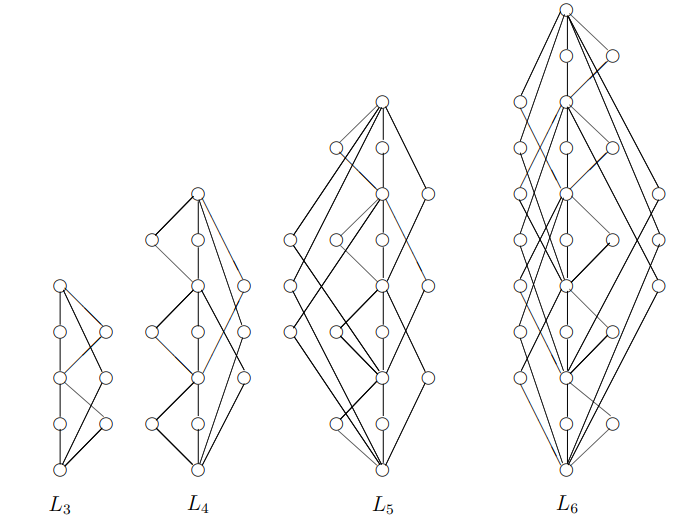
Observe that for each \(i \geq 2\), \(\eta(L_i) = \eta(L_{i-1}) + (i-1)\), since by Theorem 1.5, the nullity of a fundamental basic block is same as one less than the actual number of chains, i.e., the number of adjunct pairs, in its adjunct representation. Therefore \(\eta(L_r) = 1 + 2 + 3 + \cdots + (r-1) = {\binom{r}{2}}\). Further, \(a_1 \leq a_2 \leq \cdots \leq a_{\binom{r}{2}}\), and for \(i < j\), \(b_i \leq b_j\) whenever \(a_i=a_j\).
For \(r \geq 3\), let \(A_1 = a_1 = a_2 = a_4 = a_7 = \cdots = a_{{\binom{r-2}{2}} + 1} = a_{{\binom{r-1}{2}} + 1}\), for \(2 \leq k \leq r-1\), let \(A_k = a_{\binom{k+1}{2}} = a_{{\binom{k+1}{2}} + (k)} = a_{{\binom{k+1}{2}} + (k) + (k+1)} = \cdots = a_{{\binom{r-1}{2}} + k} = b_{{\binom{k}{2}} – (k-2)} = b_{{\binom{k}{2}} – (k-2) + 1} = \cdots = b_{{\binom{k}{2}} – 1} = b_{\binom{k}{2}}\), and let \(A_r = b_{{\binom{r-1}{2}} + 1} = b_{{\binom{r-1}{2}} + 2} = \cdots = b_{{\binom{r-1}{2}} + (r-1)}\).
Note that \({\binom{r-1}{2}} + (r-1) = {\binom{r}{2}}\) and \({\binom{k+1}{2}} + (k) + (k+1) + \cdots + (k+(r-k-2)) = {\binom{r-1}{2}} + k\). Also for \(1 \leq k \leq r\), there are \((r-k) \; a_i's\) which are same as that of \(A_k\), and there are \((k-1) \; b_i's\) which are same as that of \(A_k\). For \(r \geq 2\), let \(C : A_1 \prec x_1 \prec A_2 \prec x_2 \prec A_3 \cdots \prec x_{r-2} \prec A_{r-1} \prec x_{r-1} \prec A_r\). Then \(C\) is a maximal chain in \(L_r\) containing all the \(r\) reducible elements \(A_1, A_2, \ldots , A_r\). Thus it follows that \(L_r\) is the fundamental basic block containing \(r\) reducible elements which are all comparable. Also the fundamental basic block containing \(r\) comparable reducible elements with the largest nullity is \(L_r\). It can be observed that for all \(1 \leq i \leq r\), \((A_i] \cong L_i\) and \([A_i) \cong L_{r-i+1}\). Also \(|L_r| = \frac{r^2+3r-2}{2}\), since \(|L_r| = |C| + {\binom{r}{2}} = (2r-1) + {\binom{r}{2}}\). Also for \(\binom{r-1}{2} + 1 = \binom{r}{2} – (r-2) \leq i \leq \binom{r}{2}\), \(a_i \prec c_i \prec b_i\). Therefore \(A_{i+1} \prec c_{\binom{k}{2}+1+i} \prec A_{k+1}\) for all \(i\), \(0 \leq i \leq k-1\).
In order to obtain a bound for the dimension of an RC-lattice, firstly we obtain the dimension of \(L_r\). For that purpose, we take the help of the following result due to Baker et al. [1].
Theorem 2.2. [1] The dimension of a lattice is at most two if and only if it is planar.
Therefore by Theorem 2.2, it is clear that \(Dim(L_1) = 1\), and for \(r = 2, 3, 4, \; Dim(L_r) = 2\), since they are all planar lattices.
Theorem 2.3. For \(r \geq 5\), \(Dim(L_r) = 3\).
Proof. Let \(r \geq 5\). Clearly \(L_5\) is non planar (see Figure I). Therefore by Definition 2.1, \(L_r\) is non planar for all \(r \geq 5\). Hence \(Dim(L_r) \geq 3\). Now for \(r \geq 5\), let \(R_1^r\) be the linear extension \(A_1 \prec c_{{\binom{r-1}{2}} +1} \prec \cdots \prec c_4 \prec c_2 \prec c_1 \prec x_1 \prec A_2 \prec c_{{\binom{r-1}{2}} +2} \prec \cdots \prec c_8 \prec c_5 \prec c_3 \prec x_2 \prec A_3 \prec c_{{\binom{r-1}{2}} +3} \prec \cdots \prec c_{13} \prec c_9 \prec c_6 \prec x_3 \prec \cdots \prec A_i \prec c_{{\binom{r-1}{2}} +i} \prec \cdots \prec c_{{\binom{i+1}{2}} + (i) + (i+1)} \prec c_{{\binom{i+1}{2}} + (i)} \prec c_{{\binom{i+1}{2}}} \prec x_i \prec \cdots \prec A_{r-1} \prec c_{{\binom{r-1}{2}} + (r-1)} \prec x_{r-1} \prec A_r\), \(R_2^r\) be the linear extension \(A_1 \prec x_1 \prec c_1 \prec A_2 \prec x_2 \prec c_3 \prec c_2 \prec A_3 \prec x_3 \prec c_6 \prec c_5 \prec c_4 \prec \cdots \prec A_{r-1} \prec x_{r-1} \prec c_{{\binom{r}{2}}} \prec c_{{\binom{r}{2}} – 1} \prec c_{{\binom{r}{2}} – 2} \prec \cdots \prec c_{{\binom{r}{2}} – (r-2)} \prec A_r\), and \(R_3^r\) be the linear extension \(A_1 \prec c_{{\binom{r}{2}} – (r-2)} \prec x_1 \prec c_1 \prec A_2 \prec c_{{\binom{r}{2}} – (r-2) + 1} \prec x_2 \prec c_3 \prec c_2 \prec A_3 \prec c_{{\binom{r}{2}} – (r-2) + 2} \prec x_3 \prec c_6 \prec c_5 \prec c_4 \prec \cdots \prec A_{r-2} \prec c_{{\binom{r}{2}} – (r-2) + (r-3)} \prec x_{r-2} \prec c_{{\binom{r-1}{2}}} \prec c_{{\binom{r-1}{2}} – 1} \prec c_{{\binom{r-1}{2}} – 2} \prec \cdots \prec c_{{\binom{r-1}{2}} – (r-3)} \prec A_{r-1} \prec c_{{\binom{r-1}{2}} + (r-1)} \prec x_{r-1} \prec A_r\). Clearly \(R_1^r, R_2^r, R_3^r\) are linear extensions of \(L_r\) for all \(r \geq 5\).
Claim : For \(r \geq 5\), \(\{ R_1^r, R_2^r, R_3^r \}\) is a realizer of \(L_r\).
Using the method of induction on \(r\), we have for \(r = 5\), \(R_1^5 : A_1 \prec c_7 \prec c_4 \prec c_2 \prec c_1 \prec x_1 \prec A_2 \prec c_8 \prec c_5 \prec c_3 \prec x_2 \prec A_3 \prec c_9 \prec c_6 \prec x_3 \prec A_4 \prec c_{10} \prec x_4 \prec A_5\), \(R_2^5 : A_1 \prec x_1 \prec c_1 \prec A_2 \prec x_2 \prec c_3 \prec c_2 \prec A_3 \prec x_3 \prec c_6 \prec c_5 \prec c_4 \prec A_4 \prec x_4 \prec c_{10} \prec c_9 \prec c_8 \prec c_7 \prec A_5\), and \(R_3^5 : A_1 \prec c_7 \prec x_1 \prec c_1 \prec A_2 \prec c_8 \prec x_2 \prec c_3 \prec c_2 \prec A_3 \prec c_9 \prec x_3 \prec c_6 \prec c_5 \prec c_4 \prec A_4 \prec c_{10} \prec x_4 \prec A_5\). It can be easily checked that \(\{ R_1^5, R_2^5, R_3^5 \}\) is a realizer of \(L_5\). Now assume that \(\{ R_1^k, R_2^k, R_3^k \}\) is a realizer of \(L_k\) for some \(k \geq 5\). We prove that \(\{ R_1^{k+1}, R_2^{k+1}, R_3^{k+1} \}\) is a realizer of \(L_{k+1}\). Let \(A = \{x_k, A_{k+1}, c_{\binom{k+1}{2}}\}\) and \(B = \{c_{{\binom{k}{2}} + 1}, c_{{\binom{k}{2}} + 2}, \ldots , c_{{\binom{k}{2}} + k}\}\). Let \(C_i = (A_{i+1}, A_{k+1}) \setminus \{c_{{\binom{k}{2}} + 1 + i} \}\) for all \(i, ~ 0 \leq i \leq k-1\). Let \(D_i = L_{k+1} \setminus ((A_{i+1}] \cup U(A_{i+1}))\) for all \(i, ~ 1 \leq i \leq k-1\). Now for \(k \geq 5\), observe that
(i) \(x \leq y\) in \(L_{k+1}\) if and only if \(x, y \in L_k\) with \(x \leq y\), or \(x \in L_k\) and \(y \in A\), or \(x \in B \cup \{x_k\}\) and \(y = A_{k+1}\).
(ii) \(x \parallel y\) in \(L_{k+1}\) if and only if \(x, y \in L_k\) with \(x \parallel y\), or \(x, y \in B\), or \(x = c_{{\binom{k}{2}} + 1 + i} \in B\) and \(y \in C_i\) for all \(i, ~ 0 \leq i \leq k-1\), or \(x = c_{{\binom{k}{2}} + 1 + i} \in B\) and \(y \in D_i\) for all \(i, ~ 1 \leq i \leq k-1\).
Note that \(A_{i+1} \prec c_{\binom{k}{2}+1+i} \prec A_{k+1}\) for all \(i\), \(0 \leq i \leq k-1\), and \[\begin{aligned} D_1 =& \{ c_2, c_4, c_7, c_{11}, \ldots , c_{{\binom{k+1}{2}} – (k-1)} \}, \\ D_2 =& \{ c_4, c_5, c_7, c_8, c_{11}, c_{12}, \ldots , c_{{\binom{k+1}{2}} – (k-1)}, c_{{\binom{k+1}{2}} – (k-1) + 1}\},\\ D_3 =& \{ c_7, c_8, c_9, c_{11}, c_{12}, c_{13}, \ldots , c_{{\binom{k+1}{2}} – (k-1)}, c_{{\binom{k+1}{2}} – (k-1) + 1}, c_{{\binom{k+1}{2}} – (k-1) + 2}\},\\ &\qquad \vdots \\ D_{k-1} =& \{c_{{\binom{k+1}{2}} – (k-1)}, c_{{\binom{k+1}{2}} – (k-1) + 1}, \ldots , c_{{\binom{k+1}{2}} – (k-1) + (k-2)}\}. \end{aligned}\]
It is clear from Definition 2.1 that the set \(L_{k+1} \setminus (A \cup B) = L_k\). Now the linear extensions \(R_1^{k+1}, R_2^{k+1}, R_3^{k+1}\) restricted to \(L_k\) are respectively the linear extensions \(R_1^k, R_2^k, R_3^k\). Therefore by induction hypothesis, it is sufficient to take the care of all comparabilities and all incomparabilities of the elements in the sets \(A\) and \(B\) in \(L_{k+1}\). By taking the care of all comparabilities means, \(x \leq y\) in \(L_{k+1}\) if and only if \(x \leq y\) in each \(R_i^{k+1}\) for \(i=1,2,3\). Similarly, by taking the care of all incomparabilities means, \(x \parallel y\) in \(L_{k+1}\) if and only if \(x \leq y\) in \(R_i^{k+1}\) and \(y \leq x\) in \(R_i^{k+1}\) for \(i \neq j\).
Now the care of both the observations mentioned above is taken by all the linear extensions \(R_1^{k+1}\), \(R_2^{k+1}\), and \(R_3^{k+1}\). Hence \(\{R_1^{k+1}, R_2^{k+1}, R_3^{k+1}\}\) is a realizer of \(L_{k+1}\). Thus by mathematical induction, \(Dim(L_r) \leq 3\) for all \(r \geq 5\). Hence \(Dim(L_r) = 3\) for all \(r \geq 5\). ◻
As \(Dim(L_1) = 1\) and \(Dim(L_r) = 2\) for \(r = 2, 3, 4\), by Theorem 2.3, we have the following result.
Theorem 2.4. For \(r \geq 1\), \(Dim(L_r) \leq 3\).
The following result follows from Proposition 1.1, which gives a lower bound for the dimension of adjunct sum of two lattices.
Proposition 3.1. Let \(L_1, L_2\) be the lattices of dimension \(m, n\) respectively. Let \(L = L_1 ]^{b}_{a} L_2\). Then \(Dim(L) \geq max \{m, n\}\).
In the following result, we obtain an upper bound for the dimension of adjunct sum of two lattices.
Proposition 3.2. Let \(L_1, L_2\) be the lattices of dimension \(m, n\) respectively. Let \(L = L_1 ]^{b}_{a} L_2\). Then \(Dim(L) \leq max \{2m, m + n\}\), that is, \(Dim(L) \leq m + max \{m, n\}\).
Proof. Let \(\{E_1, E_2, \ldots , E_m\}\) be a realizer of \(L_1\). Let \(\{F_1, F_2, \ldots , F_n\}\) be a realizer of \(L_2\). Then we have the following two cases.
Case 1. Suppose \(m \geq n\).
Consider the linear extensions \(E_i((a]) \oplus F_i \oplus E_i(U(a))\) for \(1 \leq i \leq m\), where \(F_i = F_1\) for \(n+1 \leq i \leq m\), and \(E_i(D(b)) \oplus F_1 \oplus E_i([b))\) for \(1 \leq i \leq m\). As these \(2m\) extensions forms a realizer of \(L\), \(Dim(L) \leq 2m\).
Case 2. Suppose \(m < n\).
Consider the linear extensions \(E_i((a]) \oplus F_i \oplus E_i(U(a))\) for \(1 \leq i \leq n\), where \(E_i = E_1\) for \(m+1 \leq i \leq n\), and \(E_i(D(b)) \oplus F_1 \oplus E_i([b))\) for \(1 \leq i \leq m\). As these \(n + m\) extensions forms a realizer of \(L\), \(Dim(L) \leq n + m\). Thus \(Dim(L) \leq max \{2m, m + n\}\). ◻
The more precise bound for the dimension of adjunct sum of two lattices is achieved in the following result.
Theorem 3.3. Let \(L_1, L_2\) be the lattices of dimension \(m, n\) respectively. Let \(L = L_1 ]^{b}_{a} L_2\). Then \(m \leq Dim(L) \leq m + 1\) for \(m \geq n\), and \(Dim(L) = n\) for \(m < n\).
Proof. Let \(\{E=E_1, E_2, \ldots , E_m\}\) be a realizer of \(L_1\). Let \(\{F_1, F_2, \ldots , F_n\}\) be a realizer of \(L_2\). Let \(I(L_2) = \{ x \in L_1 ~|~ x \parallel y\) in \(L, \; \forall \; y \in L_2 \}\). Define two extensions of \(L\) as follows. Let \(M_1 = E((a] \cup I(L_2)) \oplus F_1 \oplus E([b))\), and let \(M_2 = E((a]) \oplus F_2 \oplus E(I(L_2) \cup [b))\) (Take \(F_2 = F_1\), if \(n = 1\)). It is clear that \(x \leq y\) in \(L\) if and only if \(x \leq y\) in \(M_1\) and \(x \leq y\) in \(M_2\). Also, \(x \parallel y\) in \(L\) if and only if \(x, y \in L_1\) with \(x \parallel y\), or \(x, y \in L_2\) with \(x \parallel y\), or \(x \in L_1 \setminus ((a] \cap [b))\) and \(y \in L_2\). Now if \(x \in L_1 \setminus ((a] \cap [b))\) and \(y \in L_2\) then \(x \leq y\) in \(M_1\) and \(y \leq x\) in \(M_2\). Therefore, if \(m \geq n\) then the partial extensions \(M_1, M_2, E_2, E_3, \ldots , E_m\) forms a realizer of \(L\). Therefore \(Dim(L) \leq m + 1\). Also, if \(m < n\) then the partial extensions \(M_1, M_2, F_3, F_4, \ldots , F_n\) forms a realizer of \(L\). Therefore \(Dim(L) \leq n\). Thus the proof follows from Proposition 3.1. ◻
Using the above Theorem 3.3, we have the following result.
Corollary 3.4. Let \(L\) be a lattice with \(|L| \geq 3\), and let \(C\) be a chain. Let \(L' = L ]_{a}^{b} C\). Then \(Dim(L) = m\) implies that \(m \leq Dim(L') \leq m+1\).
Thus, the dimension of a lattice increases by at most one if a chain is added to it by means of an adjunct sum.
Corollary 3.5. If \(L = C_0 ]_{a_1}^{b_1} C_1 \cdots ]_{a_k}^{b_k} C_{k}\) where \(C_i\) are chains for \(0 \leq i \leq k\) then \(Dim(L) \leq k+1\).
Using Theorem 1.5, in the following result, we obtain a relation between the dimension and the nullity of a dismantlable lattice.
Corollary 3.6. If \(L\) is a dismantlable lattice of nullity \(k\) then \(Dim(L) \leq k+1\).
It is clear that the dimension of adjunct sum of two chains is two. In the following result, we prove that the dimension of a dismantlable lattice remains the same if a chain is added to it by means of an adjunct sum under the given restriction.
Theorem 3.7. Let \(L\) be a dismantlable lattice which is not a chain. If \(L' = L ]_a^b C\) where \(C\) is a chain and \((a, b)\) is an adjunct pair of \(L\) then \(Dim(L') = Dim(L)\).
Proof. Suppose \(Dim(L) = n\). As \(L\) is not a chain, \(n \geq 2\). As \(L\) is a sublattice of \(L'\), by Proposition 1.1, \(Dim(L') \geq n\). Now let \(\{R_1, R_2, \cdots , R_n\}\) be a realizer of \(L\). Let \(R'_1 = (R_1 \cap (a] ) \oplus C \oplus (R_1 \cap (U(a)))\), and for \(2 \leq i \leq n\), let \(R'_i = (R_i \cap (D(b)) ) \oplus C \oplus (R_i \cap [b))\). Then \(\{R'_1, R'_2, \cdots , R'_n\}\) is a realizer of \(L'\). Hence \(Dim(L') \leq n\). Thus \(Dim(L') = n = Dim(L)\). ◻
In this section, we prove that the dimension of an RC-lattice is same as the dimension of the basic block (and also the fundamental basic block) associated to that lattice. Further, we prove that the dimension of an RC-lattice is at the most three. By Theorem 1.3, it is clear that an RC-lattice is dismantlable, as it does not contain a crown.
Theorem 4.1. Let \(L\) be an RC-lattice. If \(B\) is the basic block associated to \(L\) then \(Dim(L) = Dim(B)\).
Proof. As all the reducible elements in \(L\) are comparable, \(L\) is dismantlable lattice, as it does not contain a crown (see Theorem 1.3). By Theorem 1.4, suppose \(L = C_0 ]_{a_1}^{b_1} C_1 \dots ]_{a_k}^{b_k} C_{k}\), where \(C_0\) is a maximal chain containing all the reducible elements, and \(C_i\) is a chain for all \(1 \leq i \leq k\). If \(B\) is the basic block associated to \(L\) then by Theorem 1.8, \(B = C ]_{a_1}^{b_1} \{c_1\} \cdots ]_{a_k}^{b_k} \{c_k\}\), where \(C\) is a maximal chain containing all the reducible elements, and \(c_i \in C_i\) for all \(1 \leq i \leq k\). By Proposition 1.1, as \(B\) is a sublattice of \(L\), \(Dim(B) \leq Dim(L)\). Now we claim that \(Dim(L) \leq Dim(B)\). Let \(Dim(B) = n\). Let \(R = \{R_1, R_2, \ldots , R_n\}\) be a realizer of \(B\). For each \(i,\; 1 \leq i \leq n\), let \(R'_i\) be the linear extension obtained from \(R_i\) as follows.
(i) Replace each \(c_i\) in \(R_i\) by the chain \(C_i\) for all \(i, \; 1 \leq i \leq k\).
(ii) If \(a < b\) are consecutive reducible elements of \(L\), and \(x \in C \cap Irr(B)\) with \(a \prec x \prec b\) in \(B\), then replace \(x\) in \(R_i\) by the chain \(C_0 \cap (a, b)\) of \(L\).
(iii) If \(a < b\) are consecutive reducible elements of \(L\), and \(C \cap (a, b) = \emptyset\) in \(B\), then between \(a\) and \(b\) in \(R_i\), put the chain \(C_0 \cap (a, b)\) of \(L\).
Then it follows that \(\{R'_i ~|~ 1 \leq i \leq n\}\) is a realizer of \(L\). Therefore \(Dim(L) \leq Dim(B)\). Thus \(Dim(L) = Dim(B)\). ◻
As \(Dim(L_r) = 2\) for \(r = 2, 3, 4\), by Lemma 3.7, we have the following.
Corollary 4.2. For \(2 \leq r \leq 4\), if \(L = L_r ]_a^b C\) where \(C\) is a chain, and \((a, b)\) is an adjunct pair in \(L_r\) then \(Dim(L) = 2\).
As \(Dim(L_r) = 3\) for \(r \geq 5\), by Lemma 3.7, we have the following result.
Corollary 4.3. For \(r \geq 5\), if \(L = L_r ]_a^b C\) where \(C\) is a chain, and \((a, b)\) is an adjunct pair in \(L_r\) then \(Dim(L) = 3\).
Theorem 4.4. If \(F\) is the fundamental basic block associated to an RC-lattice \(L\) then \(Dim(F) = Dim(L)\).
Proof. Let \(B\) be the basic block associated to an RC-lattice \(L\). Suppose \(\eta(L) = k\). Then by Theorem 1.11, \(\eta(B) = k\). Therefore by Theorem 1.8, \(B = C ]_{a_1}^{b_1} \{c_1\} ]_{a_2}^{b_2} \{c_2\} \cdots ]_{a_k}^{b_k} \{c_k\}\), where \(C\) is a maximal chain containing all the reducible elements. Now \(F\) is also the fundamental basic block associated to \(B\). Therefore by Corollary 1.12, \(\eta(F) \leq k\). Suppose \(\eta(F) = l\) and \(m = k – l\). Then by Theorem 1.5, and using Definition 1.9 and Definition 1.10, \(F = C ]_{a_{i_1}}^{b_{i_1}} \{c_{i_1}\} ]_{a_{i_2}}^{b_{i_2}} \{c_{i_2}\} \cdots ]_{a_{i_l}}^{b_{i_l}} \{c_{i_l}\}\), where \(i_j \in \{1, 2, \ldots , k\}\) for each \(j, ~ 1 \leq j \leq l\), and \((a_{i_p}, b_{i_p}) \neq (a_{i_q}, b_{i_q})\) for \(1 \leq p \neq q \leq l\). As \(B\) can be obtained from \(F\) by taking adjunct of \(F\) with \(m\) chains (which consists of singletons), by Lemma 3.7, \(Dim(B) = Dim(F)\). Also by Theorem 4.1, \(Dim(L) = Dim(B)\). Hence \(Dim(L) = Dim(F)\). ◻
In \(1951\) Hiraguchi [8] proved that removal of a chain decreases the dimension of a poset by at most two. In that regard we have the following.
Proposition 4.5. If \(L = C_0 ]_{a_1}^{b_1} C_1 \cdots ]_{a_k}^{b_k} C_{k}\) where \(C_0\) is a maximal chain containing all the reducible elements, then \(Dim(L) \leq Dim(L \setminus C_i) + 1, \; \forall \; i, \; 1 \leq i \leq k\).
Proof. If \(B\) is a basic block associated to \(L\) then by Lemma 4.1, \(Dim(B) = Dim(L)\). By Theorem 1.8, suppose \(B = C ]_{a_1}^{b_1} \{c_1\} \dots ]_{a_k}^{b_k} \{c_k\}\) where \(C\) is a maximal chain containing all the reducible elements, and \(c_i \in C_i\) for \(1 \leq i \leq k\). We know that removal of an element from a poset decreases its dimension by one (see [8]). Therefore \(Dim(B) \leq Dim(B \setminus \{c_i\}) + 1, \; \forall \; i, \; 1 \leq i \leq k\). For each \(i, \; 1 \leq i \leq k\), if \(B'_i\) is the basic block associated to \(B \setminus \{c_i\}\) then it is also the basic block associated to \(L \setminus C_i\). By Theorem 4.1, \(Dim(B'_i) = Dim(B \setminus \{c_i\}) = Dim(L \setminus C_i)\). Hence the proof. ◻
We now prove the main result in the following.
Theorem 4.6. If \(L\) is an RC-lattice then \(Dim(L) \leq 3\).
Proof. Let \(L\) be an RC-lattice. Let \(B\) and \(F\) be the basic block and the fundamental basic block associated to \(L\) respectively. Then by Theorem 4.1 and by Theorem 4.4, \(Dim(L) = Dim(B) = Dim(F)\). If \(|Red(L)| = r\) then by Theorem 1.11 and Corollary 1.12, \(|Red(B)| = |Red(F)| = r\). Therefore \(F\) is a sublattice of \(L_r\), since \(L_r\) is the fundamental basic block containing \(r\) comparable reducible elements and having the largest nullity \(\binom{r}{2}\). Therefore by Proposition 1.1, \(Dim(F) \leq Dim(L_r)\). Thus the proof follows from Theorem 2.4. ◻
Finally, as a consequence of Theorem 2.2 and Theorem 4.6, we have the following result.
Theorem 4.7. Let \(L\) be an RC-lattice. Then \(Dim(L) = 3\) if and only if \(L\) is non planar.