
Graph pebbling is a mathematical game and it is one of the developing concepts in Graph theory. In Graph pebbling, a small but significant number of fundamentals have been studied. F.R.K. Chung [2] recorded the pebbling concept in 1989. Elegant view of this concept is elaborated by G. Hurlbert [5]. Lourdusamy et al. [6, 7, 8] contribution to the field of Graph Pebbling is highly valued. Minimum number of pebbles that are required to reach any target vertex with one pebble regardless of the initial configuration of the pebbles is the pebbling number of graph \(\textit{G}\) and it is denoted by \(\textit{f}\)(\(\textit{G}\)) [2]. Distinct genres of pebbling numbers have been illustrated, as referenced in [1, 4, 14, 16, 18, 17]. In 2020, Priscilla Paul [10] strengthened the concept of pebbling by finding the edge pebbling number and cover edge pebbling number of graphs. The minimum number of pebbles such that any distribution of pebbles on the edges of \(\textit{G}\) allows one pebble to be sent to any target edge is the edge pebbling number. In cover edge pebbling, the objective is to cover all the edges with at least one pebble irrespective of the initial allocation of pebbles. Priscilla Paul has also discovered the covering cover edge pebbling number in graphs. To have profound understanding in these concepts, please refer to [11, 13, 12]. The Concept of domination cover pebbling was established by J. Gardner et al. [3] and they have also analysed the domination cover pebbling number for complete graphs, wheel graphs, and for some standard graphs. For more about domination cover pebbling, see [19, 21]. We have introduced the domination cover edge pebbling number \(\textit{$\psi_{e}$}\)(\(\textit{G}\)) and compute the domination cover edge pebbling number for the Path, Wheel, Comb, Complete, \(\textit{n}\)-star, Fan and Twig graphs in [15]. In this paper, we determine \(\textit{$\psi_{e}$}\)(\(\textit{G}\)) for the Generalized Petersen graph, Jewel graph and Triangular snake graph. Throughout this paper \(\textit{P}\)(\(e_{1}\)) = 1 refers as the pebble on the edge \(e_{1}\) is 1.
Definition 2.1. [10] An edge pebbling move on a graph \(\textit{G}\) is defined to be the removal of two pebbles from one edge and the addition of one pebble to an adjacent edge.
Definition 2.2. [9] A set \(\textit{D}\) of edges is called an edge dominating set for a graph \(\textit{G}\) if every edge not in \(\textit{D}\) has at least one neighbor in \(\textit{D}\).
Definition 2.3. [20] Generalized Petersen graph \(\textit{GP}\)\(_{n, k}\) for \(\textit{n}\) \(\geq\) 3 and 1 \(\leq\) \(\textit{k}\) \(\leq\) \(\lfloor\)\(\frac{n-1}{2}\)\(\rfloor\) consisting of an inner star polygon \(\lbrace\)\(\textit{n, k}\)\(\rbrace\) and outer regular polygon \(\lbrace\)\(\textit{n}\)\(\rbrace\) with corresponding vertices in the inner and outer polygons connected with edges i.e. \(\textit{V}\)(\(\textit{GP}\)\(_{n, k}\)) = \(\lbrace\)\(v_{i}\), \(u_{i}\) : 1 \(\leq\) \(\textit{i}\) \(\leq\) \(\textit{n}\)\(\rbrace\) and \(\textit{E}\)(\(\textit{GP}\)\(_{n, k}\)) = \(\lbrace\)\(v_{i}\)\({v}_{i+1}\), \(v_{i}\)\(u_{i}\), \(u_{i}\)\(u_{i+k}\) : 1 \(\leq\) \(\textit{i}\) \(\leq\) \(\textit{n}\), subscripts modulo \(\textit{n}\)\(\rbrace\).
Definition 2.4. [15] The domination cover edge pebbling number of a graph \(\textit{G}\) is the minimum number of pebbles required such that the set of edges that contain pebbles form an edge dominating set \(\textit{S}\) of \(\textit{G}\), for the initial configuration of pebbles can be altered by a sequence of pebbling moves. It is denoted by \(\textit{$\psi_{e}$}\)(\(\textit{G}\)) for a graph \(\textit{G}\).
Theorem 2.5. [15] The domination cover edge pebbling number for the path \(P_{n}\) graph is \(\textit{$\psi_{e}$}\)(\(P_{n}\)) = \(\lceil\)\(\frac{2^{n}-2}{7}\)\(\rceil\); \(\textit{n}\) \(\geq\) 3.
Theorem 2.6.[15] The domination cover edge pebbling number for the \(\textit{n}\)-star graph is \(\textit{$\psi_{e}$}\)(\(S_{n}\)) = 1.
Theorem 2.7. [15] The domination cover edge pebbling number for the fan graph is \(\textit{$\psi_{e}$}\)(\(F_{n}\)) = 2\(\textit{n}\)-5; \(\textit{n}\) \(\geq\) 5, when \(\textit{n}\) is odd and \(\textit{$\psi_{e}$}\)(\(F_{n}\)) = 2\(\textit{n}\)-6; \(\textit{n}\) \(\geq\) 6, when \(\textit{n}\) is even.
Theorem 3.1. The domination cover edge pebbling number for the Jewel \(J_{n}\) graph is \(\textit{$\psi_{e}$}\)(\(J_{n}\)) = n+3; n \(\geq\) 1.
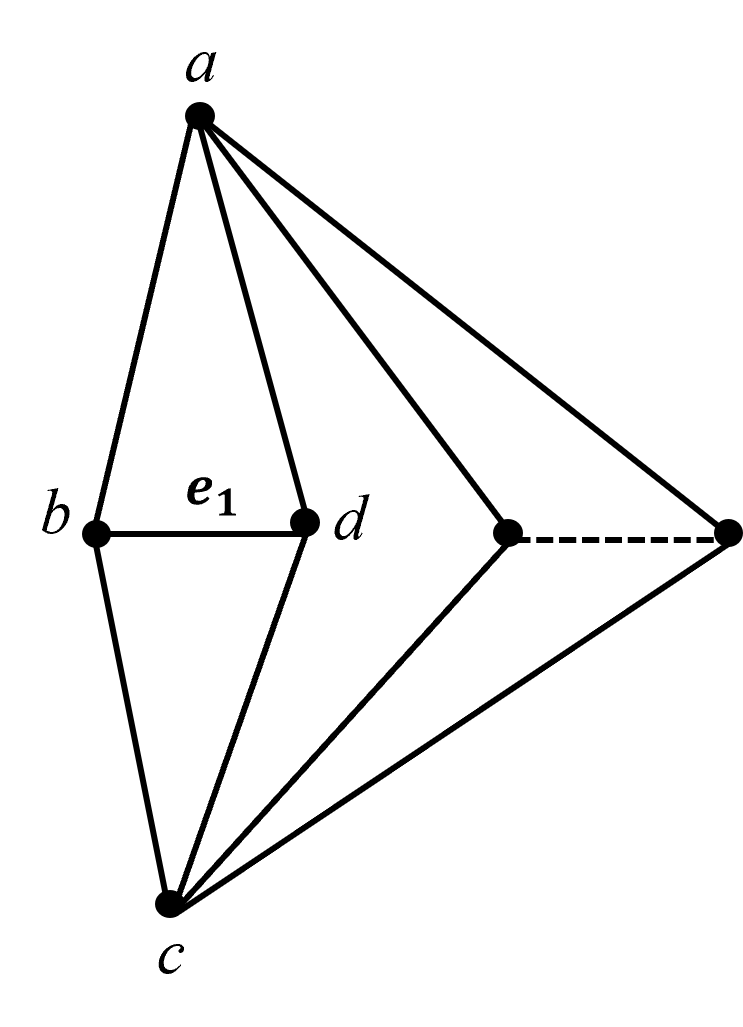
Proof. Let \(J_{n}\) be the Jewel graph with the edge set \(\lbrace\)\(e_{1}\), \(e_{2}\), …, \(e_{2n+5}\)\(\rbrace\). For Jewel graph \(J_{n}\), consider a cycle \(C_{4}\) with vertices \(\textit{a, b, c}\) and \(\textit{d}\), then add an edge \(e_{1}\) between the vertices \(\textit{b}\) and \(\textit{d}\), and finally introduce \(\textit{n}\) new vertices that connect to both vertices \(\textit{a}\) and \(\textit{c}\). Let \(e_{2}\), \(e_{3}\), \(e_{4}\), \(e_{5}\), …, \(e_{n+3}\) be the adjacent edges incident with a common vertex \(\textit{a}\) and let \(e_{n+4}\), \(e_{n+5}\), …, \(e_{2n+5}\) be the adjacent edges incident with a common vertex \(\textit{c}\).
Take \(\textit{n}\)+2 pebbles for distribution. Place \(\textit{n}\)+2 pebbles with the distribution such that one pebble on the edge \(e_{1}\), and one pebble each on the edges \(e_{2}\), \(e_{3}\), \(e_{4}\), \(e_{5}\), …, \(e_{n+2}\) of \(J_{n}\). Now, the adjacent edge of \(e_{n+3}\) that is incident with a vertex \(\textit{c}\) will be left undominated. Therefore, \(\textit{$\psi_{e}$}\)(\(J_{n}\)) \(\geq\) \(\textit{n}\)+3.
For proving the sufficient part, place \(\textit{n}\)+2 pebbles with the distribution such that one pebble each on the edges \(e_{2}\), \(e_{3}\), \(e_{4}\), \(e_{5}\), …, \(e_{n+3}\). So, we need \(\textit{n}\)+2 pebbles in such a distribution to dominate the edges of \(J_{n}\). Therefore, by this distribution of pebbles, the edges of \(J_{n}\) can be dominated with less than \(\textit{n}\)+3 pebbles. Also, the claim is true if we place \(\textit{n}\)+3 pebbles on any one of the edges of \(J_{n}\). So, by all possible configurations, the domination cover edge pebbling number for the Jewel \(J_{n}\) graph is \(\textit{$\psi_{e}$}\)(\(J_{n}\)) = \(\textit{n}\)+3; \(\textit{n}\) \(\geq\) 1. ◻
Theorem 3.2. The domination cover edge pebbling number for the triangular snake \(TS_{n}\) graph is \(\textit{$\psi_{e}$}\)(\(TS_{n}\)) = 2\(^{n}\)-(4k-1); n \(\geq\) 5 and k = \(a_{1}\), \(a_{2}\), \(a_{3}\), …; \(a_{1}\) = 3, \(a_{2}\) = 4\(a_{1}\)-1, \(a_{3}\) = 4\(a_{2}\)-1, … when n is odd and \(\textit{$\psi_{e}$}\)(\(TS_{n}\)) = 2\(^{n}\)-2(4k-1); n \(\geq\) 6 and k = \(a_{1}\), \(a_{2}\), \(a_{3}\), …; \(a_{1}\) = 3, \(a_{2}\) = 4\(a_{1}\)-1, \(a_{3}\) = 4\(a_{2}\)-1, … when n is even.
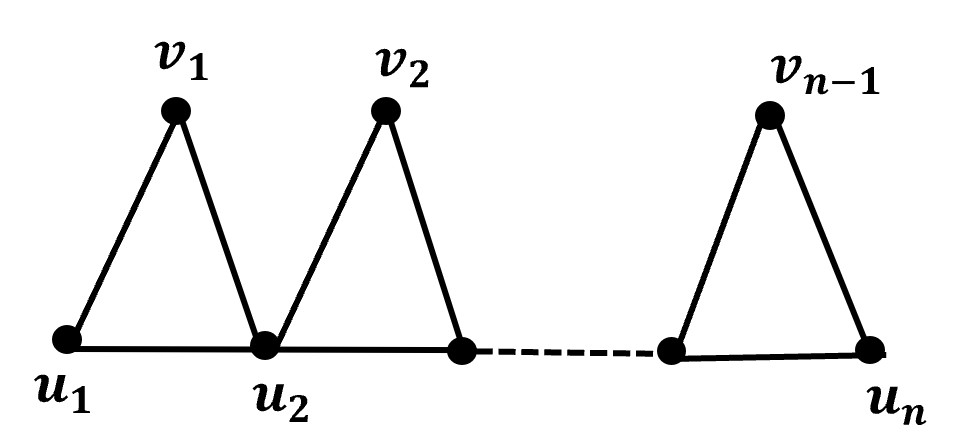
Proof. Let \(TS_{n}\) be the triangular snake graph with the edge set \(\textit{E}\)(\(TS_{n}\)) = \(\lbrace\)\(e_{1}\), \(e_{2}\), …, \(e_{3(n-1)}\)\(\rbrace\) and let \(u_{1}\), \(u_{2}\), \(u_{3}\), …, \(u_{n}\) be the vertices of \(P_{n}\) and \(\lbrace\)\(e_{1}\), \(e_{4}\), \(e_{7}\), …, \(e_{3(n-1)-2}\)\(\rbrace\) be the edges of \(P_{n}\). Let the edges \(e_{i+1}\) and \(e_{i+2}\) be adjacent to \(e_{i}\) for every \(\textit{i}\) = 1, 4, 7, …, 3(\(\textit{n}\)-1)-2 and these edges are incident with vertices in pairs, with edges \(e_{2}\) and \(e_{3}\) incident with \(v_{1}\), the edges \(e_{5}\) and \(e_{6}\) incident with \(v_{2}\), and so on, up to edges \(e_{3(n-1)-1}\) and \(e_{3(n-1)}\) incident with \(v_{n-1}\) i.e. the vertices \(u_{1}\) and \(u_{2}\) are adjacent to \(v_{1}\).
Case 1. when \(\textit{n}\) is odd.
Take 2\(^{n}\)-(4\(\textit{k}\)-1)-1 pebbles for distribution. Place 2\(^{n}\)-(4\(\textit{k}\)-1)-1 pebbles on the edge \(e_{2}\). Now, the edge \(e_{2}\) is left undominated after the pebble distribution. Therefore, \(\textit{$\psi_{e}$}\)(\(TS_{n}\)) \(\geq\) 2\(^{n}\)-(4\(\textit{k}\)-1), when \(\textit{n}\) is odd. For proving the sufficient part, place the pebbles on any one of the edges of \(P_{n}\) except the edge \(e_{3(n-1)-2}\) i.e. to dominate the edges of \(TS_{n}\) by the distribution of each edge in the edge set \(\lbrace\)\(e_{2}\), \(e_{4}\), \(e_{10}\), \(e_{16}\), \(e_{22}\), …, \(e_{3(n-1)-2}\)\(\rbrace\) has one pebble, we need 9+\(\sum\limits_{k = 4}^{\lceil\frac{n}{2}\rceil}\) 2\(^{k}\) & \(\textit{k}\) \(\neq\) 5, 7, 9, 11, 13, … pebbles on the edge \(e_{4}\). Therefore, by this distribution of pebbles, the edges of \(TS_{n}\) can be dominated with less than 2\(^{n}\)-(4\(\textit{k}\)-1)pebbles. Also, the claim is true if we place 2\(^{n}\)-(4\(\textit{k}\)-1) pebbles on the edge \(e_{2}\). So, by all possible configurations, \(\textit{$\psi_{e}$}\)(\(TS_{n}\))= 2\(^{n}\)-(4\(\textit{k}\)-1); \(\textit{n}\) \(\geq\) 5 and \(\textit{k}\) = \(a_{1}\), \(a_{2}\), \(a_{3}\), …; \(a_{1}\) = 3, \(a_{2}\) = 4\(a_{1}\)-1, \(a_{3}\) = 4\(a_{2}\)-1, … when \(\textit{n}\) is odd.
Case 2. when \(\textit{n}\) is even.
Take 2\(^{n}\)-2(4\(\textit{k}\)-1)-1 pebbles for distribution. Place 2\(^{n}\)-2(4\(\textit{k}\)-1)-1 pebbles on the edge \(e_{2}\). Now, the edge \(e_{5}\) is left undominated after the pebble distribution. Therefore, \(\textit{$\psi_{e}$}\)(\(TS_{n}\)) \(\geq\) 2\(^{n}\)-2(4\(\textit{k}\)-1), when \(\textit{n}\) is even. For proving the sufficient part, place the pebbles either on the edge \(e_{1}\) or on the edge \(e_{3(n-1)-2}\) i.e. place 5+\(\sum\limits_{k = 4}^{n-2}\) 2\(^{k}\) & \(\textit{k}\) \(\neq\) 5, 7, 9, 11, 13, … pebbles with the distribution such that each edge in the edge set \(\lbrace\)\(e_{1}\), \(e_{7}\), \(e_{13}\), \(e_{19}\), \(e_{25}\), …, \(e_{3(n-1)-2}\)\(\rbrace\) will have one pebble. So, we need \(\sum\limits_{k = 4}^{n-2}\) 2\(^{k}\) & \(\textit{k}\) \(\neq\) 5, 7, 9, 11, 13, … pebbles in such a distribution to dominate the edges of \(TS_{n}\). Therefore, by this distribution of pebbles, the edges of \(TS_{n}\) can be dominated with less than 2\(^{n}\)-2(4\(\textit{k}\)-1) pebbles. Also, the claim is true if we place 2\(^{n}\)-2(4\(\textit{k}\)-1) pebbles on the edge \(e_{2}\). So, by all possible configurations, \(\textit{$\psi_{e}$}\)(\(TS_{n}\)) = 2\(^{n}\)-2(4\(\textit{k}\)-1); \(\textit{n}\) \(\geq\) 6 and \(\textit{k}\) = \(a_{1}\), \(a_{2}\), \(a_{3}\), …; \(a_{1}\) = 3, \(a_{2}\) = 4\(a_{1}\)-1, \(a_{3}\) = 4\(a_{2}\)-1, … when \(\textit{n}\) is even. ◻
Theorem 3.3. The domination cover edge pebbling number for the Generalized Petersen graph \(GP_{3,1}\) is \(\textit{$\psi_{e}$}\)(\(GP_{3,1}\)) = 6.
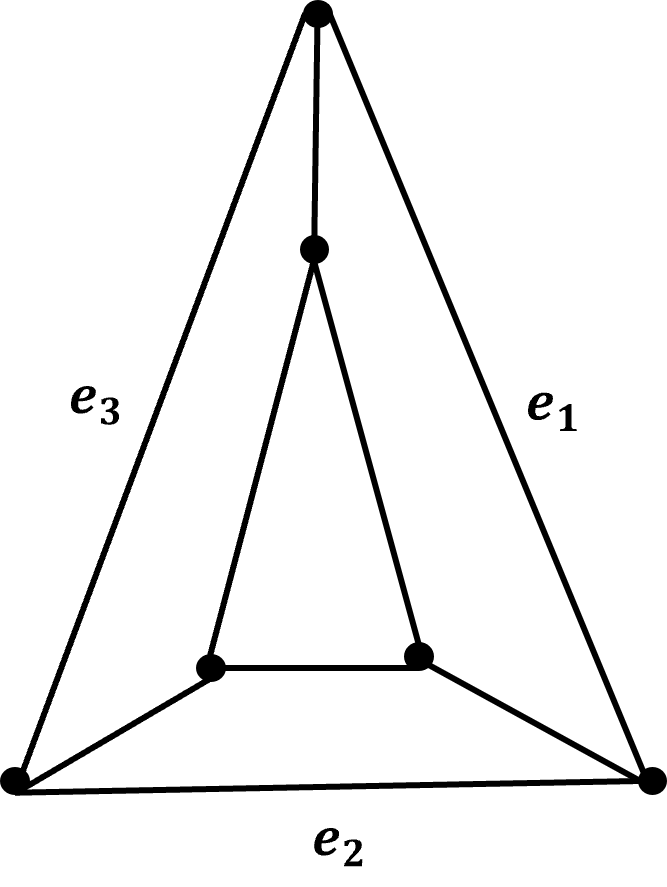
Proof. For \(GP_{3,1}\), let \(e_{1}\), \(e_{2}\), and \(e_{3}\) be the outer edges of \(GP_{3,1}\). Let \(e_{4}\) be the edge that connects both the inner and outer polygons and adjacent to both the edges \(e_{1}\) and \(e_{2}\). Let \(e_{5}\) be the edge that connects both the inner and outer polygons and adjacent to both the edges \(e_{2}\) and \(e_{3}\). Let \(e_{6}\) be the edge that connects both the inner and outer polygons and adjacent to both the edges \(e_{1}\) and \(e_{3}\). Let \(e_{7}\) be the inner edge of \(GP_{3,1}\) and adjacent to both the edges \(e_{4}\) and \(e_{5}\). Let \(e_{8}\) be the inner edge of \(GP_{3,1}\) and adjacent to both the edges \(e_{5}\) and \(e_{6}\). Let \(e_{9}\) be the inner edge of \(GP_{3,1}\) and adjacent to both the edges \(e_{4}\) and \(e_{6}\). Now, we need to find the minimum number of pebbles to cover the edges that form an edge dominating set.
If \(\textit{P}\)(\(e_{1}\)) = 1, the edges \(e_{2}\), \(e_{3}\), \(e_{4}\), and \(e_{6}\) can be dominated and the edges \(e_{5}\), \(e_{7}\), \(e_{8}\) and \(e_{9}\) will be left undominated. So, 1 is not the required number of pebbles.
If \(\textit{P}\)(\(e_{1}\)) = 1 and \(\textit{P}\)(\(e_{9}\)) = 1, we can dominate all the edges of \(GP_{3,1}\) with 2 pebbles but if \(\textit{P}\)(\(e_{9}\)) = 2, we cannot dominate all the edges of \(GP_{3,1}\) with 2 pebbles. So, 2 is not the required number of pebbles.
If \(\textit{P}\)(\(e_{1}\)) = 1, \(\textit{P}\)(\(e_{2}\)) = 1 and \(\textit{P}\)(\(e_{3}\)) = 1, we cannot dominate all the edges of \(GP_{3,1}\) with 3 pebbles. So, 3 is not the required number of pebbles.
If \(\textit{P}\)(\(e_{1}\)) = 2 and \(\textit{P}\)(\(e_{2}\)) = 2, any one of the edges of \(GP_{3,1}\) will be left undominated. So, 4 is not the required number of pebbles.
If \(\textit{P}\)(\(e_{1}\)) = 1 and place 4 pebbles on any one of the edges that connects both the inner and outer polygons, we can dominate all the edges of \(GP_{3,1}\) with 5 pebbles but if \(\textit{P}\)(\(e_{1}\)) = 3, \(\textit{P}\)(\(e_{2}\)) = 1 and \(\textit{P}\)(\(e_{3}\)) = 1, we cannot dominate all the edges of \(GP_{3,1}\) with 5 pebbles. So, 5 is not the required number of pebbles. If we place 6 pebbles on any one of the edges of \(GP_{3,1}\), we can dominate all the edges of \(GP_{3,1}\) and if we also alter the configuration of pebbles, 6 pebbles are the minimum number of pebbles required. Thus, the domination cover edge pebbling number for the Generalized Petersen \(GP_{3,1}\) graph is \(\textit{$\psi_{e}$}\)(\(GP_{3,1}\)) = 6. ◻
Theorem 3.4. The domination cover edge pebbling number for the Generalized Petersen graph \(GP_{4,1}\) is \(\textit{$\psi_{e}$}\)(\(GP_{4,1}\)) = 9.
Proof. For \(GP_{4,1}\), let \(e_{1}\), \(e_{2}\), \(e_{3}\) and \(e_{4}\) be the outer edges of \(GP_{4,1}\). Let \(e_{5}\) be the edge that connects both the inner and outer polygons and adjacent to both the edges \(e_{1}\) and \(e_{2}\). Let \(e_{6}\) be the edge that connects both the inner and outer polygons and adjacent to both the edges \(e_{2}\) and \(e_{3}\). Let \(e_{7}\) be the edge that connects both the inner and outer polygons and adjacent to both the edges \(e_{3}\) and \(e_{4}\). Let \(e_{8}\) be the edge that connects both the inner and outer polygons and adjacent to both the edges \(e_{1}\) and \(e_{4}\). Let \(e_{9}\) be the inner edge of \(GP_{4,1}\) and adjacent to both the edges \(e_{5}\) and \(e_{6}\). Let \(e_{10}\) be the inner edge of \(GP_{4,1}\) and adjacent to both the edges \(e_{6}\) and \(e_{7}\). Let \(e_{11}\) be the inner edge of \(GP_{4,1}\) and adjacent to both the edges \(e_{7}\) and \(e_{8}\). Let \(e_{12}\) be the inner edge of \(GP_{4,1}\) and adjacent to both the edges \(e_{5}\) and \(e_{8}\). Now, we need to find the minimum number of pebbles to cover the edges that form an edge dominating set.
If \(\textit{P}\)(\(e_{1}\)) = 1, the edges \(e_{1}\), \(e_{2}\), \(e_{4}\), \(e_{5}\), and \(e_{8}\) can be dominated and the edges \(e_{3}\), \(e_{6}\), \(e_{7}\), \(e_{9}\), \(e_{10}\), \(e_{11}\) and \(e_{12}\) will be left undominated. So, 1 is not the required number of pebbles. If \(\textit{P}\)(\(e_{1}\)) = 1 and \(\textit{P}\)(\(e_{12}\)) = 1, the edges \(e_{3}\), \(e_{6}\), \(e_{7}\), and \(e_{10}\) will be left undominated. So, 2 is not the required number of pebbles.
If \(\textit{P}\)(\(e_{1}\)) = 1, \(\textit{P}\)(\(e_{2}\)) = 1 and \(\textit{P}\)(\(e_{3}\)) = 1, the edges \(e_{9}\), \(e_{10}\), \(e_{11}\) and \(e_{12}\) will be left undominated. So, 3 is not the required number of pebbles.
If \(\textit{P}\)(\(e_{1}\)) = 2 and \(\textit{P}\)(\(e_{3}\)) = 2 and consider the distribution of 1 pebble moves to each of the edges \(e_{5}\) and \(e_{7}\) then the edges \(e_{6}\) and \(e_{8}\) will be left undominated. So, 4 is not the required number of pebbles.
If \(\textit{P}\)(\(e_{6}\)) = 1, \(\textit{P}\)(\(e_{1}\)) = 2 and \(\textit{P}\)(\(e_{3}\)) = 2 and consider the distribution of 1 pebble moves to each of the edges \(e_{4}\) and \(e_{5}\) then the edge \(e_{11}\) will be left undominated. So, 5 is not the required number of pebbles.
If \(\textit{P}\)(\(e_{1}\)) = 3 and \(\textit{P}\)(\(e_{3}\)) = 3 and consider the distribution of 1 pebble moves to each of the edges \(e_{5}\) and \(e_{7}\), we can dominate all the edges of \(GP_{4,1}\) with 6 pebbles but if \(\textit{P}\)(\(e_{1}\)) = 5 and \(\textit{P}\)(\(e_{3}\)) = 1 and consider the distribution of 1 pebble moves to the edge \(e_{9}\), the edge \(e_{11}\) will be left undominated. So, 6 is not the required number of pebbles.
If \(\textit{P}\)(\(e_{12}\)) = 7 and consider the distribution of 1 pebble moves to each of the edges \(e_{4}\) and \(e_{9}\) then the edge \(e_{2}\) will be left undominated. So, 7 is not the required number of pebbles.
If \(\textit{P}\)(\(e_{1}\)) = 4 and \(\textit{P}\)(\(e_{3}\)) = 4 and consider the distribution of 1 pebble moves to each of the edges \(e_{2}\), \(e_{4}\), \(e_{6}\) and \(e_{8}\), we can dominate all the edges of \(GP_{4,1}\) with 8 pebbles but if \(\textit{P}\)(\(e_{1}\)) = 8 and consider the distribution of 1 pebble moves to each of the edges \(e_{2}\), \(e_{4}\) and \(e_{9}\), the edge \(e_{11}\) will be left undominated. So, 8 is not the required number of pebbles.
If \(\textit{P}\)(\(e_{1}\)) = 9 and consider the distribution of 1 pebble moves to each of the edges \(e_{6}\) and \(e_{11}\), we can dominate all the edges of \(GP_{4,1}\) with 9 pebbles. If we also place 9 pebbles on any other edges of \(GP_{4,1}\) and alter the configuration of pebbles, we can dominate all the edges of \(GP_{4,1}\) and 9 pebbles are the minimum number of pebbles required. Thus, the domination cover edge pebbling number for the Generalized Petersen \(GP_{4,1}\) graph is \(\textit{$\psi_{e}$}\)(\(GP_{4,1}\)) = 9. ◻
Theorem 3.5. The domination cover edge pebbling number for the Generalized Petersen graph \(GP_{5,1}\) is \(\textit{$\psi_{e}$}\)(\(GP_{5,1}\)) = 13.
Proof. For \(GP_{5,1}\), let \(e_{1}\), \(e_{2}\), \(e_{3}\), \(e_{4}\) and \(e_{5}\) be the outer edges of \(GP_{5,1}\). Let \(e_{6}\) be the edge that connects both the inner and outer polygons and adjacent to both the edges \(e_{1}\) and \(e_{2}\). Let \(e_{7}\) be the edge that connects both the inner and outer polygons and adjacent to both the edges \(e_{2}\) and \(e_{3}\). Let \(e_{8}\) be the edge that connects both the inner and outer polygons and adjacent to both the edges \(e_{3}\) and \(e_{4}\). Let \(e_{9}\) be the edge that connects both the inner and outer polygons and adjacent to both the edges \(e_{4}\) and \(e_{5}\). Let \(e_{10}\) be the edge that connects both the inner and outer polygons and adjacent to both the edges \(e_{1}\) and \(e_{5}\). Let \(e_{11}\) be the inner edge of \(GP_{5,1}\) and adjacent to both the edges \(e_{6}\) and \(e_{7}\). Let \(e_{12}\) be the inner edge of \(GP_{5,1}\) and adjacent to both the edges \(e_{7}\) and \(e_{8}\). Let \(e_{13}\) be the inner edge of \(GP_{5,1}\) and adjacent to both the edges \(e_{8}\) and \(e_{9}\). Let \(e_{14}\) be the inner edge of \(GP_{5,1}\) and adjacent to both the edges \(e_{9}\) and \(e_{10}\). Let \(e_{15}\) be the inner edge of \(GP_{5,1}\) and adjacent to both the edges \(e_{6}\) and \(e_{10}\). Now, we need to find the minimum number of pebbles to cover the edges that form an edge dominating set.
If \(\textit{P}\)(\(e_{1}\)) = 1, the edges \(e_{1}\), \(e_{2}\), \(e_{5}\), \(e_{6}\), and \(e_{10}\) can be dominated and the remaining edges of \(GP_{5,1}\) will be left undominated. So, 1 is not the required number of pebbles.
If \(\textit{P}\)(\(e_{1}\)) = 1 and \(\textit{P}\)(\(e_{8}\)) = 1, the edges \(e_{7}\), \(e_{9}\), \(e_{11}\), \(e_{14}\), and \(e_{15}\) will be left undominated. So, 2 is not the required number of pebbles.
If \(\textit{P}\)(\(e_{1}\)) = 1, \(\textit{P}\)(\(e_{8}\)) = 1 and \(\textit{P}\)(\(e_{14}\)) = 1, the edges \(e_{7}\) and \(e_{11}\) will be left undominated. So, 3 is not the required number of pebbles.
If \(\textit{P}\)(\(e_{1}\)) = 2 and \(\textit{P}\)(\(e_{3}\)) = 2 and consider the distribution of 1 pebble moves to each of the edges \(e_{6}\) and \(e_{8}\) then the edges \(e_{5}\), \(e_{7}\), \(e_{9}\), \(e_{10}\), and \(e_{14}\) will be left undominated. So, 4 is not the required number of pebbles.
If \(\textit{P}\)(\(e_{3}\)) = 3, \(\textit{P}\)(\(e_{6}\)) = 1 and \(\textit{P}\)(\(e_{8}\)) = 1 and consider the distribution of 1 pebble moves to the edge \(e_{9}\) then the edges \(e_{7}\) and \(e_{10}\) will be left undominated. So, 5 is not the required number of pebbles.
If \(\textit{P}\)(\(e_{1}\)) = 1, \(\textit{P}\)(\(e_{3}\)) = 1, \(\textit{P}\)(\(e_{13}\)) = 1 and \(\textit{P}\)(\(e_{2}\)) = 3 and consider the distribution of 1 pebble moves to the edge \(e_{6}\), we can dominate all the edges of \(GP_{5,1}\) with 6 pebbles but if \(\textit{P}\)(\(e_{6}\)) = 3 and \(\textit{P}\)(\(e_{8}\)) = 3 and consider the distribution of 1 pebble moves to each of the edges \(e_{11}\) and \(e_{13}\) then the edges \(e_{5}\) and \(e_{10}\) will be left undominated. So, 6 is not the required number of pebbles.
If \(\textit{P}\)(\(e_{12}\)) = 1, \(\textit{P}\)(\(e_{14}\)) = 3 and \(\textit{P}\)(\(e_{15}\)) = 3 and consider the distribution of 1 pebble moves to each of the edges \(e_{6}\) and \(e_{9}\) then the edge \(e_{3}\) will be left undominated. So, 7 is not the required number of pebbles.
If \(\textit{P}\)(\(e_{1}\)) = 4 and \(\textit{P}\)(\(e_{2}\)) = 4 and consider the distribution of 1 pebble moves to each of the edges \(e_{6}\), \(e_{5}\), \(e_{7}\), and \(e_{3}\) then the edges \(e_{13}\) and \(e_{14}\) will be left undominated. So, 8 is not the required number of pebbles.
If \(\textit{P}\)(\(e_{1}\)) = 4, \(\textit{P}\)(\(e_{2}\)) = 4 and \(\textit{P}\)(\(e_{12}\)) = 1 and consider the distribution of 1 pebble moves to each of the edges \(e_{6}\), \(e_{5}\), \(e_{7}\), and \(e_{3}\) then the edge \(e_{14}\) will be left undominated. So, 9 is not the required number of pebbles.
If \(\textit{P}\)(\(e_{1}\)) = 4, \(\textit{P}\)(\(e_{2}\)) = 4, \(\textit{P}\)(\(e_{12}\)) = 1 and \(\textit{P}\)(\(e_{14}\)) = 1, we can dominate all the edges of \(GP_{5,1}\) with 10 pebbles but if \(\textit{P}\)(\(e_{1}\)) = 5 and \(\textit{P}\)(\(e_{3}\)) = 5 and consider the distribution of 1 pebble moves to each of the edges \(e_{6}\), \(e_{7}\), \(e_{8}\), and \(e_{10}\) then the edge \(e_{9}\) will be left undominated. So, 10 is not the required number of pebbles.
If \(\textit{P}\)(\(e_{1}\)) = 5, \(\textit{P}\)(\(e_{3}\)) = 5 and \(\textit{P}\)(\(e_{2}\)) = 1 and consider the distribution of 1 pebble moves to each of the edges \(e_{7}\), \(e_{8}\), \(e_{5}\) and \(e_{10}\), we can dominate all the edges of \(GP_{5,1}\) with 11 pebbles but if \(\textit{P}\)(\(e_{1}\)) = 11 and consider the distribution of 1 pebble moves to each of the edges \(e_{6}\), \(e_{7}\) and \(e_{9}\) then the edge \(e_{8}\) will be left undominated. So, 11 is not the required number of pebbles.
If \(\textit{P}\)(\(e_{5}\)) = 12 and consider the distribution of 1 pebble moves to each of the edges \(e_{1}\), \(e_{8}\), \(e_{9}\) and \(e_{15}\) then the edge \(e_{7}\) will be left undominated. So, 12 is not the required number of pebbles.
If \(\textit{P}\)(\(e_{4}\)) = 13 and consider the distribution of 1 pebble moves to each of the edges \(e_{1}\), \(e_{12}\), and \(e_{14}\), we can dominate all the edges of \(GP_{5,1}\) with 13 pebbles and if \(\textit{P}\)(\(e_{13}\)) = 13 and consider the distribution of 1 pebble moves to each of the edges \(e_{3}\), \(e_{5}\) and \(e_{11}\), we can dominate all the edges of \(GP_{5,1}\) with 13 pebbles. If we also place 13 pebbles on any other edges of \(GP_{5,1}\) and alter the configuration of pebbles, we can dominate all the edges of \(GP_{5,1}\) and 13 pebbles are the minimum number of pebbles required. Thus, the domination cover edge pebbling number for the Generalized Petersen \(GP_{5,1}\) graph is \(\textit{$\psi_{e}$}\)(\(GP_{5,1}\)) = 13. ◻
Theorem 3.6. The domination cover edge pebbling number for the Generalized Petersen graph \(GP_{5,2}\) is \(\textit{$\psi_{e}$}\)(\(GP_{5,2}\)) = 11.
Proof. For \(GP_{5,2}\), let \(e_{1}\), \(e_{2}\), \(e_{3}\), \(e_{4}\) and \(e_{5}\) be the outer edges of \(GP_{5,2}\). Let \(e_{6}\) be the edge that connects both the inner and outer polygons and adjacent to both the edges \(e_{1}\) and \(e_{2}\). Let \(e_{7}\) be the edge that connects both the inner and outer polygons and adjacent to both the edges \(e_{2}\) and \(e_{3}\). Let \(e_{8}\) be the edge that connects both the inner and outer polygons and adjacent to both the edges \(e_{3}\) and \(e_{4}\). Let \(e_{9}\) be the edge that connects both the inner and outer polygons and adjacent to both the edges \(e_{4}\) and \(e_{5}\). Let \(e_{10}\) be the edge that connects both the inner and outer polygons and adjacent to both the edges \(e_{1}\) and \(e_{5}\). Let \(e_{11}\) be the inner edge of \(GP_{5,2}\) and adjacent to both the edges \(e_{6}\) and \(e_{8}\). Let \(e_{12}\) be the inner edge of \(GP_{5,2}\) and adjacent to both the edges \(e_{8}\) and \(e_{10}\). Let \(e_{13}\) be the inner edge of \(GP_{5,2}\) and adjacent to both the edges \(e_{10}\) and \(e_{7}\). Let \(e_{14}\) be the inner edge of \(GP_{5,2}\) and adjacent to both the edges \(e_{7}\) and \(e_{9}\). Let \(e_{15}\) be the inner edge of \(GP_{5,2}\) and adjacent to both the edges \(e_{9}\) and \(e_{6}\). Now, we need to find the minimum number of pebbles to cover the edges that form an edge dominating set.
If \(\textit{P}\)(\(e_{1}\)) = 1, the edges \(e_{1}\), \(e_{2}\), \(e_{5}\), \(e_{6}\), and \(e_{10}\) can be dominated and the remaining edges of \(GP_{5,2}\) will be left undominated. So, 1 is not the required number of pebbles.
If \(\textit{P}\)(\(e_{1}\)) = 1 and \(\textit{P}\)(\(e_{8}\)) = 1, the edges \(e_{7}\), \(e_{9}\), \(e_{13}\), \(e_{14}\), and \(e_{15}\) will be left undominated. So, 2 is not the required number of pebbles.
If \(\textit{P}\)(\(e_{1}\)) = 1, \(\textit{P}\)(\(e_{8}\)) = 1 and \(\textit{P}\)(\(e_{7}\)) = 1, the edges \(e_{9}\) and \(e_{15}\) will be left undominated. So, 3 is not the required number of pebbles.
If \(\textit{P}\)(\(e_{1}\)) = 2 and \(\textit{P}\)(\(e_{3}\)) = 2 and consider the distribution of 1 pebble moves to each of the edges \(e_{6}\) and \(e_{8}\) then the edges \(e_{5}\), \(e_{7}\), \(e_{9}\), \(e_{10}\), \(e_{13}\) and \(e_{14}\) will be left undominated. So, 4 is not the required number of pebbles.
If \(\textit{P}\)(\(e_{3}\)) = 3, \(\textit{P}\)(\(e_{6}\)) = 1 and \(\textit{P}\)(\(e_{8}\)) = 1 and consider the distribution of 1 pebble moves to the edge \(e_{7}\) then the edges \(e_{5}\), \(e_{9}\), and \(e_{10}\) will be left undominated. So, 5 is not the required number of pebbles.
If \(\textit{P}\)(\(e_{1}\)) = 1, \(\textit{P}\)(\(e_{3}\)) = 1, \(\textit{P}\)(\(e_{9}\)) = 1 and \(\textit{P}\)(\(e_{11}\)) = 3 and consider the distribution of 1 pebble moves to the edge \(e_{12}\), we can dominate all the edges of \(GP_{5,2}\) with 6 pebbles but if \(\textit{P}\)(\(e_{6}\)) = 3 and \(\textit{P}\)(\(e_{8}\)) = 3 and consider the distribution of 1 pebble moves to each of the edges \(e_{11}\) and \(e_{12}\) then the edges \(e_{5}\), \(e_{7}\), \(e_{9}\) and \(e_{14}\) will be left undominated. So, 6 is not the required number of pebbles.
If \(\textit{P}\)(\(e_{12}\)) = 1, \(\textit{P}\)(\(e_{14}\)) = 3 and \(\textit{P}\)(\(e_{15}\)) = 3 and consider the distribution of 1 pebble moves to each of the edges \(e_{7}\) and \(e_{6}\) then the edges \(e_{4}\), and \(e_{5}\) will be left undominated. So, 7 is not the required number of pebbles.
If \(\textit{P}\)(\(e_{1}\)) = 4 and \(\textit{P}\)(\(e_{2}\)) = 4 and consider the distribution of 1 pebble moves to each of the edges \(e_{6}\), \(e_{5}\), \(e_{7}\), and \(e_{3}\) then the edge \(e_{12}\) will be left undominated. So, 8 is not the required number of pebbles.
If \(\textit{P}\)(\(e_{1}\)) = 4, \(\textit{P}\)(\(e_{2}\)) = 4 and \(\textit{P}\)(\(e_{4}\)) = 1 and consider the distribution of 1 pebble moves to each of the edges \(e_{6}\), \(e_{5}\), \(e_{7}\), and \(e_{3}\) then the edge \(e_{12}\) will be left undominated. So, 9 is not the required number of pebbles.
If \(\textit{P}\)(\(e_{1}\)) = 4, \(\textit{P}\)(\(e_{2}\)) = 4, \(\textit{P}\)(\(e_{4}\)) = 1 and P(\(e_{12}\)) = 1, we can dominate all the edges of \(GP_{5,2}\) with 10 pebbles but if \(\textit{P}\)(\(e_{1}\)) = 5 and \(\textit{P}\)(\(e_{3}\)) = 5 and consider the distribution of 1 pebble moves to each of the edges \(e_{6}\), \(e_{7}\), \(e_{8}\), and \(e_{10}\) then the edge \(e_{9}\) will be left undominated. So, 10 is not the required number of pebbles.
If \(\textit{P}\)(\(e_{4}\)) = 11 and consider the distribution of 1 pebble moves to each of the edges \(e_{1}\), \(e_{8}\), and \(e_{14}\), we can dominate all the edges of \(GP_{5,2}\) with 11 pebbles and if P(\(e_{10}\)) = 11 and consider the distribution of 1 pebble moves to each of the edges \(e_{6}\), \(e_{7}\) and \(e_{4}\), we can dominate all the edges of \(GP_{5,2}\) with 11 pebbles. If we also place 11 pebbles on any other edges of \(GP_{5,2}\) and alter the configuration of pebbles, we can dominate all the edges of \(GP_{5,2}\) and 11 pebbles are the minimum number of pebbles required. Thus, the domination cover edge pebbling number for the Generalized Petersen \(GP_{5,2}\) graph is \(\textit{$\psi_{e}$}\)(\(GP_{5,2}\)) = 11. ◻
Theorem 3.7. The domination cover edge pebbling number for the Generalized Petersen graph \(GP_{6,1}\) is \(\textit{$\psi_{e}$}\)(\(GP_{6,1}\)) = 18.
Proof. For \(GP_{6,1}\), let \(e_{1}\), \(e_{2}\), \(e_{3}\), \(e_{4}\), \(e_{5}\) and \(e_{6}\) be the outer edges of \(GP_{6,1}\). Let \(e_{7}\) be the edge that connects both the inner and outer polygons and adjacent to both the edges \(e_{1}\) and \(e_{2}\). Let \(e_{8}\) be the edge that connects both the inner and outer polygons and adjacent to both the edges \(e_{2}\) and \(e_{3}\). Let \(e_{9}\) be the edge that connects both the inner and outer polygons and adjacent to both the edges \(e_{3}\) and \(e_{4}\). Let \(e_{10}\) be the edge that connects both the inner and outer polygons and adjacent to both the edges \(e_{4}\) and \(e_{5}\). Let \(e_{11}\) be the edge that connects both the inner and outer polygons and adjacent to both the edges \(e_{5}\) and \(e_{6}\). Let \(e_{12}\) be the edge that connects both the inner and outer polygons and adjacent to both the edges \(e_{1}\) and \(e_{6}\). Let \(e_{13}\) be the inner edge of \(GP_{6,1}\) and adjacent to both the edges \(e_{7}\) and \(e_{12}\). Let \(e_{14}\) be the inner edge of \(GP_{6,1}\) and adjacent to both the edges \(e_{7}\) and \(e_{8}\). Let \(e_{15}\) be the inner edge of \(GP_{6,1}\) and adjacent to both the edges \(e_{8}\) and \(e_{9}\). Let \(e_{16}\) be the inner edge of \(GP_{6,1}\) and adjacent to both the edges \(e_{9}\) and \(e_{10}\). Let \(e_{17}\) be the inner edge of \(GP_{6,1}\) and adjacent to both the edges \(e_{10}\) and \(e_{11}\). Let \(e_{18}\) be the inner edge of \(GP_{6,1}\) and adjacent to both the edges \(e_{11}\) and \(e_{12}\). Now, we need to find the minimum number of pebbles to cover the edges that form an edge dominating set.
If P(\(e_{1}\)) = 17 and consider the distribution of 1 pebble moves to each of the edges \(e_{8}\), \(e_{9}\) and \(e_{10}\) then the edge \(e_{6}\) will be left undominated. So, \(\textit{$\psi_{e}$}\)(\(GP_{6,1}\)) \(\geq\) 18.
For proving the sufficient part, If \(\textit{P}\)(\(e_{i}\)) = 1, 2 or 3 for 1 \(\leq\) \(\textit{i}\) \(\leq\) 18, we cannot dominate all the edges of \(GP_{6,1}\). So, \(\textit{$\psi_{e}$}\)(\(GP_{6,1}\)) \(\geq\) 4. If \(\textit{P}\)(\(e_{1}\)) = 1, \(\textit{P}\)(\(e_{4}\)) = 1, \(\textit{P}\)(\(e_{15}\)) = 1 and \(\textit{P}\)(\(e_{18}\)) = 1, we can dominate all the edges of \(GP_{6,1}\) with 4 pebbles and if \(\textit{P}\)(\(e_{1}\)) = 3, \(\textit{P}\)(\(e_{4}\)) = 3, \(\textit{P}\)(\(e_{14}\)) = 1 and \(\textit{P}\)(\(e_{18}\)) = 1 and consider the distribution of 1 pebble moves to each of the edges \(e_{9}\) and \(e_{12}\), we can dominate all the edges of \(GP_{6,1}\) with 8 pebbles. So, in this distribution of pebbles, we need at most 8 pebbles to dominate all the edges of \(GP_{6,1}\).
If \(\textit{P}\)(\(e_{3}\)) = 1, \(\textit{P}\)(\(e_{5}\)) = 2, \(\textit{P}\)(\(e_{9}\)) = 3 and \(\textit{P}\)(\(e_{12}\)) = 3 and consider the distribution of 1 pebble moves to each of the edges \(e_{6}\), \(e_{13}\) and \(e_{16}\), we can dominate all the edges of \(GP_{6,1}\) with 9 pebbles. If \(\textit{P}\)(\(e_{4}\)) = 4, \(\textit{P}\)(\(e_{5}\)) = 4 and \(\textit{P}\)(\(e_{2}\)) = 5 and consider the distribution of 1 pebble moves to each of the edges \(e_{3}\), \(e_{6}\), \(e_{10}\), \(e_{11}\) and \(e_{14}\), we can dominate all the edges of \(GP_{6,1}\) with 13 pebbles. So, in this distribution of pebbles, we need at most 13 pebbles to dominate all the edges of \(GP_{6,1}\).
If \(\textit{P}\)(\(e_{1}\)) = 2, \(\textit{P}\)(\(e_{2}\)) = 4, \(\textit{P}\)(\(e_{4}\)) = 4 and \(\textit{P}\)(\(e_{5}\)) = 4 and consider the distribution of 1 pebble moves to each of the edges \(e_{3}\), \(e_{6}\), \(e_{10}\), \(e_{11}\), \(e_{12}\) and \(e_{14}\), we can dominate all the edges of \(GP_{6,1}\) with 14 pebbles. If \(\textit{P}\)(\(e_{4}\)) = 5, \(\textit{P}\)(\(e_{5}\)) = 5, \(\textit{P}\)(\(e_{6}\)) = 5 and \(\textit{P}\)(\(e_{2}\)) = 2 and consider the distribution of 1 pebble moves to each of the edges \(e_{3}\), \(e_{9}\), \(e_{10}\), \(e_{13}\) and \(e_{17}\), we can dominate all the edges of \(GP_{6,1}\) with 17 pebbles. So, in this distribution of pebbles, we need at most 17 pebbles to dominate all the edges of \(GP_{6,1}\).
If \(\textit{P}\)(\(e_{1}\)) = 18 and consider the distribution of 1 pebble moves to each of the edges \(e_{3}\), \(e_{6}\), \(e_{14}\) and \(e_{17}\), we can dominate all the edges of \(GP_{6,1}\) with 18 pebbles. If we also place 18 pebbles on any other edges of \(GP_{6,1}\) and alter the configuration of pebbles, we can dominate all the edges of \(GP_{6,1}\). Thus, the domination cover edge pebbling number for the Generalized Petersen \(GP_{6,1}\) graph is \(\textit{$\psi_{e}$}\)(\(GP_{6,1}\)) = 18. ◻
Theorem 3.8. The domination cover edge pebbling number for the Generalized Petersen graph \(GP_{6,2}\) is \(\textit{$\psi_{e}$}\)(\(GP_{6,2}\)) = 25.
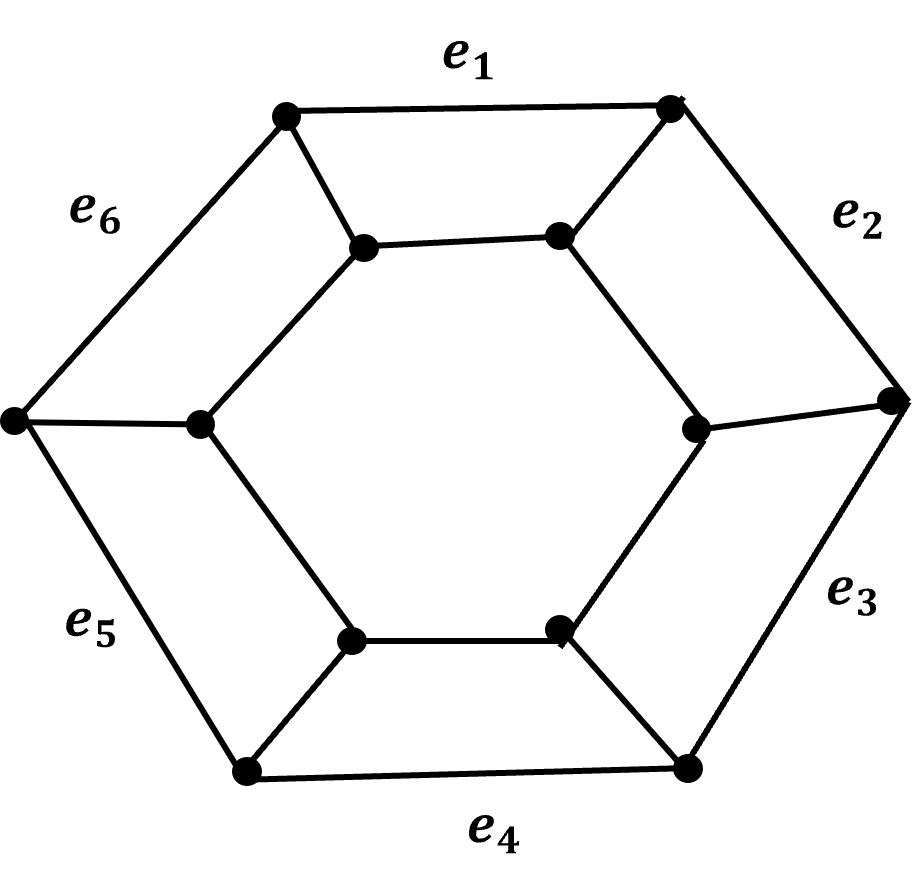
Proof. For \(GP_{6,2}\), let \(e_{1}\), \(e_{2}\), \(e_{3}\), \(e_{4}\), \(e_{5}\) and \(e_{6}\) be the outer edges of \(GP_{6,2}\). Let \(e_{7}\) be the edge that connects both the inner and outer polygons and adjacent to both the edges \(e_{1}\) and \(e_{2}\). Let \(e_{8}\) be the edge that connects both the inner and outer polygons and adjacent to both the edges \(e_{2}\) and \(e_{3}\). Let \(e_{9}\) be the edge that connects both the inner and outer polygons and adjacent to both the edges \(e_{3}\) and \(e_{4}\). Let \(e_{10}\) be the edge that connects both the inner and outer polygons and adjacent to both the edges \(e_{4}\) and \(e_{5}\). Let \(e_{11}\) be the edge that connects both the inner and outer polygons and adjacent to both the edges \(e_{5}\) and \(e_{6}\). Let \(e_{12}\) be the edge that connects both the inner and outer polygons and adjacent to both the edges \(e_{1}\) and \(e_{6}\). Let \(e_{13}\) be the inner edge of \(GP_{6,2}\) and adjacent to both the edges \(e_{7}\) and \(e_{9}\). Let \(e_{14}\) be the inner edge of \(GP_{6,2}\) and adjacent to both the edges \(e_{9}\) and \(e_{11}\). Let \(e_{15}\) be the inner edge of \(GP_{6,2}\) and adjacent to both the edges \(e_{7}\) and \(e_{11}\). Let \(e_{16}\) be the inner edge of \(GP_{6,2}\) and adjacent to both the edges \(e_{8}\) and \(e_{10}\). Let \(e_{17}\) be the inner edge of \(GP_{6,2}\) and adjacent to both the edges \(e_{10}\) and \(e_{12}\). Let \(e_{18}\) be the inner edge of \(GP_{6,2}\) and adjacent to both the edges \(e_{8}\) and \(e_{12}\). Now, we need to find the minimum number of pebbles to cover the edges that form an edge dominating set.
If \(\textit{P}\)(\(e_{14}\)) = 24, the edge \(e_{4}\) and the adjacent edges of \(e_{4}\) will be left undominated. So, \(\textit{$\psi_{e}$}\)(\(GP_{6,2}\)) \(\geq\) 25.
For proving the sufficient part, If \(\textit{P}\)(\(e_{i}\)) = 1, 2 or 3 for 1 \(\leq\) \(\textit{i}\) \(\leq\) 18, we cannot dominate all the edges of \(GP_{6,2}\). So, \(\textit{$\psi_{e}$}\)(\(GP_{6,2}\)) \(\geq\) 4. If \(\textit{P}\)(\(e_{1}\)) = 1, \(\textit{P}\)(\(e_{4}\)) = 1, \(\textit{P}\)(\(e_{15}\)) = 1 and \(\textit{P}\)(\(e_{16}\)) = 1, we can dominate all the edges of \(GP_{6,2}\) with 4 pebbles and if \(\textit{P}\)(\(e_{2}\)) = 1, \(\textit{P}\)(\(e_{5}\)) = 1, \(\textit{P}\)(\(e_{9}\)) = 3 and \(\textit{P}\)(\(e_{12}\)) = 3 and consider the distribution of 1 pebble moves to each of the edges \(e_{13}\) and \(e_{17}\), we can dominate all the edges of \(GP_{6,2}\) with 8 pebbles. So, in this distribution of pebbles, we need at most 8 pebbles to dominate all the edges of \(GP_{6,2}\).
If \(\textit{P}\)(\(e_{1}\)) = 1, \(\textit{P}\)(\(e_{5}\)) = 2, \(\textit{P}\)(\(e_{8}\)) = 3 and \(\textit{P}\)(\(e_{11}\)) = 3 and consider the distribution of 1 pebble moves to each of the edges \(e_{4}\), \(e_{14}\) and \(e_{16}\), we can dominate all the edges of \(GP_{6,2}\) with 9 pebbles. If \(\textit{P}\)(\(e_{1}\)) = 17 and consider the distribution of 1 pebble moves to each of the edges \(e_{4}\), \(e_{15}\) and \(e_{18}\), we can dominate all the edges of \(GP_{6,2}\) with 17 pebbles. So, in this distribution of pebbles, we need at most 17 pebbles to dominate all the edges of \(GP_{6,2}\).
If \(\textit{P}\)(\(e_{1}\)) = 16, \(\textit{P}\)(\(e_{2}\)) = 2 and consider the distribution of 1 pebble moves to each of the edges \(e_{1}\), \(e_{4}\), \(e_{15}\) and \(e_{18}\), we can dominate all the edges of \(GP_{6,2}\) with 18 pebbles. If \(\textit{P}\)(\(e_{14}\)) = 23 and \(\textit{P}\)(\(e_{6}\)) = 1 and consider the distribution of 1 pebble moves to each of the edges \(e_{1}\), \(e_{8}\), and \(e_{10}\), we can dominate all the edges of \(GP_{6,2}\) with 24 pebbles. So, in this distribution of pebbles, we need at most 24 pebbles to dominate all the edges of \(GP_{6,2}\).
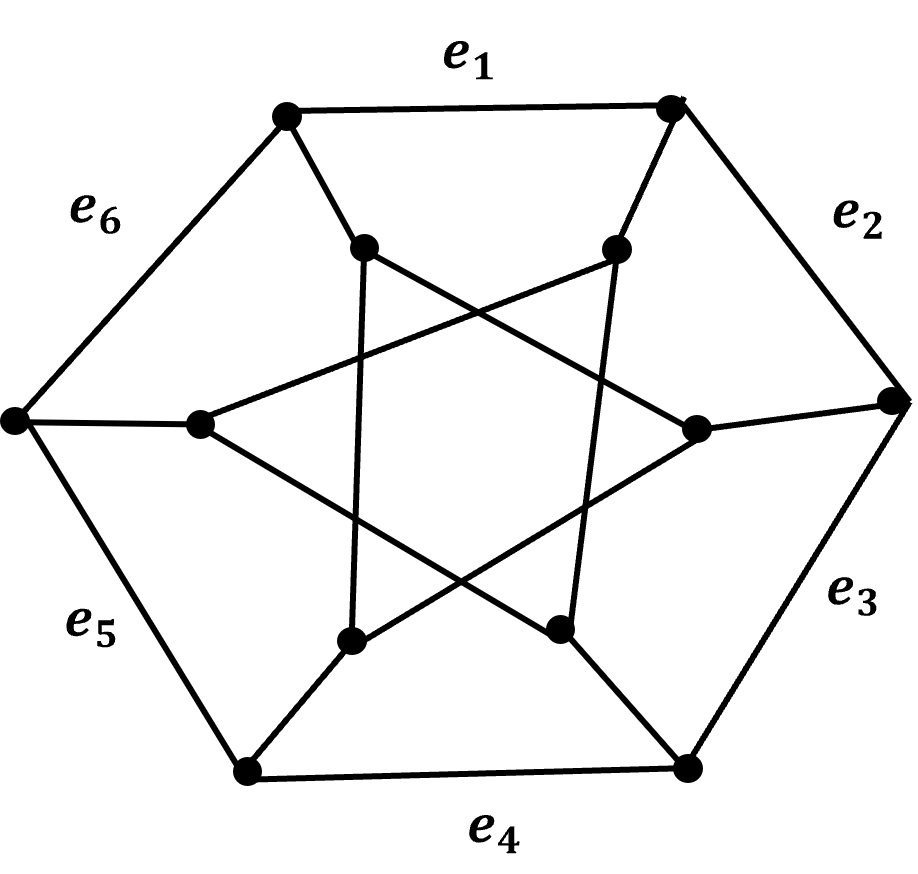
If \(\textit{P}\)(\(e_{14}\)) = 25 and consider the distribution of 1 pebble moves to each of the edges \(e_{1}\), \(e_{8}\), and \(e_{10}\), we can dominate all the edges of \(GP_{6,2}\) with 25 pebbles. If we also place 25 pebbles on any other edges of \(GP_{6,2}\) and alter the configuration of pebbles, we can dominate all the edges of \(GP_{6,2}\). Thus, the domination cover edge pebbling number for the Generalized Petersen \(GP_{6,2}\) graph is \(\textit{$\psi_{e}$}\)(\(GP_{6,2}\)) = 25. ◻
Theorem 3.9. The domination cover edge pebbling number for the Generalized Petersen graph \(GP_{7,1}\) is \(\textit{$\psi_{e}$}\)(\(GP_{7,1}\)) = 28.
Proof. For \(GP_{7,1}\), let \(e_{1}\), \(e_{2}\), \(e_{3}\), \(e_{4}\), \(e_{5}\), \(e_{6}\) and \(e_{7}\) be the outer edges of \(GP_{7,1}\). Let \(e_{8}\) be the edge that connects both the inner and outer polygons and adjacent to both the edges \(e_{1}\) and \(e_{2}\). Let \(e_{9}\) be the edge that connects both the inner and outer polygons and adjacent to both the edges \(e_{2}\) and \(e_{3}\). Let \(e_{10}\) be the edge that connects both the inner and outer polygons and adjacent to both the edges \(e_{3}\) and \(e_{4}\). Let \(e_{11}\) be the edge that connects both the inner and outer polygons and adjacent to both the edges \(e_{4}\) and \(e_{5}\). Let \(e_{12}\) be the edge that connects both the inner and outer polygons and adjacent to both the edges \(e_{5}\) and \(e_{6}\). Let \(e_{13}\) be the edge that connects both the inner and outer polygons and adjacent to both the edges \(e_{6}\) and \(e_{7}\). Let \(e_{14}\) be the edge that connects both the inner and outer polygons and adjacent to both the edges \(e_{1}\) and \(e_{7}\). Let \(e_{15}\) be the inner edge of \(GP_{7,1}\) and adjacent to both the edges \(e_{8}\) and \(e_{14}\). Let \(e_{16}\) be the inner edge of \(GP_{7,1}\) and adjacent to both the edges \(e_{8}\) and \(e_{9}\). Let \(e_{17}\) be the inner edge of \(GP_{7,1}\) and adjacent to both the edges \(e_{9}\) and \(e_{10}\). Let \(e_{18}\) be the inner edge of \(GP_{7,1}\) and adjacent to both the edges \(e_{10}\) and \(e_{11}\). Let \(e_{19}\) be the inner edge of \(GP_{7,1}\) and adjacent to both the edges \(e_{11}\) and \(e_{12}\). Let \(e_{20}\) be the inner edge of \(GP_{7,1}\) and adjacent to both the edges \(e_{12}\) and \(e_{13}\). Let \(e_{21}\) be the inner edge of \(GP_{7,1}\) and adjacent to both the edges \(e_{13}\) and \(e_{14}\). Now, we need to find the minimum number of pebbles to cover the edges that form an edge dominating set.
If \(\textit{P}\)(\(e_{1}\)) = 27 and consider the distribution of 1 pebble moves to each of the edges \(e_{4}\), \(e_{7}\), \(e_{17}\) and \(e_{20}\), the edge \(e_{15}\) will be left undominated. So, \(\textit{$\psi_{e}$}\)(\(GP_{7,1}\)) \(\geq\) 28.
For proving the sufficient part, If \(\textit{P}\)(\(e_{i}\)) = 1, 2, 3 or 4 for 1 \(\leq\) \(\textit{i}\) \(\leq\) 21, we cannot dominate all the edges of \(GP_{7,1}\). So, \(\textit{$\psi_{e}$}\)(\(GP_{7,1}\)) \(\geq\) 5. If \(\textit{P}\)(\(e_{3}\)) = 1, \(\textit{P}\)(\(e_{6}\)) = 1, \(\textit{P}\)(\(e_{8}\)) = 1, \(\textit{P}\)(\(e_{18}\)) = 1 and \(\textit{P}\)(\(e_{21}\)) = 1, we can dominate all the edges of \(GP_{7,1}\) with 5 pebbles and if \(\textit{P}\)(\(e_{8}\)) = 1, \(\textit{P}\)(\(e_{3}\)) = 3, \(\textit{P}\)(\(e_{7}\)) = 3 and \(\textit{P}\)(\(e_{18}\)) = 3 and consider the distribution of 1 pebble moves to each of the edges \(e_{4}\), \(e_{14}\) and \(e_{19}\), we can dominate all the edges of \(GP_{7,1}\) with 10 pebbles. So, in this distribution of pebbles, we need at most 10 pebbles to dominate all the edges of \(GP_{7,1}\).
If \(\textit{P}\)(\(e_{8}\)) = 1, \(\textit{P}\)(\(e_{3}\)) = 4, \(\textit{P}\)(\(e_{7}\)) = 3 and \(\textit{P}\)(\(e_{18}\)) = 3 and consider the distribution of 1 pebble moves to each of the edges \(e_{4}\), \(e_{9}\), \(e_{14}\) and \(e_{19}\), we can dominate all the edges of \(GP_{7,1}\) with 11 pebbles. If \(\textit{P}\)(\(e_{4}\)) = 17, \(\textit{P}\)(\(e_{1}\)) = 1 and \(\textit{P}\)(\(e_{19}\)) = 1 and consider the distribution of 1 pebble moves to each of the edges \(e_{13}\), \(e_{16}\) and \(e_{19}\), we can dominate all the edges of \(GP_{7,1}\) with 19 pebbles. So, in this distribution of pebbles, we need at most 19 pebbles to dominate all the edges of \(GP_{7,1}\).
If \(\textit{P}\)(\(e_{4}\)) = 17, \(\textit{P}\)(\(e_{11}\)) = 2 and \(\textit{P}\)(\(e_{1}\)) = 1 and consider the distribution of 1 pebble moves to each of the edges \(e_{13}\), \(e_{16}\) and \(e_{19}\), we can dominate all the edges of \(GP_{7,1}\) with 20 pebbles. If \(\textit{P}\)(\(e_{1}\)) = 26 and \(\textit{P}\)(\(e_{7}\)) = 1 and consider the distribution of 1 pebble moves to each of the edges \(e_{4}\), \(e_{8}\), \(e_{17}\) and \(e_{20}\), we can dominate all the edges of \(GP_{7,1}\) with 27 pebbles. So, in this distribution of pebbles, we need at most 27 pebbles to dominate all the edges of \(GP_{7,1}\).
If \(\textit{P}\)(\(e_{1}\)) = 28 and consider the distribution of 1 pebble moves to each of the edges \(e_{4}\), \(e_{7}\), \(e_{8}\), \(e_{17}\) and \(e_{20}\), we can dominate all the edges of \(GP_{7,1}\) with 28 pebbles. If we also place 28 pebbles on any other edges of \(GP_{7,1}\) and alter the configuration of pebbles, we can dominate all the edges of \(GP_{7,1}\).
Thus, the domination cover edge pebbling number for the Generalized Petersen \(GP_{7,1}\) graph is \(\textit{$\psi_{e}$}\)(\(GP_{7,1}\)) = 28. ◻
In this paper, domination cover edge pebbling number for some of the Generalized Petersen graphs, Jewel graph and Triangular snake graph are determined. Investigating the domination cover edge pebbling number for the remaining Generalized Petersen graphs and other families of graphs is still an open research question.