
With the rise of new media, people can access all kinds of information on a global scale through the Internet, social media and other channels. This change in approach has impacted the traditional regional media’s access to information, and the readers and viewers of traditional newspapers, television and other media are gradually decreasing. The rise of new media has also changed the advertising model. The advertising mode of new media is more flexible and diverse, for example, search engine advertising, social media advertising, etc., through content innovation, providing high-quality, targeted content to attract readers and viewers [19,4,18].
For enterprises, the convenience of new media communication and promotion will also lead to increasing competition for enterprise products, in addition to improving and innovating the advertising communication mechanism in new media, enterprise products should also be constantly iterated and updated, to seize the consumer’s point of request, so that the product with the help of the new media platform to better convey the advantages of the product to consumers [3,27,12,1]. In this process, the use of deep neural networks to predict the development of the enterprise platform, analyze the laws of user behavior, mining user demand is very critical [11,13,22]. Based on this, it is possible to understand the conversion effect of platform advertising, as well as the operation and development trend of enterprise products, so as to take corresponding countermeasures and promote efficient cooperation between the two sides [9,14,28].
Blockchain technology will reconstruct the new media industry in the future. On the one hand, the core advantages of blockchain are obvious. Blockchain has five major characteristics, such as highly decentralized, highly reliable, value transfer, information tamperability, and highly protected privacy. The essence of blockchain is an information decentralized decision-making mechanism that can accomplish the established social goals [16,6,7]. And the core advantage of blockchain is that it can better transfer value, can better protect user privacy and help users get more rights, and change the production relationship of the Internet [24,26,20]. On the other hand, a new media ecosystem based on blockchain will gradually take shape. Theoretically, with the gradual maturation of blockchain technology, blockchain will become the underlying operating system of the whole society, and “blockchain + media industry” will usher in a new ecology, which will make significant innovations in the concept, ecosystem, business model and other aspects [8,5,17,2].
In this paper, a multi-task deep learning neural network model is constructed, and the pooling module and attention module in the model are used to analyze the user’s key information and extract the keywords in the advertisement content to extract the relevant words that the user is interested in. Then the extracted keywords related to the advertisement content are normalized by softmax layer to get the vector representation of the advertisement content and realize the intelligent optimization of the advertisement content in the new media platform. The multi-task deep neural network model is trained by the loss function of binary classification crossover to improve its intelligent optimization effect. Subsequently, the neural network model is equipped to design the intelligent optimization and recommendation system of new media advertisement content based on blockchain technology, and the development and deployment of the system is realized by building the FISCO BCOS blockchain console, and MySQL is used to store the user’s private data in the new media platform. This study first verifies and analyzes the effect of the intelligent optimization model of advertisement content, then tests and analyzes the performance of the new media advertisement content optimization and recommendation system based on blockchain technology, and finally explores the application effect of the system through practical application.
\[\label{GrindEQ__1_} b_{j} =z^{T} \tanh \left(W_{u}^{att{\rm \; }} e_{u} +W_{q}^{att{\rm \; }} e_{q} +W_{a}^{att{\rm \; }} Em\left(d_{j} \right)\right), \tag{1}\] where \(W_{u}^{att}\), \(W_{q}^{att}\) and \(W_{a}^{att}\) are the parameters of the first layer of the network, \(e_{u}\) and \(e_{q}\) are the vector representations about the user and the query terms, \(z^{T}\) are the parameters of the second layer of the network, and \(b_{j}\) is the weight score for \(d_{j}\). Finally it is normalized by one softmax layer [10] as shown in Eq. (2):
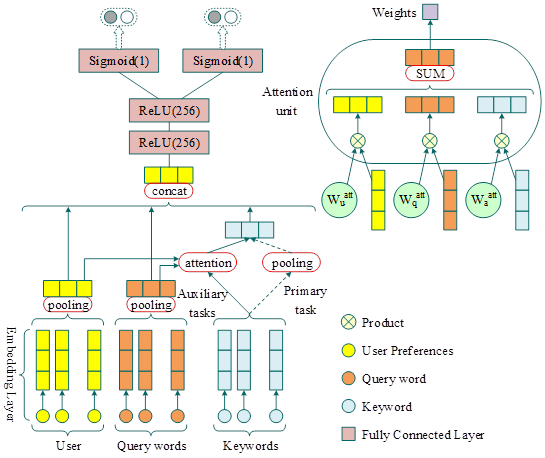
\[\label{GrindEQ__2_} \alpha _{j} =\frac{\exp \left(b_{j} \right)}{\sum _{i=1}^{n}\exp \left(b_{i} \right)} , \tag{2}\] where \(\alpha _{j}\) is the corresponding attention weight and finally combined with \(Em\left(d_{j} \right)\) to make a weighted sum as shown in Eq. (3): \[\label{GrindEQ__3_} e_{a} =\sum _{j=1}^{n}\alpha _{j} Em\left(d_{j} \right) , \tag{3}\] where \(e_{a}\) is the final needed vector representation about \(a\) the advertisement content, since the desire to extract the most important words in the advertisement content relates to the user’s own preference as well as the current input query word, this paper adds the influence of the user and the query word in the attention mechanism as a way to enhance the effect of personalized intelligent optimization.
Regarding the model training in this paper, firstly, the loss function of the model is introduced, both tasks are binary crossover loss function, and the loss function of the main task is shown in Eq. (4): \[\label{GrindEQ__4_} {\rm {\mathcal L}}_{main} =-\frac{1}{\left|S^{SF} \right|} \sum \left[y\log y{'} +(1-y)\log \left(1-y{'} \right)\right] , \tag{4}\] where \({\rm {\mathcal L}}_{main}\) denotes the loss function for the primary task and \(\left|S^{SF} \right|\) denotes the number of sample instances in \(S^{SF}\). Similarly, the loss function for the auxiliary task is shown in Eq. (5): \[\label{GrindEQ__5_} {\rm {\mathcal L}}_{aux} =-\frac{1}{\left|S^{C} \right|} \sum \left[y^{c} \log \left(y^{c} \right)^{{'} } +\left(1-y^{c} \right)\log \left(1-\left(y^{c} \right)^{{'} } \right)\right] , \tag{5}\] where \({\rm {\mathcal L}}_{aux}\) denotes the loss function of the auxiliary task, \(\left(y^{c} \right)^{{'} }\) denotes the labels of the sample instances in \(S^{c}\) and \(\left|S^{c} \right|\) denotes the number of sample instances in \(S^{c}\).
The model training approach proposed in this paper is slightly different from the classical multi-task learning model applicable to joint learning. For joint learning training, it means that the classical multi-task deep learning model has the same sample instances as inputs for one small batch update of multiple tasks during training. Multiple tasks share the same input source (i.e., the same sample instance input), and then multiple tasks simultaneously output different results. However, the two tasks in this paper do not share the same input source, but \((u,q,v)vs(u,q,a)\). For example, when taking a small batch of instances from \(S^{SF}\) or \(S^{c}\) as input, the model cannot update the parameters of both tasks simultaneously. Therefore, this paper investigates two training methods, pre-training and alternate training.
In this paper, we use \(\Theta _{1} /\Theta _{2}\) to denote the set of parameters associated with the auxiliary task/primary task, respectively. The model is trained iteratively by sampling small batches from the full training dataset, and the data sources for the primary and auxiliary tasks are randomly selected with a probability ratio of \(1:k\) at each iteration update. Then, the small batch datasets are selected from the training set \(S^{SF}\) or \(S^{c}\) according to different tasks to update the relevant model parameters. In this paper, the probability of setting the auxiliary task to be selected is \(k\) times that of the main task because the size of the dataset for \(S^{c}\) is usually larger than \(S^{SF}\). The criterion for setting \(k\) is so that the two data sources, the primary task and the auxiliary task, can both perform iterative parameter updates approximately the same number of times when the algorithm stops iterating. This ensures that the model can be adequately trained with both datasets.
First, in this paper, the parameters of the auxiliary task model are individually trained using dataset \(S^{c}\), and the model converges to obtain the trained parameter set \(\Theta _{1}\). These trained parameters (except for the parameters of the output layer and the attention module) are then used as a priori knowledge. The model for the main task overloads these trained parameters to further fine-tune the training using dataset \(S^{SF}\).
In order to make the above method of intelligent optimization of new media advertisement content be applied more efficiently and safely in the field of new media advertisement content recommendation, this paper designs a blockchain-based new media advertisement content intelligent optimization and recommendation platform to realize the application of the above method.
For a system, before the design and development of the role of the system, the function of the system needs to be an overall planning to ensure the integrity of the system development. For this reason, before designing and building the new media advertising content intelligent optimization and recommendation system, we start from the perspective of software design, and conduct a demand analysis of the designed advertising content intelligent optimization and recommendation system, to clarify the feasibility of the system implementation conditions and the required functions. Then the overall architecture of the system is designed based on certain design concepts, and finally the design and implementation of each functional module is elaborated.
System functional requirements analysis is the core task before system construction, when the user enters the new media platform its core purpose is to intelligently optimize personalized advertising content for recommendation. Therefore, the functional requirements of an intelligent optimization and recommendation system for advertising content are mainly divided into user requirements and platform requirements. For the new media platform, the core functions include advertisement content optimization and recommendation, user privacy information upload management, user information management, upload contract management, public platform management and other functions.

The overall architecture of the platform includes the bottom layer environment, database, data layer, service layer, and application layer, and its overall structure is shown in Figure 2. The blockchain bottom layer [21] is responsible for building a blockchain storage environment based on FISCO BCOS, which ensures the security of key data in the system through distributed storage. In the data layer, traditional local database and blockchain database are used to provide the platform with two data storage channels: on-chain storage and local storage, which improves the security of the platform and saves offline storage space. In the service layer, various functional functions are called to realize the business functions of the system. In the application layer, the invocation and display of functions in the service layer will be realized, through which the functions of the back-end and the front-end can be separated, so as to realize better system maintainability and expandability.
Before the system development, the blockchain underlying development environment needs to be built. This system is carried out in VMware 14Pro virtual machine under Windows 10, with Ubuntu 16 as the underlying operating system, and developed based on B/S structure.
The process of building the blockchain underlying environment is as follows.
(1) Install Ubuntu 16 in the virtual machine, utilize commands to install dependencies such as Docker, Docker Compose, etc., and download relevant script files in the terminal.
(2) Use the downloaded build_chain environment deployment script to create a chain script to build a 4-node FISCO BCOS blockchain, use the start_all.sh script file to start the node, and realize the current node status and log view.
(3) After completing the node startup, obtain the console configuration file and console-related protocol certificates through the command to realize the construction of the FISCO BCOS blockchain console.
(4) After the successful construction of FISCO BCOS, it can interact with the blockchain network through the Java SDK interface to realize the development and deployment of blockchain applications.
Privacy data upload storage utilizes the characteristics of blockchain data that are untamperable and traceable, and the information that users need to protect is uploaded and stored by designing privacy upload contracts. The local database storage adopts MySQL, which is responsible for storing the table of basic user information, the table of user interaction behavior information, and the table of advertisement content resource information.
Data tampering is one of the most concerning personal information security issues in the browsing of new media platforms.For various personal or commercial purposes, users need to share their personal information with new media platforms.Illegal merchants will take advantage of this information sharing channel to gain convenience and steal it without users’ authorization. While intelligent advertisement content optimization and recommendation system is an important part of new media platforms, this type of system lacks security control of client information to some extent. Therefore, this paper provides security for key data with the help of data storage mechanism of blockchain. First, the data uploading process is divided into three stages: the client request side, the blockchain storage side and the server. For the first stage, it is necessary to trigger the user in the client to initiate the data uploading application; then the data is transmitted to the blockchain for storage; finally, the uploading contract is written in Solidity language and deployed to the server to be called, which realizes the uploading of the private data to improve the security of the data on the recommendation platform.
(1) Datasets. Criteo is a benchmark dataset for CTR prediction, it has 52 million ad click records, it contains 28 categorical feature fields and 14 numerical feature fields.KKBox is a challenge dataset for ad content recommendation, the data contains the ad content of the users for a given time period, there are 21 user features (e.g., city, gender) and ad content features (e.g., games, music, shopping, etc.). For each dataset, it is randomly divided into 3 parts, 70% for training, 15% for validation, and 15% for testing.
(2) Evaluation Metrics. In the experiment, two indicators, AUC and Logloss, are used to judge the effect of the intelligent optimization model of advertisement content. The larger the value of AUC and the smaller the value of Logloss, the better the model predictions. When the value of AUC is increased by 0.001 or the value of Logloss is decreased by 0.001, it is important for the intelligent optimization recommendation task of new media advertising content.
(a) Logloss. This index is mainly based on the difference between the predicted value and the actual value to judge the accuracy of the recommendation, the smaller the Logloss value represents that the recommended results are closer to the user’s real evaluation, the better the prediction effect of the system. This indicator is also used as a loss function for CAN and comparison model training. The judging criteria are shown as: \[\label{GrindEQ__6_} \log loss=-\frac{1}{N} \sum _{i=1}^{N}y_{i} \log \left(p_{i} \right)+\left(1-y_{i} \right)\log \left(1-p_{i} \right) , \tag{6}\] where \(p_{i}\) is the predicted click probability of the \(i\)nd and \(y_{i}\) is the real clicks by users of that ad, and \(N\) is the total number of ads in the test set.
(b) AUC. The AUC value is equal to the probability that a randomly selected positive sample is ranked higher than a randomly selected negative sample. A higher AUC indicates a better predictive ranking performance of the recommender system. In the actual simulation, the formula is used to calculate the AUC value: \[\label{GrindEQ__7_} AUC=\frac{\sum _{i=1,j=1}^{i\le M,j\le N}\delta \left(r_{i} -r_{j} >0\right)+0.5\delta \left(r_{i} -r_{j} =0\right)}{M*N} , \tag{7}\] where \(M\) represents the number of positive samples (items actually clicked by the user), \(N\) represents the number of negative samples (items not actually clicked by the user), \(r_{i}\) is the predicted score of the positive samples, \(r_{j}\) is the predicted score of the negative samples, \(\delta (x)\) is the indicator function, \(x\) is a Boolean variable and \(\delta (x)\) is 1 when \(x\) is true, and on the contrary, \(\delta (x)\) is 0.
(3) Comparison of models. In order to test the effectiveness of the intelligent optimization model for advertisement content, comparison experiments are conducted using the following nine widely used advertisement content optimization and recommendation methods, namely FM, DeepFM, DCN, AFM, xDeepFM, AutoInt, AFN, DCN V2, and FmFM.
The AUC and Logloss of the deep network learning model and other models on the two datasets Criteo and KKBox were obtained through experiments, and the results of the experiments comparing the various models are shown in Table 1. In the Criteo dataset, the deep neural network model proposed in this paper is slightly more effective compared with the FmFM model and DCN V2 model, which are more effective among the comparison models. The AUC metric is 0.28% and 1.36% higher than the FmFM model and the DCN V2 model, respectively, and the Logloss metric is 0.50% and 0.75% lower than the two compared models. From the results of the comparative analysis of the model effect on the KKBox dataset, the deep neural network model proposed in this paper has slightly improved its effect compared with xDeepFM, with the AUC metric being 1.21% higher than that of xDeepFM, and the Logloss metric being 0.25% lower than that of xDeepFM. It can be seen through experiments that the multi-task deep neural network model model proposed in this paper is better than other models. Whether the data is fully mined also has an impact on the effect of intelligent optimization of advertising content, and the hidden vectors output from each layer in the deep neural network model proposed in this paper are given different importance through the attention mechanism. Instead of directly in the deep neural network directly into the next layer for processing, to avoid the loss of information, as a way to fully mine the information in the deep neural network, so it improves the effect of intelligent optimization of advertising content. Therefore, the model effect of the deep neural network model proposed in this paper is better than other comparative models.
| Model | Criteo | KKBox | ||
| AUC | Logloss | AUC | Logloss | |
| FM | 0.7925 | 0.4662 | 0.8194 | 0.5263 |
| DeepFM | 0.7952 | 0.4638 | 0.8266 | 0.5184 |
| DCN | 0.8022 | 0.4571 | 0.8283 | 0.5147 |
| AFM | 0.8037 | 0.4541 | 0.8316 | 0.5065 |
| xDeepFM | 0.8175 | 0.4532 | 0.8554 | 0.5052 |
| AutoInt | 0.8261 | 0.4228 | 0.8601 | 0.4895 |
| AFN | 0.8293 | 0.4213 | 0.8654 | 0.4889 |
| DCN V2 | 0.8334 | 0.4192 | 0.8655 | 0.4848 |
| FmFM | 0.8442 | 0.4167 | 0.8657 | 0.4819 |
| This model | 0.847 | 0.4117 | 0.8675 | 0.4802 |
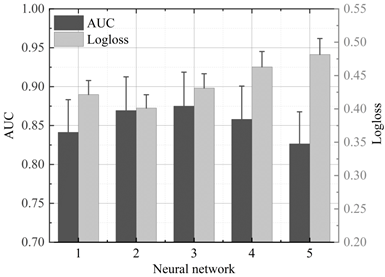
The number of neural network layers in a deep neural network model greatly affects the performance of the model. In this experiment, we verify the effect on the performance of the proposed model by setting different number of network layers, and the model adopts fully connected network layers, and the number of neurons in each layer is kept consistent at 256. In order to exclude the chance of a single experiment, three identical experiments are conducted in this paper. The results of the influence of the network depth in the deep neural network model on the effect of the intelligent optimization algorithm for advertising content are shown in Figure 3. The horizontal coordinate in the figure is the number of layers of the neural network, and the range is set from 1 to 5. In terms of Logloss, more network layers did not achieve the intelligent optimization of ad content that has been improving the algorithm, and fewer layers of nerves brought less error. In terms of AUC metrics, the 2-layer (0.8692) and 3-layer (0.8749) are comparable, but the 5-layer neuron (0.8264) greatly reduces the ad content intelligence optimization accuracy. The reason is that the deep neural network model proposed in this paper improves the training effect of the neural network by constructing low-order feature intersection, and the model creates rich feature interaction information at the bottom layer. Therefore, only fewer nonlinear function architectures are needed to train to obtain higher-order interaction information. Just the opposite, too deep models instead add complexity to the model and do not improve the performance of intelligent optimization of advertisement content. In addition, it can be seen from the results that the AUC value (0.8692) and Logloss value (0.4012) of the model with the 2 neural network layers setting are superior for all network depths.
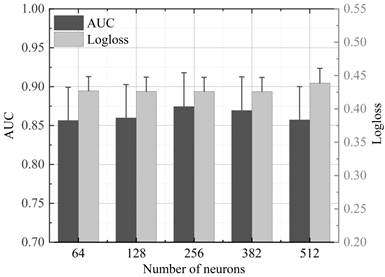
In addition to the number of neural network layers, the number of neurons per layer also affects the efficiency of the algorithm. In this paper, we explore the impact on the model effect by changing the number of neurons in each layer, the number of layers of the neural network are set to 2 layers, and the analysis results of the model’s intelligent optimization effect of the advertisement content under different numbers of neurons are shown in Figure 4. The horizontal coordinate indicates the number of neurons in each layer, ranging from 64 to 512. It can be concluded that the number of neurons has a relatively small impact on the accuracy of intelligent recommendation and optimization of advertising content, and the magnitude of the change in the index is not large under the same scale (0.8564-0.8742). This indicates that increasing the number of neurons does not increase the performance of the multitasking deep network model.
The advertisements in a new media platform are released by the company that belongs to the new media platform. In this paper, the new media advertisement content intelligent optimization and recommendation system designed by combining deep neural network and blockchain technology is applied to the advertisement recommendation system of this new media platform. The system performance is tested and analyzed from three aspects: system throughput, load test, and advertisement content optimization and recommendation effect.
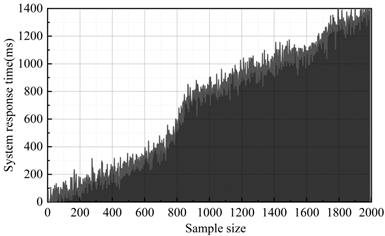
The system text recognition function is used for throughput performance testing and demonstration, and the throughput test results of the new media advertising content intelligent optimization and recommendation system are shown in Figure 5. In the 2000 data test samples, the average response time of each request is 696.86ms, the throughput is 10.63/s, and the error rate is 0. To perform text recognition in the system, the Chinese text in the request is first obtained, and then the text is recognized by the deep learning model in the system and finally the recognition results are returned. Also from the results it can be seen that the processing and response time of the system for each request is smoother and meets the requirements of the system’s non-functional needs.
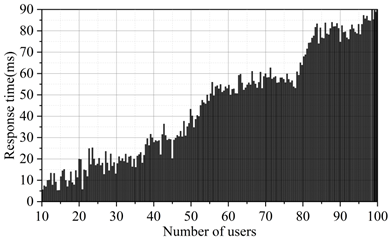
Next, the response time of the system is tested under different load conditions, and the results of the relationship between the number of users and the response time of the system are shown in Figure 6. It can be seen that as the system load increases, the average response time also increases, but the increase is not large and the performance can meet the daily demand. In order to ensure that the system can work properly within the demand range, the system load test is an essential part. Load testing is to test the performance of the system under a certain load condition. The load level can be either the number of users accessing the system by their coworkers or the amount of data processed by the system online. In this paper the system load test starts with 10 people accessing at the same time to send the request and increases in that order. When 100 people access the request at the same time, the average response time of the system is about 45.19ms. Thus the system can satisfy multiple simultaneous accesses and meets the non-functional load requirements.
The calculation time for optimizing and recommending advertisement content to a single user for different numbers of new media advertisements in the advertisement pool is tested, and the test results are shown in Table 2. In the advertisement intelligent optimization and recommendation system, optimizing the content of new media advertisements for users is the core function, and as the number of new media advertisements in the advertisement pool of the system grows more and more, the time spent on advertisement intelligent optimization and recommendation for a user also grows longer. In the process of intelligent optimization and recommendation of advertisement content, we mainly sort and recommend from the matching degree of user’s interest preference and advertisement theme, and the similarity between user’s preference vector and advertisement keyword vector. Therefore, it can be seen from the results that as the number of new media advertisements in the ad pool increases, the time required for content intelligent optimization and recommendation also increases gradually. When the number of advertisements is 500, the time required by the system is only 0.053 s. When the number of advertisements is 10,000, the time required to intelligently optimize and recommend other advertisements of interest to a user is only 0.396 s, which meets the non-functional requirements of the system for the running time of the advertisement content intelligent optimization algorithm.
| Advertising number | Computation time (s) | Advertising number | Computation time (s) |
| 500 | 0.053 | 5500 | 0.228 |
| 1000 | 0.054 | 6000 | 0.278 |
| 1500 | 0.096 | 6500 | 0.282 |
| 2000 | 0.108 | 7000 | 0.285 |
| 2500 | 0.146 | 7500 | 0.33 |
| 3000 | 0.147 | 8000 | 0.336 |
| 3500 | 0.176 | 8500 | 0.337 |
| 4000 | 0.176 | 9000 | 0.386 |
| 4500 | 0.178 | 9500 | 0.39 |
| 5000 | 0.19 | 10000 | 0.396 |
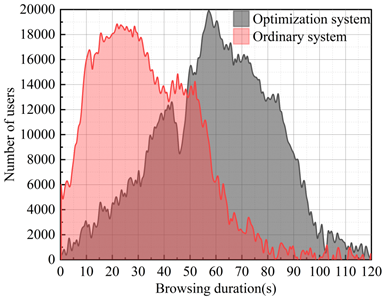
For users, their attitudes and behaviors towards new media advertisements can be divided into four categories: not interested in clicking, not interested in clicking by mistake, wanting to learn more about the details of clicking and browsing and then exiting the advertisement, browsing the advertisement to learn more about the details of the advertisement and then participating in the activity, downloading the APP or purchasing the goods. For users who have clicked on new media advertisements, the user’s attitude can be determined by the length of time the user stays in the advertisement content. In this paper, the data collected from users of a new media platform include the time stamps of users clicking on new media advertisements and the time stamps of users going to the next page/jumping out of the current page, so that the length of stay of users on new media advertisements can be obtained. This paper combines the collected user data of a new media platform with the statistics of the advertisement browsing time of users under the original advertisement content recommendation system and the intelligent optimization content and recommendation system of the new media platform to analyze the actual application effect of the content optimization and recommendation system. As shown in Figure 7, the browsing time of new media ads by users is generally controlled at about 10s-30s under the application of the original advertisement recommendation system, and some users will not browse new media ads at all. It can be assumed that users who stay in the new media ads for a very short time are likely to misuse the ads and are less interested in the ad content. Users who stay in new media ads for too long are likely to forget to close or jump out of the page after browsing the ads. With the application of intelligent content optimization and recommendation system, the advertisement browsing time of about 20,000 users reaches about 58s, and the browsing time of most users is higher than 50s, which indicates that the advertisement content intelligent optimization and recommendation system combining multi-task deep neural network and blockchain technology can accurately analyze the user’s preference and realize the intelligent optimization of advertisement content.
In this study, the attention module in the multi-task deep neural network model is used to analyze the information and advertisement content keywords of different users in the new media platform, so as to realize intelligent new media advertisement content optimization. Then it combines with blockchain technology to construct a new media advertisement content optimization and recommendation system. The performance of the model and the system is tested, and it is found that the deep neural network model proposed in this paper slightly improves the effect of intelligent optimization of advertisement content in the KKBox dataset compared with xDeepFM, with the AUC index being 1.21% higher than that of xDeepFM, and the Logloss index being 0.25% lower than that of xDeepFM. Meanwhile, it is found that the new media advertising content optimization and recommendation system has an average response time of 696.86ms per request with an error rate of 0 under 2000 data tests, and the system can satisfy multiple simultaneous accesses, which meets the non-functional load requirements. Exploring the application effect of the system in the actual environment of a new media platform, it is found that under the application of intelligent content optimization and recommendation system, the advertisement browsing time of about 20,000 users reaches about 58s, and the browsing time of most users is higher than 50s, which is much higher than the browsing time under the application of the original advertisement recommendation system of the new media platform.
Hence, no matter for the purpose of profitability and platform development, the intelligent optimization and recommendation system for new media advertisement content proposed in this paper appears to have high application value. While realizing personalized ad content optimization and accurate recommendation for new media users, it also realizes the ad configuration management and other management functions that the ad system should have.
This work was supported by Research on barrier-free communication from the perspective of digital infrastructure: A case study of the use of smart phones by visually impaired youth in Chongqing(KY202301B); Science and Technology Research Project of Chongqing Education Commission: Building and Utilizing Personal Learning Environment for College Students Based on Intelligent Technology (No. KJQN202301608-2).