
We consider finite, simple, and undirected graphs. A graph is denoted by \(G=G(V,E)\) with vertex set \(V\) and edge set \(E\). The order of \(G\) is \(n = |V|\), and the size is \(m = |E|\). An edge between vertices \(u\) and \(v\) is denoted by \(u v\). The degree of a vertex \(v_i\) in \(G\), denoted \(d_{v_i}(G)\) (or simply \(d_i\) when the context is clear), is the number of vertices adjacent to \(v_i\). A complete graph is denoted by \(K_{n}\) and its complement by \(\overline{K}_{n}.\) The union of two graphs \(G_1 = G_{1}(V_1, E_1)\) and \(G_2 =G_{2} (V_2, E_2)\) is denoted \(G_1 \cup G_2\), and has vertex set \(V_1 \cup V_2\) and edge set \(E_1 \cup E_2\). The join of \(G_1\) and \(G_2\), denoted \(G_1 + G_2\), is the graph with vertex set \(V_1 \cup V_2\) and edge set \[E_{1} \cup E_{2} \cup \{uv \mid u \in V_{1},\, v \in V_{2}\}.\]
A nonempty subset \(S \subseteq V(G)\) is called a dominating set of \(G\), if every vertex in \(V(G) \setminus S\) is adjacent to at least one vertex in \(S\). The minimum cardinality among all dominating sets of \(G\) is the domination number of \(G\), denoted \(\gamma(G)\). For an overview of domination in graphs, see [14]. Domination sets are useful in network monitoring, when sensors or guards are stationed to view each node. They are also important in social network analysis, which involves simulating the diffusion of influence through key persons.
Let \(D(G, k)\) denote the number of dominating sets of size \(k\) in a graph \(G\). The domination polynomial of \(G\), denoted \(D(G, x)\), is defined as \[D(G, x) = \sum\limits_{k = \gamma(G)}^{n} D(G, k)\, x^k.\]
This polynomial serves as a generating function for the number of dominating sets of each size. A root of \(D(G, x)=0\) is called a domination root of \(G\). In general, computing the domination polynomial is difficult, as the smallest nonzero term occurs at the domination number \(\gamma(G)\), and determining whether \(\gamma(G) \leq k\) is NP-complete [11], where \(k\) is a positive integer. We note that the degree of the polynomial \(D(G, x)\) is order \(n\), which is same as \(|V(G)|.\) As all coefficients of \(D(G, x)\) are positive, then all the real zeros of \(D(G, x)\) are non-positive. Furthermore, for every graph \(G\), it is clear that \(0\) is always root of \(D(G, x)=0\). The roots of graph polynomials provide useful information about graph structure. Brown and Tufts [7] investigated the roots of domination polynomials in several graph families. A conjecture suggests that the set of integer domination roots in any graph is a subset of \(\{-2, 0\}\), (see [3]). The domination polynomial of the friendship and book graphs were studied in [5], along with their zeros and their limiting curves. Graphs characterized by their domination polynomials are of particular interest. For instance, complete multipartite graphs are determined by their domination polynomials [6]. For further developments on domination polynomials, see [5, 1, 4, 3]. The other types of graphs like independence, independence domination, matching polynomials can be seen in [15, 21, 8, 9, 12, 17, 2, 22, 18, 16, 20, 19]. Motivated by these properties of \(D(G, x)\), we carry forward the study of the domination polynomial of friendship graphs and their generalizations. We discuss their log-concave, unimodal properties along with peaks and investigate their zeros.
A sequence \(S = \{s_0, s_1, \dots, s_n\}\) of real numbers is called unimodal if there exists an index \(t\) with \(0 \leq t \leq n\), referred to as the peak (or mode) of \(S\), such that \[s_0 \leq s_1 \leq \dots \leq s_t \quad \text{and} \quad s_t \geq s_{t+1} \geq \dots \geq s_n.\]
A polynomial \(p(x) = \sum\limits_{i=0}^{n} \alpha_i x^i\) is said to be unimodal if the sequence of its coefficients \(\Pi = \{\alpha_0, \alpha_1, \dots, \alpha_n\}\) is unimodal. In particular, if \(t = 0\), then \(\Pi\) is decreasing, and if \(t = n\), then \(\Pi\) is increasing.
A polynomial \(p(x)\) is called symmetric (or self-reciprocal) if \(\alpha_i = \alpha_{n-i}\) for all \(0 \leq i \leq \left\lfloor \frac{n}{2} \right\rfloor\). The coefficients of a binomial series are symmetric. Moreover, \(p(x)\) is said to be log-concave if it satisfies \[\alpha_i^2 \geq \alpha_{i-1} \alpha_{i+1}, \quad \text{for all } 1 \leq i \leq n-1.\]
For example, the polynomial \(1 + 4x + 5x^2 + 51x^3 + 17x^4 + 13x^5\) is unimodal, whereas \(41 + 6x + 19x^2 + 6x^3 + 2x^4\) is not.
The following classical theorem is very useful in finding the bounds for the zeros of a polynomial.
Theorem 2.1 (Eneström-Kakeya Theorem [13]). Let \(f(x) = \sum\limits_{i=0}^{n} a_i x^i\) be a polynomial with all coefficients \(a_i > 0\). Then all the zeros of \(f(x)\) lie in the annular region defined by \[r \leq |z| \leq R,\] where \[r = \min \left\{ \left| \frac{a_i}{a_{i+1}} \right| : 0 \leq i \leq n-1 \right\}, \quad R = \max \left\{ \left| \frac{a_i}{a_{i+1}} \right| : 0 \leq i \leq n-1 \right\}.\]
The friendship (or Dutch-Windmill) graph \(F_{N}^{2}\) is a graph obtained by joining vertex of \(K_{1}\) with each vertex of \(n\) copies of \(K_{2}.\) Its order is \(N=1+2n.\) The Friendship theorem, (see, Erdös, Rényi, and Sós [10]) characterizes graphs in which every pair of distinct vertices has precisely one common neighbor, that is, the only graphs satisfying this condition are the friendship graphs. The domination polynomial satisfies the following properties:
a) \(D\Big (\bigcup_{i=1}^{t}G_{i}, x\Big ) = \prod_{i=1}^{t} D(Gi, x).\)
b) \(D(G_{1}+ G_{2}, x) = \big((1 + x)^{n_{1}} -1\big)\big((1 + x)^{n_{2}}-1\big)+ D(G_{1},x)+D(G_{2}, x).\)
The domination polynomial of friendship graph \(F_{n}^{2}\) is given in the following result.
Lemma 2.2. [5] The domination polynomial of \(F_{n}^{2}\) is \[D(F_{n}^{2}, x) = (2x + x^{2})^{n} + x(1 + x)^{2n}.\]
Alikhani, Brown and Jahari [5] proved the following facts about the domination polynomial of \(F_{n}^{2}.\)
a) It is proved that for odd \(n\), the polynomial \(D(F_{n}^{2}, x)\) has no real non-zero zero for odd \(n\).
b) The limit of domination roots of the friendship graphs is \(-1\) together with the hyperbola.
c) The friendship \(F_{n}^{2}\) and the book graph \(B_{n}\) share the same domination polynomial for some vertex deletion of \(B_{n}.\)
The following problems were asked in [5].
Problem 2.3. For \(F_{n}^{2}\) and \(B_{n}\), we have the following questions.
a) For \(n\) even, does \(F_{n}^{2}\) have exactly three real roots?
b) What is a good upper bound on the modulus of the roots of \(F_{n}\)?
c) What can be said about the domination roots of book graphs?
Another problem of interest for the domination polynomial of \(F_{n}^{2}\) and \(B_{n}\) is given as:
Problem 2.4. For \(F_{n}^{2}\) and \(B_{n}\), we have the following questions.
a) Are \(D(F_{n}^{2}, x)\) and \(D(B_{n}, x)\) unimodal and log-concave polynomial?
b) How about the bounds of the zeros of \(D(F_{n}^{2}, x)\) and \(D(B_{n}, x)\)?
We consider these problems for friendship and book graphs, and discuss their possible answers.
From Lemma 2.2, we have \[\begin{aligned} D(F_{n}^{2}, x) =& (2x + x^{2})^{n} + x(1 + x)^{2n}\\ =& \sum\limits_{i=0}^{n}\binom{n}{i}(2x)^{n-i}(x^{2})^{i}+x\sum\limits_{i=0}^{2n}\binom{2n}{i}x^{i}\\ =&\sum\limits_{i=0}^{n}\binom{n}{i}2^{n-i}x^{n+i}+\sum\limits_{i=0}^{2n}\binom{2n}{i}x^{i+1}\\ =&x+2nx^{2}+\binom{2n}{2}x^{3}+\binom{2n}{3}x^{4}+\dots+\binom{2n}{n-2}x^{n-1}+x^{n}\left (2^{n}+\binom{2n}{n-1}\right )\\ &+x^{n+1}\left (2^{n-1}\binom{n}{1}+\binom{2n}{n}\right )+x^{n+2}\left (2^{n-2}\binom{n}{2}+\binom{2n}{n+1}\right )+\dots+\\ &+x^{2n-2}\left(2^{2}\binom{n}{n-2}+\binom{2n}{2n-3} \right)+x^{2n-1}\left(2\binom{n}{n-1}+\binom{2n}{2n-2} \right)\\ &+x^{2n}(1+2n)+x^{2n+1}. \end{aligned}\]
Let \(a_{i}\)’s be the coefficients of the above polynomial. Then from the above expression and by the binomial coefficient behaviour, it is clear that \[a_{1}< a_{2}<\dots <a_{n+1}> a_{n+2}>a_{n+3}>\dots>a_{2n-1}>a_{2n}.\]
Thus, \(D(F_{n}^{2}, x)\) is unimodal with peak \(n+1.\) Again by the binomial behaviour of coefficients \(D(F_{n}^{2}, x)\), the log-concave property follows. Thus, we have the following proposition.

Proposition 2.5. Let \(D(F_{n}^{2}, x)\) be the domination polynomial of \(F_{n}^{2}.\) Then \(D(F_{n}^{2}, x)\) is unimodal and log-concave.
Furthermore, calculating \(\frac{a_{i}}{a_{i+1}},\) for \(0\leq i \leq 2n,\) we get \(r>0\) and \(R=1+2n.\) Thus by Eneström-Kakeya Theorem, we have the following consequence.
Proposition 2.6. The zeros of \(D(F_{n}^{2}, x)\) lie in the annulus \[0\leq |Z|\leq 1+2n.\]
We illustrate Proposition 2.5 and 2.6 by the following example: For \(n=12,\) the domination polynomial of \(F_{12}^{2}\) is \[\begin{aligned} D(F_{12}^{2},x)=&x + 24 x^2 + 276 x^3 + 2024 x^4 + 10626 x^5 + 42504 x^6 + 134596 x^7 + 346104 x^8\\ &+ 735471 x^9 + 1307504 x^{10} + 1961256 x^{11} + 2500240 x^{12} + 2728732 x^{13}\\ & + 2563728 x^{14} + 2073896 x^{15} + 1434224 x^{16} + 836847 x^{17} + 405240 x^{18} \\ &+ 159940 x^{19} + 50424 x^{20} + 12386 x^{21} + 2288 x^{22} + 300 x^{23} + 25 x^{24} + x^{25}. \end{aligned}\]
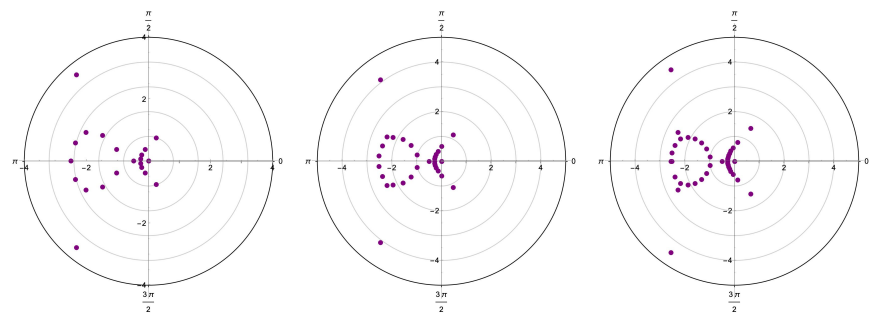
Clearly, \(D(F_{12}^{2},x)\) is log-concave and unimodal with peak value \(n+1=12+1=13\). Also, the zeros of \(D(F_{12}^{2},x)\) lie in \(0<|Z|<13\) and their zoomed view is depicted in Figure 1 (left).
For even \(n\), the domination polynomial of \(F_{n}^{2}\) has exactly three zeros, we are not able to prove, though we verified it computationally for \(1\leq n\leq 100.\)
From [5], the domination polynomial of book graphs is given in the following result.
Proposition 2.7 ([5]). The domination polynomial of book graph is given as \[D(B_{n},x)=(2x+x^{2})^{n}(1+2x)+x^{2}(1+x)^{2n}-2x^{n}.\]
Writing \(D(B_{n},x)\) in expanded form, we have \[\begin{aligned} D(B_{n},x)=&\sum\limits_{i=0}^{n}\binom{n}{i}2^{n-i}x^{n+i}(2x+1)+x^{2}\sum\limits_{i=0}^{2n}\binom{2n}{i}x^{i}-2x^{n}\\ =&\sum\limits_{i=0}^{n}\binom{n}{i}2^{n-i}(x^{n+i+1}+x^{n+i})+\sum\limits_{i=2}^{2n+2}\binom{2n}{i-2}x^{i}-2x^{n}\\ =&x^{2}+\binom{2n}{1}x^{3}+\binom{2n}{2}x^{4}+\dots+\binom{2n}{n-3}x^{n-1}+x^{n}\left(2^{n}-2+\binom{2n}{n-2}\right)\\ &+x^{n+1}\left(2^{n+1}+n2^{n-1}+\binom{2n}{n-1}\right)+x^{n+2}\left(n2^{n}+\binom{n}{2}2^{n-2}+\binom{2n}{n}\right)\\ &+\dots+x^{2n}\left(4n+1+\binom{2n}{2n-2}\right)+x^{2n+1}\left(2+\binom{2n}{2n-1}\right)+x^{2n+2}. \end{aligned}\]
For \(n=2\), we have \[D(B_{n},x)=3 x^2 + 16 x^3 + 15 x^4 + 6 x^5 + x^6,\] which is log-concave and unimodal with peak at \(3\). For \(n\geq 3,\) we have following observation:
By the binomial coefficients property, the coefficients of polynomial \(D(B_{n},x)\) satisfies \[a_{1}\leq a_{2}\leq \dots\leq a_{n}\leq a_{n+1}\leq a_{n+2}\geq a_{n+3}\geq \dots \geq a_{2n}\geq a_{2n+1}\geq a_{2n+2},\] with peak value at \(n+2\), for \(3\leq n\leq 7.\) While for \(n= 8,9\) the peak of \((2x+x^{2})^{n}(1+2x)\) is \(n+3\) and for \(x^{2}(1+x)^{2n}\), the peak value is \(n+2.\) Thus, it follows that \[a_{1}\leq a_{2}\leq \dots\leq a_{n}\leq a_{n+1}\leq a_{n+2}\leq a_{n+3}\geq a_{n+4}\geq \dots \geq a_{2n}\geq a_{2n+1}\geq a_{2n+2}.\]
While for \(n\geq 10,\) the peak value is \(n+2\), and the polynomial \(D(B_{n},x)\) is unimodal. Also, with the binomial coefficient behaviour, \(D(B_{n},x)\) is log-concave. The maximum of \(\Biggl\{\frac{a_{i}}{a_{i+1}}\Biggr\}_{i=0}^{2n+1}\) of the coefficients of \(h(x)\) is \(2n-1\), where \(D(B_{n},x)=x^{2}h(x)\) and \(a_{i}\)’s are the coefficients of \(h(x).\) The minimum of \(\Biggl\{\frac{a_{i}}{a_{i+1}}\Biggr\}_{i=0}^{2n+1}\) is strictly greater than zero. Thus, we have the following results.
Proposition 2.8. The domination polynomial \(D(B_{n}, x)\) of book graph is unimodal and log-concave.
Proposition 2.9. The zeros of \(D(B_{n}, x)\) lie in the annulus \[0\leq |Z|\leq 2n+2.\]
For \(n=8,\) the domination polynomial of \(B_{8}\) is \[\begin{aligned} D(B_{8},x)=&x^2 + 16 x^3 + 120 x^4 + 560 x^5 + 1820 x^6 + 4368 x^7 + 8262 x^8 + 12976 x^9+ 16710 x^{10} \\ &+ 16816 x^{11} + 12712 x^{12} + 7056 x^{13} + 2828 x^{14} + 800 x^{15} + 153 x^{16} + 18 x^{17} + x^{18}, \end{aligned}\] which is unimodal, log-concave and its zeros are represented in Figure 1 (right side).
Also, the limit of the zeros of \(D(B_{n}, x)\) is \(0,-1/2\), the hyperbola \(2a^{2}+4a-2b^{2}+1=0\) with center at \((-1,0)\), where \(a\) and \(b\) are real and imaginary parts of \(x.\) The other limiting curve of \(D(B_{n}, x)\) is \(a^{4}+4a^{3}+2a^{2}b^{2}+5a^{2}+4a+b^{2}-2b^{2}+1=0.\) The pictorial representation of zeros of \(D(B_{n}, x)\) is shown in Figure 2.
Now, we give the domination polynomial of generalized friendship graphs. If \(K_{2}\) is replaced by \(K_{n}\) in \(F_{n}^{2}\), then we obtain general friendship graph \(F_{N}^{n}\cong K_{1}+(nK_{n})\) of order \(N=n^{n}+1.\) If \(K_{1}\) is replaced by \(K_{n}\) in \(F_{N}^{n},\) then we obtain a generalized friendship graph \(G_{n}\cong K_{n}+(nK_{n})\) of order \(N=n^{n}+n.\) The following result gives the domination polynomial these generalized friendship graphs.
Theorem 2.10. The domination polynomial of \(F_{n}^{n}\) is \[D(F_{n}^{n},x)=x(1+x)^{n^{2}}+((1+x)^{n}-1)^{n}.\]
Proof. Since \(D(G_{1}\cup G_{2}, x) = D(G_{1}, x)D(G_{2}, x),\) so applying this concept repeatedly to \(nK_{n}=\underbrace{K_{n}\cup K_{n}\cup \dots\cup K_{n}}_{n},\) we have \[D(nK_{n};x)=((1+x)^{n}-1)^{n}.\]
Now, for \(K_{1}+(nK_{n}),\) we have \[\begin{aligned} D(F_{n}^{n},x)&=(1+x-1)^{1}((1+x)^{n^{2}}-1)+x+((1+x)^{n}-1)^{n}\\ &=x(1+x)^{n^{2}}+((1+x)^{n}-1)^{n}. \end{aligned}\] ◻
Similarly, for \(G_{n}\cong K_{n}+(nK_{n}),\) we have the following result.
Theorem 2.11. The domination polynomial of \(F_{n}^{n}\) is \[D(G_{n},x)=((1+x)^{n}-1)((1+x)^{n^{2}}-1)+(1+x)^{n}-1+((1+x)^{n}-1)^{n}.\]
From Theorem 2.10, we have \[\begin{aligned} D(F_{n}^{n},x)=&x(1+x)^{n^{2}}+((1+x)^{n}-1)^{n}\\ =&\sum\limits_{i=0}^{n^{2}}\binom{n^{2}}{i}x^{i+1}+\left(\sum\limits_{i=1}^{n}\binom{n}{i}x^{i}\right)^{n}. \end{aligned}\]
The polynomial \(\sum\limits_{i=0}^{n^{2}}\binom{n^{2}}{i}x^{i+1}\) is unimodal and log-concave due the binomial coefficient sequence. The peak is either \(\left \lceil \frac{n^{2}}{2}\right \rceil\) or \(\left \lceil \frac{n^{2}}{2}\right \rceil+1\), when \(n\) is odd, while peak is \(\frac{n^{2}}{2}+1\), for even \(n.\) Also, \(\Big(\sum\limits_{i=1}^{n}\binom{n}{i}x^{i}\Big)^{n}\) is a unimodal and log-concave polynomial with peak at \(\frac{n^{2}}{2},\) for even \(n\) and for odd \(n\), peak is \(\frac{n^{2}}{2}+1.\) The polynomial \(D(G_{n},x)\) is log-concave and unimodal with peak at \(\frac{n^{2}}{2}+1.\) Thus, we have the following result.
Proposition 2.12. The domination polynomial of \(F_{n}^{n}\) is unimodal and log-concave.
Proposition 2.13. The zeros of \(D(F_{n}^{n}, x)\) lie in the annulus \[0\leq |Z|\leq n^{2}+1.\]
Similarly, due to symmetry of the binomial coefficients of expressions in \(G_{n},\) we have the following results.
Proposition 2.14. The domination polynomial of \(G_{n}\) log-concave and is unimodal with peak \(\frac{n(n+1)}{2}.\)
Proposition 2.15. The zeros of \(D(G_{n}, x)\) lie in the annulus \[0\leq |Z|\leq n(n+1).\]
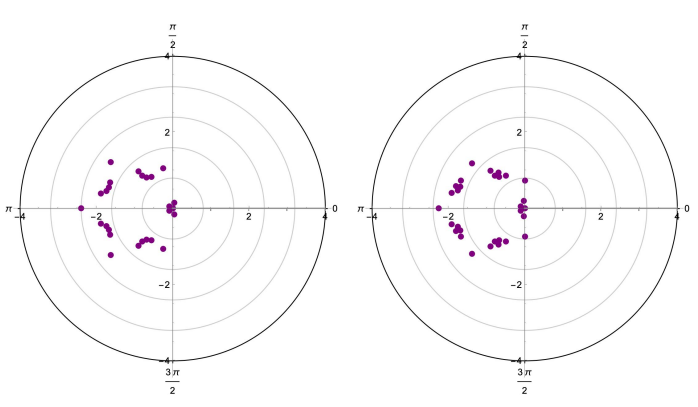
The limit of zeros of \(D(F_{n}^{n},x)\) and \(D(G_{n},x)\) represents beautiful curves (see Figure 3). It is indeed interesting to study theses curves.
If \(G\cong K_{n_{1}}+(K_{n_{2}}\cup\dots\cup K_{n_{t}}),\) with different \(n_{i}\)’s, then \(G\) is a friendship type graph with order \(n=\sum\limits_{i=1}^{t}n_{i}.\) We denote this graph by \(G(n_{1},\dots,n_{t})\). The following result gives the domination polynomial of \(G(n_{1},\dots,n_{t}).\)
Theorem 2.16. The domination polynomial of \(G\cong G(n_{1},\dots,n_{t})\) is \[D(G,x)=((1+x)^{n_{1}}-1)((1+x)^{n-n_{1}}-1)+((1+x)^{n_{1}}-1)+\prod_{i=2}^{t}((1+x)^{n_{i}}-1).\]
What can be said about the domination zeros and their limits, log-concave and unimodal property of \(D(G,x)?\) This problem can be investigated in future.
The vertex connectivity of a graph \(G\), denoted by \(\kappa(G)\), is the minimum number of vertices of \(G\) whose deletion disconnects \(G\). Let \(\mathcal{F}_n\) be the family of simple connected graphs on \(n\) vertices and let \[\mathcal{V}_n^k =\Big\{G\in\mathcal{F}_n:\kappa(G)\leq k \Big\},\] that is, \(\mathcal{V}_n^k\) is the family of graphs with vertex connectivity at most \(k.\) The graphs in the family \(\mathcal{V}_n^k\) are \(K_{k}+(K_{t}\cup K_{n-t-k}),\) for connectivity \(k=1,2,\dots,n-1\) and \(t\leq n-k-t,\) which implies that \(t \leq \left \lfloor\frac{n-k}{2}\right \rfloor.\) From Theorem 2.16, we have the following consequence.
Corollary 2.17. The domination polynomial of \(G\in \mathcal{V}_n^k\) is \[\label{eq 111} D(G,x)=((1+x)^{k}-1)((1+x)^{n-k})+((1+x)^{k}-1)+((1+x)^{t}-1)((1+x)^{n-t-k}-1). \tag{1}\]
It remains open to check the zeros, log-concave and unimodal properties of \(D(G,x)\) for \(G\in \mathcal{V}_n^k.\) Here \(n\) is fixed, \(k\) and \(t\) keeps varying. For \(n=10\), we have the following list of polynomials:
For \(k=1, t\leq 4\), and we have \[\begin{aligned} &x + 17 x^2 + 64 x^3 + 140 x^4 + 196 x^5 + 182 x^6 + 112 x^7 + 44 x^8 + 10 x^9 + x^{10},\\ &x + 23 x^2 + 85 x^3 + 175 x^4 + 231 x^5 + 203 x^6 + 119 x^7 + 45 x^8 + 10 x^9 + x^{10},\\ &x + 27 x^2 + 99 x^3 + 195 x^4 + 246 x^5 + 209 x^6 + 120 x^7 + 45 x^8 + 10 x^9 + x^{10},\\ &x + 29 x^2 + 106 x^3 + 204 x^4 + 251 x^5 + 210 x^6 + 120 x^7 + 45 x^8 + 10 x^9 + x^{10}. \end{aligned}\]
For \(k=2, t\leq 4\), and we have \[\begin{aligned} &2 x + 24 x^2 + 85 x^3 + 175 x^4 + 231 x^5 + 203 x^6 + 119 x^7 + 45 x^8 + 10 x^9 + x^{10},\\ &2 x + 29 x^2 + 100 x^3 + 195 x^4 + 246 x^5 + 209 x^6 + 120 x^7 + 45 x^8 + 10 x^9 + x^{10},\\ &2 x + 32 x^2 + 109 x^3 + 205 x^4 + 251 x^5 + 210 x^6 + 120 x^7 + 45 x^8 + 10 x^9 + x^{10},\\ & 2 x + 33 x^2 + 112 x^3 + 208 x^4 + 252 x^5 + 210 x^6 + 120 x^7 + 45 x^8 + 10 x^9 + x^{10}. \end{aligned}\]
For \(k=3, t\leq 3\), we have \[\begin{aligned} &3 x + 30 x^2 + 100 x^3 + 195 x^4 + 246 x^5 + 209 x^6 + 120 x^7 + 45 x^8 + 10 x^9 + x^{10},\\ & 3 x + 34 x^2 + 110 x^3 + 205 x^4 + 251 x^5 + 210 x^6 + 120 x^7 + 45 x^8 + 10 x^9 + x^{10},\\ & 3 x + 36 x^2 + 115 x^3 + 209 x^4 + 252 x^5 + 210 x^6 + 120 x^7 + 45 x^8 + 10 x^9 + x^{10}. \end{aligned}\]
For \(k=4, t\leq 3\), we have \[\begin{aligned} &4 x + 35 x^2 + 110 x^3 + 205 x^4 + 251 x^5 + 210 x^6 + 120 x^7 + 45 x^8 + 10 x^9 + x^{10},\\ & 4 x + 38 x^2 + 116 x^3 + 209 x^4 + 252 x^5 + 210 x^6 + 120 x^7 + 45 x^8 + 10 x^9 + x^{10},\\ & 4 x + 39 x^2 + 118 x^3 + 210 x^4 + 252 x^5 + 210 x^6 + 120 x^7 + 45 x^8 + 10 x^9 + x^{10}. \end{aligned}\]
For \(k=5, t\leq 2\), we have \[\begin{aligned} &5 x + 39 x^2 + 116 x^3 + 209 x^4 + 252 x^5 + 210 x^6 + 120 x^7 + 45 x^8 + 10 x^9 + x^{10},\\ &5 x + 41 x^2 + 119 x^3 + 210 x^4 + 252 x^5 + 210 x^6 + 120 x^7 + 45 x^8 + 10 x^9 + x^{10}. \end{aligned}\]
For \(k=6, t\leq 2\), we have \[\begin{aligned} &6 x + 42 x^2 + 119 x^3 + 210 x^4 + 252 x^5 + 210 x^6 + 120 x^7 + 45 x^8 + 10 x^9 + x^{10},\\ &6 x + 43 x^2 + 120 x^3 + 210 x^4 + 252 x^5 + 210 x^6 + 120 x^7 + 45 x^8 + 10 x^9 + x^{10}. \end{aligned}\]
For \(k=7, t\leq 1,\) we have \[7 x + 44 x^2 + 120 x^3 + 210 x^4 + 252 x^5 + 210 x^6 + 120 x^7 + 45 x^8 + 10 x^9 + x^{10}.\]
For \(k=8, t\leq 1,\) we have \[8 x + 45 x^2 + 120 x^3 + 210 x^4 + 252 x^5 + 210 x^6 + 120 x^7 + 45 x^8 + 10 x^9 + x^{10}.\]
So, for \(n=10,\) there are \(20\) domination polynomials corresponding to \(G\) where \(G\) is in \(\mathcal{V}_n^k.\) Clearly, all these polynomials are log-concave and unimodal with peak \(5.\) Is it true in general that polynomial given in (1) is log-concave and unimodal with peak \(\frac{n}{2}\)?
The domination polynomial of friendship type graphs was reviewed, and findings pertaining to the domination polynomial of their generalized forms were presented. We demonstrated that their domination polynomial is log-concave and unimodal (along their peak value identification). We presented findings pertaining to their zeros, and identified their zero regions in plane. Further generalization of the results to graphs \(G(n_{1},\dots,n_{t})\cong K_{n_{1}}+(K_{n_{2}}\cup\dots\cup K_{n_{t}})\) is possible by substituting any graph \(G_{i}\) instead of \(K_{n_{i}}\). Future research can go in this direction and the open problems can be discussed in more detail.
The author declares no competing interests.