
Graphs considered here are finite and simple. Graph labeling is used in several areas of science and technology like coding theory, astronomy, circuit design etc. For more details refer Gallian [2]. The origin of graph labeling is graceful labeling which was introduced by Rosa (1967). The concept of cordial labeling was introduced by Cahit [1]. Motivated by this several authors [9,10,12,13,11] studied about cordial related labeling. Ponraj et al. [5,4], introduced remainder cordial labeling of graphs and investigate the remainder cordial labeling behavior of path, cycle, star, bistar, complete graph, \(S(K_{1,n})\) , \(S(B_{n,n})\) , \(S(W_n)\) , \(P_{n}^{2}\) , \(P_{n}^{2}\cup K_{1,n}\) , \(P_{n}^{2}\cup B_{n,n}\) , \(P_{n}\cup B_{n,n}\) , \(P_{n}\cup K_{1,n}\) , \(K_{1,n}\cup S(K_{1,n})\) , \(K_{1,n}\cup S(B_{n,n})\) , \(S(K_{1,n})\cup S(B_{n,n})\), and also the concept of \(k\)-remainder cordial labeling introduced in [8] and investigate the \(k-\)remainder cordial labeling behavior of Grid, Subdivision of crown, Subdivision of bistar, Book, Jelly fish, Subdivision of Jelly fish, Mondolian tent, Flower graph, Sunflower graph and Subdivision of Ladder graph, \(L_{n} \odot K_{1}\), \(L_{n} \odot 2K_{1}\), \(L_{n} \odot K_{2}\) in [8,6,7]. In this paper we investigate the \(4\)-remainder cordial labeling behavior of Prism, Crossed prism graph, Web graph, Triangular snake, \(L_{n} \odot mK_{1}\), Durer graph, Dragon graph, etc,. Terms are not defined here follows from Harary [3] and Gallian [2].
Definition 2.1. The corona of \(G_{1}\) with \(G_{2}\), \(G_{1} \odot G_{2}\) is the graph obtained by taking one copy of \(G_{1}\) and \(p_{1}\) copies of \(G_{2}\) and joining the \(i^{th}\) vertex of \(G_{1}\) with an edge to every vertex in the \(i^{th}\) copy of \(G_{2}\).
Definition 2.2. Let \(G=(V_G,E_G)\) and \(H=(V_H,E_H)\) be two graphs. The Product of \(G\) and \(H\), denoted by \(G \times H\), has \(V(G\times H)=\{(g,h)/g\in G ; h \in H\}\) as the vertex set and \(E(G\times H)=\{(g_1,h_1)(g_2,h_2)/g_1g_2\in E(G)\) and \(h_1h_2\in E(H)\}\).
Definition 2.3. A Crossed prism \(CP_{n}\) for positive even values of \(n\) is a graph with \(V(CP_{n})=V(C_{n})\cup V(C_{n}^{'})\) and \(E(CP_{n})=E(C_{n})\cup E(C_{n}^{'})\cup \{ u_{i}v_{i+1}, u_{i+1}v_{i} :i=1,3,\ldots n-1 \}\).
Definition 2.4. The Web graph \(WG_{n}\) is a graph consisting of r concentric copies of the cycle graph \(C_{n}\), with corresponding vertices connected by “spokes”.
Definition 2.5. A Triangular snake denoted by \(T_{n}\) is obtained from a path \(v_{1},v_{2},\ldots ,v_{n}\) by joining \(v_{i}\) and \(v_{i+1}\) to a new vertex \(w_{i}\) for \((1\leq i \leq n-1)\).
Definition 2.6. The Durer graph denoted by \(DG_{n}\) is a graph consisting of \(V(DG_{n})=V(C_{n})\cup \{u_{i},v_{i}:1\leq i\leq n\})\) and \(E(DG_{n})=E(C_{n})\cup \{u_{i}v_{i} :1\leq i \leq n\}\cup \{u_{i}u_{i+2} :1\leq i \leq n-2\})\cup \{u_{n}u_{2}, u_{n-1}u_{1}\}\).
Definition 2.7. A Dragon is a graph formed by joining an end vertex of a path \(P_{n}\) to a vertex of the cycle \(C_{m}\). It is denoted as \(C_{m} @ P_{n}\).
Definition 3.1. Let \(G\) be a \((p,q)\) graph. Let \(f\) be a function from \(V(G)\) to the set \(\{1,2,\ldots, k\}\) where \(k\) is an integer \(2< k\leq \left|V(G)\right|\). For each edge \(uv\) assign the label \(r\) where \(r\) is the remainder when \(f(u)\) is divided by \(f(v)\) (or) \(f(v)\) is divided by \(f(u)\) according as \(f(u)\geq f(v)\) or \(f(v)\geq f(u)\). The function \(f\) is called a \(k\)-remainder cordial labeling of \(G\) if \(\left|v_{f}(i)-v_{f}(j)\right|\leq 1\), \(i,j\in \{1,\ldots , k\}\) where \(v_{f}(x)\) denote the number of vertices labeled with \(x\) and \(\left|\eta_{e}(0)-\eta_{o}(1)\right|\leq 1\) where \(\eta_{e}(0)\) and \(\eta_{o}(1)\) respectively denote the number of edges labeled with even integers and number of edges labeled with odd integers. A graph with a \(k\)-remainder cordial labeling is called a \(k\)-remainder cordial graph.
First we investigate the \(4-\)remainder cordial labeling behavior of the prism.
Theorem 3.2. The prism \(C_{n} X P_{2}\) is \(4-\)remainder cordial for all values of \(n\in N\).
Proof. Let \(V(C_{n} X P_{2})=\{u_{i},v_{i} : 1\leq i\leq n\}\) and \(E(C_{n} X P_{2})=\{u_{i}u_{i+1},v_{i}v_{i+1}:1\leq i\leq n-1\} \cup \{u_{i}v_{i} : 1\leq i\leq n\} \cup \{u_{n}u_{1}, v_{n}v_{1}\}\). Clearly the order and size of this \(C_{n} X P_{2}\) are \(2n\) and \(3n\) respectively.
Case (i). \(n\) is even.
First we consider the vertices \(u_{i}\). Assign the label \(2\) to the vertices \(u_{1}, u_{3}, \ldots ,u_{n-1}\) and \(3\) to the vertices \(u_{2}, u_{4}, \ldots ,u_{n}\). Then next assign the label \(1\) to the vertices \(v_{1}, v_{3}, \ldots ,v_{n-1}\) and assign the label \(4\) to the vertices \(v_{2}, v_{4}, \ldots ,v_{n}\).
Case (ii). \(n\) is odd.
As in case(i), assign the labels to the vertices \(u_{i}\), and \(v_{i}, (1\leq i\leq n-1)\). Next finally assign the labels \(3,4\) respectively to the vertices \(u_{n}\) and \(v_{n}\). The Table 1, given below establish that this labeling \(f\) is a \(4-\) remainder cordial labeling of \(C_{n} X P_{2}\).
| Nature of \(n\) | \(v_f(1)\) | \(v_f(2)\) | \(v_f(3)\) | \(v_f(4)\) | \(\eta_e(0)\) | \(\eta_o(1)\) |
| \(n\) is even | \(\frac{n}{2}\) | \(\frac{n}{2}\) | \(\frac{n}{2}\) | \(\frac{n}{2}\) | \(\frac{3n}{2}\) | \(\frac{3n}{2}\) |
| \(n\) is odd | \(\frac{n-1}{2}\) | \(\frac{n-1}{2}\) | \(\frac{n+1}{2}\) | \(\frac{n+1}{2}\) | \(\frac{3n+1}{2}\) | \(\frac{3n-1}{2}\) |
Next we investigate the \(4-\)remainder cordial labeling behavior of the \(n\) crossed prism.
Theorem 3.3. The crossed prism \(CP_{n}\) is \(4-\)remainder cordial for all even integers \(n\in 2N\).
Proof. Let \(C_{n}= u_{1}u_{2} \ldots u_{n}u_{1}\) be a cycle and \(C_{n}^{'}= v_{1}v_{2} \ldots v_{n}v_{1}\) be another cycle. Then crossed prism \(CP_{n}\) is a graph which is obtained from two cycles \(C_{n}\) and \(C_{n}^{'}\) with vertex set \(V(CP_{n})=V(C_{n})\cup V(C_{n}^{'})\) and \(E(CP_{n})=E(C_{n})\cup E(C_{n}^{'})\cup \{ u_{i}v_{i+1}, u_{i+1}v_{i} :i=1,3,\ldots n-1 \}\). It is easy to verify that \(CP_{n}\)has \(2n\) vertices and \(3n\) edges.
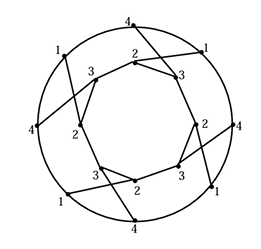
First we consider the vertices \(u_{i} (1\leq i\leq n)\) of the inner cycle \(C_{n}\). Assign the label \(2\) to the vertices \(u_{1}, u_{3}, \ldots ,u_{n-1}\) and \(3\) to the vertices \(u_{2}, u_{4}, \ldots ,u_{n}\). Then next we consider the vertices \(v_{i} (1\leq i\leq n)\) of the outer cycle \(C_{n}^{'}\). Assign the label \(4\) to the vertices \(v_{1}, v_{3}, \ldots ,v_{n-1}\) and assign the label \(1\) to the vertices \(v_{2}, v_{4}, \ldots ,v_{n}\). Clearly \(v_{f}(1)= v_{f}(2) = v_{f}(3) = v_{f}(4) = \frac{n}{2}\), \(\eta_{e}(0) = \eta_{o}(1) = \frac{3n}{2}\). For illustration, \(4\)-remainder cordial labeling of \(CP_{8}\) is shown in Figure 1.
Now we investigate the \(4-\)remainder cordial labeling behavior of the web graph \(WG_{n}\).
Theorem 3.4. The web graph \(WG_{n}\) is \(4-\)remainder cordial for all \(n\).
Proof. Let \(V(WG_{n})= V(C_{n} X P_{2})\cup \{w_{i}:1\leq i\leq n\}\) and \(E(WG_{n})= E(C_{n} X P_{2})\cup \{v_{i}w_{i}:1\leq i\leq n\}\). Then it is easy to verify that \(WG_{n}\) has \(3n\) vertices and \(4n\) edges.
Case (i). \(n\) is even.
First we consider the vertices \(u_{1}, v_{1}\) and \(w_{1}\). Assign the labels \(3 ,2\) and \(3\) respectively to the vertices \(u_{1}, v_{1}\) and \(w_{1}\). Next consider the vertices \(u_{2}, v_{2}\) and \(w_{2}\). Assign the labels \(2,3\) and \(2\) to the vertices \(u_{2}, v_{2}\) and \(w_{2}\) respectively. Next we move to the vertices \(u_{3}, v_{3}\) and \(w_{3}\) and assign the labels \(3 ,2\) and \(3\) respectively to the vertices \(u_{3}, v_{3}\) and \(w_{3}\). Next assign the labels \(2,3\) and \(2\) to the vertices \(u_{4}, v_{4}, w_{4}\). That is assign the labels \(3 ,2\) and \(3\) respectively to the vertices \(u_{2i-1}, v_{2i-1}\) and \(w_{2i-1}\), \((1\leq i\leq \frac{n}{4})\) and assign the labels \(2,3\) and \(2\) to the vertices \(u_{2i}, v_{2i}\) and \(w_{2i}\), \((1\leq i\leq \frac{n}{4})\). In the same way assign the labels \(1,4\) and \(1\) to the vertices \(u_{2i-1}, v_{2i-1}\) and \(w_{2i-1}\), \((\frac{n}{4}+1\leq i\leq \frac{n}{2})\) and assign the labels \(4,1\) and \(4\) respectively to the vertices \(u_{2i}, v_{2i}\) and \(w_{2i}\), \((\frac{n}{4}+2\leq i\leq \frac{n}{2})\).
Case (ii). \(n\) is odd.
Subcase (i). \(n\equiv 1\pmod 4\)
Assign the labels \(4 ,1\) and \(4\) respectively to the vertices \(u_{1}, v_{1}\) and \(w_{1}\). Next assign the labels \(1,4\) and \(1\) to the vertices \(u_{2}, v_{2}\) and \(w_{2}\) respectively. Next we move to the vertices \(u_{3}, v_{3}\) and \(w_{3}\) and assign the labels \(4 ,1\) and \(4\) respectively to the vertices \(u_{3}, v_{3}\) and \(w_{3}\). Therefore assign the labels \(4 ,1\) and \(4\) respectively to the vertices \(u_{2i-1}, v_{2i-1}\) and \(w_{2i-1}\), \((1\leq i\leq \frac{n-1}{4})\) and assign the labels \(1,4\) and \(1\) to the vertices \(u_{2i}, v_{2i}\) and \(w_{2i}\), \((1\leq i\leq \frac{n-1}{4})\). In the same manner assign the labels \(2,3\) and \(2\) to the vertices \(u_{2i-1}, v_{2i-1}\) and \(w_{2i-1}\), \((\frac{n-1}{4}+1\leq i\leq \frac{n-1}{2})\) and assign the labels \(3 ,2\) and \(3\) respectively to the vertices \(u_{2i}, v_{2i}\) and \(w_{2i}\), \((\frac{n-1}{4}+2\leq i\leq \frac{n-1}{2})\). Finally assign the labels \(4 ,3\) and \(1\) respectively to the vertices \(u_{n}, v_{n}\) and \(w_{n}\).
Subcase (ii). \(n\equiv 3\pmod 4\)
Assign the labels \(1,4\) and \(1\) respectively to the vertices \(u_{1}, v_{1}\) and \(w_{1}\). Next assign the labels \(4 ,1\) and \(4\) to the vertices \(u_{2}, v_{2}\) and \(w_{2}\) respectively. Then assign the labels \(1,4\) and \(1\) respectively to the vertices \(u_{3}, v_{3}\) and \(w_{3}\). Next we move to the vertices \(u_{4}, v_{4}\) and \(w_{4}\) and assign the labels \(4 ,1\) and \(4\) respectively to the vertices \(u_{4}, v_{4}\) and \(w_{4}\). We observe that assign the labels \(1,4\) and \(1\) respectively to the vertices \(u_{2i-1}, v_{2i-1}\) and \(w_{2i-1}\), \((1\leq i\leq \frac{n-1}{4})\) and assign the labels \(4 ,1\) and \(4\) to the vertices \(u_{2i}, v_{2i}\) and \(w_{2i}\), \((1\leq i\leq \frac{n-1}{4})\). In the similar manner assign the labels \(2,3\) and \(2\) to the vertices \(u_{2i-1}, v_{2i-1}\) and \(w_{2i-1}\), \((\frac{n-1}{4}+1\leq i\leq \frac{n-1}{2})\) and assign the labels \(3 ,2\) and \(3\) respectively to the vertices \(u_{2i}, v_{2i}\) and \(w_{2i}\), \((\frac{n-1}{4}+2\leq i\leq \frac{n-1}{2})\) respectively. Finally assign the labels \(3,4\) and \(1\) respectively to the vertices \(u_{n}, v_{n}\) and \(w_{n}\).
The Table 2, shows that this vertex labeling \(f\) is a \(4-\) remainder cordial labeling.
| Nature of \(n\) | \(v_f(1)\) | \(v_f(2)\) | \(v_f(3)\) | \(v_f(4)\) | \(\eta_e(0)\) | \(\eta_o(1)\) |
| \(n\equiv 0\pmod 4\) | \(\frac{3n}{4}\) | \(\frac{3n}{4}\) | \(\frac{3n}{4}\) | \(\frac{3n}{4}\) | \(2n\) | \(2n\) |
| \(n\equiv 1\pmod 4\) | \(\frac{3n+1}{4}\) | \(\frac{3n-3}{4}\) | \(\frac{3n+1}{4}\) | \(\frac{n}{2}\) | \(2n\) | \(2n\) |
| \(n\equiv 2\pmod 4\) | \(\frac{3n+2}{4}\) | \(\frac{3n+2}{4}\) | \(\frac{3n-2}{4}\) | \(\frac{3n-2}{4}\) | \(2n\) | \(2n\) |
| \(n\equiv 3\pmod 4\) | \(\frac{3n+3}{4}\) | \(\frac{3n-1}{4}\) | \(\frac{3n-1}{4}\) | \(\frac{3n-1}{4}\) | \(2n\) | \(2n\) |
Next we investigate the triangular snake \(T_{n}\).
Theorem 3.5. The triangular snake \(T_{n}\) is \(4-\)remainder cordial for all \(n\).
Proof. Let \(V(T_{n})=\{u_{i} : 1\leq i\leq n\} \cup \{v_{i} : 1\leq i\leq n-1\}\) and \(E(T_{n})=\{u_{i}u_{i+1}, u_{i}v_{i}, v_{i}u_{i+1}:1\leq i\leq n-1\}\). We observe that the order and size of the \(T_{n}\) are \(2n-1\) and \(3n-3\) respectively.
Case (i). \(n\) is even.
Assign the label \(2\) to the vertices \(u_{1}, u_{3}, \ldots ,u_{n-1}\) and \(3\) to the vertices \(u_{2}, u_{4}, \ldots ,u_{n}\). Then next consider the vertices \(v_{i}\). Assign the label \(1\) to the vertices \(v_{1}, v_{3}, \ldots ,v_{n-1}\) and assign the label \(4\) to the vertices \(v_{2}, v_{4}, \ldots ,v_{n}\).
Case (ii). \(n\) is odd.
As in case(i), assign the labels to the vertices \(u_{i}, ((1\leq i\leq n-1))\), and \(v_{i}, (1\leq i\leq n-2)\). Finally assign the labels \(2,4\) respectively to the vertices \(u_{n}\) and \(v_{n-1}\). The Table 3, establish that this labeling \(f\) is a \(4-\) remainder cordial labeling of \(T_{n}\).
| Nature of \(n\) | \(v_f(1)\) | \(v_f(2)\) | \(v_f(3)\) | \(v_f(4)\) | \(\eta_e(0)\) | \(\eta_o(1)\) |
| \(n\) is even | \(\frac{n}{2}\) | \(\frac{n}{2}\) | \(\frac{n}{2}\) | \(\frac{n-2}{2}\) | \(\frac{3n-2}{2}\) | \(\frac{3n-4}{2}\) |
| \(n\) is odd | \(\frac{n-1}{2}\) | \(\frac{n+1}{2}\) | \(\frac{n-1}{2}\) | \(\frac{n-1}{2}\) | \(\frac{3n-3}{2}\) | \(\frac{3n-3}{2}\) |
Next we investigate the corona of \(L_{n}\) with \(m K_{1}\).
Theorem 3.6. \(L_{n} \odot m K_{1}\) is \(4-\)remainder cordial for all \(n\).
Proof. We denote the vertex set and edge set of \(L_{n}\) as follows. Let \(V(L_{n})=\{u_{i},v_{i}:1\leq i\leq n\})\) and \(E(L_{n})=\{u_{i}u_{i+1}, v_{i}v_{i+1}:1\leq i \leq n-1\})\cup \{u_{i}v_{i} :1\leq i \leq n\}\).
Case (i). \(n\) is even and \(m\) is both even and odd.
Assign the label \(2\) to the vertices \(u_{1}, u_{3}, \ldots ,u_{n-1}\) and \(3\) to the vertices \(u_{2}, u_{4}, \ldots ,u_{n}\). Next assign the label \(1\) to the vertices \(v_{1}, v_{3}, \ldots ,v_{n-1}\) and assign the label \(4\) to the vertices \(v_{2}, v_{4}, \ldots ,v_{n}\). Now we consider the pendant vertices. Assign the label \(1\) to all the pendant vertices whose support receives the label \(2\) and assign the label \(4\) to all the pendant vertices whose support receives the label \(3\). Next assign the label \(2\) to all the pendant vertices whose support receives the label \(1\) and assign the label \(3\) to all the pendant vertices whose support receives the label \(4\).
Case (ii). \(n\) is odd and \(m\) is even.
Assign the labels to the vertices \(u_{i}, v_{i}\), and all the pendant vertices adjacent to \(u_{i}, v_{i},(1\leq i\leq n-1)\), as in case(i). Then next assign the label \(3\) to the vertices \(u_{n}\) and \(v_{n}\). Next assign the label \(1\) to the \(\frac{m}{2}+1\) pendant vertices which are adjacent to \(u_{n}\) and assign the label \(3\) to the remaining \(\frac{m}{2}-1\) pendant vertices which are adjacent to \(u_{n}\). Finally assign the label \(2\) to the \(\frac{m}{2}\) pendant vertices which are adjacent to \(v_{n}\) and assign the label \(4\) to the remaining non-labeled \(\frac{m}{2}\) pendant vertices which are adjacent to \(v_{n}\).
Case (iii). \(n\) is odd and \(m\) is odd.
Assign the label \(1\) to the \(\frac{m-1}{2}\) pendant vertices which are adjacent to \(u_{n}\) and assign the label \(3\) to the remaining \(\frac{m-1}{2}\) pendant vertices which are adjacent to \(u_{n}\).Finally assign the label \(4\) to the remaining pendant vertices adjacent to the vertex \(u_{n}\). Next assign the label \(2\) to the \(\frac{m+1}{2}\) pendant vertices which are adjacent to the vertex \(v_{n}\) and assign the label \(4\) to the remaining \(\frac{m-1}{2}\) pendant vertices which are adjacent to the vertex \(v_{n}\). Thus the tables [4,5], shows that this vertex labeling \(f\) is a \(4-\) remainder cordial labeling of \(L_{n} \odot m K_{1}\).
Vertex condition of \(L_{n} \odot m K_{1}\):
| Nature of \(n\) | \(v_f(1)\) | \(v_f(2)\) | \(v_f(3)\) | \(v_f(4)\) |
| \(n\) is even | \(\frac{2n(m+1)}{4}\) | \(\frac{2n(m+1)}{4}\) | \(\frac{2n(m+1)}{4}\) | \(\frac{2n(m+1)}{4}\) |
| \(n\) is odd,\(m\) is even | \(\frac{2n(m+1)+2}{4}\) | \(\frac{2n(m+1)-2}{4}\) | \(\frac{2n(m+1)+2}{4}\) | \(\frac{2n(m+1)-2}{4}\) |
| \(n\) is odd,\(m\) is odd | \(\frac{2n(m+1)}{4}\) | \(\frac{2n(m+1)}{4}\) | \(\frac{2n(m+1)}{4}\) | \(\frac{2n(m+1)}{4}\) |
Edge condition of \(L_{n} \odot m K_{1}\):
| Nature of \(n\) | \(\eta_e(0)\) | \(\eta_o(1)\) |
| \(n\) is even | \(\frac{n(2m+3)-2}{2}\) | \(\frac{n(2m+3)-2}{2}\) |
| \(n\) is odd,\(m\) is even | \(\frac{n(2m+3)-1}{2}\) | \(\frac{n(2m+3)-3}{2}\) |
| \(n\) is odd,\(m\) is odd | \(\frac{n(2m+3)-1}{2}\) | \(\frac{n(2m+3)-3}{2}\) |
Next we investigate the Durer graph \(DG_{n}\).
Theorem 3.7. The Durer graph \(DG_{n}\) is \(4-\)remainder cordial for all values of \(n\).
Proof. Let \(C_{n}=v_{1}v_{2}\ldots v_{n}v_{1}\) be the cycle. Let \(V(DG_{n})=V(C_{n})\cup \{u_{i},v_{i}:1\leq i\leq n\})\) and \(E(DG_{n})=E(C_{n})\cup \{u_{i}v_{i} :1\leq i \leq n\}\cup \{u_{i}u_{i+2} :1\leq i \leq n-2\})\cup \{u_{n}u_{2}, u_{n-1}u_{1}\}\). Then clearly the order and size of the Durer graph \(DG_{n}\) are \(2n\) and \(3n\) respectively.
Case (i). \(n\) is even and \(n\geq 6\).
First we consider the vertices \(v_{i}\) of the cycle \(C_{n}\). Assign the label \(2\) to the vertices \(v_{1}, v_{3}, \ldots ,v_{n-1}\) and \(3\) to the vertices \(v_{2}, v_{4}, \ldots ,v_{n}\). Next assign the labels to the vertices \(u_{i}\). Assign the label \(1\) to the vertices \(u_{1}, u_{3}, \ldots ,u_{n-1}\) and assign the label \(4\) to the vertices \(u_{2}, u_{4}, \ldots ,u_{n}\).
Case (ii). \(n\) is odd and \(n\geq 3\).
Assign the labels to the vertices \(u_{i}, v_{i},(1\leq i\leq n-1)\), as in case(i). Finally assign the labels \(3\) and \(4\) respectively to the vertices \(v_{n}\) and \(u_{n}\). The Table 6, establish that this vertex labeling \(f\) is a \(4-\) remainder cordial labeling of \(DG_{n}\).
| Nature of \(n\) | \(v_f(1)\) | \(v_f(2)\) | \(v_f(3)\) | \(v_f(4)\) | \(\eta_e(0)\) | \(\eta_o(1)\) |
| \(n\) is even | \(\frac{n}{2}\) | \(\frac{n}{2}\) | \(\frac{n}{2}\) | \(\frac{n}{2}\) | \(\frac{3n}{2}\) | \(\frac{3n}{2}\) |
| \(n\) is odd | \(\frac{n-1}{2}\) | \(\frac{n-1}{2}\) | \(\frac{n+1}{2}\) | \(\frac{n+1}{2}\) | \(\frac{3n+1}{2}\) | \(\frac{3n-1}{2}\) |
Next we investigate the dragon \(C_{m} @ P_{n}\).
Theorem 3.8. The dragon graph \(C_{m} @ P_{n}\) is \(4-\)remainder cordial for all \(m\geq 3\) and \(n\).
Proof. Let \(C_{m}= u_{1}u_{2}\ldots u_{m}u_{1}\) be the cycle and \(P_{n} = v_{1}v_{2} \ldots v_{n}\) be the path. Identify \(u_{1}\) with \(v_{1}\). Clearly the order and size of the dragon \(C_{m} @ P_{n}\) are \(m+n-1\) and \(m+n-1\) respectively.
Case 1. \(m\equiv 0\pmod 4\)
First we consider the vertices \(u_{1},u_{2},\ldots ,u_{m}\) of the cycle \(C_{m}\). Assign the labels \(1,2,3,4\) to the vertices \(u_{1},u_{2},u_{3}\) and \(u_{4}\) respectively. Next assign the labels \(1,2,3,4\) respectively to the next four vertices \(u_{5},u_{6},u_{7}\) and \(u_{8}\). Then assign the labels \(1,2,3,4\) respectively to the next four vertices \(u_{9},u_{10},u_{11}\) and \(u_{12}\). Proceeding like this until we reach the vertex \(u_{m}\). Clearly the vertex \(u_{m}\) received the label \(4\) for this pattern.
Next we take the vertices \(v_{1},v_{2},\ldots ,v_{n}\) of the path \(P_{n}\). Assign the labels to the vertices \(v_{1},v_{2},\ldots ,v_{n}\) by the following four subcases.
Subcase 1.1. \(n\equiv 0\pmod 4\)
We fix the labels \(2,3,4\) to the vertices \(v_{2},v_{3}\) and \(v_{4}\) respectively. Assign the labels \(1,2,3,4\) respectively to the vertices \(v_{5},v_{6},v_{7}\) and \(v_{8}\). Next assign the labels \(1,2,3,4\) respectively to the next four vertices \(v_{9},v_{10},v_{11}\) and \(v_{12}\). Then assign the labels \(1,2,3,4\) respectively to the next four vertices \(v_{13},v_{14},v_{15}\) and \(v_{16}\). Continuing like this until we reach the vertex \(v_{n}\). Clearly in this pattern the vertex \(v_{n}\) received the label \(4\).
Subcase 1.2. \(n\equiv 1\pmod 4\)
Assign the labels to the vertices \(v_{i},(1\leq i\leq n-1)\), as in subcase 1.1. Finally assign the label \(1\) to the vertices \(v_{n}\).
Subcase 1.3. \(n\equiv 2\pmod 4\)
Assign the labels to the vertices \(v_{i},(1\leq i\leq n-2)\), as in subcase 1.1. Then finally assign the labels \(3\), and \(1\) respectively to the vertices \(v_{n-1}\), and \(v_{n}\).
Subcase 1.4. \(n\equiv 3\pmod 4\)
Assign the labels to the vertices \(v_{i},(1\leq i\leq n-3)\), as in subcase 1.1. Next assign the labels \(1,2\), and \(3\) respectively to the vertices \(v_{n-2},v_{n-1}\), and \(v_{n}\). Thus the Tables 7 and 8, shows that this vertex labeling \(f\) is a \(4-\) remainder cordial labeling of the dragon with \(m\equiv 0\pmod 4\) and for all values of \(n\). Vertex condition of the dragon with \(m\equiv 0\pmod 4\) and for all values of \(n\):
| Nature of \(n\) | \(v_f(1)\) | \(v_f(2)\) | \(v_f(3)\) | \(v_f(4)\) |
| \(n\equiv 0\pmod 4\) | \(\frac{m+n-4}{4}\) | \(\frac{m+n}{4}\) | \(\frac{m+n}{4}\) | \(\frac{m+n}{4}\) |
| \(n\equiv 1\pmod 4\) | \(\frac{m+n-1}{4}\) | \(\frac{m+n-1}{4}\) | \(\frac{m+n-1}{4}\) | \(\frac{m+n-1}{4}\) |
| \(n\equiv 2\pmod 4\) | \(\frac{m+n-2}{4}\) | \(\frac{m+n-2}{4}\) | \(\frac{m+n+2}{4}\) | \(\frac{m+n-2}{4}\) |
| \(n\equiv 3\pmod 4\) | \(\frac{m+n-3}{4}\) | \(\frac{m+n+1}{4}\) | \(\frac{m+n+1}{4}\) | \(\frac{m+n-3}{4}\) |
Edge condition of the dragon with \(m\equiv 0\pmod 4\) and for all values of \(n\):
| Nature of \(m\equiv 0\pmod 4\) and \(n\) | \(\eta_e(0)\) | \(\eta_o(1)\) |
| \(n\equiv 0\pmod 4\) | \(\frac{m+n-2}{2}\) | \(\frac{m+n}{2}\) |
| \(n\equiv 1\pmod 4\) | \(\frac{m+n-1}{2}\) | \(\frac{m+n-1}{2}\) |
| \(n\equiv 2\pmod 4\) | \(\frac{m+n-2}{2}\) | \(\frac{m+n}{2}\) |
| \(n\equiv 3\pmod 4\) | \(\frac{m+n-1}{2}\) | \(\frac{m+n-1}{2}\) |
Case 2. \(m\equiv 1\pmod 4\)
As in case 1, assign the labels to the vertices \(u_{i},(1\leq i\leq m-1)\). Finally assign the label \(1\) to the vertices \(u_{m}\) of the cycle \(C_{m}\).
Next we consider the path vertices . Assign the labels to the vertices \(v_{i}\) for all \(i=1\) to \(n\) by the following four sub cases.
Subcase 2.1. \(n\equiv 0\pmod 4\)
As in subcase 1.1, assign the labels to the vertices \(v_{i}\) for all \(i=1\) to \(n\).
Subcase 2.2. \(n\equiv 1\pmod 4\)
As in subcase 1.2, assign the labels to the vertices \(v_{i}\) for all \(i=1\) to \(n\).
Subcase 2.3. \(n\equiv 2\pmod 4\)
As in subcase 1.3, assign the labels to the vertices \(v_{i}\) for all \(i=1\) to \(n\).
Subcase 2.4. \(n\equiv 3\pmod 4\)
As in subcase 1.4, assign the labels to the vertices \(v_{i}\) for all \(i=1\) to \(n\). Thus the following Tables 9 and 10, shows that this vertex labeling \(f\) is a \(4-\) remainder cordial labeling of the dragon with \(m\equiv 1\pmod 4\) and for all values of \(n\).
Vertex condition of the dragon with \(m\equiv 1\pmod 4\) and for all values of \(n\):
| Nature of \(n\) | \(v_f(1)\) | \(v_f(2)\) | \(v_f(3)\) | \(v_f(4)\) |
| \(n\equiv 0\pmod 4\) | \(\frac{m+n-1}{4}\) | \(\frac{m+n-1}{4}\) | \(\frac{m+n-1}{4}\) | \(\frac{m+n-1}{4}\) |
| \(n\equiv 1\pmod 4\) | \(\frac{m+n+2}{4}\) | \(\frac{m+n-2}{4}\) | \(\frac{m+n-2}{4}\) | \(\frac{m+n-2}{4}\) |
| \(n\equiv 2\pmod 4\) | \(\frac{m+n+1}{4}\) | \(\frac{m+n-3}{4}\) | \(\frac{m+n+1}{4}\) | \(\frac{m+n-3}{4}\) |
| \(n\equiv 3\pmod 4\) | \(\frac{m+n}{4}\) | \(\frac{m+n}{4}\) | \(\frac{m+n}{4}\) | \(\frac{m+n-4}{4}\) |
Edge condition of the dragon with \(m\equiv 1\pmod 4\) and for all values of \(n\):
| Nature of \(m\equiv 1\pmod 4\) and \(n\) | \(\eta_e(0)\) | \(\eta_o(1)\) |
| \(n\equiv 0\pmod 4\) | \(\frac{m+n-1}{2}\) | \(\frac{m+n-1}{2}\) |
| \(n\equiv 1\pmod 4\) | \(\frac{m+n}{2}\) | \(\frac{m+n-2}{2}\) |
| \(n\equiv 2\pmod 4\) | \(\frac{m+n-1}{2}\) | \(\frac{m+n-1}{2}\) |
| \(n\equiv 3\pmod 4\) | \(\frac{m+n}{2}\) | \(\frac{m+n-2}{2}\) |
Case 3. \(m\equiv 2\pmod 4\)
Assign the labels to the vertices \(u_{i},(1\leq i\leq m-2)\) as in case 1. Then finally assign the labels \(2\), and \(1\) respectively to the vertices \(u_{m-1}\) and \(u_{m}\) of the cycle \(C_{m}\).
Next we consider the vertices \(v_{i}, , (1\leq i\leq n)\) of the path \(P_{n}\).
Subcase 3.1. \(n\equiv 0\pmod 4\)
Assign the labels to the vertices \(v_{i}, (1\leq i\leq n)\) as in subcase 1.1.
Subcase 3.2. \(n\equiv 1\pmod 4\)
Assign the labels to the vertices \(v_{i}, (1\leq i\leq n-1)\) as in subcase 1.1. Next assign the label \(3\) to the end vertex \(v_{n}\) of the path \(P_{n}\).
Subcase 3.3. \(n\equiv 2\pmod 4\)
Assign the labels to the vertices \(v_{i}, (1\leq i\leq n-1)\) as in subcase 3.2. Then next assign the label \(1\) to the last vertex \(v_{n}\) of the path \(P_{n}\).
Subcase 3.4. \(n\equiv 3\pmod 4\)
Assign the labels to the vertices \(v_{i}, (1\leq i\leq n-2)\) as in subcase 3.2. Finally assign the labels \(4\) and \(1\) to the vertices \(v_{n-1}\), and \(v_{n}\) respectively. Thus the following Tables 11 and 12, establish that this vertex labeling \(f\) is a \(4-\) remainder cordial labeling of the dragon with respect to \(m\equiv 2\pmod 4\) and for all values of \(n\).
Vertex condition of the dragon with \(m\equiv 2\pmod 4\) and for all values of \(n\):
| Nature of \(n\) | \(v_f(1)\) | \(v_f(2)\) | \(v_f(3)\) | \(v_f(4)\) |
| \(n\equiv 0\pmod 4\) | \(\frac{m+n-2}{4}\) | \(\frac{m+n+2}{4}\) | \(\frac{m+n-2}{4}\) | \(\frac{m+n-2}{4}\) |
| \(n\equiv 1\pmod 4\) | \(\frac{m+n-3}{4}\) | \(\frac{m+n+1}{4}\) | \(\frac{m+n+1}{4}\) | \(\frac{m+n-3}{4}\) |
| \(n\equiv 2\pmod 4\) | \(\frac{m+n}{4}\) | \(\frac{m+n}{4}\) | \(\frac{m+n}{4}\) | \(\frac{m+n-4}{4}\) |
| \(n\equiv 3\pmod 4\) | \(\frac{m+n-1}{4}\) | \(\frac{m+n-1}{4}\) | \(\frac{m+n-1}{4}\) | \(\frac{m+n-1}{4}\) |
Edge condition of the dragon with \(m\equiv 2\pmod 4\) and for all values of \(n\):
| Nature of \(m\equiv 2\pmod 4\) and \(n\) | \(\eta_e(0)\) | \(\eta_o(1)\) |
| \(n\equiv 0\pmod 4\) | \(\frac{m+n}{2}\) | \(\frac{m+n-2}{2}\) |
| \(n\equiv 1\pmod 4\) | \(\frac{m+n-1}{2}\) | \(\frac{m+n-1}{2}\) |
| \(n\equiv 2\pmod 4\) | \(\frac{m+n}{2}\) | \(\frac{m+n-2}{2}\) |
| \(n\equiv 3\pmod 4\) | \(\frac{m+n-1}{2}\) | \(\frac{m+n-1}{2}\) |
Case 4. \(m\equiv 3\pmod 4\) and \(n\equiv 0,1\pmod 4\)
Assign the labels to the vertices \(u_{i},(1\leq i\leq m-3)\), as in case 1. Then finally assign the labels \(2,3\), and \(1\) respectively to the vertices \(u_{m-2},u_{m-1}\) and \(u_{m}\) of the cycle \(C_{m}\).
Next assign the labels to the vertices \(v_{1},v_{2}, \ldots , v_{n}\) of the path \(P_{n}\) by the following two subcases.
Subcase 4.1. \(n\equiv 0\pmod 4\)
Assign the labels to the vertices \(v_{i}, (1\leq i\leq n)\), as in subcase 1.1.
Subcase 4.2. \(n\equiv 1\pmod 4\)
Assign the labels to the vertices \(v_{i}, (1\leq i\leq n)\), as in subcase 1.2. The following Tables 13, 14 establish that this vertex labeling \(f\) is a \(4-\) remainder cordial labeling of the dragon with respect to \(m\equiv 3\pmod 4\) and for all values of \(n\).
Vertex condition of the dragon with \(m\equiv 3\pmod 4\) and for all values of \(n\):
| Nature of \(n\) | \(v_f(1)\) | \(v_f(2)\) | \(v_f(3)\) | \(v_f(4)\) |
| \(n\equiv 0\pmod 4\) | \(\frac{m+n-3}{4}\) | \(\frac{m+n+1}{4}\) | \(\frac{m+n+1}{4}\) | \(\frac{m+n-3}{4}\) |
| \(n\equiv 1\pmod 4\) | \(\frac{m+n}{4}\) | \(\frac{m+n}{4}\) | \(\frac{m+n}{4}\) | \(\frac{m+n-4}{4}\) |
Edge condition of the dragon with \(m\equiv 3\pmod 4\) and for all values of \(n\):
| Nature of \(m\equiv 3\pmod 4\) and \(n\) | \(\eta_e(0)\) | \(\eta_o(1)\) |
| \(n\equiv 0\pmod 4\) | \(\frac{m+n-1}{2}\) | \(\frac{m+n-1}{2}\) |
| \(n\equiv 1\pmod 4\) | \(\frac{m+n}{2}\) | \(\frac{m+n-2}{2}\) |
Case 5. \(m\equiv 3\pmod 4\) and \(n\equiv 2,3\pmod 4\)
Assign the labels to the vertices \(u_{i},(1\leq i\leq m-3)\), as in case 1. Then finally assign the labels \(3,2\), and \(1\) to the vertices \(u_{m-2},u_{m-1}\) and \(u_{m}\) of the cycle \(C_{m}\) respectively.
Next we consider the vertices \(v_{1},v_{2}, \ldots , v_{n}\) of the path \(P_{n}\). Assign the labels to the vertices \(v_{1},v_{2}, \ldots , v_{n}\) of the path \(P_{n}\) by the following the remaining subcases.
Subcase 5.1. \(n\equiv 2\pmod 4\)
Assign the labels to the vertices \(v_{i}, (1\leq i\leq n-2)\) as in subcase 1.1. Then assign the labels \(4\) and \(1\) respectively to the last two vertices\(v_{n-1}\) and \(v_{n}\) of the path \(P_{n}\).
Subcase 5.2. \(n\equiv 3\pmod 4\)
Assign the labels to the vertices \(v_{i}, (1\leq i\leq n-3)\) as in subcase 1.1. Finally assign the labels \(4,3\) and \(1\) to the vertices \(v_{n-2},v_{n-1}\), and \(v_{n}\) respectively. The following Tables 15 and 16 establish that this vertex labeling \(f\) is a \(4-\) remainder cordial labeling of the dragon with \(m\equiv 3\pmod 4\) and for all values of \(n\).
Vertex condition of the dragon with \(m\equiv 3\pmod 4\) and for all values of \(n\):
| Nature of \(n\) | \(v_f(1)\) | \(v_f(2)\) | \(v_f(3)\) | \(v_f(4)\) |
| \(n\equiv 2\pmod 4\) | \(\frac{m+n-1}{4}\) | \(\frac{m+n-1}{4}\) | \(\frac{m+n-1}{4}\) | \(\frac{m+n-1}{4}\) |
| \(n\equiv 3\pmod 4\) | \(\frac{m+n-2}{4}\) | \(\frac{m+n-2}{4}\) | \(\frac{m+n+2}{4}\) | \(\frac{m+n-2}{4}\) |
Edge condition of the dragon with \(m\equiv 3\pmod 4\) and for all values of \(n\):
| Nature of \(m\equiv 3\pmod 4\) and \(n\) | \(\eta_e(0)\) | \(\eta_o(1)\) |
| \(n\equiv 2\pmod 4\) | \(\frac{m+n-1}{2}\) | \(\frac{m+n-1}{2}\) |
| \(n\equiv 3\pmod 4\) | \(\frac{m+n-2}{2}\) | \(\frac{m+n}{2}\) |