
In 1988, Chartrand et al. [8] coined a notion of irregular assignment of a graph. An irregular assignment of a graph involves assigning labels to the edges of a graph such that the resulting weighted degrees—the sum of labels of edges incident to each vertex—are unique for all vertices. This ensures that no two vertices share the same weighted degree, creating a form of irregularity in the graph. In formal way, let \(G\) be a graph and \(k\) be a positive integer. A labeling \(f : E(G) \to [1,k]\) is called a irregular \(k\)-labeling if for every two distinct vertices \(x\) and \(z\), it holds that \(wt_f(x) \ne wt_f(z)\) where \(wt_f(x)\) is the sum of every labels of edges incident to \(x\). The irregularity strength of the graph \(G\), denoted by \(s(G)\), is the least \(k\) such that there exists an irregular \(k\)-labeling of the graph \(G\).
Decades later, a modification of this graph irregularity is investigated by Ahmad et al. [2]. Let \(G\) be a graph and \(k\) be a positive integer. A map \(f : V(G) \to [1,k]\) is called an edge irregular labeling if for every two distinct edges \(vx\) and \(yz\), it holds that \(f(v) + f(x) \ne f(y) + f(z)\). The edge irregularity strength of the graph \(G\), denoted by \(es(G)\), is the minimum \(k\) such that there exists an edge irregular \(k\)-labeling of the graph \(G\). Ahmad et al. [2] investigated the bounds of the edge irregularity strength of any graph \(G\). In addition, they determined that \(es(P_n) = \left\lceil \displaystyle\frac{n}{2} \right\rceil\) for the path graph \(P_n\), \(es(K_{1,n}) = n\) for the star graph \(K_{1,n}\), and \(es(S_{m,n}) = n\) for the double star graph \(S_{m,n}\) where \(3 \le m \le n\).
Further, Bača et al. [7] considered a combination of the vertex labeling and edge labeling. The map \(f : V(G) \cup E(G) \to [1,k]\) is said to be total edge \(k\)-irregular labeling of \(G\) if for every edges \(vx\) and \(yz\), \(f(v) + f(vx) + f(x) \ne f(y) + f(yz) + f(z)\). The invariant \(tes(G)\) is the least number \(k\) such that there exists a total edge \(k\)-irregular of \(G\), called total edge irregularity strength of \(G\). Ivančo and Jendrol’ [11] proved that the total edge irregularity strength of any trees \(T\) is either \(\left\lceil \displaystyle\frac{|E(T)| + 2}{3} \right\rceil\) or \(\left\lceil \displaystyle\frac{\Delta(T) + 1}{2} \right\rceil\) based on which one is the largest. Meanwhile, Rajendran and Kathiresan [14] investigated the edge irregularity strength of graphs related to cycles. Moreover, the total edge irregularity strength of triangular grid graphs and its certain subgraphs is determined by Huda and Susanti [9].
In 2016, Ashraf et al. [4] introduced two variants of irregularity labeling. The first one is a vertex \(H\)-irregularity labeling for a graph \(H\). A graph \(G\) is said to have \(H\)-covering if for every edge \(e\) in \(G\) there exists a subgraph \(H'\) of \(G\), which is isomorphic to \(H\), such that \(e\) is contained in \(H'\). For a graph \(G\) which admits \(H\)-covering, the map \(f : V(G) \to [1,k]\) is said to be vertex \(H\)-irregular \(k\)-labeling if for every subgraphs \(H_1\) and \(H_2\) that is isomorphic to \(H\) it holds that \(wt_f(H_1) \ne wt_f(H_2)\) where \(wt_f(H_1) = \sum_{v \in V(H_1)} f(v)\). The smallest \(k\) such that there exists a vertex \(H\)-irregular \(k\)-labeling is called vertex \(H\)-irregularity strength of \(G\), denoted by \(vhs(G,H)\). Tilukay [17] considered the vertex \(H\)-irregularity strength of grid graphs. In addition, Labane investigated the vertex \(H\)-irregularity strength of diamond graphs.
The second variant introduced by Ashraf et al. [4] is called edge \(H\)-irrgularity labeling. Let \(G\) be a graph that admits \(H\)-covering. The labeling \(f : E(G) \to [1,k]\) is defined as edge \(H\)-irregular labeling if every subgraphs \(H_1\) and \(H_2\) that is isomorphic to \(H\) it holds that \(wt_f(H_1) \ne wt_f(H_2)\) where \(wt_f(H_1) = \sum_{e \in E(H_1)} f(e)\). The least number \(k\) such that there exists an edge \(H\)-irregular \(k\)-labeling, denoted by \(ehs(G,H)\), is said to be edge \(H\)-irregularity strength of \(G\). The study of edge \(H\)-irregularity strength has been conducted in grid graphs [17], prisms, antiprisms, triangular ladders, diagonal ladders, wheels, gears [13], hexagonal and octagonal grid graphs [10], diamond graphs [12], and cartesian product of graphs [1].
Furthermore, another variant called total \(H\)-irregularity labeling is also considered by Ashraf et al. [5] in 2017. A map \(f : V(G) \cup E(G) \to [1,k]\) is called total \(H\)-irregular \(k\)-labeling if every subgraphs \(H_1\) and \(H_2\) which is isomorphic to \(H\), \(wt_f(H_1) \ne wt_f(H_2)\) where \(wt_f(H_1) = \sum_{v \in V(H_1)} f(v) + \sum_{e \in E(H_1)} f(e)\). The smallest integer \(k\) such that there exists a total \(H\)-irregular \(k\)-labeling for \(G\) is called total \(H\)-irregularity strength, denoted by \(ths(G,H)\). Investigations of total \(H\)-irregularity labeling is conducted for many kind of graphs which includes cartesian product of cycles and paths [3], ladders, fan graphs [6], grid graphs [17], and cycles [12]. In particular, Wahyujati and Susanti [18] considered the total \(H\)-irregularity strength of edge comb products \(G \unrhd H\) for some graph \(G\).
The following part is the description of comb product and edge comb product of two graphs. Let \(G\) and \(H\) be any graphs and \(v \in V(H)\). The comb product \(G \rhd_v H\) is a graph obtained from a graph \(G\) and \(|V(G)|\) copies of \(H\) such that each vertex \(u \in V(G)\) is identified by the vertex \(v\) of a copy of \(H\) [15]. Similarly, the edge comb product \(G \unrhd_e H\) is a graph obtained from a graph \(G\) and \(|E(G)|\) copies of \(H\) such that each edge \(e' \in E(G)\) is identified by the edge \(e\) of a copy of \(H\) [16].
In this paper, we investigate the vertex, edge, and total \((F \rhd_v H)\)-irregularity strength of \(G \rhd_v H\) and the vertex, edge, and total \((F \unrhd_e H)\)-irregularity strength of \(G \unrhd_e H\) for a \(2\)-connected graph \(H\).
Throughout this paper, we only consider graphs with non-empty edges. We use the notations of \(V_G\) which is the vertex set of \(G\) and \(E_G\) which is the edge set of \(G\). Ashraf et al. [4] proved the lower bound for vertex and edge \(H\)-irregularity strength of any graph \(G\).
Theorem 2.1. [4] Let \(G\) be a graph that admits \(H\)-covering. Let \(t\) be the number of distinct subgraphs of \(G\) which are isomorphic to \(H\). We have \[\begin{aligned} vhs(G,H) \ge \left\lceil 1 + \displaystyle\frac{t – 1}{|V_G|}\right\rceil. \end{aligned}\]
Theorem 2.2. [4] Let \(G\) be a graph that admits \(H\)-covering. Let \(t\) be the number of distinct subgraphs of \(G\) which are isomorphic to \(H\). We have \[\begin{aligned} ehs(G,H) \ge \left\lceil 1 + \displaystyle\frac{t – 1}{|E_G|}\right\rceil. \end{aligned}\]
Moreover, a lower bound for the total \(H\)-irregularity strength of any graph \(G\) is also determined a year later.
Theorem 2.3. [5] Let \(G\) be a graph that admits \(H\)-covering. Let \(t\) be the number of distinct subgraphs of \(G\) which are isomorphic to \(H\). We have \[\begin{aligned} ths(G,H) \ge \left\lceil 1 + \displaystyle\frac{t – 1}{|V_G|+|E_G|}\right\rceil. \end{aligned}\]
To have our result, we need to define a notion called optimal multiset. A multiset is an extension of sets where repetition of elements are allowed. Let \(n\) and \(k\) be positive integers where \(n \ge k\). An optimal multiset-\((n,k)\), denoted by \(O_{n,k}\), is a multiset consisting of \(k\) positive integers not larger than \(\left\lceil \displaystyle\frac{n}{k} \right\rceil\) and not smaller than \(\left\lfloor \displaystyle\frac{n}{k} \right\rfloor\) such that the sum of every elements equals to \(n\). For example, the optimal multisets \(O_{21,6}\) and \(O_{30,7}\) are \[\begin{aligned} O_{21,6} & = \{3,3,3,4,4,4\},\\ O_{30,7} & = \{4,4,4,4,4,5,5\}. \end{aligned}\]
This notion of optimal multiset is used in every proof we presented in the following sections.
Let \(G\) be a graph with \(V_G = \{u_1,u_2,\ldots,u_m\}\) and \(H\) be a \(2\)-connected graph with \(V_H = \{v = v_1,v_2,\ldots,v_n\}\) for some positive integers \(m,n\). Let \(H_i\) with \(V_{H^{(i)}} = \{v_1^{(i)},v_2^{(i)},\ldots,v_n^{(i)}\}\) be a copy of \(H\) such that \(v_jv_k \in E_H\) if and only if \(v_j^{(i)}v_k^{(i)} \in E_{H^{(i)}}\) for some \(i \in [1,m]\). Then, the comb product \(G \rhd_v H\) is a graph defined by the vertex set \[\begin{aligned} V(G \rhd_v H) = \bigcup_{i = 1}^{m} V_{H^{(i)}}, \end{aligned}\] and the edge set \[\begin{aligned} E(G \rhd_v H) = \bigcup_{i = 1}^{m} E_{H^{(i)}} \cup \{v_1^{(i)}v_1^{(j)} \mid u_iu_j \in E_G\}. \end{aligned}\]
Observe that \(|V(G \rhd_v H)| = |V_G||V_H|\) and \(|E(G \rhd_v H)| = |E_G| + |V_G||E_H|\). In addition, if \(G\) admits an \(F\)-covering, then \(G \rhd_v H\) admits an \((F \rhd_v H)\)-covering. First, we deal the vertex \((F \rhd_v H)\)-irregularity strength of \(G \rhd_v H\).
Theorem 3.1. Let \(H\) be a \(2\)-connected graph and \(v \in V(H)\). Let \(G\) be a graph which admits \(F\)-covering and does not contain \(H\). It follows that \[\begin{aligned} vhs(G \rhd_v H, F \rhd_v H) = \left\lceil 1 + \displaystyle\frac{vhs(G,F)-1}{|V_H|} \right\rceil. \end{aligned}\]
Proof. Let \(V_G = \{u_1,u_2,\ldots,u_m\}\) and \(V_{H^{(i)}} = \{ v_1^{(i)},v_2^{(i)},\ldots,v_n^{(i)}\}\) for some positive integers \(m, n\) and \(i \in [1,m]\). Let \(t\) be the number of subgraph of \(G\) which is isomorphic to \(F\). Let \((F \rhd_v H)^{(i)}\) be the \(i\)-th subgraph of \(G \rhd_v H\) that is isomorphic to \(F \rhd_v H\). Since \(H\) is \(2\)-connected and \(G\) does not contain \(H\), then there exists \(F^{(i)} \cong F\) which is a subgraph of \(G\) such that \((F \rhd_v H)^{(i)} = F^{(i)} \rhd_v H\). This implies the number of subgraph of \(G \rhd_v H\) that is isomorphic to \(F \rhd_v H\) is also \(t\). Let \(s = \left\lceil 1 + \displaystyle\frac{vhs(G,F)-1}{n} \right\rceil\).
First, we will show that \(vhs(G \rhd_v H,F \rhd_v H) \le s\). Let \(\varphi : V(G) \to \mathbb{Z}\) be a vertex \(F\)-irregularity labeling of \(G\) and let \(\alpha_i = \varphi(u_i)+n-1\). Let \(wt_\varphi : \{F^{(i)} \mid i \in [1,t]\} \to \mathbb{Z}\) be a weight function induced by \(\varphi\). For every \(i \in [1,m]\), choose a bijection \(\sigma_i\) from \(V(H^{(i)})\) to the optimal multiset-\((\alpha_i,n)\). Define a labeling \(\sigma : V(G \rhd_v H) \to \mathbb{Z}\) such that the restriction \(\sigma|_{V_{H^{(i)}}}\) is exactly \(\sigma_i\). In other words, \(\sigma|_{V_{H^{(i)}}}(v_j^{(i)}) = \sigma_i(v_j^{(i)})\) for every \(i \in [1,m]\) and \(j \in [1,n]\). Now, we will show that \(\sigma\) is a vertex \((F \rhd_v H)\)-irregularity labeling. Observe that \(\sigma\) induces a weight function \(wt_\sigma : \{(F \rhd_v H)^{(i)} \mid i \in [1,t]\} \to \mathbb{Z}\) such that \[\begin{aligned} wt_\sigma((F \rhd_v H)^{(i)}) & = wt_\sigma(F^{(i)} \rhd_v H),\\ & = \sum_{u_k \in V(F^{(i)})} \left(\sum_{a \in O_{\alpha_k,n}} a \right),\\ & = \sum_{u_k \in V(F^{(i)})} \alpha_k,\\ & = wt_\varphi(F^{(i)}) + |V_F|(n-1). \end{aligned}\]
Since \(wt_\varphi(F^{(i)})\) is unique for every \(i \in [1,t]\), then \(wt_\sigma((F \rhd_v H)^{(i)})\) is also unique for every \(i \in [1,t]\). Therefore, \(\sigma\) is a vertex \((F \rhd_v H)\)-irregular labeling. Moreover, the largest label of \(\sigma\) must be contained in \(O_{vhs(G,F)+n-1,n}\) that is \(\left\lceil \displaystyle\frac{vhs(G,F) + n -1}{n} \right\rceil = \left\lceil 1 + \displaystyle\frac{vhs(G,F)-1}{|V_H|} \right\rceil = s\). This shows that \(vhs(G \rhd_v H,F \rhd_v H) \le s\).
To show \(vhs(G \rhd_v H,F \rhd_v H) \ge s\), suppose there exists a vertex \((F \rhd_v H)\)-irregular labeling \(\sigma : V(G \rhd_v H) \to [1,s-1]\). Let \(wt_\sigma : \{(F \rhd_v H)^{(i)} \mid i \in [1,t]\} \to \mathbb{Z}\) be the weight function induced by \(\sigma\). Define a labeling \(\varphi : V(G) \to \mathbb{Z}\) such that \[\begin{aligned} \varphi(u_i) = \sum_{j=1}^{n} \sigma(v_j^{(i)}) – n + 1, \qquad \text{for } i \in [1,m]. \end{aligned}\]
Let \(wt_\varphi : \{F^{(i)} \mid i \in [1,t]\} \to \mathbb{Z}\) be the weight map induced by \(\varphi\). Observe that \[\begin{aligned} wt_\varphi(F^{(i)}) & = \sum_{u_k \in V(F^{(i)})} \varphi(u_k),\\ & = \sum_{u_k \in V(F^{(i)})} \left( \sum_{j=1}^{n} \sigma(v_j^{(i)}) – n + 1 \right),\\ & = \sum_{u_k \in V(F^{(i)})} \left(\sum_{j=1}^{n} \sigma(v_j^{(i)}) \right) – |V_F|(n-1),\\ & = wt_\sigma((F \rhd_v H)^{(i)}) – |V_F|(n-1). \end{aligned}\]
Therefore, \(\varphi\) is a vertex \(F\)-irregularity labeling of \(G\). However, it holds that \[\begin{aligned} \varphi(u_i) & \le n(s-1) – n + 1,\\ & \le n \left\lceil \displaystyle\frac{vhs(G,F) + n-1}{n} \right\rceil -2n + 1,\\ & \le n \left( \displaystyle\frac{vhs(G,F) + 2n – 2}{n} \right) – 2n + 1,\\ & \le vhs(G,F) – 1. \end{aligned}\]
This is a contradiction to the minimality of \(vhs(G,F)\). Therefore, \(vhs(G \rhd_v H,F \rhd_v H) \ge s\). This shows the theorem. ◻
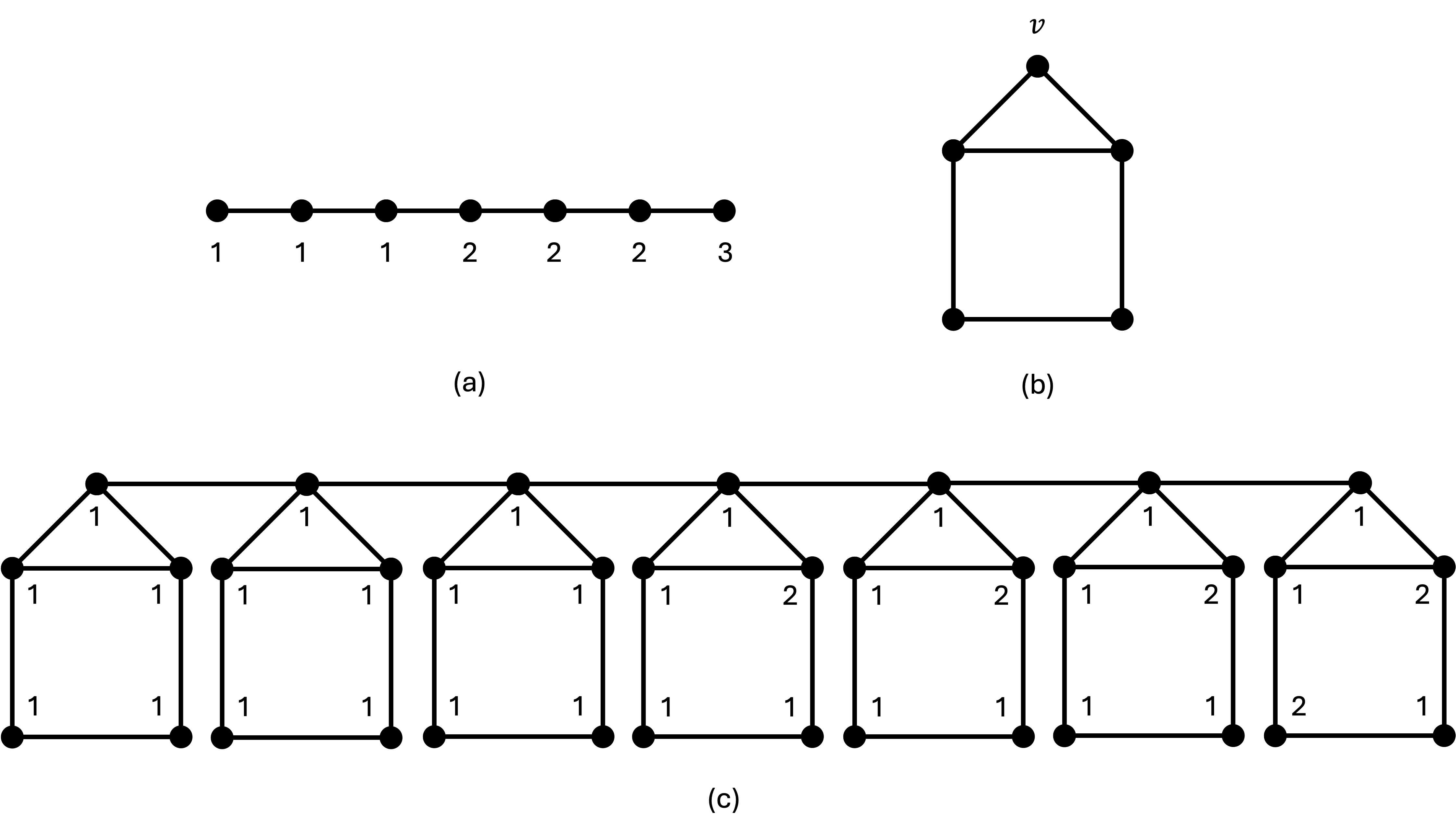
As an example, consider a vertex \(P_3\)-irregular labeling of \(P_7\) in Figure 1(a) and a \(2\)-connected graph with a fixed vertex \(v\) depicted in Figure 1(b). Then, we have the vertex \((P_3 \rhd_v H)\)-irregular labeling of \(P_7 \rhd_v H\) in Figure 1(c).
Observe that every graph admits \(K_2\)-covering. Recall that any edge irregular labeling is also a vertex \(K_2\)-irregular labeling for any graph \(G\). Hence, we have the following corollary.
Corollary 3.2. Let \(H\) be a \(2\)-connected graph and \(v \in V(H)\). Let \(G\) be a graph which does not contain \(H\). It follows that \[\begin{aligned} vhs(G \rhd_v H, K_2 \rhd_v H) = \left\lceil 1 + \displaystyle\frac{es(G)-1}{|V_H|} \right\rceil. \end{aligned}\]
Next, we deal with the edge \((F \rhd_v H)\)-irregularity. The proof will follow in a similar way given in Theorem 3.1.
Theorem 3.3. Let \(H\) be a \(2\)-connected graph and \(v \in V(H)\). Let \(G\) be a graph which admits \(F\)-covering and does not contain \(H\). Let \(t\) be the number of subgraph of \(G\) which is isomorphic to \(F\). It follows that \[\begin{aligned} \left\lceil 1 + \displaystyle\frac{t-1}{|E_F|+|V_F||E_H|} \right\rceil \le ehs(G \rhd_v H, F \rhd_v H) \le \left\lceil 1 +\displaystyle\frac{vhs(G,F)-1}{|E_H|} \right\rceil, \end{aligned}\] and the bound is sharp.
Proof. The lower bound is just an implication of Theorem 2.2. To show the upper bound, let \(V_G = \{u_1,u_2,\ldots,u_m\}\) and \(E_{H^{(i)}} = \{ y_1^{(i)},y_2^{(i)},\ldots,y_q^{(i)}\}\) for some positive integers \(m, q\) and \(i \in [1,m]\). Let \(t\) be the number of subgraph of \(G\) which is isomorphic to \(F\). Let \((F \rhd_v H)^{(i)}\) be the \(i\)-th subgraph of \(G \rhd_v H\) that is isomorphic to \(F \rhd_v H\). Hence, the number of subgraph of \(G \rhd_v H\) that is isomorphic to \(F \rhd_v H\) is also \(t\). Let \(s = \left\lceil 1 + \displaystyle\frac{vhs(G,F)-1}{q} \right\rceil\).
Let \(\varphi : V(G) \to \mathbb{Z}\) be a vertex \(F\)-irregularity labeling of \(G\) and let \(\beta_i = \varphi(u_i)+q-1\). Let \(wt_\varphi : \{F^{(i)} \mid i \in [1,t]\} \to \mathbb{Z}\) be a weight map induced by \(\varphi\). For every \(i \in [1,q]\), choose a bijection \(\sigma_i\) from \(E(H^{(i)})\) to the optimal multiset-\((\beta_i,q)\). Define a labeling \(\sigma : E(G \rhd_v H) \to \mathbb{Z}\) such that \[\begin{aligned} \sigma(e) = \begin{cases} \sigma_i(y_j^{(i)}), & \text{if } e = y_j^{(i)}, i \in [1,m], j \in [1,q],\\ 1, & \text{otherwise}. \end{cases} \end{aligned}\]
We will show that \(\sigma\) is an edge \((F \rhd_v H)\)-irregularity labeling. Observe that \(\sigma\) induces a weight function \(wt_\sigma : \{(F \rhd_v H)^{(i)} \mid i \in [1,t]\} \to \mathbb{Z}\) such that \[\begin{aligned} wt_\sigma((F \rhd_v H)^{(i)}) & = wt_\sigma(F^{(i)} \rhd_v H),\\ & = \sum_{x \in E(F^{(i)})} 1 + \sum_{u_k \in V(F^{(i)})} \left(\sum_{b \in O_{\beta_k,q}} b\right),\\ & = |E_F| + \sum_{u_k \in V(F^{(i)})} \beta_k,\\ & = wt_\varphi(F^{(i)}) + |E_F| + |V_F|(q-1). \end{aligned}\]
Since \(wt_\varphi(F^{(i)})\) is unique for every \(i \in [1,t]\), then \(wt_\sigma((F \rhd_v H)^{(i)})\) is also unique for every \(i \in [1,t]\). Therefore, \(\sigma\) is an edge \((F \rhd_v H)\)-irregular labeling. The largest label of \(\sigma\) must be contained in \(O_{vhs(G,F)+q-1,q}\) that is \(\left\lceil \displaystyle\frac{vhs(G,F) + q -1}{q} \right\rceil = \left\lceil 1 + \displaystyle\frac{vhs(G,F)-1}{|E_H|} \right\rceil = s\). Hence, \(ehs(G \rhd_v H,F \rhd_v H) \le s\).
To show the sharpness of the bound, let \(F\) be a graph and \(G \not\cong F\) be a graph which admits \(F\)-covering. Consider a \(2\)-connected graph \(H\) such that \(|E_H| > vhs(G,F) – 1\). Since \(\displaystyle\frac{t-1}{|E_F|+|V_F||E_H|}\) is positive, then \[\begin{aligned} \left\lceil 1 + \displaystyle\frac{t-1}{|E_F|+|V_F||E_H|} \right\rceil \le ehs(G \rhd_v H, F \rhd_v H) & \le \left\lceil 1 +\displaystyle\frac{vhs(G,F)-1}{|E_H|} \right\rceil,\\ 2 \le ehs(G \rhd_v H,F \rhd_v H) & \le 2,\\ ehs(G \rhd_v H,F \rhd_v H) & = 2. \end{aligned}\]
Hence, the theorem holds. ◻
Since \(|V(K_2)| = 2\) and \(|E(K_2)| = 1\), we have the following corollary.
Corollary 3.4. Let \(H\) be a \(2\)-connected graph and \(v \in V(H)\). Let \(G\) be a graph which does not contain \(H\). Let \(t\) be the number of subgraph of \(G\) which is isomorphic to \(F\). It follows that \[\begin{aligned} \left\lceil 1 + \displaystyle\frac{|E_G|-1}{1+2|E_H|} \right\rceil \le ehs(G \rhd_v H, K_2 \rhd_v H) \le \left\lceil 1 + \displaystyle\frac{es(G)-1}{|E_H|} \right\rceil. \end{aligned}\]
Moreover, we also have the bound for total \((F \rhd_v H)\)-irregularity strength. Again, the proof will follow in similar manner.
Theorem 3.5. Let \(H\) be a \(2\)-connected graph and \(v \in V(H)\). Let \(G\) be a graph which admits \(F\)-covering and does not contain \(H\). Let \(t\) be the number of subgraph of \(G\) which is isomorphic to \(F\). It follows that \[\begin{aligned} \left\lceil 1 + \displaystyle\frac{t-1}{|E_F|+|V_F|(|V_H|+|E_H|)} \right\rceil \le ths(G \rhd_v H, F \rhd_v H) \le \left\lceil 1 +\displaystyle\frac{vhs(G,F)-1}{|V_H|+|E_H|} \right\rceil, \end{aligned}\] and the bound is sharp.
Proof. The lower bound is just an implication of Theorem 2.3. To show the upper bound, let \(V_G = \{u_1,u_2,\ldots,u_m\}\), \(V_{H^{(i)}} = \{v_1^{(i)},v_2^{(i)},\ldots,v_n^{(i)}\}\) and \(E_{H^{(i)}} = \{ y_1^{(i)},y_2^{(i)},\ldots,y_q^{(i)}\}\) for some positive integers \(m, q\) and \(i \in [1,m]\). Let \(t\) be the number of subgraph of \(G\) which is isomorphic to \(F\). Let \((F \rhd_v H)^{(i)}\) be the \(i\)-th subgraph of \(G \rhd_v H\) that is isomorphic to \(F \rhd_v H\). Hence, the number of subgraph of \(G \rhd_v H\) that is isomorphic to \(F \rhd_v H\) is also \(t\). Let \(s = \left\lceil 1 + \displaystyle\frac{vhs(G,F)-1}{n+q} \right\rceil\).
Let \(\varphi : V(G) \to \mathbb{Z}\) be a vertex \(F\)-irregularity labeling of \(G\) and let \(\gamma_i = \varphi(u_i)+n+q-1\). Let \(wt_\varphi : \{F^{(i)} \mid i \in [1,t]\} \to \mathbb{Z}\) be a weight map induced by \(\varphi\). For every \(i \in [1,q]\), choose a bijection \(\sigma_i\) from \(V(H^{(i)}) \cup E(H^{(i)})\) to the optimal multiset-\((\gamma_i,n+q)\). Define a labeling \(\sigma : V(G \rhd_v H) \cup E(G \rhd_v H) \to \mathbb{Z}\) such that \[\begin{aligned} \sigma(v_j^{(i)}) & = \sigma_i(v_j^{(i)}), \hspace{16pt} \text{for } i \in [1,m], j \in [1,n],\\ \sigma(e) & = \begin{cases} \sigma_i(y_j^{(i)}), & \text{if } e = y_j^{(i)}, i \in [1,m], j \in [1,q],\\ 1, & \text{otherwise}. \end{cases} \end{aligned}\]
We will show that \(\sigma\) is a total \((F \rhd_v H)\)-irregularity labeling. Observe that \(\sigma\) induces a weight function \(wt_\sigma : \{(F \rhd_v H)^{(i)} \mid i \in [1,t]\} \to \mathbb{Z}\) such that \[\begin{aligned} wt_\sigma((F \rhd_v H)^{(i)}) & = wt_\sigma(F^{(i)} \rhd_v H),\\ & = \sum_{x \in E(F^{(i)})} 1 + \sum_{u_k \in V(F^{(i)})} \left(\sum_{c \in O_{\gamma_k,n+q}} c\right),\\ & = |E_F| + \sum_{u_k \in V(F^{(i)})} \gamma_k,\\ & = wt_\varphi(F^{(i)}) + |E_F| + |V_F|(q-1). \end{aligned}\] Since \(wt_\varphi(F^{(i)})\) is unique for every \(i \in [1,t]\), then \(wt_\sigma((F \rhd_v H)^{(i)})\) is also unique for every \(i \in [1,t]\). Hence, \(\sigma\) is a total \((F \rhd_v H)\)-irregular labeling. The largest label of \(\sigma\) must be contained in \(O_{vhs(G,F)+n+q-1,n+q}\) which is \(\left\lceil \displaystyle\frac{vhs(G,F) + n + q – 1}{n+q} \right\rceil =\left\lceil 1 + \displaystyle\frac{vhs(G,F)-1}{|V_H|+|E_H|} \right\rceil = s\). Therefore, \(ehs(G \rhd_v H,F \rhd_v H) \le s\).
To show the sharpness of the bound, let \(F\) be a graph and \(G \not\cong F\) be a graph which admits \(F\)-covering. Consider a \(2\)-connected graph \(H\) such that \(|V_H| + |E_H| > vhs(G,F) – 1\). Since \(\displaystyle\frac{t-1}{|E_F|+|V_F|(|V_H|+|E_H|)}\) is positive, then \[\begin{aligned} \left\lceil 1 + \displaystyle\frac{t-1}{|E_F|+|V_F|(|V_H|+|E_H|)} \right\rceil \le ths(G \rhd_v H, F \rhd_v H) & \le \left\lceil 1 +\displaystyle\frac{vhs(G,F)-1}{|V_H|+|E_H|} \right\rceil,\\ 2 \le ths(G \rhd_v H,F \rhd_v H) & \le 2,\\ ths(G \rhd_v H,F \rhd_v H) & = 2. \end{aligned}\]
Therefore, the theorem holds. ◻
Likewise, we have the following corollary if we choose \(F = K_2\).
Corollary 3.6. Let \(H\) be a \(2\)-connected graph and \(v \in V(H)\). Let \(G\) be a graph which does not contain \(H\). Let \(t\) be the number of subgraph of \(G\) which is isomorphic to \(F\). It follows that \[\begin{aligned} \left\lceil 1 + \displaystyle\frac{|E_G|-1}{1+2(|V_H|+|E_H|)} \right\rceil \le ths(G \rhd_v H, K_2 \rhd_v H) \le \left\lceil 1 +\displaystyle\frac{es(G)-1}{|V_H|+|E_H|} \right\rceil. \end{aligned}\]
Let \(G\) be a graph with \(V_G = \{u_1,u_2,\ldots,u_m\}\) and \(E_G = \{x_1,x_2,\ldots,x_p\}\) for some positive integers \(m\) and \(p\). Let \(H\) be a \(2\)-connected graph with \(V_H = \{v_1,v_2,\ldots,v_n\}\) and \(E_H = \{e = y_1,y_2,\ldots,y_q\}\) for some positive integers \(n,q\) and \(i \in [1,m]\). Let \(H_i\) with \(V_{H^{(i)}} = \{v_1^{(i)},v_2^{(i)},\ldots,v_n^{(i)}\}\) be a copy of \(H\) such that \(v_jv_k \in E_H\) if and only if \(v_j^{(i)}v_k^{(i)} \in E_{H^{(i)}}\) for some \(i \in [1,m]\). Then, the edge comb product \(G \unrhd_e H\) is a graph defined by the vertex set \[\begin{aligned} V(G \unrhd_e H) = \bigcup_{i = 1}^{p} V_{H^{(i)}}, \end{aligned}\] where if \(u_iu_j \in E_G\) then \(v_1^{(i)} = u_i\) and \(v_2^{(j)} = u_j\) along with the edge set \[\begin{aligned} E(G \rhd_v H) = \bigcup_{i = 1}^{p} E_{H^{(i)}}. \end{aligned}\]
Note that \(|V(G \unrhd_e H)| = |V_G| + |E_G|(|V_H|-2)\) and \(|E(G \unrhd_e H)| = |E_G||E_H|\). Moreover, if \(G\) admits an \(F\)-covering, then \(G \unrhd_e H\) admits an \((F \unrhd_e H)\)-covering. Now, we present the edge \((F \unrhd_e H)\)-irregularity strength of any \(G \unrhd_e H\).
Theorem 4.1. ] Let \(H\) be a \(2\)-connected graph and \(e \in E(H)\). Let \(G\) be a graph which admits \(F\)-covering and does not contain \(H\). It holds that \[\begin{aligned} ehs(G \unrhd_e H, F \unrhd_e H) = \left\lceil 1 + \displaystyle\frac{ehs(G,F)-1}{|E_H|} \right\rceil. \end{aligned}\]
Proof. Let \(V_G = \{u_1,u_2,\ldots,u_m\}\) and \(E_G = \{x_1,x_2,\ldots,x_p\}\). Let \(E_{H^{(i)}} = \{ y_1^{(i)},y_2^{(i)},\ldots,y_q^{(i)}\}\) for some positive integers \(m, p, q\) and \(i \in [1,p]\). Let \(t\) be the number of subgraph of \(G\) which is isomorphic to \(F\). Let \((F \unrhd_e H)^{(i)}\) be the \(i\)-th subgraph of \(G \unrhd_e H\) that is isomorphic to \(F \unrhd_e H\). Since \(H\) is \(2\)-connected and \(G\) does not contain \(H\), then there exists \(F^{(i)} \cong F\) which is a subgraph of \(G\) such that \((F \unrhd_e H)^{(i)} = F^{(i)} \unrhd_e H\). This implies the number of subgraph of \(G \unrhd_e H\) that is isomorphic to \(F \unrhd_e H\) is also \(t\). Let \(s = \left\lceil 1 + \displaystyle\frac{ehs(G,F)-1}{q} \right\rceil\).
To show that \(ehs(G \unrhd_e H, F \unrhd_e H) \le s\), let \(\psi : E(G) \to \mathbb{Z}\) be an edge \(F\)-irregularity labeling of \(G\) and \(\alpha_i = \psi(x_i) + q -1\). Let \(wt_\psi : \{F^{(i)} \mid i \in [1,t]\} \to \mathbb{Z}\) be a weight map induced by \(\psi\). For every \(i \in [1,p]\), fix any bijection \(\sigma_i\) from \(E(H^{(i)})\) to the optimal multiset-\((\alpha_i,q)\). Let \(\sigma : E(G \unrhd_e H) \to \mathbb{Z}\) be a labeling such that the restriction \(\sigma|_{E_{H^{(i)}}}\) is exactly \(\sigma_i\) for every \(i \in [1,p]\). Next, we will show that \(\sigma\) is an edge \((F \unrhd_e H)\)-irregularity labeling. Note that \(\sigma\) induces a weight map \(wt_\sigma : \{(F \unrhd_e H)^{(i)} \mid i \in [1,t]\} \to \mathbb{Z}\) such that \[\begin{aligned} wt_\sigma((F \unrhd_e H)^{(i)}) & = wt_\sigma(F^{(i)} \unrhd_e H),\\ & = \sum_{x_k \in E(F^{(i)})} \left(\sum_{a \in O_{\alpha_k,q}} a \right),\\ & = \sum_{x_k \in E(F^{(i)})} \alpha_k,\\ & = wt_\varphi(F^{(i)}) + |E_F|(q-1). \end{aligned}\]
For every \(i \in [1,t]\), since \(wt_\psi(F^{(i)})\) is unique then \(wt_\sigma((F \unrhd_e H)^{(i)})\) is also unique. Hence, \(\sigma\) is an edge \((F \unrhd_e H)\)-irregular labeling. Further, the maximum label of \(\sigma\) is contained in \(O_{ehs(G,F)+q-1,q}\) which is \(\left\lceil \displaystyle\frac{ehs(G,F)+q-1}{q} \right\rceil = \left\lceil 1 + \displaystyle\frac{ehs(G,F)-1}{|E_H|} \right\rceil = s\). Thus \(ehs(G \unrhd_e H,F \unrhd_e H) \le s\).
Next, we will show that \(ehs(G \unrhd_e H, F \unrhd_e H) \ge s\). Assume there exists an edge \((F \unrhd_e H)\)-irregular labeling \(\sigma : E(G \unrhd_e H) \to [1,s-1]\). Let \(wt_\sigma : \{(F \unrhd_e H)^{(i)} \mid i \in [1,t]\} \to \mathbb{Z}\) be the weight map induced by \(\sigma\). Let \(\psi : E(G) \to \mathbb{Z}\) such that \[\begin{aligned} \psi(x_i) = \sum_{j=1}^q \sigma(y_j^{(i)}) – q + 1, \qquad \text{for }i \in [1,p]. \end{aligned}\]
Let \(wt_\psi : \{F^{(i)} \mid i \in [1,t]\} \to \mathbb{Z}\) be the weight function induced by \(\psi\). It holds that \[\begin{aligned} wt_\psi (F^{(i)}) & = \sum_{x_k \in E(F^{(i)})} \psi(x_k),\\ & = \sum_{x_k \in E(F^{(i)})} \left( \sum_{j=1}^q \sigma(v_j^{(i)}) – q + 1 \right),\\ & = \sum_{x_k \in E(F^{(i)})} \left(\sum_{j=1}^q \sigma(v_j^{(i)}) \right) – |E_F|(q-1),\\ & = wt_\sigma((F \unrhd_e H)^{(i)}) – |E_F|(q-1). \end{aligned}\]
This shows that \(\psi\) is an edge \(F\)-irregularity labeling of \(G\). Nevertheless, observe that \[\begin{aligned} \psi(x_i) & \le q(s-1) -q +1,\\ & \le q \left\lceil \displaystyle\frac{ehs(G,F) + q -1}{q} \right\rceil – 2q + 1,\\ & \le q \left( \displaystyle\frac{ehs(G,F) + 2q -2}{q} \right) – 2q +1,\\ & \le ehs(G,F) – 1. \end{aligned}\]
This is a contradiction to the minimality of \(ehs(G,F)\). Hence, \(ehs(G \unrhd_e H, F \unrhd_e H) \ge s\) and the proof is complete. ◻
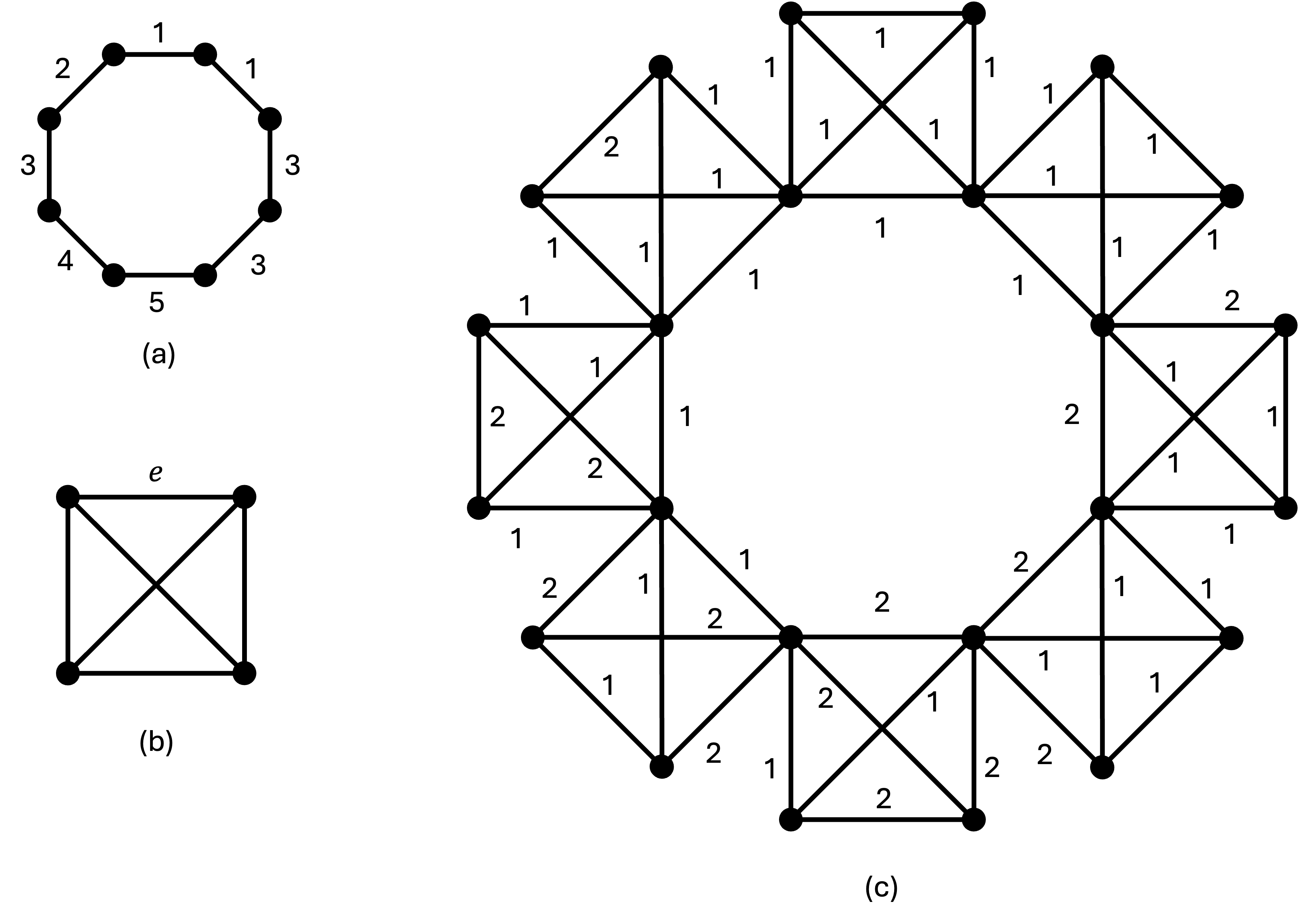
For example, consider an edge \(P_3\)-irregular labeling of \(C_8\) in Figure 2(a) and \(K_4\) with any edge \(e\) shown in Figure 2(b). Then, we have the edge \((P_3 \rhd_v H)\)-irregular labeling of \(C_8 \rhd_v K_4\) in Figure 2(c).
It is not hard to show that \(ehs(G,K_2) = |E_G|\) for any graph \(G\). Since \(K_2 \unrhd_e H = H\) and any irregular labeling of \(G\) is also an edge \(K_2\)-irregular labeling of \(G\), then the following statement is immediate.
Corollary 4.2. Let \(G\) be a graph, \(H\) be a \(2\)-connected graph and \(e \in E(H)\). It holds that \[\begin{aligned} ehs(G \unrhd_e H, H) = \left\lceil 1 + \displaystyle\frac{|E_G|-1}{|E_H|} \right\rceil. \end{aligned}\]
The example presented in Figure 2 gives a hint that an edge \(H\)-irregular labeling of \(G\) is also an irregular labeling of \(G\) for some particular graph \(H\) and \(G\). That is, if \(G\) is a \(r\)-regular graph then an edge \(K_{1,r}\)-irregular labeling \(G\) is also an irregular labeling of \(G\). Hence, we can utilize the irregularity strength of a regular graph when we choose \(F\) to be a star.
Corollary 4.3. Let \(r \ge 2\) be an integer. Let \(G\) be a \(r\)-regular graph with, \(H\) be a \(2\)-connected graph and \(e \in E(H)\). It holds that \[\begin{aligned} ehs(G \unrhd_e H, K_{1,r} \unrhd_e H) = \left\lceil 1 + \displaystyle\frac{s(G)-1}{|E_H|} \right\rceil. \end{aligned}\]
Further, we can determine the upper bound for the vertex \((F \unrhd_e H)\)-irregularity strength for any edge comb product \(G \unrhd_e H\). The proof will be similar to the proof of Theorem 4.1.
Theorem 4.4. Let \(H\) be a \(2\)-connected graph and \(e \in E(H)\). Let \(t\) be the number of subgraph of \(G\) which is isomorphic to \(F\). It holds that \[\begin{aligned} \left\lceil 1 + \displaystyle\frac{t-1}{|V_F| + |E_F|(|V_H|-2)} \right\rceil \le vhs(G \unrhd_e H, F \unrhd_e H) \le \left\lceil 1 + \displaystyle\frac{ehs(G,F)-1}{|V_H|-2} \right\rceil, \end{aligned}\] and the bound is sharp.
Proof. Let \(V_G = \{u_1,u_2,\ldots,u_m\}\) and \(E_G = \{x_1,x_2,\ldots,x_p\}\). Let \(V_{H^{(i)}} = \{ v_1^{(i)},v_2^{(i)},\ldots,v_n^{(i)}\}\) for some positive integers \(m, n, p\) and \(i \in [1,p]\). Let \(t\) be the number of subgraph of \(G\) which is isomorphic to \(F\). Hence, the number of subgraph of \(G \unrhd_e H\) that is isomorphic to \(F \unrhd_e H\) is also \(t\). Let \(s = \left\lceil 1 + \displaystyle\frac{vhs(G,F)-1}{n-2} \right\rceil\).
To show that \(vhs(G \unrhd_e H, F \unrhd_e H) \le s\), let \(\psi : E(G) \to \mathbb{Z}\) be an edge \(F\)-irregularity labeling of \(G\) and \(\beta_i = \psi(x_i) + n – 3\). Let \(wt_\psi : \{F^{(i)} \mid i \in [1,t]\} \to \mathbb{Z}\) be a weight function induced by \(\psi\). For every \(i \in [1,p]\), fix any bijection \(\sigma_i\) from \(V(H^{(i)})\) to the optimal multiset-\((\beta_i,n-2)\). Define a labeling \(\sigma : E(G \unrhd_e H) \to \mathbb{Z}\) such that \[\begin{aligned} \sigma(z) = \begin{cases} \sigma_i(v_j^{(i)}), & \text{if } z = v_j^{(i)}, i \in [1,m], j \in [3,n],\\ 1, & \text{otherwise}. \end{cases} \end{aligned}\]
We will show that \(\sigma\) is a vertex \((F \unrhd_e H)\)-irregularity labeling. Note that \(\sigma\) induces a weight function \(wt_\sigma : \{(F \unrhd_e H)^{(i)} \mid i \in [1,t]\} \to \mathbb{Z}\) such that \[\begin{aligned} wt_\sigma((F \unrhd_e H)^{(i)}) & = wt_\sigma(F^{(i)} \unrhd_e H),\\ & = \sum_{u_k \in V(F^{(i)})} 1 + \sum_{x_k \in E(F^{(i)})} \left( \sum_{b \in O_{\beta_k,n-2}} b \right),\\ & = |V_F| +\sum_{x_k \in E(F^{(i)})} \beta_k,\\ & = wt_\varphi(F^{(i)}) + |V_F|(n-2). \end{aligned}\]
For every \(i \in [1,t]\), since \(wt_\psi(F^{(i)})\) is unique then \(wt_\sigma((F \unrhd_e H)^{(i)})\) is also unique. Hence, \(\sigma\) is a vertex \((F \unrhd_e H)\)-irregular labeling. Further, the maximum label of \(\sigma\) is contained in \(O_{ehs(G,F)+n-3,n-2}\) which is \(\left\lceil \displaystyle\frac{ehs(G,F)+n-3}{n-2}\right\rceil = \left\lceil 1 + \displaystyle\frac{ehs(G,F)-1}{|V_H|-2} \right\rceil = s\). Therefore, \(ehs(G \unrhd_e H,F \unrhd_e H) \le s\).
Now, we will show that the bound is sharp. Consider a graph \(F\) and a graph \(G \not\cong F\) that admits \(F\)-covering. Let \(H\) be a \(2\)-connected graph such that \(|V_H| – 2 > ehs(G,F) -1\). Since \(\displaystyle\frac{t-1}{|V_F| + |E_F|(|V_H|-2)}\) is positive, then \[\begin{aligned} \left\lceil 1 + \displaystyle\frac{t-1}{|V_F| + |E_F|(|V_H|-2)} \right\rceil \le vhs(G \unrhd_e H, F \unrhd_e H) & \le \left\lceil 1 +\displaystyle\frac{ehs(G,F)-1}{|V_H|-2} \right\rceil,\\ 2 \le vhs(G \unrhd_e H,F \unrhd_e H) & \le 2,\\ vhs(G \unrhd_e H,F \unrhd_e H) & = 2. \end{aligned}\]
This shows the theorem. ◻
Likewise, the following corollary also holds.
Corollary 4.5. Let \(G\) be a graph, \(H\) be a \(2\)-connected graph and \(e \in E(H)\). It holds that \[\begin{aligned} \left\lceil 1 + \displaystyle\frac{|E_G|-1}{|V_H|} \right\rceil \le vhs(G \unrhd_e H, H) \le \left\lceil 1 + \displaystyle\frac{|E_G|-1}{|V_H|-2} \right\rceil. \end{aligned}\]
Corollary 4.6. Let \(r \ge 2\) be an integer. Let \(G\) be a \(r\)-regular graph, \(H\) be a \(2\)-connected graph and \(e \in E(H)\). It holds that \[\begin{aligned} \left\lceil 1 + \displaystyle\frac{|V_G|-1}{1 + r(|V_H|-1)} \right\rceil \le vhs(G \unrhd_e H, K_{1,r} \unrhd_e H) \le \left\lceil 1 + \displaystyle\frac{s(G)-1}{|V_H|-2} \right\rceil, \end{aligned}\] and the bound is sharp.
Lastly, we prove the upper bound for the total \((F \unrhd_e H)\)-irregularity strength for any edge comb product \(G \unrhd_e H\).
Theorem 4.7. Let \(G\) be a graph, \(H\) be a \(2\)-connected graph and \(e \in E(H)\). It holds that \[\begin{aligned} \left\lceil 1 + \displaystyle\frac{t-1}{|V_F| + |E_F|(|V_H|+|E_H|-2)} \right\rceil \le ths(G \unrhd_e H, F \unrhd_e H) \le \left\lceil 1 + \displaystyle\frac{ehs(G,F)-1}{|V_H|+|E_H|-2} \right\rceil, \end{aligned}\] and the bound is sharp.
Proof. Let \(V_G = \{u_1,u_2,\ldots,u_m\}\) and \(E_G = \{x_1,x_2,\ldots,x_p\}\). Let \(V_{H^{(i)}} = \{ v_1^{(i)},v_2^{(i)},\ldots,v_n^{(i)}\}\) and \(E_{H^{(i)}} = \{ y_1^{(i)},y_2^{(i)},\ldots,y_n^{(i)}\}\) for some positive integers \(m, n, p, q\) and \(i \in [1,p]\). Let \(t\) be the number of subgraph of \(G\) which is isomorphic to \(F\). Hence, the number of subgraph of \(G \unrhd_e H\) that is isomorphic to \(F \unrhd_e H\) is also \(t\). Let \(s = \left\lceil 1 + \displaystyle\frac{vhs(G,F)-1}{n+q-2} \right\rceil\).
To show that \(vhs(G \unrhd_e H, F \unrhd_e H) \le s\), let \(\psi : E(G) \to \mathbb{Z}\) be an edge \(F\)-irregularity labeling of \(G\) and \(\gamma_i = \psi(x_i) + n + q – 3\). Let \(wt_\psi : \{F^{(i)} \mid i \in [1,t]\} \to \mathbb{Z}\) be a weight function induced by \(\psi\). For every \(i \in [1,p]\), fix any bijection \(\sigma_i\) from \(V(H^{(i)}) \cup E(H^{(i)})\) to the optimal multiset-\((\gamma_i,n+q-2)\). Define a labeling \(\sigma : V(G \unrhd_e H) \cup E(G \unrhd_e H) \to \mathbb{Z}\) such that \[\begin{aligned} \sigma(y_j^{(i)}) & = \sigma_i(y_j^{(i)}), \hspace{16pt} \text{for } i \in [1,p], j \in [1,q], \\ \sigma(v_j^{(i)}) & = \begin{cases} \sigma_i(v_j^{(i)}), & \text{if } i \in [1,m], j \in [3,n],\\ 1, & \text{otherwise}. \end{cases} \end{aligned}\]
We will show that \(\sigma\) is a total \((F \unrhd_e H)\)-irregularity labeling. Note that \(\sigma\) induces a weight function \(wt_\sigma : \{(F \unrhd_e H)^{(i)} \mid i \in [1,t]\} \to \mathbb{Z}\) such that \[\begin{aligned} wt_\sigma((F \unrhd_e H)^{(i)}) & = wt_\sigma(F^{(i)} \unrhd_e H),\\ & = \sum_{u_k \in V(F^{(i)})} 1 + \sum_{x_k \in E(F^{(i)})} \left(\sum_{c \in O_{\gamma_k,n+q-2}} c \right),\\ & = |V_F| + \sum_{x_k \in E(F^{(i)})} \gamma_k,\\ & = wt_\varphi(F^{(i)}) + |V_F|(n+q-2). \end{aligned}\]
For every \(i \in [1,t]\), since \(wt_\psi(F^{(i)})\) is unique then \(wt_\sigma((F \unrhd_e H)^{(i)})\) is also unique. Therefore, \(\sigma\) is a vertex \((F \unrhd_e H)\)-irregular labeling. Further, the maximum label of \(\sigma\) is contained in \(O_{ehs(G,F)+n+q-3,n+q-2}\) which is \(\left\lceil \displaystyle\frac{ehs(G,F)+n+q-3}{n+q-2} \right\rceil = \left\lceil 1 + \displaystyle\frac{ehs(G,F)-1}{|V_H|+|E_H|-2} \right\rceil = s\). Hence, \(ehs(G \unrhd_e H,F \unrhd_e H) \le s\).
Now, we will show that the bound is sharp. Consider a graph \(F\) and a graph \(G \not\cong F\) that admits \(F\)-covering. Let \(H\) be a \(2\)-connected graph such that \(|V_H| + |E_H| – 2 > ehs(G,F) -1\). Since \(\displaystyle\frac{t-1}{|V_F| + |E_F|(|V_H|+|E_H|-2)}\) is positive, then \[\begin{aligned} \left\lceil 1 + \displaystyle\frac{t-1}{|V_F| + |E_F|(|V_H|+E_H|-2)} \right\rceil \le vhs(G \unrhd_e H, F \unrhd_e H) & \le \left\lceil 1 +\displaystyle\frac{ehs(G,F)-1}{|V_H|+|E_H|-2} \right\rceil,\\ 2 \le vhs(G \unrhd_e H,F \unrhd_e H) & \le 2,\\ vhs(G \unrhd_e H,F \unrhd_e H) & = 2. \end{aligned}\]
Therefore, the theorem holds. ◻
Corollary 4.8. Let \(G\) be a graph, \(H\) be a \(2\)-connected graph and \(e \in E(H)\). It holds that \[\begin{aligned} \left\lceil 1 + \displaystyle\frac{|E_G|-1}{|V_H|+|E_H|} \right\rceil \le ths(G \unrhd_e H, H) \le \left\lceil 1 + \displaystyle\frac{|E_G|-1}{|V_H|+|E_H|-2} \right\rceil. \end{aligned}\]
Results from Wahyujati et al. [18] presents several examples of graphs whose total \(H\)-irregularity strength is contained within the bounds. If \(G = C_m\) and \(H = C_n\) for some integers \(m,n \ge 3\), then \[\begin{aligned} ths(C_m \unrhd_e C_n,C_n) = \left\lceil 1 + \displaystyle\frac{|E_{C_m}|-1}{|V_{C_n}|+|E_{C_n}|} \right\rceil. \end{aligned}\]
Moreover, for any graph \(H\) if \(G = P_m\) for some integer \(m \ge 2\), then \[\begin{aligned} ths(P_m \unrhd_e H, H) = \left\lceil 1 + \displaystyle\frac{|E_{P_m}|-1}{|V_H|+|E_H|} \right\rceil. \end{aligned}\]
In addition, for any graph \(H\) if \(G = K_{1,m}\) for some integer \(m \ge 3\), then \[\begin{aligned} ths(K_{1,m} \unrhd_e H,H) = \left\lceil 1 + \displaystyle\frac{|E_{K_{1,m}}|-1}{|V_H|+|E_H|-1} \right\rceil. \end{aligned}\]
Corollary 4.9. Let \(r \ge 2\) be an integer. Let \(G\) be a \(r\)-regular graph, \(H\) be a \(2\)-connected graph and \(e \in E(H)\). It holds that \[\begin{aligned} \left\lceil 1 + \displaystyle\frac{|V_G|-1}{1 + r(|V_H|+|E_H|-1)} \right\rceil \le ths(G \unrhd_e H, K_{1,r} \unrhd_e H) \le \left\lceil 1 + \displaystyle\frac{s(G)-1}{|V_H|+|E_H|-2} \right\rceil. \end{aligned}\]