
In \(1940\) Birkhoff [4] raised the open problem, compute for small \(n\) all non-isomorphic posets/lattices on a set of \(n\) elements. This NP-complete problem was attempted by many authors from all over the world. Enumeration of all non-isomorphic posets with \(15\) and \(16\) elements was done by Brinkmann and Mckay [5]. The work of enumeration of all non-isomorphic (unlabeled) posets is still in progress for \(n\geq 17\). Counting of all non-isomorphic (unlabeled) lattices on up to \(18\) elements was carried out by Heitzig and Reinhold [7].
The concept of a nullity of a poset as nullity of its cover graph was introduced by Bhavale and Waphare [3]. In the same paper, they introduced the concept of an RC-lattice as a lattice in which all the reducible elements are comparable. According to Bhavale and Waphare [3], if a dismantlable lattice of nullity \(k\) contains \(r\) reducible elements then \(2\leq r\leq 2k\). In particular for \(k=2\), \(2\leq r\leq 4\). In \(2003\) Pawar and Waphare [9] counted all non-isomorphic lattices with \(n\) elements, containing exactly two reducible elements, and having nullity one (that is, \(r=2\) and \(k=1\)). Recently, Bhavale and Aware [2] counted all non-isomorphic lattices on \(n\) elements, containing up to three reducible elements, and having nullity two (that is, \(r\leq 3\) and \(k=2\)). In this paper, we count up to isomorphism the class of all non-isomorphic lattices on \(n\) elements, containing exactly four (comparable) reducible elements, and having nullity two (that is, \(r=4\) and \(k = 2\)). In fact, this counting covers the counting of all non-isomorphic lattices on \(n\) elements having nullity up to two.
Let \((P,\leq)\) be a poset. Elements \(a,b \in P\) are said to be \(comparable\), if either \(a \leq b\) or \(b\leq a\), otherwise \(a,b \in P\) are said to be incomparable, denoted by \(a||b\). An element \(u\in P\) is upper bound (lower bound) of \(a,b\in P\) if \(a\leq u,b\leq u(u\leq a,u\leq b)\). A join(meet) of \(a,b \in P\), denoted by \(a \vee b\)(\(a \wedge b\)), is defined as the least upper bound(greatest lower bound) of \(a\) and \(b\). A poset \(L\) is a lattice if \(a \vee b\) and \(a \wedge b\), exist in \(L\), \(\forall a,b\in L\). Lattices \(L_1\) and \(L_2\) are isomorphic, denoted by \(L_1\cong L_2\), and the map \(\phi:L_1\to L_2\) is an isomorphism if and only if \(\phi\) is bijective, and \(a \leq b\) in \(L_1\) if and only if \(\phi(a) \leq \phi(b)\) in \(L_2\).
An element \(u\) in \(P\) covers an element \(l\) in \(P\) if \(l<u\), and there is no element \(m\) in \(P\) such that \(l<m<u\). We denote this fact by \(l\prec u\), and say that pair \(<l, u>\) is a covering or an edge(see [12]). An element of a poset \(P\) is called doubly irreducible if it has at most one upper cover and at most one lower cover in \(P\). Let \(Irr(P)\) denotes the set of all doubly irreducible elements in the poset \(P\). Let \(Irr^*(P)= \{x \in Irr(P):x\) has exactly one lower cover and exactly one upper cover in \(P\}\). The graph on a poset \(P\) with edges as covering relations is called the cover graph and is denoted by \(C(P)\). Length of a chain is the number of coverings in a chain.
Let \(G\) be a graph on \(l\) vertices, containing \(m\) edges, with \(n\) connected components. Then the nullity of a graph \(G\) is given by \(m-l+n\). Bhavale and Waphare [3] defined nullity of a poset \(P\), denoted by \(\eta(P)\), to be the nullity of its cover graph \(C(P)\). For \(a<b\), the interval \([a,b)=\{x\in P:a\leq x< b\}\), and \((a,b)=\{x\in P:a< x<b\}\); likewise, we can define \([a,b]\) and \((a,b]\). An element \(a\) in a lattice \(L\) is meet-reducible(join-reducible) in \(L\) if there exist \(b,c\in L\) both distinct from \(a\), such that \(b\wedge c=a(b\vee c=a)\). Reducible element of a lattice \(L\) is either meet-reducible or join-reducible element of \(L\). Element of a lattice \(L\) is meet-irreducible(join-irreducible) if it is not meet-reducible(join-reducible); Element of a lattice \(L\) is doubly irreducible if it is both meet-irreducible and join-irreducible. The set of all doubly irreducible elements in \(L\) is denoted by \(Irr(L)\), and the set of all reducible elements in \(L\) is denoted by \(Red(L)\). A pendant vertex of a graph is a vertex with degree one.
In 1974 Rival [10] introduced and studied the class of dismantlable lattices.
Definition 1.1. [10] A finite lattice of order \(n\) is called dismantlable if there exists a chain \(L_{1} \subset L_{2} \subset \ldots\subset L_{n}(=L)\) of sublattices of \(L\) such that \(|L_{i}| = i\), for all \(i\).
Following result is due to Kelly and Rival [8].
Theorem 1.2. [8]A finite lattice is dismantlable if and only if it contains no crown.
The concept of adjunct operation of lattices, is introduced by Thakare, Pawar and Waphare [12]. Suppose \(L_1\) and \(L_2\) are two disjoint lattices and \((a, b)\) is a pair of elements in \(L_1\) such that \(a<b\) and \(a\not\prec b\). Define the partial order \(\leq\) on \(L = L_1 \cup L_2\) with respect to the pair \((a,b)\) as follows: \(x \leq y\) in L if \(x,y \in L_1\) and \(x \leq y\) in \(L_1\), or \(x,y \in L_2\) and \(x \leq y\) in \(L_2\), or \(x \in L_1,\) \(y \in L_2\) and \(x \leq a\) in \(L_1\), or \(x \in L_2,\) \(y \in L_1\) and \(b \leq y\) in \(L_1\).
It is easy to see that \(L\) is a lattice containing \(L_1\) and \(L_2\) as sublattices. The procedure for obtaining \(L\) in this way is called adjunct operation (or adjunct sum) of \(L_1\) with \(L_2\). We call the pair \((a,b)\) as an adjunct pair and \(L\) as an adjunct of \(L_1\) with \(L_2\) with respect to the adjunct pair \((a,b)\) and write \(L = L_1 ]^b_a L_2\). A diagram of \(L\) is obtained by placing a diagram of \(L_1\) and a diagram of \(L_2\) side by side in such a way that the largest element \(1\) of \(L_2\) is at lower position than \(b\) and the least element \(0\) of \(L_2\) is at the higher position than \(a\) and then by adding the coverings \(<1,b>\) and \(<a,0>\). This clearly gives \(|E(L)|=|E(L_1)|+|E(L_2)|+2\). A lattice \(L\) is called an adjunct of lattices \(L_0,L_1,\ldots,L_k,\) if it is of the form \(L = L_0]^{b_1}_{a_1} L_1 ]^{b_2}_{a_2} L_2 \cdots ]^{b_{k}}_{a_{k}} L_k\).
Following result is due to Thakare et al. [12].
Theorem 1.3. [12] A finite lattice is dismantlable if and only if it is an adjunct of chains.
The direct sum (see [11]) of two disjoint posets, namely \(P_1\) and \(P_2\) is denoted by \(P_1 \oplus P_2\), and is defined by taking the order relation \(\leq\) on \(P_1\cup P_2\) as: \(x\leq y\) in \(P_1\cup P_2\) if and only if \(x,y\in P_1\) and \(x\leq y\) in \(P_1\), or \(x,y\in P_2\) and \(x\leq y\) in \(P_2\) or \(x\in P_1,y\in P_2\). In general \(P_1 \oplus P_2\neq P_2 \oplus P_1\). Also, if \(P_1\) and \(P_2\) are lattices then \(|E(P_1\oplus P_2)|=|E(P_1)|+|E(P_2)|+1\).
Thakare et al. [12] defined a block as a finite lattice in which the largest element \(1\) is join-reducible and the smallest element \(0\) is meet-reducible. Moreover, if \(L\) is any lattice which is different from chain, then \(L\) contains a unique maximal sublattice which is a block called as maximal block. The lattice \(L\) is of the form \(C\oplus\textbf{B}\) or \(\textbf{B}\oplus C\) or \(C\oplus\textbf{B}\oplus C'\), where \(C,C'\) are chains and \(\textbf{B}\) is the maximal block. Bhavale and Waphare [3] introduced the following concepts namely, retractible element, basic retract, basic block, basic block associated to a poset.
Definition 1.4. [3] Let \(P\) be a poset. Let \(x \in Irr(P)\). Then \(x\) is called a retractible element of \(P\) if it satisfies either of the following conditions.
(a) There are no \(y,z \in Red(P)\) such that \(y \prec x \prec z\).
(b) There are \(y,z \in Red(P)\) such that \(y \prec x \prec z\) and there is no other directed path from \(y\) to \(z\) in \(P\).
Definition 1.5. [3] A poset \(P\) is a \(basic\) \(retract\) if no element of \(Irr^{*}(P)\) is retractible in the poset \(P\).
Definition 1.6. [3] A poset \(P\) is a basic block if it is one element or \(Irr(P) = \phi\) or removal of any doubly irreducible element reduces nullity by one.
Definition 1.7. [3]\(B\) is a \(basic\) \(block\) \(associated\) \(to\) \(a\) \(poset\) \(P\) if \(B\) is obtained from the basic retract associated to \(P\) by successive removal of all the pendant vertices.
Following result is due to Bhavale [1].
Theorem 1.8. [1]Let \(B\) be an RC-lattice on \(n\) elements. Then \(B\) is a basic block having nullity \(k\) if and only if \(B=C_0]_{a_1}^{b_1}C_1]_{a_2}^{b_2}C_2\cdots]_{a_k}^{b_k}C_k\) with \(a_i,b_i\in C_0,\) satisfying
(i) \(|C_i|=1\) for all \(i,1\leq i\leq k\),
(ii) \(n=|C_0|+k\),
(iii) \(Irr(B)=k+m\), where \(m\) is the number of distinct adjunct pairs \((a_i,b_i)\) such that the interval \((a_i,b_i)\subseteq Irr(B)\), and
(iv) \(|C_0|=|Red(B)|+m\).
Following result is due to Bhavale and Waphare [3].
Theorem 1.9. [3] Let \(B\) be the basic block associated to a poset \(P\). Then \(Red(B)=Red(P)\).
For the other definitions, notation, and terminology see [2, 6, 13].
In this section, we discuss counting of all non-isomorphic lattices on \(n\) elements containing up to three comparable reducible elements, and having nullity up to two. Note that chain is the only lattice containing no reducible element and having nullity \(0\). Obviously, there is no lattice on one reducible element. In 2003 Pawar and Waphare [9] enumerated all non-isomorphic lattices on \(n\) elements, containing exactly two reducible elements, and having nullity one. Let \(\mathscr{L}(n;r,k)\) be the class of all non-isomorphic lattices on \(n\) elements such that every member of it contains \(r\) comparable reducible elements, and has nullity \(k\). Let \(P_n^k\) denote the number of partitions of \(n\) into \(k\) non-decreasing positive integer parts. Pawar and Waphare [9] obtained the following result.
Theorem 2.1. [9] \(n\geq 4\), \[|\mathscr{L}(n;2,1)|= \begin{cases} \frac{m(m-1)(4m+1)}{6};& if~n=2m+1, \\ \frac{m(m-1)(4m-5)}{6};&if~n=2m. \end{cases}\]
Recently, Bhavale and Aware [2] counted all non-isomorphic lattices on \(n\) elements, containing three comparable reducible elements and having nullity \(k\geq 2\). In particular for \(k=2\), Bhavale and Aware [2] obtained the following result.
Theorem 2.2. [2] For an integer \(n\geq 6\), \[\displaystyle |\mathscr{L}(n;3,2)| = \sum_{j=0}^{n-6}\sum_{l=1}^{n-j-5}\sum_{i=1}^{n-j-l-4}2(j+1)P^{2}_{n-j-l-i-2}+\sum_{j=0}^{n-7} \sum_{l=4}^{n-j-3}(j+1)P^{2}_{l-2}P^{2}_{n-j-l-1}.\]
In this section, we count all non-isomorphic lattices on \(n\) elements containing four comparable reducible elements, and having nullity two.
Let \(\mathscr{L}(n;r,k,h)\) be the subclass of \(\mathscr{L}(n;r,k)\) such that the basic block associated to a member of it is of height \(h\). Let \(\mathscr{B}(j;r,k)\) be the class of all non-isomorphic maximal blocks on \(j\) elements such that every member of it contains \(r\) comparable reducible elements, and has nullity \(k\). Let \(\mathscr{B}(j;r,k,h)\) be the subclass of \(\mathscr{B}(j;r,k)\) such that the basic block associated to a member of it is of height \(h\). Let \(\mathscr{L}'(n;2,k)\) be the subclass of \(\mathscr{L}(n;2,k)\) such that any \(L\in\mathscr{L}'(n;2,k)\) is of the form \(L=C\oplus \textbf{B}\oplus C'\) where \(\textbf{B}\) is the maximal block, and \(C,C'\) are chains with \(|C|\geq 1,|C'|\geq 1\). According to Bhavale [1] (Proposition 3.2.5) there are exactly three basic blocks (see Figure 1) containing four (comparable) reducible elements and having nullity two. Therefore, we have the following result.
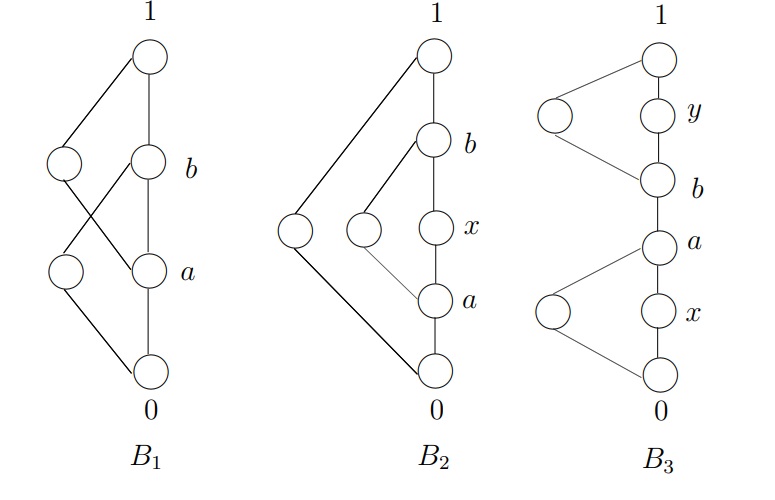
Proposition 3.1. [1] If \(B\) is
the basic block associated to \(\textbf{B}\in
\mathscr{B}(j;4,2)\) then \(B\in
\{B_1,B_2,B_3\}\)
(see Figure 1).
Recall that, if \(L\) is a lattice of nullity \(k\geq 1\) then \(2 \leq |Red(L)| \leq 2k\). Therefore, if \(L\) is any lattice of nullity \(2\) then \(2 \leq |Red(L)|=r\leq 4\). Also, if \(L \in \mathscr{L}(n;4,2,h)\) then \(3 \leq h \leq 5\). Now firstly, we count the classes of all non-isomorphic maximal blocks \(\mathscr{B}(j;4,2,h)\) for \(3 \leq h \leq 5\) and secondly, we count the classes \(\mathscr{L}(n;4,2,h)\) for \(3 \leq h \leq 5\), and thereby we count the class \(\mathscr{L}(n;4,2)\). Note that \(\mathscr{B}(j;4,2)=\mathscr{B}(j;4,2,3)\dot\cup\mathscr{B}(j;4,2,4) \dot\cup \mathscr{B}(j;4,2,5)\).
Let \(p(n,k)\) denote the number of week compositions of integer \(n\) into \(k\) non-negative parts. In fact \(p(n,k)\) is the number of all non-negative unordered solutions of the equation \(x_1+x_2+\cdots+x_k=n\). \(p(n,k)\) is also the number of ways of distributing \(n\) (identical) objects into \(k\) boxes. Further \(p(n,k)=\binom{n+k-1}{n}\).
Now in the following result, we count the class \(\mathscr{B}(j;4,2,3)\).
Proposition 3.2. For \(j\geq 6,\)\[|\mathscr{B}(j;4,2,3)|=\displaystyle\binom{j-2}{4}=\sum_{l=1}^{j-5}\sum_{s=1}^{j-l-4}\sum_{r=1}^{j-s-l-3}(j-s-l-r-2).\]
Proof. Let \(\textbf{B}\in \mathscr{B}(j;4,2,3)\). Let \(0<a<b<1\) be the reducible elements of \(\textbf{B}\). Let \(B\) be the basic block associated to \(\textbf{B}\). Then \(B=B_1\)(see Figure 1), and hence by Theorem 1.8, an adjunct representation of \(B\) is given by \(B=C]_{0}^{b}\{c_1\}]_{a}^{1}\{c_2\}\), where \(C:0\prec a\prec b\prec 1\) is a \(4\)-chain. Also by Theorem 1.9, \(Red(B)=Red(\textbf{B})\) and \(\eta(B)=\eta(\textbf{B})=2\). Therefore an adjunct representation of \(\textbf{B}\) is given by \(\textbf{B}=C_0]_{0}^{b}C_1]_{a}^{1}C_2\), where \(C_0\) is a maximal chain containing all the reducible elements of \(\textbf{B}\), and \(C_1, C_2\) are chains. Let \(s=|\textbf{B}\cap[0,a)|=|C_0\cap[0,a)|\), \(m=|\textbf{B}\cap[a,b)|=|C_0\cap[a,b)|\), \(t=|\textbf{B}\cap[b,1]|=|C_0\cap[b,1]|\), \(l=|\textbf{B}\cap C_1|\), and \(r=|\textbf{B}\cap C_2|\). Let \(S=\{(s,m,t,l,r)|s,m,t,l,r \in \mathbb{N}, s+m+t+l+r=j, t\geq 2\}\). Now given any \(\textbf{B}\in\mathscr{B}(j;4,2,3)\) there exists unique \((s,m,t,l,r)\in S\) and vice-versa. Also for \(\textbf{B}'\in\mathscr{B}(j;4,2,3)\), suppose there exists \((s',m',t',l',r')\in S\). Then \(\textbf{B}\cong\textbf{B}'\) if and only if \((s,m,t,l,r)=(s',m',t',l',r')\). Therefore the set \(S\) is equivalent to the class \(\mathscr{B}(j;4,2,3)\), and hence \(|S|=|\mathscr{B}(j;4,2,3)|\). Now let \(S'=\{(x_1,x_2,x_3,x_4,x_5)~|~ x_i \in \mathbb{N}\cup\{0\}, 1\leq i\leq 5, x_1+x_2+x_3+x_4+x_5=j-6\}\). Then \(|S|=|S'|\). But \(|S'|\) is the number of all unordered non-negative integer solutions of the equation \(x_1+x_2+x_3+x_4+x_5=j-6\), which is given by \(p(j-6,5)=\binom{(j-6)+5-1}{j-6}=\binom{j-2}{4}\).
If we take \(p\) as \(m+t\) then in the following, we obtain an alternate formula for \(|\mathscr{B}(j;4,2,3)|\).
For fixed \(s,l,r\), there are \(p-2=j-s-l-r-2\) choices for \(b\) in \(\textbf{B}\) up to isomorphism. That is, for fixed \(s,l,r\), there are \(p-2=j-s-l-r-2\) non-isomorphic maximal blocks in \(\mathscr{B}(j;4,2,3)\). Now for fixed \(s,l\), \(1\leq r=j-s-p-l\leq j-s-l-3\), since \(p\geq 3\). Therefore there are \(\displaystyle \sum_{r=1}^{j-s-l-3}(j-s-l-r-2)\) maximal blocks in \(\mathscr{B}(j;4,2,3)\) up to isomorphism. Again for fixed \(l\), \(1\leq s=j-p-l-r\leq j-l-4\), since \(p\geq 3\), \(r\geq 1\), and there are \(\displaystyle\sum_{s=1}^{j-l-4}\sum_{r=1}^{j-s-l-3}(j-s-l-r-2)\) maximal blocks in \(\mathscr{B}(j;4,2,3)\) up to isomorphism. Further \(1\leq l=j-s-p-r\leq j-5\), since \(s\geq 1\), \(p\geq 3\), \(r\geq 1\), and there are \(\displaystyle\sum_{l=1}^{j-5}\sum_{s=1}^{j-l-4}\sum_{r=1}^{j-s-l-3}(j-s-l-r-2)\) maximal blocks in \(\mathscr{B}(j;4,2,3)\) up to isomorphism. ◻
Following result is due to Bhavale and aware [2].
Lemma 3.3. [2] For the integers \(m\geq 4\) and \(0\leq k\leq m-4\), \[|\mathscr{B}(m;2,k+1)|=P^{k+2}_{m-2}.\]
Using Lemma 3.3, we have the following result.
Proposition 3.4. For \(n\geq 6\), \[|\mathscr{L}'(n;2,1)|=\displaystyle\sum_{l=2}^{n-4}(l-1)P^{2}_{n-l-2}.\]
Proof. Let \(L\in\mathscr{L}'(n;2,1)\). Then \(L=C\oplus\textbf{B}\oplus C'\) where \(C,C'\) are chains with \(|C|\geq 1,|C'|\geq 1\), \(|C|+|C'|=l\geq 2\), and \(\textbf{B}\in\mathscr{B}(m;2,1)\) with \(m=n-l\geq 4\). For fixed \(l\), by Lemma 3.3, there are \(P^{2}_{n-l-2}\) maximal blocks of type \(\textbf{B}\) in \(\mathscr{B}(n-l;2,1)\) up to isomorphism. Also \(l\) elements out of \(n\) elements can be distributed over the chains \(C',C''\) in \((l-2)+1=l-1\) ways up to isomorphism. Therefore for fixed \(l\) there are \((l-1)\times P^{2}_{n-l-2}\) lattices of type \(L\) in \(\mathscr{L}'(n;2,1)\) up to isomorphism. Further, \(2\leq l=n-m\leq n-4\), since \(m\geq 4\). Therefore there are \(\displaystyle\sum_{l=2}^{n-4}(l-1) P^{2}_{n-l-2}\) lattices of type \(L\) in \(\mathscr{L}'(k;2,1)\) up to isomorphism. ◻
Now we count the class \(\mathscr{B}(j;4,2,4)\) using Proposition 3.4 in the following.
Proposition 3.5. For \(j\geq 7\), \[|\mathscr{B}(j;4,2,4)|=\displaystyle\sum_{i=1}^{j-6}\sum_{l=2}^{j-i-4}(l-1)P^{2}_{j-i-l-2}.\]
Proof. Let \(\textbf{B}\in \mathscr{B}(j;4,2,4)\). Let \(0<a<b<1\) be the reducible elements of \(\textbf{B}\). Let \(B\) be the basic block associated to \(\textbf{B}\). Then \(B=B_2\)(see Figure 1), and hence by Theorem 1.8, an adjunct representation of \(B\) is given by \(B=C]_{a}^{b}\{c_1\}]_{0}^{1}\{c_2\}\), where \(C:0\prec a\prec x\prec b\prec 1\) is a 5-chain with \(x\in Irr(\textbf{B}\cap C)\). Also by Theorem 1.9, \(Red(B)=Red(\textbf{B})\) and \(\eta(B)=\eta(\textbf{B})=2\). Therefore an adjunct representation of \(\textbf{B}\) is given by \(\textbf{B}=C_0]_{a}^{b}C_1]_{0}^{1}C_2\), where \(C_0\) is a maximal chain containing all the reducible elements of \(\textbf{B}\), and \(C_1,C_2\) are chains. Moreover \(\textbf{B}=L]_{0}^{1}C_2\), where \(L\in \mathscr{L}'(k;2,1)\) with \(k\geq 6\) and \(|C_2|=i\geq 1\) with \(j=k+i\). As \(L\in \mathscr{L}'(k;2,1)\), \(L=C'\oplus \textbf{B}'\oplus C''\), where \(C',C''\) are chains with \(|C'|\geq 1,|C''|\geq 1, |C'|+|C''|=l\geq 2\), and \(\textbf{B}'\in \mathscr{B}(m;2,1)\) where \(m=k-l=j-i-l\geq 4\).
For fixed \(i\), there are \(\displaystyle|\mathscr{L}'(j-i;2,1)|\) maximal blocks of type \(\textbf{B}\) in \(\mathscr{B}(j;4,2,4)\) up to isomorphism. Further \(1\leq i=j-k\leq j-6\), since \(k=l+m\geq 6\). Therefore there are \(\displaystyle\sum_{i=1}^{j-6}\displaystyle|\mathscr{L}'(j-i;2,1)|\) maximal blocks of type \(\textbf{B}\) in \(\mathscr{B}(j;4,2,4)\) up to isomorphism. Thus proof follows from Proposition 3.4. ◻
In the following result, we count the class \(\mathscr{B}(j;4,2,5)\).
Proposition 3.6. For \(j\geq 8,\) \[\displaystyle |\mathscr{B}(j;4,2,5)|=\sum_{m=0}^{j-8}\sum_{s=4}^{j-m-4}P^{2}_{s-2}P^{2}_{j-m-s-2}.\]
Proof. Let \(\textbf{B}\in \mathscr{B}(j;4,2,5)\). Let \(0<a<b<1\) be the reducible elements of \(\textbf{B}\). Let \(B\) be the basic block associated to \(\textbf{B}\). Then \(B=B_3\)(see Figure 1), and hence by Theorem 1.8, an adjunct representation of \(B\) is given by \(B=C]_{0}^{a}\{c_1\}]_{b}^{1}\{c_2\}\), where \(C:0\prec a\prec x\prec b\prec y\prec 1\) is a \(6\)-chain. Also by Theorem 1.9, \(Red(B)=Red(\textbf{B})\) and \(\eta(B)=\eta(\textbf{B})=2\). Therefore an adjunct representation of \(\textbf{B}\) is given by \(\textbf{B}=C_0]_{0}^{a}C_1]_{b}^{1}C_2\), where \(C_0\) is a maximal chain containing all the reducible elements of \(\textbf{B}\), and \(C_1,C_2\) are chains. Let \(s=|\textbf{B}\cap[0,a]|=|C_0\cap[0,a]|\), \(m=|\textbf{B}\cap(a,b)|=|C_0\cap(a,b)|\), \(t=|\textbf{B}\cap[b,1]|=|C_0\cap[b,1]|\). Observe that \(\textbf{B}=\textbf{B}' \oplus C \oplus \textbf{B}''\), where \(\textbf{B}' \in \mathscr{B}(s;2,1), s\geq 4\), \(\textbf{B}'' \in \mathscr{B}(t;2,1), t\geq 4\), \(C\) is a chain with \(|C|=m \geq 0\), and \(s+m+t=j\geq 8\).
Now for fixed \(s\), \(m\) there are \(|\mathscr{B}(s;2,1)|\times |\mathscr{B}(t;2,1)|\), where \(t=j-m-s\) maximal blocks of type \(\textbf{B}\) in \(\mathscr{B}(j;4,2,5)\) up to isomorphism. Now for fixed \(m\), \(4\leq s=j-m-t\leq j-m-4\), since \(s\geq 4\). Therefore there are \(\displaystyle\sum_{s=4}^{j-m-4}\left(|\mathscr{B}(s;2,1)|\times|\mathscr{B}(j-m-s;2,1)|\right)\) maximal blocks of type \(\textbf{B}\) in \(\mathscr{B}(j;4,2,5)\) up to isomorphism. Further \(0\leq m=j-s-t\leq j-8\), since \(s\geq 4\), \(t\geq 4\). Thus there are \(\displaystyle\sum_{m=0}^{j-8}\left(\sum_{s=4}^{j-m-4}\left(|\mathscr{B}(s;2,1)|\times|\mathscr{B}(j-m-s;2,1)|\right)\right)\) non-isomorphic maximal blocks of type \(\textbf{B}\) in \(\mathscr{B}(j;4,2,5)\) to isomorphism. Thus proof follows from Lemma 3.3. ◻
Using Proposition 3.2, we have the following result.
Corollary 3.7. For \(n\geq 6\), \[|\mathscr{L}(n;4,2,3)|=\displaystyle \sum_{i=0}^{n-6}(i+1) \binom{n-i-2}{4}.\]
Proof. Let \(L \in \mathscr{L}(n ; 4, 2, 3)\). Then \(L = C \oplus \textbf{B} \oplus C'\), where \(\textbf{B} \in \mathscr{B}(j;4,2,3)\) and \(C, C'\) are chains with \(|C|+|C'|=i=n-j \geq 0\). Note that \(0 \leq i=n-j \leq n-6\), since \(j \geq 6\). Now remaining \(n-j=i\) elements can be distributed over the chains \(C\) and \(C'\) in \(i+1\) ways up to isomorphism. Therefore by Proposition 3.2, \[\displaystyle|\mathscr{L}(n;4,2,3)|=\sum_{i=0}^{n-6}(i+1)\times|\mathscr{B}(n-i;4,2,3)|=\sum_{i=0}^{n-6}(i+1)\binom{n-i-2}{4}.\] ◻
Similarly, using Proposition 3.5, we have the following result.
Corollary 3.8. For \(n\geq 7\), \[|\mathscr{L}(n;4,2,4)|=\displaystyle\sum_{i=0}^{n-7}\sum_{p=1}^{n-i-6}\sum_{l=2}^{n-i-p-4}(i+1)(l-1)P^{2}_{n-i-p-l-2}.\]
Also, using Proposition 3.6, we have the following result.
Corollary 3.9. For \(n\geq 8\), \[\displaystyle |\mathscr{L}(n;4,2,5)| = \sum_{i=0}^{n-8}\sum_{m=0}^{n-i-8}\sum_{s=4}^{n-i-m-4} (i+1)P^{2}_{s-2}P^{2}_{n-i-m-s-2}.\]
Using Corollary 3.7, Corollary 3.8, and Corollary 3.9, we have for \(n\geq 6\), \[\displaystyle|\mathscr{L}(n;4,2)|=\sum_{h=3}^{5}|\mathscr{L}(n;4,2,h)|,\] and hence we have the following main result.
Theorem 3.10. For \(n\geq 6\), \[\begin{aligned}\displaystyle|\mathscr{L}(n;4,2)| =& \sum_{i=0}^{n-6} (i+1) \binom{n-i-2}{4} + \sum_{i=0}^{n-7}\sum_{p=1}^{n-i-6}\sum_{l=2}^{n-i-p-4}(i+1)(l-1)P^{2}_{n-i-p-l-2}\\ &+ \sum_{i=0}^{n-8}\sum_{m=0}^{n-i-8}\sum_{s=4}^{n-i-m-4} (i+1)P^{2}_{s-2}P^{2}_{n-i-m-s-2}.\end{aligned}\]
Bhavale and Aware [2] proved that, if a lattice contains \(r \leq 3\) reducible elements then they are all comparable, but the result is not true for \(r \geq 4\). However, there is no lattice containing four reducible elements and having nullity two such that not all the reducible elements are comparable. Therefore the counting of all non-isomorphic lattices containing four (comparable) reducible elements and having nullity two accomplishes the counting of all non-isomorphic lattices having nullity up to two.